- Market Value (2025): USD 3.55 Bn
- Estimated Value (2026): USD 3.72 Bn
- Forecast Value (2036): USD 5.89 Bn
- CAGR (2026-2036): 4.7%
How Big Is the Trailer Equipment Market in 2026?
The global trailer equipment market is valued at USD 3.72 billion in 2026, up from USD 3.55 billion in 2025, and is projected by Fact.MR to reach USD 5.89 billion by 2036, expanding at a 4.7% CAGR from 2026 to 2036 and generating USD 2.20 billion in incremental revenue over the 10-year forecast period.
| Market Metric | Valuation / Share / Forecast Benchmark |
|---|---|
| 2025 Market Size (Historical) | USD 3.55 billion |
| 2026 Market Size (Estimated) | USD 3.72 billion |
| 2036 Market Size (Projected) | USD 5.89 billion |
| CAGR (2026 to 2036) | 4.7% |
| Incremental Dollar Opportunity (2026 to 2036) | USD 2.20 billion (1.59x the 2026 base) |
| Dominant Product Type (2026 share) | Dry van trailers, 28.5% (about USD 1.05 billion) |
| Leading Application (2026 share) | Logistics, 35.2% (about USD 1.30 billion) |
| Leading Material (2026 share) | Steel, 58.3% (about USD 2.16 billion) |
| Largest Country Markets (2026 share) | United States 30.0%, Germany 15.0%, Brazil and United Kingdom 8.0% each |
| Fastest-Growing Countries (CAGR, 2026 to 2036) | Germany 6.1%, Brazil 5.6%, United States 5.0% |
| Leading Tier-1 Companies | Wabash, Great Dane, Utility Trailer, Hyundai Translead, Schmitz Cargobull, KRONE, CIMC Vehicles |
Source: Fact.MR analysis. Updated Nov 13, 2026
Source: Fact.MR analysis of the trailer equipment market, 2026.
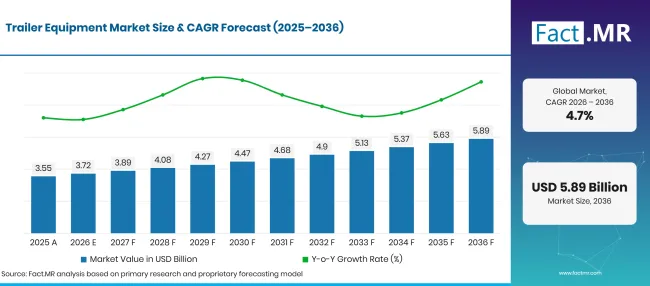
Trailer Equipment Market Forecast Global | Source: Fact.MR
Executive Market Overview
Demand for trailer equipment is centred on the United States, which holds 30.0% of revenue, twice the share of Germany (15.0%), while Brazil and the United Kingdom hold 8.0% each. Logistics fleets moving general freight between plants, warehouses and stores account for 35.2% of 2026 revenue, and manufacturers are the largest end-user group at 28.4%. Operators hauling chilled food, machinery, building materials and bulk liquids add demand for reefers, flatbeds and tankers. Drop-and-hook operations, where several trailers serve each tractor, multiply the trailer pool well beyond the number of trucks on the road. China, Mexico, Canada, India and the rest of Europe generate most of the 32.0% earned outside the named countries.
Sales of trailers swing with the freight cycle, because fleets postpone orders when freight rates or margins weaken and steel and aluminium costs pass straight into prices. Lighter aluminium builds, refrigerated units with hybrid or electric cooling, telematics and longer warranties are raising revenue per trailer, so value grows faster than units through the cycle. Order books are also lumpy, with large fleets placing annual orders for the next build year in the autumn. Germany (6.1% CAGR), Brazil (5.6%) and the United States (5.0%) grow faster than the global 4.8%, while the United Kingdom (4.5%) and Japan (4.0%) trail. Fact.MR sizes the market to include new dry van, flatbed, refrigerated, tank and other towed trailers and semi-trailers, while excluding truck bodies, tractor units, transport refrigeration units sold separately, used trailers and leasing revenue.
Analyst Perspective
"Trailer revenue will grow faster than unit volume, because fleets are paying for lighter aluminium builds, efficient reefers and built-in telematics that raise payload and cut downtime. The main risk is the freight cycle, since much of the current US order surge reflects buyers moving ahead of tariff-driven price increases and could fade once that pull-forward is used up."
Shambhu Nath Jha, Principal Consultant, Fact.MR
Major Market Trends and Insights
- Aluminium Flatbeds Chase Higher Payloads: Adoption of lightweight trailers is rising as fleets look to carry more freight within legal gross weight limits. Great Dane (August 2026) launched the Freedom Ultra all-aluminium flatbed with a welded main beam that it says is 50% more rigid than comparable products, integrated FleetPulse telematics and a 10-year main-beam warranty. The trailer also carries a RIG30-compliant rear impact guard as standard and a welded floor with built-in securement tracks. Lower tare weight lets operators sell more payload per trip, which favours aluminium over steel in open-deck work such as lumber, steel and machinery hauling.
- Manufacturing Moves Closer to Customers: Investment in regional trailer plants is growing as makers try to shorten lead times and avoid cross-border costs. Hyundai Translead (March 2026) announced a USD 450 million plan to build two trailer plants in Will County, Illinois, on former Caterpillar and Lion Electric sites, creating about 2,500 jobs, after years of supplying the United States from Mexico. Schmitz Cargobull (March 2026) opened an assembly plant in Oradea, Romania, for curtainsider and tipper semi-trailers for Central Europe, with capacity for up to 80 units a week on a single shift. Plants closer to customers also make it easier to offer short-notice builds and local service.
- Telematics and Safety Systems Become Standard Fit: Use of connected trailers is spreading because fleets want to track assets, monitor tyres and brakes and plan maintenance without waiting for a breakdown. Hyundai Translead (March 2026) added HT ReadyVue, which warns drivers when the trailer air system is not ready to release the brakes, along with blind-spot monitoring and camera systems. Great Dane (August 2026) now fits FleetPulse telematics on the Freedom Ultra as standard. Telematics data also supports trailer-pool planning and theft recovery, linking trailer sales to the fleet telematics market and creating subscription revenue for makers.
What Are the Main Drivers, Restraints, and Opportunities?
Trailer demand rests on fleet replacement cycles, freight activity and manufacturing output. High prices and financing costs restrain sales, while lighter, connected and more efficient trailers are the main premium opportunity.
Driver: Pent-Up Fleet Replacement and Freight Recovery
Replacement of ageing fleets is driving a strong order season, as carriers that held back during the freight downturn renew trailers that have become costly to maintain.
ACT Research (October 2026) reported US net trailer orders of 42,700 units in September 2026, more than 32,000 above a year earlier, lifting industry backlogs 29% month on month to a backlog-to-build ratio of 5.9 months. ACT linked the jump to pent-up replacement demand, better carrier profits, a tighter driver supply and buyers moving ahead of tariff-related price rises. Transport Topics (September 2026) reported that ACT expects US trailer sales of about 198,000 units in 2026 and 262,000 in 2027, a sign that the recovery has further to run.
Restraint: High Prices and Financing Costs
Purchase prices and financing costs remain the main brake on trailer orders, as steel, aluminium and component costs push list prices up while interest rates raise the cost of financing a fleet order.
Transport Topics (September 2026) reported that some refrigerated trailer configurations cost more than USD 10,000 more than a year earlier. Smaller carriers respond by running older equipment for longer or leasing, which delays new unit sales and links demand closely to the commercial vehicle leasing market. Excess trailer capacity left from the last cycle also keeps used prices low, which competes with new trailers for budget.
Opportunity: Lighter, Connected and Efficient Trailers
Spending on lighter, connected and more efficient trailers lets makers raise revenue per unit even when volumes are flat.
Great Dane (August 2026) pairs aluminium construction with telematics and a long warranty, and Schmitz Cargobull (March 2026) says it holds about 25% of the European semi-trailer market with refrigerated, curtainsider and tipper ranges that use its TrailerConnect telematics. Verkehrsrundschau (September 2026) reports that Schmitz Cargobull is also investing in digital diagnostics and plans to lift sales to about 49,000 vehicles this financial year. Suppliers that bundle hardware, telematics and service contracts can win fleet-wide agreements rather than one-off orders.
How Is the Trailer Equipment Market Segmented?
Fact.MR segments trailer equipment by product type, application, material, end user and country, valuing every segment in USD at the point of first sale.
| Segmentation Axis | Sub-Segments Covered | 2026 Leading Segment & Share | Main Growth Benchmark (2026 to 2036) |
|---|---|---|---|
| Product Type | Dry van, flatbed, refrigerated, tank and other trailers | Dry van, 28.5% (USD 1.05 billion) | Global market 4.8% CAGR, USD 3.70 billion to USD 5.90 billion |
| Application | Logistics, construction, agriculture, oil and gas, others | Logistics, 35.2% (USD 1.30 billion) | USD 2.20 billion added across all applications |
| Material | Steel, aluminium, composite | Steel, 58.3% (USD 2.16 billion) | Global market grows 1.59x by 2036 |
| End User | Manufacturing, transportation, construction, others | Manufacturing, 28.4% (USD 1.05 billion) | Manufacturing remains the largest buyer group through 2036 |
| Region / Country | North America, Latin America, Europe, East Asia, South Asia and Pacific, Middle East and Africa | United States, 30.0% (USD 1.11 billion) | Germany fastest at 6.1% CAGR; Japan slowest named country at 4.0% |
Source: Fact.MR analysis. Updated Nov 13, 2026
Source: Fact.MR analysis of the trailer equipment market, 2026.
Why Does the Dry Van Segment Lead by Product Type?
Dry vans generate 28.5% of 2026 revenue, about USD 1.05 billion.
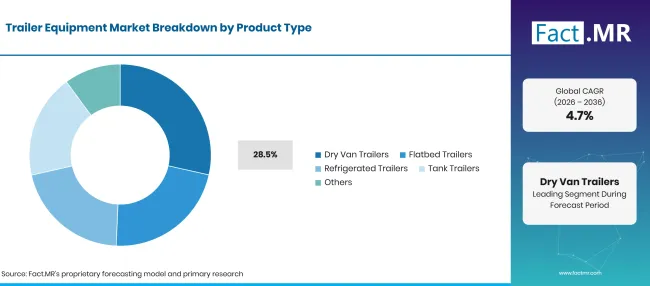
Trailer Equipment Market Breakdown Product Type | Source: Fact.MR
An enclosed van carries almost any palletised or packaged freight, protects it from weather and theft and can move between customers without changes, which keeps utilisation high. Hyundai Translead (March 2026) describes itself as the largest van-trailer maker in North America, and van orders lead every replacement cycle because truckload carriers run the largest pools. Refrigerated trailers, tied to the cold chain logistics market, are the second-largest type and carry higher prices, while flatbeds and tankers serve construction, agriculture and energy.
Why Does the Logistics Segment Lead by Application?
Use of trailers in logistics accounts for 35.2% of 2026 revenue, about USD 1.30 billion.
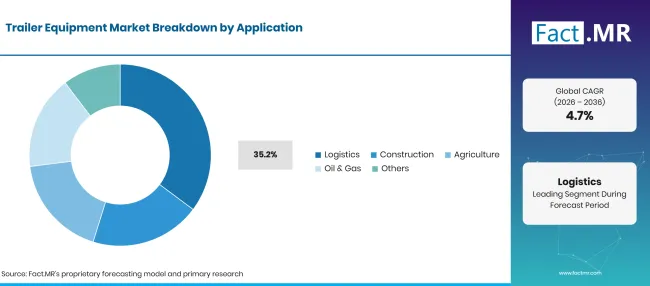
Trailer Equipment Market Breakdown Application | Source: Fact.MR
Truckload and less-than-truckload carriers, parcel networks and retail distribution fleets run the largest trailer pools, often at ratios of several trailers per tractor for drop-and-hook operations. ACT Research (October 2026) traced the September order surge mainly to these carriers as their profits improved. E-commerce has also raised demand for trailers that can be loaded at distribution centres and left at stores. Construction, agriculture and oil and gas add demand for flatbeds, tippers and tankers.
Why Does Steel Lead by Material?
Steel trailers account for 58.3% of 2026 revenue, about USD 2.16 billion.
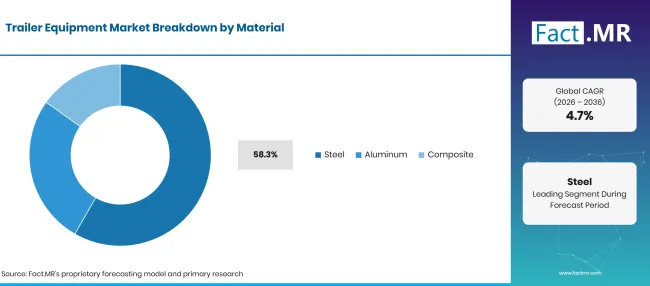
Trailer Equipment Market Breakdown Material | Source: Fact.MR
Steel is cheaper than aluminium, easy to weld and repair anywhere, and strong enough for chassis, tippers and heavy-haul trailers that take hard knocks on construction sites. Aluminium and composites are gaining ground where payload matters most, as Great Dane (August 2026) shows with its all-aluminium Freedom Ultra. Buyers weigh the higher purchase price of aluminium against extra payload, lower fuel use and better corrosion resistance over the trailer's life, so the material mix shifts slowly as fleets renew.
Why Does the Manufacturing Segment Lead by End User?
Manufacturers account for 28.4% of 2026 revenue, about USD 1.05 billion.
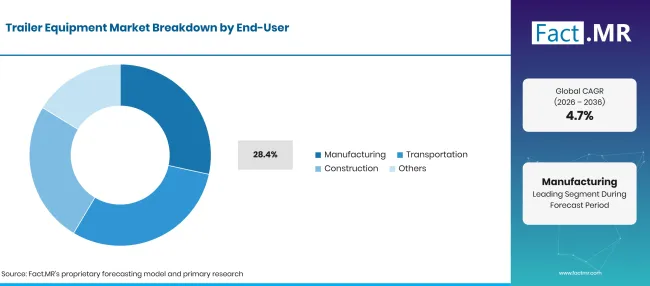
Trailer Equipment Market Breakdown End User | Source: Fact.MR
buying trailers for private fleets that move raw materials, components and finished goods between their own plants, suppliers and customers. Flatbeds carry machinery and steel, vans carry packaged goods, and specialised trailers handle bulk inputs. The US Census Bureau (November 2026) reported manufacturers' shipments of USD 668.5 billion in September 2026, up 1.3% on the month, a sign that goods movement remains steady. Transportation companies are the second-largest end user, followed by construction firms.
Trailer Equipment Market by Region and Country (2026 to 2036)
Trailer revenue is concentrated in the United States, Germany, Brazil, the United Kingdom and Japan, which together account for 68.0% of 2026 revenue (USD 2,516.0 million), rising to 70.6% by 2036 as Germany, Brazil and the United States grow faster than the rest of the world. Germany gains the most share, while the United Kingdom and Japan lose share.
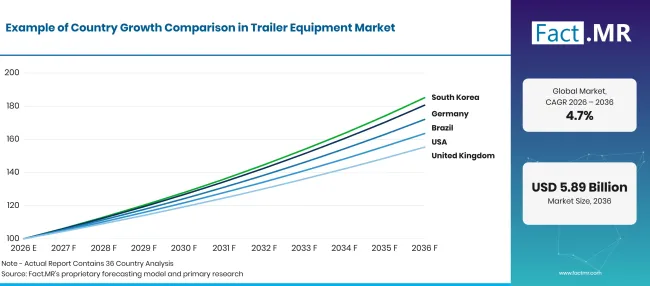
Trailer Equipment Market Growth Index | Source: Fact.MR
| Country | 2026 Revenue | 2036 Revenue | 10-Year Addition | 2026 to 2036 CAGR | Global Share (2026 → 2036) |
|---|---|---|---|---|---|
| United States | USD 1,110.0 million | USD 1,808.0 million | USD 698.0 million | 5.0% | 30.0% → 30.6% |
| Germany | USD 555.0 million | USD 1,003.0 million | USD 448.0 million | 6.1% | 15.0% → 17.0% |
| Brazil | USD 296.0 million | USD 510.4 million | USD 214.4 million | 5.6% | 8.0% → 8.7% |
| United Kingdom | USD 296.0 million | USD 459.7 million | USD 163.7 million | 4.5% | 8.0% → 7.8% |
| Japan | USD 259.0 million | USD 383.4 million | USD 124.4 million | 4.0% | 7.0% → 6.5% |
| Rest of world | USD 1,184.0 million | USD 1,735.5 million | USD 551.5 million | 3.9% | 32.0% → 29.4% |
| Global total | USD 3,700.0 million | USD 5,900.0 million | USD 2,200.0 million | 4.8% | 100.0% → 100.0% |
Source: Fact.MR analysis. Updated Nov 13, 2026
Source: Fact.MR analysis of the trailer equipment market, 2026.
United States
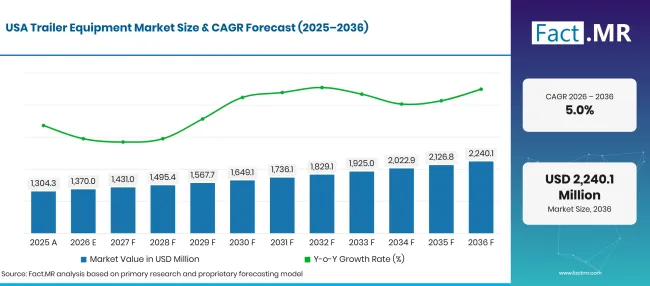
Trailer Equipment Market Forecast Usa | Source: Fact.MR
Sales of trailers in the United States are projected to rise from USD 1,110.0 million in 2026 to USD 1,808.0 million by 2036 at a 5.0% CAGR, adding USD 698.0 million (1.63x) and lifting the US share from 30.0% to 30.6%. Large truckload fleets, private manufacturing fleets and lessors drive demand. ACT Research (October 2026) reported that September 2026 orders pushed backlogs to 5.9 months of build, committing production well into 2027. Hyundai Translead (March 2026) is adding two Illinois plants to serve more than 500 customer locations within 100 miles, which should ease lead times for Midwest fleets.
Germany
Demand for trailers in Germany is the fastest among the named markets, expanding from USD 555.0 million in 2026 to USD 1,003.0 million by 2036 at a 6.1% CAGR. The USD 448.0 million addition (1.81x) raises its share from 15.0% to 17.0%. Demand is recovering from weak trailer registrations in 2025, which the German Association of the Automotive Industry (December 2025) expected to stabilise in 2026. Domestic makers Schmitz Cargobull, KRONE and Kögel supply both the home market and exports, and Verkehrsrundschau (September 2026) reports that Schmitz Cargobull plans to raise sales to about 49,000 vehicles this financial year. Germany's position as Europe's main transit country keeps curtainsider and reefer demand high.
Brazil
Adoption of new trailers in Brazil is projected to lift revenue from USD 296.0 million in 2026 to USD 510.4 million by 2036 at a 5.6% CAGR, adding USD 214.4 million (1.72x) and lifting its share from 8.0% to 8.7%. Road freight carries most of the country's grain, fuel and manufactured goods over long distances, which supports demand for grain trailers, tankers and multi-axle combinations. Transporte Moderno (October 2025) reported that high interest rates cut road implement sales by 5.62% in the first nine months of 2025, so growth depends on credit conditions easing. Record harvests support the long-term case for more grain-hauling capacity.
United Kingdom
UK trailer revenue is projected to rise from USD 296.0 million in 2026 to USD 459.7 million by 2036 at a 4.5% CAGR, adding USD 163.7 million (1.55x), while its share eases from 8.0% to 7.8%. Supermarket and parcel distribution fleets are the core buyers of curtainsiders, vans, double-deck trailers and refrigerated units. The Society of Motor Manufacturers and Traders (October 2026) reported that UK commercial vehicle production slipped 0.9% to 3,200 units in September 2026, reflecting a cautious fleet market. Schmitz Cargobull (March 2026) builds trailers in the UK, which helps it serve local fleets quickly.
Japan
Sales of trailers in Japan are the slowest-growing of the named markets, moving from USD 259.0 million in 2026 to USD 383.4 million by 2036 at a 4.0% CAGR. They add USD 124.4 million (1.48x), while the share slips from 7.0% to 6.5%. Most freight moves in rigid trucks rather than tractor-trailers, which limits the trailer pool. Tighter limits on truck driver working hours are slowly encouraging larger tractor-trailer combinations and relay operations, where one trailer is handed between drivers, which supports steady replacement and some new demand.
Rest of World
Outside the named countries, trailer revenue is projected to grow from USD 1,184.0 million in 2026 to USD 1,735.5 million by 2036 at a 3.9% CAGR, adding USD 551.5 million (1.47x) as the share falls from 32.0% to 29.4%. China, Mexico, Canada, India and the rest of Europe make up most of this demand. Low-cost production by CIMC Vehicles and other Chinese makers keeps prices down in many of these markets, so value grows more slowly than units. Mexico and Canada follow the US cycle closely through cross-border freight.
Competitive Environment and Notable Companies
The trailer supply base is led by Wabash, Great Dane, Utility Trailer, Hyundai Translead, Schmitz Cargobull, KRONE and CIMC Vehicles, which form the Tier-1 group with high-volume plants and broad ranges. Tier-2 includes Kögel, Stoughton Trailers and Manac, which compete on regional strength and specialist trailers, along with many local body builders. Large lessors and fleets often buy trailers built to their own specification, and dealers add telematics, tail lifts and other options before delivery. Component suppliers of axles, suspensions and refrigeration units also shape what each maker can offer.
How Are Companies Positioned in the Trailer Equipment Market?
Competition among trailer makers splits three ways. Wabash, Great Dane, Hyundai Translead and CIMC Vehicles compete on scale and range in high-volume vans and reefers. Utility Trailer and Manac lean on specialist strengths in refrigerated and heavy-haul trailers. Schmitz Cargobull and KRONE combine trailer building with telematics and digital services, which ties customers to their platforms and supports service revenue after the sale.
What Matters When a Buyer Selects a Trailer Equipment Supplier?
Buyers of trailer equipment start with configuration fit, covering trailer type, length, axle layout, floor, suspension and brakes for the freight and roads concerned. They then compare tare weight, durability, insulation for reefers, maintenance needs and resale value, since many fleets sell trailers after five to seven years. Delivery slots, dealer coverage, parts supply and telematics compatibility often decide the order when specifications are similar, especially in a tight build year.
Which Capabilities Distinguish Product Offers?
Product offers in trailers are now separated by weight, refrigeration efficiency, safety technology and connectivity. Great Dane (August 2026) uses a welded aluminium main beam that it says is 50% more rigid than comparable products, Hyundai Translead (March 2026) adds air-system and blind-spot warnings, and Schmitz Cargobull (March 2026) sells refrigerated, curtainsider and tipper ranges with factory telematics. Long structural warranties are becoming a selling point in their own right, as fleets look to extend trailer life.
How Does Geographic Reach Affect Competition?
Plant location and dealer reach shape trailer sales, because trailers are bulky and costly to ship and fleets need fast access to parts and repairs. Schmitz Cargobull (March 2026) runs plants in Germany, Lithuania, Spain, Turkey, Romania and the United Kingdom, while CIMC Vehicles operates brands in North America and Europe as well as China. Hyundai Translead (March 2026) is moving part of its production from Mexico to Illinois to cut lead times for US fleets. Makers with dense service networks win repeat orders from large fleets that standardise on one brand.
| Verified Company Evidence (2026) | Commercial Effect | Buyer Action |
|---|---|---|
| 4 March 2026: Schmitz Cargobull opened an assembly plant in Oradea, Romania, for S.CS curtainsider and S.KI tipper semi-trailers (Schmitz Cargobull, March 2026). | Adds Central European capacity of up to 80 units a week in single-shift operation. | Compare delivery slots from Oradea with other European plants before placing fleet orders. |
| 16 March 2026: Hyundai Translead announced a USD 450 million plan for two trailer plants in Will County, Illinois (Hyundai Translead, March 2026). | Moves van-trailer capacity into the United States and should shorten lead times. | Confirm production start dates and model availability before committing to large orders. |
| 5 August 2026: Great Dane launched the Freedom Ultra aluminium flatbed with FleetPulse telematics and a 10-year main-beam warranty (Great Dane, August 2026). | Raises competition in lightweight flatbeds on payload and lifetime value. | Compare tare weight, warranty terms and telematics fees against steel and mixed-material flatbeds. |
| 23 October 2026: ACT Research reported September 2026 US net trailer orders of 42,700 units and a 29% rise in backlogs (ACT Research, October 2026). | Signals a strong 2027 order season and tighter build slots. | Book build slots early for 2027 deliveries and lock in pricing where possible. |
Source: Fact.MR analysis. Updated Nov 13, 2026
Source: Verified corporate disclosures and Fact.MR analysis, 2026.
| Company | Core Positioning | Verified Activity & Source Attribution |
|---|---|---|
| Great Dane (Tier-1) | Vans, reefers and Freedom flatbeds | Launched the Freedom Ultra aluminium flatbed (Great Dane, August 2026). |
| Hyundai Translead (Tier-1) | Largest van-trailer maker in North America | Announced two Illinois plants and HT ReadyVue safety technology (Hyundai Translead, March 2026). |
| Schmitz Cargobull (Tier-1) | European leader in curtainsiders, reefers and tippers | Opened Oradea assembly plant; about 25% share of the European semi-trailer market (Schmitz Cargobull, March 2026). |
| Wabash (Tier-1) | North American dry vans, reefers and platform trailers | Dry van, refrigerated and platform trailer portfolio (Wabash, accessed November 2026). |
| Utility Trailer (Tier-1) | Refrigerated and dry van trailers | 3000R refrigerated trailer range (Utility Trailer, accessed November 2026). |
| KRONE (Tier-1) | European semi-trailers with telematics and digital services | KRONE Telematics and mykrone.blue customer platform (KRONE, accessed November 2026). |
| CIMC Vehicles (Tier-1) | Global semi-trailer maker with brands in China, North America and Europe | Operates Vanguard in North America and SDC and LAG in Europe (CIMC Vehicles, accessed November 2026). |
| Stoughton Trailers (Tier-2) | US dry vans and intermodal chassis | Dry van and chassis range (Stoughton Trailers, accessed November 2026). |
| Manac (Tier-2) | Flatbed, heavy-duty and specialised trailers | Specialised hauling and flatbed range (Manac, accessed November 2026). |
Source: Fact.MR analysis. Updated Nov 13, 2026
Source: Verified corporate disclosures and Fact.MR analysis, 2026.
Trailer Equipment Market Report Scope and Research Methodology
Fact.MR builds the trailer equipment estimate from unit production and registrations by trailer type in each country, multiplied by average selling prices for steel, aluminium and composite builds. Unit assumptions are tested against order and backlog data, freight indicators, manufacturing shipments and manufacturer disclosures. Country revenue is counted where the trailer is first sold. The five named countries are modelled individually, and all other countries form the rest-of-world residual.
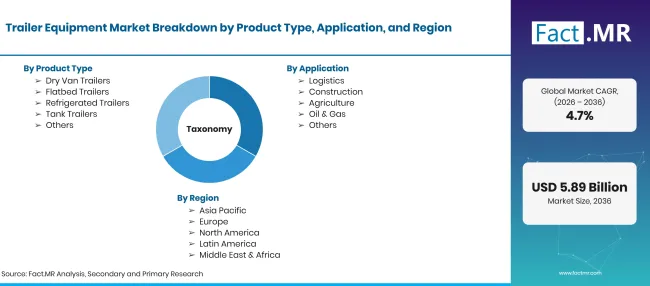
Trailer Equipment Market Taxonomy | Source: Fact.MR
| Coverage Field | Report Scope |
|---|---|
| Market definition | New towed trailers and semi-trailers used to carry freight behind trucks and tractor units |
| Product types | Dry van, flatbed, refrigerated, tank and other trailers |
| Variants | Full trailers and semi-trailers; single, tandem and multi-axle; curtainsider, tipper and drop-deck designs |
| Ingredients included | Chassis, body, axles, suspension, brakes, flooring and factory-fitted telematics |
| Packaging formats | Complete trailers delivered by road, with dealer-fitted options |
| Distribution channels | Direct OEM sales to fleets, dealers and sales to leasing companies |
| End users | Manufacturing, transportation, construction and others |
| Exclusions | Truck bodies, tractor units, separately sold refrigeration units, used trailers and leasing revenue |
| Quantitative units | USD million and USD billion for value; percentage for share and CAGR |
| Volume basis | Units of new trailers sold, counted once at first sale |
| Value basis | Manufacturer and dealer selling price in the country of first sale, constant 2026 USD |
| Regions covered | North America, Latin America, Europe, East Asia, South Asia and Pacific, Middle East and Africa |
| National coverage | United States, Germany, Brazil, United Kingdom, Japan, with the rest of the world as a residual |
| Companies covered | Wabash, Great Dane, Utility Trailer, Hyundai Translead, Schmitz Cargobull, KRONE, CIMC Vehicles, Kögel, Stoughton Trailers, Manac |
Source: Fact.MR analysis. Updated Nov 13, 2026
Source: Fact.MR analysis of the trailer equipment market, 2026.
Research Sources and Bibliography
- ACT Research. (2026, October 23). State of the Industry: U.S. Trailers, September 2026 orders.
- CIMC Vehicles. (Accessed 2026, November 12). About CIMC Vehicles.
- German Association of the Automotive Industry. (2025, December 8). Forecasts for 2026: New car registrations in Germany rise slightly.
- Great Dane. (2026, August 5). Great Dane launches Freedom Ultra aluminum flatbed trailer.
- Hyundai Translead. (2026, March 16). Hyundai Translead announces manufacturing expansion in Illinois.
- KRONE. (Accessed 2026, November 12). KRONE Telematics and mykrone.blue.
- Manac. (Accessed 2026, November 12). Trailers.
- Schmitz Cargobull. (2026, March 4). Schmitz Cargobull begins operations at new production plant in Romania.
- Society of Motor Manufacturers and Traders. (2026, October 29). UK vehicle production, September 2026.
- Stoughton Trailers. (Accessed 2026, November 12). Press releases and products.
- Transport Topics. (2026, September 26). Replacement demand revives trailer market.
- Transporte Moderno. (2025, October 6). Com alta dos juros, vendas de implementos rodoviários caem 5,62% até setembro.
- US Census Bureau. (2026, November 3). Full report on manufacturers' shipments, inventories and orders, September 2026.
- Verkehrsrundschau. (2026, September 30). Schmitz Cargobull will seine Ertragskraft nachhaltig verbessern.
- Wabash. (Accessed 2026, November 12). Trailers.
Frequently Asked Questions
How big is the trailer equipment market in 2026?
How fast is the trailer equipment market expected to grow through 2036?
Which product type leads the trailer equipment market?
Which application leads the trailer equipment market?
Which material leads the trailer equipment market?
Which country is the largest trailer equipment market?
Which country is expected to grow fastest in the trailer equipment market?
What limits growth in the trailer equipment market?
Who worked on this report


Preview the report firsthand - request a free sample
Free SampleGet the brochure for pricing and purchase details
Download PDF