- Base Value(2025): 5.9 Bn
- Forecast Value (2036): 9.8 Bn
- CAGR (2036): 4.7%
Transmission Crossmember Market Forecast and Outlook By Fact.MR
The transmission crossmember market was valued at USD 5.9 billion in 2025 and is forecast to reach USD 6.2 billion in 2026 and USD 9.8 billion by 2036, at a CAGR of 4.7%. High-strength Steel leads material type at 58.7% share in 2026. Passenger Cars holds the top vehicle type position at 61.3%, with OEM commanding sales channel demand at 84.9% in 2026. The transmission crossmember is the kind of component that does not appear in consumer marketing or technology roadmaps, yet it absorbs a significant amount of engineering effort at every vehicle program. When an automaker redesigns an underbody architecture for a new EV platform, or decides to reduce vehicle weight by 80 kilograms to improve range, or introduces a new transmission layout, the crossmember is among the first components that has to be re-engineered. That invisibility combined with that frequency of redesign is what makes this a more dynamic market than it appears from the outside.

Transmission Crossmember Market Market Value Analysis | Source: Fact.MR
Key Drivers
- Platform Production: Large vehicle build volumes continue to anchor demand for crossmember assemblies across global manufacturing hubs.
- Lightweighting Pressure: Automakers are reworking structural components to reduce mass without compromising crash and durability requirements.
- Architecture Change: EV and hybrid platforms are altering underbody packaging and structural integration requirements for crossmember design.
Key Segments Analyzed in the Report
- Material Type: High-Strength Steel, Aluminum, Multi-Material Composites, And Others
- Vehicle Type: Passenger Cars, Light Commercial Vehicles, Heavy Commercial Vehicles, And Battery Electric Vehicles
- Sales Channel: OEM And Aftermarket
- Region: North America, Latin America, Europe, Asia Pacific, And Middle East & Africa
Analyst Opinion
Shambhu Nath Jha, Principal Consultant, Fact.MR says transmission crossmembers look simple until platform engineers ask them to do more with less mass. The market rewards suppliers that can meet stiffness, crash, corrosion, and cost targets while fitting increasingly complex underbody packaging. The EV transition is making this problem harder, not easier, because the underbody now has to accommodate battery systems that compete directly with traditional driveline packaging space.
Transmission Crossmember Market Definition
The transmission crossmember market covers structural chassis components used to support transmissions, driveline assemblies, and associated underbody systems in passenger and commercial vehicles.
Transmission Crossmember Market Inclusions
- Revenue from transmission crossmembers and closely related structural support assemblies supplied to OEM and aftermarket channels.
- Components manufactured in steel, aluminum, or multi-material formats for passenger and commercial vehicle architectures.
- Demand across North America, Latin America, Europe, Asia Pacific, and the Middle East & Africa.
Transmission Crossmember Market Exclusions
- Broader chassis module revenue where transmission crossmember content is not separately attributable.
- Non-automotive structural frames and industrial mounts.
- Complete transmission system revenue beyond the structural support component.
Transmission Crossmember Market Research Methodology
This study evaluates the transmission crossmember market across material type, vehicle type, sales channel, and region, using 2025 as the base year and 2026 to 2036 as the forecast period. Market value is expressed in USD billion. Evidence inputs include chassis-system supplier capabilities, automotive lightweighting trends, vehicle platform production logic, and first-party information from Magna, Martinrea, and other body and chassis manufacturers. Triangulation aligns vehicle output, component content per platform, material substitution trends, and OEM sourcing patterns to derive segment and regional estimates.
Key Drivers, Restraints, and Trends in Transmission Crossmember Market
Drivers
The transmission crossmember market is supported by high-volume vehicle production and the ongoing need to package driveline loads into the underbody structure reliably. Even where the component does not attract public attention, it remains essential to stiffness, mounting integrity, and manufacturability. Platform refresh cycles therefore keep the market active.
Restraints
The category faces pricing pressure because it is embedded in a highly cost-competitive supply chain. Automakers expect structural performance gains without giving up manufacturing efficiency or cost control. That limits how quickly more expensive material substitutions can scale outside selected vehicle programs.
Trends
The strongest trend is toward smarter lightweighting over blanket replacement of steel. High-strength steel remains important, but aluminum and multi-material strategies are gaining share where weight savings and packaging advantages justify them. Electrified vehicle layouts are also changing how underbody structural components are designed and integrated.
Segmental Analysis
Transmission Crossmember Market Analysis by Material Type
Transmission Crossmember Market Analysis By Material Type | Source: Fact.MR
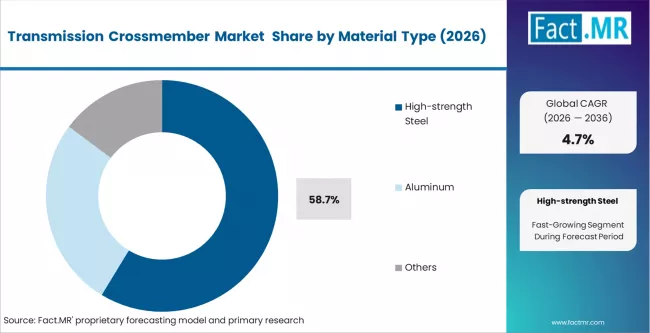
The High-strength Steel segment is expected to lead the material type category with a 58.7% share in 2026. High-strength steel leads because it offers the best balance of cost, manufacturability, durability, and structural performance for a large portion of global vehicle programs. Automakers can still achieve meaningful mass optimization without abandoning established forming and joining economics.
Transmission Crossmember Market Analysis by Vehicle Type
Transmission Crossmember Market Analysis By Vehicle Type | Source: Fact.MR
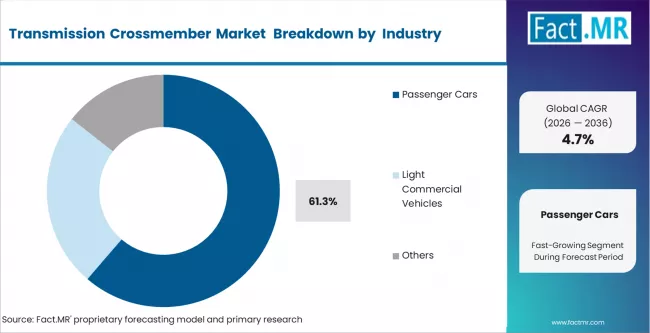
The Passenger Cars segment is expected to lead the vehicle type category with a 61.3% share in 2026. Passenger cars lead because they represent the broadest production base for crossmember demand and include both conventional and increasingly electrified layouts. Volume alone keeps this segment structurally dominant even as commercial vehicle designs remain important in value terms.
Competitive Aligners for Market Players
Transmission Crossmember Market Analysis By Company | Source: Fact.MR
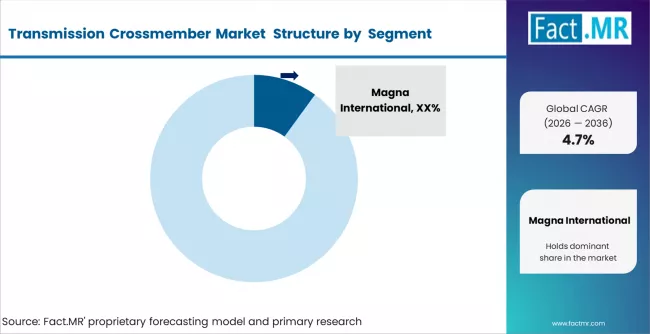
Transmission crossmember competition is won at the platform award stage and defended through execution over a production program that often runs five to eight years. The initial award decision is made on a combination of technical competence, tooling capability, cost structure, and supply reliability record. Suppliers that have a demonstrated history of delivering complex stamped or roll-formed chassis components on time, at specification, and within cost targets are systematically preferred over those with better unit economics on paper but an uncertain track record in high-volume automotive programs. In this market, past performance is genuinely predictive of future award probability.
The lightweighting transition is reshaping supplier investment requirements in a meaningful way. Producing high-strength steel crossmembers requires press lines and tooling calibrated for the forming behavior of advanced high-strength steels, which differ significantly from conventional mild steel. Aluminum crossmembers add extrusion, die-casting, or hydroforming processes that many traditional stamping suppliers do not have in-house. Multi-material designs add bonding and joining complexity on top of that. As OEMs push toward lighter architectures, suppliers that have not invested in these process capabilities are finding themselves locked out of advanced-platform awards even when their conventional stamping operations are cost-competitive.
The EV platform opportunity is the most consequential near-term competitive variable. Battery electric vehicles require underbody architectures that are fundamentally different from ICE platforms: the battery pack occupies the floor space that the fuel tank, exhaust, and transmission tunnel previously used, and the structural load paths change accordingly. Crossmember designs for BEV platforms need to work around battery pack geometries, contribute to battery protection in crash scenarios, and meet NVH requirements for a powertrain that is much quieter than an internal combustion alternative. Suppliers that have engaged early with leading EV platform programs at Volkswagen, Hyundai, and GM are building engineering knowledge and tooling assets that will translate into sustained business on those platforms for the duration of their production lives.
Key Players in Transmission Crossmember Market
- Magna International
- Martinrea International
- Gestamp
- Metalsa
- Benteler Automotive
- CIE Automotive
- thyssenkrupp Automotive Body Solutions
- Tower International
- Aisin
- JBM Auto
Strategic Outlook by Fact.MR on Transmission Crossmember Market
Fact.MR expects transmission crossmembers to remain a steady structural market with incremental value migration toward lighter and more integrated designs. Supplier advantage will come from balancing weight reduction with manufacturability and cost, especially as vehicle architectures diversify. The EV transition is creating both risk and opportunity: suppliers who move early to develop BEV-compatible crossmember solutions are positioning for programs that will run into the 2030s, while those who wait will find the design space on those platforms already occupied.
Bibliography
- Magna International Inc. (2025). Annual information form.
- Martinrea International Inc. (2025). Annual report 2024.
- International Energy Agency. (2025). Global EV outlook 2025.
- European Automobile Manufacturers’ Association. (2025). New car registrations: +0.8% in 2024; battery-electric 13.6% market share.
- United States Environmental Protection Agency. (2024). Final rule greenhouse gas emissions standards for heavy-duty vehicles – Phase 3.
- Gestamp Automoción, S.A. (2025). Annual information 2024.
Segmentation
Scope of the Report
Transmission Crossmember Market Breakdown By Material Type, Vehicle Type, And Region | Source: Fact.MR
| Metric | Value |
|---|---|
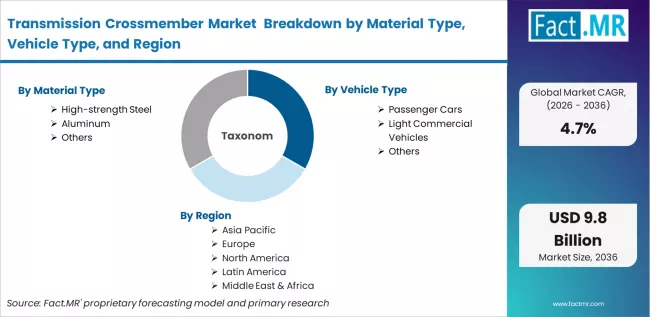
| Market Value | USD 5.9 billion in 2025 to USD 9.8 billion by 2036 |
| CAGR | 4.7% from 2026 to 2036 |
| Base Year | 2025 |
| Forecast Period | 2026 to 2036 |
| Material Type Segmentation | High-strength Steel, Aluminum, Multi-material Composites, Others |
| Vehicle Type Segmentation | Passenger Cars, Light Commercial Vehicles, Heavy Commercial Vehicles, Battery Electric Vehicles |
| Sales Channel Segmentation | OEM, Aftermarket |
| Regional Coverage | North America, Latin America, Europe, Asia Pacific, and Middle East & Africa |
Source: Fact.MR analysis. Updated Mar 17, 2026
Frequently Asked Questions
What is the projected size of the Transmission Crossmember Market by 2036?
What is the CAGR of the Transmission Crossmember Market from 2026 to 2036?
Which material type segment leads the Transmission Crossmember Market?
Which vehicle type segment dominates the Transmission Crossmember Market?
Which sales channel segment leads the Transmission Crossmember Market?
Who are the key companies in the Transmission Crossmember Market?
What is driving demand in the Transmission Crossmember Market?
Who worked on this report


Preview the report firsthand - request a free sample
Free SampleGet the brochure for pricing and purchase details
Download PDF