- Forecast Value (2035): 46.9 Bn
- CAGR (2035): 5.1%
Commercial Vehicle Transmission Market Outlook 2025 to 2035
The global commercial vehicle transmission market is projected to rise from USD 28.5 billion in 2025 to USD 46.9 billion by 2035, growing at a CAGR of 5.1% during the forecast period. This growth is driven by the evolution of fleet efficiency standards, increasing demand for freight transportation, and global transition toward low-emission drivetrains. Additionally, the adoption of automatic and automated manual transmissions (AMTs) in heavy-duty commercial vehicles is boosting operational efficiency and driver comfort.
Transmission systems are pivotal to optimizing vehicle performance, fuel efficiency, and maintenance cost across light, medium, and heavy commercial vehicles. In recent years, regulatory pressures for fuel economy, combined with the need for smoother operation in urban logistics, have catalyzed investments into advanced and electrified transmission technologies. The push toward hybridization and electrification of commercial fleets, particularly in Europe and Asia, is also contributing to significant innovation in the market.
Metric Overview
| Metric | Value |
|---|---|
| Market Size (2025E) | USD 28.5 billion |
| Market Size (2035F) | USD 46.9 billion |
| CAGR (2025-2035) | 5.1% |
Source: Fact.MR analysis. Updated Aug 13, 2025
2025-to-2035.webp "Us Commercial Vehicle Transmission Market Market Value(usd Million)2025 To 2035")
Us Commercial Vehicle Transmission Market Market Value(usd Million)2025 To 2035 | Source: Fact.MR
What are the Key Drivers of the Commercial Vehicle Transmission Market?
The global rise in e-commerce and last-mile delivery services is directly increasing the number of light and medium-duty commercial vehicles on roads. This surge requires transmission systems that offer fuel economy, responsiveness in stop-and-go traffic, and minimal downtime.
Transmissions with higher torque conversion and smoother gear shifting help optimize these vehicle classes, which is accelerating the demand for more efficient and automated systems.
In addition, expanding road freight corridors in North America, India, and Southeast Asia are contributing to a larger pool of heavy-duty trucks, requiring robust transmission architectures for cross-country haulage.
There is a significant market shift from manual transmissions to automatic and automated manual transmissions (AMTs) in both medium and heavy-duty commercial vehicles. Automatic gearboxes improve fuel efficiency through real-time shift decisions and reduce driver fatigue. With growing shortages of skilled commercial drivers, fleets are favoring easier-to-operate transmission types.
Automated solutions are now being tailored for off-road, mining, and heavy-load environments markets historically dominated by manual systems due to recent improvements in heat management, clutch durability, and software calibration.
With mounting pressure to decarbonize transport, OEMs are incorporating hybrid-electric and fully electric transmissions for commercial applications. Hybrid CV transmissions integrate with regenerative braking and electric drive modules to lower emissions while offering the torque characteristics needed for freight.
Manufacturers like Allison Transmission and Eaton are introducing integrated electric axle and e-drive transmission solutions for electric buses and Class 6 8 trucks. These innovations are anticipated to transform the landscape of CV drivetrains by the end of the decade.
What are the Regional Trends of the Commercial Vehicle Transmission Market?
Asia-Pacific Dominates Global Market with Manufacturing and Demand Strength
Asia-Pacific, particularly China, India, and Japan, is the dominant region due to its large-scale commercial vehicle manufacturing, infrastructure growth, and logistics demand. China has embraced AMT systems for long-haul trucks to combat fuel inefficiencies, while India is gradually adopting automatic and hybrid CV transmissions amid regulatory changes and urban transport reforms. Japan leads in compact, hybrid-ready transmission units for commercial minivans and delivery fleets.
The presence of major domestic OEMs like Tata Motors, Foton, and Dongfeng, as well as international players like Isuzu and Hino, ensures stable transmission system demand across all classes of commercial vehicles.
North America Leverages Technology and Fleet Modernization
North America has seen rapid adoption of automatic and hybrid transmission technologies, especially in logistics, utility services, and school buses. Regulatory actions such as EPA's Phase 2 GHG regulations have forced OEMs to incorporate fuel-saving transmission systems.
Major truck manufacturers like Freightliner, Kenworth, and Navistar are incorporating AMTs and electric propulsion-ready transmissions. Regional investments in autonomous driving, particularly in Class 8 trucks, are spurring demand for shift-by-wire and integrated control transmission systems.
Europe Pushes Electrification and Emission-Optimized Transmissions
Europe’s strict carbon emission targets and urban mobility policies are pushing OEMs to integrate dual-clutch, AMT, and e-drive transmissions in commercial vehicles. Germany, the Netherlands, and France are at the forefront of adopting battery-electric trucks and buses, which use integrated powertrain systems to replace conventional transmissions.
Scandinavian countries are also promoting electric and hybrid buses in urban public transport networks, creating demand for lightweight, maintenance-free electric drivetrains with regenerative transmission features.
What are the Challenges and Restraining Factors of the Commercial Vehicle Transmission Market?
Automatic and AMT systems cost significantly more than manual transmission systems. Fleet operators in developing regions like Africa and parts of Southeast Asia still prefer manual CV transmissions due to cost constraints. The cost of electronic controllers, precision actuators, and maintenance for automatic systems discourages small fleet owners from adopting them, particularly in heavy-duty segments.
Although electric drivetrains eliminate traditional multi-speed gearboxes, integrating transmission systems in hybrid CVs requires advanced control algorithms, motor synchronizations, and compact design. Ensuring seamless communication between engine, battery, and transmission units remains a major hurdle. Component overheating and durability challenges under full payload in hybrid trucks reduce the scalability of these systems across all commercial vehicle categories.
Many regions still lack skilled technicians trained to handle diagnostic and servicing needs of AMTs or e-drive systems. This results in longer vehicle downtime and increased maintenance costs. Additionally, aftermarket access to genuine parts for electronically-controlled transmissions is limited in remote markets, reducing their operational reliability.
Country-Wise Outlook
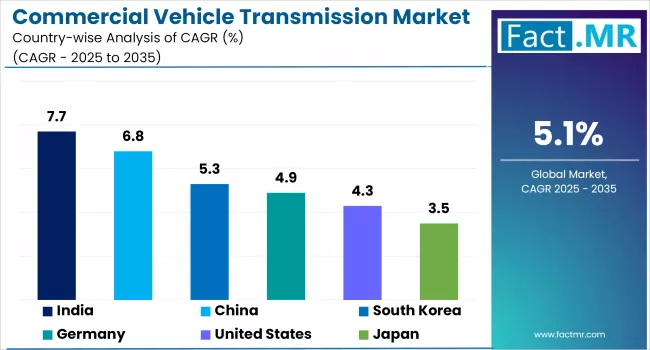
Commercial Vehicle Transmission Market By Country | Source: Fact.MR
| Countries | CAGR (2025 to 2035) |
|---|---|
| United States | 4.6% |
| China | 6.8% |
| Germany | 4.9% |
Source: Fact.MR analysis. Updated Aug 13, 2025
United States: Fleet Modernization and Electrification Leading the Shift
2025-to-2035.webp "Us Commercial Vehicle Transmission Market Country Value(usd Million)2025 To 2035")
Us Commercial Vehicle Transmission Market Country Value(usd Million)2025 To 2035 | Source: Fact.MR
The U.S. is a key player in the commercial vehicle transmission market, owing to its extensive Class 6 8 truck fleet and rapid electrification in logistics and public services. The presence of leading transmission OEMs such as Allison Transmission, Eaton, and Dana supports domestic innovation.
Fleet operators are transitioning from manual to automated transmissions to comply with stringent fuel efficiency regulations under EPA Phase 2. The growth of last-mile delivery fleets operated by UPS and FedEx has also fueled demand for smoother and fuel-efficient transmission systems. Electrification pilots in cities such as Los Angeles and New York are creating demand for e-axles and multi-speed EV transmissions.
China: Dominance in Production and Technological Shift
China continues to lead the global commercial vehicle production volumes. With initiatives like the "New Energy Vehicles (NEV) policy", the government supports electric and hybrid trucks, driving demand for high-efficiency, low-emission transmissions.
Major Chinese OEMs including FAW, Dongfeng, and SAIC are localizing production of AMT and electric CV transmissions to reduce dependence on foreign technology. Heavy-duty AMT systems are also being deployed for inter-city freight to reduce driver fatigue and increase long-term fleet efficiency. Collaborations with global firms like ZF and Voith have improved the technical sophistication of domestically produced transmission systems.
Germany: Engineering Precision Drives Hybrid and EV Adoption
Germany is the innovation hub of Europe for both automotive and transmission system engineering. The market is witnessing growing integration of hybrid and e-drive transmissions in electric buses, municipal utility vehicles, and commercial vans.
Regulations under the EU Green Deal and Euro 7 standards are forcing OEMs to accelerate electrified transmission development. Companies like ZF Friedrichshafen and Voith are leading the development of modular and integrated transmission-electric motor systems for commercial vehicles. Germany also supports dedicated R&D funding for CV electrification under the “Mobility and Fuel Strategy” program.
Category-wise Analysis
Manual Transmission (MT): Economical but Losing Ground
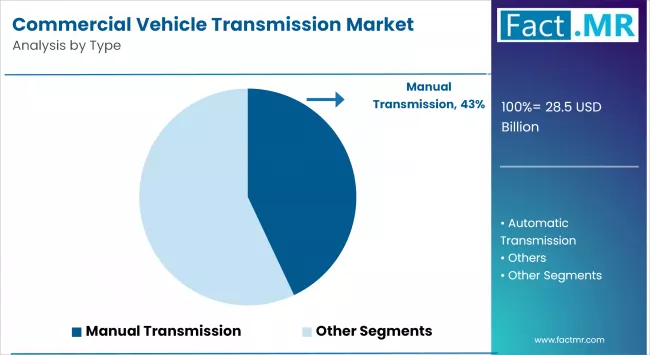
Commercial Vehicle Transmission Market By Type | Source: Fact.MR
Manual transmission continues to be used in regions with cost-sensitive markets and limited driver automation requirements. They are favored in agriculture, construction, and entry-level freight vehicles in Latin America, Africa, and parts of South Asia due to their simplicity and low maintenance cost.
However, MTs are gradually being phased out in developed markets due to driver fatigue, lower efficiency, and difficulty in operation for urban deliveries. OEMs are reducing MT options in new truck models in favor of AMTs or fully automatic units.
Automatic Transmission (AT): Urban Driving and Bus Transit Oriented
Automatic transmissions are the system of choice for urban bus fleets, school transport, and municipal utility vehicles due to seamless shifting, ease of training drivers, and consistent fuel consumption.
Cities across Europe, North America, and Japan are phasing out MT-equipped buses for fully automatic CVs. Recent innovations in torque converter lock-up mechanisms, shift logic optimization, and thermal efficiency have boosted AT reliability even in heavy-duty commercial applications.
Automated Manual Transmission (AMT): Blending Economy with Automation
AMTs combine the structure of a manual gearbox with electronic shifting and clutch control, providing the fuel efficiency of MTs with driver comfort of ATs. This hybrid approach is gaining rapid acceptance in both developed and developing countries.
In heavy-duty trucks, AMTs enable optimal fuel usage in long-distance transport. Their use is rising sharply in Class 7–8 trucks in North America, intra-city delivery vans in Europe, and mining dumpers in Asia. Leading manufacturers like ZF and Eaton are investing in multi-speed AMTs with real-time telemetry to support autonomous driving and remote diagnostics.
Electric and Hybrid Transmissions: Fastest Growing Segment
With the growth in electric buses, delivery vans, and drayage trucks, transmission systems are evolving into compact, single-speed or multi-speed integrated e-drives. These systems replace traditional gearboxes with direct motor-drive or e-axle assemblies.
Hybrid CVs also require dedicated power-split or dual-clutch e-transmissions to balance engine and battery input. These setups provide high starting torque and regenerative energy recovery in urban driving. As electric CV adoption grows across China, Europe, and the U.S., this category is expected to witness the fastest CAGR over the forecast period.
Competitive Analysis
The commercial vehicle transmission market is moderately consolidated, with global players competing on performance, cost, and integration capabilities. Leaders like Allison Transmission, ZF Friedrichshafen, Eaton Corporation, Voith, Dana Incorporated, and BorgWarner dominate due to technological know-how and strategic OEM partnerships.
Product innovations center on lightweight designs, electronic control units (ECUs), multi-speed hybrid architectures, and integrated e-axles. Companies are also embedding smart diagnostics and condition monitoring systems to support predictive maintenance and reduce unplanned downtime. Joint ventures, such as ZF’s partnership with Tata Motors and Eaton’s ventures in China, are facilitating regional product localization and cost competitiveness.
Recent Developments (2024–2025)
- Allison Transmission expanded its eGen Power® electric axle portfolio for heavy-duty vehicles and buses in 2025, incorporating two-speed gearboxes to improve performance.
- ZF commissioned a second production line for commercial vehicle gear systems and introduced the TraXon 2 Hybrid transmission in 2025.
- In 2024, Eaton introduced the Precision Gen2 AMT for Class 7–8 trucks, which boasts sophisticated shift logic and telematics systems.
- 2024–2025 – Voith advanced its VEDS with the Future Inverter Platform, introducing it into series production in 2024 (without DMU) and 2025 (with incorporated DMU).
- In 2024, Dana introduced the Spicer Electrified™ Zero-6 e-Transmission, which features patented shifting and lubrication technologies to produce high-torque e-transaxles.
Segmentation
Segmentation of Commercial Vehicle Transmission Market
-
By Type :
- Manual Transmission
- Automatic Transmission
- Automated Manual Transmission (AMT)
- Electric & Hybrid Transmission
-
By Transmission Type :
- Single-Speed
- Multi-Speed
-
By Vehicle Class :
- Light Commercial Vehicles (LCVs)
- Medium Commercial Vehicles (MCVs)
- Heavy Commercial Vehicles (HCVs)
-
By Application :
- Freight Transport
- Public Transit
- Construction & Mining
- Utility & Emergency Services
- Last-Mile Delivery
- Others
-
By Region :
- North America
- Latin America
- Western Europe
- Eastern Europe
- East Asia
- South Asia & Pacific
- Middle East & Africa
Frequently Asked Questions
What is the size of the commercial vehicle transmission market in 2025?
What is the expected market value by 2035?
What is the compound annual growth rate (CAGR) of the market?
Which transmission type is expected to grow the fastest?
Who are the major players in the commercial vehicle transmission market?
Who worked on this report


Preview the report firsthand - request a free sample
Free SampleGet the brochure for pricing and purchase details
Download PDF