- Base Value(2026): 940.9 Mn
- Estimated Value(2026): 940.9 Mn
- Forecast Value (2036): 1314.5 Mn
- CAGR (2026 - 2036): 3.4%
Engine and Transmission Mount Fasteners Market Forecast and Outlook 2026 to 2036
Revenue from engine and transmission mount fasteners market is projected to grow from USD 940.9 million in 2026 to USD 1314.5 million by 2036 at a compound annual growth rate of 3.4%.
Key Takeaways from Engine and Transmission Mount Fasteners Market
- Engine and Transmission Mount Fasteners Market Value 2026: USD 940.9 million
- Engine and Transmission Mount Fasteners Market Forecast Value 2036: USD 1314.5 million
- Engine and Transmission Mount Fasteners Market Forecast CAGR: 3.4%
- Leading Fastener Type in Engine and Transmission Mount Fasteners Market: Vibration-isolating bolts 39%
- Leading Mount Type in Engine and Transmission Mount Fasteners Market: Engine mounts 46%
- Key Growth Regions in Engine and Transmission Mount Fasteners Market: India, China, Turkey, Thailand, Mexico, U.S., Germany, Japan
- Key Players in Engine and Transmission Mount Fasteners Market: Meidoh, Sundram Fasteners, Bulten, KAMAX, LISI Automotive, SFS Group, Fontana Gruppo, Chun Yu Group, ITW Automotive
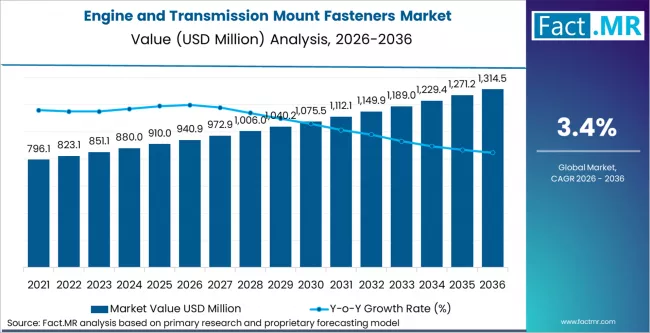
Engine And Transmission Mount Fasteners Market Market Value Analysis | Source: Fact.MR
The expansion is driven by increasing vehicle production and the need for enhanced vibration control, noise reduction, and drivetrain stability. These fasteners secure engine mounts, transmission mounts, and torque strut mounts, ensuring that powertrain components remain properly aligned while isolating vibration and torque forces.
Vibration-isolating bolts dominate the segment due to their capacity to reduce noise, vibration, and harshness, while elastomer-integrated fasteners and high-load studs are used in specialized applications requiring combined mechanical strength and flexibility. Engine mounts account for the largest share of mount applications, reflecting their critical role in powertrain stability.
Alloy steel is the leading material, offering high strength and durability, while zinc-nickel coated steel and stainless steel are adopted in areas requiring corrosion protection or reduced wear. OEM direct supply handles most installations during assembly, with Tier-1 mount suppliers and aftermarket service channels supporting replacement and repair.
Growth is particularly strong in India and China due to expanding vehicle production, whereas mature markets such as the U.S., Germany, and Japan continue to maintain stable adoption. Suppliers focus on precision engineering, mechanical performance, and long-term reliability to meet vehicle safety and noise, vibration, and harshness requirements.
Engine and Transmission Mount Fasteners Market
| Metric | Value |
|---|---|
| Estimated Value in (2026E) | USD 940.9 million |
| Forecast Value in (2036F) | USD 1,314.5 million |
| Forecast CAGR 2026 to 2036 | 3.4% |
Source: Fact.MR analysis. Updated Jan 23, 2026
Category
| Category | Segments |
|---|---|
| Fastener Type | Vibration-Isolating Bolts; Elastomer-Integrated Fasteners; High-Load Studs; Other |
| Mount Type | Engine Mounts; Transmission Mounts; Torque Strut Mounts; Other |
| Material or Coating | Alloy Steel; Zinc-Nickel Coated Steel; Stainless Steel; Other |
| Sales Channel | OEM Direct; Tier-1 Mount Suppliers; Aftermarket; Other |
| Region | North America; Europe; Asia Pacific; Latin America; Middle East & Africa |
Source: Fact.MR analysis. Updated Jan 23, 2026
Segmental Analysis
By Fastener Type, Which Segment Holds the Dominant Share in the Engine and Transmission Mount Fasteners Market?
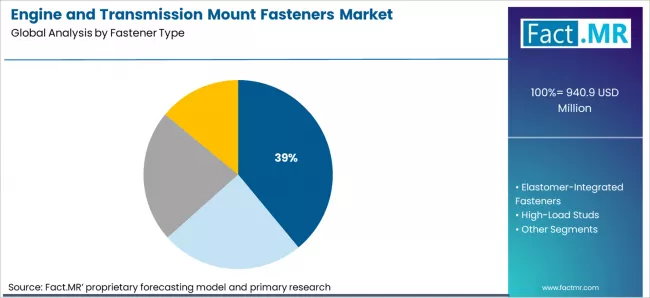
Engine And Transmission Mount Fasteners Market Analysis By Fastener Type | Source: Fact.MR
In terms of fastener type, vibration isolating bolts lead the Engine and Transmission Mount Fasteners Market with a 39% share. These bolts are designed to work directly with elastomeric mount elements, limiting powertrain vibration transfer into the vehicle body. Their placement at engine cradle interfaces and mount brackets makes clamp stability critical under continuous torque fluctuation and idle shake conditions.
- Powertrain engineers specify vibration isolating bolts to control noise and harshness across varying engine speeds.
- Growth in refined ride comfort targets continues to reinforce demand for vibration-focused fastening solutions.
By Mount Type, Which Segment Registers the Highest Share in the Engine and Transmission Mount Fasteners Market?
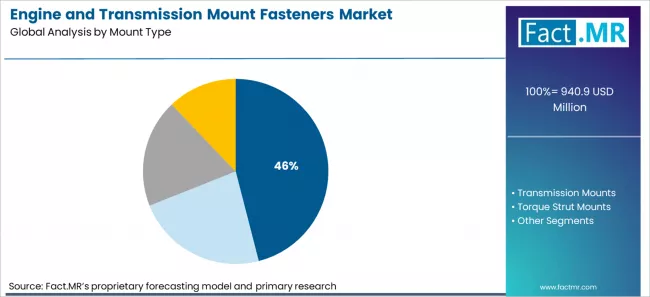
Engine And Transmission Mount Fasteners Market Analysis By Mount Type | Source: Fact.MR
By mount type, engine mounts account for a 46% share. Engine mounts carry the primary load of the powertrain while managing movement during acceleration, braking, and cornering. Fasteners used in this segment must retain preload under cyclic compression and shear generated by engine motion.
- Engine mount geometry drives fastener selection at block-side and subframe-side interfaces.
- Higher torque output engines sustain consistent fastener demand in this mounting category.
By Material and Coating, Which Segment Holds the Dominant Share in the Engine and Transmission Mount Fasteners Market?
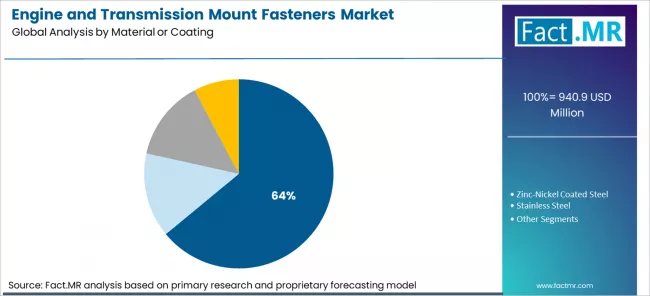
Engine And Transmission Mount Fasteners Market Analysis By Material Or Coating | Source: Fact.MR
By material and coating, alloy steel dominates with a 64% share. Engine and transmission mounting points require fasteners with high tensile strength and fatigue resistance due to constant vibration exposure. Alloy steel supports stable clamp force while resisting deformation under prolonged dynamic loading.
- Material choice reflects durability requirements near high-heat powertrain zones.
- Coating selection remains focused on corrosion protection in underbody environments.
By Sales Channel, Which Segment Registers the Highest Share in the Engine and Transmission Mount Fasteners Market?
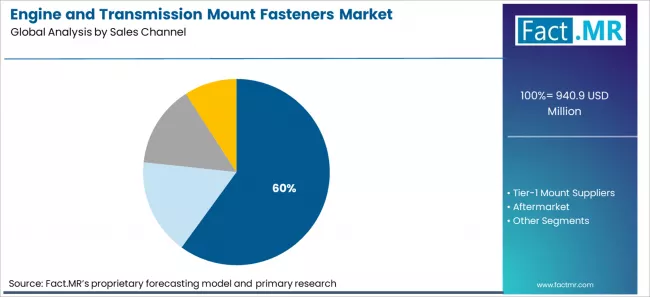
Engine And Transmission Mount Fasteners Market Analysis By Sales Channel | Source: Fact.MR
By sales channel, OEM direct supply leads with a 60% share. Engine and transmission mount fasteners are installed during powertrain assembly to meet alignment accuracy and durability validation standards. Direct sourcing allows manufacturers to control torque strategy and material consistency across vehicle platforms.
- Assembly-stage installation ensures compatibility with mount tuning and powertrain calibration.
- OEM-led procurement remains dominant due to responsibility for ride quality and long-term reliability.
What are the Drivers, Restraints, and Key Trends of the Engine and Transmission Mount Fasteners Market?
- Drivers: Automakers are focusing on reducing noise, vibration, and harshness while supporting heavier and more complex powertrain systems, increasing reliance on specialized fasteners that securely anchor engine and transmission mounts while managing continuous vibration and torque loads.
- Restraint: Engine and transmission mount fasteners must perform consistently under high thermal exposure, oil contamination, and cyclic stress, making material selection and coating performance critical and slowing approval of alternative fastening solutions.
- Trend 1: Vibration isolating bolts and elastomer integrated fasteners are gaining wider adoption as manufacturers seek to improve powertrain refinement and long term mount durability without increasing system complexity.
- Trend 2: OEM direct sourcing and Tier 1 mount supplier collaboration is strengthening as fasteners are increasingly engineered as part of complete mount assemblies, ensuring precise preload control, repeatable installation, and stable powertrain positioning over the vehicle lifecycle.
Analysis of the Engine and Transmission Mount Fasteners Market by Key Country
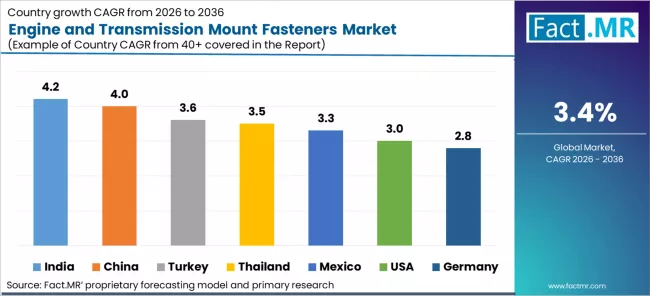
Engine And Transmission Mount Fasteners Market Cagr Analysis By Country | Source: Fact.MR
| Country | CAGR |
|---|---|
| India | 4.2% |
| China | 4.0% |
| Turkey | 3.6% |
| Thailand | 3.5% |
| Mexico | 3.3% |
| U.S. | 3.0% |
| Germany | 2.8% |
| Japan | 2.6% |
Source: Fact.MR analysis. Updated Jan 23, 2026
The report covers an in depth analysis of 8 countries; higher growth markets are highlighted below.
What Is Driving Growth in the Engine and Transmission Mount Fasteners Market in India?
India leads this group with a CAGR of 4.2%, supported by rising powertrain production and increased localization of mount assemblies. Engine and transmission mounts rely on fasteners that manage vibration isolation while maintaining long term clamp stability. Growing use of elastomer integrated mount designs is influencing fastener geometry and surface treatment choices. OEMs emphasize durability due to operating conditions that involve wide temperature ranges and road induced vibration. Domestic sourcing continues to expand as powertrain manufacturing footprints grow.
- Expansion of localized engine and transmission mount production is supporting steady demand for vibration isolating fasteners.
- Increased use of elastomer integrated mounts is shaping demand for application specific bolt designs.
How Is China Shaping Demand for Engine and Transmission Mount Fasteners?
China is projected to grow at a CAGR of 4.0%, driven by high powertrain output across passenger and commercial vehicles. Engine mounts account for a large share of fastener consumption due to their role in load transfer and noise control. Alloy steel fasteners dominate usage to balance strength and cost. OEM controlled sourcing remains prevalent because mount performance directly affects vehicle refinement metrics. Supplier alignment with tier one mount manufacturers supports consistent demand planning.
- High powertrain production volumes are sustaining regular demand for mount fastening solutions.
- Emphasis on ride comfort is reinforcing use of vibration optimized fasteners.
What Role Does Turkey Play in the Engine and Transmission Mount Fasteners Market?
Turkey is expected to expand at a CAGR of 3.6%, reflecting its growing role in regional powertrain and vehicle assembly. Engine and transmission mounts supplied to export programs require standardized fastener specifications. Zinc nickel coated fasteners are commonly used to meet corrosion resistance requirements. Production continuity across assembly plants supports predictable component offtake. Demand remains concentrated within OEM and tier one supplier channels.
- Export oriented mount assembly is maintaining consistent fastener demand.
- Standardized powertrain platforms are reinforcing recurring fastener specifications.
How Is Thailand Contributing to Market Expansion?
Thailand is forecast to register a CAGR of 3.5%, supported by steady production of passenger vehicles and light commercial vehicles. Torque strut and transmission mounts influence fastener load characteristics due to dynamic drivetrain movement. Stainless steel fasteners are adopted selectively for durability in high humidity environments. Tier one mount suppliers play a central role in sourcing decisions.
- Growth in powertrain assembly is supporting demand for high load stud fasteners.
- Environmental durability requirements are influencing material selection for mount fasteners.
What Defines the Engine and Transmission Mount Fasteners Market in Mexico?
Mexico is projected to grow at a CAGR of 3.3%, reflecting its position within North American powertrain supply chains. Mount assemblies produced locally follow platform level specifications set by global OEMs. Fastener demand is shaped by long production runs and consistent design carryover. OEM and tier one sourcing dominates procurement activity.
- Export focused powertrain assembly is sustaining predictable fastener demand.
- Platform continuity is reinforcing stable sourcing volumes.
How Is the U.S. Market Evolving?
The U.S. market is expected to expand at a CAGR of 3.0%, supported by ongoing production of internal combustion and hybrid vehicles. Engine and transmission mounts are designed to manage higher torque outputs and vehicle mass. Fasteners must retain preload under sustained thermal and mechanical stress. OEM direct sourcing remains dominant due to warranty exposure and refinement targets.
- Higher torque powertrain configurations are sustaining demand for high strength mount fasteners.
- Emphasis on long service life is reinforcing original equipment sourcing.
What Shapes Demand in Germany?
Germany is forecast to grow at a CAGR of 2.8%, influenced by precision driven powertrain engineering and strict noise vibration standards. Engine and transmission mount fasteners must meet tight tolerance and fatigue resistance requirements. Premium vehicle platforms account for a significant share of demand. Supplier qualification processes remain rigorous due to refinement expectations.
- Precision focused mount design is driving demand for tightly specified fasteners.
- Premium powertrain production is sustaining steady original equipment consumption.
How Is the Engine and Transmission Mount Fasteners Market Progressing in Japan?
Japan is expected to register a CAGR of 2.6%, shaped by conservative evolution of powertrain architectures and high reliability expectations. Mount systems prioritize smooth load transfer and vibration damping. Fastener demand remains stable with limited growth momentum. Proven fastening solutions are favored to support long service intervals.
- Stable powertrain designs are sustaining consistent fastener demand.
- Limited architectural change is moderating overall market expansion.
Competitive Landscape of the Engine and Transmission Mount Fasteners Market
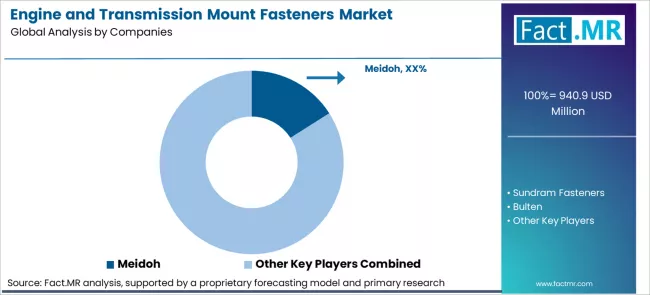
Engine And Transmission Mount Fasteners Market Analysis By Company | Source: Fact.MR
The engine and transmission mount fasteners market serves one of the most vibration-sensitive interfaces in a vehicle, where fasteners play a critical role in isolating noise, absorbing movement, and maintaining drivetrain alignment. These fasteners secure mounts that must manage engine torque, road shock, and thermal expansion without transmitting excessive vibration into the cabin. Competition centers on preload stability, fatigue resistance, and compatibility with elastomer-based mount designs used across internal combustion and hybrid powertrains.
Suppliers in this market focus on vibration-isolating bolts, elastomer-integrated fasteners, and high-load studs designed to work in harmony with rubber and hydraulic mount systems. Alloy steel dominates due to its ability to handle cyclic stress, supported by zinc-nickel coatings that protect against corrosion near the engine bay. OEMs prioritize fastener suppliers that can deliver consistent clamp force, tight dimensional control, and proven performance across engine mounts, transmission mounts, and torque strut assemblies.
Market players include Meidoh, Sundram Fasteners, Bulten, KAMAX, LISI Automotive, SFS Group, Fontana Gruppo, Chun Yu Group, and ITW Automotive, supplying vibration-damping bolts, elastomer-compatible fasteners, and structural studs for engine and transmission mounting systems. Meidoh and Sundram Fasteners maintain strong positions through close alignment with OEM and Tier 1 mount suppliers, while KAMAX, Bulten, and LISI Automotive support global vehicle platforms with fasteners engineered to balance load control and vibration isolation over long service life.
Key Players in the Engine and Transmission Mount Fasteners Market
- Meidoh
- Sundram Fasteners
- Bulten
- KAMAX
- LISI Automotive
- SFS Group
- Fontana Gruppo
- Chun Yu Group
- ITW Automotive
Bibliography
- International Organization for Standardization. 2023.Road vehicles powertrain mounting systems mechanical fastener performance vibration isolation and durability requirements ISO Technical Report. ISO.
- United Nations Economic Commission for Europe World Forum for Harmonization of Vehicle Regulations. 2024.Powertrain mounting and attachment performance requirements for vibration control and drivetrain stability in road vehicles UNECE vehicle regulations series. UNECE.
- National Highway Traffic Safety Administration. 2023.Engine and transmission mounting integrity vibration isolation and attachment performance under dynamic operating conditions. U.S. Department of Transportation.
- Society of Automotive Engineers International Standards Committee. 2024.Engine and transmission mount fastener design preload retention fatigue performance and noise vibration harshness control guidelines for road vehicles. SAE International.
- European Commission Directorate General for Mobility and Transport. 2023.Road vehicle powertrain noise vibration reduction and mounting system safety assessment including fastener performance requirements. European Commission.
Segmentation
Scope of the Report
| Items | Values |
|---|---|
| Quantitative Units 2026 | USD 940.9 Million |
| Fastener Type | Vibration-isolating bolts for powertrain mounts, Elastomer-integrated fasteners for damping control, High-load studs for engine and transmission mounting |
| Mount Type | Engine mounts, Transmission mounts, Torque strut mounts |
| Material or Coating | Alloy steel fasteners, Zinc-nickel coated steel fasteners, Stainless steel fasteners |
| Sales Channel | OEM direct supply for powertrain mounting systems, Tier 1 mount supplier integration, Aftermarket replacement fasteners |
| Regions Covered | North America, Europe, Asia Pacific, Latin America, Middle East & Africa |
| Countries Covered | India, China, Turkey, Thailand, Mexico, U.S., Germany, Japan |
| Key Companies Profiled | Meidoh, Sundram Fasteners, Bulten, KAMAX, LISI Automotive, SFS Group, Fontana Gruppo, Chun Yu Group, ITW Automotive |
| Additional Attributes | Dollar revenue by engine and transmission mount fastener type, mount type, material or coating, and sales channel; regional demand trends; vibration isolation and noise control requirements; powertrain load management considerations; durability under thermal cycling; OEM powertrain platform standardization initiatives |
Source: Fact.MR analysis. Updated Jan 23, 2026
Engine and Transmission Mount Fasteners Market by Segments
-
Fastener Type:
- Vibration-Isolating Bolts
- Elastomer-Integrated Fasteners
- High-Load Studs
- Other
-
Mount Type:
- Engine Mounts
- Transmission Mounts
- Torque Strut Mounts
- Other
-
Material or Coating:
- Alloy Steel
- Zinc-Nickel Coated Steel
- Stainless Steel
- Other
-
Sales Channel:
- OEM Direct
- Tier-1 Mount Suppliers
- Aftermarket
- Other
-
Region:
- North America
- U.S.
- Canada
- Mexico
- Europe
- Germany
- Italy
- UK
- France
- Spain
- Netherlands
- Switzerland
- Rest of Europe
- Asia Pacific
- Japan
- Australia
- South Korea
- China
- India
- Rest of Asia Pacific
- Latin America
- Brazil
- Argentina
- Rest of Latin America
- Middle East and Africa
- United Arab Emirates
- South Africa
- Rest of Middle East and Africa
- North America
Frequently Asked Questions
How big is the engine and transmission mount fasteners market in 2026?
What will be the size of engine and transmission mount fasteners market in 2036?
How much will be the engine and transmission mount fasteners market growth between 2026 and 2036?
What are the key product types in the engine and transmission mount fasteners market?
Which mount type segment to contribute significant share in the engine and transmission mount fasteners market in 2026?
Who worked on this report


Preview the report firsthand - request a free sample
Free SampleGet the brochure for pricing and purchase details
Download PDF