- Market Value (2025): USD 796.1 Mn
- Estimated Value (2026): USD 878.9 Mn
- Forecast Value (2036): USD 2363.9 Mn
- CAGR (2026-2036): 10.4%
What is the Tumor-Selective Immunotherapy Biologics Market forecast to be worth by 2036?
USD 878.9 million in 2026 to USD 2,363.9 million by 2036, at a 10.4% CAGR.
- The market entered 2026 at USD 878.9 million, up from USD 796.1 million in 2025, reflecting the fact that this is one of the few markets in this evidence set where a Commercialized product tier already exists alongside earlier-stage conditional-activity candidates.
- Demand is projected to increase from USD 878.9 million in 2026 to USD 2,363.9 million by 2036.
- The market is forecast to record a 10.4% CAGR from 2026 to 2036 as conditional activity based on proteases, pH, antigen combinations, or microenvironment signals extends from checkpoint inhibitors into cytokines and antibody-drug conjugates.
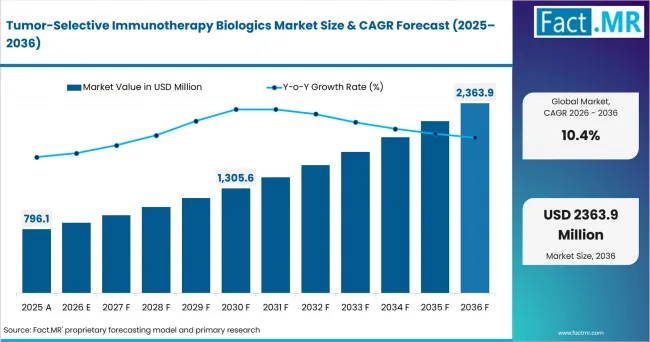
Tumor Selective Immunotherapy Biologics Market Value Analysis | Source: Fact.MR
What are the defining numbers behind Tumor-Selective Immunotherapy Biologics Market growth?
USD 1,485.0 million absolute opportunity is expected by 2036.
- Demand Drivers in the Market
- CytomX's Probody platform has already advanced beyond T-cell engagers into checkpoint biologics: CX-072, a protease-activated anti-PD-L1 Probody, was the first CytomX Probody studied in humans (PROCLAIM-CX-072, NCT03013491), and a pH-responsive conditionally active anti-CTLA-4 antibody published in PNAS matched a conventional anti-CTLA-4 analog's efficacy in nonhuman primates while markedly reducing toxicity when combined with an anti-PD-1 agent.
- Tumor-selective cytokine engineering has reached clinical stage: XTX202, a masked IL-2 agent unmasked specifically by tumor-associated matrix metalloproteases, is already in clinical development, while a PD-1-targeted, receptor-masked IL-2 immunocytokine published in Cell Reports Medicine selectively activates PD-1-positive tumor-reactive T cells to reduce the vascular-leak toxicity associated with conventional IL-2 therapy.
- A published patent application (WO2025049948A1) for VHH-masked IL-2 cytokines with explicit masking-efficiency and protease-release design criteria indicates multiple independent organizations are actively engineering this masked-cytokine sub-class in parallel, consistent with a genuinely contested, multi-platform market rather than a single-sponsor niche.
- Key Segments Analyzed
- By Biologic Type: Tumor-Activated Antibodies are expected to hold 25.0% share in 2026, supported by their ability to remain less active in healthy tissue and become functional within the tumor environment.
- By Cancer Type: Solid Tumors are projected to account for 45.0% share in 2026, reflecting the broad range of indications being studied with tumor-selective biologic therapies.
- By Mechanism of Action: Tumor Microenvironment Activation is anticipated to capture 25.0% share in 2026 as developers focus on treatment designs that respond to conditions found within tumors.
- By Development Stage: Commercialized products are estimated to represent 25.0% share in 2026, supported by established clinical use and wider treatment access.
- By End User: Hospitals are forecast to hold 30.0% share in 2026 through their role in diagnosis, treatment delivery, patient monitoring, and management of therapy-related risks.
- Analyst Opinion at Fact.MR
- Shambhu Nath Jha, Senior Analyst at Fact.MR, notes, that the commercial gap will widen between platforms that can show patient-level selectivity data, tumor tissue concentration versus healthy tissue exposure, for instance, and those that only offer a conditional-activation mechanism story. Licensing partners are increasingly asking for that patient-level evidence before committing to co-development, which shortens the runway for programs still relying solely on preclinical engineering claims.
- Strategic Implications
- Treat tumor-activated antibodies, bispecifics, T-cell engagers, cytokines, and antibody-drug conjugates as five distinct manufacturing and monitoring problems rather than one shared launch playbook, since a plan built for one design rarely transfers cleanly to another.
- Build a dedicated validation assay for each conditional-activity trigger, protease, pH, antigen combination, or microenvironment signal, rather than assuming preclinical engineering data will hold up unchanged in later trials.
- Generate independent, multi-site evidence separating tumor efficacy from normal-tissue toxicity before broad expansion; a therapeutic-index advantage measured at one specialist center does not automatically hold in a broader, less-selected population.
- Plan for heterogeneous antigen expression across solid tumors from the outset, since a meaningful subset of patients will likely need a different dosing or monitoring plan than the trial population did.
Germany is projected to record the fastest pace at a 14.0% CAGR from 2026 to 2036, supported by its university-hospital base. Brazil is estimated to post a 13.0% CAGR through its large, diverse patient population. The USA is anticipated to advance at a 12.0% CAGR through its trial-dense ecosystem. South Korea is forecast to record a 10.9% CAGR through precision-medicine infrastructure. The U.K. is projected at 9.9%, while Japan is estimated to post the slowest pace at an 8.8% CAGR through domestic manufacturing-consistency review requirements.
How does the Tumor-Selective Immunotherapy Biologics Market break down by segment?
Tumor-Activated Antibodies are expected to lead Biologic Type at 25.0%, and Solid Tumors are projected to lead Cancer Type at 45.0% share in 2026.
Why does Tumor-Activated Antibodies lead Biologic Type?
Tumor-Activated Antibodies lead the Biologic Type segment at 25.0% of 2026 demand.
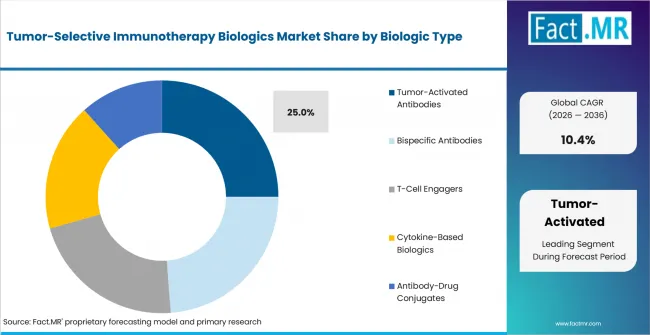
Tumor Selective Immunotherapy Biologics Market Analysis By Biologic Type | Source: Fact.MR
The biologic type categories are Tumor-Activated Antibodies, Bispecific Antibodies, T-Cell Engagers, Cytokine-Based Biologics, and Antibody-Drug Conjugates. Tumor-activated antibodies and cytokine-based biologics rely on conditional activation to stay inert until they reach the tumor, illustrated by CytomX's protease-activated PD-L1 Probody CX-072 and the receptor-masked ProIL2 cytokine prodrug published in Nature Communications, while T-cell engagers and antibody-drug conjugates instead depend on target-antigen specificity to achieve the same selectivity by a different route.
Why does Solid Tumors lead Cancer Type?
Solid Tumor leads the Cancer Type segment at 45.0% of 2026 demand.
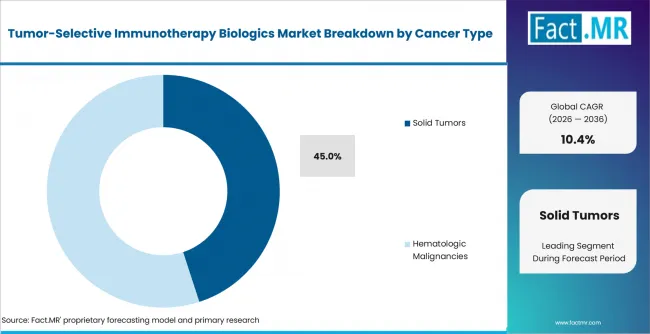
Tumor Selective Immunotherapy Biologics Market Analysis By Cancer Type | Source: Fact.MR
Cancer type coverage splits into Solid Tumors and Hematologic Malignancies. Selectivity engineering carries more weight in solid tumors, where healthy-tissue exposure is harder to avoid, than in hematologic disease, where target antigens tend to be more compartmentalized; the pH-responsive CAB anti-CTLA-4 platform specifically exploits the elevated tumor-microenvironment acidity characteristic of solid, glycolytic tumors.
Why does Tumor Microenvironment Activation lead Mechanism of Action?
Tumor Microenvironment Activation leads the Mechanism of Action segment at 25.0% of 2026 demand.
The mechanism of action categories are Tumor Microenvironment Activation, Immune Checkpoint Modulation, T-Cell Activation, Targeted Immune Cell Recruitment, and Conditional Immune Activation. Checkpoint modulation and T-cell activation are the most clinically established of the five, which is part of why newer conditional-activation mechanisms, such as matrix-metalloprotease-triggered cytokine unmasking, are still catching up on commercialization despite comparable preclinical promise.
Why does Commercialized lead Development Stage?
Commercialized leads the Development Stage segment at 25.0% of 2026 demand.
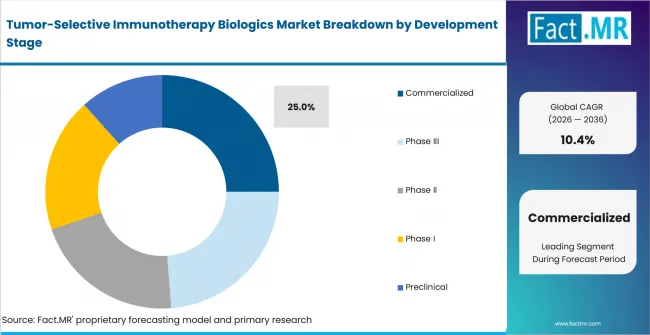
Tumor Selective Immunotherapy Biologics Market Analysis By Development Stage | Source: Fact.MR
The development stage categories are Commercialized, Phase III, Phase II, Phase I, and Preclinical. This is one of the few markets in this evidence set where Development Stage already shows a Commercialized leader; commercialized checkpoint and antibody-drug-conjugate products set the safety and efficacy bar that every earlier-stage conditional-activity candidate, including masked cytokines and pH-switch antibodies, is implicitly being measured against.
Why does Hospitals lead End User?
Hospital leads the End User segment at 30.0% of 2026 demand.
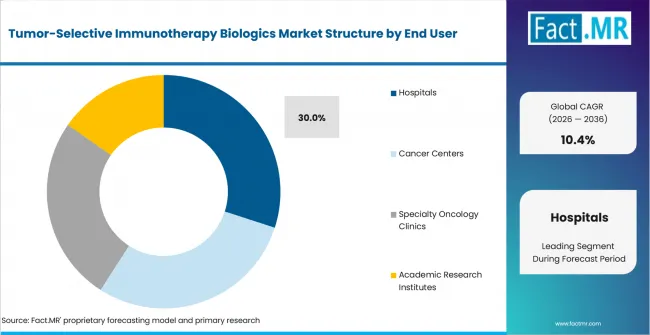
Tumor Selective Immunotherapy Biologics Market Analysis By End User | Source: Fact.MR
End users covered are Hospitals, Cancer Centers, Specialty Oncology Clinics, and Academic Research Institutes. Hospitals currently handle most of the specialist monitoring these biologics require, while academic groups such as UT Southwestern Medical Center, which published the ProIL2 masked-cytokine prodrug, are typically the ones generating the early therapeutic-index evidence that later commercial rollout depends on.
What is accelerating Tumor-Selective Immunotherapy Biologics Market adoption, and what is holding it back?
Tumor-selective design is now a widely understood standard, not a differentiator on its own. Funding increasingly follows developers who can show patient-level selectivity evidence, tumor tissue concentration relative to healthy-tissue exposure, for instance, for a specific biologic design, rather than a conditional-activation mechanism story alone.
Drivers Impact Analysis
| DRIVER | (~) % IMPACT ON CAGR | GEOGRAPHIC RELEVANCE | IMPACT TIMELINE |
|---|---|---|---|
| Tumor selectivity design standard | +1.6% | Germany and university-hospital markets | Medium term (2-4 years) |
| Solid tumor treatment demand | +1.3% | South Korea and solid-tumor referral centers | Long term (>=4 years) |
| Bispecific and T-cell engager expansion | +1.0% | U.K. and multinational biologics developers | Medium term (2-4 years) |
| Regulatory and evidentiary standard-setting | +0.8% | USA and FDA-aligned markets | Short term (<=2 years) |
| Specialist hospital infrastructure buildout | +0.6% | Germany and Japan | Long term (>=4 years) |
Source: Fact.MR analysis. Updated Jul 21, 2026
- Tumor selectivity design standard: Fact.MR's analyst view treats tumor selectivity as a central design standard, rewarding conditional binding and tumor-restricted payload release; Germany's university-hospital base gives these platforms an early testing ground.
- Solid tumor treatment demand: Solid Tumors lead the Cancer Type segment at 45.0% of 2026 demand, and conditional activation addresses antigen heterogeneity and microenvironment suppression, visible in South Korea's precision-medicine programs.
- Bispecific and T-cell engager expansion: Bispecific Antibodies and T-Cell Engagers sit alongside Tumor-Activated Antibodies in the core Biologic Type categories; the U.K.'s NHS purchasing is positioned to scale these at population level.
Opportunity Impact Analysis
| OPPORTUNITY | (~) % IMPACT ON CAGR | GEOGRAPHIC RELEVANCE | IMPACT TIMELINE |
|---|---|---|---|
| Biomarker-driven patient stratification | +0.7% | Germany and specialist referral networks | Medium term (2-4 years) |
| Antibody-drug conjugate combination regimens | +0.5% | USA and venture-backed developers | Medium term (2-4 years) |
| Public-private access expansion in Brazil | +0.4% | Brazil and mixed public-private systems | Long term (>=4 years) |
| Academic research institute translational partnerships | +0.3% | Japan and academic-clinical networks | Long term (>=4 years) |
Source: Fact.MR analysis. Updated Jul 21, 2026
- Biomarker-driven patient stratification: Biomarker-driven selection tied to credible clinical management gives Germany's specialist referral networks a route to widen the addressable patient pool.
- Antibody-drug conjugate combination regimens: Antibody-Drug Conjugates form one of five core Biologic Type categories, and the USA's venture-backed developers are best placed to advance combination regimens.
- Public-private access expansion in Brazil: Brazil's mixed public-private delivery system currently limits access and affordability; closing that gap converts a known constraint into incremental demand.
Restraints Impact Analysis
| RESTRAINT | (~) % IMPACT ON CAGR | GEOGRAPHIC RELEVANCE | IMPACT TIMELINE |
|---|---|---|---|
| Specialist monitoring and reimbursement gaps | -0.5% | Brazil and mixed public-private systems | Short term (<=2 years) |
| Tumor efficacy and normal-tissue toxicity separation | -0.4% | USA and multi-site trial networks | Medium term (2-4 years) |
| Solid-tumor antigen heterogeneity and microenvironment suppression | -0.3% | South Korea and solid-tumor centers | Long term (>=4 years) |
| Manufacturing consistency and potency assay burden | -0.2% | Japan and regulated manufacturing markets | Short term (<=2 years) |
Source: Fact.MR analysis. Updated Jul 21, 2026
- Specialist monitoring and reimbursement gaps: The central adoption barrier is an incomplete pathway around specialist-center monitoring, reimbursement, and evidence of benefit after complex treatment sequences.
- Tumor efficacy and normal-tissue toxicity separation: Broad expansion requires independent multi-site evidence separating tumor efficacy from normal-tissue toxicity, a bar the USA's trial base is best placed to clear first.
- Solid-tumor antigen heterogeneity and microenvironment suppression: Solid tumors, the leading Cancer Type category at 45.0%, carry heterogeneity requiring price exceptions and long-term monitoring, worked through in South Korea.
Which countries are scaling Tumor-Selective Immunotherapy Biologics Market fastest?
A global growth rate represents the weighted average of all markets included in the analysis. Germany and Brazil remain above the 10.4% global figure, while South Korea, U.K. and Japan remain below it. The six countries presented are illustrative examples, and their comparison with the worldwide rate makes this difference visible.
| COUNTRY | CAGR 2026 to 2036 |
|---|---|
| Germany | 14.0% |
| Brazil | 13.0% |
| USA | 12.0% |
| South Korea | 10.9% |
| U.K. | 9.9% |
| Japan | 8.8% |
Source: Fact.MR analysis. Updated Jul 21, 2026
What shapes growth in Germany?
Germany: tumor-activated antibodies, bispecifics, T-cell engagers, cytokines, and antibody-drug conjugates as distinct biologic designs.
Germany is projected at 14.0% CAGR from 2026 to 2036, the fastest of the six countries tracked. Its university-hospital and laboratory base, aligned EU regulation, and specialist referral networks make it a strong early testing ground for tumor-activated antibodies, bispecifics, T-cell engagers, cytokines, and antibody-drug conjugates alike, though not every biologic design is expected to move at the same pace.
What shapes growth in Brazil?
Brazil: conditional activity based on proteases, pH, antigen combinations, or microenvironment signals.
Brazil is projected at 13.0% CAGR from 2026 to 2036. A large, diverse patient population gives Brazil real scale, but its mixed public-private delivery system means affordability and regional laboratory capacity, not the underlying conditional-activation science, will decide how quickly these biologics reach patients outside major centers.
What shapes growth in USA?
USA: separation between tumor efficacy and normal-tissue immune toxicity.
USA is projected at 12.0% CAGR from 2026 to 2036. Its dense concentration of clinical trials, specialised cancer centers, and venture-backed developers supports faster generation of the tumor-efficacy-versus-normal-tissue-toxicity evidence that separates a genuinely selective biologic from a merely potent one.
What shapes growth in South Korea?
South Korea: solid-tumor antigen heterogeneity and microenvironment suppression.
South Korea is projected at 10.9% CAGR from 2026 to 2036. Advanced digital infrastructure and active precision-medicine programs give South Korea an edge in characterizing solid-tumor antigen heterogeneity and microenvironment suppression, the evidence this market's largest cancer-type segment depends on.
What shapes growth in U.K.?
U.K.: immune-checkpoint modulation, targeted recruitment, and local cytokine exposure.
U.K. is projected at 9.9% CAGR from 2026 to 2036. Centralized NHS purchasing and genomic laboratory networks let the United Kingdom coordinate rollout of immune-checkpoint modulation, targeted recruitment, and local cytokine-exposure approaches at population level, rather than relying on individual hospitals to adopt independently.
What shapes growth in Japan?
Japan: manufacturing consistency, potency assays, stability, and immunogenicity.
Japan is projected at 8.8% CAGR from 2026 to 2036, the slowest of the six. Japan's specialist medicine and life-science base are strong, but new biologics here typically need to clear manufacturing-consistency, potency-assay, and immunogenicity review domestically before hospital pathways integrate them.
Who leads the Tumor-Selective Immunotherapy Biologics Market?
This market is led by large oncology biologics developers with established checkpoint and bispecific franchises, alongside smaller biotechs built specifically around conditional-activation platforms. Roche, Merck, Bristol Myers Squibb, and AstraZeneca bring commercialized checkpoint-inhibitor and antibody-drug-conjugate infrastructure, while Genmab and Amgen contribute established bispecific antibody platforms. CytomX Therapeutics' Probody chemistry, already validated in a clinical-stage PD-L1 checkpoint biologic (CX-072) and a preclinical pH-switch CTLA-4 platform, together with Janux Therapeutics, BioNTech, and Xencor's specialist conditional-activation and cytokine-engineering work, represent the platform-focused tier of this market.
Which companies are the key providers?
Ten developers are tracked in this market, spanning established large-cap biologics franchises and specialist conditional-activation platform companies:
- Roche Holding AG
- Merck & Co., Inc.
- Bristol Myers Squibb Company
- AstraZeneca PLC
- Genmab A/S
- Amgen Inc.
- CytomX Therapeutics, Inc.
- Janux Therapeutics, Inc.
- BioNTech SE
- Xencor, Inc.
Bibliography
- Ramagopal, U. A. et al. Generating tumor-selective conditionally active biologic anti-CTLA4 antibodies via protein-associated chemical switches. PNAS, 2021.
- Conditionally activated affibody-based prodrug targeting EGFR demonstrates improved tumor selectivity. ScienceDirect, 2023.
- Clinical Trials.gov protocol NCT03013491 — PROCLAIM-CX-072, a Phase 1 study of the Probody therapeutic CX-072 in solid tumors and lymphomas.
- Hsu, E. J. et al. A cytokine receptor-masked IL2 prodrug selectively activates tumor-infiltrating lymphocytes for potent antitumor therapy. Nature Communications, 2021.
- A PD-1-targeted, receptor-masked IL-2 immunocytokine that engages IL-2Rα strengthens T cell-mediated anti-tumor therapies. Cell Reports Medicine, 2024.
- Next-generation cytokines for cancer immunotherapy. Antibody Therapeutics (Oxford Academic), 2021.
- WO2025049948A1 — Masked IL-2 cytokines and methods of use thereof. Google Patents.
- A New Generation of Cytokine-Based Immunotherapy Takes Shape. OncLive (clinical-stage status reference for XTX202).
- A Probody T Cell-Engaging Bispecific Antibody Targeting EGFR and CD3 Inhibits Colon Cancer Growth with Limited Toxicity. Cancer Research (AACR), 2022.
This Report Addresses
- The report provides strategic intelligence on the Tumor-Selective Immunotherapy Biologics Market across Biologic Type and Cancer Type choices that shape development decisions.
- Segment analysis covers Tumor-Activated Antibodies as the share leader within the 2026 market structure.
- Regional outlook evaluates Germany and Brazil alongside USA and South Korea, while U.K. and Japan complete the growth comparison.
- Competitive analysis profiles Roche and Merck alongside CytomX Therapeutics and Genmab, followed by additional active providers.
- Use-case assessment covers the conditional-activation mechanisms that shape tumor-selective biologics demand across the forecast period.
What does the Tumor-Selective Immunotherapy Biologics Market cover?
Immunotherapy biologics engineered for conditional, tumor-restricted activation across checkpoint inhibitors, bispecifics, T-cell engagers, cytokines, and antibody-drug conjugates.
The Tumor-Selective Immunotherapy Biologics Market covers tumor-activated antibodies, bispecific antibodies, T-cell engagers, cytokine-based biologics, and antibody-drug conjugates engineered to remain inert in circulation and activate specifically within the tumor microenvironment through protease cleavage, pH-responsive chemical switches, antigen-combination logic gates, or receptor-masking chemistry. Coverage spans both commercialized checkpoint/ADC products and earlier-stage conditionally active cytokine and antibody platforms.
The market differs from the Next-Generation Masked T-Cell Engager Therapeutics Market because it spans the full breadth of conditional-activation biologic modalities, checkpoint inhibitors and cytokines in addition to CD3-engaging bispecifics, rather than CD3-masking constructs specifically. Constitutively active, non-conditional immunotherapy biologics and general oncology supportive-care products remain outside the boundary.
What is included in the scope?
Included are the biologic modalities, cancer types, and activation mechanisms that define this tumor-selectivity category.
The scope includes Biologic Type, Cancer Type, Mechanism of Action, Development Stage, and End User, the recorded country growth estimates, the company set where available, recent non-commercial evidence on protease-, pH-, and receptor-based conditional-activation chemistry, regulatory and patent filings, and long-term development considerations such as manufacturing consistency and potency-assay validation.
What is excluded from the scope?
Constitutively active immunotherapy biologics and unrelated supportive-care products remain outside the scope of this market.
Excluded are constitutively active, non-conditional checkpoint inhibitors, antibodies, and cytokines already marketed without a tumor-selectivity mechanism, general oncology supportive-care products, cellular therapies covered under separate market definitions, and claims that cannot be tied to a current named academic, clinical, or patent source.
How Was the Analysis Built?
The analysis draws on peer-reviewed immunology literature, clinical-trial protocol documentation, and patent filings.
- Primary evidence base: peer-reviewed conditional-activation studies from PNAS, Nature Communications, and Cell Reports Medicine, cross-checked against ClinicalTrials.gov protocol filings and published patent applications.
- Desk research: FDA and international regulatory filings for checkpoint and antibody-drug-conjugate approvals. Every source used is documented in the bibliography.
- Market sizing and forecasting: estimates combine segment taxonomy, country-level growth indicators, and development-stage mix across the 2025, 2026 and 2036 reference years.
- Data validation and update cycle: findings are validated by comparing primary academic literature with clinical-trial registry updates, regulatory developments, and patent-filing activity.
Segmentation
What is the report's scope and coverage?
| Attribute | Details |
|---|---|
| 2025 Market Size | USD 796.1 million |
| 2026 Market Size | USD 878.9 million |
| 2036 Market Size | USD 2,363.9 million |
| Forecast CAGR | 10.4% |
| Forecast Period | 2026-2036 |
| Segmentation | Biologic Type, Cancer Type, Mechanism of Action, Development Stage, End User |
| Countries Analyzed | Germany, Brazil, USA, South Korea, U.K., Japan + 30 countries |
| Company Coverage | Roche Holding AG, Merck & Co., Inc., Bristol Myers Squibb Company, AstraZeneca PLC, Genmab A/S, Amgen Inc., CytomX Therapeutics, Inc., Janux Therapeutics, Inc., BioNTech SE, Xencor, Inc. |
Source: Fact.MR analysis. Updated Jul 21, 2026
How is the market segmented?
-
By Biologic Type:
- Tumor-Activated Antibodies - 25.0% in 2026
- Bispecific Antibodies
- T-Cell Engagers
- Cytokine-Based Biologics
- Antibody-Drug Conjugates
-
By Cancer Type:
- Solid Tumors - 45.0% in 2026
- Hematologic Malignancies
-
By Mechanism of Action:
- Tumor Microenvironment Activation - 25.0% in 2026
- Immune Checkpoint Modulation
- T-Cell Activation
- Targeted Immune Cell Recruitment
- Conditional Immune Activation
-
By Development Stage:
- Commercialized - 25.0% in 2026
- Phase III
- Phase II
- Phase I
- Preclinical
-
By End User:
- Hospitals - 30.0% in 2026
- Cancer Centers
- Specialty Oncology Clinics
- Academic Research Institutes
-
By Region:
- North America
- Latin America
- Western Europe
- Eastern Europe
- East Asia
- South Asia and Pacific
- Middle East and Africa
Frequently Asked Questions
What exactly is included in the Tumor-Selective Immunotherapy Biologics Market?
What is the 2026 market size and 2036 outlook?
Why does Tumor-Activated Antibodies lead Biologic Type?
What would cause a developer to prioritize Solid Tumors over Hematologic Malignancies?
What is the central adoption barrier?
Why is Germany the fastest-growing country in this set?
How should evidence be shown to transfer beyond one research site?
Who worked on this report


Preview the report firsthand - request a free sample
Free SampleGet the brochure for pricing and purchase details
Download PDF