- Market Value (2025): USD 230.2 Mn
- Estimated Value (2026): USD 240.8 Mn
- Forecast Value (2036): USD 376.8 Mn
- CAGR (2026-2036): 4.6%
What is the Turbidity Barriers Market forecast to be worth by 2036?
USD 240.8 million in 2026 to USD 376.8 million by 2036, at a 4.6% CAGR.
- According to Fact.MR analysis, the turbidity barriers market was valued at USD 230.2 million in 2025.
- Demand will increase from USD 240.8 million in 2026 to USD 376.8 million by 2036.
- The market is forecast to grow at a 4.6% CAGR from 2026 to 2036, shaped by coastal construction and dredging work.
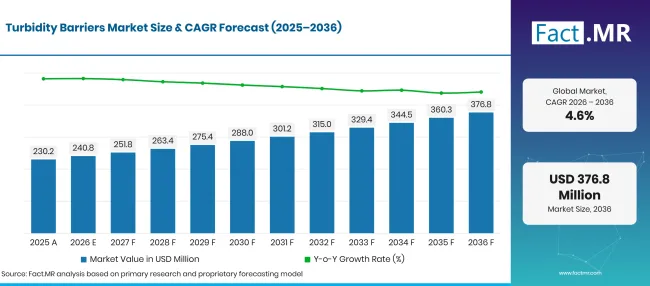
Factmr Turbidity Barriers Market Forecast Global | Source: Fact.MR
| Year | Basis | Market Value (USD million) |
|---|---|---|
| 2026 | Estimate | 240.8 |
| 2036 | Forecast | 376.8 |
| CAGR 2026 to 2036 | Forecast period | 4.6% |
Source: Fact.MR analysis. Updated Oct 19, 2026
What are the defining numbers behind Turbidity Barriers Market growth?
As per Fact.MR analysis, the absolute opportunity is USD 136.0 million between 2026 and 2036, with silt curtains and construction applications forming the main purchasing base.
- Demand Drivers in the Market
- Marine construction contractors need temporary curtains around disturbed sediments while managing tides and boat movements. Deployment plans influence fabric selection and the number of anchoring points.
- Dredging teams commonly specify suspended-sediment controls when permits or site conditions require limiting the movement of disturbed material beyond the work zone.
- Shoreline engineers use temporary barriers where bank repairs or piling work create a risk of sediment escaping into adjacent water.
- Site managers compare curtain prices with the labor needed to install, move and inspect them during a project. These operating costs can matter as much as the fabric itself.
- Key Segments Analyzed
- by Product Type: Silt Curtains account for 38.5% share in 2026, reflecting marine sediment-control installations.
- by Material: PVC represents 42.8% share in 2026 because coated curtain fabric is widely specified for wet-site use.
- by Application: Construction holds 38.2% share in 2026, covering shoreline and in-water building work.
- by End-User: Construction leads with 38.2% share in 2026 as contractors arrange temporary site protection.
- Analyst Opinion at Fact.MR
- Shambhu Nath Jha, Principal Consultant at Fact.MR, states “A turbidity curtain must match the water conditions at the site, but the material is only one part of the choice. Contractors also need suitable anchors, easy site access, and dependable installation support. Reusable fittings can offer good value when the same equipment is used across projects.”
- Strategic Implications
- Barrier manufacturers should provide drawings that show suitable current conditions and skirt depth so marine crews can compare models before ordering.
- Dredging contractors should assess deployment access and routine inspection needs when calculating the full operating cost of a silt curtain.
- Distributors can reduce site delays by stocking repair panels and fittings used with common curtain configurations.
- Port engineers should match sediment-control measures to permit requirements and actual work-zone conditions before finalizing a barrier specification.
Germany leads with 5.8% CAGR, supported by maintenance around busy waterways. The United Kingdom follows at 5.2%, while Japan is forecast at 4.8% as coastal work continues. Brazil records 3.6%, ahead of the United States at 3.3%.
How does the Turbidity Barriers Market break down by segment?
Silt Curtains holds 38.5% share in 2026, while PVC leads with 42.8% share.
Which Product Type dominates?
Silt Curtains hold 38.5% share in 2026.
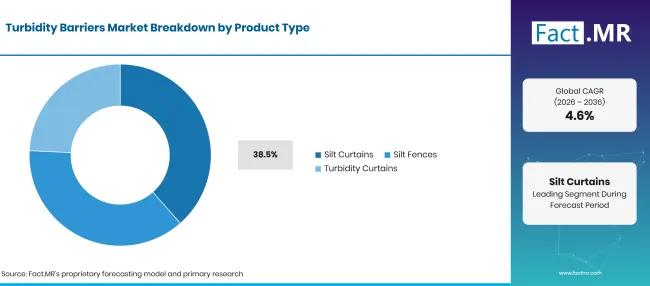
Factmr Turbidity Barriers Market Breakdown Product Type | Source: Fact.MR
| Product Type | Share (2026) |
|---|---|
| Silt Curtains (Leading segment) | 38.5% |
| Other segments combined | 61.5% |
| Total | 100.0% |
Source: Fact.MR analysis. Updated Oct 19, 2026
Silt curtains use floating sections and weighted fabric to limit the movement of suspended sediment near dredging or construction work. Their length and depth can be adjusted to suit the work zone. Silt fences serve a different purpose by filtering runoff along land-based construction areas. Turbidity curtains are another name commonly used for floating silt curtains, so product descriptions need to distinguish design differences from alternative labels.
What leads the Material segment?
PVC accounts for 42.8% share in 2026.
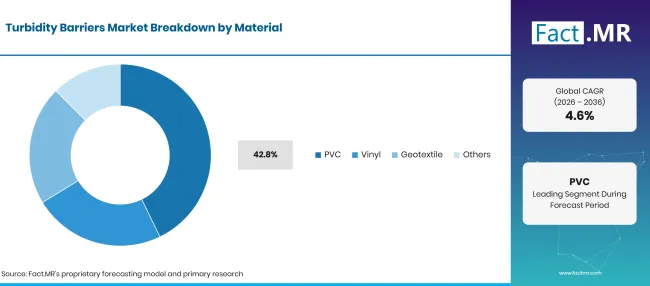
Factmr Turbidity Barriers Market Breakdown Material | Source: Fact.MR
| Material | Share (2026) |
|---|---|
| PVC (Leading segment) | 42.8% |
| Other segments combined | 57.2% |
| Total | 100.0% |
Source: Fact.MR analysis. Updated Oct 19, 2026
PVC lead the material segment with 42.8% share in 2026. Contractors use PVC-coated fabric where lifting, wet conditions and repeated handling place stress on seams. They compare the coating and ease of handling with alternatives such as geotextiles. The right choice depends on currents, exposure and how often the curtain will be moved.
Which Application accounts for the largest share?
Construction holds 38.2% share in 2026.
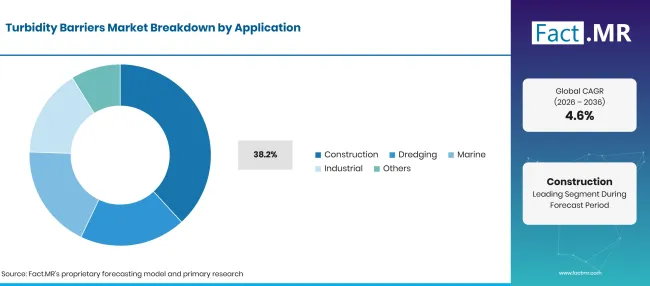
Factmr Turbidity Barriers Market Breakdown Application | Source: Fact.MR
| Application | Share (2026) |
|---|---|
| Construction (Leading segment) | 38.2% |
| Other segments combined | 61.8% |
| Total | 100.0% |
Source: Fact.MR analysis. Updated Oct 19, 2026
Construction leading the application segment. Work near bridge foundations and waterfront structures can release fine sediment into the surrounding water. Dredging projects often require curtains positioned around excavation areas or sediment placement sites. Marine applications include port repairs and protected shoreline work. Industrial applications depend on the type of activity and the water-quality conditions covered by the site plan.
How does End-User purchasing shape sales?
Construction leads with 38.2% share in 2026.
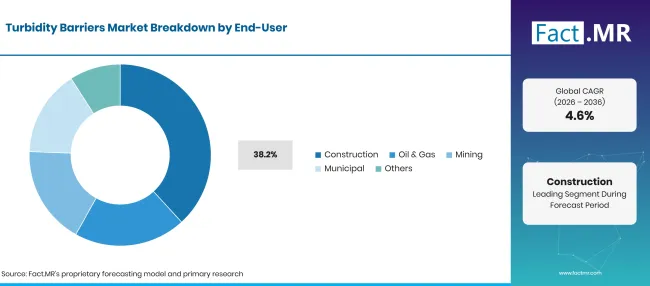
Factmr Turbidity Barriers Market Breakdown End User | Source: Fact.MR
| End-User | Share (2026) |
|---|---|
| Construction (Leading segment) | 38.2% |
| Other segments combined | 61.8% |
| Total | 100.0% |
Source: Fact.MR analysis. Updated Oct 19, 2026
Construction holds 38.2% share in 2026. They purchase curtains for individual projects and compare the installation plan against the expected period of use. Oil and gas operators can use temporary sediment controls during relevant waterfront works. Mining and municipal operators have separate needs at water-facing project sites. Buyers assess access for routine inspection alongside the cost of moving panels when a project changes location.
What is accelerating Turbidity Barriers Market adoption, and what is holding it back?
Temporary sediment containment supports sales around marine works, but water conditions and installation expenses determine which barriers contractors can use.
Drivers Impact Analysis
| DRIVER | (~) % IMPACT ON CAGR | GEOGRAPHIC RELEVANCE | IMPACT TIMELINE |
|---|---|---|---|
| Coastal construction | +1.0% | Global | Medium term (2–4 years) |
| Dredging work | +0.8% | Ports and rivers | Short term (<= 2 years) |
| Water-quality controls | +0.7% | Global | Medium term (2–4 years) |
| Barrier design options | +0.5% | Global | Medium term (2–4 years) |
| Repair and reuse | +0.4% | Global | Long term (>= 4 years) |
Source: Fact.MR analysis. Updated Oct 19, 2026
Opportunity Impact Analysis
| OPPORTUNITY | (~) % IMPACT ON CAGR | GEOGRAPHIC RELEVANCE | IMPACT TIMELINE |
|---|---|---|---|
| Modular panels | +0.8% | Global | Medium term (2–4 years) |
| Inland waterways | +0.6% | Europe and Americas | Medium term (2–4 years) |
| Monitoring services | +0.5% | Coastal sites | Long term (>= 4 years) |
| Reusable floats | +0.4% | Global | Medium term (2–4 years) |
Source: Fact.MR analysis. Updated Oct 19, 2026
Restraints Impact Analysis
| RESTRAINT | (~) % IMPACT ON CAGR | GEOGRAPHIC RELEVANCE | IMPACT TIMELINE |
|---|---|---|---|
| High currents | -0.8% | Exposed waters | Short term (<= 2 years) |
| Installation expense | -0.6% | Global | Medium term (2–4 years) |
| Curtain damage | -0.5% | Global | Medium term (2–4 years) |
| Permit variation | -0.4% | Global | Long term (>= 4 years) |
Source: Fact.MR analysis. Updated Oct 19, 2026
Which countries are scaling the Turbidity Barriers Market through 2036?
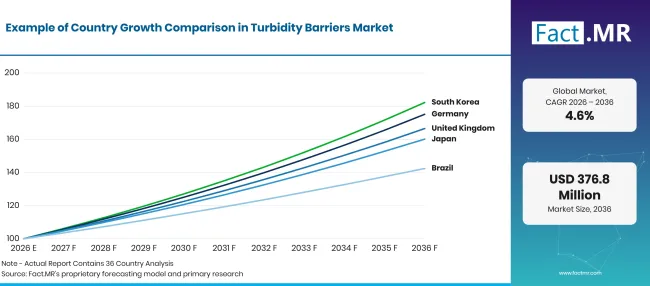
Factmr Turbidity Barriers Market Growth Index | Source: Fact.MR
| Country | CAGR (2026–2036) |
|---|---|
| Germany | 5.8% |
| United Kingdom | 5.2% |
| Japan | 4.8% |
| Brazil | 3.6% |
| United States | 3.3% |
Source: Fact.MR analysis. Updated Oct 19, 2026
Why is Germany expanding turbidity barrier use around ports and waterways?
5.8% CAGR through 2036, supported by harbor works and sediment-control requirements.
German seaports handled 284.4 million tonnes of cargo in 2025, according to Destatis in March 2026 [6]. Marine contractors working near busy terminals check curtain depth and anchor positions before starting berth repairs or channel maintenance. Germany’s Waterways and Shipping Administration manages federal channels, where dredging needs careful planning around suspended sediment. The Federal Maritime and Hydrographic Agency also considers nearby water conditions when reviewing project plans.
How is the United Kingdom shaping demand for turbidity barriers?
5.2% CAGR through 2036, linked to coastal maintenance and controlled marine works.
The United Kingdom had 51 major ports in 2025, the Department for Transport reported in July 2026 [2]. Maintenance around busy harbors requires contractors to plan sediment control while keeping navigation safe. In June 2026, the Environment Agency announced that around 300,000 cubic meters of sand would be placed on Lincolnshire beaches [4]. This beach-replenishment work shows how much sediment can move along the coast. The right turbidity curtain still depends on each project’s location and working conditions.
What supports Japan’s turbidity barrier outlook?
4.8% CAGR through 2036, influenced by harbor improvements and coastal worksite controls.
Japan’s Ministry of Land, Infrastructure, Transport and Tourism announced a port-facility program of about JPY 76.2 billion in July 2026 for selected harbor works [5]. Contractors working along the coast are considering floating barriers near quays and breakwaters. Port managers need to keep ships moving while stopping disturbed sediment from spreading.
How is Brazil developing turbidity barrier use for dredging?
3.6% CAGR through 2036, shaped by channel-deepening and waterway maintenance.
Brazilian dredging and port projects create regular settings for temporary sediment-control barriers. Inland works need curtain layouts that can handle changing water levels and vessel movement, while local installation support and access to replacement parts help contractors manage projects in harder-to-reach locations.
What shapes turbidity barrier purchases in the United States?
3.3% CAGR through 2036, influenced by dredging plans and waterway protection.
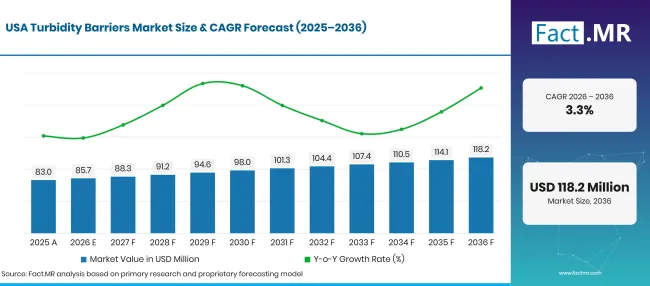
Factmr Turbidity Barriers Market Forecast Usa | Source: Fact.MR
The U.S. Maritime Administration announced USD 774 million in port project awards in April 2026 [3]. These waterfront improvements give marine contractors places to assess sediment-control equipment. In September 2026, the U.S. Army Corps of Engineers reported about 190,000 cubic yards of dredged material at Buffalo Harbor [1]. Dredging plans and permit rules guide contractors in choosing curtain depths and floating setups. Suppliers that offer different skirt designs can meet more sheltered harbor conditions.
Who leads the Turbidity Barriers Market?
Elastec and Ecocoast offer floating sediment-control curtains, alongside specialist suppliers serving project-specific requirements.
Elastec sells turbidity curtains through its American Marine range for dredging, marine construction, and other sediment-control work. Ecocoast offers Ecobarrier silt curtains along with help with engineering, sizing, and installation. Fact.MR notes that suppliers compete on how well their curtains suit each site’s water depth, current, waves, and anchoring needs.
Enviro-USA™ (formerly GEI Works) and ABASCO also make turbidity and sediment-control curtains for dredging, construction, and shoreline projects. Their product designs and coverage differ by supplier. Fact.MR says contractors may weigh availability, installation help, spare parts, and overall fit for the job, not just price. A company’s size alone does not mean its curtain will perform better at a particular site.
Which companies are the key providers?
Key companies include Enviro-USA™ (formerly GEI Works); Elastec; ABASCO LLC; ACME Environmental; Ecocoast; Layfield Group; Cunningham Covers.
- Enviro-USA™ (formerly GEI Works)
- Elastec
- ABASCO LLC
- ACME Environmental
- Ecocoast
- Layfield Group
- Cunningham Covers
Bibliography
- [1] U.S. Army Corps of Engineers. (2026, September 2). Buffalo dredging completed before Labor Day weekend.
- [2] Department for Transport. (2026, July 29). Port freight annual statistics: 2025.
- [3] Maritime Administration. (2026, April 28). Trump’s Transportation Secretary Sean P. Duffy invests nearly $800 million into American ports to strengthen supply chains.
- [4] Environment Agency. (2026, June 8). Vital annual beach work reduces flood risk on Lincolnshire coast. GOV.UK.
- [5] Ministry of Land, Infrastructure, Transport and Tourism. (2026, July 24). 令和8年度 特定港湾施設整備事業基本計画を閣議決定 [FY2026 Basic Plan for Specified Port Facility Development approved by Cabinet].
- [6] Statistisches Bundesamt (Destatis). (2026, March 10). Seeverkehr 2025: Güterumschlag steigt um 3,8 % gegenüber dem Vorjahr.
This Report Answers
- The study explains how marine contractors select silt curtains for water depth and expected current exposure.
- Material analysis compares PVC fabric with vinyl and geotextile arrangements used for site protection.
- Construction and dredging applications are assessed according to the type of sediment disturbance involved.
- The country comparison covers Germany, Brazil, the United States, the United Kingdom and Japan.
- Competitive discussion separates specialist floating-curtain suppliers from wider erosion-control product businesses.
What does the Turbidity Barriers Market cover?
The market covers temporary sediment-control products used during construction and dredging. Floating silt curtains operate in water, whereas silt fences are normally installed on land to slow sediment runoff. Related Fact.MR analysis of geotextile materials addresses the wider fabric category.
What is included in the scope?
Included products comprise floating curtains with buoyancy and ballast as well as relevant temporary silt fencing for land runoff. Applications cover active worksites where the installer aims to reduce movement of disturbed particles beyond the project area. The analysis considers product supply and associated fittings within the defined market boundary.
What is excluded from the scope?
The scope excludes permanent harbor walls and unrelated oil-spill containment booms sold only for hydrocarbon recovery. General dredging services and water-quality testing contracts are also outside product revenue unless sold as part of the defined barrier system.
How Was the Analysis Built?
The analysis draws on 120+ sources, 35+ company portfolios, 25+ countries, and more than 20 industry interviews.
- Primary Research: Primary research includes discussions with manufacturers, service providers, technology developers, distributors, end users, and subject-matter experts. These conversations examine purchasing priorities, product adoption, operational challenges, approval requirements, competitive positioning, and the factors that influence wider market acceptance.
- Desk Research: Desk research covers government statistics, regulatory publications, company filings, trade data, technical studies, industry associations, standards, public policy, and other authoritative sources. Every source used in the analysis is documented in the bibliography.
- Market Sizing and Forecasting: Market estimates combine historical performance, demand indicators, pricing and volume trends, segment shares, company participation, country-level growth, adoption patterns, investment activity, and barriers to market expansion.
- Data Validation and Update Cycle: Findings are validated by comparing primary interviews with public data, company activity, regulatory changes, trade patterns, and industry developments. Regular updates review new product launches, capacity changes, partnerships, approvals, and shifts in commercial adoption.
Segmentation
What is the report’s scope and coverage?
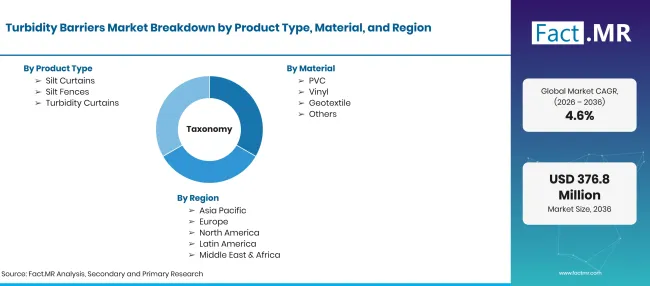
Factmr Turbidity Barriers Market Taxonomy | Source: Fact.MR
| Attribute | Details |
|---|---|
| Quantitative Units | USD million in 2026 to USD million by 2036 at CAGR |
| Market Definition | Temporary floating or land-based systems intended to restrict movement of suspended sediment or soil runoff. |
| Product Type | Silt Curtains; Silt Fences; Turbidity Curtains |
| Material | PVC; Vinyl; Geotextile; Others |
| Application | Construction; Dredging; Marine; Industrial; Others |
| End-User | Construction; Oil & Gas; Mining; Municipal; Others |
| Regions Covered | North America; Latin America; Western Europe; Eastern Europe; East Asia; South Asia & Pacific; Middle East & Africa |
| Countries Covered | Germany; Brazil; United States; United Kingdom; Japan |
| Companies Profiled | Enviro-USA™ (formerly GEI Works); Elastec; ABASCO LLC; ACME Environmental; Ecocoast; Layfield Group; Cunningham Covers |
| Forecast Period | 2026 to 2036 |
| Approach | Application analysis and review of official project records and product descriptions |
Source: Fact.MR analysis. Updated Oct 19, 2026
How is the market segmented?
-
By Product Type
- Silt Curtains
- Silt Fences
- Turbidity Curtains
-
By Material
- PVC
- Vinyl
- Geotextile
- Others
-
By Application
- Construction
- Dredging
- Marine
- Industrial
- Others
-
By End-User
- Construction
- Oil & Gas
- Mining
- Municipal
- Others
-
By Region
- North America
- Latin America
- Western Europe
- Eastern Europe
- East Asia
- South Asia & Pacific
- Middle East & Africa
Frequently Asked Questions
How big is the turbidity barriers market in 2026?
What is its 2036 forecast value?
What is the CAGR from 2026 to 2036?
Which material is most widely represented?
Who are the main companies in the turbidity barriers market?
Who worked on this report


Preview the report firsthand - request a free sample
Free SampleGet the brochure for pricing and purchase details
Download PDF