- Base Value(2026): 420.0 Mn
- Estimated Value(2026): 420.0 Mn
- Forecast Value (2036): 980.0 Mn
- CAGR (2026 - 2036): 8.8%
Multi-Sensor Barrier Packs Market Forecast and Outlook 2026 to 2036
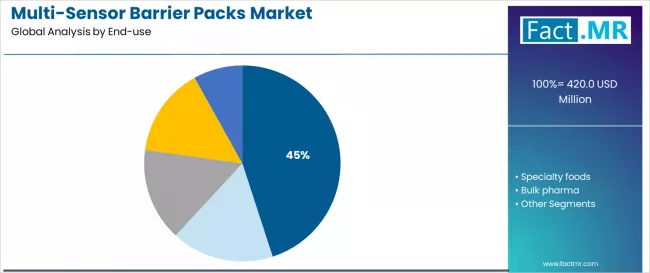
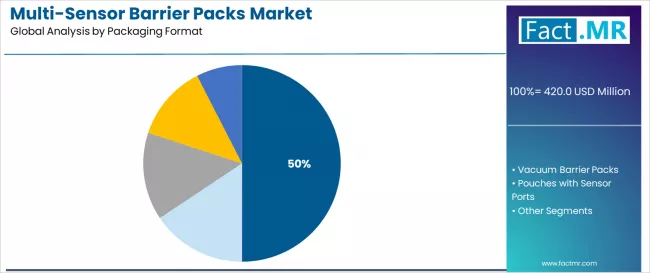
The global multi-sensor barrier packs market is valued at USD 420.0 million in 2026 and is set to reach USD 980.0 million by 2036, recording a compound annual growth rate (CAGR) of 8.8% between 2026 and 2036. In 2026, the high-value food & pharma application segment is projected to hold a 45% share, while rigid barrier pouches/packs account for 50% by packaging format.
Key Takeaways from the Multi-Sensor Barrier Packs Market Report
- Market Value of the Multi-Sensor Barrier Packs Market (2026): USD 420.0 Million
- Market Forecast Value of the Multi-Sensor Barrier Packs Market (2036): USD 980.0 Million
- Forecast CAGR of the Multi-Sensor Barrier Packs Market (2026-2036): 8.8%
- Leading Application Segment of the Multi-Sensor Barrier Packs Market: High-value Food & Pharma (45%)
- Leading Packaging Format of the Multi-Sensor Barrier Packs Market: Rigid Barrier Pouches / Packs (50%)
- Key Growth Regions of the Multi-Sensor Barrier Packs Market: North America, Europe, Asia Pacific, Latin America, MEA
- Key Players in the Multi-Sensor Barrier Packs Market: Sealed Air Corporation, Mondi plc., Amcor plc., UFlex, Klabin, Toray Industries Inc.
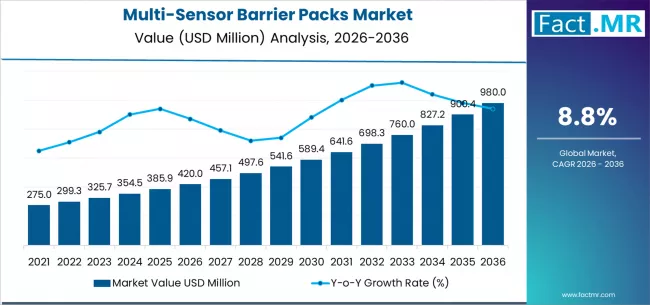
Multi Sensor Barrier Packs Market Market Value Analysis | Source: Fact.MR
Market expansion is driven by the critical need for absolute integrity assurance in sensitive supply chains. These advanced packs combine robust barrier materials with embedded sensor technology, providing real-time monitoring of oxygen exposure, temperature history, and humidity. This dual physical-digital protection is essential for products where even minor environmental breaches can compromise efficacy, safety, and value, such as biologics, premium coffee, and nutraceuticals.
Growth throughout the forecast period will be shaped by the convergence of material science and smart systems. Innovations in co-extruded and high-temperature laminates enhance passive barrier performance, while advancements in printed electronics and miniaturized sensors enable more affordable, seamless active monitoring integration. This evolution supports a shift towards predictive logistics, where sensor data triggers automatic replenishment or conditional alerts before product quality degrades.
Multi-Sensor Barrier Packs Market Key Takeaways
| Metric | Value |
|---|---|
| Estimated Value in (2026E) | USD 420.0 Million |
| Forecast Value in (2036F) | USD 980.0 Million |
| Forecast CAGR (2026 to 2036) | 8.8% |
Source: Fact.MR analysis. Updated Dec 19, 2025
Category
| Category | Segments |
|---|---|
| End-use/Application | High-value Food & Pharma, Specialty Foods, Bulk Pharma, E-commerce Food, Others |
| Packaging Format/Type | Rigid Barrier Pouches / Packs, Vacuum Barrier Packs, Pouches with Sensor Ports, Retortable Barrier Packs, Others |
| Material | High-barrier Laminates (Alu/PA/EVOH), Co-extruded Films, Metallized Films, High-temp Laminates, Others |
| Technology | Integrated O₂ / TTI / Humidity Sensors, Sensor Embedding, RFID + Sensor Integration, Printed Electronics, Others |
| Region | North America, Europe, Asia Pacific, Latin America, MEA |
Source: Fact.MR analysis. Updated Dec 19, 2025
Segmental Analysis
By End-use/Application, Which Segment Accounts for the Maximum Usage of Multi-Sensor Barrier Packs?
Multi Sensor Barrier Packs Market Analysis By End Use | Source: Fact.MR
High-value food & pharma commands a 45% market share in 2026, representing the core application where product value justifies sophisticated packaging investment. For pharmaceuticals like vaccines and biologics, and for foods like premium probiotics or gourmet ingredients, maintaining a specific modified atmosphere (MAP) is non-negotiable. Multi-sensor packs provide continuous verification of this internal environment, detecting oxygen ingress or temperature fluctuations that could destroy product efficacy or flavor profile.
This segment addresses stringent regulatory compliance and extreme brand protection needs. The ability to provide irrefutable, sensor-logged evidence of stable conditions throughout distribution is a powerful tool for mitigating liability, ensuring patient safety, and preserving premium brand equity.
- Regulatory frameworks demanding stricter cold-chain validation for temperature-sensitive pharmaceuticals are a primary adoption driver.
- The segment requires the highest reliability standards, pushing innovation in sensor accuracy and long-term stability within the packaged environment.
Why are Rigid Barrier Pouches/Packs the Preferred Packaging Format?
Multi Sensor Barrier Packs Market Analysis By Packaging Format | Source: Fact.MR
Rigid barrier pouches and packs will hold a 50% share by format in 2026. Their dominance is based on superior structural integrity and optimal sensor integration potential. The rigid structure protects embedded sensors from physical damage during handling and transport, ensuring data integrity. This format also offers excellent barrier properties and is well-suited for vacuum or gas-flush applications common in premium food and pharma.
The format provides a stable platform for integrating multiple sensor types and often includes dedicated, transparent windows for visual indicator checks. Its compatibility with automated filling and sealing lines for sterile or controlled environments makes it a practical choice for high-speed, high-value production.
- The design allows for easy inclusion of access ports or dedicated compartments for sensors, facilitating both manufacturing and end-user readability.
- Its stackability and robustness are essential for the long-distance shipping and complex logistics involved in global pharmaceutical and gourmet food supply chains.
What are the Drivers, Restraints, and Trends in the Multi-Sensor Barrier Packs Market?
The market is driven by escalating value concentration in sensitive products like biologics and specialty foods, where the cost of failure vastly exceeds the cost of advanced packaging. Stricter global supply chain regulations and serialization mandates further propel adoption.
A key restraint is the significant cost premium over standard barrier packaging, limiting use to high-margin products. The market is trending towards hybrid systems combining time-temperature indicators (TTIs) with gas sensors for holistic condition monitoring, and the use of printed electronics to reduce sensor cost and facilitate direct integration into packaging films.
Analysis of the Multi-Sensor Barrier Packs Market by Key Countries
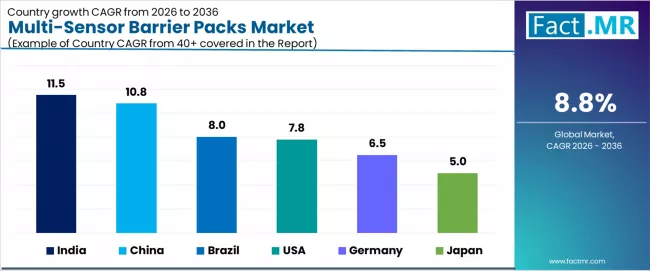
Multi Sensor Barrier Packs Market Cagr Analysis By Country | Source: Fact.MR
| Country | CAGR (2026-2036) |
|---|---|
| India | 11.5% |
| China | 10.8% |
| USA | 7.8% |
| Brazil | 8.0% |
| Germany | 6.5% |
| Japan | 5.0% |
Source: Fact.MR analysis. Updated Dec 19, 2025
How is Pharma Export Growth and Supply Chain Modernization Fueling Demand in India?
Demand for multi-sensor barrier packs in India is projected to grow at a leading CAGR of 11.5% through 2036. This is propelled by India's position as the "pharmacy of the world," with growing exports of complex generics and vaccines that require validated cold-chain packaging. Domestic modernization of food processing for export, particularly in meat and specialty spices, further drives adoption to meet international safety standards.
- Government initiatives to strengthen pharma manufacturing and cold-chain infrastructure are creating a supportive ecosystem for advanced packaging solutions.
- The growth of domestic biopharma and precision nutrition startups is generating new demand for high-integrity primary packaging with monitoring capabilities.
What Drives Adoption in China's Expanding Biologics and Specialty Export Sectors?
The market in China is forecast to grow at a CAGR of 10.8%. Rapid growth in domestic biopharmaceutical production and stringent regulatory evolution are primary drivers. Chinese manufacturers of high-value specialty foods, such as premium teas and herbal extracts for export, are increasingly adopting these packs to guarantee freshness and authenticate premium positioning in global markets.
- Massive investment in domestic biologics production capacity directly translates into scaled demand for advanced primary packaging with integrated monitoring.
- The push towards brand elevation and combating counterfeit goods in export markets makes verifiable, smart packaging a strategic tool.
How do Regulatory Stringency and High-Value Logistics Shape the US Market?
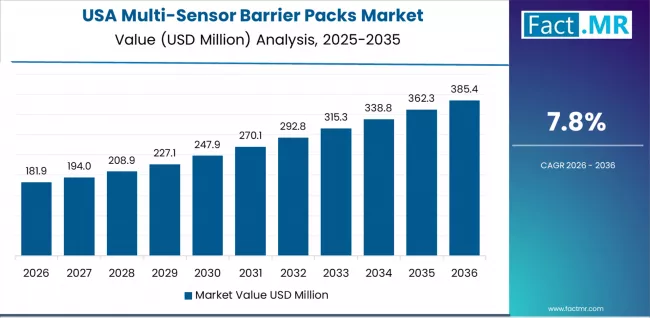
Multi Sensor Barrier Packs Market Country Value Analysis | Source: Fact.MR
Deployment of multi-sensor barrier packs in the USA is set to grow at a CAGR of 7.8%. The world’s most stringent FDA regulations for drug packaging and a sophisticated logistics network for premium perishables drive the market. Pharmaceutical companies use these packs for clinical trial materials and high-cost therapies, while the food sector applies them to gourmet, air-freighted products like specialty cheeses and fresh truffles.
- The need for compliance with DSCSA (Drug Supply Chain Security Act) and other track-and-trace regulations encourages integration of sensor data with digital serialization systems.
- Third-party logistics providers specializing in high-value goods are adopting smart packaging as a value-added service to attract premium clients.
How is the Growth of Temperature-Sensitive Agri-Exports Influencing the Brazilian Market?
The market in Brazil is projected to grow at a CAGR of 8.0%. As a major exporter of temperature-sensitive products like premium beef, poultry, and increasingly, biopharmaceutical raw materials, Brazil utilizes multi-sensor packs to provide verifiable proof of cold-chain integrity to importers. This technology is key to accessing and competing in the most demanding high-value international markets.
- The focus on adding value to commodity exports drives investment in packaging that enhances product quality assurance and brand trust.
- Local development focuses on packs that can withstand long maritime transit times while providing reliable data upon arrival.
How does Precision Engineering and Pharma Leadership define the Multi-Sensor Barrier Packs Market in Germany?
The demand for multi-sensor barrier packs in Germany is expected to grow at a CAGR of 6.5%. Germany’s leadership in precision engineering and the pharmaceutical chemical sector characterizes the market. Manufacturers of active pharmaceutical ingredients (APIs) and high-end diagnostic kits require absolute barrier protection with monitoring for sensitive contents. The emphasis is on flawless integration, data accuracy, and compliance with EU Good Distribution Practice (GDP).
- A strong engineering culture drives innovation in sensor miniaturization and pack design for optimal performance.
- Adoption is steady in high-value processed meats and dairy, where protection against oxidation is critical for premium quality.
What role does Premiumization and Technical Innovation Play in Japan?
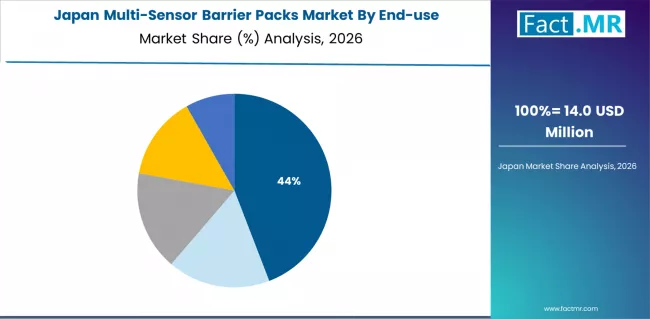
Multi Sensor Barrier Packs Market Japan Market Share Analysis By End Use | Source: Fact.MR
The market in Japan is projected to grow at a CAGR of 5.0%. Adoption is focused on ultra-premium applications within the food and advanced materials sectors. Examples include packaging for rare, aged food products requiring specific atmospheric conditions, and for sensitive electronic or photonic components during shipping. The demand is for exceptionally reliable, miniaturized, and aesthetically integrated solutions.
- The extreme focus on quality, shelf-life extension, and perfection in presentation supports investment in the highest-tier protective packaging.
- Collaboration between material scientists (e.g., Toray) and packaging converters drives innovation in next-generation, high-performance sensor-embedded films.
Competitive Landscape of the Multi-Sensor Barrier Packs Market
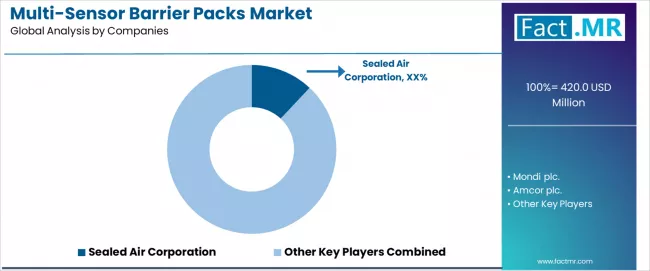
Multi Sensor Barrier Packs Market Analysis By Company | Source: Fact.MR
The competitive landscape is defined by global packaging leaders with deep expertise in material science forming alliances with specialist sensor technology firms. Companies compete on the breadth of their high-barrier material portfolio, their ability to co-develop integrated solutions with brand owners, and the reliability of their sensor data platforms.
Key players are investing in proprietary co-extrusion and lamination technologies to create thinner, stronger barriers, while simultaneously developing in-house printed electronic sensor capabilities to control the full smart packaging system. Success hinges on securing long-term partnerships with multinational pharmaceutical and premium food conglomerates.
Key Players in the Multi-Sensor Barrier Packs Market
- Sealed Air Corporation
- Mondi plc.
- Amcor plc.
- UFlex
- Klabin
- Toray Industries Inc.
Segmentation
Scope of the Report
| Items | Values |
|---|---|
| Quantitative Units (2026) | USD 420.0 Million |
| End-use/Application | High-value Food & Pharma, Specialty Foods, Bulk Pharma, E-commerce Food, Others |
| Packaging Format/Type | Rigid Barrier Pouches / Packs, Vacuum Barrier Packs, Pouches with Sensor Ports, Retortable Barrier Packs, Others |
| Material | High-barrier Laminates (Alu/PA/EVOH), Co-extruded Films, Metallized Films, High-temp Laminates, Others |
| Technology | Integrated O₂ / TTI / Humidity Sensors, Sensor Embedding, RFID + Sensor Integration, Printed Electronics, Others |
| Regions Covered | North America, Europe, Asia Pacific, Latin America, MEA |
| Key Companies Profiled | Sealed Air, Mondi, Amcor, UFlex, Klabin, Toray, and other leading manufacturers |
| Additional Attributes | Market share analysis, cost-benefit analysis of sensor integration, regulatory landscape for pharma packaging, insights into material innovation and smart system interoperability. |
Source: Fact.MR analysis. Updated Dec 19, 2025
Multi-Sensor Barrier Packs Market by Segments
-
By End-use/Application :
- High-value Food & Pharma
- Specialty Foods
- Bulk Pharma
- E-commerce Food
- Others
-
By Packaging Format/Type :
- Rigid Barrier Pouches/Packs
- Vacuum Barrier Packs
- Pouches with Sensor Ports
- Retortable Barrier Packs
- Others
-
By Material :
- High-barrier Laminates (Alu/PA/EVOH)
- Co-extruded Films
- Metallized Films
- High-temp Laminates
- Others
-
By Technology :
- Integrated O₂/TTI/Humidity Sensors
- Sensor Embedding
- RFID + Sensor Integration
- Printed Electronics
- Others
-
By Region :
-
North America
- USA
- Canada
- Mexico
-
Europe
- Germany
- UK
- France
- Italy
- Spain
- Nordic Countries
- BENELUX
- Rest of Europe
-
Asia Pacific
- China
- India
- Japan
- South Korea
- Australia
- Rest of Asia Pacific
-
Latin America
- Brazil
- Argentina
- Rest of Latin America
-
MEA
- Saudi Arabia
- UAE
- South Africa
- Rest of MEA
-
Frequently Asked Questions
How big is the multi-sensor barrier packs market in 2026?
What will be the size of multi-sensor barrier packs market in 2036?
How much will be the multi-sensor barrier packs market growth between 2026 and 2036?
What are the key product types in the multi-sensor barrier packs market?
Which packaging format/type segment to contribute significant share in the multi-sensor barrier packs market in 2026?
Who worked on this report


Preview the report firsthand - request a free sample
Free SampleGet the brochure for pricing and purchase details
Download PDF