- Base Value(2025): 0.8 Bn
- Estimated Value(2026): 1.1 Bn
- Forecast Value (2036): 5.7 Bn
- CAGR (2026 - 2036): 17.9%
Lidar Sensor Modules for Passenger Car ADAS Market Forecast and Outlook (2026 to 2036)
The market was valued at USD 0.8 billion in 2025 and is projected by Fact.MR to reach USD 1.1 billion in 2026. Long-term expansion is expected to push the market to USD 5.7 billion by 2036, reflecting a CAGR of 17.9% during the assessment period. This growth trajectory indicates strong momentum, supported by both technology adoption and evolving automotive safety requirements.
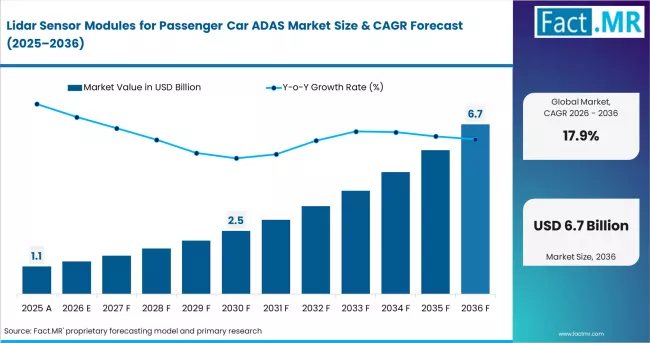
Lidar Sensor Modules For Passenger Car Adas Market Market Value Analysis | Source: Fact.MR
| Metric | Value |
|---|---|
| Estimated Value in 2026 | USD 1.1 billion |
| Forecast Value in 2036 | USD 5.7 billion |
| Forecast CAGR (2026–2036) | 17.9% |
Source: Fact.MR analysis. Updated May 6, 2026
Absolute opportunity remains significant as demand gradually extends beyond premium vehicles into mid-range segments. Early adoption has been concentrated in high-end models where cost constraints are less restrictive. Broader deployment is now being supported by declining component costs and improved system integration. Expansion of ADAS features across vehicle categories continues to drive sensor demand, particularly as OEMs move toward more advanced perception systems. Sensor fusion strategies, combining multiple sensing technologies, are further strengthening the role of these systems in automated driving frameworks.
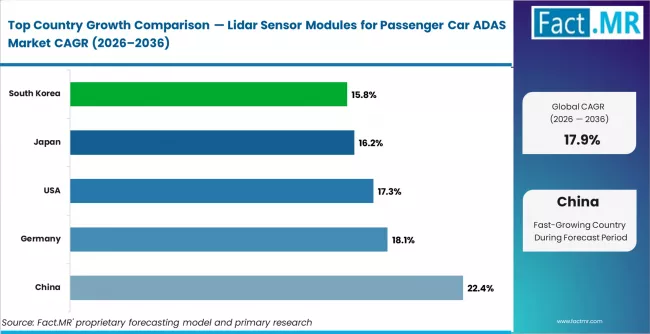
China is expected to lead global growth, with demand projected to rise at a CAGR of 22.4%. Strong electric vehicle production and a rapidly developing domestic lidar ecosystem are supporting large-scale adoption. Germany follows with 18.1% CAGR, where premium OEM strategies and focus on advanced safety technologies continue to drive integration. The United States is set to grow at 17.3%, supported by ongoing investment in autonomous driving development and testing. Japan records a CAGR of 16.2%, with steady adoption led by OEM-driven upgrades and a focus on system reliability. South Korea is projected to expand at 15.8%, benefiting from vertically integrated automotive electronics supply chains that support efficient production and faster technology deployment.
Drivers, Restraints, and Opportunities
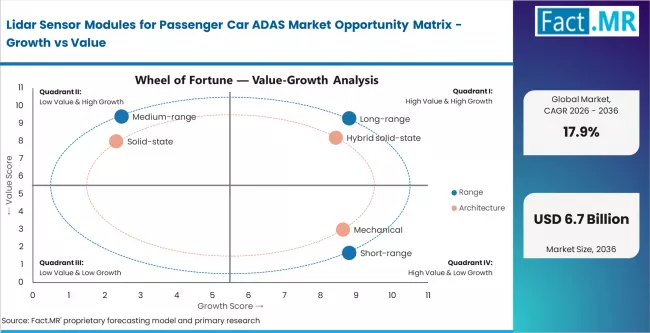
Lidar Sensor Modules For Passenger Car Adas Market Opportunity Matrix Growth Vs Value | Source: Fact.MR
Fact.MR analysis indicates that the lidar market is moving through a high-growth transition phase, supported by expanding ADAS adoption and the need for more precise environmental perception. Demand is closely tied to the limitations of standalone camera and radar systems, particularly in complex or low-visibility conditions. Lidar addresses these gaps by providing accurate depth mapping and object detection, making it an essential complementary technology within multi-sensor architectures.
Market dynamics reflect an ongoing balance between cost constraints and performance expectations. Mechanical lidar systems are gradually losing relevance due to higher costs and moving components that affect durability. Hybrid and solid-state solutions are gaining traction as they offer improved reliability and lower long-term production costs. While initial pricing for these newer systems remains relatively high, advances in semiconductor integration and simplified designs are helping reduce cost barriers. This shift is improving the commercial viability of lidar, particularly as OEMs prepare for broader deployment across vehicle segments.
- ADAS expansion is a primary growth driver. Increasing adoption of Level 2+ and Level 3 systems is creating demand for more advanced sensing capabilities, with lidar being integrated into premium vehicle platforms to enhance perception accuracy.
- Regulatory frameworks are influencing adoption strategies. Programs such as Euro NCAP are encouraging improved safety performance, prompting OEMs to diversify sensor technologies within ADAS systems.
- Asia continues to emerge as a key growth region. China and South Korea are strengthening their positions as production hubs, supported by domestic supplier ecosystems and increasing investment in automotive sensor technologies.
Segment Analysis
Lidar Sensor Modules Market Analysis by Range
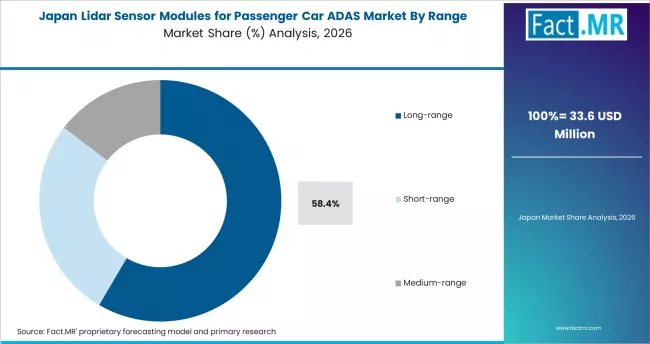
Lidar Sensor Modules For Passenger Car Adas Market Japan Market Share Analysis By Range | Source: Fact.MR
Long-range lidar modules are projected to account for 58.0% share in 2026 in the lidar sensor modules market. Their dominance is linked to the operational requirements of highway driving, where extended detection distance is essential for safe navigation at higher speeds. These modules enable earlier object recognition, allowing ADAS systems to make timely decisions in dynamic traffic environments. OEMs are prioritizing long-range capabilities as they expand Level 2+ and Level 3 functionalities, particularly in premium and performance-oriented vehicles.
Highway-focused ADAS applications such as adaptive cruise control, lane centering, and collision avoidance depend heavily on reliable long-distance sensing. Long-range lidar supports these functions by delivering accurate depth data even in challenging lighting conditions, where cameras and radar may face limitations. This capability is strengthening its role as a core component in advanced perception stacks.
- Product adoption is accelerating through OEM partnerships. Luminar secured long-term supply agreements with Volvo in 2024 for highway autonomy programs [1]. These collaborations highlight the growing importance of long-range lidar in next-generation vehicle platforms.
- Innovation is focused on improving resolution and detection accuracy. Hesai introduced high-resolution long-range lidar sensors in 2025, targeting automotive integration [2]. These advancements aim to enhance object classification at extended distances.
- Industry adoption trends indicate increasing integration into highway ADAS features. Long-range lidar is being positioned as a critical enabler for safe high-speed automation, supporting OEM strategies focused on performance and safety differentiation.
Lidar Sensor Modules Market Analysis by Architecture
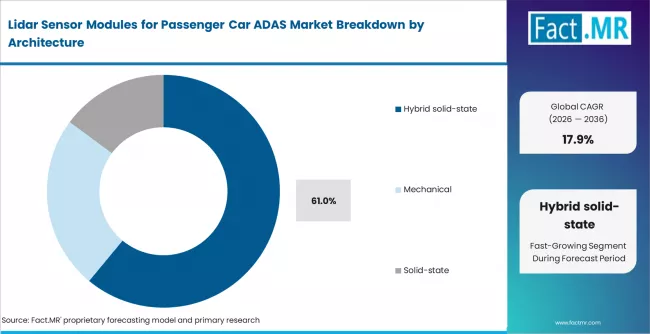
Lidar Sensor Modules For Passenger Car Adas Market Analysis By Architecture | Source: Fact.MR
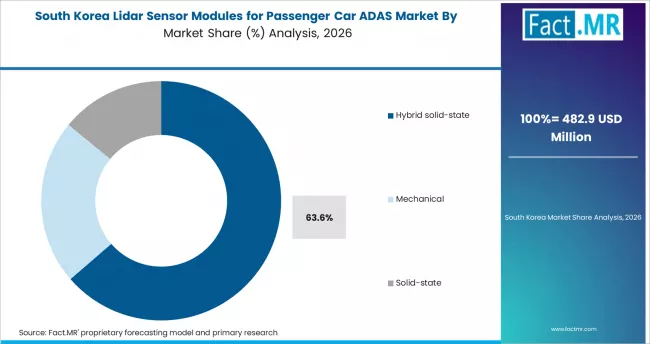
Hybrid solid-state lidar is expected to represent 61.0% share in 2026. This architecture balances cost, durability, and performance, making it more suitable for automotive deployment compared to traditional mechanical systems. By reducing reliance on moving parts, hybrid solid-state designs improve reliability and extend product lifespan, which aligns with OEM expectations for automotive-grade components.
The transition toward semiconductor-driven architectures is reshaping product development strategies. These systems offer better scalability and are more compatible with mass production processes, allowing suppliers to reduce unit costs over time. As a result, hybrid solid-state lidar is emerging as the preferred choice for both premium and gradually expanding mid-range applications.
- Technology development is advancing through targeted innovation. Innoviz launched next-generation solid-state lidar modules in 2024 designed for OEM integration [3]. These modules focus on compact design and improved system efficiency.
- Production expansion is supporting broader deployment. Valeo increased manufacturing capacity for automotive-grade lidar sensors, particularly for European OEM programs [4]. This expansion reflects rising demand for scalable solutions.
- Supply-side trends show a clear shift toward semiconductor-based lidar architectures. This transition is improving production efficiency and enabling higher output volumes, which are necessary for wider adoption across vehicle segments.
Lidar Sensor Modules Market Analysis by Mounting Position
Lidar Sensor Modules For Passenger Car Adas Market Analysis By Mounting Position | Source: Fact.MR
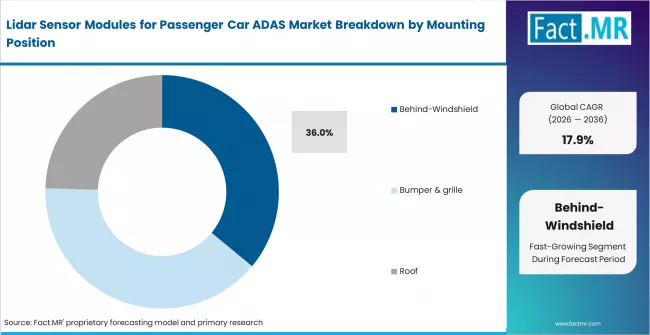
Behind-windshield mounting is projected to account for 36.0% share in 2026. This configuration is gaining traction due to its integration advantages, including protection from environmental exposure and improved system durability. Positioning lidar sensors behind the windshield reduces the risk of damage from debris, weather conditions, and external impacts, which is critical for maintaining long-term performance.
OEMs are also adopting this mounting approach to maintain vehicle design aesthetics and aerodynamic efficiency. External sensor placements can disrupt vehicle styling and increase drag, while behind-windshield integration allows for a more seamless appearance. This approach aligns with the industry’s focus on combining advanced technology with design consistency.
- OEM integration strategies are evolving toward concealed sensor placement. Several manufacturers are adopting windshield-mounted lidar to improve both functionality and vehicle design [5]. This approach supports cleaner vehicle profiles while maintaining sensing capability.
- Technology integration is benefiting from the use of existing vehicle structures. Embedding lidar within the windshield area reduces additional hardware requirements, lowering system complexity and integration costs.
- Manufacturing and logistics efficiency is improving. Simplified installation processes are reducing assembly time and supporting higher production throughput. This advantage becomes increasingly important as lidar adoption scales across larger vehicle volumes.
Regional Analysis
The market is segmented across North America, Europe, East Asia, South Asia & Pacific, Latin America, and Middle East & Africa. Each region reflects different adoption rates driven by regulatory frameworks and OEM strategies. The report includes detailed market attractiveness analysis.
.webp "Top Country Growth Comparison Lidar Sensor Modules For Passenger Car Adas Market Cagr (2026 2036)")
Top Country Growth Comparison Lidar Sensor Modules For Passenger Car Adas Market Cagr (2026 2036) | Source: Fact.MR
| Country | CAGR (2026–2036) |
|---|---|
| China | 22.4% |
| Germany | 18.1% |
| United States | 17.3% |
| Japan | 16.2% |
| South Korea | 15.8% |
Source: Fact.MR analysis. Updated May 6, 2026
Source: Fact.MR (FACTMR) analysis, based on proprietary forecasting model and primary research
Lidar Sensor Modules For Passenger Car Adas Market Cagr Analysis By Country | Source: Fact.MR
East Asia
Lidar Sensor Modules For Passenger Car Adas Market South Korea Market Share Analysis By Architecture | Source: Fact.MR
East Asia serves as the global production epicenter for lidar systems, supported by strong domestic supply chains and rapid integration into vehicle platforms. The region benefits from a combination of government support, advanced electronics manufacturing, and aggressive OEM strategies focused on ADAS and autonomous technologies.
- China: China leads the regional landscape, with demand projected to rise at a 22.4% CAGR through 2036. Government support for electric vehicles and advanced safety technologies has accelerated lidar adoption across multiple vehicle segments. Domestic OEMs are increasingly integrating lidar systems into production vehicles, moving beyond pilot programs into scaled deployment. The presence of strong local suppliers enables cost efficiencies and faster innovation cycles, allowing lidar to become more accessible across mid-range and premium vehicles. Growth is further supported by expanding EV production and increasing competition among automakers to differentiate through advanced safety features.
Europe
Lidar Sensor Modules For Passenger Car Adas Market Europe Country Market Share Analysis, 2026 & 2036 | Source: Fact.MR
Europe acts as a regulatory innovation hub, where strict safety standards and premium automotive positioning drive lidar adoption. The region’s focus on vehicle safety and performance encourages OEMs to integrate advanced sensing technologies as part of compliance and product differentiation strategies.
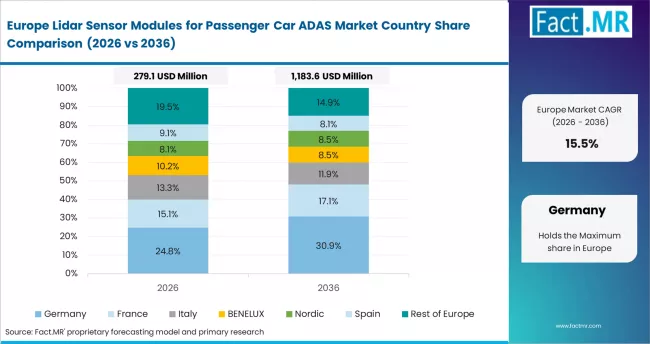
- Germany: Germany remains the key market, with demand projected to rise at an 18.1% CAGR through 2036. Premium automotive manufacturers are incorporating lidar systems to enhance safety capabilities and maintain competitive advantage in high-end vehicle segments. Regulatory frameworks such as Euro NCAP guidelines are pushing automakers to adopt more advanced ADAS technologies, including lidar, to meet evolving safety benchmarks. Demand is therefore closely linked to both compliance requirements and the need for innovation in premium vehicle offerings. Suppliers that meet stringent engineering and regulatory standards can secure long-term partnerships with leading OEMs in this market.
North America
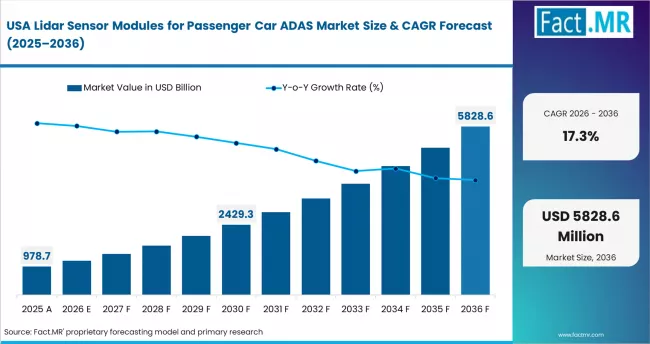
Lidar Sensor Modules For Passenger Car Adas Market Country Value Analysis | Source: Fact.MR
North America focuses on autonomous driving innovation and advanced technology integration, making it a key market for lidar adoption. The region benefits from strong investment in autonomous vehicle programs and collaboration between automotive manufacturers and technology companies.
- United States: The United States leads regional demand, with the market expected to grow at a 17.3% CAGR through 2036. Adoption is driven by ongoing development of autonomous driving systems and increasing integration of lidar into advanced driver assistance features. OEMs and technology firms are working together to accelerate commercialization, particularly in higher-end vehicles and pilot autonomous fleets. Demand is also supported by the need for enhanced safety and perception capabilities in complex driving environments. Suppliers that align with innovation-driven ecosystems and deliver high-performance solutions can capture significant opportunities in this evolving market.
Japan
Japan emphasizes precision engineering and a measured approach to technology adoption, which shapes its lidar market trajectory. Automakers in the country prioritize reliability, consistency, and seamless integration of new technologies into existing vehicle platforms.
- Japan: Demand is projected to rise at a 16.2% CAGR through 2036, reflecting steady growth driven by incremental adoption of lidar technologies. OEMs are focusing on enhancing safety and performance while maintaining high standards of quality and durability. Rather than rapid large-scale deployment, the market is characterized by careful integration into select vehicle models. Suppliers that align with Japan’s emphasis on precision and long-term performance can maintain stable growth in this disciplined environment.
South Korea
South Korea benefits from strong electronics manufacturing capabilities and advanced automotive production, supporting steady adoption of lidar systems. The country’s automotive sector is actively integrating ADAS technologies, supported by domestic innovation and semiconductor advancements.
- South Korea: Demand is projected to rise at a 15.8% CAGR through 2036, reflecting consistent growth driven by OEM strategies and technology investment. Automakers are accelerating integration of lidar systems across their vehicle portfolios to enhance safety and competitiveness. Strong domestic supply chains enable efficient production and system integration, providing a competitive edge in global markets. Suppliers that leverage these capabilities can benefit from sustained demand as lidar adoption expands.
Competitive Aligners for Market Players
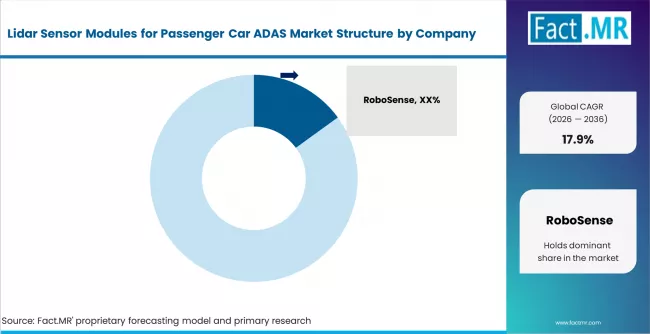
Lidar Sensor Modules For Passenger Car Adas Market Analysis By Company | Source: Fact.MR
The lidar sensor modules market remains moderately fragmented, with a mix of emerging technology providers and established automotive suppliers competing across different application areas. No single player dominates the landscape, which creates space for innovation-driven entrants to gain traction. Competitive differentiation is shaped by sensor performance, cost efficiency, and the ability to integrate effectively within ADAS and autonomous driving systems. Suppliers that can deliver consistent detection accuracy while maintaining scalable cost structures are better positioned to secure OEM programs.
Structural advantages are concentrated among companies with strong semiconductor partnerships and established OEM relationships. Close collaboration with chip manufacturers supports improvements in processing capability, power efficiency, and system miniaturization. Long-term engagement with OEMs allows suppliers to align product development with vehicle platform requirements. Firms such as Luminar and Valeo benefit from such positioning, combining technical capability with access to large-scale automotive programs. Vertical integration across critical components, including lasers and photodetectors, enables better cost control and product differentiation while supporting higher production volumes.
Buyer influence remains significant, as automotive OEMs account for the majority of demand and operate with structured procurement strategies. Large order volumes give OEMs strong negotiating leverage, particularly in pricing discussions. Long qualification cycles and strict validation standards limit frequent supplier changes, favoring vendors with proven reliability. At the same time, these requirements increase pressure on suppliers to meet both performance and cost expectations, especially as lidar adoption expands into more price-sensitive vehicle segments.
Key Players
- RoboSense
- Hesai Technology
- Luminar Technologies
- Innoviz Technologies
- Valeo
- Huawei
Bibliography
- [1] Luminar Technologies – Volvo Partnership Announcement, 2024
- [2] Hesai Technology – Product Launch Release, 2025
- [3] Innoviz Technologies – Annual Report, 2024
- [4] Valeo – Lidar Production Update, 2024
- [5] European Commission – ADAS Safety Regulations Update, 2024
This Report Addresses
- Market intelligence on lidar sensor adoption in passenger vehicle ADAS
- Market size and forecast from 2026 to 2036
- Growth opportunity mapping across regions and segments
- Segment and regional demand analysis
- Competitive landscape and strategy assessment
- Technology and product tracking
- Regulatory impact analysis
- Delivery in PDF, Excel, and presentation formats
Lidar Sensor Modules for Passenger Car ADAS Market Definition
The lidar sensor modules for passenger car ADAS market includes optical sensing systems that use laser pulses to measure distance and generate high-resolution 3D maps of the surrounding environment. These modules are integrated into vehicles to support advanced driver assistance functions such as object detection, lane monitoring, and collision avoidance. Lidar enables accurate perception in complex driving conditions and complements radar and camera systems. It is primarily used in passenger vehicles equipped with Level 2+ to Level 4 automation features, where precise environmental sensing is critical for safety and navigation.
Lidar Sensor Modules for Passenger Car ADAS Market Inclusions
The report covers global and regional market size estimates and forecasts from 2026 to 2036. It includes segmentation by range, architecture, mounting position, and vehicle type. The study analyzes demand across passenger vehicle ADAS applications, along with pricing trends, technology evolution, and supply chain dynamics. It also includes country-level growth analysis and competitive landscape assessment.
Lidar Sensor Modules for Passenger Car ADAS Market Exclusions
The scope excludes non-automotive lidar applications such as industrial mapping, robotics, and defense systems. It does not cover fully integrated autonomous driving software platforms or downstream ADAS system integration beyond sensor modules. Mechanical-only legacy lidar systems used exclusively for testing and research are also excluded unless deployed in commercial passenger vehicles.
Lidar Sensor Modules for Passenger Car ADAS Market Research Methodology
- Primary Research
- Interviews with automotive OEMs, lidar module manufacturers, semiconductor suppliers, and ADAS system integrators.
- Desk Research
- Use of regulatory publications, OEM announcements, semiconductor data, and company disclosures from lidar suppliers.
- Market-Sizing and Forecasting
- Hybrid top-down and bottom-up model using vehicle production data and ADAS penetration rates.
- Data Validation and Update Cycle
- Validated through supplier shipment data, OEM integration announcements, and annual updates.
Segmentation
Scope of Report
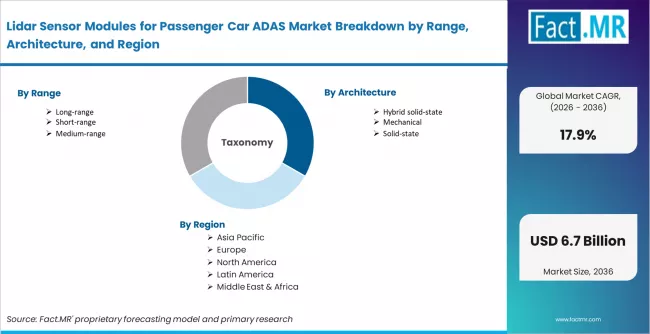
Lidar Sensor Modules For Passenger Car Adas Market Breakdown By Range, Architecture, And Region | Source: Fact.MR
| Metric | Value |
|---|---|
| Market Name | Lidar Sensor Modules for Passenger Car ADAS Market |
| Base Year | 2025 |
| Estimated Market Size (2025) | USD 0.8 Billion |
| Projected Market Size (2026) | USD 1.1 Billion |
| Forecast Market Size (2036) | USD 5.7 Billion |
| Forecast Period | 2026 to 2036 |
| CAGR (2026–2036) | 17.9% |
| Study Scope | Global |
| Key Segments Covered | Range, Architecture, Mounting Position, Vehicle Type, Region |
| Regions Covered | North America, Europe, East Asia, South Asia & Pacific, Latin America, Middle East & Africa |
| Key Countries Covered | China, Germany, United States, Japan, South Korea |
| Research Methodology | Primary interviews, secondary research, and FACTMR proprietary model |
| Approach | Hybrid top-down and bottom-up model with demand-supply triangulation |
| Report Format | PDF, Excel, and PPT |
Source: Fact.MR analysis. Updated May 6, 2026
Lidar Sensor Modules Market by Segments
-
By Range:
- Short-range
- Medium-range
- Long-range
-
By Architecture:
- Mechanical
- Solid-state
- Hybrid solid-state
-
By Mounting Position:
- Roof
- Behind-windshield
- Bumper & grille
- Others
-
By Vehicle Type:
- Passenger cars
-
By Region:
-
North America
- United States
- Canada
- Mexico
-
Latin America
- Brazil
- Argentina
- Chile
- Rest of Latin America
-
Western Europe
- Germany
- France
- United Kingdom
- Italy
- Spain
- Nordic Countries
- BENELUX
- Rest of Western Europe
-
Eastern Europe
- Russia
- Poland
- Hungary
- Balkan and Baltic
- Rest of Eastern Europe
-
East Asia
- China
- Japan
- South Korea
-
South Asia and Pacific
- India
- ASEAN
- Australia and New Zealand
- Rest of South Asia and Pacific
-
Middle East and Africa
- Kingdom of Saudi Arabia
- Other GCC Countries
- Turkey
- South Africa
- Rest of Middle East and Africa
-
Frequently Asked Questions
What is the size of the lidar sensor modules for passenger car ADAS market in 2025?
What will be the market size in 2026?
What is the forecast market size by 2036?
What is the expected CAGR of the lidar ADAS market?
Which lidar segment leads the market?
Which mounting position dominates lidar integration?
Why is lidar used in ADAS systems?
Which country shows the fastest growth in this market?
What is driving lidar adoption in passenger vehicles?
What are the major challenges in lidar adoption?
How does lidar compare with radar and cameras?
Which vehicle segment dominates lidar demand?
What role do regulations play in this market?
Who are the key players in the lidar ADAS market?
What opportunities exist for lidar manufacturers?
Who worked on this report


Preview the report firsthand - request a free sample
Free SampleGet the brochure for pricing and purchase details
Download PDF