- Base Value(2026): 0.7 Bn
- Estimated Value(2026): 0.7 Bn
- Forecast Value (2036): 1.3 Bn
- CAGR (2026 - 2036): 6.5%
Demand for Chemical Protective Suits in the UK 2026 to 2036
Demand for chemical protective suits in the UK is projected to rise from USD 0.71 billion in 2026 to about USD 1.33 billion in 2036, at a 6.5% CAGR. Growth reflects ongoing industrial safety upgrades, wider uptake of specialized protective equipment, and stronger alignment with evolving compliance expectations across manufacturing hubs. England’s large processing base continues to shape adoption patterns as modernization programs encourage facilities to integrate advanced protection layers and digital monitoring features.
Key Takeaways from the UK Chemical Protective Suits Industry
- UK Chemical Protective Suits Sales Value (2026): USD 0.71 billion
- UK Chemical Protective Suits Forecast Value (2036): USD 1.33 billion
- UK Chemical Protective Suits Forecast CAGR: 6.5%
- Leading Product Type in UK Chemical Protective Suits Industry: Durable Suits (62.3%)
- Key Growth Regions in UK Chemical Protective Suits Industry: England, Scotland, Wales, and Northern Ireland
- Regional Leadership: England holds the leading position in demand
- Key Players in UK Chemical Protective Suits Industry: 3M Company, Ansell Limited, E. I. du Pont de Nemours and Company, Drägerwerk AG & Co. KGaA, Lakeland Industries Incorporated, Delta Plus Group, MSA Safety Incorporated, Uvex Group, Kappler Incorporated, Protective Industrial Products Incorporated
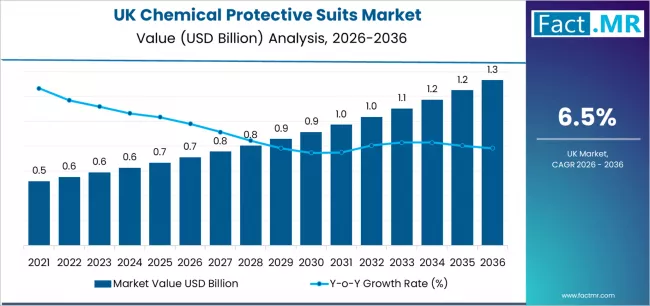
Uk Chemical Protective Suits Market Market Value Analysis | Source: Fact.MR
UK operators are reassessing protection strategies as hazardous material handling becomes more complex. Investments now lean toward technologies that deliver consistent barrier performance, structured validation, and long-term operational reliability. This shift is also encouraging a broader transition toward connected safety platforms, with facilities prioritizing systems that streamline oversight and improve readiness during high-risk tasks.
Between 2030 and 2036, consumption is projected to expand from USD 967.21 million to USD 1.33 billion, adding USD 362.79 million across the period. Momentum is expected to emerge from customized protection designs, new material engineering capabilities, and deeper integration of quality assurance frameworks across industrial environments. Scotland and England are likely to lead adoption as regional programs emphasize higher protection standards and future-ready safety infrastructure.
UK Chemical Protective Suits Industry
| Metric | Value |
|---|---|
| UK Chemical Protective Suits Sales Value (2026) | USD 0.71 billion |
| UK Chemical Protective Suits Forecast Value (2036) | USD 1.33 billion |
| UK Chemical Protective Suits Forecast CAGR (2026-2036) | 6.5% |
Source: Fact.MR analysis. Updated Dec 16, 2025
Category
| Category | Segments |
|---|---|
| Product | Durable Suits, Disposable Suits, Others |
| End Use | Industrial Applications, Healthcare Applications, Emergency Response, Others |
| Region | England, Scotland, Wales, Northern Ireland |
Source: Fact.MR analysis. Updated Dec 16, 2025
Segmental Analysis
Which Product Category occupies the Dominant Share in the UK’s Chemical Protective Suits Industry?
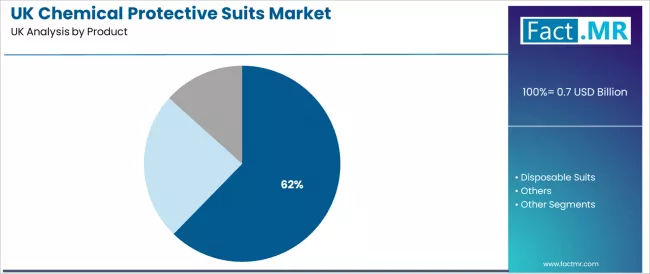
Uk Chemical Protective Suits Market Analysis By Product | Source: Fact.MR
Durable suits are projected to hold 62.3% of UK chemical protective suit consumption in 2026. Their barrier strength, long service life, and reliable performance make them a practical fit for industrial environments that rely on consistent protection standards.
Companies select this category because it adapts well to varied risk settings while preserving operational continuity. Ongoing improvements in materials and construction enhance precision, durability, and comfort, which strengthens manufacturer confidence and supports broad uptake across established facilities.
- Strong safety alignment supports integration into routine industrial workflows.
- Proven field performance reinforces trust and encourages large-scale use.
Which End Use Category Captures the Maximum Share in UK’s Chemical Protective Suits Landscape?

Uk Chemical Protective Suits Market Analysis By End Use | Source: Fact.MR
Industrial applications are expected to represent 49.8% of consumption in 2026. These environments require dependable protection solutions that support hazardous handling, production continuity, and compliance needs across chemical plants, petrochemical units, and manufacturing sites.
The segment maintains steady purchasing activity due to the scale of operations and the technical demands associated with managing exposure risks. UK facilities depend on protective suits that sustain efficiency while meeting safety thresholds across diverse industrial settings.
- High-risk processes maintain consistent suit requirements across major facilities.
- Protective integration strengthens workflow stability and supports operational resilience.
What are the Drivers, Restraints, and Key Trends in the UK Chemical Protective Suits Industry?
Chemical protective suits adoption in the UK is progressing as organizations place stronger emphasis on workforce safety and industrial risk management. England continues to influence product development due to its concentration of regulated industries and investment in advanced protection practices. Growth remains steady as safety expectations rise across manufacturing, energy, and emergency response environments.
Cost pressures, competing safety solutions, and the need for rigorous barrier validation shape purchasing decisions. Regulatory interpretation also varies across sectors, creating differences in product qualification cycles and extending evaluation timelines for new protective technologies.
Evolving protection standards are guiding structured procurement and enabling suppliers to position differentiated systems without extensive redesign. Industrial programs in England and Scotland reinforce standardized usage patterns and create predictable opportunities for contract-based supply relationships. These developments support suppliers that invest in technical depth and structured safety capabilities.
Smart protection technologies are gaining relevance as industrial operators streamline safety management. Integrated validation tools, high-precision barrier materials, and centralized monitoring frameworks are improving consistency across dispersed facilities. Collaborative research groups are emerging to reduce development costs and accelerate conformity testing. Such models are expanding the role of advanced protective systems within both routine operations and specialized chemical environments.
Analysis of UK Chemical Protective Suits Industry by Key Countries
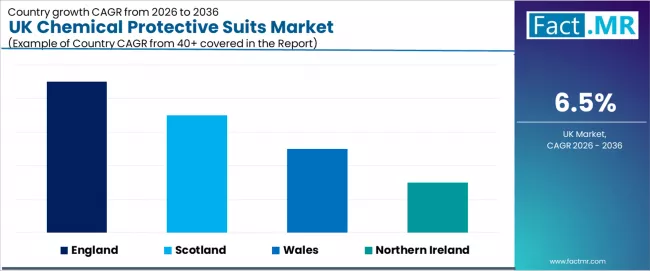
Uk Chemical Protective Suits Market Cagr Analysis By Country | Source: Fact.MR
| Region | CAGR (2026-2036) |
|---|---|
| England | 6.7% |
| Scotland | 6.5% |
| Wales | 6.3% |
| Northern Ireland | 6.1% |
Source: Fact.MR analysis. Updated Dec 16, 2025
Why does England hold a Leading Position in Chemical Protective Suits Usage?
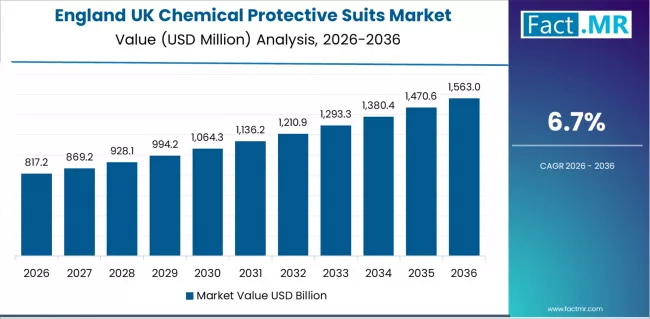
Uk Chemical Protective Suits Market Country Value Analysis | Source: Fact.MR
England maintains the largest demand due to its dense industrial corridors and mature safety culture. Growth at a CAGR of 6.7% reflects sustained investment in protection capabilities across London and surrounding manufacturing zones. Companies pursue advanced suit technologies to align with regulatory expectations and operational precision. Strong supplier presence supports continuous development, enabling wider adoption across high-risk environments that require reliable barrier performance and validated application consistency.
- Industrial safety programs are expanding the need for suit systems with proven protection strength and long-term operational reliability across varied applications.
- Innovation funding and concentrated technical expertise encourage deployment of next-generation suit solutions that enhance adoption economics and widen usage pathways across England’s industrial base.
What drives Scotland’s Steady Rise in Chemical Protective Suits Demand?
Scotland records a 6.5% CAGR supported by manufacturing clusters that rely on structured safety programs. Facilities across Edinburgh, Glasgow, and associated industrial corridors require consistent protection coverage, creating an environment suited for integrated suit adoption. Sector operators invest in coordinated safety frameworks, enabling systematic deployment across established and emerging use cases.
- Concentrated industrial activity creates openings for suppliers offering suit systems aligned with existing operational infrastructure.
- Regional expertise and expanding protection needs strengthen Scotland’s position as a growth zone for specialized applications.
Why is Wales Experiencing Sustained Growth in Chemical Protective Suits Adoption?
Wales maintains a 6.3% CAGR due to its manufacturing footprint and rising emphasis on protection performance across regional operations. Companies integrate suit solutions to meet competitive pressures and reinforce safety outcomes. Suppliers are expanding their presence through localized support models and protection-focused infrastructure suited to regional needs.
- Modernization plans across manufacturing sites encourage adoption of suit technologies that enhance operational continuity and protection quality.
- Regional capabilities and diversified application profiles create pathways for steady suit utilization across Welsh industrial activities.
What shapes Chemical Protective Suits Requirements in Northern Ireland?
Northern Ireland grows at a CAGR of 6.1% as industrial facilities expand their safety functions and reinforce protection expectations. Increased investment in regional capability building supports broader use of suit technologies across emerging and established sectors. Collaboration between operators and suppliers enables consistent deployment practices aligned with evolving safety needs.
- Industrial diversification and protection upgrades stimulate adoption of suit systems across facilities seeking improved operational assurance.
- Shared safety infrastructure and coordinated development frameworks encourage multi-site deployment and strengthen long-term adoption prospects across Northern Ireland.
Competitive Landscape of UK Chemical Protective Suits Industry
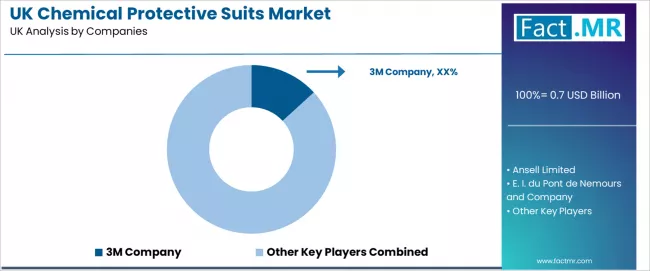
Uk Chemical Protective Suits Market Analysis By Company | Source: Fact.MR
The UK chemical protective suits industry features active competition among specialist manufacturers, safety component suppliers, and integrated solution providers. Large corporations shape the environment through strong research capability and established application development platforms. Companies continue to expand protection technologies, reinforce safety assurance processes, and refine distribution structures. Many are also scaling validation services to strengthen reliability across industrial operations in the UK.
3M Company maintains a prominent position supported by wide product availability, technical services, and an established presence across high-priority industrial settings. E. I. du Pont de Nemours and Company operates extensive protection supply channels supported by custom integration and technical support for domestic and international projects.
Ansell Limited positions its portfolio around advanced protective solutions, drawing on sector expertise and integrated safety functions. Lakeland Industries Incorporated focuses on application development and protection performance improvement for industrial and safety environments across the UK.
Collaboration among manufacturers, distributors, and technology partners shapes competitive progress. Investment continues to flow into new materials, accelerated production methods, and digital support systems that improve compliance and traceability. Stakeholders are directing attention toward stable sourcing models as raw material constraints affect operational planning.
Companies are also strengthening technical training programs to build skilled workforces that support complex protective systems. Industry visibility increasingly depends on the ability to pair robust product performance with scalable service models. Organisations capable of aligning innovation, supply resilience, and technical support gain stronger positioning across UK industrial applications.
Key Players in UK Chemical Protective Suits Industry
- 3M Company
- Ansell Limited
- E. I. du Pont de Nemours and Company
- Drägerwerk AG & Co. KGaA
- Lakeland Industries Incorporated
- Delta Plus Group
- MSA Safety Incorporated
- Uvex Group
- Kappler Incorporated
- Protective Industrial Products Incorporated
Segmentation
Scope of the Report
| Item | Value |
|---|---|
| Quantitative Units | USD 1.33 billion |
| Product | Durable Suits, Disposable Suits, Others |
| End Use | Industrial Applications, Healthcare Applications, Emergency Response, Others |
| Regions Covered | England, Scotland, Wales, Northern Ireland |
| Key Companies | 3M Company, Ansell Limited, E. I. du Pont de Nemours and Company, Drägerwerk AG & Co. KGaA, Lakeland Industries Incorporated, Delta Plus Group, MSA Safety Incorporated, Uvex Group, Kappler Incorporated, Protective Industrial Products Incorporated, Regional chemical protective suits specialists |
| Additional Attributes | Sales by product and end use segment; regional demand trends across England, Scotland, Wales, and Northern Ireland; competitive landscape with established chemical protective suits suppliers and specialized protection developers; safety preferences for durable suits versus disposable suits technologies; integration with protection programs and advanced safety policies, particularly advanced in the England region |
Source: Fact.MR analysis. Updated Dec 16, 2025
UK Chemical Protective Suits Industry by Segments
-
Product :
- Durable Suits
- Disposable Suits
- Others
-
End Use :
- Industrial Applications
- Healthcare Applications
- Emergency Response
- Others
-
Region :
- England
- Scotland
- Wales
- Northern Ireland
Frequently Asked Questions
How big is the demand for chemical protective suits in UK in 2026?
What will be the size of chemical protective suits in UK in 2036?
How much will be the demand for chemical protective suits in UK growth between 2026 and 2036?
What are the key product types in the chemical protective suits in UK?
Which end use segment is expected to contribute significant share in the chemical protective suits in UK in 2026?
Who worked on this report


Preview the report firsthand - request a free sample
Free SampleGet the brochure for pricing and purchase details
Download PDF