Upcycled Textile Pouch Market
Upcycled Textile Pouch Market Size and Share Forecast Outlook 2026 to 2036
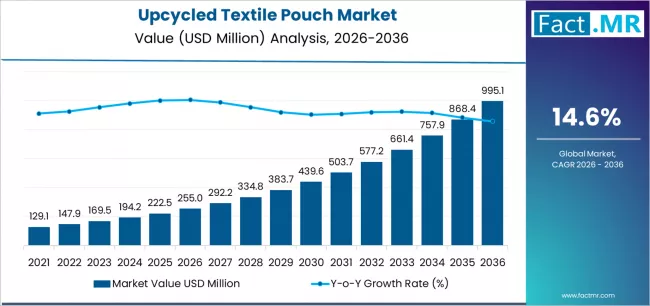
The upcycled textile pouch market is projected to grow from USD 255.0 million in 2026 to USD 995.1 million by 2036, at a CAGR of 14.6%. Fashion & Luxury Gifting will dominate with a 35.0% market share, while reusable fabric pouches will lead the packaging format/type segment with a 50.0% share.
Upcycled Textile Pouch Market Forecast and Outlook 2026 to 2036
The global upcycled textile pouch market is valued at USD 255.0 million in 2026. The market is forecast to reach USD 995.1 million by 2036, an increase of USD 740.1 million. This represents remarkable total growth of 290.2%, expanding at a compound annual growth rate (CAGR) of 14.6% between 2026 and 2036.
Key Takeaways from the Upcycled Textile Pouch Market Study
- Market Value (2026): USD 255.0 Million
- Market Forecast Value (2036): USD 995.1 Million
- Market Forecast CAGR: 14.6%
- Leading End-Use: Fashion & Luxury Gifting (35.0%)
- Key Growth Regions: Asia Pacific, North America, Europe
- Key Players in the Upcycled Textile Pouch Market: Bolt Threads (concept), Toppan (branding), Others

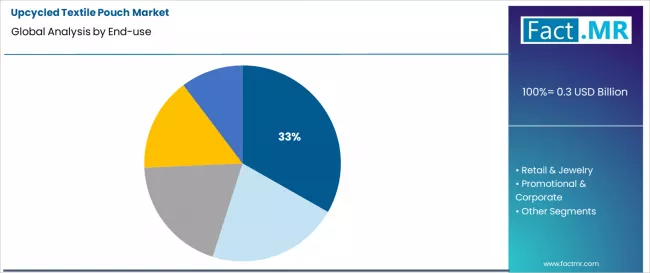
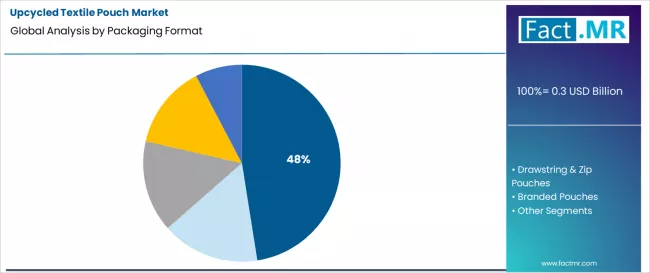
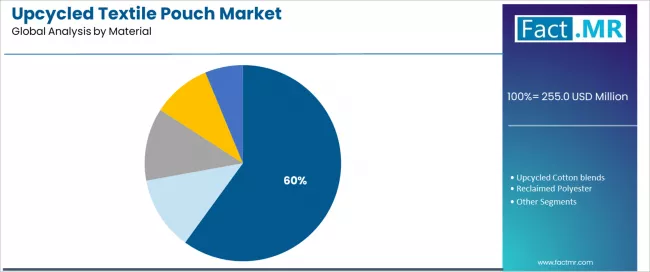
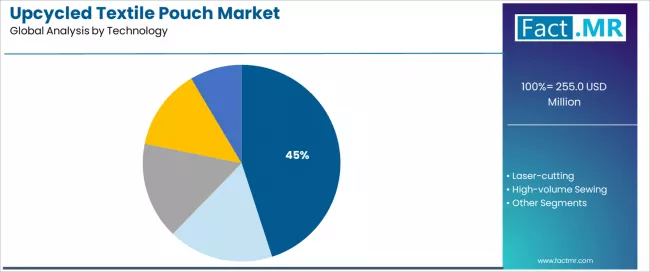
Segmentation reveals a market where sustainability and brand narrative intersect. By end-use, the fashion and luxury gifting sector commands a leading 35.0% share in 2026. Reusable fabric pouches dominate the packaging format segment with a 50.0% share. Reclaimed textile and PET holds a dominant 60.0% material share, while ultrasonic welding and stitching is a key technology with a 45.0% share. This data underscores a transition from disposable packaging to durable, value-added brand assets.
A central macro trend is the strategic embrace of the circular economy by the fashion and luxury sectors as a core component of brand identity. Upcycled textile pouches serve as a tangible, experiential expression of a brand’s sustainability commitment. These pouches extend the lifecycle of materials, tell a story of resourcefulness, and enhance the unboxing ritual, transforming packaging from a cost into a powerful marketing tool that builds customer loyalty and justifies premium positioning.
Furthermore, the market's expansion is fueled by advancements in material sourcing and processing technology. Establishing reliable, scalable supply chains for post-industrial and post-consumer textile waste is a critical challenge. Innovations in sorting, cleaning, and converting heterogeneous textile streams into consistent, workable fabrics are enabling commercial-scale production. Concurrently, technologies like ultrasonic welding allow for the clean, efficient, and adhesive-free assembly of pouches, maintaining the purity and aesthetic of upcycled materials while enabling more efficient manufacturing.
Upcycled Textile Pouch Market
| Metric | Value |
|---|---|
| Estimated Value in (2026E) | USD 255.0 million |
| Forecast Value in (2036F) | USD 995.1 million |
| Forecast CAGR (2026 to 2036) | 14.6% |
Category
| Category | Segment |
|---|---|
| End-use/Application | Fashion & Luxury Gifting, Retail & Jewelry, Promotional & Corporate, Handicraft / Local Markets, Others |
| Packaging Format/Type | Reusable Fabric Pouches, Drawstring & Zip Pouches, Branded Pouches, Printed Textile Pouches, Others |
| Material | Reclaimed Textile / PET, Upcycled Cotton Blends, Reclaimed Polyester, Jute-textile Blends, Others |
| Technology | Ultrasonic Welding / Stitching, Laser-cutting, High-volume Sewing, Block-print & Sewing, Others |
| Region | North America, Europe, Asia Pacific, Latin America, MEA |
Segment Analysis
How is Fashion & Luxury Gifting Redefining Packaging as a Keepsake?
The fashion and luxury gifting segment holds a 35.0% market share in 2026. This leadership is driven by the industry's need to deliver an unparalleled brand experience that aligns with evolving consumer values. An upcycled textile pouch is no longer discardable packaging; it is a durable, often beautiful, secondary product.
Brands utilize these pouches for jewelry, watches, scarves, and high-end cosmetics, encouraging reuse for travel or storage. This practice deepens brand engagement, as the pouch remains in daily use, and provides a authentic narrative about material circularity that resonates with a conscientious luxury clientele.
What Makes Reusable Fabric Pouches the Core of a Circular Packaging Strategy?
Reusable fabric pouches lead the packaging format segment with a 50.0% share. Their dominance is rooted in their fundamental purpose: to be used repeatedly over many years. This format directly challenges the single-use paradigm, offering superior functionality and perceived value.
For brands, investing in a well-made fabric pouch reduces long-term packaging needs and waste. The development focus is on creating designs that are both aesthetically brand-appropriate and functionally versatile, easy to clean, durable, and sized for multiple uses, ensuring they become a permanent part of the consumer’s life rather than a transient piece of waste.
Why is Reclaimed Textile/PET the Foundational Material for Authentic Circularity?

Reclaimed textile and PET accounts for a dominant 60.0% material share. This combination represents the most direct path to upcycling, giving a second life to discarded clothing, industrial fabric waste, and plastic bottles. Using these materials provides an undeniable and marketable story of resource recovery.
The technical challenge and focus of development involve creating consistent, strong, and printable fabric substrates from variable waste streams. The authenticity of using truly post-consumer materials is a key differentiator, demanding robust traceability and certification systems to verify claims and maintain brand integrity.
Is Ultrasonic Welding Technology Enabling Clean and Efficient Assembly?

Ultrasonic welding and stitching technology commands a 45.0% share. This method is critical for assembling pouches without traditional sewing threads or chemical adhesives, which can compromise the recyclability or compostability of the final product.
Ultrasonic welding uses high-frequency vibrations to fuse synthetic fabric layers together, creating strong, clean seams. This technology supports faster production, reduces material contamination, and aligns with the pure, sustainable ethos of upcycled products. Its adoption is a key enabler for scaling production while maintaining the environmental credentials of the pouch.
What are the Drivers, Restraints, and Key Trends of the Upcycled Textile Pouch Market?
Market growth is propelled by stringent ESG commitments from corporations, consumer demand for authentic sustainable products, and regulatory pressures to reduce textile waste. The desire for unique, story-driven packaging that enhances brand perception is a powerful driver.
Higher production costs compared to virgin material pouches, complexities in sourcing consistent quality and volume of textile waste, and the current lack of standardized certification for upcycled content serve as key restraints.
Development concentrates on creating scalable, automated sorting and preprocessing systems for textile waste. Another focus is on digital tracing technologies, like blockchain, to provide transparent provenance from waste source to finished pouch, building consumer trust.
Analysis of the Upcycled Textile Pouch Market by Key Countries
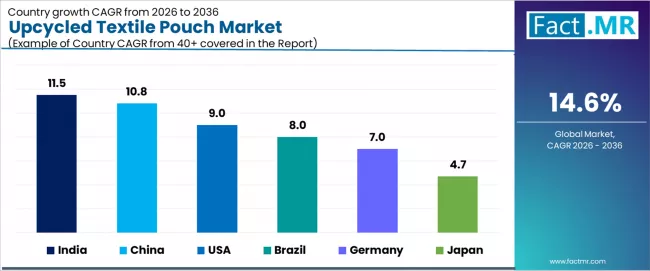
| Country | CAGR (2026-2036) |
|---|---|
| USA | 9.0% |
| Germany | 7.0% |
| China | 10.8% |
| India | 11.5% |
| Brazil | 8.0% |
| Japan | 4.7% |
How are USA’s Market Dynamics Shaped by Corporate Sustainability and DTC Brands?

The USA’s market grows at a 9.0% CAGR, significantly influenced by corporate sustainability pledges and the innovative drive of direct-to-consumer (DTC) brands. Companies across sectors seek upcycled pouches for employee gifts, product packaging, and event swag to meet internal ESG goals.
DTC brands in fashion and beauty leverage these pouches as a key point of differentiation and community building with environmentally aware customers. Development focuses on creating versatile, modular pouch designs that can be customized in smaller runs and on establishing partnerships with reliable waste textile aggregators.
- The demand for certified B Corp brands is creating a natural market for upcycled packaging solutions that verify social and environmental impact.
- Collaborations between pouch manufacturers and large apparel brands to utilize their own pre-consumer cutting waste are becoming more common.
Will Certified Processes and High-Quality Design Influence Upcycled Textile Pouch Sales in Germany?
Germany’s market advances at a 7.0% CAGR, where demand is coupled with a requirement for certified environmental management and meticulous design. Pouches must often comply with standards for recycled content and be designed for another lifecycle after their use as packaging.
Growth is steady in the premium retail and automotive sectors, particularly for luxury car accessories. The market favors high-quality construction, minimalist aesthetics, and clear documentation of the material’s origin and the production footprint.
- There is strong interest in cradle-to-cradle certification for pouches, ensuring they are designed for continuous material recovery.
- Development integrates smart labels with QR codes that detail the pouch’s upcycling journey, appealing to transparency-minded consumers.
Is China’s Growth Fueled by Manufacturing Scale and Green Policy Directives?
China’s market is projected to grow at a 10.8% CAGR, driven by its vast textile manufacturing base and national policies promoting circular economy initiatives. Growth is evident in retail packaging for domestic brands seeking a green edge and in export-oriented goods where sustainable packaging adds value. Development emphasizes creating efficient, large-scale systems to collect and process industrial textile scraps into uniform non-woven or woven fabrics suitable for automated pouch making.
- Government-led initiatives to reduce industrial waste are incentivizing manufacturers to find value in their textile off-cuts.
- E-commerce giants are exploring upcycled packaging options for premium merchants on their platforms as a value-added service.
Can India’s Market Leverage its Artisanal Heritage and Textile Industry Waste?
India demonstrates the highest growth potential at an 11.5% CAGR. The market uniquely blends large-scale textile waste from garment production with traditional artisan techniques like block printing. This allows for the creation of pouches with distinctive, handcrafted appeal at varying scales.
Growth is strong in promotional corporate gifting and for packaging indigenous handicrafts. Development focuses on decentralized models that connect waste collectors, small-scale converters, and artisan communities, creating rural employment while solving urban waste problems.
- The rise of social enterprises focused on upcycling is creating branded pouch lines that tell a specific social impact story.
- Blending traditional fabrics like khadi with reclaimed materials creates unique products with strong cultural and sustainable resonance.
How is Brazil’s Market Focused on Vibrant Design and Local Material Streams?
Brazil’s market is set to grow at an 8.0% CAGR, with a focus on vibrant, colorful designs that reflect local culture and the utilization of specific regional waste streams, such as upholstery or uniform fabrics. The handicraft and local markets segment is a significant driver, where upcycled pouches are sold as products in themselves.
Development often involves small-batch, creative production that highlights the unique character of the source materials, turning potential defects or variations into design features.
- Fashion and footwear brands are incorporating upcycled pouches made from their own production waste as part of limited-edition collections.
- There is growing use of pouches made from upcycled materials for packaging natural cosmetics and food products, emphasizing an overall eco-friendly brand ethos.
Does Japan’s Market Demand Minimalist Aesthetics and Technical Innovation?
Japan’s market grows at a 4.7% CAGR, where the concept of upcycling meets an extreme reverence for craftsmanship and minimalist design. Pouches are expected to be flawlessly constructed, with a focus on subtle textures and functional elegance. The market values innovative techniques that transform waste textiles into high-tech materials, such as ultra-thin, durable fabrics.
Development focuses on precision laser-cutting to minimize material waste during production and on creating designs that are both beautiful and multi-functional, aligning with space-conscious living.
- Luxury brands incorporate upcycled silk or high-end fabric scraps into exquisite pouches for watches and jewelry, emphasizing heritage and renewal.
- Research into chemical recycling of blended textile wastes to create new polymers for pouch components represents a high-tech approach to upcycling.
Competitive Landscape of the Upcycled Textile Pouch Market
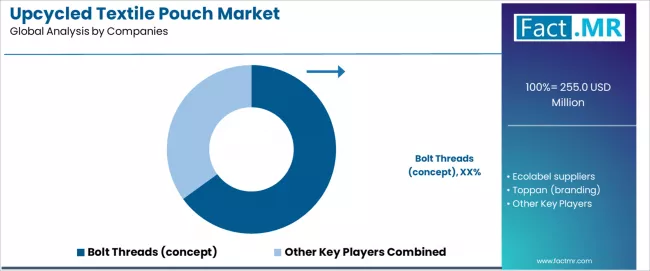
The competitive landscape is diverse, encompassing specialist upcycling startups, sustainable packaging converters, and traditional textile companies expanding into circular product lines. Competition centers on securing consistent and cost-effective access to quality waste feedstock, mastering the processing of variable input materials, and establishing brand partnerships built on trust and transparency.
Key players differentiate through proprietary cleaning and bonding technologies, unique design capabilities that highlight the origin of materials, and robust traceability systems. Success requires operating at the intersection of supply chain logistics, environmental science, and creative design, with companies that can reliably deliver both compelling stories and consistent product quality gaining a distinct advantage.
Key Players in the Upcycled Textile Pouch Market
- Toppan (branding)
- Bolt Threads (concept)
- Other ecolabel suppliers
Scope of the Report
| Items | Values |
|---|---|
| Quantitative Units (2026) | USD 255.0 Million |
| End-use/Application | Fashion & Luxury Gifting, Retail & Jewelry, Promotional & Corporate, Handicraft/Local Markets, Others |
| Packaging Format/Type | Reusable Fabric Pouches, Drawstring & Zip Pouches, Branded Pouches, Printed Textile Pouches, Others |
| Material | Reclaimed Textile / PET, Upcycled Cotton Blends, Reclaimed Polyester, Jute-textile Blends, Others |
| Technology | Ultrasonic Welding / Stitching, Laser-cutting, High-volume Sewing, Block-print & Sewing, Others |
| Regions Covered | North America, Europe, Asia Pacific, Latin America, MEA |
Upcycled Textile Pouch Market by Segments
-
End-use/Application :
- Fashion & Luxury Gifting
- Retail & Jewelry
- Promotional & Corporate
- Handicraft / Local Markets
- Others
-
Packaging Format/Type :
- Reusable Fabric Pouches
- Drawstring & Zip Pouches
- Branded Pouches
- Printed Textile Pouches
- Others
-
Material :
- Reclaimed Textile/PET
- Upcycled Cotton Blends
- Reclaimed Polyester
- Jute-textile Blends
- Others
-
Technology :
- Ultrasonic Welding / Stitching
- Laser-cutting
- High-volume Sewing
- Block-print & Sewing
- Others
-
Region :
-
North America
- USA
- Canada
- Mexico
-
Europe
- Germany
- UK
- France
- Italy
- Spain
- Rest of Europe
-
Asia Pacific
- China
- India
- Japan
- South Korea
- Australia
- Rest of Asia Pacific
-
Latin America
- Brazil
- Argentina
- Rest of Latin America
-
MEA
- Saudi Arabia
- UAE
- South Africa
- Rest of MEA
-
Table of Content
- Executive Summary
- Global Market Outlook
- Demand to side Trends
- Supply to side Trends
- Technology Roadmap Analysis
- Analysis and Recommendations
- Market Overview
- Market Coverage / Taxonomy
- Market Definition / Scope / Limitations
- Market Background
- Market Dynamics
- Drivers
- Restraints
- Opportunity
- Trends
- Scenario Forecast
- Demand in Optimistic Scenario
- Demand in Likely Scenario
- Demand in Conservative Scenario
- Opportunity Map Analysis
- Product Life Cycle Analysis
- Supply Chain Analysis
- Investment Feasibility Matrix
- Value Chain Analysis
- PESTLE and Porter’s Analysis
- Regulatory Landscape
- Regional Parent Market Outlook
- Production and Consumption Statistics
- Import and Export Statistics
- Market Dynamics
- Global Market Analysis 2021 to 2025 and Forecast, 2026 to 2036
- Historical Market Size Value (USD Million) Analysis, 2021 to 2025
- Current and Future Market Size Value (USD Million) Projections, 2026 to 2036
- Y to o to Y Growth Trend Analysis
- Absolute $ Opportunity Analysis
- Global Market Pricing Analysis 2021 to 2025 and Forecast 2026 to 2036
- Global Market Analysis 2021 to 2025 and Forecast 2026 to 2036, By End-use/Application
- Introduction / Key Findings
- Historical Market Size Value (USD Million) Analysis By End-use/Application, 2021 to 2025
- Current and Future Market Size Value (USD Million) Analysis and Forecast By End-use/Application, 2026 to 2036
- Fashion & Luxury Gifting
- Retail & Jewelry
- Promotional & Corporate
- Handicraft / Local Markets
- Others
- Y to o to Y Growth Trend Analysis By End-use/Application, 2021 to 2025
- Absolute $ Opportunity Analysis By End-use/Application, 2026 to 2036
- Global Market Analysis 2021 to 2025 and Forecast 2026 to 2036, By Packaging Format/Type
- Introduction / Key Findings
- Historical Market Size Value (USD Million) Analysis By Packaging Format/Type, 2021 to 2025
- Current and Future Market Size Value (USD Million) Analysis and Forecast By Packaging Format/Type, 2026 to 2036
- Reusable Fabric Pouches
- Drawstring & Zip Pouches
- Branded Pouches
- Printed Textile Pouches
- Others
- Y to o to Y Growth Trend Analysis By Packaging Format/Type, 2021 to 2025
- Absolute $ Opportunity Analysis By Packaging Format/Type, 2026 to 2036
- Global Market Analysis 2021 to 2025 and Forecast 2026 to 2036, By Material
- Introduction / Key Findings
- Historical Market Size Value (USD Million) Analysis By Material, 2021 to 2025
- Current and Future Market Size Value (USD Million) Analysis and Forecast By Material, 2026 to 2036
- Reclaimed Textile / PET
- Upcycled Cotton blends
- Reclaimed Polyester
- Jute-textile blends
- Others
- Y to o to Y Growth Trend Analysis By Material, 2021 to 2025
- Absolute $ Opportunity Analysis By Material, 2026 to 2036
- Global Market Analysis 2021 to 2025 and Forecast 2026 to 2036, By Technology
- Introduction / Key Findings
- Historical Market Size Value (USD Million) Analysis By Technology, 2021 to 2025
- Current and Future Market Size Value (USD Million) Analysis and Forecast By Technology, 2026 to 2036
- Ultrasonic Welding / Stitching
- Laser-cutting
- High-volume Sewing
- Block-print & sewing
- Others
- Y to o to Y Growth Trend Analysis By Technology, 2021 to 2025
- Absolute $ Opportunity Analysis By Technology, 2026 to 2036
- Global Market Analysis 2021 to 2025 and Forecast 2026 to 2036, By Region
- Introduction
- Historical Market Size Value (USD Million) Analysis By Region, 2021 to 2025
- Current Market Size Value (USD Million) Analysis and Forecast By Region, 2026 to 2036
- North America
- Latin America
- Western Europe
- Eastern Europe
- East Asia
- South Asia and Pacific
- Middle East & Africa
- Market Attractiveness Analysis By Region
- North America Market Analysis 2021 to 2025 and Forecast 2026 to 2036, By Country
- Historical Market Size Value (USD Million) Trend Analysis By Market Taxonomy, 2021 to 2025
- Market Size Value (USD Million) Forecast By Market Taxonomy, 2026 to 2036
- By Country
- USA
- Canada
- Mexico
- By End-use/Application
- By Packaging Format/Type
- By Material
- By Technology
- By Country
- Market Attractiveness Analysis
- By Country
- By End-use/Application
- By Packaging Format/Type
- By Material
- By Technology
- Key Takeaways
- Latin America Market Analysis 2021 to 2025 and Forecast 2026 to 2036, By Country
- Historical Market Size Value (USD Million) Trend Analysis By Market Taxonomy, 2021 to 2025
- Market Size Value (USD Million) Forecast By Market Taxonomy, 2026 to 2036
- By Country
- Brazil
- Chile
- Rest of Latin America
- By End-use/Application
- By Packaging Format/Type
- By Material
- By Technology
- By Country
- Market Attractiveness Analysis
- By Country
- By End-use/Application
- By Packaging Format/Type
- By Material
- By Technology
- Key Takeaways
- Western Europe Market Analysis 2021 to 2025 and Forecast 2026 to 2036, By Country
- Historical Market Size Value (USD Million) Trend Analysis By Market Taxonomy, 2021 to 2025
- Market Size Value (USD Million) Forecast By Market Taxonomy, 2026 to 2036
- By Country
- Germany
- UK
- Italy
- Spain
- France
- Nordic
- BENELUX
- Rest of Western Europe
- By End-use/Application
- By Packaging Format/Type
- By Material
- By Technology
- By Country
- Market Attractiveness Analysis
- By Country
- By End-use/Application
- By Packaging Format/Type
- By Material
- By Technology
- Key Takeaways
- Eastern Europe Market Analysis 2021 to 2025 and Forecast 2026 to 2036, By Country
- Historical Market Size Value (USD Million) Trend Analysis By Market Taxonomy, 2021 to 2025
- Market Size Value (USD Million) Forecast By Market Taxonomy, 2026 to 2036
- By Country
- Russia
- Poland
- Hungary
- Balkan & Baltic
- Rest of Eastern Europe
- By End-use/Application
- By Packaging Format/Type
- By Material
- By Technology
- By Country
- Market Attractiveness Analysis
- By Country
- By End-use/Application
- By Packaging Format/Type
- By Material
- By Technology
- Key Takeaways
- East Asia Market Analysis 2021 to 2025 and Forecast 2026 to 2036, By Country
- Historical Market Size Value (USD Million) Trend Analysis By Market Taxonomy, 2021 to 2025
- Market Size Value (USD Million) Forecast By Market Taxonomy, 2026 to 2036
- By Country
- China
- Japan
- South Korea
- By End-use/Application
- By Packaging Format/Type
- By Material
- By Technology
- By Country
- Market Attractiveness Analysis
- By Country
- By End-use/Application
- By Packaging Format/Type
- By Material
- By Technology
- Key Takeaways
- South Asia and Pacific Market Analysis 2021 to 2025 and Forecast 2026 to 2036, By Country
- Historical Market Size Value (USD Million) Trend Analysis By Market Taxonomy, 2021 to 2025
- Market Size Value (USD Million) Forecast By Market Taxonomy, 2026 to 2036
- By Country
- India
- ASEAN
- Australia & New Zealand
- Rest of South Asia and Pacific
- By End-use/Application
- By Packaging Format/Type
- By Material
- By Technology
- By Country
- Market Attractiveness Analysis
- By Country
- By End-use/Application
- By Packaging Format/Type
- By Material
- By Technology
- Key Takeaways
- Middle East & Africa Market Analysis 2021 to 2025 and Forecast 2026 to 2036, By Country
- Historical Market Size Value (USD Million) Trend Analysis By Market Taxonomy, 2021 to 2025
- Market Size Value (USD Million) Forecast By Market Taxonomy, 2026 to 2036
- By Country
- Kingdom of Saudi Arabia
- Other GCC Countries
- Turkiye
- South Africa
- Other African Union
- Rest of Middle East & Africa
- By End-use/Application
- By Packaging Format/Type
- By Material
- By Technology
- By Country
- Market Attractiveness Analysis
- By Country
- By End-use/Application
- By Packaging Format/Type
- By Material
- By Technology
- Key Takeaways
- Key Countries Market Analysis
- USA
- Pricing Analysis
- Market Share Analysis, 2025
- By End-use/Application
- By Packaging Format/Type
- By Material
- By Technology
- Canada
- Pricing Analysis
- Market Share Analysis, 2025
- By End-use/Application
- By Packaging Format/Type
- By Material
- By Technology
- Mexico
- Pricing Analysis
- Market Share Analysis, 2025
- By End-use/Application
- By Packaging Format/Type
- By Material
- By Technology
- Brazil
- Pricing Analysis
- Market Share Analysis, 2025
- By End-use/Application
- By Packaging Format/Type
- By Material
- By Technology
- Chile
- Pricing Analysis
- Market Share Analysis, 2025
- By End-use/Application
- By Packaging Format/Type
- By Material
- By Technology
- Germany
- Pricing Analysis
- Market Share Analysis, 2025
- By End-use/Application
- By Packaging Format/Type
- By Material
- By Technology
- UK
- Pricing Analysis
- Market Share Analysis, 2025
- By End-use/Application
- By Packaging Format/Type
- By Material
- By Technology
- Italy
- Pricing Analysis
- Market Share Analysis, 2025
- By End-use/Application
- By Packaging Format/Type
- By Material
- By Technology
- Spain
- Pricing Analysis
- Market Share Analysis, 2025
- By End-use/Application
- By Packaging Format/Type
- By Material
- By Technology
- France
- Pricing Analysis
- Market Share Analysis, 2025
- By End-use/Application
- By Packaging Format/Type
- By Material
- By Technology
- India
- Pricing Analysis
- Market Share Analysis, 2025
- By End-use/Application
- By Packaging Format/Type
- By Material
- By Technology
- ASEAN
- Pricing Analysis
- Market Share Analysis, 2025
- By End-use/Application
- By Packaging Format/Type
- By Material
- By Technology
- Australia & New Zealand
- Pricing Analysis
- Market Share Analysis, 2025
- By End-use/Application
- By Packaging Format/Type
- By Material
- By Technology
- China
- Pricing Analysis
- Market Share Analysis, 2025
- By End-use/Application
- By Packaging Format/Type
- By Material
- By Technology
- Japan
- Pricing Analysis
- Market Share Analysis, 2025
- By End-use/Application
- By Packaging Format/Type
- By Material
- By Technology
- South Korea
- Pricing Analysis
- Market Share Analysis, 2025
- By End-use/Application
- By Packaging Format/Type
- By Material
- By Technology
- Russia
- Pricing Analysis
- Market Share Analysis, 2025
- By End-use/Application
- By Packaging Format/Type
- By Material
- By Technology
- Poland
- Pricing Analysis
- Market Share Analysis, 2025
- By End-use/Application
- By Packaging Format/Type
- By Material
- By Technology
- Hungary
- Pricing Analysis
- Market Share Analysis, 2025
- By End-use/Application
- By Packaging Format/Type
- By Material
- By Technology
- Kingdom of Saudi Arabia
- Pricing Analysis
- Market Share Analysis, 2025
- By End-use/Application
- By Packaging Format/Type
- By Material
- By Technology
- Turkiye
- Pricing Analysis
- Market Share Analysis, 2025
- By End-use/Application
- By Packaging Format/Type
- By Material
- By Technology
- South Africa
- Pricing Analysis
- Market Share Analysis, 2025
- By End-use/Application
- By Packaging Format/Type
- By Material
- By Technology
- USA
- Market Structure Analysis
- Competition Dashboard
- Competition Benchmarking
- Market Share Analysis of Top Players
- By Regional
- By End-use/Application
- By Packaging Format/Type
- By Material
- By Technology
- Competition Analysis
- Competition Deep Dive
- Bolt Threads (concept)
- Overview
- Product Portfolio
- Profitability by Market Segments (Product/Age /Sales Channel/Region)
- Sales Footprint
- Strategy Overview
- Marketing Strategy
- Product Strategy
- Channel Strategy
- Ecolabel suppliers
- Toppan (branding)
- Bolt Threads (concept)
- Competition Deep Dive
- Assumptions & Acronyms Used
- Research Methodology
List Of Table
- Table 1: Global Market Value (USD Million) Forecast by Region, 2021 to 2036
- Table 2: Global Market Value (USD Million) Forecast by End-use/Application, 2021 to 2036
- Table 3: Global Market Value (USD Million) Forecast by Packaging Format/Type, 2021 to 2036
- Table 4: Global Market Value (USD Million) Forecast by Material, 2021 to 2036
- Table 5: Global Market Value (USD Million) Forecast by Technology, 2021 to 2036
- Table 6: North America Market Value (USD Million) Forecast by Country, 2021 to 2036
- Table 7: North America Market Value (USD Million) Forecast by End-use/Application, 2021 to 2036
- Table 8: North America Market Value (USD Million) Forecast by Packaging Format/Type, 2021 to 2036
- Table 9: North America Market Value (USD Million) Forecast by Material, 2021 to 2036
- Table 10: North America Market Value (USD Million) Forecast by Technology, 2021 to 2036
- Table 11: Latin America Market Value (USD Million) Forecast by Country, 2021 to 2036
- Table 12: Latin America Market Value (USD Million) Forecast by End-use/Application, 2021 to 2036
- Table 13: Latin America Market Value (USD Million) Forecast by Packaging Format/Type, 2021 to 2036
- Table 14: Latin America Market Value (USD Million) Forecast by Material, 2021 to 2036
- Table 15: Latin America Market Value (USD Million) Forecast by Technology, 2021 to 2036
- Table 16: Western Europe Market Value (USD Million) Forecast by Country, 2021 to 2036
- Table 17: Western Europe Market Value (USD Million) Forecast by End-use/Application, 2021 to 2036
- Table 18: Western Europe Market Value (USD Million) Forecast by Packaging Format/Type, 2021 to 2036
- Table 19: Western Europe Market Value (USD Million) Forecast by Material, 2021 to 2036
- Table 20: Western Europe Market Value (USD Million) Forecast by Technology, 2021 to 2036
- Table 21: Eastern Europe Market Value (USD Million) Forecast by Country, 2021 to 2036
- Table 22: Eastern Europe Market Value (USD Million) Forecast by End-use/Application, 2021 to 2036
- Table 23: Eastern Europe Market Value (USD Million) Forecast by Packaging Format/Type, 2021 to 2036
- Table 24: Eastern Europe Market Value (USD Million) Forecast by Material, 2021 to 2036
- Table 25: Eastern Europe Market Value (USD Million) Forecast by Technology, 2021 to 2036
- Table 26: East Asia Market Value (USD Million) Forecast by Country, 2021 to 2036
- Table 27: East Asia Market Value (USD Million) Forecast by End-use/Application, 2021 to 2036
- Table 28: East Asia Market Value (USD Million) Forecast by Packaging Format/Type, 2021 to 2036
- Table 29: East Asia Market Value (USD Million) Forecast by Material, 2021 to 2036
- Table 30: East Asia Market Value (USD Million) Forecast by Technology, 2021 to 2036
- Table 31: South Asia and Pacific Market Value (USD Million) Forecast by Country, 2021 to 2036
- Table 32: South Asia and Pacific Market Value (USD Million) Forecast by End-use/Application, 2021 to 2036
- Table 33: South Asia and Pacific Market Value (USD Million) Forecast by Packaging Format/Type, 2021 to 2036
- Table 34: South Asia and Pacific Market Value (USD Million) Forecast by Material, 2021 to 2036
- Table 35: South Asia and Pacific Market Value (USD Million) Forecast by Technology, 2021 to 2036
- Table 36: Middle East & Africa Market Value (USD Million) Forecast by Country, 2021 to 2036
- Table 37: Middle East & Africa Market Value (USD Million) Forecast by End-use/Application, 2021 to 2036
- Table 38: Middle East & Africa Market Value (USD Million) Forecast by Packaging Format/Type, 2021 to 2036
- Table 39: Middle East & Africa Market Value (USD Million) Forecast by Material, 2021 to 2036
- Table 40: Middle East & Africa Market Value (USD Million) Forecast by Technology, 2021 to 2036
List Of Figures
- Figure 1: Global Market Pricing Analysis
- Figure 2: Global Market Value (USD Million) Forecast 2021 to 2036
- Figure 3: Global Market Value Share and BPS Analysis by End-use/Application, 2026 and 2036
- Figure 4: Global Market Y to o to Y Growth Comparison by End-use/Application, 2026 to 2036
- Figure 5: Global Market Attractiveness Analysis by End-use/Application
- Figure 6: Global Market Value Share and BPS Analysis by Packaging Format/Type, 2026 and 2036
- Figure 7: Global Market Y to o to Y Growth Comparison by Packaging Format/Type, 2026 to 2036
- Figure 8: Global Market Attractiveness Analysis by Packaging Format/Type
- Figure 9: Global Market Value Share and BPS Analysis by Material, 2026 and 2036
- Figure 10: Global Market Y to o to Y Growth Comparison by Material, 2026 to 2036
- Figure 11: Global Market Attractiveness Analysis by Material
- Figure 12: Global Market Value Share and BPS Analysis by Technology, 2026 and 2036
- Figure 13: Global Market Y to o to Y Growth Comparison by Technology, 2026 to 2036
- Figure 14: Global Market Attractiveness Analysis by Technology
- Figure 15: Global Market Value (USD Million) Share and BPS Analysis by Region, 2026 and 2036
- Figure 16: Global Market Y to o to Y Growth Comparison by Region, 2026 to 2036
- Figure 17: Global Market Attractiveness Analysis by Region
- Figure 18: North America Market Incremental Dollar Opportunity, 2026 to 2036
- Figure 19: Latin America Market Incremental Dollar Opportunity, 2026 to 2036
- Figure 20: Western Europe Market Incremental Dollar Opportunity, 2026 to 2036
- Figure 21: Eastern Europe Market Incremental Dollar Opportunity, 2026 to 2036
- Figure 22: East Asia Market Incremental Dollar Opportunity, 2026 to 2036
- Figure 23: South Asia and Pacific Market Incremental Dollar Opportunity, 2026 to 2036
- Figure 24: Middle East & Africa Market Incremental Dollar Opportunity, 2026 to 2036
- Figure 25: North America Market Value Share and BPS Analysis by Country, 2026 and 2036
- Figure 26: North America Market Value Share and BPS Analysis by End-use/Application, 2026 and 2036
- Figure 27: North America Market Y to o to Y Growth Comparison by End-use/Application, 2026 to 2036
- Figure 28: North America Market Attractiveness Analysis by End-use/Application
- Figure 29: North America Market Value Share and BPS Analysis by Packaging Format/Type, 2026 and 2036
- Figure 30: North America Market Y to o to Y Growth Comparison by Packaging Format/Type, 2026 to 2036
- Figure 31: North America Market Attractiveness Analysis by Packaging Format/Type
- Figure 32: North America Market Value Share and BPS Analysis by Material, 2026 and 2036
- Figure 33: North America Market Y to o to Y Growth Comparison by Material, 2026 to 2036
- Figure 34: North America Market Attractiveness Analysis by Material
- Figure 35: North America Market Value Share and BPS Analysis by Technology, 2026 and 2036
- Figure 36: North America Market Y to o to Y Growth Comparison by Technology, 2026 to 2036
- Figure 37: North America Market Attractiveness Analysis by Technology
- Figure 38: Latin America Market Value Share and BPS Analysis by Country, 2026 and 2036
- Figure 39: Latin America Market Value Share and BPS Analysis by End-use/Application, 2026 and 2036
- Figure 40: Latin America Market Y to o to Y Growth Comparison by End-use/Application, 2026 to 2036
- Figure 41: Latin America Market Attractiveness Analysis by End-use/Application
- Figure 42: Latin America Market Value Share and BPS Analysis by Packaging Format/Type, 2026 and 2036
- Figure 43: Latin America Market Y to o to Y Growth Comparison by Packaging Format/Type, 2026 to 2036
- Figure 44: Latin America Market Attractiveness Analysis by Packaging Format/Type
- Figure 45: Latin America Market Value Share and BPS Analysis by Material, 2026 and 2036
- Figure 46: Latin America Market Y to o to Y Growth Comparison by Material, 2026 to 2036
- Figure 47: Latin America Market Attractiveness Analysis by Material
- Figure 48: Latin America Market Value Share and BPS Analysis by Technology, 2026 and 2036
- Figure 49: Latin America Market Y to o to Y Growth Comparison by Technology, 2026 to 2036
- Figure 50: Latin America Market Attractiveness Analysis by Technology
- Figure 51: Western Europe Market Value Share and BPS Analysis by Country, 2026 and 2036
- Figure 52: Western Europe Market Value Share and BPS Analysis by End-use/Application, 2026 and 2036
- Figure 53: Western Europe Market Y to o to Y Growth Comparison by End-use/Application, 2026 to 2036
- Figure 54: Western Europe Market Attractiveness Analysis by End-use/Application
- Figure 55: Western Europe Market Value Share and BPS Analysis by Packaging Format/Type, 2026 and 2036
- Figure 56: Western Europe Market Y to o to Y Growth Comparison by Packaging Format/Type, 2026 to 2036
- Figure 57: Western Europe Market Attractiveness Analysis by Packaging Format/Type
- Figure 58: Western Europe Market Value Share and BPS Analysis by Material, 2026 and 2036
- Figure 59: Western Europe Market Y to o to Y Growth Comparison by Material, 2026 to 2036
- Figure 60: Western Europe Market Attractiveness Analysis by Material
- Figure 61: Western Europe Market Value Share and BPS Analysis by Technology, 2026 and 2036
- Figure 62: Western Europe Market Y to o to Y Growth Comparison by Technology, 2026 to 2036
- Figure 63: Western Europe Market Attractiveness Analysis by Technology
- Figure 64: Eastern Europe Market Value Share and BPS Analysis by Country, 2026 and 2036
- Figure 65: Eastern Europe Market Value Share and BPS Analysis by End-use/Application, 2026 and 2036
- Figure 66: Eastern Europe Market Y to o to Y Growth Comparison by End-use/Application, 2026 to 2036
- Figure 67: Eastern Europe Market Attractiveness Analysis by End-use/Application
- Figure 68: Eastern Europe Market Value Share and BPS Analysis by Packaging Format/Type, 2026 and 2036
- Figure 69: Eastern Europe Market Y to o to Y Growth Comparison by Packaging Format/Type, 2026 to 2036
- Figure 70: Eastern Europe Market Attractiveness Analysis by Packaging Format/Type
- Figure 71: Eastern Europe Market Value Share and BPS Analysis by Material, 2026 and 2036
- Figure 72: Eastern Europe Market Y to o to Y Growth Comparison by Material, 2026 to 2036
- Figure 73: Eastern Europe Market Attractiveness Analysis by Material
- Figure 74: Eastern Europe Market Value Share and BPS Analysis by Technology, 2026 and 2036
- Figure 75: Eastern Europe Market Y to o to Y Growth Comparison by Technology, 2026 to 2036
- Figure 76: Eastern Europe Market Attractiveness Analysis by Technology
- Figure 77: East Asia Market Value Share and BPS Analysis by Country, 2026 and 2036
- Figure 78: East Asia Market Value Share and BPS Analysis by End-use/Application, 2026 and 2036
- Figure 79: East Asia Market Y to o to Y Growth Comparison by End-use/Application, 2026 to 2036
- Figure 80: East Asia Market Attractiveness Analysis by End-use/Application
- Figure 81: East Asia Market Value Share and BPS Analysis by Packaging Format/Type, 2026 and 2036
- Figure 82: East Asia Market Y to o to Y Growth Comparison by Packaging Format/Type, 2026 to 2036
- Figure 83: East Asia Market Attractiveness Analysis by Packaging Format/Type
- Figure 84: East Asia Market Value Share and BPS Analysis by Material, 2026 and 2036
- Figure 85: East Asia Market Y to o to Y Growth Comparison by Material, 2026 to 2036
- Figure 86: East Asia Market Attractiveness Analysis by Material
- Figure 87: East Asia Market Value Share and BPS Analysis by Technology, 2026 and 2036
- Figure 88: East Asia Market Y to o to Y Growth Comparison by Technology, 2026 to 2036
- Figure 89: East Asia Market Attractiveness Analysis by Technology
- Figure 90: South Asia and Pacific Market Value Share and BPS Analysis by Country, 2026 and 2036
- Figure 91: South Asia and Pacific Market Value Share and BPS Analysis by End-use/Application, 2026 and 2036
- Figure 92: South Asia and Pacific Market Y to o to Y Growth Comparison by End-use/Application, 2026 to 2036
- Figure 93: South Asia and Pacific Market Attractiveness Analysis by End-use/Application
- Figure 94: South Asia and Pacific Market Value Share and BPS Analysis by Packaging Format/Type, 2026 and 2036
- Figure 95: South Asia and Pacific Market Y to o to Y Growth Comparison by Packaging Format/Type, 2026 to 2036
- Figure 96: South Asia and Pacific Market Attractiveness Analysis by Packaging Format/Type
- Figure 97: South Asia and Pacific Market Value Share and BPS Analysis by Material, 2026 and 2036
- Figure 98: South Asia and Pacific Market Y to o to Y Growth Comparison by Material, 2026 to 2036
- Figure 99: South Asia and Pacific Market Attractiveness Analysis by Material
- Figure 100: South Asia and Pacific Market Value Share and BPS Analysis by Technology, 2026 and 2036
- Figure 101: South Asia and Pacific Market Y to o to Y Growth Comparison by Technology, 2026 to 2036
- Figure 102: South Asia and Pacific Market Attractiveness Analysis by Technology
- Figure 103: Middle East & Africa Market Value Share and BPS Analysis by Country, 2026 and 2036
- Figure 104: Middle East & Africa Market Value Share and BPS Analysis by End-use/Application, 2026 and 2036
- Figure 105: Middle East & Africa Market Y to o to Y Growth Comparison by End-use/Application, 2026 to 2036
- Figure 106: Middle East & Africa Market Attractiveness Analysis by End-use/Application
- Figure 107: Middle East & Africa Market Value Share and BPS Analysis by Packaging Format/Type, 2026 and 2036
- Figure 108: Middle East & Africa Market Y to o to Y Growth Comparison by Packaging Format/Type, 2026 to 2036
- Figure 109: Middle East & Africa Market Attractiveness Analysis by Packaging Format/Type
- Figure 110: Middle East & Africa Market Value Share and BPS Analysis by Material, 2026 and 2036
- Figure 111: Middle East & Africa Market Y to o to Y Growth Comparison by Material, 2026 to 2036
- Figure 112: Middle East & Africa Market Attractiveness Analysis by Material
- Figure 113: Middle East & Africa Market Value Share and BPS Analysis by Technology, 2026 and 2036
- Figure 114: Middle East & Africa Market Y to o to Y Growth Comparison by Technology, 2026 to 2036
- Figure 115: Middle East & Africa Market Attractiveness Analysis by Technology
- Figure 116: Global Market - Tier Structure Analysis
- Figure 117: Global Market - Company Share Analysis
- FAQs -
How big is the upcycled textile pouch market in 2026?
The global upcycled textile pouch market is estimated to be valued at USD 255.0 million in 2026.
What will be the size of upcycled textile pouch market in 2036?
The market size for the upcycled textile pouch market is projected to reach USD 995.1 million by 2036.
How much will be the upcycled textile pouch market growth between 2026 and 2036?
The upcycled textile pouch market is expected to grow at a 14.6% CAGR between 2026 and 2036.
What are the key product types in the upcycled textile pouch market?
The key product types in upcycled textile pouch market are fashion & luxury gifting, retail & jewelry, promotional & corporate, handicraft / local markets and others.
Which packaging format/type segment to contribute significant share in the upcycled textile pouch market in 2026?
In terms of packaging format/type, reusable fabric pouches segment to command 50.0% share in the upcycled textile pouch market in 2026.