Urology Supplements Market
Urology Supplements Market Size and Share Forecast Outlook 2026 to 2036
Urology supplements market is projected to grow from USD 2.1 billion in 2026 to USD 4.6 billion by 2036, at a CAGR of 8.4%. Multi-ingredient will dominate with a 61.3% market share, while urinary tract infections will lead the application segment with a 36.9% share.
Urology Supplements Market Forecast and Outlook 2026 to 2036
The global urology supplements market is set to grow from USD 2.05 billion in 2026 to USD 4.60 billion by 2036, adding USD 2.55 billion in new revenue and advancing at a CAGR of 8.4%. Growth is driven by escalating demand for urinary tract health management solutions, expanding preventive healthcare consciousness across aging populations, and accelerating natural remedy adoption requirements among health-conscious consumers seeking alternative therapeutic capabilities.
Key Takeaways from the Urology Supplements Market
- Urology Supplements Market Value (2026): USD 2.05 billion
- Urology Supplements Market Forecast Value (2036): USD 4.60 billion
- Urology Supplements Market Forecast CAGR: 8.4%
- Leading Type in Urology Supplements Market: Multi-ingredient (61.3%)
- Key Growth Regions in Urology Supplements Market: Asia Pacific, North America, and Europe
- Top Players in Urology Supplements Market: Theralogix, Nature's Bounty, Solaray, Puritan's Pride, Schiff Nutrition
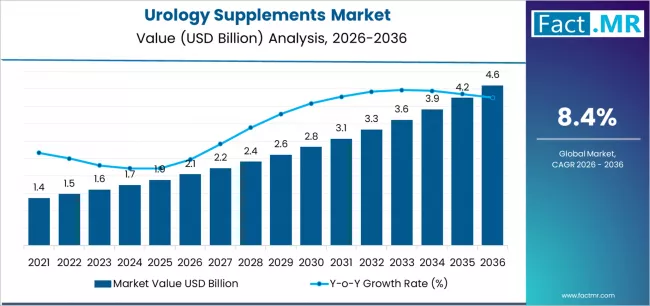
The first half of the decade will witness the market climbing from USD 2.05 billion to approximately USD 3.07 billion, adding USD 1.02 billion in value, which constitutes 40.0% of the total forecast growth period. This phase will be characterized by the continued dominance of multi-ingredient methodologies in urinary wellness settings, combined with accelerating adoption of cranberry-based technologies in UTI prevention applications where clinical validation and consumer familiarity create favorable compliance outcomes.
The latter half will witness sustained expansion from USD 3.07 billion to USD 4.60 billion, representing an addition of USD 1.53 billion or 60.0% of the decade's growth, defined by broadening acceptance of prostate health protocols and integration of e-commerce distribution platforms across mainstream supplement purchasing facilities.
Urology Supplements Market At-a-Glance Metrics
| Metric | Value |
|---|---|
| Market Value (2026) | USD 2.05 billion |
| Market Forecast (2036) | USD 4.60 billion |
| Growth Rate | 8.4% CAGR |
Category
| Category | Segments |
|---|---|
| Type | Multi-ingredient, Single ingredient |
| Application | Urinary Tract Infections, Kidney Health, Prostate Health, Bladder Health |
| Formulation | Capsules, Softgels, Tablets, Liquid, Others |
| Distribution Channel | Brick & Mortar, E-Commerce |
| Region | North America, Europe, Asia Pacific, Latin America, Middle East & Africa |
Segmental Analysis
By Type, Which Urology Supplements Category Captures the Largest Share?
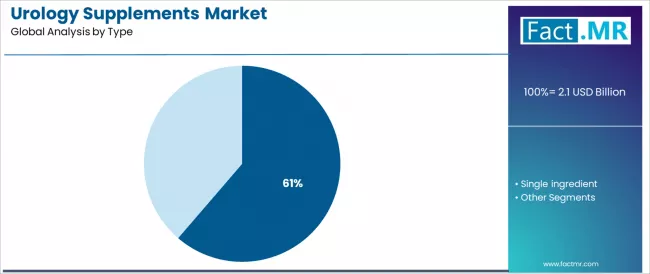
Multi-ingredient supplements command the leading position with a 61.3% share through superior synergistic benefit characteristics, including established comprehensive support presence, extensive multi-target action capabilities, and standardized convenience pathways that enable consumers to achieve predictable wellness outcomes across varied urological concerns and diverse health demographics.
The segment benefits from efficacy advantages through botanical synergy, comprehensive support without multiple product purchases, and established formulation frameworks without requiring extensive dosing complexity. Advanced multi-ingredient technology enables cranberry-D-mannose optimization, saw palmetto combination customization, and pumpkin seed blend variation, where ingredient compatibility and bioavailability represent critical wellness requirements.
Key market characteristics:
- Advanced synergistic properties with complementary ingredient action and enhanced bioavailability for comprehensive urological support
- Superior convenience factors, enabling single-product regimens and simplified dosing schedules for consumer applications
- Comprehensive target coverage, including multiple urological systems and preventive mechanisms for wellness optimization
Which is the Dominant Application Segment in the Urinary Supplements Market?
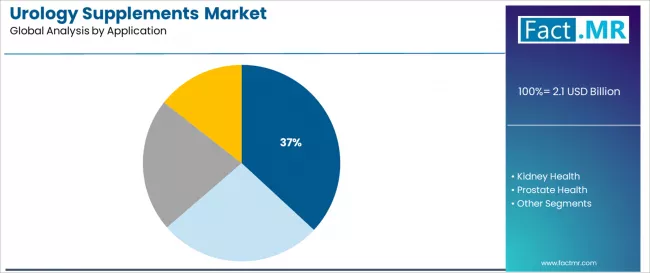
Urinary tract infections demonstrates application leadership with a 36.9% share due to widespread recurrent infection prevalence and established focus on antibiotic alternative seeking, natural prevention approaches, and symptom management that maximizes urinary comfort while maintaining consistent bladder health standards.
Consumers and healthcare providers prioritize UTI applications for high recurrence rates, antibiotic resistance concerns, and integration with established prevention strategies that enables coordinated wellness experiences across multiple infection episodes.
Which Formulation Category Occupies the Top Position in the Market?
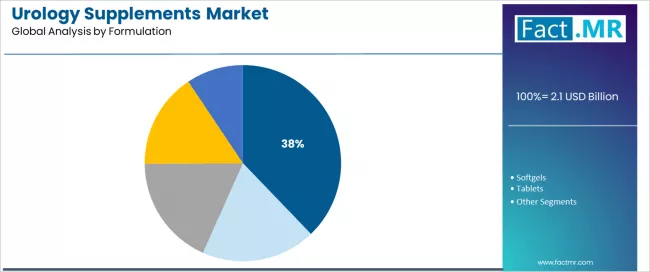
Capsules establish market leadership in the urology supplements sector with a 37.82% share due to comprehensive consumer preference requirements and sustained focus on easy swallowing, rapid dissolution, and taste masking that maximizes compliance while maintaining appropriate dosing convenience standards.
Consumers and retailers prioritize capsule formulations for manufacturing flexibility, ingredient stability protection, and integration with established supplement consumption habits that enables coordinated wellness experiences across multiple health categories.
Formulation dynamics include:
- Strong growth in delayed-release capsules requiring enteric coating technology and gastric bypass arrangements
- Increasing adoption in two-piece gelatin capsules for cost-effectiveness and manufacturing flexibility positioning
- Rising integration with pullulan capsules for oxygen barrier and moisture protection enhancement
What are the Drivers, Restraints, and Key Trends of the Urology Supplements Market?
The urology supplements market is supported by rising geriatric populations, growing preventive-health awareness, and expanding digital retail channels. Aging-related urological concerns strengthen demand for natural and supportive formulations, while self-care movements encourage consumers to adopt botanical and evidence-based wellness products. E-commerce expansion further increases accessibility, enabling wider product reach and consistent engagement through subscription models and educational platforms.
Growth is moderated by limited clinical validation, regulatory constraints, and competition from established pharmaceutical therapies. These factors create trust barriers for evidence-oriented consumers and restrict penetration in medically guided treatment pathways. Personalized nutrition, DNA-based recommendations, and microbiome-focused formulations are emerging as key trends that shift the category toward targeted, science-aligned solutions and support premium positioning within advanced wellness segments.
Analysis of the Urology Supplements Market by Key Countries

| Country | CAGR (2026-2036) |
|---|---|
| Brazil | 9.3% |
| China | 9.1% |
| USA | 8.5% |
| Saudi Arabia | 8.0% |
| Japan | 7.9% |
| Germany | 7.5% |
| UK | 7.3% |
How will Brazil’s Market for Urology Supplements Expand?
Brazil establishes middle-class health awareness through progressive urbanization expansion and comprehensive preventive healthcare adoption programs, positioning urology supplement technologies as essential wellness solutions in pharmacy retail channels and emerging e-commerce platforms.
The country's 9.3% growth rate reflects rising disposable income levels supporting supplement spending and growing natural health consciousness that encourages the deployment of botanical remedy solutions in diverse consumer settings. Growth concentrates in major urban centers, including São Paulo, Rio de Janeiro, and Brasília, where retail facilities showcase increasing capacity for premium supplement adoption that appeal to middle-class consumers demanding validated urinary health and preventive wellness outcomes.
How is Emphasis on Geriatric Care Elevating Urology Supplements Demand in China?
In China, health supplement retailers and e-commerce platforms are adopting advanced urology supplement technologies as essential preventive tools for aging population operations, driven by increasing government preventive health alignment with chronic disease management and elevation of natural remedy expectations that emphasize the importance of validated botanical supplementation.
With a 9.1% growth rate, expansion is supported by national healthy aging programs and traditional medicine integration that promote supplement adoption for elderly health applications. Consumers are favoring multi-ingredient platforms that provide comprehensive wellness capabilities and traditional herb integration evidence, particularly appealing in urban clusters where preventive care and quality of life represent critical aging factors.
How will the Urology Supplements Market expand in USA?
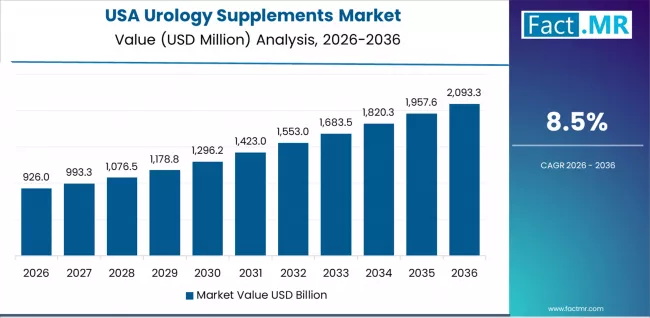
The urology supplements market in USA is influenced by comprehensive dietary supplement infrastructure and established FDA regulatory ecosystem, integrating urology supplement solutions across specialty retailers, mass-market channels, and online platforms. The country's 8.5% growth rate reflects established supplement industry maturity and sophisticated health-conscious consumer levels that support widespread deployment of validated botanical solutions in retail and direct-to-consumer applications.
Growth concentrates in established health-conscious regions, including California, Northeast, and Southwest, where retailers showcase advanced natural product adoption that appeals to wellness-focused consumers seeking predictable urinary health outcomes and comprehensive clinical documentation.
How will Urology Supplements Consumption rise in Saudi Arabia?
Saudi Arabia's developing wellness market demonstrates progressive urology supplement adoption with documented lifestyle disease emphasis in preventive health implementation and natural remedy protocol execution through specialized pharmacy chains and established healthcare retail organizations. The country maintains an 8.0% growth rate, leveraging growing healthcare infrastructure with increasing disposable income and wellness-focused lifestyle investment.
Major urban regions, including Riyadh, Jeddah, and Dammam, showcase healthcare modernization approaches where urology supplements integrate with established wellness cultures and comprehensive preventive care systems to optimize urological health and maintain quality of life under expanding healthcare access requirements.
How will the Focus on Geriatrics Generate Urology Supplements Demand in Japan?

Japan's market demonstrates sophisticated urology supplement integration with documented aging demographic emphasis in prostate health and natural remedy preference through specialized health food stores and established pharmacy networks. The country maintains a 7.9% growth rate, leveraging super-aged society demographics with high health consciousness and preventive care frameworks.
Premium retail regions, including Tokyo, Osaka, and Nagoya, showcase elderly wellness approaches where urology supplements integrate with established longevity cultures and meticulous quality systems to optimize urological function and ensure appropriate aging support.
How do Prospects Appear for the Market in Germany?
Germany demonstrates established urology product integration with documented regulatory emphasis in quality standards and efficacy validation through specialized health stores and established pharmacy channels. The country maintains a 7.5% growth rate, leveraging stringent BfArM oversight with evidence-based supplement frameworks.
Premium health regions, including Bavaria, North Rhine-Westphalia, and Baden-Württemberg, showcase quality assurance approaches where urology supplements integrate with established pharmaceutical cultures and thorough documentation practices to optimize safety compliance and ensure appropriate health claim substantiation.
How is Growing E-Commerce enhancing Outreach of Urology Supplements to Consumers in UK?
UK's evolving supplement market demonstrates progressive urology product adoption with documented online retail emphasis in direct-to-consumer delivery and natural health protocol execution through specialized e-commerce platforms and established health retailer organizations. The country maintains a 7.3% growth rate, leveraging high internet penetration with preventive health adoption and convenience-focused purchasing investment.
Major consumer regions, including England and Scotland, showcase digital commerce approaches where urology supplements integrate with established online shopping cultures and comprehensive product review systems to optimize purchase convenience and maintain quality assessment under MHRA regulatory requirements.
Competitive Landscape of the Urology Supplements Market

The urology supplements market exhibits a moderately fragmented competitive structure with approximately 80-120 active players operating across global dietary supplement networks and regional natural product portfolios.
This competitive landscape demonstrates the maturation of urology supplement technology, where established players leverage quality sourcing advantages, extensive healthcare practitioner relationship programs, and clinical research to maintain dominant positions, while emerging specialty brands and private label manufacturers create niche opportunities through innovative formulation offerings and competitive pricing strategies.
Market leadership is maintained through several critical competitive advantages extending beyond manufacturing capabilities and ingredient portfolios. Global distribution networks enable leading players to navigate diverse regulatory requirements and access varied consumer segments including UTI-prone women, aging men, and preventive health enthusiasts.
Clinical expertise and practitioner education program availability represent crucial differentiators in urology supplement categories, where years of urological health research, ingredient standardization protocols, and evidence generation frameworks create recommendation preference among quality-focused healthcare providers.
Manufacturing efficiency in GMP-certified facilities, raw material quality control, and supply chain botanical sourcing separate major brands from smaller competitors, while comprehensive clinical documentation addressing efficacy studies, safety profiles, and mechanism validation strengthen market position and consumer confidence.
Key Players in the Urology Supplements Market
- Theralogix LLC
- Nature's Bounty Co.
- Solaray Inc.
- Puritan's Pride Inc.
- Schiff Nutrition International Inc.
- Zahler LLC.
- Natrol, LLC.
- Biotexlife Technologies Pvt. Ltd.
- Himalaya Wellness Company
- Himalayan Organics
Scope of the Report
| Items | Values |
|---|---|
| Quantitative Units (2026) | USD 2.05 billion |
| Type | Multi-ingredient, Single ingredient |
| Application | Urinary Tract Infections, Kidney Health, Prostate Health, Bladder Health |
| Formulation | Capsules, Softgels, Tablets, Liquid, Others |
| Distribution Channel | Brick & Mortar, E-Commerce |
| Regions Covered | North America, Europe, Asia Pacific, Latin America, Middle East & Africa |
| Countries Covered | USA, China, Japan, Germany, UK, Brazil, Saudi Arabia, and 15+ additional countries |
| Key Companies Profiled | Theralogix, Nature's Bounty, Solaray, Puritan's Pride, Schiff Nutrition, ZAHLER, Natrol, LLC. |
| Additional Attributes | Dollar sales by type and application categories, regional adoption trends across North America, Asia Pacific, and Europe, competitive landscape with established supplement corporations and specialty urological health companies, consumer preferences for multi-ingredient methodologies and clinical evidence validation, integration with pharmacy retail facilities and e-commerce platforms, innovations in microbiome-targeted formulations and personalized supplement protocols, and development of sophisticated botanical combinations with enhanced bioavailability profiles and comprehensive clinical documentation frameworks. |
Urology Supplements Market by Segments
-
Type :
- Multi-ingredient
- Cranberry & D-mannose
- Saw Palmetto
- Pumpkin Seed Extract
- Beta-sitosterol
- Others
- Single ingredient
- Cranberry Extract
- D-mannose
- Zinc
- Pygeum Africanus
- Others
- Multi-ingredient
-
Application :
- Urinary Tract Infections
- Kidney Health
- Prostate Health
- Bladder Health
-
Formulation :
- Capsules
- Softgels
- Tablets
- Liquid
- Others
-
Distribution Channel :
- Brick & Mortar
- E-Commerce
-
Region :
- North America
- USA
- Canada
- Mexico
- Europe
- Germany
- France
- UK
- Italy
- Spain
- Rest of Europe
- Asia Pacific
- China
- Japan
- South Korea
- India
- ASEAN
- Australia & New Zealand
- Rest of Asia Pacific
- Latin America
- Brazil
- Rest of Latin America
- Middle East & Africa
- GCC Countries
- South Africa
- Rest of Middle East & Africa
- North America
Table of Content
- Executive Summary
- Global Market Outlook
- Demand to side Trends
- Supply to side Trends
- Technology Roadmap Analysis
- Analysis and Recommendations
- Market Overview
- Market Coverage / Taxonomy
- Market Definition / Scope / Limitations
- Market Background
- Market Dynamics
- Drivers
- Restraints
- Opportunity
- Trends
- Scenario Forecast
- Demand in Optimistic Scenario
- Demand in Likely Scenario
- Demand in Conservative Scenario
- Opportunity Map Analysis
- Product Life Cycle Analysis
- Supply Chain Analysis
- Investment Feasibility Matrix
- Value Chain Analysis
- PESTLE and Porter’s Analysis
- Regulatory Landscape
- Regional Parent Market Outlook
- Production and Consumption Statistics
- Import and Export Statistics
- Market Dynamics
- Global Market Analysis 2021 to 2025 and Forecast, 2026 to 2036
- Historical Market Size Value (USD Million) Analysis, 2021 to 2025
- Current and Future Market Size Value (USD Million) Projections, 2026 to 2036
- Y to o to Y Growth Trend Analysis
- Absolute $ Opportunity Analysis
- Global Market Pricing Analysis 2021 to 2025 and Forecast 2026 to 2036
- Global Market Analysis 2021 to 2025 and Forecast 2026 to 2036, By Type
- Introduction / Key Findings
- Historical Market Size Value (USD Million) Analysis By Type, 2021 to 2025
- Current and Future Market Size Value (USD Million) Analysis and Forecast By Type, 2026 to 2036
- Multi-ingredient
- Single ingredient
- Y to o to Y Growth Trend Analysis By Type, 2021 to 2025
- Absolute $ Opportunity Analysis By Type, 2026 to 2036
- Global Market Analysis 2021 to 2025 and Forecast 2026 to 2036, By Application
- Introduction / Key Findings
- Historical Market Size Value (USD Million) Analysis By Application, 2021 to 2025
- Current and Future Market Size Value (USD Million) Analysis and Forecast By Application, 2026 to 2036
- Urinary Tract Infections
- Kidney Health
- Prostate Health
- Bladder Health
- Y to o to Y Growth Trend Analysis By Application, 2021 to 2025
- Absolute $ Opportunity Analysis By Application, 2026 to 2036
- Global Market Analysis 2021 to 2025 and Forecast 2026 to 2036, By Formulation
- Introduction / Key Findings
- Historical Market Size Value (USD Million) Analysis By Formulation, 2021 to 2025
- Current and Future Market Size Value (USD Million) Analysis and Forecast By Formulation, 2026 to 2036
- Capsules
- Softgels
- Tablets
- Liquid
- Others
- Y to o to Y Growth Trend Analysis By Formulation, 2021 to 2025
- Absolute $ Opportunity Analysis By Formulation, 2026 to 2036
- Global Market Analysis 2021 to 2025 and Forecast 2026 to 2036, By Region
- Introduction
- Historical Market Size Value (USD Million) Analysis By Region, 2021 to 2025
- Current Market Size Value (USD Million) Analysis and Forecast By Region, 2026 to 2036
- North America
- Latin America
- Western Europe
- Eastern Europe
- East Asia
- South Asia and Pacific
- Middle East & Africa
- Market Attractiveness Analysis By Region
- North America Market Analysis 2021 to 2025 and Forecast 2026 to 2036, By Country
- Historical Market Size Value (USD Million) Trend Analysis By Market Taxonomy, 2021 to 2025
- Market Size Value (USD Million) Forecast By Market Taxonomy, 2026 to 2036
- By Country
- USA
- Canada
- Mexico
- By Type
- By Application
- By Formulation
- By Country
- Market Attractiveness Analysis
- By Country
- By Type
- By Application
- By Formulation
- Key Takeaways
- Latin America Market Analysis 2021 to 2025 and Forecast 2026 to 2036, By Country
- Historical Market Size Value (USD Million) Trend Analysis By Market Taxonomy, 2021 to 2025
- Market Size Value (USD Million) Forecast By Market Taxonomy, 2026 to 2036
- By Country
- Brazil
- Chile
- Rest of Latin America
- By Type
- By Application
- By Formulation
- By Country
- Market Attractiveness Analysis
- By Country
- By Type
- By Application
- By Formulation
- Key Takeaways
- Western Europe Market Analysis 2021 to 2025 and Forecast 2026 to 2036, By Country
- Historical Market Size Value (USD Million) Trend Analysis By Market Taxonomy, 2021 to 2025
- Market Size Value (USD Million) Forecast By Market Taxonomy, 2026 to 2036
- By Country
- Germany
- UK
- Italy
- Spain
- France
- Nordic
- BENELUX
- Rest of Western Europe
- By Type
- By Application
- By Formulation
- By Country
- Market Attractiveness Analysis
- By Country
- By Type
- By Application
- By Formulation
- Key Takeaways
- Eastern Europe Market Analysis 2021 to 2025 and Forecast 2026 to 2036, By Country
- Historical Market Size Value (USD Million) Trend Analysis By Market Taxonomy, 2021 to 2025
- Market Size Value (USD Million) Forecast By Market Taxonomy, 2026 to 2036
- By Country
- Russia
- Poland
- Hungary
- Balkan & Baltic
- Rest of Eastern Europe
- By Type
- By Application
- By Formulation
- By Country
- Market Attractiveness Analysis
- By Country
- By Type
- By Application
- By Formulation
- Key Takeaways
- East Asia Market Analysis 2021 to 2025 and Forecast 2026 to 2036, By Country
- Historical Market Size Value (USD Million) Trend Analysis By Market Taxonomy, 2021 to 2025
- Market Size Value (USD Million) Forecast By Market Taxonomy, 2026 to 2036
- By Country
- China
- Japan
- South Korea
- By Type
- By Application
- By Formulation
- By Country
- Market Attractiveness Analysis
- By Country
- By Type
- By Application
- By Formulation
- Key Takeaways
- South Asia and Pacific Market Analysis 2021 to 2025 and Forecast 2026 to 2036, By Country
- Historical Market Size Value (USD Million) Trend Analysis By Market Taxonomy, 2021 to 2025
- Market Size Value (USD Million) Forecast By Market Taxonomy, 2026 to 2036
- By Country
- India
- ASEAN
- Australia & New Zealand
- Rest of South Asia and Pacific
- By Type
- By Application
- By Formulation
- By Country
- Market Attractiveness Analysis
- By Country
- By Type
- By Application
- By Formulation
- Key Takeaways
- Middle East & Africa Market Analysis 2021 to 2025 and Forecast 2026 to 2036, By Country
- Historical Market Size Value (USD Million) Trend Analysis By Market Taxonomy, 2021 to 2025
- Market Size Value (USD Million) Forecast By Market Taxonomy, 2026 to 2036
- By Country
- Kingdom of Saudi Arabia
- Other GCC Countries
- Turkiye
- South Africa
- Other African Union
- Rest of Middle East & Africa
- By Type
- By Application
- By Formulation
- By Country
- Market Attractiveness Analysis
- By Country
- By Type
- By Application
- By Formulation
- Key Takeaways
- Key Countries Market Analysis
- USA
- Pricing Analysis
- Market Share Analysis, 2025
- By Type
- By Application
- By Formulation
- Canada
- Pricing Analysis
- Market Share Analysis, 2025
- By Type
- By Application
- By Formulation
- Mexico
- Pricing Analysis
- Market Share Analysis, 2025
- By Type
- By Application
- By Formulation
- Brazil
- Pricing Analysis
- Market Share Analysis, 2025
- By Type
- By Application
- By Formulation
- Chile
- Pricing Analysis
- Market Share Analysis, 2025
- By Type
- By Application
- By Formulation
- Germany
- Pricing Analysis
- Market Share Analysis, 2025
- By Type
- By Application
- By Formulation
- UK
- Pricing Analysis
- Market Share Analysis, 2025
- By Type
- By Application
- By Formulation
- Italy
- Pricing Analysis
- Market Share Analysis, 2025
- By Type
- By Application
- By Formulation
- Spain
- Pricing Analysis
- Market Share Analysis, 2025
- By Type
- By Application
- By Formulation
- France
- Pricing Analysis
- Market Share Analysis, 2025
- By Type
- By Application
- By Formulation
- India
- Pricing Analysis
- Market Share Analysis, 2025
- By Type
- By Application
- By Formulation
- ASEAN
- Pricing Analysis
- Market Share Analysis, 2025
- By Type
- By Application
- By Formulation
- Australia & New Zealand
- Pricing Analysis
- Market Share Analysis, 2025
- By Type
- By Application
- By Formulation
- China
- Pricing Analysis
- Market Share Analysis, 2025
- By Type
- By Application
- By Formulation
- Japan
- Pricing Analysis
- Market Share Analysis, 2025
- By Type
- By Application
- By Formulation
- South Korea
- Pricing Analysis
- Market Share Analysis, 2025
- By Type
- By Application
- By Formulation
- Russia
- Pricing Analysis
- Market Share Analysis, 2025
- By Type
- By Application
- By Formulation
- Poland
- Pricing Analysis
- Market Share Analysis, 2025
- By Type
- By Application
- By Formulation
- Hungary
- Pricing Analysis
- Market Share Analysis, 2025
- By Type
- By Application
- By Formulation
- Kingdom of Saudi Arabia
- Pricing Analysis
- Market Share Analysis, 2025
- By Type
- By Application
- By Formulation
- Turkiye
- Pricing Analysis
- Market Share Analysis, 2025
- By Type
- By Application
- By Formulation
- South Africa
- Pricing Analysis
- Market Share Analysis, 2025
- By Type
- By Application
- By Formulation
- USA
- Market Structure Analysis
- Competition Dashboard
- Competition Benchmarking
- Market Share Analysis of Top Players
- By Regional
- By Type
- By Application
- By Formulation
- Competition Analysis
- Competition Deep Dive
- Theralogix LLC
- Overview
- Product Portfolio
- Profitability by Market Segments (Product/Age /Sales Channel/Region)
- Sales Footprint
- Strategy Overview
- Marketing Strategy
- Product Strategy
- Channel Strategy
- Nature's Bounty Co.
- Solaray Inc.
- Puritan's Pride Inc.
- Schiff Nutrition International Inc.
- Zahler LLC
- Natrol, LLC.
- Biotexlife Technologies Pvt. Ltd.
- Himalaya Wellness Company
- Himalayan Organics
- Theralogix LLC
- Competition Deep Dive
- Assumptions & Acronyms Used
- Research Methodology
List Of Table
- Table 1: Global Market Value (USD Million) Forecast by Region, 2021 to 2036
- Table 2: Global Market Value (USD Million) Forecast by Type, 2021 to 2036
- Table 3: Global Market Value (USD Million) Forecast by Application, 2021 to 2036
- Table 4: Global Market Value (USD Million) Forecast by Formulation, 2021 to 2036
- Table 5: North America Market Value (USD Million) Forecast by Country, 2021 to 2036
- Table 6: North America Market Value (USD Million) Forecast by Type, 2021 to 2036
- Table 7: North America Market Value (USD Million) Forecast by Application, 2021 to 2036
- Table 8: North America Market Value (USD Million) Forecast by Formulation, 2021 to 2036
- Table 9: Latin America Market Value (USD Million) Forecast by Country, 2021 to 2036
- Table 10: Latin America Market Value (USD Million) Forecast by Type, 2021 to 2036
- Table 11: Latin America Market Value (USD Million) Forecast by Application, 2021 to 2036
- Table 12: Latin America Market Value (USD Million) Forecast by Formulation, 2021 to 2036
- Table 13: Western Europe Market Value (USD Million) Forecast by Country, 2021 to 2036
- Table 14: Western Europe Market Value (USD Million) Forecast by Type, 2021 to 2036
- Table 15: Western Europe Market Value (USD Million) Forecast by Application, 2021 to 2036
- Table 16: Western Europe Market Value (USD Million) Forecast by Formulation, 2021 to 2036
- Table 17: Eastern Europe Market Value (USD Million) Forecast by Country, 2021 to 2036
- Table 18: Eastern Europe Market Value (USD Million) Forecast by Type, 2021 to 2036
- Table 19: Eastern Europe Market Value (USD Million) Forecast by Application, 2021 to 2036
- Table 20: Eastern Europe Market Value (USD Million) Forecast by Formulation, 2021 to 2036
- Table 21: East Asia Market Value (USD Million) Forecast by Country, 2021 to 2036
- Table 22: East Asia Market Value (USD Million) Forecast by Type, 2021 to 2036
- Table 23: East Asia Market Value (USD Million) Forecast by Application, 2021 to 2036
- Table 24: East Asia Market Value (USD Million) Forecast by Formulation, 2021 to 2036
- Table 25: South Asia and Pacific Market Value (USD Million) Forecast by Country, 2021 to 2036
- Table 26: South Asia and Pacific Market Value (USD Million) Forecast by Type, 2021 to 2036
- Table 27: South Asia and Pacific Market Value (USD Million) Forecast by Application, 2021 to 2036
- Table 28: South Asia and Pacific Market Value (USD Million) Forecast by Formulation, 2021 to 2036
- Table 29: Middle East & Africa Market Value (USD Million) Forecast by Country, 2021 to 2036
- Table 30: Middle East & Africa Market Value (USD Million) Forecast by Type, 2021 to 2036
- Table 31: Middle East & Africa Market Value (USD Million) Forecast by Application, 2021 to 2036
- Table 32: Middle East & Africa Market Value (USD Million) Forecast by Formulation, 2021 to 2036
List Of Figures
- Figure 1: Global Market Pricing Analysis
- Figure 2: Global Market Value (USD Million) Forecast 2021 to 2036
- Figure 3: Global Market Value Share and BPS Analysis by Type, 2026 and 2036
- Figure 4: Global Market Y to o to Y Growth Comparison by Type, 2026 to 2036
- Figure 5: Global Market Attractiveness Analysis by Type
- Figure 6: Global Market Value Share and BPS Analysis by Application, 2026 and 2036
- Figure 7: Global Market Y to o to Y Growth Comparison by Application, 2026 to 2036
- Figure 8: Global Market Attractiveness Analysis by Application
- Figure 9: Global Market Value Share and BPS Analysis by Formulation, 2026 and 2036
- Figure 10: Global Market Y to o to Y Growth Comparison by Formulation, 2026 to 2036
- Figure 11: Global Market Attractiveness Analysis by Formulation
- Figure 12: Global Market Value (USD Million) Share and BPS Analysis by Region, 2026 and 2036
- Figure 13: Global Market Y to o to Y Growth Comparison by Region, 2026 to 2036
- Figure 14: Global Market Attractiveness Analysis by Region
- Figure 15: North America Market Incremental Dollar Opportunity, 2026 to 2036
- Figure 16: Latin America Market Incremental Dollar Opportunity, 2026 to 2036
- Figure 17: Western Europe Market Incremental Dollar Opportunity, 2026 to 2036
- Figure 18: Eastern Europe Market Incremental Dollar Opportunity, 2026 to 2036
- Figure 19: East Asia Market Incremental Dollar Opportunity, 2026 to 2036
- Figure 20: South Asia and Pacific Market Incremental Dollar Opportunity, 2026 to 2036
- Figure 21: Middle East & Africa Market Incremental Dollar Opportunity, 2026 to 2036
- Figure 22: North America Market Value Share and BPS Analysis by Country, 2026 and 2036
- Figure 23: North America Market Value Share and BPS Analysis by Type, 2026 and 2036
- Figure 24: North America Market Y to o to Y Growth Comparison by Type, 2026 to 2036
- Figure 25: North America Market Attractiveness Analysis by Type
- Figure 26: North America Market Value Share and BPS Analysis by Application, 2026 and 2036
- Figure 27: North America Market Y to o to Y Growth Comparison by Application, 2026 to 2036
- Figure 28: North America Market Attractiveness Analysis by Application
- Figure 29: North America Market Value Share and BPS Analysis by Formulation, 2026 and 2036
- Figure 30: North America Market Y to o to Y Growth Comparison by Formulation, 2026 to 2036
- Figure 31: North America Market Attractiveness Analysis by Formulation
- Figure 32: Latin America Market Value Share and BPS Analysis by Country, 2026 and 2036
- Figure 33: Latin America Market Value Share and BPS Analysis by Type, 2026 and 2036
- Figure 34: Latin America Market Y to o to Y Growth Comparison by Type, 2026 to 2036
- Figure 35: Latin America Market Attractiveness Analysis by Type
- Figure 36: Latin America Market Value Share and BPS Analysis by Application, 2026 and 2036
- Figure 37: Latin America Market Y to o to Y Growth Comparison by Application, 2026 to 2036
- Figure 38: Latin America Market Attractiveness Analysis by Application
- Figure 39: Latin America Market Value Share and BPS Analysis by Formulation, 2026 and 2036
- Figure 40: Latin America Market Y to o to Y Growth Comparison by Formulation, 2026 to 2036
- Figure 41: Latin America Market Attractiveness Analysis by Formulation
- Figure 42: Western Europe Market Value Share and BPS Analysis by Country, 2026 and 2036
- Figure 43: Western Europe Market Value Share and BPS Analysis by Type, 2026 and 2036
- Figure 44: Western Europe Market Y to o to Y Growth Comparison by Type, 2026 to 2036
- Figure 45: Western Europe Market Attractiveness Analysis by Type
- Figure 46: Western Europe Market Value Share and BPS Analysis by Application, 2026 and 2036
- Figure 47: Western Europe Market Y to o to Y Growth Comparison by Application, 2026 to 2036
- Figure 48: Western Europe Market Attractiveness Analysis by Application
- Figure 49: Western Europe Market Value Share and BPS Analysis by Formulation, 2026 and 2036
- Figure 50: Western Europe Market Y to o to Y Growth Comparison by Formulation, 2026 to 2036
- Figure 51: Western Europe Market Attractiveness Analysis by Formulation
- Figure 52: Eastern Europe Market Value Share and BPS Analysis by Country, 2026 and 2036
- Figure 53: Eastern Europe Market Value Share and BPS Analysis by Type, 2026 and 2036
- Figure 54: Eastern Europe Market Y to o to Y Growth Comparison by Type, 2026 to 2036
- Figure 55: Eastern Europe Market Attractiveness Analysis by Type
- Figure 56: Eastern Europe Market Value Share and BPS Analysis by Application, 2026 and 2036
- Figure 57: Eastern Europe Market Y to o to Y Growth Comparison by Application, 2026 to 2036
- Figure 58: Eastern Europe Market Attractiveness Analysis by Application
- Figure 59: Eastern Europe Market Value Share and BPS Analysis by Formulation, 2026 and 2036
- Figure 60: Eastern Europe Market Y to o to Y Growth Comparison by Formulation, 2026 to 2036
- Figure 61: Eastern Europe Market Attractiveness Analysis by Formulation
- Figure 62: East Asia Market Value Share and BPS Analysis by Country, 2026 and 2036
- Figure 63: East Asia Market Value Share and BPS Analysis by Type, 2026 and 2036
- Figure 64: East Asia Market Y to o to Y Growth Comparison by Type, 2026 to 2036
- Figure 65: East Asia Market Attractiveness Analysis by Type
- Figure 66: East Asia Market Value Share and BPS Analysis by Application, 2026 and 2036
- Figure 67: East Asia Market Y to o to Y Growth Comparison by Application, 2026 to 2036
- Figure 68: East Asia Market Attractiveness Analysis by Application
- Figure 69: East Asia Market Value Share and BPS Analysis by Formulation, 2026 and 2036
- Figure 70: East Asia Market Y to o to Y Growth Comparison by Formulation, 2026 to 2036
- Figure 71: East Asia Market Attractiveness Analysis by Formulation
- Figure 72: South Asia and Pacific Market Value Share and BPS Analysis by Country, 2026 and 2036
- Figure 73: South Asia and Pacific Market Value Share and BPS Analysis by Type, 2026 and 2036
- Figure 74: South Asia and Pacific Market Y to o to Y Growth Comparison by Type, 2026 to 2036
- Figure 75: South Asia and Pacific Market Attractiveness Analysis by Type
- Figure 76: South Asia and Pacific Market Value Share and BPS Analysis by Application, 2026 and 2036
- Figure 77: South Asia and Pacific Market Y to o to Y Growth Comparison by Application, 2026 to 2036
- Figure 78: South Asia and Pacific Market Attractiveness Analysis by Application
- Figure 79: South Asia and Pacific Market Value Share and BPS Analysis by Formulation, 2026 and 2036
- Figure 80: South Asia and Pacific Market Y to o to Y Growth Comparison by Formulation, 2026 to 2036
- Figure 81: South Asia and Pacific Market Attractiveness Analysis by Formulation
- Figure 82: Middle East & Africa Market Value Share and BPS Analysis by Country, 2026 and 2036
- Figure 83: Middle East & Africa Market Value Share and BPS Analysis by Type, 2026 and 2036
- Figure 84: Middle East & Africa Market Y to o to Y Growth Comparison by Type, 2026 to 2036
- Figure 85: Middle East & Africa Market Attractiveness Analysis by Type
- Figure 86: Middle East & Africa Market Value Share and BPS Analysis by Application, 2026 and 2036
- Figure 87: Middle East & Africa Market Y to o to Y Growth Comparison by Application, 2026 to 2036
- Figure 88: Middle East & Africa Market Attractiveness Analysis by Application
- Figure 89: Middle East & Africa Market Value Share and BPS Analysis by Formulation, 2026 and 2036
- Figure 90: Middle East & Africa Market Y to o to Y Growth Comparison by Formulation, 2026 to 2036
- Figure 91: Middle East & Africa Market Attractiveness Analysis by Formulation
- Figure 92: Global Market - Tier Structure Analysis
- Figure 93: Global Market - Company Share Analysis
- FAQs -
How big is the urology supplements market in 2026?
The global urology supplements market is estimated to be valued at USD 2.1 billion in 2026.
What will be the size of urology supplements market in 2036?
The market size for the urology supplements market is projected to reach USD 4.6 billion by 2036.
How much will be the urology supplements market growth between 2026 and 2036?
The urology supplements market is expected to grow at a 8.4% CAGR between 2026 and 2036.
What are the key product types in the urology supplements market?
The key product types in urology supplements market are multi-ingredient and single ingredient .
Which application segment to contribute significant share in the urology supplements market in 2026?
In terms of application, urinary tract infections segment to command 36.9% share in the urology supplements market in 2026.