- Base Value(2025): 5.7 Bn
- Estimated Value(2026): 6.9 Bn
- Forecast Value (2036): 47.7 Bn
- CAGR (2026 - 2036): 21.3%
Subscription-Based Automotive Feature Platform Market Analysis and Forecast by Fact.MR
- The Subscription-Based Automotive Feature Platform Market is expected to grow from USD 6.9 billion in 2026 to USD 47.7 billion by 2036, at a 21.3% CAGR.
- Driven by OEM transition to software-defined vehicle architectures enabling over-the-air feature delivery, growing consumer acceptance of pay-per-use and subscription-based vehicle feature models, and expanding connected service ecosystems that generate recurring revenue beyond vehicle purchase.
- With connected vehicle subscription features accounting for 79.2% share and passenger vehicle applications contributing 36.8% share as manufacturers prioritize post-sale monetization, customer lifetime value, and digital service differentiation.
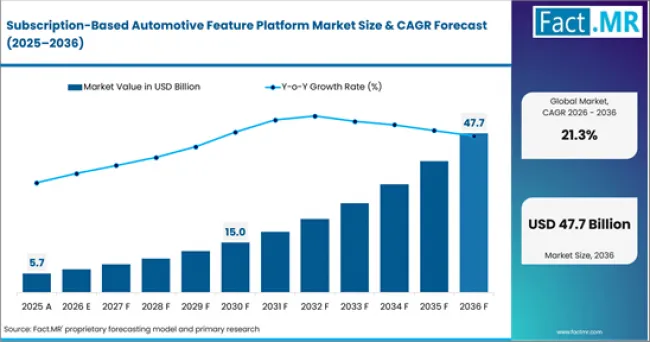
Subscription Based Automotive Feature Platform Market Value Analysis | Source: Fact.MR
Summary of the Subscription-Based Automotive Feature Platform Market
- Market Snapshot
- In 2025, the global Subscription-Based Automotive Feature Platform Market was valued at approximately USD 5.7 billion.
- The market is estimated to reach USD 6.9 billion in 2026 and is projected to attain USD 47.7 billion by 2036.
- The subscription-based automotive feature platform market is likely to expand at a CAGR of 21.3% during the forecast period.
- The market is anticipated to create an absolute dollar opportunity of USD 40.8 billion between 2026 and 2036.
- Connected vehicle subscription features account for 79.2% of product segment share in 2026.
- Japan (23.2%) and USA (22.5%) are the key growth markets during the forecast period.
- Demand and Growth Drivers
- By the way, Tesla, Inc., BMW, Mercedes-Benz and GM have adopted software-defined vehicle architecture, enabling them to activate features after purchase via over-the-air updates. This is the technical foundation for subscription-based feature delivery.
- OEMs are focusing on creating recurring revenue streams beyond the single sale of a vehicle, which is driving investment in subscription models. Monthly and annual subscription income is being created from connected services, ADAS feature tiers and performance upgrades.
- Younger vehicle buyers are more likely to embrace automotive feature subscriptions because they are used to subscription models from streaming, software and mobile services.
- The delivery infrastructure for remote feature activation and subscription management is provided by connected vehicle penetration.
- “Fleet management operators are embracing subscription telematics, safety and compliance feature packages that can be deployed across fleets of vehicles without the need to visit a physical dealer.
- Product and Segment View
- Connected vehicle subscription features such as navigation, remote access, streaming entertainment, safety monitoring and telematics services, will dominate the product segment at 79.2% by 2026.
- The passenger vehicle application segment is estimated to hold 36.8% of the application segment in 2026 with premium vehicle owners having the highest subscription attachment rates.
- The formulation segment is dominated by Software-as-a-Service platforms (71.6%), reflecting the cloud-native architecture of automotive subscription delivery and management systems.
- Key segmentation includes:
- Product: Connected Vehicle Subscription Features, Autonomous Driving Feature Subscriptions, Infotainment Subscription Features, Performance Enhancement Subscriptions
- Application: Passenger Vehicle Applications, Commercial Vehicle Applications, Electric Vehicle Applications, Mobility Service Applications
- End Use: Automotive OEMs, Fleet Operators, Mobility Service Providers, Technology Service Providers
- Distribution Channel: OEM Direct Distribution, Connected Vehicle App Stores, Dealer-Activated Subscriptions, Fleet Management Platforms
- These platforms enable:
- Over-the-air software updates for post-purchase feature activation, no hardware changes or dealer visits required
- OEMs derive recurring revenue through monthly and annual subscription fees for connected, safety and performance features.
- Dynamic feature management and the ability to upgrade, downgrade or transfer vehicle capabilities between vehicles within an OEM ecosystem
- Geography and Competitive Outlook
- Japan leads growth at 23.2%, supported by Toyota, Honda, and Nissan investment in connected vehicle platforms and strong consumer adoption of digital subscription services.
- The USA at 22.5% reflects GM OnStar ecosystem maturity, Tesla, Inc. subscription model leadership, and Ford connected services expansion across the vehicle lineup.
- UK at 22.1% and Germany at 20.6% reflect premium OEM subscription feature adoption by BMW, Mercedes-Benz, and Jaguar Land Rover across European connected vehicle platforms.
- Key players include Tesla, Inc., BMW, General Motors (OnStar), Ford, Toyota, and Volkswagen.
- Analyst Opinion
- Shambhu Nath Jha, Principal Consultant at Fact.MR, says "The subscription-based automotive feature platform market represents the most significant business model transformation in the automotive industry in decades. OEMs are shifting from a one-time transaction model to a recurring revenue relationship with vehicle owners, and software-defined vehicle architectures make this technically feasible at scale. The critical success factor is consumer value perception. Subscriptions that deliver continuous utility, such as real-time navigation and safety monitoring, show strong retention. Feature subscriptions that gate pre-installed hardware, such as heated seats or performance modes, face consumer backlash and regulatory scrutiny. The market will bifurcate between high-retention service subscriptions and contested hardware-gating models."
Key Growth Drivers, Constraints, and Opportunities
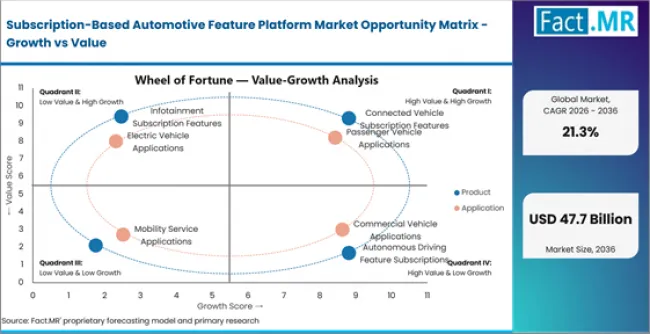
Subscription Based Automotive Feature Platform Market Opportunity Matrix Growth Vs Value | Source: Fact.MR
Key Factors Driving Growth
- Tesla, Inc. has shown that software-defined vehicle features can deliver high-margin recurring revenue. Full Self-Driving subscription prices of USD 99 to USD 199 per month have set a premium benchmark that other OEMs are chasing with their own ADAS subscription tiers.
- BMW, Mercedes-Benz and GM have launched connected service subscription programs that bundle navigation, remote access, safety monitoring and entertainment features into monthly packages that generate USD 10 to USD 25 per vehicle per month in recurring revenue.
- Fleet management operators are increasingly utilizing feature subscriptions that allow them to centrally enable telematics, safety and compliance features across their vehicle fleets without requiring individual dealer visits for each vehicle.
Key Market Constraints
- The backlash from consumers on hardware-gating subscription models, where features like heated seats are pre-installed but require an ongoing subscription fee, leads to negative brand perception and regulatory scrutiny in several markets.
- 30 to 50% subscription churn rates after free trial periods suggest that many consumers don’t see enough continued value to maintain paid subscriptions beyond initial novelty periods.
- In the EU and some states in the USA regulatory frameworks are emerging that could see hardware-gating subscriptions as unfair commercial practice, and this creates legal ambiguity for OEM subscription strategies.
Key Opportunity Areas
- ADAS subscription tiers that deliver progressively higher levels of automated driving capability are the highest-value subscription category, with per-vehicle monthly revenues 5 to 10 times higher than basic connected service packages.
- The use of telematics data from connected vehicles for usage-based insurance pricing, embedded in feature subscriptions, enables co-branded subscription offerings that add value for both the OEM and insurance partners.
- The monetization window can be extended beyond the first-owner lifecycle by used vehicle subscription transfer programs where the subscription features transfer from the vehicle through ownership changes.
Segment-wise Analysis of the Subscription-Based Automotive Feature Platform Market
- Connected vehicle subscription features have the widest range of features from navigation and remote access to entertainment and safety monitoring in 2026, with a share of 79.2%.
- In 2026, passenger vehicles applications will account for 36.8% share of the application segment. The premium and luxury segment vehicles exhibit the highest subscription attachment and retention rates.
- Direct distribution through OEMs makes up 57.3% of the distribution channel, which indicates the direct relationship between vehicle manufacturers and subscription customers through branded mobile applications.
The market segmentation is based on product type, application, end use, technology, formulation, distribution channel and region. Connected vehicle subscriptions are the most prevalent due to the most complete feature set and the longest market presence through programs such as GM OnStar, which pioneered connected vehicle services.
Which Product Segment Dominates the Subscription-Based Automotive Feature Platform Market?
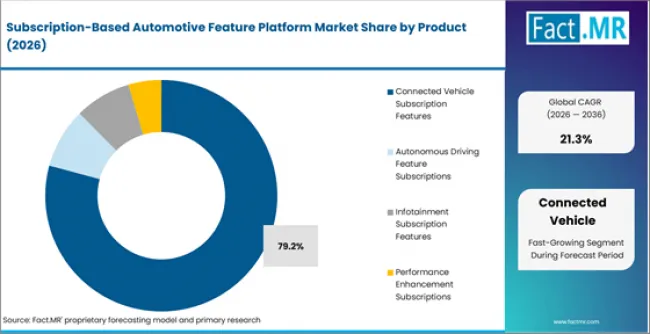
Subscription Based Automotive Feature Platform Market Analysis By Product | Source: Fact.MR
Connected vehicle subscription features make up 79.2% of the product segment in 2026. Their dominance is a testament to the wide applicability of connected services across all vehicle segments and the market presence of established programs such as GM OnStar, BMW ConnectedDrive and Mercedes me connect. These subscriptions bundle real-time navigation, remote vehicle access, emergency services, stolen vehicle tracking and Wi-Fi hotspot capabilities into monthly or annual packages.
ADAS feature subscriptions are the fastest growing sub-segment with Tesla, Inc. Full Self-Driving and GM Super Cruise setting the premium pricing benchmarks. Powertrain and performance subscriptions are a niche space where OEMs offer power output upgrades, exhaust sound profiles and suspension tuning through software activation. Connected vehicle subscriptions are expected to remain dominant as the underlying subscription layer most vehicle owners experience first.
Which Application Segment Dominates the Subscription-Based Automotive Feature Platform Market?
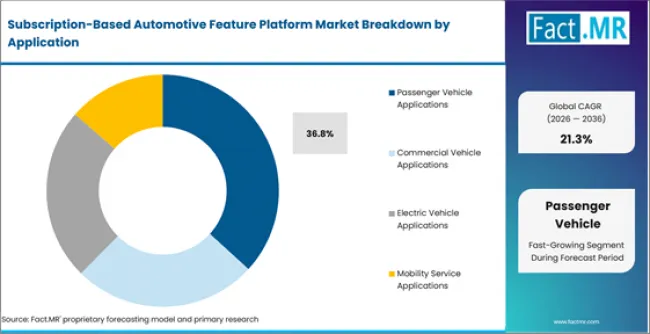
Subscription Based Automotive Feature Platform Market Analysis By Application | Source: Fact.MR
The passenger vehicle applications segment held the largest share of 36.8% in 2026. Premium and luxury vehicle owners have the highest subscription attachment rates. BMW, Mercedes-Benz, and Tesla, Inc. have attachment rates above 50% for basic connected service packages in the first year of ownership. Mass market passenger cars have lower attach rates but greater total volume potential as OEMs roll out subscriptions across wider model ranges.
The second largest segment is fleet and commercial applications where telematics and safety feature subscriptions provide a clear ROI for fleet operators. Luxury and performance vehicle applications are the largest subscription revenue generators per vehicle through ADAS and performance feature packages. Shared mobility applications are coming into play as connected vehicle features become commonplace for ride-hailing and car-sharing platforms.
Which Product Trend is Shaping the Next Phase of Growth in the Subscription-Based Automotive Feature Platform Market?
Software-defined vehicle (SDV) architecture adoption is the foundational technology trend enabling the subscription-based feature market. SDV architecture centralizes vehicle computing onto high-performance domain controllers that run software applications managing everything from ADAS functions to climate control. This architecture enables features to be added, modified, or removed through over-the-air software updates without physical hardware changes, creating the technical foundation for post-purchase feature subscription delivery.
The commercial implications are transformative. With SDV architecture, vehicles become upgradeable platforms instead of fixed-specification products, enabling OEMs to generate revenue across the vehicle lifecycle. A vehicle sold with the basic feature specification can be upgraded to premium features through subscription activation months or years after the vehicle is purchased. This changes the OEM revenue relationship from a one-time sale at the point of purchase to a multi-year recurring revenue stream. OEMs betting on SDV architecture including Volkswagen’s CARIAD software unit and GM’s Ultifi platform are building out the infrastructure to scale subscription revenue across millions of connected vehicles.
Regional Outlook Across Key Markets
- Japan leads growth at 23.2%, supported by Toyota Connected Services expansion, Honda connected vehicle platform investment, and strong consumer digital subscription adoption culture.
- The USA at 22.5% reflects GM OnStar ecosystem maturity with over 30 million connected vehicles, Tesla, Inc. subscription model leadership, and Ford connected services expansion across the full vehicle lineup.
- UK at 22.1% reflects premium OEM subscription adoption by BMW, Mercedes-Benz, and Jaguar Land Rover across the UK vehicle parc, with high connected vehicle penetration supporting feature delivery.
- Germany at 20.6% is driven by Volkswagen CARIAD SDV platform investment, BMW ConnectedDrive subscription expansion, and Mercedes me connect premium feature delivery.
.webp "Top Country Growth Comparison Subscription Based Automotive Feature Platform Market Cagr (2026 2036)")
Top Country Growth Comparison Subscription Based Automotive Feature Platform Market Cagr (2026 2036) | Source: Fact.MR
| Country | CAGR (%) |
|---|---|
| Japan | 23.2% |
| USA | 22.5% |
| UK | 22.1% |
| Germany | 20.6% |
| China | 19.8% |
Source: Fact.MR analysis. Updated Jun 13, 2026
Source: Fact.MR analysis, based on proprietary forecasting model and primary research.
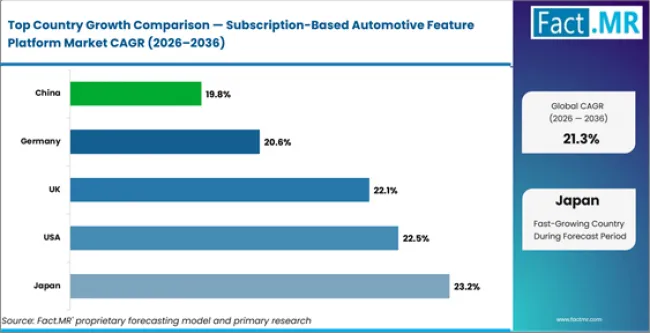
Subscription Based Automotive Feature Platform Market Cagr Analysis By Country | Source: Fact.MR
Market Outlook for Subscription-Based Automotive Feature Platforms in the United States
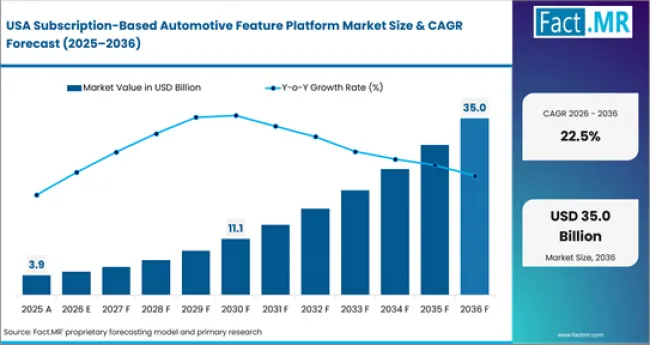
Subscription Based Automotive Feature Platform Market Country Value Analysis | Source: Fact.MR
The U.S. market is expected to grow at a CAGR of 22.5% through 2036. GM OnStar is the most mature connected vehicle subscription platform with more than 30 million connected vehicles generating recurring service revenue. Tesla, Inc. Full Self-Driving subscription sets the premium pricing benchmark for ADAS features. Ford, Stellantis and Hyundai are expanding subscription programs across their North American lineups, with CHIPS Act semiconductor investment supporting the connected vehicle hardware infrastructure needed to deliver features.
- Largest existing subscription base with 30+ million connected vehicles and recurring monthly revenue across safety, navigation and remote access features through maturity of the GM OnStar ecosystem.
- The benchmark for premium ADAS subscription pricing that other OEMs are targeting is the Tesla, Inc. Full Self-Driving subscription at USD 99 to USD 199 monthly.
Subscription-Based Automotive Feature Platform Demand in Japan
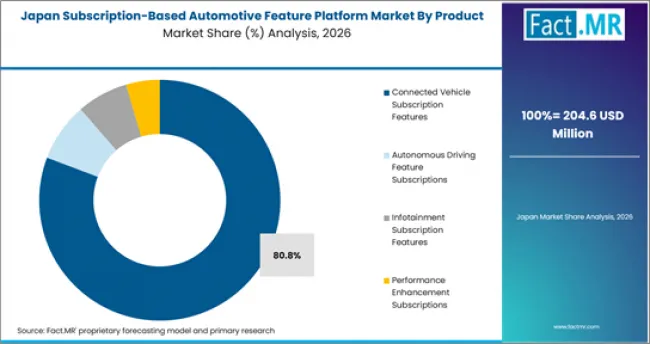
Subscription Based Automotive Feature Platform Market Japan Market Share Analysis By Product | Source: Fact.MR
Japan is at a 23.2% CAGR through 2036, with strong culture of consumer digital subscription adoption. Toyota Connected Services and Honda are investing in connected platforms, expanding feature subscription availability across mass-market vehicle lineups. The readiness of Japanese consumers to pay for quality and convenience provides fertile ground for the adoption of premium subscription features. Domestic semiconductor and software capabilities underpin connected vehicle platform development.
- Toyota Connected Services Expanding Across Corolla, RAV4 and Crown Platforms to Scale Access to Subscription Features from Premium to Mass-Market Vehicle Segments
- Japanese consumer culture of paying for quality digital services results in higher subscription retention rates over markets where free service expectations are more pronounced.
United Kingdom Subscription-Based Automotive Feature Platform Growth
The UK is poised for 22.1% CAGR through 2036, driven by high connected vehicle penetration and concentration of premium OEMs. BMW ConnectedDrive, Mercedes me connect and Jaguar Land Rover InControl subscriptions are addressing a vehicle parc that has a good premium segment representation. The way the rules are set post-Brexit is changing how car subscription features are treated in terms of consumer protection. That could have an impact on how the subscription model is designed.
- UK vehicle parc premium OEM focus is resulting in above average subscription attachment rates on BMW, Mercedes-Benz and Audi connected feature programs.
- In the post Brexit world, consumer protection regimes may introduce rules on subscription automotive features and their impact on OEM pricing and cancellation policies.
Germany Subscription-Based Automotive Feature Platform Market Analysis
Volkswagen CARIAD SDV platform investment and BMW and Mercedes-Benz subscription program expansion define the German market at a CAGR of 20.6% through 2036. Subscription design is subject to EU consumer protection rules, and hardware-gating models are particularly in the spotlight. Industry 4.0 Manufacturing Capabilities support production of SDV-enabled vehicles with the computing hardware needed to deliver subscription features.
- With the investment in the Volkswagen CARIAD software unit, the group is in a position to offer subscription functions across VW, Audi, Porsche and Skoda platforms via a common SDV architecture.
- EU consumer protection scrutiny of hardware-gating subscription models is starting to affect German OEM subscription strategy away from hardware-access models and toward service-based ones.
China Subscription-Based Automotive Feature Platform Demand Trends
Supported by domestic EV manufacturers such as NIO, Xpeng and Li Auto, who are building subscription ecosystems that include battery-as-a-service, ADAS feature tiers and connected entertainment packages, the China market is expected to grow at a 19.8% CAGR through 2036. Understanding the Chinese consumer digital payment infrastructure and super-app ecosystem reduces friction for in-vehicle subscription activation. Programs for technology self-sufficiency promote the development of domestic platforms for connected vehicles.
- The NIO battery-as-a-service subscription model is a prime example of Chinese consumer acceptance of automotive subscription concepts that go beyond software features to include hardware components.
- Integration with the super-app ecosystem enables integrated in-vehicle subscription management via WeChat, Alipay and OEM mobile apps that Chinese consumers already use for digital payments.
Competitive Benchmarking and Company Positioning
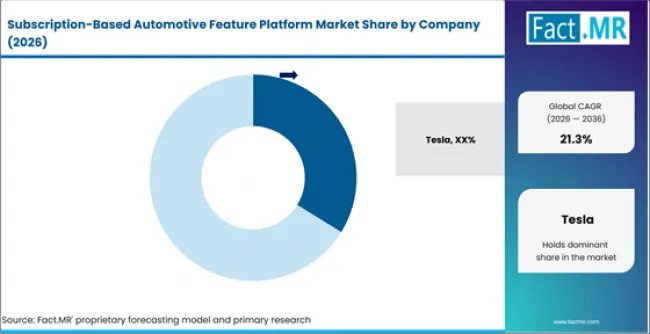
Subscription Based Automotive Feature Platform Market Analysis By Company | Source: Fact.MR
Subscription-Based Automotive Feature Platform Market Analysis By Company
- Tesla, Inc., BMW, and General Motors hold leading positions through established connected vehicle subscription ecosystems, with Tesla, Inc. defining the ADAS subscription pricing benchmark and GM OnStar representing the largest connected vehicle subscriber base by volume.
- Ford, Toyota, and Volkswagen are investing heavily in SDV platform development to scale subscription feature delivery across mass-market vehicle lineups, targeting the volume segment where individual subscription values are lower but aggregate revenue potential is highest.
- Consumer value perception and subscription retention rates create the primary competitive differentiators, as OEMs that deliver continuous utility through subscriptions retain customers while those relying on hardware-gating face backlash and churn.
The competitive landscape is defined by OEMs rather than independent technology providers, as vehicle manufacturers control the hardware, software, connectivity, and customer relationship required for subscription delivery. Tesla, Inc.has established the most advanced SDV architecture, enabling rapid feature deployment and iteration. BMW and Mercedes-Benz compete through premium brand positioning and bundled luxury subscription packages.
GM OnStar represents the most established subscription platform by subscriber count, with connected safety and navigation services generating steady recurring revenue. Ford and Volkswagen are in earlier stages of SDV platform development, with significant investment committed to building the architecture required for large-scale subscription feature deployment across their global vehicle portfolios.
Key Companies in the Subscription-Based Automotive Feature Platform Market
- Tesla, Inc., BMW, General Motors (OnStar), Ford, and Toyota are among the leading players, supported by connected vehicle platform investment, SDV architecture development, and growing subscription subscriber bases.
- Volkswagen, Mercedes-Benz, Hyundai, NIO, Stellantis, and Honda compete through regional subscription program launches, SDV platform investment, and connected service ecosystem development.
Recent Industry Developments
- 2025 | Tesla | Subscription Offering: Full Self-Driving Monthly Subscription
- Tesla continued offering its Full Self-Driving (FSD) subscription across eligible vehicle models, strengthening its software-based recurring revenue strategy and broadening customer access to advanced driver assistance features.
- October 2025 | General Motors | Platform Investment: Centralized SDV Computing Platform
- General Motors continued advancing its software-defined vehicle architecture across future vehicle programs, establishing a foundation for digital services and enhanced connected vehicle capabilities beyond existing OnStar offerings.
- 2025 | BMW | Subscription Program Support: ConnectedDrive Feature Expansion
- BMW continued offering ConnectedDrive digital services through over-the-air activation, supporting increased personalization and recurring software revenue opportunities.
Key Companies in the Subscription-Based Automotive Feature Platform Market
- Tesla, Inc.
- BMW
- General Motors (OnStar)
- Ford
- Toyota
- Volkswagen
- Mercedes-Benz
- Hyundai
- NIO
- Stellantis
Sources and Research References
- BMW Group. (2025, January 28). BMW model updates, spring 2025. BMW Group PressClub.
- BMW Group. (2026). BMW ConnectedDrive: Digital services and connectivity. BMW Group.
- General Motors. (2025, October 22). GM unveils centralized vehicle computing platform for electric and gas vehicles. General Motors.
- General Motors. (2025, October 22). GM announces eyes-off driving, conversational AI, and unified software platform. General Motors.
- Tesla, Inc. (2026). Full Self-Driving (Supervised) subscriptions. Tesla, Inc.
This bibliography is provided for reader reference and is not exhaustive. The full report contains the complete reference list and detailed citations.
Key Questions This Report Addresses
- What is the current and future size of the Subscription-Based Automotive Feature Platform Market?
- How fast is this market expected to grow between 2026 and 2036?
- Which product type is likely to lead the market by 2026?
- Which application segment is expected to account for the highest demand by 2026?
- What factors are driving demand for subscription-based automotive feature platforms?
- How is software-defined vehicle architecture enabling subscription feature delivery?
- Why are Japan and the USA the fastest-growing markets?
- How is consumer backlash against hardware-gating influencing subscription model design?
- Which countries are projected to show the fastest growth through 2036?
- Who are the key companies active in this market?
- How does Fact.MR estimate and validate the market forecast?
Subscription-Based Automotive Feature Platform Market Definition
The subscription-based automotive feature platform market covers software platforms and services that enable OEMs to deliver, manage, and monetize vehicle features through subscription and pay-per-use models. It includes connected vehicle services, ADAS feature tiers, performance and powertrain subscriptions, and comfort and convenience features activated through over-the-air updates on software-defined vehicle architectures.
Subscription-Based Automotive Feature Platform Market Inclusions
- The scope covers global and regional market size and forecasts for 2026 to 2036 across product type, application, end use, technology, formulation, distribution channel, and region.
- It includes regional demand analysis based on connected vehicle penetration, OEM subscription program launches, consumer adoption rates, and regulatory frameworks for automotive feature subscriptions.
- The report covers pricing analysis across monthly, annual, and lifetime subscription tiers for connected, safety, performance, and comfort features.
Subscription-Based Automotive Feature Platform Market Exclusions
- The scope excludes traditional vehicle infotainment system hardware and head unit purchases not delivered through subscription models.
- It excludes insurance telematics programs where data collection is used for insurance pricing rather than vehicle feature delivery.
- The report excludes vehicle leasing and financing products classified as financial services rather than feature subscription platforms.
Subscription-Based Automotive Feature Platform Market Research Methodology
- The methodology combines secondary research, primary interviews, and forecast modelling.
- It draws on 100+ secondary sources and benchmarks 30+ OEM subscription program portfolios.
- Market sizing covers 25+ countries through a demand-side model, supported by top-down validation.
- Key inputs include connected vehicle penetration rates, OEM subscription program pricing and feature catalogs, consumer adoption and retention data, and fleet management platform spending.
- The model cross-checks demand with OEM connected services revenue disclosures, subscription attachment rate data, and app store download statistics.
- Primary validation includes 20+ interviews across OEM connected services teams, platform technology providers, dealer groups, and automotive analysts.
- Final estimates go through subscription-lifecycle analysis, churn-rate validation, and sensitivity testing.
Segmentation
Scope of Analysis
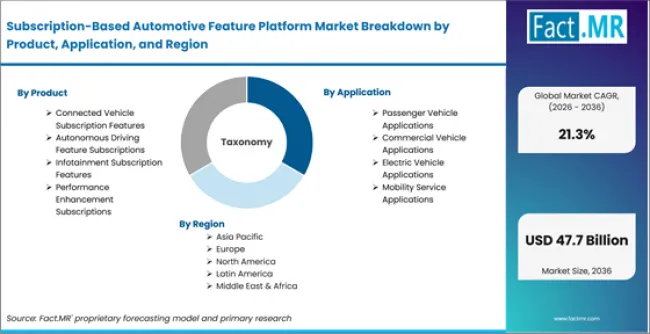
Subscription Based Automotive Feature Platform Market Breakdown By Product, Application, And Region | Source: Fact.MR
| Parameter | Details |
|---|---|
| Quantitative Units |
USD billion to USD billion, at a CAGR |
| Market Definition | The Subscription-Based Automotive Feature Platform Market covers software platforms and services enabling OEMs to deliver, manage, and monetize vehicle features through subscription and pay-per-use models via over-the-air updates. |
| Product |
Source: Fact.MR analysis. Updated Jun 13, 2026 Connected Vehicle Subscription Features, Autonomous Driving Feature Subscriptions, Infotainment Subscription Features, Performance Enhancement SubscriptionsSource: Fact.MR analysis. Updated Jun 13, 2026 |
| Application |
Source: Fact.MR analysis. Updated Jun 13, 2026 Passenger Vehicle Applications, Commercial Vehicle Applications, Electric Vehicle Applications, Mobility Service ApplicationsSource: Fact.MR analysis. Updated Jun 13, 2026 |
| End Use |
Source: Fact.MR analysis. Updated Jun 13, 2026 Automotive OEMs, Fleet Operators, Mobility Service Providers, Technology Service ProvidersSource: Fact.MR analysis. Updated Jun 13, 2026 Source: Fact.MR analysis. Updated Jun 13, 2026 Source: Fact.MR analysis. Updated Jun 13, 2026 Source: Fact.MR analysis. Updated Jun 13, 2026 |
| Technology |
Source: Fact.MR analysis. Updated Jun 13, 2026 Cloud Based Vehicle Platforms, Artificial Intelligence Platforms, Connectivity Technology Platforms, Cybersecurity Technology PlatformsSource: Fact.MR analysis. Updated Jun 13, 2026 |
| Formulation | Software as a Service Platforms, Hybrid Platform Models, Tiered Subscription Models, Enterprise Platform Models |
| Distribution Channel |
Source: Fact.MR analysis. Updated Jun 13, 2026 OEM Direct Distribution, Automotive Dealership Channels, Online Subscription Platforms, Fleet Service ChannelsSource: Fact.MR analysis. Updated Jun 13, 2026 |
| Regions Covered | North America, Latin America, Europe, East Asia, South Asia and Pacific, Middle East and Africa |
| Countries Covered | Japan, USA, UK, Germany, China, 25 plus countries |
| Key Companies | Tesla, Inc., BMW, General Motors (OnStar), Ford, Toyota, Volkswagen, Mercedes-Benz, Hyundai, NIO, Stellantis |
| Forecast Period | 2026 to 2036 |
| Approach | Hybrid demand-side and top-down methodology built on connected vehicle penetration rates, OEM subscription program pricing, consumer adoption data, and primary interviews across OEM connected services teams, platform technology providers, and automotive analysts |
Source: Fact.MR analysis. Updated Jun 13, 2026
Subscription-Based Automotive Feature Platform Market Segmentation
-
Subscription-Based Automotive Feature Platform Market Segmented by Product:
- Connected Vehicle Subscription Features
- Remote Vehicle Access Services
- Remote Lock and Unlock Features
- Remote Vehicle Start Services
- Vehicle Monitoring Services
- Real Time Vehicle Health Monitoring
- Driver Behavior Analytics Services
- Remote Vehicle Access Services
- Autonomous Driving Feature Subscriptions
- Highway Driving Assistance Features
- Adaptive Cruise Control Subscriptions
- Lane Centering Assistance Services
- Advanced Autonomous Features
- Hands Free Driving Capabilities
- Automated Parking Services
- Highway Driving Assistance Features
- Infotainment Subscription Features
- Streaming Entertainment Services
- In Vehicle Video Streaming Features
- Music Subscription Integration Services
- Premium Content Services
- Live Content Access Features
- Personalized Media Platforms
- Streaming Entertainment Services
- Performance Enhancement Subscriptions
- Powertrain Optimization Features
- Performance Mode Activation Services
- Torque Enhancement Features
- Driving Experience Features
- Dynamic Suspension Control Services
- Custom Drive Profile Features
- Powertrain Optimization Features
- Connected Vehicle Subscription Features
-
Subscription-Based Automotive Feature Platform Market Segmented by Application:
- Passenger Vehicle Applications
- Premium Passenger Vehicles
- Luxury Sedan Subscription Features
- Premium SUV Subscription Services
- Mass Market Passenger Vehicles
- Connected Compact Car Features
- Connected Family Vehicle Services
- Premium Passenger Vehicles
- Commercial Vehicle Applications
- Fleet Vehicle Applications
- Fleet Monitoring Subscription Services
- Fleet Optimization Features
- Logistics Vehicle Applications
- Route Management Subscription Services
- Driver Efficiency Monitoring Features
- Fleet Vehicle Applications
- Electric Vehicle Applications
- Battery Management Applications
- Battery Performance Monitoring Services
- Range Optimization Features
- Charging Management Applications
- Smart Charging Subscription Services
- Charging Network Access Features
- Battery Management Applications
- Mobility Service Applications
- Ride Sharing Applications
- Connected Ride Management Services
- Passenger Experience Features
- Vehicle Sharing Applications
- Digital Vehicle Access Services
- Usage Based Mobility Features
- Ride Sharing Applications
- Passenger Vehicle Applications
-
Subscription-Based Automotive Feature Platform Market Segmented by End Use:
- Automotive OEMs
- Premium Vehicle Manufacturers
- Luxury Automotive Brands
- Performance Vehicle Manufacturers
- Mass Market Vehicle Manufacturers
- Passenger Vehicle OEMs
- Commercial Vehicle OEMs
- Premium Vehicle Manufacturers
- Fleet Operators
- Corporate Fleet Operators
- Enterprise Mobility Fleets
- Company Vehicle Operators
- Rental Fleet Operators
- Vehicle Leasing Providers
- Car Rental Companies
- Corporate Fleet Operators
- Mobility Service Providers
- Ride Hailing Companies
- Urban Mobility Operators
- Regional Ride Service Providers
- Vehicle Sharing Companies
- Car Sharing Platforms
- Peer to Peer Mobility Operators
- Ride Hailing Companies
- Technology Service Providers
- Connected Vehicle Platform Providers
- Automotive Software Companies
- Vehicle Connectivity Providers
- Digital Subscription Service Providers
- Subscription Management Platforms
- Automotive Cloud Service Providers
- Connected Vehicle Platform Providers
- Automotive OEMs
-
Subscription-Based Automotive Feature Platform Market Segmented by Technology:
- Cloud Based Vehicle Platforms
- Vehicle Data Management Platforms
- Real Time Data Processing Systems
- Vehicle Telemetry Platforms
- Subscription Service Platforms
- Digital Feature Activation Systems
- Usage Monitoring Platforms
- Vehicle Data Management Platforms
- Artificial Intelligence Platforms
- Driver Assistance AI Systems
- Predictive Driving Analytics
- Behavior Learning Algorithms
- Vehicle Optimization AI Systems
- Predictive Maintenance Platforms
- Performance Optimization Engines
- Driver Assistance AI Systems
- Connectivity Technology Platforms
- Cellular Connectivity Systems
- 5G Vehicle Connectivity Platforms
- LTE Vehicle Communication Systems
- Satellite Connectivity Systems
- Global Vehicle Communication Platforms
- Remote Coverage Connectivity Systems
- Cellular Connectivity Systems
- Cybersecurity Technology Platforms
- Vehicle Security Systems
- Secure Feature Authentication Systems
- Vehicle Access Protection Platforms
- Data Protection Systems
- Cloud Data Encryption Platforms
- Privacy Management Systems
- Vehicle Security Systems
- Cloud Based Vehicle Platforms
-
Subscription-Based Automotive Feature Platform Market Segmented by Formulation:
- Software as a Service Platforms
- Feature Subscription Platforms
- Monthly Feature Access Systems
- Usage Based Subscription Systems
- Digital Service Platforms
- Connected Vehicle Service Suites
- Integrated Mobility Service Platforms
- Feature Subscription Platforms
- Hybrid Platform Models
- Software Hardware Integration Models
- Embedded Connectivity Platforms
- Integrated Vehicle Service Systems
- Cloud Connected Platform Models
- Remote Feature Management Systems
- Vehicle Cloud Synchronization Platforms
- Software Hardware Integration Models
- Tiered Subscription Models
- Premium Tier Platforms
- Advanced Feature Subscription Packages
- Luxury Service Bundles
- Standard Tier Platforms
- Core Connectivity Service Packages
- Essential Feature Subscription Bundles
- Premium Tier Platforms
- Enterprise Platform Models
- Fleet Subscription Platforms
- Commercial Fleet Service Systems
- Enterprise Mobility Management Platforms
- Corporate Service Platforms
- Business Vehicle Connectivity Systems
- Corporate Driver Management Platforms
- Fleet Subscription Platforms
- Software as a Service Platforms
-
Subscription-Based Automotive Feature Platform Market Segmented by Distribution Channel:
- OEM Direct Distribution
- Factory Integrated Sales Channels
- New Vehicle Subscription Activation
- Factory Installed Service Distribution
- Digital OEM Platforms
- Manufacturer Subscription Portals
- Vehicle Companion Application Platforms
- Factory Integrated Sales Channels
- Automotive Dealership Channels
- Physical Dealership Networks
- Dealer Activated Service Programs
- Vehicle Upgrade Subscription Sales
- Certified Dealer Platforms
- Premium Feature Sales Programs
- Connected Service Enrollment Channels
- Physical Dealership Networks
- Online Subscription Platforms
- Direct Consumer Platforms
- Web Based Subscription Portals
- Mobile Application Subscription Platforms
- Third Party Marketplaces
- Automotive Service Marketplaces
- Connected Vehicle Platform Aggregators
- Direct Consumer Platforms
- Fleet Service Channels
- Enterprise Sales Channels
- Corporate Fleet Service Contracts
- Commercial Vehicle Subscription Programs
- Mobility Provider Channels
- Ride Service Subscription Agreements
- Vehicle Sharing Platform Contracts
- Enterprise Sales Channels
- OEM Direct Distribution
-
Subscription-Based Automotive Feature Platform Market by Region:
- North America
- USA
- Canada
- Latin America
- Brazil
- Mexico
- Chile
- Rest of Latin America
- Western Europe
- Germany
- UK
- Italy
- Spain
- France
- Nordic
- BENELUX
- Rest of Western Europe
- Eastern Europe
- Russia
- Poland
- Hungary
- Balkan & Baltic
- Rest of Eastern Europe
- East Asia
- China
- Japan
- South Korea
- South Asia and Pacific
- India
- ASEAN
- Australia & New Zealand
- Rest of South Asia and Pacific
- Middle East & Africa
- Kingdom of Saudi Arabia
- Other GCC Countries
- Turkiye
- South Africa
- Other African Union
- Rest of Middle East & Africa
- North America
Frequently Asked Questions
How big is the subscription-based automotive feature platform market in 2026?
What will be the size of subscription-based automotive feature platform market in 2036?
How much will be the subscription-based automotive feature platform market growth between 2026 and 2036?
What are the key product in the subscription-based automotive feature platform market?
Which application segment is expected to contribute significant share in the subscription-based automotive feature platform market in 2026?
Who worked on this report


Preview the report firsthand - request a free sample
Free SampleGet the brochure for pricing and purchase details
Download PDF