UV Nail Gel Market Size, Share, Growth and Forecast (2026 - 2036)

The UV Nail Gel Market is segmented by Type (Polish, Basecoats, Top Coats, Builder Gels, and Gel Extensions), Application (Commercial, Personal, Salon Services, Nail Art, and Professional Training), Chemistry (Methacrylate, Acrylate, Hybrid Gel Systems, HEMA-Free Gels, and Others), End User (Nail Salons, Individual Consumers, Beauty Spas, Professional Nail Studios, and Training Academies), Distribution Channel (Online, Offline, Salon Supply Stores, Specialty Beauty Retailers, and Direct Brand Sales), and Region. Forecast for 2026 to 2036.

Fact.MR analysis indicates that the UV nail gel market is moving through a durability and self-care adoption phase. Salons, beauty retailers, and individual users are evaluating UV nail gels through wear time, gloss retention, curing behavior, and removal safety. Demand is gaining depth where long-lasting manicures, nail art, and at-home beauty routines are becoming routine parts of grooming.

UV Nail Gel Market Forecast and Outlook By Fact.MR

  • The UV nail gel market was valued at USD 61.0 million in 2025.
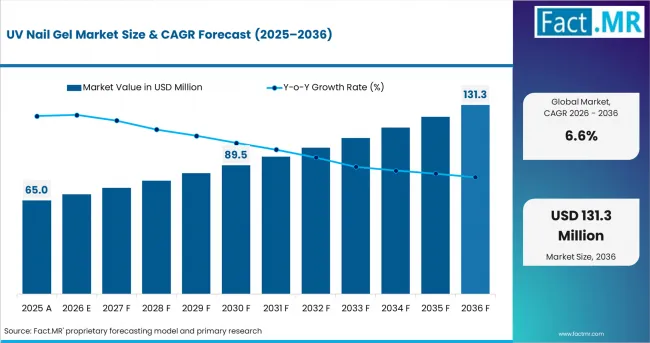
  • According to Fact.MR, demand is projected to reach USD 65.0 million in 2026 and expand to USD 123.3 million by 2036, reflecting a CAGR of 6.6% during the forecast period.
Uv Nail Gel Market Market Value Analysis

Metric Value
Estimated Value in 2026 USD 65.0 million
Forecast Value in 2036 USD 123.3 million
Forecast CAGR (2026 to 2036) 6.6%

Summary of UV Nail Gel Market

  • Market Definition
    • The market includes UV-curable gel products used for durable manicures, nail overlays, base layers, top coats, nail art, and gel extensions.
  • Demand Drivers
    • Salons are using UV nail gels because clients want glossy manicures with longer wear than conventional polish.
    • Online beauty retailers are expanding gel kit access as home users learn curing and removal routines through digital tutorials.
    • Professional nail studios are adopting specialty gels for nail art, builder overlays, and premium service pricing.
  • Key Segments Analyzed
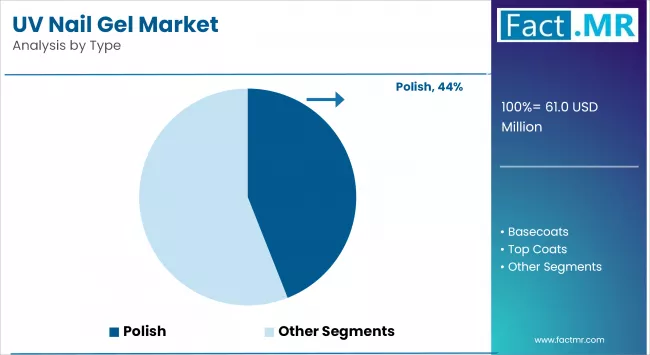
    • By Type: Polish is expected to hold approximately 39.0% share in 2026, supported by frequent salon and home manicure use.
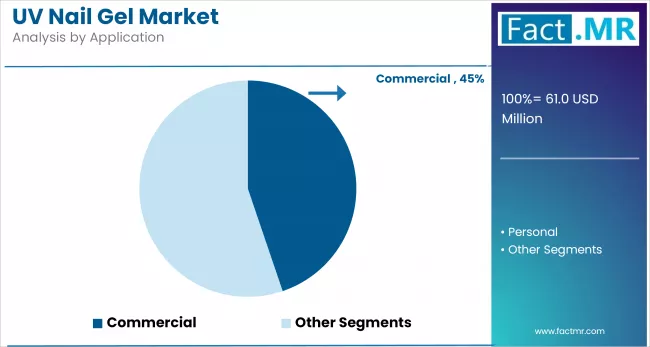
    • By Application: Commercial use leads in 2026 with around 61.0% share, due to recurring salon service demand.
    • By Chemistry: Methacrylate-based systems account for nearly 46.0% share in 2026, driven by adhesion and curing performance.
    • By End User: Nail salons hold about 52.0% share in 2026, since professional application remains the core demand base.
    • By Distribution Channel: Online sales are projected to lead with 43.0% share in 2026, as beauty e-commerce expands product access.
    • By Geography: China leads growth through 2036 at 8.4% CAGR, driven by beauty retail expansion and nail studio growth.
  • Analyst Opinion at Fact.MR
    • Shambhu Nath Jha, Senior Analyst at Fact.MR, states, “UV nail gel demand is no longer defined only by manicure durability. The stronger shift is toward safer formulations, easier removal, and product systems that work for both salons and home users. Brands that can combine color range, curing reliability, and ingredient transparency will hold a better position than companies competing only on price.”
  • Strategic Implications
    • Brands should improve formulation safety and removal ease because users judge gel products through wear time and nail condition after use.
    • Salons need reliable product systems to reduce lifting, curing failure, and client complaints.
    • Retailers should build education around curing, removal, and patch testing because at-home users need clear application guidance.
  • Methodology
    • Market sizing uses salon product consumption, home kit sales, online retail demand, product replacement cycles, and average selling prices.
    • Analysis includes FDA cosmetic guidance, EU cosmetic regulation, OSHA nail salon resources, ingredient safety reviews, and brand product data. [2]
    • Forecasts account for salon service growth, beauty, gel chemistry adoption, nail art trends, and regional cosmetic retail expansion.

The market is expected to generate an absolute opportunity of USD 58.3 million between 2026 and 2036, supported by evolving beauty trends. Growth is being driven by demand for chip-resistant manicures, expansion of salon-based nail services, growth in online beauty retail, and wider use of gel systems for nail art. Regulatory oversight from the U.S. Food and Drug Administration keeps ingredient safety and labeling important for cosmetic products, while Occupational Safety and Health Administration guidance highlights chemical exposure considerations in nail salons. These factors reinforce the need for safe formulations, proper ventilation, and responsible handling in professional and consumer use. [1]

China leads with a projected CAGR of 8.4% through 2036, driven by beauty retail growth and nail service expansion. India follows at 7.2%, helped by salon penetration and online beauty commerce. The United States records 6.4%, with demand anchored in professional salons and at-home gel kits. Germany grows at 5.5%, supported by regulated cosmetic retail and nail studio demand. Brazil advances at 5.2%, backed by beauty service culture and social media-led nail trends. Korea posts 4.6%, supported by nail art influence and premium beauty formats.

Segmental Analysis

UV Nail Gel Market Analysis by Type
Uv Nail Gel Market Analysis By Type

Polish is expected to hold 39.0% share in 2026 because it is the most frequently used UV gel format across salon and home manicures. Nail technicians use polish gels for color coverage, glossy finish, and longer wear compared with conventional nail polish. Basecoats and top coats remain essential within complete gel systems, but color polish leads because shade changes drive repeat purchases. Builder gels and extensions gain use in nail art and strengthening services. Poor polish quality can cause lifting, uneven curing, and weak client retention.

  • Repeat Color Demand: Polish gels drive recurring purchases because users change shades often.
  • Salon Service Fit: Professional manicures depend on color gels for durable finish and shine.
  • Home Kit Use: At-home users prefer polish gels because application steps are easier to learn.

UV Nail Gel Market Analysis by Application
Uv Nail Gel Market Analysis By Application

Commercial use forms the largest application base because salons and nail studios apply UV gel products daily across manicure and nail art services. Commercial use is projected to account for 61.0% share in 2026. Professional nail technicians need base gels, color gels, top coats, and builder products that cure consistently across different client nails. OSHA guidance on nail salon chemical hazards highlights the need for safe handling and ventilation in professional nail environments [4]. Personal use is growing through online kits, yet salons keep the main demand base because professional users buy larger volumes and broader color ranges. Weak product performance can affect service time and repeat appointments.

  • Service Frequency: Salons use UV gels daily across manicure and nail art work.
  • Product Range: Commercial users need several shades, finishes, and gel functions.
  • Application Skill: Professional training helps reduce curing errors and removal damage.

UV Nail Gel Market Analysis by Chemistry
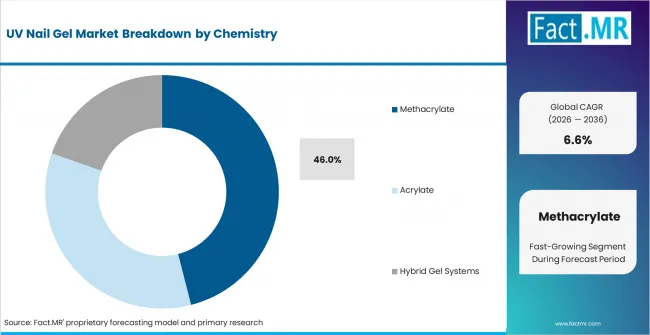
Uv Nail Gel Market Analysis By Chemistry

Methacrylate-based systems remain the main chemistry base because they provide strong adhesion, hard finish, and UV curing performance. This chemistry is estimated to hold 46.0% share in 2026. Nail gel products often use acrylate or methacrylate chemistry to form a cured coating after lamp exposure. The European Commission’s cosmetic regulation framework requires safety assessment and ingredient control for cosmetics placed on the EU market. HEMA-free and lower-sensitization systems are gaining attention as users and salons become more aware of irritation and allergy risks. Methacrylate systems stay ahead because performance and product familiarity are strong. Poor formulation control can raise complaint risk and brand trust issues.

  • Adhesion Strength: Methacrylate systems help gel layers bond to the nail surface.
  • Curing Performance: UV-curable chemistry supports hard finish and longer wear.
  • Safety Shift: HEMA-free systems gain interest where users seek gentler product options.

UV Nail Gel Market Analysis by End User
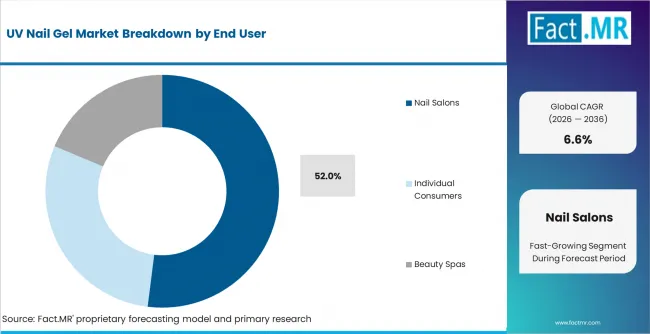
Uv Nail Gel Market Analysis By End User

Nail salons lead demand because professional application remains the main use point for UV gel products. The end-user base is expected to be led by nail salons with 52.0% share in 2026. Salons use gel polish systems to offer chip-resistant manicures, nail art, overlays, and extension services. NIOSH resources for nail salon workers highlight the need to manage workplace exposure in nail services, which makes safer salon practices important [5]. Individual consumers are growing quickly, but salons keep the largest value because they purchase larger product sets and use gels across many clients. Salons that use inconsistent product systems may face service complaints and nail damage concerns.

  • Professional Volume: Salons use gels across many appointments each week.
  • Client Retention: Durable finish and color choice influence repeat manicure bookings.
  • Workplace Safety: Salons need safer handling practices for gel products and removal chemicals.

UV Nail Gel Market Analysis by Distribution Channel
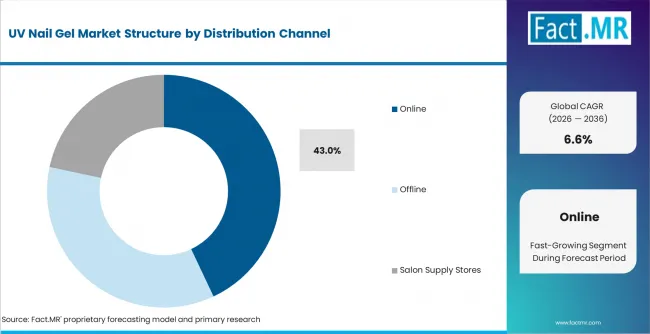
Uv Nail Gel Market Analysis By Distribution Channel

Online sales lead because consumers and small salons increasingly buy nail gel kits, color sets, and specialty products through beauty e-commerce platforms. Online sales are expected to account for 43.0% share in 2026. Digital channels help brands promote shade collections, tutorials, and bundle kits directly to users. Fact.MR links market expansion to social media beauty trends and influencer marketing, which strengthens online product discovery. Offline beauty stores and salon supply outlets remain important for professional replenishment and shade testing. Online sales keep leadership because product comparison and tutorial-led purchase behavior are strong. Weak instructions can increase misuse risk among home users.

  • Product Discovery: Online platforms help users compare shades, finishes, and starter kits.
  • Tutorial Link: Social media content can convert viewers into at-home gel buyers.
  • Replenishment Ease: Small salons use online channels to reorder colors and accessories quickly.

Regional Analysis

The UV nail gel market is assessed across North America, Europe, Asia Pacific, Latin America, and Middle East and Africa, covering 40+ countries with demand profiles shaped by salon density, beauty retail penetration, social media trends, cosmetic safety rules, disposable income, and e-commerce access.

Top Country Growth Comparison Uv Nail Gel Market Cagr (2026 2036)

Country CAGR (2026 to 2036)
China 8.4%
India 7.2%
USA 6.4%
Germany 5.5%
Brazil 5.2%
Korea 4.6%

Source: Fact.MR analysis, based on proprietary forecasting model and primary research
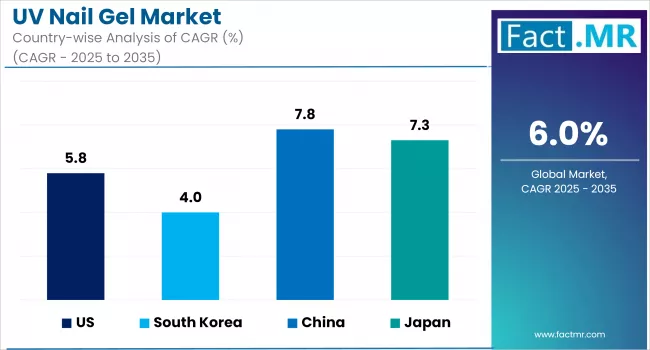
Uv Nail Gel Market Cagr Analysis By Country

Asia Pacific UV Nail Gel Market Analysis

Asia Pacific records the strongest growth because beauty retail, social media influence, and salon penetration are rising together. China is expanding nail service demand through urban beauty studios and online retail platforms. India is adding salon chains and home beauty kit adoption across metro cities.

  • China: China leads the country outlook as beauty retail expansion and nail studio growth strengthen UV nail gel demand. The country is projected to grow at 8.4% CAGR over the assessment period. Urban consumers are using gel manicures for durable finish and nail art styles. Domestic brands compete through affordable color sets, while premium brands gain demand in professional studios. Buyers weigh shade range, curing reliability, and removal ease before repeat purchase.
  • India: Salon penetration and online beauty commerce support UV nail gel demand in India. Metro consumers are adopting gel manicures through nail studios and at-home kits. India is forecast to grow at 7.2% CAGR by 2036. Price sensitivity remains important, but premium gel services are gaining space in urban salons. Brands that combine affordable kits with clear application guidance can improve adoption.
  • Korea: Nail art influence and premium beauty culture support UV nail gel demand in Korea. Consumers value color trends, glossy finishes, and detailed nail designs. Korea is projected to post 4.6% CAGR through 2036. Growth is moderate because beauty product access is already strong. Brands with trend-led shade launches and safer formulations can maintain salon and retail demand.

North America UV Nail Gel Market Analysis
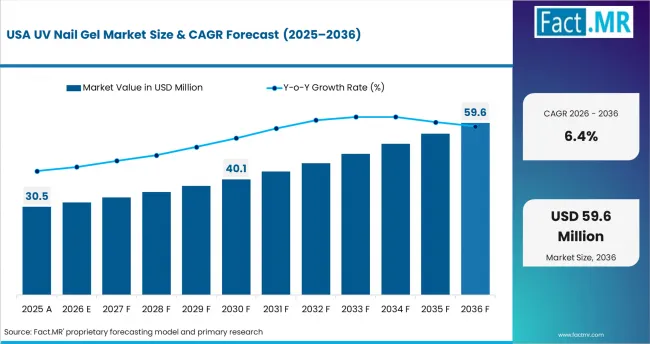
Uv Nail Gel Market Country Value Analysis

North America remains a high-value region because salon culture, at-home beauty kits, and influencer-led product discovery support UV nail gel use. The United States anchors regional demand through professional nail salons and online beauty retail.

  • USA: The United States has a strong base of nail salons, beauty retailers, and home manicure users. UV nail gel demand is anchored in long-wear manicures, nail art, and e-commerce product discovery. The country is projected to record 6.4% CAGR by 2036. Professional salons continue buying broader color ranges, while home users prefer kits with clear instructions. Brands that invest in formulation transparency and safe removal education can strengthen repeat purchase.

Europe UV Nail Gel Market Analysis
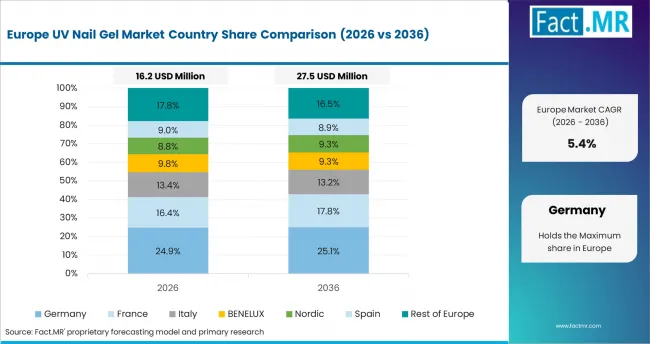
Uv Nail Gel Market Europe Country Market Share Analysis, 2026 & 2036

Europe shows steady demand because salon services, regulated cosmetics retail, and beauty specialty stores are well established. Germany leads regional growth through nail studio demand and strong beauty product distribution. EU cosmetic rules require safety assessment, responsible person obligations, and product information documentation, which influences UV nail gel brand compliance. Consumers are becoming more aware of ingredient safety and nail damage from poor removal. Demand growth is moderate because the salon base is already developed. Brands compete through safer formulas, professional training, and product durability.

  • Germany: Germany benefits from regulated beauty retail, professional nail studios, and strong consumer awareness of product safety. Demand is linked to salon manicures, at-home gel kits, and premium nail care routines. Germany is forecast to grow at 5.5% CAGR from 2026 to 2036. Salons tend to favor gels with predictable curing and easy removal. Compliance documentation and ingredient clarity influence brand selection.

Latin America UV Nail Gel Market Analysis

Latin America shows selective growth where beauty service culture and social media trends strengthen demand for salon nail products. Brazil leads regional demand through active salon use, nail art adoption, and strong personal grooming habits. Price sensitivity remains a key restraint, especially for premium gels and professional lamp systems. Suppliers need local distribution and accessible price points. Demand improves when salons can maintain color variety and affordable replenishment. Growth remains uneven because beauty retail access differs across urban and regional markets.

  • Brazil: Beauty service culture and salon-based grooming support UV nail gel demand in Brazil. Nail studios and beauty salons use gel polish for durable manicures and decorative nail styles. Brazil is projected to expand at 5.2% CAGR by 2036. Buyers often compare shade variety with price before choosing gel brands. Distributors play a major role in product availability and salon replenishment. Brands that offer accessible color ranges can strengthen adoption.

Fact.MR analysis of regional demand covers Asia Pacific, North America, Europe, Latin America, and Middle East and Africa. The study assesses salon penetration, beauty e-commerce, cosmetic regulation, product safety awareness, consumer grooming spend, and supplier support across major markets.

Competitive Aligners for Market Players
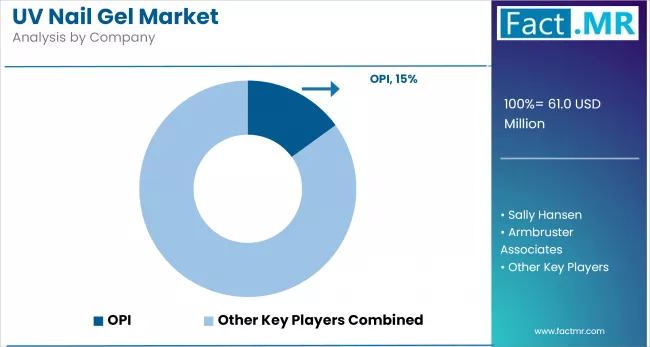
Uv Nail Gel Market Analysis By Company

The UV nail gel market is fragmented, with global beauty brands, professional salon suppliers, and online-first labels competing across price tiers. Large brands hold advantages in color range, retail visibility, and salon trust. Smaller brands often compete through nail art trends, affordable kits, and social media-led launches.

Competitive advantage depends on curing reliability, shade depth, gloss retention, removal ease, ingredient transparency, and education support. OPI, Sally Hansen, Creative Nail Design, Light Elegance, Crystal Nails, Alessandro, Shany Cosmetics, Keystone, UV-Nails, and Chemence represent supplier groups where brand trust and product performance matter. Salons are less likely to switch brands when technicians are trained on a complete gel system.

The market is divided between professional salon systems and home-use gel kits. Suppliers that combine durable performance with safer-use instructions can protect repeat demand. Online-first brands can gain share where social content, starter kits, and affordable shade bundles influence buying.

Key Players

  • OPI Products Inc.
  • Sally Hansen
  • Armbruster Associates, Inc.
  • Alessandro International GmbH
  • Creative Nail Design, Inc.
  • Shany Cosmetics
  • Light Elegance
  • Nail Art
  • Sheba Nail
  • Crystal Nails
  • UV-Nails
  • Keystone Industries
  • Chemence Limited

Bibliography

  • [1] United States Food and Drug Administration. (2024). Cosmetics. FDA.
  • [2] European Commission. (2024). Cosmetics. European Commission.
  • [3] Cosmetic Ingredient Review. (2024). Ingredient Safety Assessments. CIR.
  • [4] Occupational Safety and Health Administration. (2024). Nail Salons: Chemical Hazards and Worker Safety. OSHA.
  • [5] National Institute for Occupational Safety and Health. (2024). Nail Salon Worker Safety. CDC NIOSH.

This Report Addresses

  1. Strategic intelligence on UV nail gel demand across polish, basecoats, top coats, builder gels, and gel extensions globally.
  2. Market forecast from USD 65.0 million in 2026 to USD 123.3 million by 2036 at a CAGR of 6.60%.
  3. Growth opportunity mapping across China beauty retail growth, India salon penetration, U.S. at-home gel kits, Germany regulated beauty retail, and Brazil nail service demand.
  4. Segment analysis by type, application, chemistry, end user, distribution channel, and region.
  5. Regional outlook covering Asia Pacific beauty e-commerce growth, North America salon and home kit demand, and Europe safety-oriented product evaluation.
  6. Competitive analysis of OPI, Sally Hansen, Armbruster Associates, Alessandro, Creative Nail Design, Shany Cosmetics, Light Elegance, Crystal Nails, Keystone, and Chemence.
  7. Product adoption analysis covering wear time, curing reliability, removal ease, shade variety, ingredient transparency, and salon training.
  8. Report delivered with market sizing, segment outlook, regional analysis, company profiling, and forecast assumptions.

Market Definition

The market covers UV-curable nail gel products used to create long-lasting manicures, base layers, top coats, extensions, builder overlays, and decorative nail art. These products cure under UV or LED lamps and are used across salons, beauty studios, home manicure kits, and training environments. The scope includes polish gels, basecoats, top coats, builder gels, and gel extension products.

UV Nail Gel Market Inclusions

The study includes global and regional forecasts from 2026 to 2036. It covers UV nail gels used in commercial salons, professional nail studios, beauty spas, personal grooming, nail art, and training academies. It includes methacrylate, acrylate, hybrid gel systems, HEMA-free gels, and related UV-curable formulations sold through online and offline beauty channels.

UV Nail Gel Market Exclusions

The scope excludes standard air-dry nail polish, press-on nails without UV gel use, acrylic powders sold without UV-curable gel systems, nail tools, UV lamps sold separately, and general hand care products. It also excludes salon services when product revenue cannot be separated. The focus stays on UV-curable gel products used for nail coating, bonding, building, and finishing.

UV Nail Gel Market Research Methodology

  • Primary Research
    • Interviews with nail salon owners, beauty product distributors, cosmetic chemists, professional nail educators, online beauty retailers, and brand sales managers across major consuming regions.
  • Desk Research
    • Uses cosmetic safety guidance, salon chemical exposure resources, product catalogues, ingredient review references, brand information, and beauty retail documentation. [3]
  • Market-Sizing and Forecasting
    • Hybrid model using salon service demand, online beauty sales, product replacement frequency, professional gel use, home kit adoption, and average selling prices by product type.
  • Data Validation and Update Cycle
    • Forecasts were validated through distributor checks, salon product purchase patterns, online retail availability, brand catalogues, and regional beauty service indicators.

Scope of Report

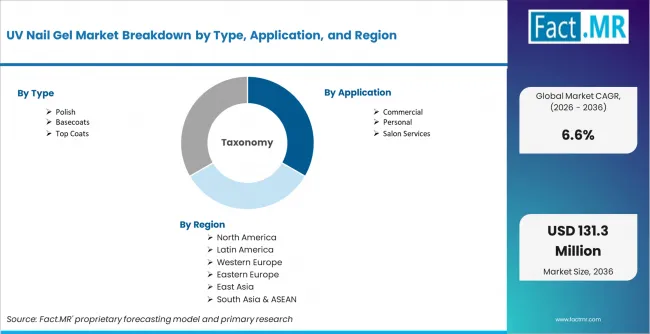
Uv Nail Gel Market Breakdown By Type, Application, And Region

Attribute Details
Quantitative Units USD 65.0 million (2026) to USD 123.3 million (2036), at a CAGR of 6.6%
Market Definition UV-curable nail gel products used for durable manicures, gel overlays, nail art, extensions, and finishing
Forecast Period 2026 to 2036
Historical Reference 2025
Type Covered Polish, basecoats, top coats, builder gels, gel extensions
Application Covered Commercial, personal, salon services, nail art, professional training
Chemistry Covered Methacrylate, acrylate, hybrid gel systems, HEMA-free gels, others
End User Covered Nail salons, individual consumers, beauty spas, professional nail studios, training academies
Distribution Channel Covered Online, offline, salon supply stores, specialty beauty retailers, direct brand sales
Regions Covered North America, Europe, Asia Pacific, Latin America, Middle East and Africa
Countries Covered USA, Canada, Mexico, Germany, UK, France, Italy, Spain, Nordic, BENELUX, China, Japan, Korea, India, ASEAN, Australia and New Zealand, Brazil, Argentina, Chile, Saudi Arabia, GCC, Turkey, South Africa, and Rest of MEA
Key Companies Profiled OPI, Sally Hansen, Armbruster Associates, Alessandro, Creative Nail Design, Shany Cosmetics, Light Elegance, Nail Art, Sheba Nail, Crystal Nails, UV-Nails, Keystone, Chemence
Approach Hybrid top-down and bottom-up model using salon service demand, gel product consumption, online retail sales, professional product replenishment, average selling prices, and primary interviews with salon and beauty retail stakeholders

UV Nail Gel Market by Segments

  • By Type:

    • Polish
    • Basecoats
    • Top Coats
    • Builder Gels
    • Gel Extensions
  • By Application:

    • Commercial
    • Personal
    • Salon Services
    • Nail Art
    • Professional Training
  • By Chemistry:

    • Methacrylate
    • Acrylate
    • Hybrid Gel Systems
    • HEMA-Free Gels
    • Others
  • By End User:

    • Nail Salons
    • Individual Consumers
    • Beauty Spas
    • Professional Nail Studios
    • Training Academies
  • By Distribution Channel:

    • Online
    • Offline
    • Salon Supply Stores
    • Specialty Beauty Retailers
    • Direct Brand Sales
  • By Region:

    • North America
    • United States
    • Canada
    • Mexico
    • Latin America
    • Brazil
    • Argentina
    • Chile
    • Rest of Latin America
  • Western Europe
    • Germany
    • France
    • United Kingdom
    • Italy
    • Spain
    • Nordic Countries
    • BENELUX
    • Rest of Western Europe
  • Eastern Europe
    • Russia
    • Poland
    • Hungary
    • Balkan and Baltic
    • Rest of Eastern Europe
  • East Asia
    • China
    • Japan
    • Korea
    • South Asia and Pacific
    • India
    • ASEAN
    • Australia and New Zealand
    • Rest of South Asia and Pacific
  • Middle East and Africa
    • Kingdom of Saudi Arabia
    • Other GCC Countries
    • Turkey
    • South Africa
    • Rest of Middle East and Africa

- Frequently Asked Questions -

How large is the global UV nail gel market in 2025?

The global UV nail gel market was valued at USD 61.0 million in 2025.

What will the market size be in 2026?

Based on revised Fact.MR analysis, demand for UV nail gel is estimated to grow to USD 65.0 million in 2026.

What is the projected market size by 2036?

The market is projected to reach USD 123.3 million by 2036, generating USD 58.3 million in absolute dollar opportunity.

What is the expected CAGR from 2026 to 2036?

Fact.MR projects a CAGR of 6.60% for the global UV nail gel market during the forecast period.

Which type is poised to lead the market?

Polish leads with approximately 39.0% share in 2026 due to frequent salon and home manicure use.

Which application accounts for the largest demand?

Commercial use accounts for around 61.0% share in 2026 because salons and nail studios use UV gels daily.

Which chemistry holds the highest share?

Methacrylate-based systems hold nearly 46.0% share in 2026 due to adhesion and curing performance.

Which end user leads the market?

Nail salons hold about 52.0% share in 2026 because professional application remains the core demand base.

Which distribution channel leads demand?

Online sales hold around 43.0% share in 2026 because beauty e-commerce expands access to gel kits and color ranges.

Which country shows the fastest growth?

China leads at 8.4% CAGR through 2036, driven by beauty retail expansion and nail studio growth.

What is driving demand for UV nail gel?

Demand is driven by long-lasting manicures, nail art trends, salon service growth, at-home beauty kits, and online beauty retail.

What is the key challenge in this market?

Ingredient sensitivity, incorrect curing, nail damage during removal, and salon chemical exposure concerns limit faster adoption.

Table of Content

  1. Executive Summary
    • Global Market Outlook
    • Demand to side Trends
    • Supply to side Trends
    • Technology Roadmap Analysis
    • Analysis and Recommendations
  2. Market Overview
    • Market Coverage / Taxonomy
    • Market Definition / Scope / Limitations
  3. Research Methodology
    • Chapter Orientation
    • Analytical Lens and Working Hypotheses
      • Market Structure, Signals, and Trend Drivers
      • Benchmarking and Cross-market Comparability
      • Research Design and Evidence Framework
        • Desk Research Programme (Secondary Evidence)
          • Company Annual and Sustainability Reports
          • Peer-reviewed Journals and Academic Literature
          • Corporate Websites, Product Literature, and Technical Notes
          • Earnings Decks and Investor Briefings
          • Statutory Filings and Regulatory Disclosures
          • Technical White Papers and Standards Notes
          • Trade Journals, Industry Magazines, and Analyst Briefs
          • Conference Proceedings, Webinars, and Seminar Materials
          • Government Statistics Portals and Public Data Releases
          • Press Releases and Reputable Media Coverage
          • Specialist Newsletters and Curated Briefings
          • Sector Databases and Reference Repositories
          • Fact.MR Internal Proprietary Databases and Historical Market Datasets
          • Subscription Datasets and Paid Sources
          • Social Channels, Communities, and Digital Listening Inputs
          • Additional Desk Sources
        • Expert Input and Fieldwork (Primary Evidence)
          • Primary Modes
            • Qualitative Interviews and Expert Elicitation
            • Quantitative Surveys and Structured Data Capture
            • Blended Approach
          • Why Primary Evidence is Used
          • Focus Groups
          • Observational and In-context Research
          • Social and Community Interactions
        • Stakeholder Universe Engaged
          • C-suite Leaders
          • Board Members
          • Presidents and Vice Presidents
          • R&D and Innovation Heads
          • Technical Specialists
          • Domain Subject-matter Experts
          • Scientists
          • Physicians and Other Healthcare Professionals
        • Governance, Ethics, and Data Stewardship
          • Research Ethics
          • Data Integrity and Handling
      • Tooling, Models, and Reference Databases
    • Data Engineering and Model Build
      • Data Acquisition and Ingestion
      • Cleaning, Normalisation, and Verification
      • Synthesis, Triangulation, and Analysis
    • Quality Assurance and Audit Trail
  4. Market Background
    • Market Dynamics
      • Drivers
      • Restraints
      • Opportunity
      • Trends
    • Scenario Forecast
      • Demand in Optimistic Scenario
      • Demand in Likely Scenario
      • Demand in Conservative Scenario
    • Opportunity Map Analysis
    • Product Life Cycle Analysis
    • Supply Chain Analysis
    • Investment Feasibility Matrix
    • Value Chain Analysis
    • PESTLE and Porter’s Analysis
    • Regulatory Landscape
    • Regional Parent Market Outlook
    • Production and Consumption Statistics
    • Import and Export Statistics
  5. Global Market Analysis 2021 to 2025 and Forecast, 2026 to 2036
    • Historical Market Size Value (USD Million) Analysis, 2021 to 2025
    • Current and Future Market Size Value (USD Million) Projections, 2026 to 2036
      • Y to o to Y Growth Trend Analysis
      • Absolute $ Opportunity Analysis
  6. Global Market Pricing Analysis 2021 to 2025 and Forecast 2026 to 2036
  7. Global Market Analysis 2021 to 2025 and Forecast 2026 to 2036, By Drive Type
    • Introduction / Key Findings
    • Historical Market Size Value (USD Million) Analysis By Drive Type , 2021 to 2025
    • Current and Future Market Size Value (USD Million) Analysis and Forecast By Drive Type , 2026 to 2036
      • Electric
      • Gasoline
    • Y to o to Y Growth Trend Analysis By Drive Type , 2021 to 2025
    • Absolute $ Opportunity Analysis By Drive Type , 2026 to 2036
  8. Global Market Analysis 2021 to 2025 and Forecast 2026 to 2036, By Use Case
    • Introduction / Key Findings
    • Historical Market Size Value (USD Million) Analysis By Use Case, 2021 to 2025
    • Current and Future Market Size Value (USD Million) Analysis and Forecast By Use Case, 2026 to 2036
      • Golf Courses
      • Leisure/Resort
      • Utility
    • Y to o to Y Growth Trend Analysis By Use Case, 2021 to 2025
    • Absolute $ Opportunity Analysis By Use Case, 2026 to 2036
  9. Global Market Analysis 2021 to 2025 and Forecast 2026 to 2036, By Price Tier
    • Introduction / Key Findings
    • Historical Market Size Value (USD Million) Analysis By Price Tier, 2021 to 2025
    • Current and Future Market Size Value (USD Million) Analysis and Forecast By Price Tier, 2026 to 2036
      • Mid-range
      • Premium
      • Entry
    • Y to o to Y Growth Trend Analysis By Price Tier, 2021 to 2025
    • Absolute $ Opportunity Analysis By Price Tier, 2026 to 2036
  10. Global Market Analysis 2021 to 2025 and Forecast 2026 to 2036, By Distribution Channel
    • Introduction / Key Findings
    • Historical Market Size Value (USD Million) Analysis By Distribution Channel, 2021 to 2025
    • Current and Future Market Size Value (USD Million) Analysis and Forecast By Distribution Channel, 2026 to 2036
      • Specialty Sports Stores
      • Pro Shops & Golf Clubs
      • Online Retail
    • Y to o to Y Growth Trend Analysis By Distribution Channel, 2021 to 2025
    • Absolute $ Opportunity Analysis By Distribution Channel, 2026 to 2036
  11. Global Market Analysis 2021 to 2025 and Forecast 2026 to 2036, By Region
    • Introduction
    • Historical Market Size Value (USD Million) Analysis By Region, 2021 to 2025
    • Current Market Size Value (USD Million) Analysis and Forecast By Region, 2026 to 2036
      • North America
      • Latin America
      • Western Europe
      • Eastern Europe
      • East Asia
      • South Asia and Pacific
      • Middle East & Africa
    • Market Attractiveness Analysis By Region
  12. North America Market Analysis 2021 to 2025 and Forecast 2026 to 2036, By Country
    • Historical Market Size Value (USD Million) Trend Analysis By Market Taxonomy, 2021 to 2025
    • Market Size Value (USD Million) Forecast By Market Taxonomy, 2026 to 2036
      • By Country
        • USA
        • Canada
        • Mexico
      • By Drive Type
      • By Use Case
      • By Price Tier
      • By Distribution Channel
    • Market Attractiveness Analysis
      • By Country
      • By Drive Type
      • By Use Case
      • By Price Tier
      • By Distribution Channel
    • Key Takeaways
  13. Latin America Market Analysis 2021 to 2025 and Forecast 2026 to 2036, By Country
    • Historical Market Size Value (USD Million) Trend Analysis By Market Taxonomy, 2021 to 2025
    • Market Size Value (USD Million) Forecast By Market Taxonomy, 2026 to 2036
      • By Country
        • Brazil
        • Chile
        • Rest of Latin America
      • By Drive Type
      • By Use Case
      • By Price Tier
      • By Distribution Channel
    • Market Attractiveness Analysis
      • By Country
      • By Drive Type
      • By Use Case
      • By Price Tier
      • By Distribution Channel
    • Key Takeaways
  14. Western Europe Market Analysis 2021 to 2025 and Forecast 2026 to 2036, By Country
    • Historical Market Size Value (USD Million) Trend Analysis By Market Taxonomy, 2021 to 2025
    • Market Size Value (USD Million) Forecast By Market Taxonomy, 2026 to 2036
      • By Country
        • Germany
        • UK
        • Italy
        • Spain
        • France
        • Nordic
        • BENELUX
        • Rest of Western Europe
      • By Drive Type
      • By Use Case
      • By Price Tier
      • By Distribution Channel
    • Market Attractiveness Analysis
      • By Country
      • By Drive Type
      • By Use Case
      • By Price Tier
      • By Distribution Channel
    • Key Takeaways
  15. Eastern Europe Market Analysis 2021 to 2025 and Forecast 2026 to 2036, By Country
    • Historical Market Size Value (USD Million) Trend Analysis By Market Taxonomy, 2021 to 2025
    • Market Size Value (USD Million) Forecast By Market Taxonomy, 2026 to 2036
      • By Country
        • Russia
        • Poland
        • Hungary
        • Balkan & Baltic
        • Rest of Eastern Europe
      • By Drive Type
      • By Use Case
      • By Price Tier
      • By Distribution Channel
    • Market Attractiveness Analysis
      • By Country
      • By Drive Type
      • By Use Case
      • By Price Tier
      • By Distribution Channel
    • Key Takeaways
  16. East Asia Market Analysis 2021 to 2025 and Forecast 2026 to 2036, By Country
    • Historical Market Size Value (USD Million) Trend Analysis By Market Taxonomy, 2021 to 2025
    • Market Size Value (USD Million) Forecast By Market Taxonomy, 2026 to 2036
      • By Country
        • China
        • Japan
        • South Korea
      • By Drive Type
      • By Use Case
      • By Price Tier
      • By Distribution Channel
    • Market Attractiveness Analysis
      • By Country
      • By Drive Type
      • By Use Case
      • By Price Tier
      • By Distribution Channel
    • Key Takeaways
  17. South Asia and Pacific Market Analysis 2021 to 2025 and Forecast 2026 to 2036, By Country
    • Historical Market Size Value (USD Million) Trend Analysis By Market Taxonomy, 2021 to 2025
    • Market Size Value (USD Million) Forecast By Market Taxonomy, 2026 to 2036
      • By Country
        • India
        • ASEAN
        • Australia & New Zealand
        • Rest of South Asia and Pacific
      • By Drive Type
      • By Use Case
      • By Price Tier
      • By Distribution Channel
    • Market Attractiveness Analysis
      • By Country
      • By Drive Type
      • By Use Case
      • By Price Tier
      • By Distribution Channel
    • Key Takeaways
  18. Middle East & Africa Market Analysis 2021 to 2025 and Forecast 2026 to 2036, By Country
    • Historical Market Size Value (USD Million) Trend Analysis By Market Taxonomy, 2021 to 2025
    • Market Size Value (USD Million) Forecast By Market Taxonomy, 2026 to 2036
      • By Country
        • Kingdom of Saudi Arabia
        • Other GCC Countries
        • Turkiye
        • South Africa
        • Other African Union
        • Rest of Middle East & Africa
      • By Drive Type
      • By Use Case
      • By Price Tier
      • By Distribution Channel
    • Market Attractiveness Analysis
      • By Country
      • By Drive Type
      • By Use Case
      • By Price Tier
      • By Distribution Channel
    • Key Takeaways
  19. Key Countries Market Analysis
    • USA
      • Pricing Analysis
      • Market Share Analysis, 2025
        • By Drive Type
        • By Use Case
        • By Price Tier
        • By Distribution Channel
    • Canada
      • Pricing Analysis
      • Market Share Analysis, 2025
        • By Drive Type
        • By Use Case
        • By Price Tier
        • By Distribution Channel
    • Mexico
      • Pricing Analysis
      • Market Share Analysis, 2025
        • By Drive Type
        • By Use Case
        • By Price Tier
        • By Distribution Channel
    • Brazil
      • Pricing Analysis
      • Market Share Analysis, 2025
        • By Drive Type
        • By Use Case
        • By Price Tier
        • By Distribution Channel
    • Chile
      • Pricing Analysis
      • Market Share Analysis, 2025
        • By Drive Type
        • By Use Case
        • By Price Tier
        • By Distribution Channel
    • Germany
      • Pricing Analysis
      • Market Share Analysis, 2025
        • By Drive Type
        • By Use Case
        • By Price Tier
        • By Distribution Channel
    • UK
      • Pricing Analysis
      • Market Share Analysis, 2025
        • By Drive Type
        • By Use Case
        • By Price Tier
        • By Distribution Channel
    • Italy
      • Pricing Analysis
      • Market Share Analysis, 2025
        • By Drive Type
        • By Use Case
        • By Price Tier
        • By Distribution Channel
    • Spain
      • Pricing Analysis
      • Market Share Analysis, 2025
        • By Drive Type
        • By Use Case
        • By Price Tier
        • By Distribution Channel
    • France
      • Pricing Analysis
      • Market Share Analysis, 2025
        • By Drive Type
        • By Use Case
        • By Price Tier
        • By Distribution Channel
    • India
      • Pricing Analysis
      • Market Share Analysis, 2025
        • By Drive Type
        • By Use Case
        • By Price Tier
        • By Distribution Channel
    • ASEAN
      • Pricing Analysis
      • Market Share Analysis, 2025
        • By Drive Type
        • By Use Case
        • By Price Tier
        • By Distribution Channel
    • Australia & New Zealand
      • Pricing Analysis
      • Market Share Analysis, 2025
        • By Drive Type
        • By Use Case
        • By Price Tier
        • By Distribution Channel
    • China
      • Pricing Analysis
      • Market Share Analysis, 2025
        • By Drive Type
        • By Use Case
        • By Price Tier
        • By Distribution Channel
    • Japan
      • Pricing Analysis
      • Market Share Analysis, 2025
        • By Drive Type
        • By Use Case
        • By Price Tier
        • By Distribution Channel
    • South Korea
      • Pricing Analysis
      • Market Share Analysis, 2025
        • By Drive Type
        • By Use Case
        • By Price Tier
        • By Distribution Channel
    • Russia
      • Pricing Analysis
      • Market Share Analysis, 2025
        • By Drive Type
        • By Use Case
        • By Price Tier
        • By Distribution Channel
    • Poland
      • Pricing Analysis
      • Market Share Analysis, 2025
        • By Drive Type
        • By Use Case
        • By Price Tier
        • By Distribution Channel
    • Hungary
      • Pricing Analysis
      • Market Share Analysis, 2025
        • By Drive Type
        • By Use Case
        • By Price Tier
        • By Distribution Channel
    • Kingdom of Saudi Arabia
      • Pricing Analysis
      • Market Share Analysis, 2025
        • By Drive Type
        • By Use Case
        • By Price Tier
        • By Distribution Channel
    • Turkiye
      • Pricing Analysis
      • Market Share Analysis, 2025
        • By Drive Type
        • By Use Case
        • By Price Tier
        • By Distribution Channel
    • South Africa
      • Pricing Analysis
      • Market Share Analysis, 2025
        • By Drive Type
        • By Use Case
        • By Price Tier
        • By Distribution Channel
  20. Market Structure Analysis
    • Competition Dashboard
    • Competition Benchmarking
    • Market Share Analysis of Top Players
      • By Regional
      • By Drive Type
      • By Use Case
      • By Price Tier
      • By Distribution Channel
  21. Competition Analysis
    • Competition Deep Dive
      • Yamaha Golf-Car Company
        • Overview
        • Product Portfolio
        • Profitability by Market Segments (Product/Age /Sales Channel/Region)
        • Sales Footprint
        • Strategy Overview
          • Marketing Strategy
          • Product Strategy
          • Channel Strategy
      • Club Car
      • E-Z-GO
      • Cushman
      • Garia
      • Star EV
      • Clicgear
      • Sun Mountain Sports
      • PowaKaddy
      • Motocaddy
  22. Assumptions & Acronyms Used

List Of Table

  • Table 1: Global Market Value (USD Million) Forecast by Region, 2021 to 2036
  • Table 2: Global Market Value (USD Million) Forecast by Drive Type, 2021 to 2036
  • Table 3: Global Market Value (USD Million) Forecast by Use Case, 2021 to 2036
  • Table 4: Global Market Value (USD Million) Forecast by Price Tier, 2021 to 2036
  • Table 5: Global Market Value (USD Million) Forecast by Distribution Channel, 2021 to 2036
  • Table 6: North America Market Value (USD Million) Forecast by Country, 2021 to 2036
  • Table 7: North America Market Value (USD Million) Forecast by Drive Type, 2021 to 2036
  • Table 8: North America Market Value (USD Million) Forecast by Use Case, 2021 to 2036
  • Table 9: North America Market Value (USD Million) Forecast by Price Tier, 2021 to 2036
  • Table 10: North America Market Value (USD Million) Forecast by Distribution Channel, 2021 to 2036
  • Table 11: Latin America Market Value (USD Million) Forecast by Country, 2021 to 2036
  • Table 12: Latin America Market Value (USD Million) Forecast by Drive Type, 2021 to 2036
  • Table 13: Latin America Market Value (USD Million) Forecast by Use Case, 2021 to 2036
  • Table 14: Latin America Market Value (USD Million) Forecast by Price Tier, 2021 to 2036
  • Table 15: Latin America Market Value (USD Million) Forecast by Distribution Channel, 2021 to 2036
  • Table 16: Western Europe Market Value (USD Million) Forecast by Country, 2021 to 2036
  • Table 17: Western Europe Market Value (USD Million) Forecast by Drive Type, 2021 to 2036
  • Table 18: Western Europe Market Value (USD Million) Forecast by Use Case, 2021 to 2036
  • Table 19: Western Europe Market Value (USD Million) Forecast by Price Tier, 2021 to 2036
  • Table 20: Western Europe Market Value (USD Million) Forecast by Distribution Channel, 2021 to 2036
  • Table 21: Eastern Europe Market Value (USD Million) Forecast by Country, 2021 to 2036
  • Table 22: Eastern Europe Market Value (USD Million) Forecast by Drive Type, 2021 to 2036
  • Table 23: Eastern Europe Market Value (USD Million) Forecast by Use Case, 2021 to 2036
  • Table 24: Eastern Europe Market Value (USD Million) Forecast by Price Tier, 2021 to 2036
  • Table 25: Eastern Europe Market Value (USD Million) Forecast by Distribution Channel, 2021 to 2036
  • Table 26: East Asia Market Value (USD Million) Forecast by Country, 2021 to 2036
  • Table 27: East Asia Market Value (USD Million) Forecast by Drive Type, 2021 to 2036
  • Table 28: East Asia Market Value (USD Million) Forecast by Use Case, 2021 to 2036
  • Table 29: East Asia Market Value (USD Million) Forecast by Price Tier, 2021 to 2036
  • Table 30: East Asia Market Value (USD Million) Forecast by Distribution Channel, 2021 to 2036
  • Table 31: South Asia and Pacific Market Value (USD Million) Forecast by Country, 2021 to 2036
  • Table 32: South Asia and Pacific Market Value (USD Million) Forecast by Drive Type, 2021 to 2036
  • Table 33: South Asia and Pacific Market Value (USD Million) Forecast by Use Case, 2021 to 2036
  • Table 34: South Asia and Pacific Market Value (USD Million) Forecast by Price Tier, 2021 to 2036
  • Table 35: South Asia and Pacific Market Value (USD Million) Forecast by Distribution Channel, 2021 to 2036
  • Table 36: Middle East & Africa Market Value (USD Million) Forecast by Country, 2021 to 2036
  • Table 37: Middle East & Africa Market Value (USD Million) Forecast by Drive Type, 2021 to 2036
  • Table 38: Middle East & Africa Market Value (USD Million) Forecast by Use Case, 2021 to 2036
  • Table 39: Middle East & Africa Market Value (USD Million) Forecast by Price Tier, 2021 to 2036
  • Table 40: Middle East & Africa Market Value (USD Million) Forecast by Distribution Channel, 2021 to 2036

List Of Figures

  • Figure 1: Global Market Pricing Analysis
  • Figure 2: Global Market Value (USD Million) Forecast 2021-2036
  • Figure 3: Global Market Value Share and BPS Analysis by Drive Type, 2026 and 2036
  • Figure 4: Global Market Y-o-Y Growth Comparison by Drive Type, 2026 to 2036
  • Figure 5: Global Market Attractiveness Analysis by Drive Type
  • Figure 6: Global Market Value Share and BPS Analysis by Use Case, 2026 and 2036
  • Figure 7: Global Market Y-o-Y Growth Comparison by Use Case, 2026 to 2036
  • Figure 8: Global Market Attractiveness Analysis by Use Case
  • Figure 9: Global Market Value Share and BPS Analysis by Price Tier, 2026 and 2036
  • Figure 10: Global Market Y-o-Y Growth Comparison by Price Tier, 2026 to 2036
  • Figure 11: Global Market Attractiveness Analysis by Price Tier
  • Figure 12: Global Market Value Share and BPS Analysis by Distribution Channel, 2026 and 2036
  • Figure 13: Global Market Y-o-Y Growth Comparison by Distribution Channel, 2026 to 2036
  • Figure 14: Global Market Attractiveness Analysis by Distribution Channel
  • Figure 15: Global Market Value (USD Million) Share and BPS Analysis by Region, 2026 and 2036
  • Figure 16: Global Market Y-o-Y Growth Comparison by Region, 2026 to 2036
  • Figure 17: Global Market Attractiveness Analysis by Region
  • Figure 18: North America Market Incremental Dollar Opportunity, 2026 to 2036
  • Figure 19: Latin America Market Incremental Dollar Opportunity, 2026 to 2036
  • Figure 20: Western Europe Market Incremental Dollar Opportunity, 2026 to 2036
  • Figure 21: Eastern Europe Market Incremental Dollar Opportunity, 2026 to 2036
  • Figure 22: East Asia Market Incremental Dollar Opportunity, 2026 to 2036
  • Figure 23: South Asia and Pacific Market Incremental Dollar Opportunity, 2026 to 2036
  • Figure 24: Middle East & Africa Market Incremental Dollar Opportunity, 2026 to 2036
  • Figure 25: North America Market Value Share and BPS Analysis by Country, 2026 and 2036
  • Figure 26: North America Market Value Share and BPS Analysis by Drive Type, 2026 and 2036
  • Figure 27: North America Market Y-o-Y Growth Comparison by Drive Type, 2026 to 2036
  • Figure 28: North America Market Attractiveness Analysis by Drive Type
  • Figure 29: North America Market Value Share and BPS Analysis by Use Case, 2026 and 2036
  • Figure 30: North America Market Y-o-Y Growth Comparison by Use Case, 2026 to 2036
  • Figure 31: North America Market Attractiveness Analysis by Use Case
  • Figure 32: North America Market Value Share and BPS Analysis by Price Tier, 2026 and 2036
  • Figure 33: North America Market Y-o-Y Growth Comparison by Price Tier, 2026 to 2036
  • Figure 34: North America Market Attractiveness Analysis by Price Tier
  • Figure 35: North America Market Value Share and BPS Analysis by Distribution Channel, 2026 and 2036
  • Figure 36: North America Market Y-o-Y Growth Comparison by Distribution Channel, 2026 to 2036
  • Figure 37: North America Market Attractiveness Analysis by Distribution Channel
  • Figure 38: Latin America Market Value Share and BPS Analysis by Country, 2026 and 2036
  • Figure 39: Latin America Market Value Share and BPS Analysis by Drive Type, 2026 and 2036
  • Figure 40: Latin America Market Y-o-Y Growth Comparison by Drive Type, 2026 to 2036
  • Figure 41: Latin America Market Attractiveness Analysis by Drive Type
  • Figure 42: Latin America Market Value Share and BPS Analysis by Use Case, 2026 and 2036
  • Figure 43: Latin America Market Y-o-Y Growth Comparison by Use Case, 2026 to 2036
  • Figure 44: Latin America Market Attractiveness Analysis by Use Case
  • Figure 45: Latin America Market Value Share and BPS Analysis by Price Tier, 2026 and 2036
  • Figure 46: Latin America Market Y-o-Y Growth Comparison by Price Tier, 2026 to 2036
  • Figure 47: Latin America Market Attractiveness Analysis by Price Tier
  • Figure 48: Latin America Market Value Share and BPS Analysis by Distribution Channel, 2026 and 2036
  • Figure 49: Latin America Market Y-o-Y Growth Comparison by Distribution Channel, 2026 to 2036
  • Figure 50: Latin America Market Attractiveness Analysis by Distribution Channel
  • Figure 51: Western Europe Market Value Share and BPS Analysis by Country, 2026 and 2036
  • Figure 52: Western Europe Market Value Share and BPS Analysis by Drive Type, 2026 and 2036
  • Figure 53: Western Europe Market Y-o-Y Growth Comparison by Drive Type, 2026 to 2036
  • Figure 54: Western Europe Market Attractiveness Analysis by Drive Type
  • Figure 55: Western Europe Market Value Share and BPS Analysis by Use Case, 2026 and 2036
  • Figure 56: Western Europe Market Y-o-Y Growth Comparison by Use Case, 2026 to 2036
  • Figure 57: Western Europe Market Attractiveness Analysis by Use Case
  • Figure 58: Western Europe Market Value Share and BPS Analysis by Price Tier, 2026 and 2036
  • Figure 59: Western Europe Market Y-o-Y Growth Comparison by Price Tier, 2026 to 2036
  • Figure 60: Western Europe Market Attractiveness Analysis by Price Tier
  • Figure 61: Western Europe Market Value Share and BPS Analysis by Distribution Channel, 2026 and 2036
  • Figure 62: Western Europe Market Y-o-Y Growth Comparison by Distribution Channel, 2026 to 2036
  • Figure 63: Western Europe Market Attractiveness Analysis by Distribution Channel
  • Figure 64: Eastern Europe Market Value Share and BPS Analysis by Country, 2026 and 2036
  • Figure 65: Eastern Europe Market Value Share and BPS Analysis by Drive Type, 2026 and 2036
  • Figure 66: Eastern Europe Market Y-o-Y Growth Comparison by Drive Type, 2026 to 2036
  • Figure 67: Eastern Europe Market Attractiveness Analysis by Drive Type
  • Figure 68: Eastern Europe Market Value Share and BPS Analysis by Use Case, 2026 and 2036
  • Figure 69: Eastern Europe Market Y-o-Y Growth Comparison by Use Case, 2026 to 2036
  • Figure 70: Eastern Europe Market Attractiveness Analysis by Use Case
  • Figure 71: Eastern Europe Market Value Share and BPS Analysis by Price Tier, 2026 and 2036
  • Figure 72: Eastern Europe Market Y-o-Y Growth Comparison by Price Tier, 2026 to 2036
  • Figure 73: Eastern Europe Market Attractiveness Analysis by Price Tier
  • Figure 74: Eastern Europe Market Value Share and BPS Analysis by Distribution Channel, 2026 and 2036
  • Figure 75: Eastern Europe Market Y-o-Y Growth Comparison by Distribution Channel, 2026 to 2036
  • Figure 76: Eastern Europe Market Attractiveness Analysis by Distribution Channel
  • Figure 77: East Asia Market Value Share and BPS Analysis by Country, 2026 and 2036
  • Figure 78: East Asia Market Value Share and BPS Analysis by Drive Type, 2026 and 2036
  • Figure 79: East Asia Market Y-o-Y Growth Comparison by Drive Type, 2026 to 2036
  • Figure 80: East Asia Market Attractiveness Analysis by Drive Type
  • Figure 81: East Asia Market Value Share and BPS Analysis by Use Case, 2026 and 2036
  • Figure 82: East Asia Market Y-o-Y Growth Comparison by Use Case, 2026 to 2036
  • Figure 83: East Asia Market Attractiveness Analysis by Use Case
  • Figure 84: East Asia Market Value Share and BPS Analysis by Price Tier, 2026 and 2036
  • Figure 85: East Asia Market Y-o-Y Growth Comparison by Price Tier, 2026 to 2036
  • Figure 86: East Asia Market Attractiveness Analysis by Price Tier
  • Figure 87: East Asia Market Value Share and BPS Analysis by Distribution Channel, 2026 and 2036
  • Figure 88: East Asia Market Y-o-Y Growth Comparison by Distribution Channel, 2026 to 2036
  • Figure 89: East Asia Market Attractiveness Analysis by Distribution Channel
  • Figure 90: South Asia and Pacific Market Value Share and BPS Analysis by Country, 2026 and 2036
  • Figure 91: South Asia and Pacific Market Value Share and BPS Analysis by Drive Type, 2026 and 2036
  • Figure 92: South Asia and Pacific Market Y-o-Y Growth Comparison by Drive Type, 2026 to 2036
  • Figure 93: South Asia and Pacific Market Attractiveness Analysis by Drive Type
  • Figure 94: South Asia and Pacific Market Value Share and BPS Analysis by Use Case, 2026 and 2036
  • Figure 95: South Asia and Pacific Market Y-o-Y Growth Comparison by Use Case, 2026 to 2036
  • Figure 96: South Asia and Pacific Market Attractiveness Analysis by Use Case
  • Figure 97: South Asia and Pacific Market Value Share and BPS Analysis by Price Tier, 2026 and 2036
  • Figure 98: South Asia and Pacific Market Y-o-Y Growth Comparison by Price Tier, 2026 to 2036
  • Figure 99: South Asia and Pacific Market Attractiveness Analysis by Price Tier
  • Figure 100: South Asia and Pacific Market Value Share and BPS Analysis by Distribution Channel, 2026 and 2036
  • Figure 101: South Asia and Pacific Market Y-o-Y Growth Comparison by Distribution Channel, 2026 to 2036
  • Figure 102: South Asia and Pacific Market Attractiveness Analysis by Distribution Channel
  • Figure 103: Middle East & Africa Market Value Share and BPS Analysis by Country, 2026 and 2036
  • Figure 104: Middle East & Africa Market Value Share and BPS Analysis by Drive Type, 2026 and 2036
  • Figure 105: Middle East & Africa Market Y-o-Y Growth Comparison by Drive Type, 2026 to 2036
  • Figure 106: Middle East & Africa Market Attractiveness Analysis by Drive Type
  • Figure 107: Middle East & Africa Market Value Share and BPS Analysis by Use Case, 2026 and 2036
  • Figure 108: Middle East & Africa Market Y-o-Y Growth Comparison by Use Case, 2026 to 2036
  • Figure 109: Middle East & Africa Market Attractiveness Analysis by Use Case
  • Figure 110: Middle East & Africa Market Value Share and BPS Analysis by Price Tier, 2026 and 2036
  • Figure 111: Middle East & Africa Market Y-o-Y Growth Comparison by Price Tier, 2026 to 2036
  • Figure 112: Middle East & Africa Market Attractiveness Analysis by Price Tier
  • Figure 113: Middle East & Africa Market Value Share and BPS Analysis by Distribution Channel, 2026 and 2036
  • Figure 114: Middle East & Africa Market Y-o-Y Growth Comparison by Distribution Channel, 2026 to 2036
  • Figure 115: Middle East & Africa Market Attractiveness Analysis by Distribution Channel
  • Figure 116: Global Market - Tier Structure Analysis
  • Figure 117: Global Market - Company Share Analysis

UV Nail Gel Market