- Base Value(2025): 2001.0 Mn
- Forecast Value (2035): 3353.8 Mn
- CAGR (2035): 6.5%
Waterless Shampoo Market Outlook 2025 to 2035
The global waterless shampoo market is expected to reach USD 3,353.8 million by 2035, up from USD 2,001.0 million in 2025. During the forecast period (2025–2035), the industry is projected to expand at a CAGR of 5.3%.
Growing demand for convenient products by busy travel-based consumers, more understanding of water conservation through sustainability-related water-saving efforts, and a range of novel premium formulations with natural bases and value-added benefits have driven the waterless shampoo market.
2025-to-2035.webp "Us Waterless Shampoo Industry Value(usd Million)2025 To 2035")
Us Waterless Shampoo Industry Value(usd Million)2025 To 2035 | Source: Fact.MR
All these reasons contribute to the idea that waterless shampoos are a convenient, sustainable, and new product of personal care that different consumers can quickly embrace.
Quick Stats for Waterless Shampoo Market
- Industry Value (2025): USD 2,001.0 Million
- Projected Value (2035): USD 3,353.8 Million
- Forecast CAGR (2025 to 2035): 5.3%
- Leading Segment (2025): Spray (66% Market Share)
- Fastest Growing Country (2025-2035): South Korea (5.9% CAGR)
- Top Key Players: The Powder Shampoo, Everist, Church & Dwight Co., Henkel Corporation, Honasa Consumer Limited, and Amika
What are the drivers of the waterless shampoo market?
The increase in consumer demand is the main factor contributing to the market of waterless shampoo. Because of the hectic lifestyles, brisk movements and the popularity of fast grooming products, consumers are shifting towards time and work-saving commodities. Waterless shampoos offer a convenient alternative because they do not require rinsing and hence appealing more to urban citizens and working people.
The other most significant motivator is the increase in water conservation awareness. Since water shortage is a worldwide problem, people are moving towards sustainable substitutes habitually. Waterless shampoos, as such, are in line with this sustainability trend, providing a water-saving solution to personal care that keeps feet healthy and clean using less water consumption. This relationship to sustainability has been a very strong determinant in the popularity of the market to the environmentally conscious consumers.
The growth in specialty and high-end formulations is another great fueler of waterless shampoos. They are being introduced by manufacturers with added value propositions in terms of being natural, maintaining a healthy scalp and fresh scent. These inventions not only improve on functionality, but they also place products in a higher personal care category. With utility and luxury brand is catching attention of more customers thus fueling the market further.
What are the regional trends of the waterless shampoo market?
The market in North America is experiencing robust demand of waterless shampoos as their consumers adopt convenience and products that are friendly to the environment which are the U.S. and Canada. The adoption is facilitated by the increase in their availability via large retail chains and online stores.
Countries in Europe that are leading in transition to a sustainable and premium personal care solutions include Germany, U.K. and France. Formulations that are organic and eco-certified are especially popular in these markets.
Rapid adoption in Asia-Pacific is being fuelled by India, South Korea and Japan in support of urbanization, increasing disposable income and beauty awareness amongst the younger groups. Penetration is also enhanced by growth in e-commerce.
In Latin America, the emerging market that Brazil is experiencing is having issues on water shortages as a point of concern and positioning of the products as being affordable to the consumers is impacting consumer adoption. As functional alternatives of everyday use, regional brands are marketing waterless solutions.
In Middle East & Africa, the usage is gradually gaining the pace of acceptance, especially in the UAE, Saudi Arabia, and South Africa which are factoring in the water scarcity problem and the availability of modern groomers that people have learned about. Entry and distribution channels of brands between countries are advancing more rapidly.
What are the challenges and restraining factors of the waterless shampoo market?
One of the major challenge in the waterless shampoo market is the doubt that consumers have on whether it will work when compared to regular shampoos. Various users are doubting the ability of the waterless variants to offer the same effect of deep cleansing and freshness hence, often affecting the repeat ordering. To overcome this gap, it is necessary to conduct specific marketing campaigns, conduct product demonstrations, and clearly explain the benefits.
Another interesting obstacle is the pricing system because waterless shampoos are often ranked as the high-end products on the personal care market. They are also unable to reach price conscious consumers especially in the developing regions where affordability is one of the major areas of concern. That restricts wide-scale usage and limits demand to the urban, well-off groups.
The constraint of the market is low penetration in rural and emerging economies. Less marketing awareness, low distribution channels and pathetic strength in non-metropolitan markets are status quo of hindrance towards broader growth. Retail extension and greater access will be a key to exploiting new prospects in these areas.
Country-Wise Insights
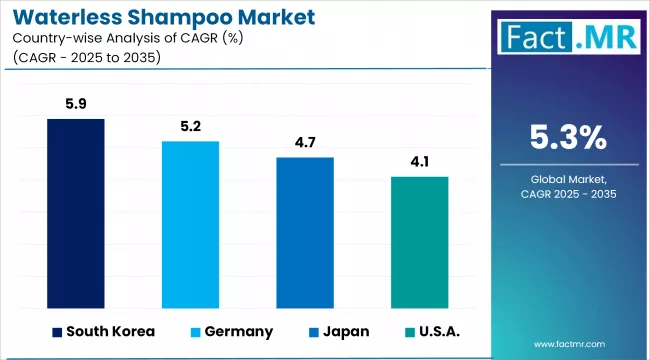
Waterless Shampoo Market By Country | Source: Fact.MR
U.S. waterless shampoo market expands with eco-conscious innovation and lifestyle convenience
The increasing consumer demand to satisfy their convenience needs and time-saving grooming product, in addition to the spreading knowledge of saving water is catalyzing the waterless shampoo market in the U.S. Rinse-free haircare follows the trend of busy urban schedule, travelling, and sustainability-relating decisions. Innovation centers like California and New York are experiencing emergence of start-ups, beauty-tech, labs, and partnership with world haircare companies.
2025-to-2035.webp "Us Waterless Shampoo Market Country Value(usd Million)2025 To 2035")
Us Waterless Shampoo Market Country Value(usd Million)2025 To 2035 | Source: Fact.MR
Major brands such as Unilever, Procter & Gamble and emerging indie labels are developing product lines by improving the premium botanical formulas, scalp health products and fragrance scented versions. Strategic retail extension, e-commerce inroads, and the eco-label certification, in addition to growing consumer consciousness of health and hygiene support the rate of commercialization making the U.S. the epicenter of the development of waterless haircare products.
South Korea waterless shampoo market thrives on k-beauty innovation and tech-integrated haircare
Korean beauty culture and product innovation is driving the waterless shampoo market in South Korea as people begin to use modern grooming products that also save time. The focus on environmentally safe, multifunctional and scalp-nourishing formula is appealing to younger consumers and professionals that live in large cities. In Seoul beauty-tech startups and partnerships with international haircare giants are shaping up to entwine AI diagnostics and mobile beauty programs in the city to layer consumer experiences.
Dominant brands, such as Amorepacific, LG Household, and new indie brands expand their product catalog into high-end flexible and travel-friendly products. South Korea also has robust e-commerce ecosystems and tech-savvy consumers that further increase the pace of commercializing waterless haircare in the country, with recent regulatory alignment, and sustainability efforts being a plus to this industry trend.
Germany waterless shampoo market strengthens with sustainability focus and premium haircare demand
The high demand of waterless shampoo in Germany is high, due to the notion of personal care products is sustainable and eco-certified. Customers are becoming more interested in rinse-free products suitable to satisfy the environmental perspective, but fitting the current lifestyle requirements. Berlin and Hamburg are becoming the hubs of innovation where startups and major brands cooperate to bring to the community natural, vegan, and dermatologically tested haircare lines.
Organic formulas, recyclable packages, and premium positioning offerings are the avenues through which key players like Henkel, or international entrants are strengthening their product line. Positive EU sustainability policies, the strength of retail distribution, and consumer awareness of the challenge are contributing to the increasing rate of the commercialization of waterless haircare solutions, and Germany is the key country in this market.
Category-Wise Analysis
Spray-Based waterless shampoo market gains momentum with convenience and premium appeal
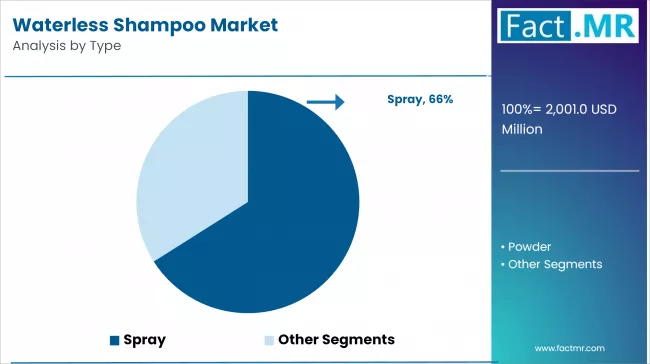
Waterless Shampoo Market By Type | Source: Fact.MR
The waterless shampoo market is led by the spray format, as it can be easily applied, is portable, and it helps re-freshen. City-based consumers and people who travel frequently find spray form and use more convenient to add instant oil absorption and volume without rinsing.
The trend on product innovation is nourishing the scalp, sustainability of freshness and innovation on small size packaging in line with both the premium and mass-market brands. Increment in e-commerce penetration, salon promotion and awareness among the consumers about the sustainable grooming routine are some of the other factors driving the commercialization of spray-based waterless shampoos at an international level.
Daily Care waterless shampoo market expands with lifestyle integration and scalp health benefits
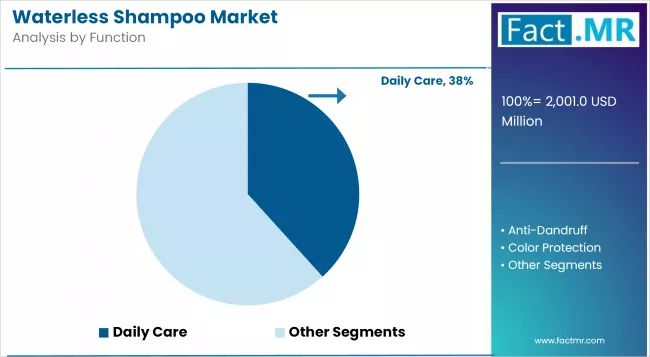
Waterless Shampoo Market By Function | Source: Fact.MR
Daily care utility aspect of waterless shampoos is already becoming fast and having an important growth opportunity, as demand grows in easy to use, time-efficient grooming applications. A growing number of consumers are incorporating these products as a part of their daily grooming ritual in order to control their odor, keep their skin oil-free, and make their hair thicker.
Market leaders like Dove, Batiste, and Livingproof are launching everyday formulas that have natural ingredients, scalp balancing agents, that can be used every day. The trend of urban lifestyle, time-strained life, and increased consciousness about environmentally friendly haircare are boosting the commercialization rate of waterless daily care shampoos across mass and premium segments.
Offline distribution of waterless shampoo strengthens through retail expansion and consumer accessibility
Distribution channels without an online connection are particularly important in the waterless shampoo market, owing to the fact that there is a high consumer preference to in-store test, purchase and availability. Supermarkets, hypermarkets, pharmacies and specialty beauty stores are increasing shelf space of this rinse-free shampoos, both with premium and mass products.
Brand names such as Unilever, Loreal and Procter and Gamble are tapering into offline on their way forward with appealing packaging, in-store promotions and salon collaborations. The increasing penetration of major retail outlets, along with the consumer confidence in-store shopping, keeps pushing the offline environment as one of the leading factors towards commercialization of waterless shampoo.
Competitive Analysis
The waterless shampoo industry is a young marketplace characterized by eco-conscious product invention, multipurpose product category, and changing consumer acceptance of rinse-free cleaning products. Signs of competitiveness are the possibilities to provide eco-certified formulations, guarantees of scalp health effects, and the preservation of product performance across different hair types and in different usage frequencies. The critical issue in the manufacturing process is maintaining a large scale of production to ensure uniform quality, cost-discovery, fragrance stability, subjecting the manufacturing process to regulatory guidelines on the use of aerosol, labeling of cosmetic products and environmental safety.
The ability to scale consumption of raw materials, particularly natural starches, clays and botanical extracts is essential when it comes to reliability and cost effectiveness. Unified uniformity of formulation consistency, oil-absorption performance, and non-hazardous dermatological safety testing continue to be key factors of consumer confidence. The market is becoming more competitive due to the developments in packaging innovation, prevalence of bio-based propellants, and coalescing with global sustainability ambitions, which altogether fashion the competitiveness.
Key players in the waterless shampoo market are The Powder Shampoo, Everist, Church & Dwight Co., Henkel Corporation, Honasa Consumer Limited, Amika, and others.
Recent Developments
- In July 2025, K18 Biomimetic Hairscience has unveiled AirWash, a new dry shampoo designed specifically for active lifestyles.
- In April 2025, Global dry shampoo experts, COLAB has just launched its game-changing Supreme Clean dry shampoo formula, designed to deliver an enhanced clean without the cakey, and heavy feel.
Fact.MR has provided detailed information about the price points of key manufacturers of Waterless Shampoo Market positioned across regions, sales growth, production capacity, and speculative technological expansion, in the recently published report.
Methodology and Industry Tracking Approach
This 2025 Global Waterless Shampoo Market Report is prepared on an extensive range of in-depth interviews with over 11,200 professionals, researchers, formulation scientists, sustainability experts, dermatologists and innovators in the areas of personal care, environmentally benign personal care and hair care technology. The participants were the directors of the R&D departments of major beauty and cosmetic companies, managers of the product innovation department, supply chain and packaging experts, marketing strategists, leaders of the regulatory affairs departments, and representatives of emerging clean-beauty companies.
The research method was a horizontal purpose where a planned series of questions were conducted between the month of September 2024 to July 2025. This system has allowed a closer evaluation of the most important topics, including the scalability of waterless shampoo manufacture, consistency and safety of no-rinse formulas, sustainable sourcing of materials, packaging, and the increase in consumer tolerance to environment-friendly hair care products. The process was also used to assess the formulation and craft of commercialization programs, distribution, and compliance with regulations which created a detailed rundown of the process that the waterless shampoo market has gone through globally.
With Fact.MR monitoring consumer behavior, product efficacy, industry trends, and market opportunities since 2018, this report is becoming an authoritative source of information that stakeholders can rely on.
Segmentation
Segmentation of Waterless Shampoo Market
-
By Type :
- Spray
- Power
-
By Function :
- Anti-Dandruff
- Color Protection
- Hair loss Protection
- Daily Care
-
By Distribution Channel :
- Online
- Offline
-
By End-User :
- Men
- Women
- Children
-
By Region :
- North America
- Latin America
- Western Europe
- Eastern Europe
- East Asia
- South Asia & Pacific
- Middle East & Africa
Frequently Asked Questions
What was the waterless shampoo market size reported by Fact.MR for 2025?
Who are the major players operating in the waterless shampoo market?
What is the estimated valuation of the waterless shampoo market in 2035?
What value CAGR did the waterless shampoo market exhibit over the last five years?
Who worked on this report


Preview the report firsthand - request a free sample
Free SampleGet the brochure for pricing and purchase details
Download PDF