- Market Value (2025): USD 1.6 Bn
- Estimated Value (2026): USD 1.7 Bn
- Forecast Value (2036): USD 3.4 Bn
- CAGR (2026-2036): 7.3%
What is the Uveal Melanoma Treatment Market forecast to be worth by 2036?
USD 1.7 billion in 2026 and USD 3.4 billion by 2036 at a 7.3% CAGR.
- The Uveal Melanoma Treatment Market was valued at approximately USD 1.6 billion in 2025.
- Demand is projected to increase from USD 1.7 billion in 2026 to USD 3.4 billion by 2036.
- The market is forecast to expand at a 7.3% CAGR from 2026 to 2036.
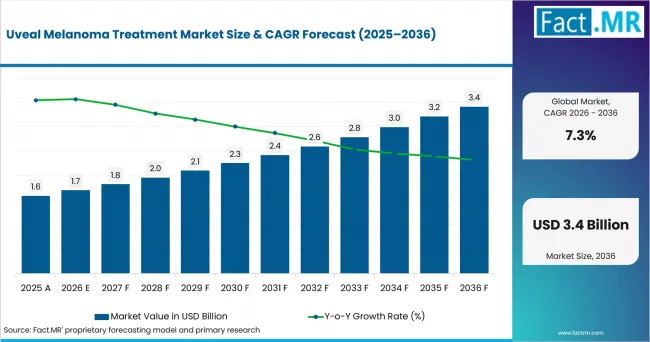
Uveal Melanoma Treatment Market Value Analysis | Source: Fact.MR
What are the defining numbers behind Uveal Melanoma Treatment Market growth?
An absolute opportunity of USD 1.7 billion is expected between 2026 and 2036. Radiation remains central to localized disease, while metastatic treatment is becoming more disease-specific through HLA-directed therapy, liver-directed treatment and late-stage targeted-drug development.
- Demand Drivers in the Market
- Eye-preserving radiation remains a core treatment pathway. The 2026 ESMO-EURACAN guideline identifies plaque brachytherapy and proton beam radiotherapy as established local treatments, keeping ocular-radiation capability central to primary disease management.
- Disease-specific systemic treatment has changed care for HLA-A*02:01-positive metastatic disease. Tebentafusp is an established first-line option for eligible patients, with regulatory and reimbursement pathways in the USA, Europe, the UK, Germany and Brazil.
- Liver-directed treatment creates an additional commercial pathway because the liver is the dominant metastatic site. The FDA-approved HEPZATO KIT provides a treatment option for selected adults with unresectable hepatic metastases from uveal melanoma.
- Late-stage targeted therapy is broadening development beyond the HLA-A*02:01-positive population. IDEAYA and Servier reported positive 2026 registrational data for darovasertib plus crizotinib in first-line HLA-A*02:01-negative metastatic uveal melanoma, with U.S. filing activity underway.
- Clinical development is moving earlier in the disease course. Immunocore continues the Phase 3 ATOM adjuvant trial, while Aura Biosciences completed enrollment in a Phase 3 study of bel-sar for early choroidal melanoma in June 2026.
- Systemic treatment development also sits within the wider cancer immunotherapy market, but uveal melanoma remains differentiated by HLA eligibility, ocular local treatment and liver-dominant metastatic biology.
- Key Segments Analyzed
- Radiation Therapy accounts for 34.8% of Product in 2026. Plaque brachytherapy and external beam approaches support local tumor control while preserving the eye in selected patients with localized disease.
- Primary Uveal Melanoma represents 63.5% of Disease Stage in 2026 because treatment activity usually begins with control of the ocular primary before metastatic therapy becomes necessary.
- Intravenous holds 46.9% of Route Of Administration in 2026. Advanced-disease treatment includes infused therapies such as tebentafusp and checkpoint inhibitors, keeping infusion capacity central to systemic care.
- Hospitals account for 48.6% of End Use in 2026. Radiation, surgery, monitored infusion and liver-directed procedures require specialist infrastructure and multidisciplinary oncology oversight.
- Adult Patients represent 69.3% of Patient Age Group in 2026. Uveal melanoma is predominantly diagnosed in adults, while pediatric disease remains uncommon.
- Analyst Opinion at Fact.MR
- Shambhu Nath Jha, Principal Consultant, Fact.MR
- “Uveal melanoma is moving toward a more segmented treatment pathway. Localized disease continues to depend on specialist radiation and eye-preserving procedures, while advanced disease is increasingly divided by HLA status, liver involvement and access to disease-specific systemic therapy. Commercial growth will depend on whether new targeted and adjuvant programs can broaden treatment without creating excessive monitoring or referral burden.”
- Strategic Implications
- Build treatment pathways around ocular-oncology referral centers because diagnosis, radiation planning, surveillance and systemic escalation require coordinated specialist care.
- Prioritize biomarker-linked treatment access, including HLA testing, because systemic therapy eligibility can depend on immunogenetic status as well as disease stage.
- Develop separate metastatic strategies for systemic and liver-dominant disease so treatment sequencing can incorporate tebentafusp, liver-directed therapy and emerging targeted options where clinically appropriate.
- Maintain radiation capability as a core commercial requirement because local control remains central to primary uveal melanoma even as drug development expands.
- Track adjuvant and early-disease trials because successful recurrence-prevention or vision-preserving approaches could create treatment demand before metastatic progression.
How does the Uveal Melanoma Treatment Market break down by segment?
The market is segmented by Product, Disease Stage, Route Of Administration, End Use and Patient Age Group.
Why does Radiation Therapy lead Product?
Radiation Therapy accounts for a 34.8% share of Product in 2026.
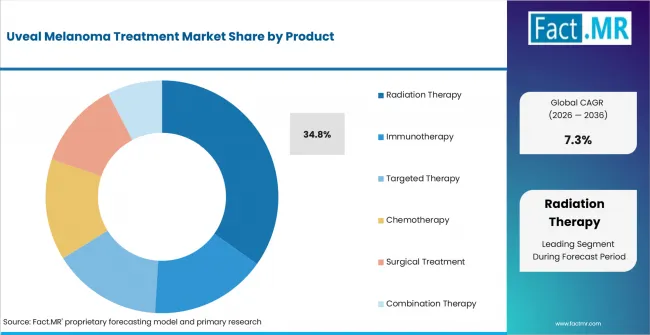
Uveal Melanoma Treatment Market Analysis By Product | Source: Fact.MR
Local control is the immediate treatment objective for primary uveal melanoma. Plaque brachytherapy and proton beam radiotherapy allow clinicians to treat the ocular tumor while preserving the eye in many patients, making radiation a central part of established treatment practice.
This segment is linked to the brachytherapy devices market because source delivery, treatment planning and dose precision directly influence localized ocular cancer care.
Why does Primary Uveal Melanoma lead Disease Stage?
Primary Uveal Melanoma accounts for a 63.5% share of Disease Stage in 2026.
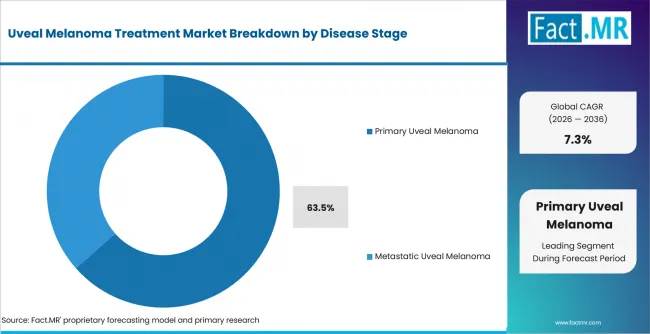
Uveal Melanoma Treatment Market Analysis By Disease Stage | Source: Fact.MR
Treatment usually begins with control of the ocular primary through brachytherapy, proton therapy, local resection or enucleation according to tumor size, location and visual potential. This makes primary disease the main entry point into the treatment pathway.
Commercial activity continues after local therapy because patients require surveillance for metastatic recurrence. The liver is the principal metastatic site, creating a later link to systemic and liver-directed oncology treatment.
Why does Intravenous lead Route Of Administration?
Intravenous accounts for a 46.9% share of Route Of Administration in 2026.
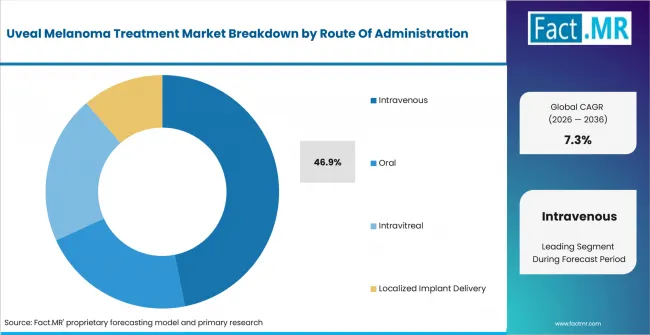
Uveal Melanoma Treatment Market Analysis By Route Of Administration | Source: Fact.MR
Advanced uveal melanoma is treated in specialist oncology settings where several systemic therapies are administered by infusion. Tebentafusp is given by weekly intravenous infusion, and early administrations require monitored observation because of treatment-related acute effects.
The route also intersects with the checkpoint inhibitors market because anti-PD-1 and CTLA-4 therapies remain part of treatment options for selected metastatic patients.
Why do Hospitals lead End Use?
Hospitals account for a 48.6% share of End Use in 2026.
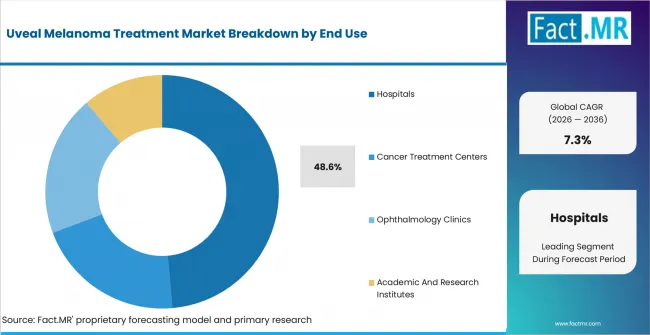
Uveal Melanoma Treatment Market Analysis By End Use | Source: Fact.MR
Uveal melanoma combines ocular procedures and systemic oncology care that are difficult to decentralize. Plaque placement, radiation, enucleation, liver-directed procedures and monitored infusions require specialist teams, imaging, operating-room access or radiation infrastructure.
Hospital concentration is reinforced by the need for HLA testing, treatment observation and coordinated management of metastatic disease, particularly when patients move between ocular oncology, medical oncology and interventional radiology.
Why do Adult Patients lead Patient Age Group?
Adult Patients account for a 69.3% share of Patient Age Group in 2026.
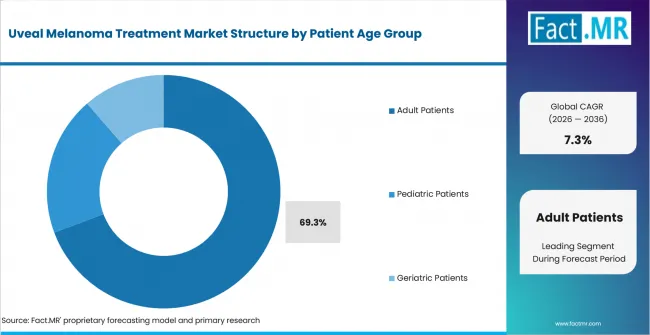
Uveal Melanoma Treatment Market Analysis By Patient Age Group | Source: Fact.MR
Uveal melanoma is primarily an adult malignancy, and incidence rises with age. Pediatric uveal melanoma remains uncommon, so adult-focused evidence shapes most local and systemic treatment protocols.
Ocular oncology treatment also sits alongside the wider ophthalmic drugs market, although uveal melanoma relies more heavily on oncology drugs, radiation and surgical procedures than routine topical ophthalmic therapy.
What is accelerating Uveal Melanoma Treatment Market adoption, and what is holding it back?
Adoption is supported by established eye-preserving radiation, disease-specific treatment for metastatic disease, liver-directed therapy and an active late-stage development pipeline. Growth is constrained by the rarity of the cancer, concentration of expertise in referral centers, HLA restrictions for tebentafusp and the cost and monitoring burden of specialized treatment.
Drivers Impact Analysis
| Factor | (~) % Impact on CAGR | Geographic Relevance | Impact Timeline |
|---|---|---|---|
| Eye-preserving radiation and local-control demand | +1.4% | Global | Short term (<= 2 years) |
| Disease-specific systemic therapy for metastatic disease | +1.2% | Germany, USA, UK and Brazil | Short term (<= 2 years) |
| Specialist referral and biomarker testing pathways | +0.9% | Germany, USA and UK | Medium term (2-4 years) |
| Long-term surveillance and metastatic treatment need | +0.7% | Global | Long term (>= 4 years) |
Source: Fact.MR analysis. Updated Sep 3, 2026
Opportunity Impact Analysis
| Factor | (~) % Impact on CAGR | Geographic Relevance | Impact Timeline |
|---|---|---|---|
| Adjuvant treatment for high-risk primary disease | +0.9% | Germany, USA and UK | Medium term (2-4 years) |
| PKC and other targeted therapy development | +0.8% | USA, Germany and Japan | Medium term (2-4 years) |
| Systemic and liver-directed treatment sequencing | +0.6% | Global | Medium term (2-4 years) |
| New market access after national regulatory approvals | +0.5% | Brazil and other emerging markets | Long term (>= 4 years) |
Source: Fact.MR analysis. Updated Sep 3, 2026
Restraints Impact Analysis
| Factor | (~) % Impact on CAGR | Geographic Relevance | Impact Timeline |
|---|---|---|---|
| Rare disease and concentrated specialist capacity | -0.8% | Global | Short term (<= 2 years) |
| HLA restriction for tebentafusp eligibility | -0.7% | Global | Short term (<= 2 years) |
| Infusion monitoring and treatment burden | -0.6% | USA, UK, Germany and Brazil | Medium term (2-4 years) |
| Limited access to ocular radiation and advanced trials | -0.4% | Japan, Brazil and underserved markets | Long term (>= 4 years) |
Source: Fact.MR analysis. Updated Sep 3, 2026
Which countries are scaling the Uveal Melanoma Treatment Market through 2036?
- Germany: Reimbursement and specialist access support disease-specific therapy. The G-BA completed a 2024 reassessment of tebentafusp for HLA-A*02:01-positive unresectable or metastatic uveal melanoma, while German centers also participate in current adjuvant development.
- Brazil: ANVISA registered tebentafusp in February 2025 for HLA-A*02:01-positive adults with unresectable or metastatic uveal melanoma, creating a national regulatory route for disease-specific systemic treatment.
- USA: FDA-approved tebentafusp and HEPZATO provide systemic and liver-directed treatment options, while current registrational programs are expanding development in HLA-A*02:01-negative metastatic disease and earlier-stage ocular melanoma.
- UK: NICE recommended tebentafusp in January 2025 for eligible adults, creating a funded NHS pathway for advanced disease and supporting treatment concentration in specialist oncology centers.
- Japan: Uveal melanoma represents a small share of melanoma cases in national registry data, so growth depends on specialist referral, precision-oncology access and participation in international clinical development.
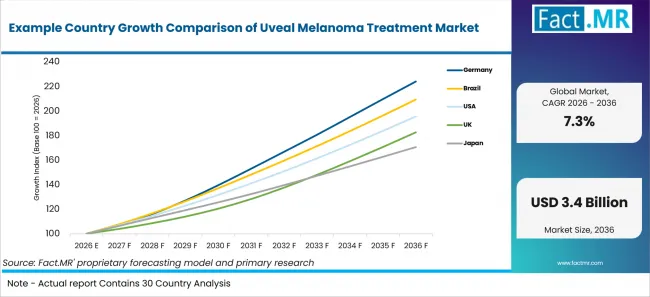
Example Country Growth Comparison Of Uveal Melanoma Treatment Market | Source: Fact.MR
| Country | CAGR (2026-2036) |
|---|---|
| Germany | 8.4% |
| Brazil | 7.7% |
| USA | 6.9% |
| UK | 6.2% |
| Japan | 5.5% |
Source: Fact.MR analysis. Updated Sep 3, 2026
What is driving Germany's growth through 2036?
Germany is forecast to expand at an 8.4% CAGR from 2026 to 2036.
Germany has an established health-technology assessment pathway for disease-specific therapy. The G-BA completed its 2024 reassessment of tebentafusp for HLA-A*02:01-positive unresectable or metastatic uveal melanoma after the therapy exceeded the orphan-drug turnover threshold.
German centers also participate in the ATOM Phase 3 adjuvant study, supporting specialist awareness and infrastructure for potential movement of tebentafusp into high-risk disease after definitive local treatment.
What is driving Brazil's growth through 2036?
Brazil is forecast to expand at a 7.7% CAGR from 2026 to 2036.
ANVISA granted a new-product registration for tebentafusp in February 2025 for eligible adults with unresectable or metastatic uveal melanoma. This provides a national regulatory basis for disease-specific systemic treatment rather than relying only on therapies developed for cutaneous melanoma.
Commercial adoption remains concentrated in specialist cancer centers because HLA testing, weekly intravenous administration and management of early treatment reactions require coordinated oncology capacity.
What is driving USA's growth through 2036?
The USA is forecast to expand at a 6.9% CAGR from 2026 to 2036.
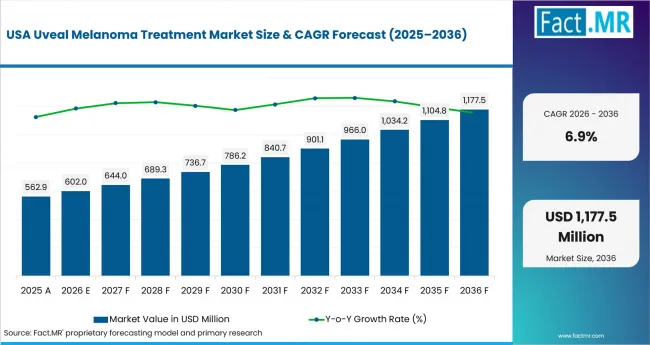
Uveal Melanoma Treatment Market Country Value Analysis | Source: Fact.MR
The FDA approved tebentafusp in 2022 for HLA-A*02:01-positive adults with unresectable or metastatic uveal melanoma and HEPZATO KIT in 2023 for selected adults with unresectable hepatic metastases. These approvals create distinct systemic and liver-directed treatment pathways.
Development activity is also broadening. IDEAYA and Servier reported positive 2026 registrational data for darovasertib plus crizotinib in HLA-A*02:01-negative metastatic disease, while Aura Biosciences completed enrollment in a Phase 3 study of bel-sar for early choroidal melanoma.
What is driving UK's growth through 2036?
The UK is forecast to expand at a 6.2% CAGR from 2026 to 2036.
NICE recommended tebentafusp in January 2025 for HLA-A*02:01-positive unresectable or metastatic uveal melanoma in adults under a commercial arrangement. This gives eligible patients a defined funded pathway through specialist NHS services.
The UK also participates in the ATOM adjuvant Phase 3 study, creating a route for specialist centers to evaluate recurrence-prevention treatment alongside established ocular radiation and metastatic care.
What is driving Japan's growth through 2036?
Japan is forecast to expand at a 5.5% CAGR from 2026 to 2036.
A 2025 analysis of Japan's National Cancer Registry found that uveal melanoma represented 2.7% of melanoma cases in 2016-2017, confirming a comparatively small patient pool and concentrating care in specialist centers.
Treatment development remains connected to the wider anti-cancer drugs landscape, but uveal melanoma is differentiated by ocular local-treatment requirements, HLA-directed therapy and liver-dominant metastatic biology.
Who Leads the Uveal Melanoma Treatment Market?
Key players in the Uveal Melanoma Treatment Market include Immunocore Holdings plc, Delcath Systems, Inc., IDEAYA Biosciences, Inc., Servier, Aura Biosciences, Inc., Merck & Co., Inc. and Bristol Myers Squibb.
Competition is stage-specific. Immunocore markets KIMMTRAK for HLA-A*02:01-positive unresectable or metastatic uveal melanoma and continues the ATOM adjuvant program. Delcath supplies HEPZATO KIT for selected patients with unresectable hepatic metastases, creating a liver-directed commercial pathway alongside systemic treatment.
The development pipeline is also reshaping competitive positioning. IDEAYA and Servier are advancing darovasertib across metastatic and primary uveal melanoma after positive 2026 registrational data in HLA-A*02:01-negative metastatic disease. Aura Biosciences has completed enrollment in its Phase 3 CoMpass study of bel-sar for early choroidal melanoma, with topline data expected in 2027.
Merck & Co. and Bristol Myers Squibb remain relevant through checkpoint-inhibitor use in advanced disease, particularly when disease-specific treatment is not applicable. Supplier positioning therefore depends on disease stage, HLA status, metastatic distribution, route of administration and access to specialist treatment infrastructure.
Which companies are the key providers?
Key providers include Immunocore Holdings plc, Delcath Systems, Inc., IDEAYA Biosciences, Inc., Servier, Aura Biosciences, Inc., Merck & Co., Inc. and Bristol Myers Squibb.
- Immunocore Holdings plc
- Delcath Systems, Inc.
- IDEAYA Biosciences, Inc.
- Servier
- Aura Biosciences, Inc.
- Merck & Co., Inc.
- Bristol Myers Squibb
Bibliography
- Piperno-Neumann, S., et al. (2026). Uveal melanoma: ESMO-EURACAN Clinical Practice Guideline for diagnosis, treatment and follow-up. ESMO Open.
- National Cancer Institute. (2025). Intraocular (Uveal) Melanoma Treatment (PDQ), Health Professional Version. National Institutes of Health.
- National Cancer Institute. (2024). Childhood Intraocular (Uveal) Melanoma Treatment (PDQ), Health Professional Version. National Institutes of Health.
- U.S. Food and Drug Administration. (2022). Drug Trials Snapshot: KIMMTRAK (tebentafusp). U.S. Department of Health and Human Services.
- U.S. Food and Drug Administration. (2023). FDA approves melphalan as a liver-directed treatment for uveal melanoma. U.S. Department of Health and Human Services.
- European Medicines Agency. (2025). Kimmtrak: European Public Assessment Report and product information. European Medicines Agency.
- National Institute for Health and Care Excellence. (2025). Tebentafusp for treating advanced uveal melanoma, TA1027. NICE.
- Gemeinsamer Bundesausschuss. (2024). Tebentafusp benefit assessment for HLA-A*02:01-positive uveal melanoma. Federal Joint Committee, Germany.
- Agencia Nacional de Vigilancia Sanitaria. (2025). Kimmtrak (tebentafusp): New product registration for unresectable or metastatic uveal melanoma. Government of Brazil.
- Immunocore Holdings plc. (2026). Second Quarter 2026 Financial Results and Business Update. Immunocore.
- Immunocore Holdings plc. (2026). Pipeline and Portfolio: Tebentafusp in Adjuvant Uveal Melanoma. Immunocore.
- Delcath Systems, Inc. (2026). CHEMOSAT/HEPZATO and Uveal Melanoma Clinical Development Updates. Delcath Systems.
- IDEAYA Biosciences, Inc. and Servier. (2026). Complete Data from the Phase 2/3 OptimUM-02 Trial of Darovasertib plus Crizotinib in Metastatic Uveal Melanoma. IDEAYA Biosciences.
- Aura Biosciences, Inc. (2026). Enrollment Completion in Phase 3 CoMpass Trial of Bel-sar in Early Choroidal Melanoma. Aura Biosciences.
- ClinicalTrials.gov. (2026). NCT06246149: Adjuvant Tebentafusp in High Risk Ocular Melanoma (ATOM). U.S. National Library of Medicine.
- Ogata, D., et al. (2025). Comprehensive epidemiology of melanoma at all sites: insights from Japan's National Cancer Registry, 2016-2017. International Journal of Clinical Oncology.
- Weinberger, Y., Bena, J., & Singh, A. D. (2025). Uveal Melanoma: 5-Year Update on Incidence, Treatment, and Survival. Ocular Oncology and Pathology.
This Report Answers
- What is the Uveal Melanoma Treatment Market value in 2026 and what value is forecast for 2036?
- Why does Radiation Therapy hold the leading Product share in 2026?
- Why does Primary Uveal Melanoma account for the leading Disease Stage share?
- Why is Intravenous the leading Route Of Administration?
- Why do Hospitals account for the leading End Use share?
- Why do Adult Patients account for the leading Patient Age Group share?
- How are HLA-directed therapy, liver-directed treatment and targeted drug development changing metastatic care?
- How do growth conditions differ across Germany, Brazil, USA, UK and Japan?
- Which companies currently participate in uveal melanoma treatment and late-stage development?
- What barriers can slow adoption of specialized treatment?
What does the Uveal Melanoma Treatment Market cover?
The Uveal Melanoma Treatment Market covers commercial revenue from therapeutic interventions used to manage primary and metastatic uveal melanoma. Revenue includes local ocular treatment and systemic or liver-directed oncology treatment when used specifically for uveal melanoma.
Coverage includes radiation therapy, immunotherapy, targeted therapy, chemotherapy, surgical treatment and combination therapy, together with the applicable administration routes, care settings and patient age groups.
What is included in the scope?
Product includes Radiation Therapy, Immunotherapy, Targeted Therapy, Chemotherapy, Surgical Treatment and Combination Therapy, together with their listed subsegments. Disease Stage includes Primary Uveal Melanoma and Metastatic Uveal Melanoma with the associated localized, advanced-local, liver-metastatic and extrahepatic categories.
Route Of Administration includes Intravenous, Oral, Intravitreal and Localized Implant Delivery. End Use includes Hospitals, Cancer Treatment Centers, Ophthalmology Clinics and Academic And Research Institutes. Patient Age Group includes Adult Patients, Pediatric Patients and Geriatric Patients.
What is excluded from the scope?
The scope excludes stand-alone diagnostic imaging and eye-examination equipment when these are not sold as part of treatment. It also excludes cutaneous melanoma treatment unless the therapy is used within a uveal melanoma treatment pathway.
General supportive care, unrelated ophthalmic drugs and oncology products without a uveal melanoma treatment role are outside the market. Research-only compounds are discussed as pipeline evidence but are not counted as commercial treatment revenue until they enter the market.
How Was the Analysis Built?
The analysis draws on more than 120 public and technical sources, over 35 company and treatment portfolios and more than 20 industry interviews across at least 25 countries.
- Primary Research: Interviews with ocular oncologists, medical oncologists, radiation oncologists, hospital procurement teams, specialist pharmacists and treatment centers examine referral patterns, treatment sequencing, biomarker use, reimbursement, capacity constraints and therapy adoption.
- Desk Research: The review covers regulator decisions, health-technology assessments, clinical guidelines, cancer registries, clinical-trial databases, peer-reviewed studies and current company or product information relevant to uveal melanoma treatment.
- Market Sizing and Forecasting: Estimates combine treated patient volumes with local versus metastatic treatment mix, therapy duration, administration intensity, procedure and drug pricing, adoption of disease-specific therapy and access to specialist centers.
- Data Validation and Update Cycle: Findings are cross-checked against approvals, reimbursement decisions, guideline changes, phase II and phase III trial progress and current company status. Updates account for changes in local treatment practice, metastatic sequencing and commercial access.
Segmentation
What is the report's scope and coverage?
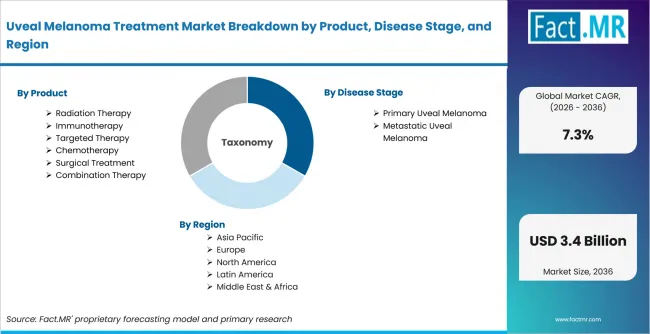
Uveal Melanoma Treatment Market Breakdown By Product, Disease Stage, And Region | Source: Fact.MR
| Attribute | Details |
|---|---|
| Quantitative Units | USD billion |
| Market Definition | Therapeutic interventions used for primary and metastatic uveal melanoma across treatment, route, care-setting and patient-age categories |
| Segments Covered | Product; Disease Stage; Route Of Administration; End Use; Patient Age Group |
| Regions Covered | North America; Latin America; Europe; East Asia; South Asia and Pacific; Middle East and Africa |
| Countries Covered | Germany; Brazil; USA; UK; Japan |
| Key Companies Profiled | Immunocore Holdings plc; Delcath Systems, Inc.; IDEAYA Biosciences, Inc.; Servier; Aura Biosciences, Inc.; Merck & Co., Inc.; Bristol Myers Squibb |
| Forecast Period | 2026 to 2036 |
| Base Year | 2025 |
| Market Value, 2026 | USD 1.7 billion |
| Market Value, 2036 | USD 3.4 billion |
| CAGR, 2026-2036 | 7.3% |
| Absolute Opportunity | USD 1.7 billion |
| Approach | Hybrid top-down and bottom-up assessment using treated patient volumes, modality mix, route, treatment intensity, pricing, specialist capacity and access conditions |
Source: Fact.MR analysis. Updated Sep 3, 2026
How is the market segmented?
-
By Product
- Radiation Therapy
- Brachytherapy
- External Beam Radiation Therapy
- Immunotherapy
- Immune Checkpoint Inhibitors
- T Cell Therapies
- Bispecific Therapies
- Targeted Therapy
- MEK Inhibitors
- Protein Kinase Inhibitors
- Anti Angiogenic Therapy
- Chemotherapy
- Alkylating Agents
- Antimetabolites
- Surgical Treatment
- Local Tumor Resection
- Enucleation
- Combination Therapy
- Immunotherapy And Radiation
- Targeted Therapy And Chemotherapy
- Radiation Therapy
-
By Disease Stage
- Primary Uveal Melanoma
- Localized Disease
- Advanced Local Disease
- Metastatic Uveal Melanoma
- Liver Metastasis
- Extrahepatic Metastasis
- Primary Uveal Melanoma
-
By Route Of Administration
- Intravenous
- Oral
- Intravitreal
- Localized Implant Delivery
-
By End Use
- Hospitals
- Cancer Treatment Centers
- Ophthalmology Clinics
- Academic And Research Institutes
-
By Patient Age Group
- Adult Patients
- Pediatric Patients
- Geriatric Patients
-
By Region
- North America
- Latin America
- Western Europe
- Eastern Europe
- East Asia
- South Asia and Pacific
- Middle East & Africa
Frequently Asked Questions
What is the Uveal Melanoma Treatment Market value in 2026?
At what CAGR is the Uveal Melanoma Treatment Market projected to grow?
What is the projected Uveal Melanoma Treatment Market value by 2036?
Which Product segment leads the Uveal Melanoma Treatment Market?
Which Disease Stage segment leads the Uveal Melanoma Treatment Market?
Which Route Of Administration leads the Uveal Melanoma Treatment Market?
Which End Use segment leads the Uveal Melanoma Treatment Market?
Which Patient Age Group leads the Uveal Melanoma Treatment Market?
What is Germany's CAGR in the Uveal Melanoma Treatment Market?
What is a major demand driver for the Uveal Melanoma Treatment Market?
What is a major restraint on the Uveal Melanoma Treatment Market?
Who are the key companies in the Uveal Melanoma Treatment Market?
Who worked on this report


Preview the report firsthand - request a free sample
Free SampleGet the brochure for pricing and purchase details
Download PDF