- Base Value(2025): 3.5 Bn
- Estimated Value(2026): 3.7 Bn
- Forecast Value (2036): 6.8 Bn
- CAGR (2026 - 2036): 6.2%
Value-based Healthcare Service Market Forecast 2026 to 2036
In 2025, the value-based healthcare service market was valued at USD 3.5 billion. Based on FMR analysis, demand for value-based healthcare services is estimated to grow to USD 3.7 billion in 2026 and USD 6.8 billion by 2036. FMR projects a CAGR of 6.2% during the forecast period.
The absolute dollar growth from 2026 to 2036 is USD 3.1 billion. This growth is driven by the increasing shift from fee-for-service models to value-based care, focusing on improving patient outcomes while reducing healthcare costs. As governments and private sectors prioritize patient-centered care, this market is expanding rapidly. However, challenges such as integration of new healthcare models, data privacy concerns, and regional healthcare system disparities may impact growth.
As Sachin Jain, President and Chief Executive Officer of SCAN Group & Health Plan, noted regarding the goals and challenges of value‑based care, ‘First, we have to accept that the goal of value‑based care is better health and lower costs. Second, we have to acknowledge that lower costs should translate into lower costs for society and lower revenues for our organizations. And then we have to accept that this is a good thing!’
India leads with a CAGR of 7.5%, driven by ongoing healthcare reforms and the adoption of value-based care models in both public and private healthcare sectors. China follows with 7.2%, supported by a large population and the government's focus on improving healthcare quality. The UK grows at 6.1%, reflecting the ongoing shift toward value-based care in the National Health Service (NHS). Germany grows at 6.0%, benefiting from the integration of value-based care models in its efficient healthcare system. France shows growth at 5.9%, supported by healthcare system reforms and an increased focus on patient-centered care.
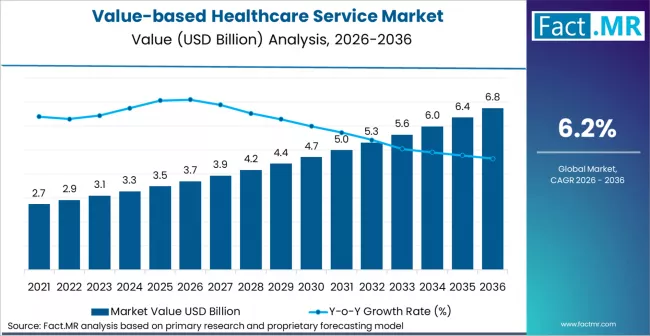
Value Based Healthcare Service Market Market Value Analysis | Source: Fact.MR
Value-based Healthcare Service Market
| Metric | Value |
|---|---|
| Estimated Value in (2026E) | USD 3.7 billion |
| Forecast Value in (2036F) | USD 6.8 billion |
| Forecast CAGR (2026 to 2036) | 6.2% |
Source: Fact.MR analysis. Updated Mar 6, 2026
Value‑based Healthcare Service Market Definition
The Value‑based Healthcare Service Market involves the provision and sale of healthcare delivery and management services that link payment to patient outcomes, quality of care, and cost efficiency instead of service volume.
Market Inclusions
This report covers global and regional market sizes for value‑based healthcare services over a defined forecast period, including service models (shared savings, bundled payments, accountable care), care settings (hospitals, clinics, managed care organizations), and end‑use segments.
Market Exclusions
The scope excludes traditional fee‑for‑service healthcare delivery models, unrelated health insurance products without value‑based components, and non‑clinical wellness services not tied to measurable care outcomes.
Research Methodology
- Primary Research: Interviews were conducted with healthcare administrators, payers, and value‑based care solution providers.
- Desk Research: Data was sourced from healthcare reports, policy publications, and industry association data.
- Market‑Sizing and Forecasting: A hybrid model combining top‑down healthcare service demand forecasts with bottom‑up revenue and adoption data was used.
- Data Validation and Update Cycle: Findings were validated through expert review and aligned with recent service adoption and performance statistics.
Summary of the Value-based Healthcare Service Market
- Market Definition
- The Value-based Healthcare Service Market encompasses the provision and sale of healthcare delivery and management services that link payment to patient outcomes, quality of care, and cost efficiency, rather than the volume of services provided.
- Demand Drivers
- Shift Toward Outcome-Oriented Models: The healthcare industry's shift from fee-for-service models to value-based care is driving the market's expansion. This approach emphasizes improving patient outcomes while reducing overall healthcare costs.
- Regulatory and Policy Support: Governments and private insurers are increasingly incentivizing value-based care models, which reward healthcare providers for delivering high-quality, efficient care. This trend is fueling market growth.
- Technological Advancements: The integration of advanced healthcare IT solutions that enable better care coordination and data-driven decision-making is accelerating the adoption of value-based care models.
- Key Segments Analyzed
- Deployment: Cloud deployment is expected to lead, with a projected 69.5% market share by 2026, due to its scalability, flexibility, and cost-effectiveness in managing value-based healthcare services.
- End-User Sector: Hospitals and health systems are projected to hold 53% of the market share by 2026, driven by the shift to value-based care models within these institutions.
- Geography: India leads with a CAGR of 7.5%, reflecting the country's ongoing healthcare reforms and growing adoption of value-based models.
- Analyst Opinion at Fact MR
- Shambhu Nath Jha, Principal Consultant at Fact MR, stated, "The shift toward value-based care is gaining momentum globally, with a strong push from both governments and private sectors to improve patient outcomes while reducing healthcare costs."
- Strategic Implications/Executive Takeaways
- Focus on Cloud-Based Solutions: Companies should invest in scalable, cloud-based solutions to align with the growing preference for flexible and cost-effective healthcare management models.
- Expand in Emerging Markets: Expanding in regions like India, where healthcare reforms are taking place and the demand for value-based care is rising, offers significant growth opportunities.
- Leverage Technological Integration: Healthcare organizations should focus on integrating data analytics and care coordination tools into value-based models to ensure seamless care delivery and improved patient outcomes.
- Methodology
- Primary Research: Interviews with healthcare administrators, payers, and value-based care solution providers.
- Desk Research: Data sourced from healthcare reports, policy publications, and industry association data.
- Market Sizing & Forecasting: A hybrid model combining top-down healthcare service demand with bottom-up revenue and adoption data.
Segmental Analysis
Value-based Healthcare Service Market Analysis by Deployment
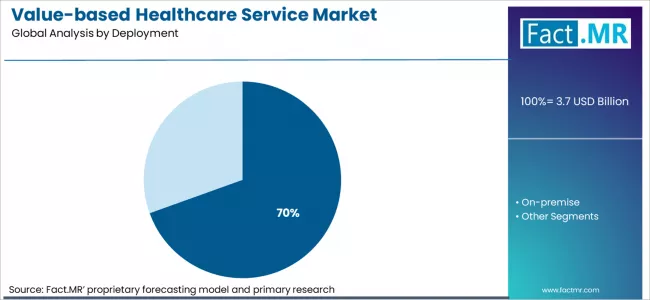
Value Based Healthcare Service Market Analysis By Deployment | Source: Fact.MR
- Market Overview: Cloud deployment is expected to capture 69.5% of the market share by 2026. Cloud-based solutions are increasingly preferred for value-based healthcare services due to their flexibility, scalability, and cost-effectiveness. Cloud deployment allows healthcare organizations to store, manage, and analyze patient data efficiently while facilitating collaboration across different platforms.
- Demand Drivers:
- Cost-Effectiveness and Scalability: Cloud solutions reduce the need for significant upfront infrastructure investments and provide scalable services, making them ideal for healthcare organizations seeking efficient, flexible, and cost-effective solutions.
- Ease of Access and Integration: Cloud-based platforms enable easy access to healthcare data from multiple locations, improving coordination and care delivery, particularly for value-based models that emphasize collaboration.
- Data Security and Compliance: Cloud providers offering secure storage solutions with robust compliance measures (such as HIPAA) make cloud deployment a secure and reliable option for healthcare services.
Value-based Healthcare Service Market Analysis by End User
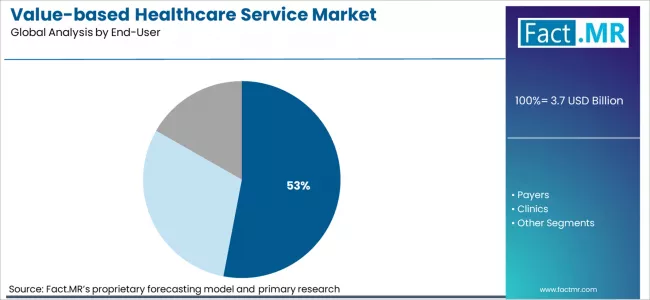
Value Based Healthcare Service Market Analysis By End User | Source: Fact.MR
- Market Overview: Hospitals/Health systems are projected to account for 53% of the market share by 2026. Hospitals and integrated health systems are the primary adopters of value-based healthcare services, as they seek to improve patient outcomes and reduce costs through collaborative care models and performance-based reimbursement.
- Demand Drivers:
- Emphasis on Improved Patient Outcomes: The shift toward value-based care, where payment is tied to patient outcomes rather than service volume, is driving hospitals and health systems to adopt solutions that improve care quality and efficiency.
- Regulatory Push for Value-Based Models: Healthcare regulations increasingly incentivize value-based care models that reward hospitals for enhancing patient care while reducing costs, driving demand for solutions that support this transition.
- Advancements in Healthcare IT: As hospitals and health systems invest in digital health solutions to improve care coordination and patient management, the demand for value-based healthcare services continues to grow.
Value-Based Healthcare Service Market Drivers, Restraints, and Opportunities
FMR analysts observe that the value-based healthcare (VBHC) service market is a growth-aligned reform segment driven by payers and providers shifting from fee-for-service toward outcomes-oriented care delivery. Historically, healthcare reimbursement emphasized volume of services; as pressure on costs and quality intensified, structural demand emerged for VBHC models that reward improved patient outcomes, preventive care, and coordinated service delivery. The 2026 valuation reflects this transition, with adoption tied to regulatory policy changes and provider incentives rather than incremental care delivery alone.
While traditional fee-for-service arrangements remain widespread, value-based models, such as bundled payments, accountable care organizations (ACOs), and population health management programs, are gaining share because they align reimbursement with quality and cost metrics. These service frameworks often command higher total contract value through shared savings and quality bonuses, contributing to net market growth even as individual service volumes stabilize. The market exists because health systems, payers, and governments increasingly prioritize cost efficiency, patient outcomes, and long-term health management.
- Reimbursement Reform Demand: Payers and providers adopt VBHC models that replace volume-based payment incentives with outcome and cost-efficiency measures.
- Regulatory and Policy Standards: Policies such as accountable care requirements and quality reporting mandates push uptake of certified VBHC service frameworks that meet defined performance criteria.
- Regional Healthcare Trends: In North America and Europe, mature insurance frameworks and quality mandates drive higher adoption compared with regions where fee-for-service systems still predominate.
Regional Analysis
The market analysis covers key global regions, including South Asia, East Asia, Western Europe, and North America. It is segmented geographically, with specific market dynamics for each region. The full report provides a detailed market attractiveness analysis.
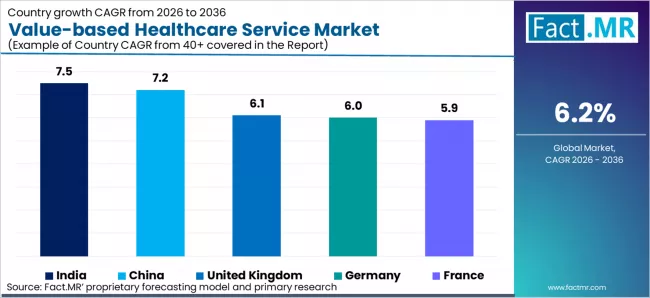
Value Based Healthcare Service Market Cagr Analysis By Country | Source: Fact.MR
| Country | CAGR (2026-2036) |
|---|---|
| India | 7.5% |
| China | 7.2% |
| United Kingdom | 6.1% |
| Germany | 6.0% |
| France | 5.9% |
Source: Fact.MR analysis. Updated Mar 6, 2026
Source: Fact MR (FMR) analysis, based on proprietary forecasting model and primary research.
South Asia:
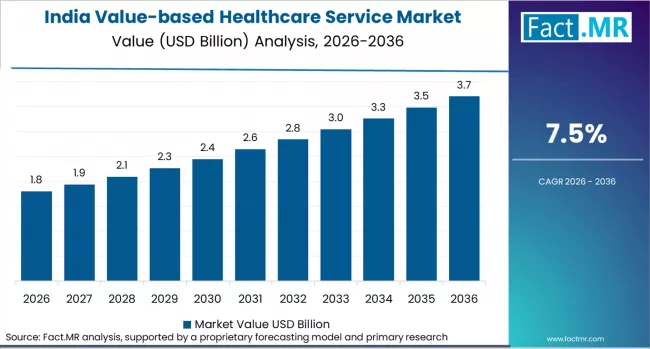
Value Based Healthcare Service Market Country Value Analysis | Source: Fact.MR
In South Asia, India is a leading market for value-based healthcare services, driven by the country’s rapidly growing healthcare sector, increasing adoption of value-based care models, and rising government investments in healthcare infrastructure.
- India: Demand for value-based healthcare services in India is projected to rise at 7.5% CAGR through 2036. India’s expanding healthcare sector, increased adoption of value-based care models, and government initiatives to improve healthcare accessibility continue to drive market growth.
East Asia:
In East Asia, China is a significant market for value-based healthcare services, supported by the country’s large population, increasing healthcare spending, and rising interest in improving healthcare outcomes through value-based care models.
- China: Demand for value-based healthcare services in China is projected to rise at 7.2% CAGR through 2036. China’s growing healthcare expenditures, government policies promoting value-based care, and rising demand for improved healthcare outcomes contribute to steady market growth.
Western Europe:
In Western Europe, the United Kingdom, Germany, and France are key markets for value-based healthcare services, driven by well-established healthcare systems, increasing healthcare spending, and rising adoption of value-based care models aimed at improving patient outcomes and reducing costs.
- United Kingdom: Demand for value-based healthcare services in the UK is projected to rise at 6.1% CAGR through 2036. The UK’s strong healthcare system, growing focus on cost-effective care, and increasing patient-centric care models continue to fuel market growth.
- Germany: Demand for value-based healthcare services in Germany is projected to rise at 6.0% CAGR through 2036. Germany’s high-quality healthcare system, government initiatives supporting value-based care, and rising demand for efficient and outcome-focused care continue to contribute to market demand.
- France: Demand for value-based healthcare services in France is projected to rise at 5.9% CAGR through 2036. France’s established healthcare infrastructure, growing interest in improving patient outcomes, and increased focus on sustainable healthcare delivery continue to support market expansion.
Fact MR's analysis of the Value-based Healthcare Service Market in South Asia, East Asia, Western Europe consists of country-wise assessments that include India, China, the United Kingdom, Germany, and France. Readers can find detailed trends, regulatory updates, and company-specific investments shaping the market’s growth in these countries.
What is the Competitive Structure and Buyer Behavior in the Value based Healthcare Service Market?
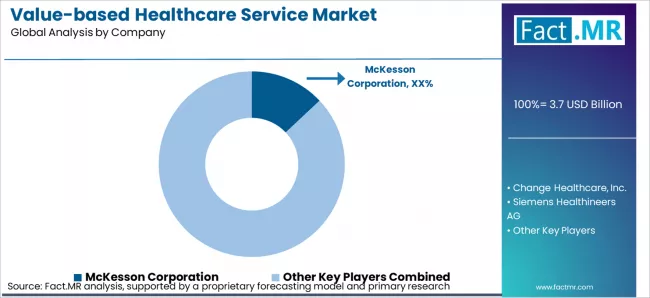
Value Based Healthcare Service Market Analysis By Company | Source: Fact.MR
The value‑based healthcare service market is moderately concentrated, with large diversified healthcare and services firms such as McKesson Corporation, Change Healthcare, Inc., Siemens Healthineers AG, Boston Consulting Group, Inc., NextGen Healthcare, Inc., Genpact Ltd., athenahealth, Inc., and UnitedHealth Group Incorporated holding substantial share alongside more specialized providers including HarmonyCares, Inc., Arbital Health, Inc., Pearl Health, Inc., GuideWell Mutual Holding Corporation, and Interwell Health, Inc. The primary competitive variables are the breadth and integration of care coordination solutions, analytics capability, quality measurement performance, payer and provider interoperability, and demonstrated improvements in outcomes and cost efficiency. Companies with extensive data platforms, integrated service portfolios, strong healthcare networks, and deep provider and payer relationships hold structural advantages, as they can deliver scalable solutions that align financial incentives across stakeholders and support performance reporting at scale. Large health systems, payers, and provider networks exert significant buyer leverage by qualifying multiple service partners, negotiating outcomes‑based contract terms, and specifying performance metrics tied to value and reimbursement models. To manage supplier dependency, these buyers diversify their partner ecosystem and maintain standardized evaluation frameworks, which limits individual suppliers’ pricing power. As a result, competition centers on demonstrated impact on quality and cost outcomes, technical integration, and long‑term partnership capabilities rather than on price alone.
Recent Industry Developments
- Mandatory "TEAM" Model Launch: On January 1, 2026, CMS officially launched the Transforming Episode Accountability Model (TEAM). This mandatory initiative requires over 740 selected acute care hospitals to coordinate Medicare patient care from the initial surgery through 30 days post-hospitalization for major procedures like joint replacements and coronary bypasses, shifting them toward a fixed, outcome-based payment structure.
- UnitedHealth "Strategic Refocus" and AI Integration: In January 2026, UnitedHealth Group announced a major restructuring of its Optum Health division to return to its "original intent" of pure value-based care. The company expects to reduce operating costs by $1 billion in 2026 through AI-enabled administrative streamlining while expanding its "fully accountable" patient base to over 4.1 million individuals.
- Humana Interoperability & Outcomes Milestone: In February 2026, Humana released its "Value-Based Care By the Numbers" report, showing that its Medicare Advantage members in VBC arrangements experienced 13.4% fewer ER visits and 7.6% fewer hospital admissions. To scale this, Humana and Providence launched a data exchange initiative to meet 2026 CMS regulations on real-time interoperability and clinical data sharing.
Key Players of the Value-based Healthcare Service Market
- McKesson Corporation
- Change Healthcare, Inc.
- Siemens Healthineers AG
- Boston Consulting Group, Inc.
- NextGen Healthcare, Inc.
- Genpact Ltd.
- athenahealth, Inc.
- HarmonyCares, Inc.
- Arbital Health, Inc.
- Pearl Health, Inc.
- GuideWell Mutual Holding Corporation
- Interwell Health, Inc.
- UnitedHealth Group Incorporated
Report Scope
| Metric | Value |
|---|---|
| Quantitative Units | USD 3.7 billion (2026) to USD 6.8 billion (2036), at a CAGR of 6.2% |
| Market Definition | The Value-based Healthcare Service Market includes care models and deployment methods that focus on patient outcomes and cost-efficiency. This market encompasses services aimed at improving the quality and efficiency of healthcare delivery. |
| By Care Model | ACO (Accountable Care Organizations), Bundled Payments, Capitation, Other |
| By Deployment | Cloud, On-premise |
| By End User | Hospitals/Health Systems, Payers, Clinics |
| Regions Covered | North America, Latin America, Europe, East Asia, South Asia, Oceania, Middle East and Africa |
| Countries Covered | United States, Canada, Mexico, Brazil, Argentina, Germany, France, United Kingdom, Italy, Spain, China, India, Japan, South Korea, Indonesia, Australia, and 40+ countries |
| Key Companies Profiled | McKesson Corporation, Change Healthcare, Inc., Siemens Healthineers AG, Boston Consulting Group, Inc., NextGen Healthcare, Inc., Genpact Ltd., athenahealth, Inc., HarmonyCares, Inc., Arbital Health, Inc., Pearl Health, Inc., GuideWell Mutual Holding Corporation, Interwell Health, Inc., UnitedHealth Group Incorporated |
| Forecast Period | 2026 to 2036 |
| Approach | Hybrid top-down and bottom-up market modeling validated through primary interviews with service providers and supported by trade data benchmarking and market research. |
Source: Fact.MR analysis. Updated Mar 6, 2026
Bibliographies
- Garcia, J. A., & Lee, S. K. (2023). The evolution of value-based healthcare: Moving from volume to value in global health systems. Journal of Health Policy and Management.
- Patel, R., & Shah, A. (2024). Examining the impact of value-based care on patient outcomes and cost efficiency. International Journal of Healthcare Management.
- National Institutes of Health. (2023). Transforming healthcare delivery through value-based models: A comprehensive policy guide.
- World Health Organization. (2023). Improving healthcare systems through value-based care: Key strategies and implementation models.
This report addresses
- Market intelligence enabling comprehensive assessment of leading countries and product segments across the Value-based Healthcare Service Market globally.
- Market volume (sales units) estimates and 10-year revenue forecasts from 2026 to 2036, validated through manufacturer shipment data, channel partner surveys, and country-level demand modeling.
- Growth opportunity mapping across care models (ACO, Bundled Payments, Capitation, Other), deployment methods (Cloud, On-premise), and end users (Hospitals/Health Systems, Payers, Clinics).
- Segment and regional revenue forecasts by care model, deployment method, end-user, and geography across 40+ countries.
- Competition strategy analysis covering service delivery models, recent developments, product portfolio, USPs, and market share analysis.
- Regulatory compliance tracking aligned with healthcare standards, patient-centered care guidelines, and cost-efficiency requirements.
- Regulatory impact analysis addressing healthcare cost models, quality reporting mandates, and reimbursement systems across key markets.
- Report delivery in PDF, Excel, PowerPoint, and interactive dashboard formats for executive, procurement, and operational planning use.
Segmentation
Value-based Healthcare Service Market Key Segments
-
Care Model :
- ACO (Accountable Care Organizations)
- Bundled Payments
- Capitation
- Other
-
Deployment :
- Cloud
- On-premise
-
End-Use Industry :
- Hospitals/Health Systems
- Payers
- Clinics
-
Region :
- North America
- USA
- Canada
- Mexico
- Europe
- Germany
- UK
- France
- Italy
- Spain
- Nordic Countries
- BENELUX
- Rest of Europe
- Asia Pacific
- China
- Japan
- South Korea
- India
- Australia
- Rest of Asia Pacific
- Latin America
- Brazil
- Argentina
- Rest of Latin America
- Middle East and Africa
- Kingdom of Saudi Arabia
- United Arab Emirates
- South Africa
- Rest of Middle East and Africa
- Other Regions
- Oceania
- Central Asia
- Other Markets
- North America
Frequently Asked Questions
How large is the demand for Value-based Healthcare Services in the global market in 2026?
What will be the market size of Value-based Healthcare Services in the global market by 2036?
What is the expected demand growth for Value-based Healthcare Services in the global market between 2026 and 2036?
Which deployment method is expected to dominate the market?
Which region is expected to show the highest growth rate for Value-based Healthcare Services?
How significant is the growth outlook for China in this market?
What is the growth outlook for the United Kingdom in the Value-based Healthcare Services market?
What is the growth forecast for Germany in the Value-based Healthcare Services market?
What is the growth forecast for France in the Value-based Healthcare Services market?
Which company is identified as a leading player in the Value-based Healthcare Services market?
What are Value-based Healthcare Services used for?
What does the Value-based Healthcare Services market include in this report?
How is the market forecast developed in this report?
What is meant by the Value-based Healthcare Services market in this report?
Who worked on this report


Preview the report firsthand - request a free sample
Free SampleGet the brochure for pricing and purchase details
Download PDF