- Base Value(2025): 4.5 Bn
- Estimated Value(2026): 4.8 Bn
- Forecast Value (2036): 10.4 Bn
- CAGR (2026 - 2036): 8.0%
Healthcare Business Intelligence Market Forecast and Outlook 2026 to 2036
In 2025, the healthcare business intelligence market was valued at USD 4.5 billion. Based on Future Market Insights' analysis, demand for healthcare business intelligence solutions is estimated to grow to USD 4.8 billion in 2026 and USD 10.4 billion by 2036. FMI projects a CAGR of 8.0% during the forecast period.
The global healthcare business intelligence market is expected to generate an absolute dollar opportunity of around USD 5.6 billion during the 2026 to 2036 period. Growth is supported by value-based care reimbursement expansion, mandatory quality reporting obligations, and hospital digitization programmes across emerging and developed economies. Growth is moderated by data privacy regulation complexity, interoperability gaps between legacy electronic health record systems, and high implementation costs for mid-size healthcare providers.
Country growth reflects health system digitization investment, value-based reimbursement pressure, and government health data mandates. China leads at 11.2% CAGR, driven by the Healthy China 2030 hospital digitization programme and mandatory EMR analytics requirements for Grade 3A hospitals. Spain follows at 11.0%, supported by EU Recovery and Resilience Facility-funded SNS digital health investment. Japan posts 10.7% as Ministry of Health hospital digitization subsidies accelerate under the Healthcare DX Promotion Strategy. Canada registers 9.7% driven by Info way provincial health data integration programmes. Germany posts 8.0% where the Hospital Future Act mandates analytics-capable digital infrastructure at eligible hospitals.
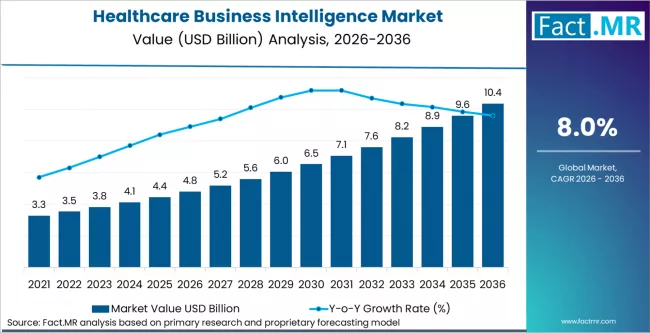
Healthcare Business Intelligence Market Market Value Analysis | Source: Fact.MR
| Metric | Value |
|---|---|
| Estimated Value in 2026 | USD 4.8 billion |
| Forecast Value in 2036 | USD 10.4 billion |
| Forecast CAGR (2026 to 2036) | 8.0% |
Source: Fact.MR analysis. Updated Mar 11, 2026
Market Definition
Healthcare business intelligence includes software and services that analyse clinical, financial, and operational data from hospitals and health systems.
Market Inclusions
Includes global and regional forecasts from 2026–2036 covering clinical, financial, and operational analytics across cloud and on-premises platforms.
Market Exclusions
Excludes standalone EHR systems without analytics, general BI tools not designed for healthcare, telemedicine platforms, and healthcare CRM without analytics output.
Research Methodology
- Primary Research: Interviews with hospital analytics leaders, CFOs, clinical informatics teams, health IT procurement heads, and BI consultants.
- Desk Research:Sources include CMS reporting data, government digital health strategies, OEM earnings calls, and health IT industry reports from 2024–2025.
- Market Sizing and Forecasting:Hybrid model using healthcare IT spending estimates, BI platform adoption rates, and average contract values by deployment type.
- Data Validation and Update Cycle : Results validated through vendor revenues, health IT surveys, CMS participation data, and government digital health investments with annual updates.
Healthcare Business Intelligence Market Summary
- Market Definition
- Healthcare BI platforms analyse clinical, financial, and operational data to support dashboards, predictive insights, and regulatory reporting for healthcare organisations.
- Demand Drivers
- Value-based care programmes require continuous monitoring of quality and cost performance.
- Government hospital digitisation initiatives are increasing investment in BI and analytics systems.
- Hospital network consolidation is driving demand for unified multi-site analytics platforms.
- Key Segments Analyzed
- By Function: Clinical analytics holds about 46.5% share in 2026 due to its impact on patient outcomes and quality reporting.
- By Deployment: Cloud deployment leads with roughly 59% share in 2026 due to scalability and easier cross-site access.
- By Geography: China records the fastest growth, while North America leads revenue due to high healthcare IT spending.
- Analyst Opinion at FACT.MR
- Shambhu Nath Jha, Principal Consultant at Fact.MR, opines, 'CXOs will find that the healthcare BI market driven by value-based care analytics mandates in North America, hospital digitisation programme investment in China, Spain, and Japan, and AI-native clinical analytics platforms creating a premium tier that legacy reporting dashboard vendors cannot compete against without fundamental platform redevelopment.'
- Strategic Implications
- Vendors should offer pre-built analytics modules aligned with healthcare quality reporting standards.
- Companies entering China, Spain, and Japan should partner with local health IT integrators and EHR providers.
- Providers should introduce outcome-based pricing tied to quality improvement or cost reduction.
- Methodology
- Market sizing used healthcare IT spending estimates and BI adoption rates validated with vendor revenue data.
- Government digitization programmes and CMS records supported country demand projections.
- Forecasts used hospital network data, EHR adoption rates, and interviews with healthcare analytics leaders.
Segmental Analysis
Healthcare Business Intelligence Market Analysis by Function
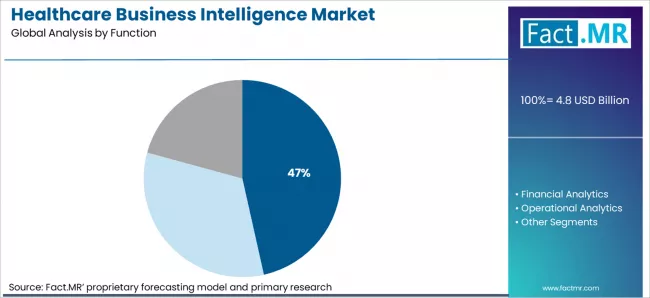
Healthcare Business Intelligence Market Analysis By Function | Source: Fact.MR
Based on FACT.MR analysis, clinical analytics is projected to hold about 46.5% share in 2026 due to its role in improving patient outcomes and supporting quality reporting.
- Oracle Health Clinical Analytics Expansion: In 2025, Oracle Health expanded its analytics platform with AI-based risk prediction and readmission monitoring tools. [5]
- Microsoft Azure Health Data Services Launch: Microsoft enhanced Azure Health Data Services with improved clinical data integration and analytics capabilities. [6]
- Clinical Quality Analytics Adoption Trend: Hospitals are increasing investment in clinical analytics to support value-based care performance monitoring. [7]
Healthcare Business Intelligence Market Analysis by Deployment
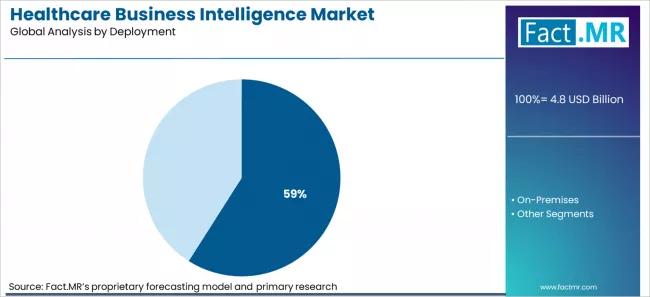
Healthcare Business Intelligence Market Analysis By Deployment | Source: Fact.MR
Based on FACT.MR analysis, cloud deployment is expected to hold around 59% share in 2026 due to scalability and cross-site data access.
- SAP Analytics Cloud Healthcare Expansion: SAP expanded healthcare analytics tools with dashboards supporting financial and operational monitoring. [8]
- Tableau Pulse for Healthcare Launch: Tableau introduced AI-powered insights for hospital clinical and operational data analysis. [9]
- On-Premises Persistence in Regulated Markets: Public health systems in regulated markets still prefer on-premises or private cloud deployments due to patient data security requirements. [10]
Drivers, Restraints, and Opportunities
FACT.MR analysts observe that the healthcare BI market grows alongside healthcare policy and reimbursement cycles. Developed markets drive demand through value-based care analytics, while emerging markets expand through hospital digitisation programmes.
The market shows two parallel trends. Mature regions upgrade legacy reporting tools to AI-driven analytics platforms, while emerging markets adopt BI systems for the first time following EHR deployment and digital compliance requirements.
- CMS Value-Based Care Reporting Expansion: Expanded CMS performance benchmarks in 2024 increased quality reporting requirements, driving BI platform upgrades across U.S. healthcare systems. [2]
- China Healthy China 2030 Digitisation Mandate: China introduced updated hospital information standards in 2024 requiring advanced EMR capability with integrated clinical analytics. [3]
- Germany Hospital Future Act Analytics Investment: Germany allocated €3 billion for hospital digital infrastructure, including BI and analytics implementation. [4]
Regional Analysis
The healthcare business intelligence market is analysed across Asia Pacific, Europe, North America, Latin America, and Middle East and Africa, spanning 35-plus countries with distinct demand profiles shaped by health system digitisation maturity, value-based reimbursement pressure, government digital health investment, and interoperability regulation. The full report offers market attractiveness analysis based on programme timelines and BI adoption rates.
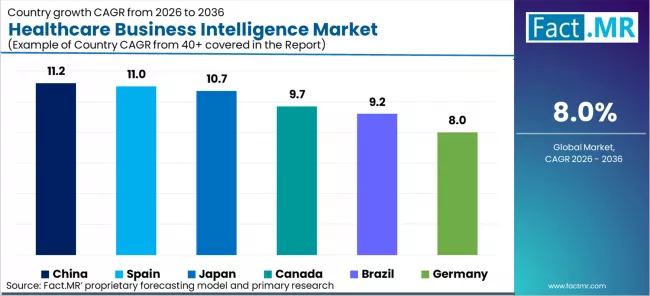
Healthcare Business Intelligence Market Cagr Analysis By Country | Source: Fact.MR
| Country | CAGR (2026-2036) |
|---|---|
| China | 11.2% |
| Spain | 11.0% |
| Japan | 10.7% |
| Canada | 9.7% |
| Brazil | 9.2% |
| Germany | 8.0% |
Source: Fact.MR analysis. Updated Mar 11, 2026
Source: Fact.MR (FACT.MR) analysis, based on proprietary forecasting model and primary research
Asia Pacific Healthcare Business Intelligence Market
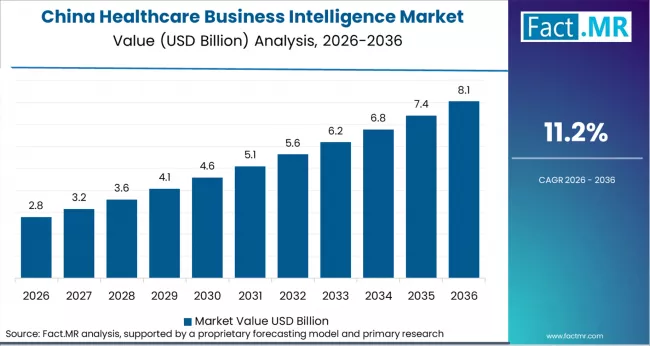
Healthcare Business Intelligence Market Country Value Analysis | Source: Fact.MR
Analysis Asia Pacific is the fastest-growing region for healthcare BI due to government-led hospital digitisation and increasing healthcare IT investment. Global vendors compete for major hospital networks while domestic platforms address local compliance and hosting requirements.
- China: Healthcare BI demand in China is projected to grow at about 11.2% CAGR through 2036. Hospital digitisation mandates and DRG-based cost monitoring requirements are accelerating analytics platform adoption across large public hospitals. [3]
- Japan: Japan is expected to witness around 10.7% CAGR through 2036. National healthcare digital transformation programmes and subsidy funding are supporting analytics deployment across public hospital systems. [4]
FACT.MR's Asia Pacific analysis of the healthcare BI market covers China, Japan, South Korea, India, Australia and New Zealand, ASEAN, and Rest of Asia Pacific. Readers can find country CAGR forecasts, hospital digitisation programme timelines, analytics adoption data, and vendor positioning by function.
Europe Healthcare Business Intelligence Market Analysis
Europe represents a policy-driven healthcare BI market supported by EU health data initiatives and national hospital digitalization programmes.
- Spain: Healthcare BI demand in Spain is forecast to increase at nearly 11.0% CAGR through 2036. EU-funded digital health investment and hospital analytics capability requirements are expanding BI procurement across regional health systems. [5]
- Germany: Germany is projected to record about 8.0% CAGR through 2036, supported by Hospital Future Act funding and expanded hospital quality reporting analytics. Hospital Future Act funding and updated quality reporting requirements are encouraging hospitals to adopt analytics platforms. [6]
FACT.MR's European analysis of the healthcare BI market covers Germany, France, the United Kingdom, Italy, Spain, the Netherlands, the Nordics, and Rest of Europe. Readers can find EU health data policy impact, hospital digitisation programme insights, analytics adoption trends, and country forecasts.
North America Healthcare Business Intelligence Market
Analysis North America remains the largest healthcare BI market due to advanced value-based care analytics adoption and high healthcare IT spending.
- Canada: Canada is set to grow at close to 9.7% CAGR through 2036, reflecting strong provincial digital health investments and population health analytics initiatives. Provincial digital health initiatives and population health analytics programmes are expanding BI implementation across hospital networks. [7]
FACT.MR's North American analysis of the healthcare BI market covers the United States, Canada, and Mexico. Readers can find reimbursement policy impact, integrated delivery network analytics trends, digital health investment data, and country forecasts by function.
Latin America Healthcare Business Intelligence Market Analysis
Latin America is an emerging healthcare BI market supported by hospital digitisation and growing health data integration initiatives.
- Brazil: Healthcare BI demand in Brazil is projected to expand at approximately 9.2% CAGR through 2036. National health data integration programmes and accreditation reporting requirements are driving analytics adoption across hospital systems. [8]
FACT.MR's Latin American analysis of the healthcare BI market covers Brazil, Mexico, Colombia, and Rest of Latin America. Readers can find health ministry digital programme timelines, hospital accreditation analytics requirements, EHR adoption benchmarks, and country-level forecasts by function and deployment.
Competitive Aligners for Market Players
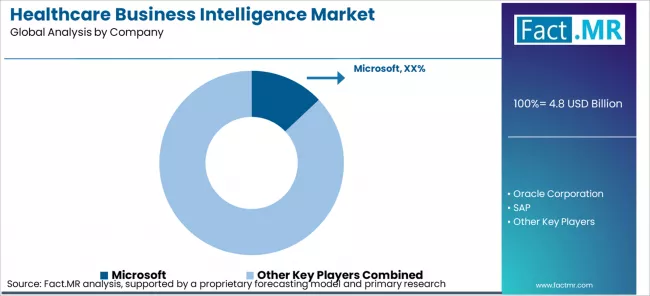
Healthcare Business Intelligence Market Analysis By Company | Source: Fact.MR
The global healthcare business intelligence market shows moderate concentration at the enterprise tier, with Microsoft, Oracle, SAP, and IBM controlling the majority of large health system revenue through integrated platform capabilities and EHR connectivity. Competitive position is determined by clinical content library depth, EHR interoperability, pre-built regulatory reporting configuration, and AI analytics capability. Vendors without pre-built healthcare content and certified EHR integration face significant implementation cost and time disadvantages in competitive evaluations at large hospital procurement programmes.
Platform vendors with established EHR partnerships hold structural advantages. Oracle Health benefits from its Cerner EHR installed base, which provides a natural upgrade path for clinical analytics within existing customer relationships. Microsoft leverages Azure Health Data Services and FHIR integration to connect BI tools to diverse EHR sources. SAP's strength in hospital financial management provides a dominant position in financial analytics. Tableau benefits from Salesforce's health cloud relationships for mid-market clinical analytics deployments where speed of implementation is prioritized over deep EHR integration.
Large hospital networks manage BI vendor dependency by maintaining open data standards requirements in procurement contracts and requiring FHIR-compliant data export to preserve future platform portability. Mid-size providers show higher price sensitivity and rely on EHR vendor bundled analytics, making standalone BI vendor entry dependent on significant price advantage or outcome-based contract structures. Government health system procurement in Europe and Asia is typically tender-based with multi-year fixed contracts, limiting pricing flexibility for incumbent vendors.
Key Players of Healthcare Business Intelligence Market
- Microsoft
- Oracle Corporation
- SAP
- Tableau Software Inc.
- Perficient Inc.
- Tibco Software Inc.
- Infor Inc.
- Domo Inc.
- Sisense Inc.
- Panorama Software Inc.
Healthcare Business Intelligence Market by Segment
-
By Function :
- Clinical Analytics
- Financial Analytics
- Operational Analytics
-
By Deployment :
- Cloud-Based
- On-Premises
-
By Region :
- North America
- United States
- Canada
- Mexico
- Europe
- Germany
- United Kingdom
- France
- Italy
- Spain
- Netherlands
- Nordics
- Rest of Europe
- Asia Pacific
- China
- Japan
- South Korea
- India
- Australia and New Zealand
- ASEAN
- Rest of Asia Pacific
- Latin America
- Brazil
- Mexico
- Colombia
- Rest of Latin America
- Middle East and Africa
- Kingdom of Saudi Arabia
- United Arab Emirates
- South Africa
- Turkey
- Rest of Middle East and Africa
- North America
Bibliography
[1] Centers for Medicare and Medicaid Services. (2024). Medicare Shared Savings Programme 2024 Performance Year Update: Expanded Quality Measure Reporting Requirements and APM Benchmark Revisions. November 2024. cms.gov
[2] National Health Commission, People's Republic of China. (2024). Hospital Information Construction Standards Update: Grade 3A EMR Level 5 Analytics Compliance Requirements. August 2024. nhc.gov.cn
[3] Federal Ministry of Health, Germany. (2024). Krankenhauszukunftsgesetz Implementation Report: Eligible Digital Infrastructure Categories Including Business Intelligence Platforms. October 2024. bundesgesundheitsministerium.de
[4] Oracle Health. (2025). Product Press Release: Clinical Analytics Suite Expansion with AI-Driven Sepsis Risk Prediction and Readmission Alert Modules. February 2025. oracle.com/health
[5] Microsoft Corporation. (2024). Azure Health Data Services Product Update: FHIR-Based Clinical Data Aggregation and Power BI Healthcare Dashboard Integration Launch. September 2024. microsoft.com/azure
[6] Healthcare Information and Management Systems Society. (2024). HIMSS Healthcare IT Survey 2024: Clinical Quality Analytics Adoption Trends and Hospital BI Investment Plans for 2025. October 2024. himss.org
[7] SAP SE. (2025). Product Launch: SAP Analytics Cloud for Healthcare with Hospital Financial Performance Dashboards and Claims Data Integration Connectors. January 2025. sap.com
[8] Tableau Software Inc. / Salesforce. (2024). Product Announcement: Tableau Pulse for Healthcare with AI-Generated Clinical and Operational Metric Insights. August 2024. tableau.com
[9] KLAS Research. (2024). Healthcare BI and Analytics Deployment Survey 2024: On-Premises Preference in European and Asian Public Health Systems. November 2024. klasresearch.com
This Report Addresses
- Strategic intelligence on value-based care analytics mandates, hospital digitisation investment in China, Spain, and Japan, AI-native clinical BI adoption, and EHR interoperability as the primary BI implementation cost driver globally.
- Market forecast from USD 4.8 billion in 2026 to USD 10.4 billion by 2036 at 8.0% CAGR, segmented by function, deployment, and region.
- Growth opportunities across China NHC hospital analytics compliance, Spain RRF-funded SNS BI investment, Germany HZA analytics procurement, and Canada Infoway provincial data integration funding.
- Country CAGR outlook for China 11.2%, Spain 11.0%, Japan 10.7%, Canada 9.7%, and Germany 8.0%, with key health system investment and regulatory demand drivers per country.
- Competitive analysis of Oracle Health, Microsoft, SAP, Tableau, and Perficient covering clinical content libraries, EHR integration depth, cloud capabilities, and government health system procurement positioning.
- Technology tracking including AI-driven clinical risk models, FHIR-native data aggregation, natural language BI insight generation, cloud-native interoperability, and value-based care performance dashboards.
- Regulatory analysis covering CMS MSSP and APM reporting, EU European Health Data Space, China NHC hospital information standards, Germany HZA qualifying criteria, Spain RRF programme requirements, and Japan Healthcare DX guidelines.
- Report delivered in PDF, Excel datasets, PowerPoint summary, and dashboard formats supported by vendor disclosures, government programme records, and primary research.
Segmentation
Scope of Report
| Metric | Value |
|---|---|
| Country | CAGR (2026-2036) |
| Quantitative Units | USD 4.8 billion (2026) to USD 10.4 billion (2036), at a CAGR of 8.0% |
| Market Definition | Software platforms and services aggregating clinical, financial, and operational health system data into dashboards, predictive models, and regulatory reports for hospitals, health networks, and payers. |
| Function Segmentation | Clinical Analytics (46.5%), Financial Analytics, Operational Analytics |
| Deployment Segmentation | Cloud-Based (59%), On-Premises |
| Application Coverage | Value-based care performance tracking, quality measure reporting, clinical risk stratification, population health management, hospital operational efficiency, and financial contract monitoring. |
| Regions Covered | Asia Pacific, Europe, North America, Latin America, Middle East and Africa |
| Countries Covered | China, Japan, South Korea, India, Australia and New Zealand, ASEAN, Rest of Asia Pacific, Germany, UK, France, Italy, Spain, Netherlands, Nordics, Rest of Europe, United States, Canada, Mexico, Brazil, Colombia, Rest of Latin America, Saudi Arabia, UAE, South Africa, Turkey, Rest of MEA |
| Key Companies Profiled | Microsoft, Oracle Corporation, SAP, Tableau Software Inc., Perficient Inc., Tibco Software Inc., Infor Inc., Domo Inc., Sisense Inc., Panorama Software Inc. |
| Forecast Period | 2026 to 2036 |
| Approach | A hybrid top-down and bottom-up model was used. Top-down inputs included healthcare IT spending and hospital network counts. Bottom-up analysis used BI contract values by function, deployment adoption rates, and provider type penetration from primary interviews. |
Source: Fact.MR analysis. Updated Mar 11, 2026
Frequently Asked Questions
How large is the healthcare business intelligence market in 2025?
What will the market size be in 2026?
What is the projected market size by 2036?
What is the expected CAGR for the forecast period 2026 to 2036?
Which function segment holds the leading share?
Which deployment mode commands the largest share?
Which country is projected to grow the fastest?
What is the expected growth rate for Spain?
What is the forecast CAGR for Japan's healthcare BI market?
How is the healthcare business intelligence market in Canada expected to grow?
Who worked on this report


Preview the report firsthand - request a free sample
Free SampleGet the brochure for pricing and purchase details
Download PDF