- Market Value (2025): USD 110.7 Mn
- Estimated Value (2026): USD 117.8 Mn
- Forecast Value (2036): USD 219.5 Mn
- CAGR (2026-2036): 6.4%
What is the Vegetable Rennin Market forecast to be worth by 2036?
USD 117.8 million in 2026 to USD 219.5 million by 2036, at a 6.4% CAGR.
- As per Fact.MR analysis, the vegetable rennin market reached USD 110.7 million in 2025.
- Sales are forecast to rise from USD 117.8 million in 2026 to USD 219.5 million by 2036.
- The market is expected to grow at 6.4% CAGR from 2026 to 2036 as cheese producers adopt suitable non-animal coagulants.
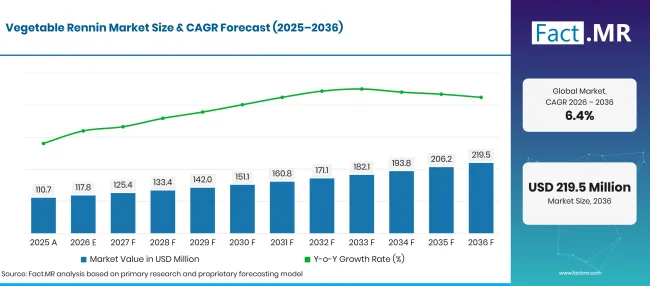
Factmr Vegetable Rennin Market Forecast Global | Source: Fact.MR
| Year | Basis | Market Value (USD million) |
|---|---|---|
| 2025 | Historical estimate | 110.7 |
| 2026 | Estimate | 117.8 |
| 2036 | Forecast | 219.5 |
| CAGR 2026 to 2036 | Forecast period | 6.4% |
Source: Fact.MR analysis. Updated Oct 19, 2026
What are the defining numbers behind Vegetable Rennin Market growth?
USD 101.7 million absolute opportunity from 2026 to 2036, led by microbial coagulants and cheese production.
- Demand Drivers in the Market
- Large cheese plants need predictable curd-setting times to keep production on schedule.
- Specialty cheese makers may choose non-animal coagulants when vegetarian suitability matters for the finished product.
- Ingredient distributors help smaller dairies compare enzyme strength, pack size and storage needs.
- Food manufacturers also consider how cheese behaves during heating and further processing.
- Key Segments Analyzed
- By Source: Microbial coagulants hold 67.4% share in 2026, reflecting their use in controlled cheese manufacturing.
- By Application: Cheese Production captures 42.3% share in 2026, since milk coagulation is its main technical use.
- By Sales Channel: Specialty Stores account for 48.2% share in 2026 through specialist ingredient distribution.
- By End-User: Food and Beverage represents 78.3% share in 2026, reflecting ingredient purchases by dairy processors.
- Analyst Opinion at Fact.MR
- Shambhu Nath Jha, Principal Consultant at Fact.MR, states, “Cheese producers need coagulants that give reliable curd formation across normal production runs. Suppliers can strengthen repeat sales by providing clear enzyme specifications and support during recipe trials.”
- Strategic Implications
- Enzyme suppliers should document clotting results under normal factory conditions.
- Cheese producers should test a new coagulant in pilot batches and check curd firmness before adopting it.
- Distributors should provide clear storage temperatures and activity information for each enzyme preparation. Brazil’s IBGE recorded 36.684 billion litres of milk produced in 2025 [8].
- Specialty cheese brands should confirm whether each coagulant meets their vegetarian requirements and gives acceptable results in the finished cheese.
Germany is forecast to grow at 7.8% CAGR, followed by Brazil at 7.1%. The United States is estimated at 6.5%, while the United Kingdom records 5.8% and Japan 5.1% through 2036.
How does the Vegetable Rennin Market break down by segment?
Microbial holds 67.4% share in 2026, while Cheese Production account for 42.3% share.
Which Source segment dominates?
Microbial holds 67.4% share in 2026.
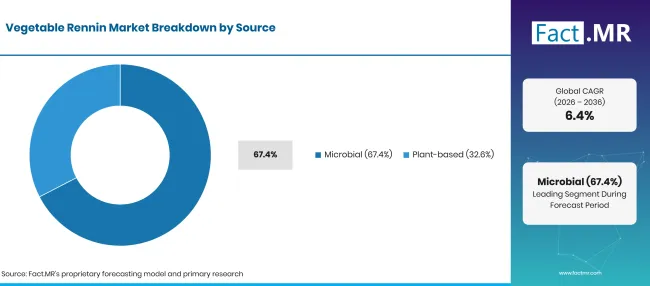
Factmr Vegetable Rennin Market Breakdown Source | Source: Fact.MR
| Source | Share (2026) |
|---|---|
| Microbial (Leading segment) | 67.4% |
| Other segments combined | 32.6% |
| Total | 100.0% |
Source: Fact.MR analysis. Updated Oct 19, 2026
Microbial coagulants are used in cheese plants that need predictable clotting from batch to batch. Plant-derived products serve cheese makers looking for a botanical ingredient, provided the final flavor is suitable.
What leads the Application segment?
Cheese Production leads with 42.3% share in 2026.
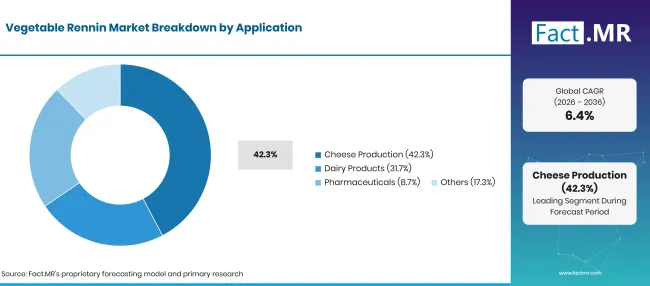
Factmr Vegetable Rennin Market Breakdown Application | Source: Fact.MR
| Application | Share (2026) |
|---|---|
| Cheese Production (Leading segment) | 42.3% |
| Other segments combined | 57.7% |
| Total | 100.0% |
Source: Fact.MR analysis. Updated Oct 19, 2026
Cheese production depends on enzymes that form curds before whey is drained. Other dairy products require separate process checks because coagulation is not part of every recipe.
Which Sales Channel serves the largest share?
Specialty Stores account for 48.2% share in 2026.
| Sales Channel serves the largest share | Share (2026) |
|---|---|
| Specialty Stores (Leading segment) | 48.2% |
| Other segments combined | 51.8% |
| Total | 100.0% |
Source: Fact.MR analysis. Updated Oct 19, 2026
Specialist ingredient suppliers offer smaller packs and practical instructions to cheese makers testing a new enzyme. Retail outlets serve hobby producers, while regular commercial customers may reorder online. Clear handling advice helps producers manage enzyme use as output changes.
How does End-User purchasing shape sales?
Food and Beverage Industry represents 78.3% share in 2026.
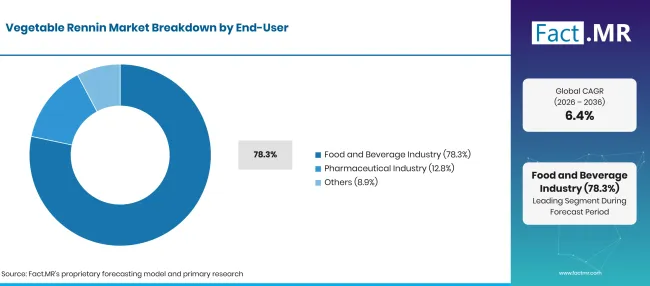
Factmr Vegetable Rennin Market Breakdown End User | Source: Fact.MR
| End-User purchasing shape sales | Share (2026) |
|---|---|
| Food and Beverage Industry (Leading segment) | 78.3% |
| Other segments combined | 21.7% |
| Total | 100.0% |
Source: Fact.MR analysis. Updated Oct 19, 2026
Food and beverage companies buy coagulants primarily for cheese manufacturing. Other potential applications require separate specifications and approvals. Dairy processors therefore have a practical reason to assess enzyme use and finished-cheese yield.
What is accelerating Vegetable Rennin Market adoption, and what is holding it back?
Cheese plants buy coagulants that work reliably in established recipes. Testing a new enzyme takes time because its clotting activity and effect on finished cheese must be checked before regular use.
Drivers Impact Analysis
| DRIVER | (~) % IMPACT ON CAGR | GEOGRAPHIC RELEVANCE | IMPACT TIMELINE |
|---|---|---|---|
| Cheese processing activity | +1.0% | Global | Medium term (2–4 years) |
| Reliable milk clotting | +0.8% | Europe, United States | Short term (<= 2 years) |
| Vegetarian cheese recipes | +0.7% | Global | Medium term (2–4 years) |
| Specialist ingredient supply | +0.5% | Brazil, Japan | Medium term (2–4 years) |
| Consistent whey quality | +0.4% | Global | Long term (>= 4 years) |
Source: Fact.MR analysis. Updated Oct 19, 2026
Opportunity Impact Analysis
| OPPORTUNITY | (~) % IMPACT ON CAGR | GEOGRAPHIC RELEVANCE | IMPACT TIMELINE |
|---|---|---|---|
| Microbial product refinement | +0.8% | Global | Medium term (2–4 years) |
| Plant-extract applications | +0.6% | Europe, Japan | Long term (>= 4 years) |
| Smaller dairy packaging | +0.5% | Brazil, UK | Short term (<= 2 years) |
| Process-support services | +0.4% | Global | Medium term (2–4 years) |
Source: Fact.MR analysis. Updated Oct 19, 2026
Restraints Impact Analysis
| RESTRAINT | (~) % IMPACT ON CAGR | GEOGRAPHIC RELEVANCE | IMPACT TIMELINE |
|---|---|---|---|
| Recipe qualification | -0.8% | Global | Short term (<= 2 years) |
| Enzyme performance differences | -0.6% | Global | Medium term (2–4 years) |
| Temperature and storage controls | -0.5% | Global | Medium term (2–4 years) |
| Ingredient cost review | -0.4% | Brazil, Japan | Long term (>= 4 years) |
Source: Fact.MR analysis. Updated Oct 19, 2026
Which countries are scaling the Vegetable Rennin Market through 2036?
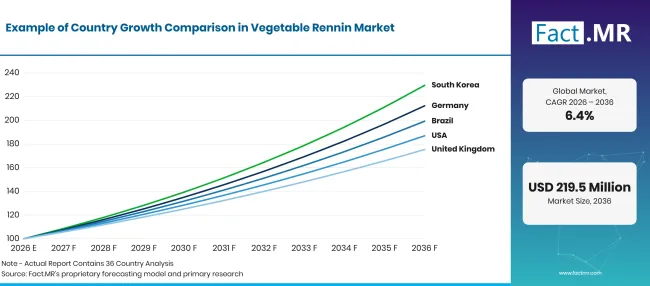
Factmr Vegetable Rennin Market Growth Index | Source: Fact.MR
| Country | CAGR (2026–2036) |
|---|---|
| Germany | 7.8% |
| Brazil | 7.1% |
| United States | 6.5% |
| United Kingdom | 5.8% |
| Japan | 5.1% |
Source: Fact.MR analysis. Updated Oct 19, 2026
Why is Germany increasing its use of non-animal coagulants?
7.8% CAGR, supported by established cheese manufacturing and careful ingredient selection.
German cheese processors check whether microbial and plant-based coagulants form curds consistently in their established recipes. Eurostat reported that Germany produced 22.5% of EU cheese in 2024 [2]. This large processing base creates opportunities for trials, although each plant must confirm how a preparation affects its own cheese.
How is Brazil developing its vegetable rennin market?
7.1% CAGR, shaped by raw milk processing and regional cheese production.
Brazilian cheese makers operate at different production scales, giving specialist distributors a role in supplying suitable enzyme quantities. IBGE reported in March 2026 that dairies purchased 27.51 billion litres of raw milk in 2025 [3]. Before placing regular orders, processors compare how microbial and plant-derived coagulants perform in their own batches.
What supports vegetable rennin sales in the United States?
6.5% CAGR, linked to established cheese output and detailed ingredient testing.
U.S. cheese plants select coagulants according to the curd-setting time and texture required for each variety. USDA reported in April 2026 that cheese production, excluding cottage cheese, reached 14.8 billion pounds in 2025 [1]. Makers considering non-animal enzymes need repeatable activity and dependable results before changing recipes.
How is the United Kingdom shaping vegetable rennin purchases?
5.8% CAGR, influenced by domestic cheese making and specialist ingredient channels.
British cheese processors look for coagulants that suit established cheddar recipes as well as smaller specialty batches. Defra reported in September 2026 that UK milk production for human consumption reached 15.8 billion litres in 2025 [7]. Ingredient suppliers can help producers test alternatives before using them in regular cheese production.
Why is Japan maintaining targeted vegetable rennin growth?
5.1% CAGR, influenced by domestic cheese processing and close attention to recipe quality.
Japanese cheese manufacturers compare coagulants against local milk supplies and the texture required for each product. The agriculture ministry published its fiscal 2025 cheese supply and demand tables in July 2026 [6], separating domestic production from imported finished cheese. That distinction matters because local enzyme sales depend on cheese processed within Japan.
Who leads the Vegetable Rennin Market?
Novonesis and International Flavors & Fragrances offer documented non-animal coagulants for cheese production. Novonesis markets fermentation-produced CHY-MAX products, while IFF supplies MARZYME microbial coagulants [4][5]. Dairy processors compare their product performance and technical support when choosing a supplier.
The remaining named food and dairy groups operate at different points in the wider supply chain. Their presence in cheese or food ingredients does not automatically make them direct vegetable rennin producers. Competitive comparisons therefore concentrate on documented coagulant ranges and the ability to support a processor’s recipe trials.
Which companies are the key providers?
Key companies include Novonesis; International Flavors & Fragrances Inc.; dsm-firmenich AG; and Kerry Group plc.
- Novonesis
- International Flavors & Fragrances Inc.
- dsm-firmenich AG
- Kerry Group plc
Bibliography
- [1] U.S. Department of Agriculture, National Agricultural Statistics Service. (2026, April 24). Dairy Products 2025 Summary.
- [2] Eurostat. (2025, November 20). Milk production reached 161.8 million tonnes in 2024.
- [3] Instituto Brasileiro de Geografia e Estatística. (2026, March 18). In 2025, Brazil registers the highest production of milk, leather and eggs in history; slaughter of cattle, chickens and pigs also hits record.
- [4] Novonesis. (n.d.). Chy-Max® M.
- [5] International Flavors & Fragrances. (n.d.). MARZYME® coagulants, easy, speedy, and effective milk clotting.
- [6] Ministry of Agriculture, Forestry and Fisheries. (2026, July 17).[Fiscal 2025 cheese supply and demand tables].
- [7] Department for Environment, Food & Rural Affairs. (2026, September 3). Agriculture in the United Kingdom 2025: Chapter 8, livestock.
- [8] Instituto Brasileiro de Geografia e Estatística. (n.d.). Produção de leite no Brasil [Milk production in Brazil].
- [9] Ministry of Agriculture, Forestry and Fisheries. (2026, March 31).[Milk and milk products statistics survey results: 2025 basic survey].
This Report Answers
- The report compares microbial and plant-based sources used for cheese coagulation.
- Application analysis separates cheese manufacturing from adjacent dairy and other end uses.
- Country outlooks examine Germany, Brazil, the United States, the United Kingdom and Japan.
- Channel analysis distinguishes specialist ingredient distribution from consumer retail ordering.
- Company coverage focuses on coagulant products documented by their manufacturers.
What does the Vegetable Rennin Market cover?
Vegetable rennin covers non-animal enzyme preparations marketed for milk coagulation. This includes selected microbial enzyme products and plant-based coagulants. It is related to the broader dairy enzymes market but has a narrower purpose focused on curd formation. Fact.MR examines related enzyme categories include dairy-processing enzymes used for coagulation and fermentation.
What is included in the scope?
Relevant coagulants sold to cheese manufacturers and approved adjacent applications enter the assessment.
The definition covers product selection by origin and practical use in milk coagulation. General-purpose cultures or flavor ingredients are considered only when they are sold specifically as coagulating preparations.
What is excluded from the scope?
Animal-derived rennet is excluded from the non-animal product definition.
Finished cheese sales are also excluded because they represent downstream products, not enzyme ingredient sales. General dairy processing aids without a milk-clotting function sit outside this market boundary.
How Was the Analysis Built?
The analysis draws on 120+ sources, 35+ company portfolios, 25+ countries, and more than 20 industry interviews.
- Primary Research: Primary research includes discussions with manufacturers, service providers, technology developers, distributors, end users, and subject-matter experts. These conversations examine purchasing priorities, product adoption, operational challenges, approval requirements, competitive positioning, and the factors that influence wider market acceptance.
- Desk Research: Desk research covers government statistics, regulatory publications, company filings, trade data, technical studies, industry associations, standards, public policy, and other authoritative sources. Every source used in the analysis is documented in the bibliography.
- Market Sizing and Forecasting: Market estimates combine historical performance, demand indicators, pricing and volume trends, segment shares, company participation, country-level growth, adoption patterns, investment activity, and barriers to market expansion.
- Data Validation and Update Cycle: Findings are validated by comparing primary interviews with public data, company activity, regulatory changes, trade patterns, and industry developments. Regular updates review new product launches, capacity changes, partnerships, approvals, and shifts in commercial adoption.
Segmentation
What is the report’s scope and coverage?
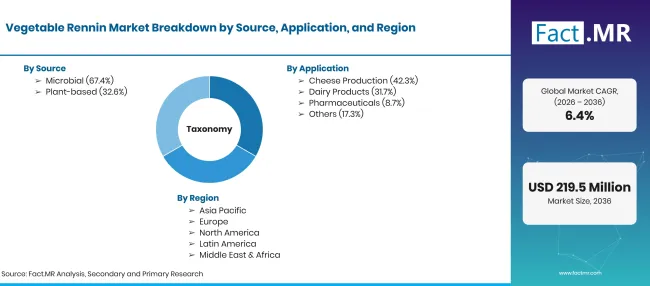
Factmr Vegetable Rennin Market Taxonomy | Source: Fact.MR
| Attribute | Details |
|---|---|
| Quantitative Units | USD million |
| Market Definition | Non-animal milk-coagulating enzyme products used in relevant cheese and approved related applications |
| Source | Microbial; Plant-based |
| Application | Cheese Production; Dairy Products; Pharmaceuticals; Others |
| Sales Channel | Specialty Stores; Supermarkets/Hypermarkets; Online Retail; Others |
| End-User | Food and Beverage Industry; Pharmaceutical Industry; Others |
| Regions Covered | North America; Latin America; Western Europe; Eastern Europe; East Asia; South Asia & Pacific; Middle East & Africa |
| Countries Covered | Germany; Brazil; United States; United Kingdom; Japan |
| Companies Profiled | Novonesis; International Flavors & Fragrances Inc.; dsm-firmenich AG; and Kerry Group plc. |
| Forecast Period | 2026 to 2036 |
| Approach | Product application review, cheese-processing indicators, country comparison and source checks |
Source: Fact.MR analysis. Updated Oct 19, 2026
How is the market segmented?
-
By Source
- Microbial
- Plant-based
-
By Application
- Cheese Production
- Dairy Products
- Pharmaceuticals
- Others
-
By Sales Channel
- Specialty Stores
- Supermarkets/Hypermarkets
- Online Retail
- Others
-
By End-User
- Food and Beverage Industry
- Pharmaceutical Industry
- Others
-
By Region
- North America
- Latin America
- Western Europe
- Eastern Europe
- East Asia
- South Asia & Pacific
- Middle East & Africa
Frequently Asked Questions
How big is the Vegetable Rennin Market in 2026?
What is the CAGR of the Vegetable Rennin Market from 2026 to 2036?
Which source leads the Vegetable Rennin Market?
Which application leads the Vegetable Rennin Market?
Who are the leading companies in the Vegetable Rennin Market?
Who worked on this report


Preview the report firsthand - request a free sample
Free SampleGet the brochure for pricing and purchase details
Download PDF