- Market Value (2025): USD 58.2 Bn
- Estimated Value (2026): USD 60.9 Bn
- Forecast Value (2036): USD 95.5 Bn
- CAGR (2026-2036): 4.6%
What is the Vehicle Brake Systems and Subsystems Market forecast to be worth by 2036?
USD 60.9 billion in 2026 to USD 95.5 billion by 2036 at a 4.6% CAGR.
- The vehicle brake systems and subsystems market stood at USD 58.2 billion in 2025.
- Revenue is forecast to reach from USD 60.9 billion in 2026 to USD 95.5 billion by 2036 as brake hardware and electronic control systems remain essential to new-vehicle assembly.
- The 2026 to 2036 outlook carries a 4.6% CAGR, reflecting ongoing maintenance needs and electronic braking.
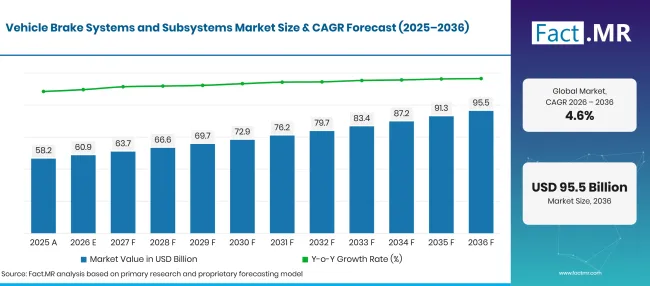
Vehicle Brake Systems And Subsystems Market Forecast Global | Source: Fact.MR
| Year | Basis | Market Value (USD billion) |
|---|---|---|
| 2025 | Actual | 58.2 |
| 2026 | Estimate | 60.9 |
| 2036 | Forecast | 95.5 |
| CAGR 2026 to 2036 | Forecast period | 4.6% |
Source: Fact.MR analysis. Updated Nov 6, 2026
What are the defining numbers behind Vehicle Brake Systems and Subsystems Market growth?
The market adds USD 34.6 billion in annual value between 2026 and 2036.
- Demand Drivers in the Market
- Vehicle engineering teams need braking performance that remains consistent across changing road and load conditions.
- Fleet operators assess braking equipment through the effect that maintenance has on vehicle availability. When a truck or bus needs repairs, the workshop must be able to obtain the correct discs, pads and control modules for that model, since fitting delays can keep the vehicle out of service.
- Vehicle manufacturers increasingly evaluate electronic braking capability during platform design. In January 2025, Bosch reported completing a 3,300-kilometer public-road test of its hydraulic brake-by-wire system [3].
- Key Segments Analyzed
- By Product Type: Disc Brakes represent 38.5% of 2026 market value; their direct friction interface supports repeatable performance and routine service replacement.
- By Vehicle Type: Heavy Commercial Vehicles account for 82.0% of the 2026 vehicle-type mix; vehicles working under high loads require demanding braking specifications and service attention.
- By Sales Channel: OEM leads with 58.7% in 2026 because braking architecture selection occurs before vehicles enter series manufacture.
- By Technology: Hydraulic systems hold 64.3% in 2026 since hydraulic pressure remains a familiar way to operate disc and drum brakes across passenger vehicles.
- Analyst Opinion at Fact.MR
- Shambhu Nath Jha, Principal Consultant at Fact.MR, states, “For a brake supplier, winning a new vehicle program requires reliable fault handling as well as stopping performance. Manufacturers need to establish how an electronic unit responds to specified failures during development, and they must also keep suitable replacement parts available after the vehicle enters service.”
- Strategic Implications
- Brake manufacturers should document repeatable friction performance and show how electronic controls respond to specified faults during vehicle testing. This gives vehicle makers a clearer basis for approving the system before series production.
- Vehicle assemblers benefit from selecting the braking architecture early in platform development because regenerative deceleration, stability controls and conventional friction brakes have to operate together. Late design changes can create further integration and testing work.
- Fleet service networks should plan brake replacement around inspection results and actual component wear, while keeping vehicle-specific parts available. This helps workshops complete repairs without extending scheduled vehicle downtime.
- Component distributors can reduce fitting mistakes by maintaining accurate model and part-number records, allowing workshops to distinguish approved replacements from visually similar but incompatible products.
Germany is forecast to record 5.3% CAGR, followed by Brazil at 4.8%. The USA is projected at 4.4%, while the UK is estimated at 3.9%.
How does the Vehicle Brake Systems and Subsystems Market break down by segment?
Disc Brakes lead Product Type at 38.5%; Heavy Commercial Vehicles lead Vehicle Type at 82.0%; OEM leads Sales Channel at 58.7%; Hydraulic leads Technology at 64.3%.
Which Product Type dominates?
Disc Brakes represent 38.5% of 2026 value.
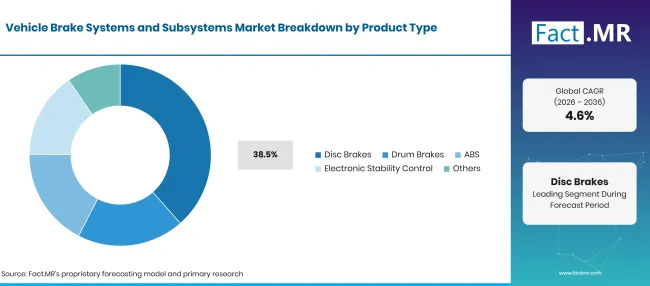
Vehicle Brake Systems And Subsystems Market Breakdown Product Type | Source: Fact.MR
| Product Type | Share (2026) |
|---|---|
| Disc Brakes | 38.5% |
| Other product types combined | 61.5% |
| Total | 100.0% |
Source: Fact.MR analysis. Updated Nov 6, 2026
Disc brakes hold a leading position as manufacturers use rotor-and-caliper systems for consistent braking, heat management, and integration with electronic control systems. Their broad use across passenger and commercial vehicles supports component demand for discs, pads, and calipers. ZF continues supplying disc brake systems for original equipment and aftermarket applications.
What leads the Vehicle Type segment?
Heavy Commercial Vehicles capture 82.0% of 2026 value.
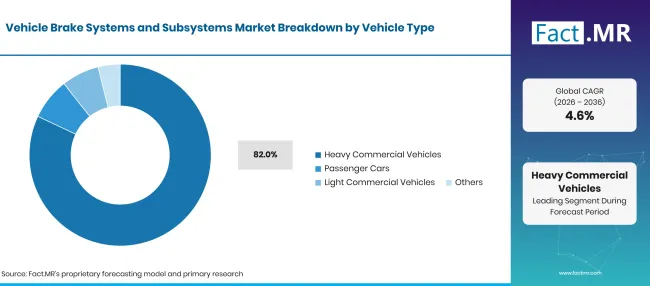
Vehicle Brake Systems And Subsystems Market Breakdown Vehicle Type | Source: Fact.MR
| Vehicle Type | Share (2026) |
|---|---|
| Heavy Commercial Vehicles | 82.0% |
| Other vehicle types combined | 18.0% |
| Total | 100.0% |
Source: Fact.MR analysis. Updated Nov 6, 2026
Heavy commercial vehicles account for substantial brake-system demand because trucks, buses, and trailers require robust braking components for high vehicle mass and repeated stopping cycles. Current commercial-vehicle portfolios include pneumatic braking systems, disc brakes, drum brakes, cylinders, and control units, supporting continued equipment and replacement demand across heavy-duty fleets.
How does Sales Channel shape demand?
OEM leads with 58.7% of 2026 value.
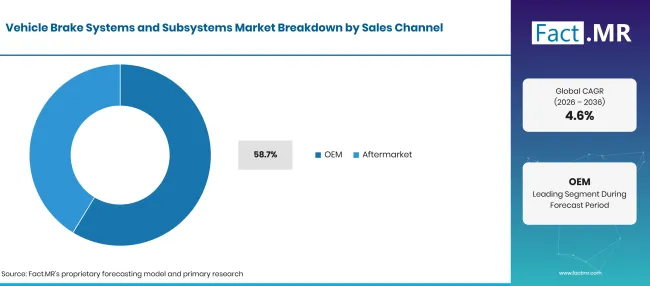
Vehicle Brake Systems And Subsystems Market Breakdown Sales Channel | Source: Fact.MR
| Sales Channel | Share (2026) |
|---|---|
| OEM | 58.7% |
| Aftermarket | 41.3% |
| Total | 100.0% |
Source: Fact.MR analysis. Updated Nov 6, 2026
OEM demand remains prominent because braking systems are engineered, tested, and integrated during vehicle production, with suppliers working directly with manufacturers on discs, calipers, actuation, and electronic controls. The aftermarket remains significant as fleets and vehicle owners replace wear components, creating recurring demand for brake pads, rotors, calipers, and related service parts.
What supports Hydraulic technology?
Hydraulic systems hold 64.3% of 2026 value.
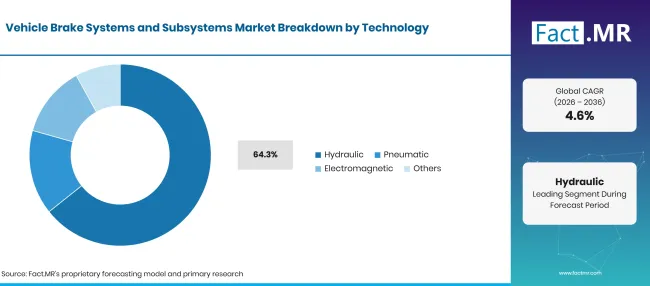
Vehicle Brake Systems And Subsystems Market Breakdown Technology | Source: Fact.MR
| Hydraulic | Share (2026) |
|---|---|
| Hydraulic | 64.3% |
| Other technologies combined | 35.7% |
| Total | 100.0% |
Source: Fact.MR analysis. Updated Nov 6, 2026
Hydraulic braking remains a familiar architecture in passenger cars and lighter vehicle categories. Pedal input or an electronically controlled actuator creates fluid pressure that applies force at the wheel. Pneumatic systems are particularly relevant to heavy commercial vehicles because compressed air can operate demanding brake assemblies.
What is accelerating Vehicle Brake Systems and Subsystems Market adoption, and what is holding it back?
New vehicle programs and electronic brake controls support demand for complete braking systems. Manufacturers must also manage safety approval, integration testing and the cost of serviceable replacement parts before these designs can enter wider use.
Drivers Impact Analysis
| DRIVER | (~) % IMPACT ON CAGR | GEOGRAPHIC RELEVANCE | IMPACT TIMELINE |
|---|---|---|---|
| Vehicle production and platform renewal | +1.2% | Global | Short to medium term |
| Brake-by-wire vehicle programs | +0.9% | Europe, North America, East Asia | Medium term |
| Commercial fleet maintenance | +0.8% | Global | Short term |
| Regenerative brake coordination | +0.6% | North America, Europe, East Asia | Medium term |
| Electronic stability functions | +0.5% | Global | Medium term |
Source: Fact.MR analysis. Updated Nov 6, 2026
Opportunity Impact Analysis
| OPPORTUNITY | (~) % IMPACT ON CAGR | GEOGRAPHIC RELEVANCE | IMPACT TIMELINE |
|---|---|---|---|
| Integrated brake-by-wire assemblies | +0.8% | Europe, East Asia | Medium term |
| Commercial vehicle service coverage | +0.6% | Global | Short term |
| Low-drag calipers for electric vehicles | +0.5% | Europe, East Asia | Medium term |
| Vehicle-specific aftermarket catalogues | +0.3% | Global | Short term |
Source: Fact.MR analysis. Updated Nov 6, 2026
Restraints Impact Analysis
| RESTRAINT | (~) % IMPACT ON CAGR | GEOGRAPHIC RELEVANCE | IMPACT TIMELINE |
|---|---|---|---|
| Safety approval and fault testing | -0.8% | Global | Medium term |
| High complexity of electronic integration | -0.6% | Global | Medium term |
| Price pressure on replacement parts | -0.4% | Global | Short term |
| Uneven vehicle production | -0.3% | Europe, Americas | Short term |
Source: Fact.MR analysis. Updated Nov 6, 2026
Which countries are scaling the Vehicle Brake Systems and Subsystems Market through 2036?
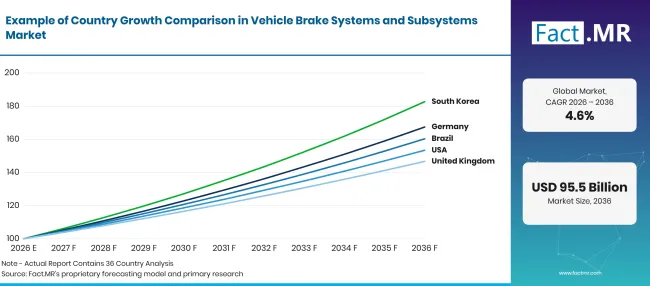
Vehicle Brake Systems And Subsystems Market Growth Index | Source: Fact.MR
| Country | CAGR (2026 to 2036) |
|---|---|
| Germany | 5.3% |
| Brazil | 4.8% |
| USA | 4.4% |
| UK | 3.9% |
| Japan | 3.5% |
Source: Fact.MR analysis. Updated Nov 6, 2026
What supports Germany’s vehicle braking demand?
5.3% CAGR, linked to local vehicle production and system engineering.
Germany's braking system demand is closely tied to vehicle assembly and early component approval. The German Association of the Automotive Industry reported in January 2026 that local factories produced approximately 4.15 million passenger cars during 2025 [1]. Each vehicle program creates opportunities for disc assemblies and brake controls that meet the manufacturer's exact operating requirements. In the same January 2026 release, the association recorded around 856,600 electric passenger-car registrations during 2025.
How is Brazil developing brake system demand?
4.8% CAGR, linked to vehicle assembly and fleet renewal.
Brazil's vehicle assembly lines provide a market for complete braking assemblies and supporting components.
What is supporting USA adoption?
4.4% CAGR, shaped by vehicle technology and the service market.
United States brake-system demand combines new-vehicle electronics with a large repair market. The U.S. Energy Information Administration reported in February 2026 that electrified vehicles represented approximately 22% of new light-duty vehicle sales in 2025 [2]. These vehicles need friction braking controls that work with motor-based energy recovery. In October 2026, the same agency reported hybrid vehicles accounted for 16% of new light-duty sales during the third quarter [6].
How is the UK brake systems market progressing?
3.9% CAGR, connected to new registrations and vehicle-service needs.
The United Kingdom offers braking suppliers opportunities in electric-vehicle applications and the replacement market. The Department for Transport reported in April 2026 that 473,226 zero-emission cars were newly registered during 2025 [7]. Each additional electric model requires braking hardware suited to its vehicle mass and control layout. The department also counted 30,524 newly registered zero-emission light goods vehicles during 2025. Factory output poses a constraint for direct original-equipment orders. In January 2026, the Society of Motor Manufacturers and Traders reported that UK vehicle production fell by 15.5% during 2025 [5].
What shapes Japan’s brake systems outlook?
3.5% CAGR, linked to established vehicle makers and supplier engineering.
Japan's brake supply chain is closely linked to established vehicle producers and their component engineering teams.
Who leads the Vehicle Brake Systems and Subsystems Market?
Brake suppliers compete on the applications they support, the scope of their approved components and their ability to service vehicle platforms over time. Robert Bosch develops braking controls and replacement parts.
Continental’s Automotive group introduced the AUMOVIO identity in 2025 [4], so the current operating identity should be distinguished from the historical Continental name. Knorr-Bremse focuses on rail and commercial vehicle systems, and Haldex serves commercial-vehicle braking applications within the SAF-HOLLAND group. The mix of passenger and commercial suppliers means competitive comparisons must be made within the correct vehicle category.
Which companies are the key providers?
Key companies include Robert Bosch GmbH; Continental AG / AUMOVIO (automotive braking business); ZF Friedrichshafen AG; AISIN Corporation; Akebono Brake Industry Co., Ltd.; Brembo; Astemo Ltd.; HL Mando; Haldex (SAF-HOLLAND group); Knorr-Bremse AG.
- Robert Bosch GmbH
- Continental AG / AUMOVIO (automotive braking business)
- ZF Friedrichshafen AG
- AISIN Corporation
- Akebono Brake Industry Co., Ltd.
- Brembo
- Astemo Ltd.
- HL Mando
- Haldex (SAF-HOLLAND group)
- Knorr-Bremse AG
Bibliography
- [1] Statistisches Bundesamt (Destatis). (2025, November 19). Production of passenger cars.
- [2] U.S. Energy Information Administration. (2026, February 9). Electric vehicle sales fell as hybrid vehicle sales continued to rise in 2025.
- [3] Robert Bosch GmbH. (2025, January 28). With brake-by-wire from Bosch to the Arctic Circle.
- [4] Continental AG. (2025, July 31). Group Sector Automotive introduces itself as AUMOVIO with technologies for future mobility.
- [5] Office for National Statistics. (2026, October 8). UK new vehicle registrations and production.
- [6] U.S. Energy Information Administration. (2026, October 19). Hybrid sales rise while battery electric sales remain lower after tax credit expiration.
- [7] Department for Transport. (2026, April 29). Vehicle licensing statistics, United Kingdom: 2025. GOV.UK.
This Report Answers
- The analysis compares disc and drum brakes with electronic control functions.
- Vehicle analysis compares braking requirements across commercial vehicles and passenger cars.
- Channel analysis examines how OEM platform approval differs from workshop and fleet replacement purchasing.
- Country coverage examines assembly and electrification in Germany, Brazil, the USA, the UK and Japan.
- Supplier analysis distinguishes passenger-car systems, commercial braking specialists and the role of brake-by-wire development.
What does the Vehicle Brake Systems and Subsystems Market cover?
The market covers braking assemblies used on road vehicles, including friction brakes and their controls. Revenue is counted across components sold for new vehicle assembly and replacement use.
What is included in the scope?
Research on automotive brake calipers and brake discs and rotors provides greater detail on those individual components.
What is excluded from the scope?
Vehicle propulsion systems and unrelated chassis components are outside this analysis. The market excludes complete vehicles and braking components used only in industrial machinery.
How Was the Analysis Built?
The analysis draws on 120+ sources, 35+ company portfolios, 25+ countries, and more than 20 industry interviews.
- Primary Research: Primary research includes discussions with manufacturers, service providers, technology developers, distributors, end users, and subject-matter experts. These conversations examine purchasing priorities, product adoption, operational challenges, approval requirements, competitive positioning, and the factors that influence wider market acceptance.
- Desk Research: Desk research covers government statistics, regulatory publications, company filings, trade data, technical studies, industry associations, standards, public policy, and other authoritative sources. Every source used in the analysis is documented in the bibliography.
- Market Sizing and Forecasting: Market estimates combine historical performance, demand indicators, pricing and volume trends, segment shares, company participation, country-level growth, adoption patterns, investment activity, and barriers to market expansion.
- Data Validation and Update Cycle: Findings are validated by comparing primary interviews with public data, company activity, regulatory changes, trade patterns, and industry developments. Regular updates review new product launches, capacity changes, partnerships, approvals, and shifts in commercial adoption.
Segmentation
What is the report’s scope and coverage?
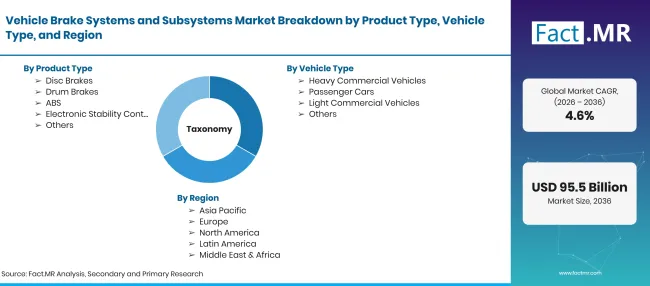
Vehicle Brake Systems And Subsystems Market Taxonomy | Source: Fact.MR
| Attribute | Details |
|---|---|
| Quantitative Units | USD billion |
| Market Definition | Vehicle brake assemblies and subsystems used to slow, stop and stabilize passenger and commercial road vehicles. |
| Product Type | Disc Brakes; Drum Brakes; ABS; Electronic Stability Control; Others |
| Vehicle Type | Heavy Commercial Vehicles; Passenger Cars; Light Commercial Vehicles |
| Sales Channel | OEM; Aftermarket |
| Technology | Hydraulic; Pneumatic; Electromagnetic; Others |
| Regions Covered | North America; Latin America; Western Europe; Eastern Europe; East Asia; South Asia & Pacific; Middle East & Africa |
| Countries Covered | Germany; Brazil; USA; UK; Japan |
| Companies Profiled | Robert Bosch GmbH; Continental AG / AUMOVIO (automotive braking business); ZF Friedrichshafen AG; AISIN Corporation; Akebono Brake Industry Co., Ltd.; Brembo; Astemo Ltd.; HL Mando; Haldex (SAF-HOLLAND group); Knorr-Bremse AG. |
| Forecast Period | 2026 to 2036 |
| Approach | Vehicle production, brake architecture, OEM assembly fitment, vehicle parc and replacement-channel analysis |
Source: Fact.MR analysis. Updated Nov 6, 2026
How is the market segmented?
-
By Product Type
- Disc Brakes
- Drum Brakes
- ABS
- Electronic Stability Control
- Others
-
By Vehicle Type
- Heavy Commercial Vehicles
- Passenger Cars
- Light Commercial Vehicles
-
By Sales Channel
- OEM
- Aftermarket
-
By Technology
- Hydraulic
- Pneumatic
- Electromagnetic
- Others
-
By Region
- North America
- Latin America
- Western Europe
- Eastern Europe
- East Asia
- South Asia & Pacific
- Middle East & Africa
Frequently Asked Questions
How big is the vehicle brake systems and subsystems market in 2026?
What CAGR applies from 2026 to 2036?
Which product type accounts for the specified leading share?
Which vehicle type leads?
Which sales channel has the larger share?
Which actuation technology leads?
Which of the selected countries has the highest CAGR?
Which suppliers are covered?
Who worked on this report


Preview the report firsthand - request a free sample
Free SampleGet the brochure for pricing and purchase details
Download PDF