The Vertical Farming Optimized Liquid Nutrient Market is analyzed across its key product, application and end-use segments, with regional trends and demand outlook, forecast 2026 to 2036.
By Fact.MR Chemical & Materials DeskLead analyst:
S.N. JhaPublished :
Updated :
9 min read
Fact-checked under the Fact.MR editorial process
Vertical Farming Optimized Liquid Nutrient Market Forecast and Outlook 2026 to 2036
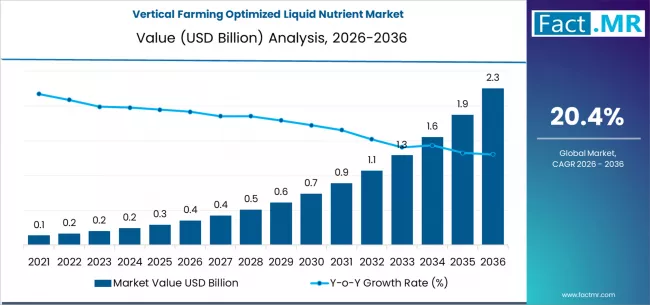
The global market for vertical farming optimized liquid nutrients is projected for exponential growth, surging from USD 0.35 billion in 2026 to USD 2.25 billion by 2036, advancing at a remarkable CAGR of 20.4%.
Summary of Vertical Farming Optimized Liquid Nutrient Market
Market Snapshot
Global vertical farming optimized liquid nutrient market revenue stood at USD 0.35 billion in 2026 and is forecast to reach USD 2.25 billion by 2036.
At a 20.4% CAGR from 2026 to 2036, this market is set to expand ~6.4x in value, adding USD 1.90 billion in absolute opportunity.
This marketrepresentsa core input layer within controlled environment agriculture (CEA), enabling precise nutrient delivery in hydroponic, aeroponic, and aquaponic systems.
Liquid nutrient solutions are evolving into precision-engineered formulations, designed for full bioavailability, system compatibility, and optimized plant growth in vertically stacked environments.
Demand and Growth Drivers
Rapid expansion of urban vertical farming and high-tech greenhouse infrastructure is the primary driver of demand.
Increasing consumer preference for locally produced, pesticide-free, and climate-resilient food systems is accelerating adoption.
Need for precise nutrient control in recirculating systems is reinforcing demand for optimized liquid formulations with stable pH and minimal residue buildup.
Integration with automation, IoT-based dosing systems, and climate-controlled agriculture platforms is enhancing adoption.
Growth in high-margin crops such as leafy greens, herbs, and cannabis is further supporting market expansion.
Product and Segment View
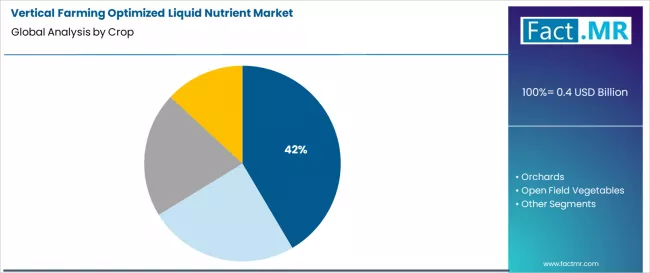
Greenhouse vegetables account for 42% of crop segment share in 2026,emergingas the dominant segment due to high yield density and short cultivation cycles.
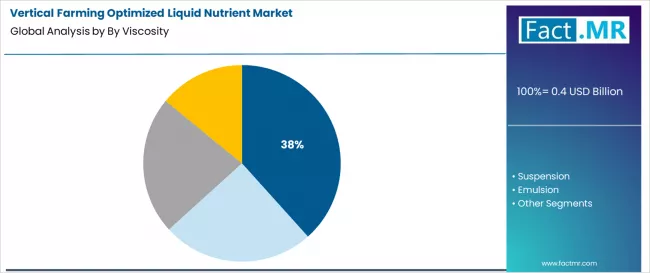
Clear liquid formulations hold 38% of viscosity segment share in 2026, driven by system compatibility and prevention of clogging in hydroponic setups.
Ag-retailers account for 65% of sales channel share in 2026, positioning them as the leading distribution channel due to technical support requirements and supply chain specialization.
Product innovation is focused on:
Crop-specific nutrient formulations
Growth-stage optimization
System-friendly, clog-resistant chemistries
Geography and Competitive Outlook
Growth is supported across North America, Europe, and Asia Pacific, aligned with expansion of vertical farming infrastructure.
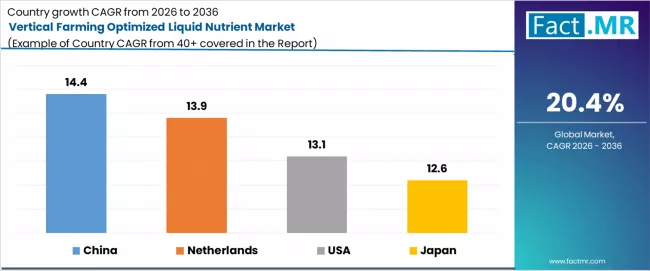
China (14.4% CAGR), Netherlands (13.9%), United States (13.1%), and Japan (12.6%) are key growth markets.
Market expansion is closely tied to food security strategies, urban agriculture investments, and greenhouse technology leadership.
Key companies active in this market include ICL Group Ltd., Haifa Group, Yara International ASA,Nutrien,EuroChemGroup A.G., and Compass Minerals.
Vertical Farming Optimized Liquid Nutrient Market — At a Glance
Attribute
Details
Market Value 2026
USD 0.35 billion
Market Value 2036
USD 2.25 billion
Absolute Dollar Opportunity 2026-2036
USD 1.90 billion
Total Growth 2026-2036
542.9%
CAGR 2026-2036
20.4%
Growth Multiple
~6.4x
Key Demand Theme
Precision nutrient delivery systems enabling high-efficiency vertical farming and controlled environment agriculture
Leading Segment by Crop (2026)
Greenhouse Vegetables
Crop Segment Share (2026)
42%
Leading Segment by Viscosity (2026)
Clear Liquid
Viscosity Segment Share (2026)
38%
Leading Segment by Sales Channel (2026)
Ag-Retailers
Sales Channel Share (2026)
65%
Key Growth Regions
North America, Europe, Asia Pacific
Country CAGRs
China 14.4%, Netherlands 13.9%, USA 13.1%, Japan 12.6%
North America, Latin America, Western Europe, Eastern Europe, East Asia, South Asia & Pacific, MEA
Source: Fact.MR analysis. Updated Apr 1, 2026
This market is a cornerstone of the Controlled Environment Agriculture (CEA) revolution, providing the specialized nutritional foundation for soilless production systems that stack growth vertically. Unlike traditional field fertilizers, these products are precision-engineered solutions formulated for complete bioavailability in recirculating hydroponic, aeroponic, and aquaponic systems, where nutrient efficiency and system cleanliness are paramount. Growth is driven by the rapid global expansion of urban vertical farms and high-tech greenhouses, fueled by demand for local, pesticide-free produce and the necessity of climate-resilient food production. These liquid nutrients are the lifeblood of CEA, enabling exact control over plant growth, flavor, and nutritional content. The market’s expansion reflects a shift from agricultural chemistry to biosystem engineering, where nutrients are part of an integrated technological loop involving LED lighting, climate computers, and automated irrigation. Success depends on formulations that prevent salt buildup, maintain stable pH, and provide perfectly balanced ionic nutrition for fast-growing crops in artificial environments, maximizing yield per cubic foot of space.
Category
Category
Segments
Crop
Greenhouse Vegetables, Orchards, Open Field Vegetables, Cannabis/Hemp
Greenhouse vegetables command a 42% share, led by high-value crops like lettuce, leafy greens, herbs, and tomatoes. These crops have short cycles and high yield density in vertical systems, making them economically viable and technically mature for soilless production.
The nutrient formulas for these crops are highly refined, focusing on rapid uptake to support fast growth under continuous or near-continuous light, establishing this segment as the commercial backbone of the vertical farming industry.
By Viscosity, Which Type Ensures System Reliability?
Vertical Farming Optimized Liquid Nutrient Market Analysis By By Viscosity | Source: Fact.MR
Clear liquid formulations lead with a 38% share. In sensitive recirculating systems with fine drippers and misters, clarity is critical to prevent clogging and biofilm formation. Clear, fully chelated solutions ensure consistent nutrient delivery and easier monitoring of solution health. Large-scale vertical farm operators for whom system downtime equates to direct and significant revenue loss prioritize this operational reliability.
By Sales Channel, How are Technical Products Sourced?
Ag-Retailers specializing in horticulture and CEA supplies are the dominant channel at 65%. While some large farms procure direct, most operators rely on specialized retailers for technical support, just-in-time delivery, and access to a range of complementary inputs such as pH adjusters, beneficial microbes, and cleaning agents. The retailer acts as a crucial technical partner, not just a distributor.
What are the Drivers, Restraints, and Key Trends of the Vertical Farming Optimized Liquid Nutrient Market?
The primary driver is massive investment in urban and peri-urban vertical farming infrastructure worldwide, supported by food security and sustainability goals. The superior resource efficiency and year-round production capability of CEA create a compelling case. Consumer demand for hyper-local, clean-label produce and the legalization of cannabis for medical/adult use are creating additional, high-margin market segments that depend entirely on these optimized nutrients.
A key restraint is the high energy cost of vertical farming, which pressures overall operational economics and can limit expansion. The technical expertise required to manage complex nutrient recipes poses a barrier to entry for new growers. Furthermore, the capital intensity of vertical farms can slow the rate of new facility build-out, temporarily capping demand.
Key trends include the development of crop-specific and growth-stage-specific formulation lines, moving from generic greens formulas to varieties optimized for basil, strawberry, or microgreens. Integration with IoT and dosing systems allows for fully automated, data-driven nutrient management. There is also a strong trend toward sourcing organic-compliant or clean-mineral ingredients to meet the marketing demands of premium CEA produce.
Analysis of the Vertical Farming Optimized Liquid Nutrient Market by Key Countries
Vertical Farming Optimized Liquid Nutrient Market Cagr Analysis By Country | Source: Fact.MR
Country
CAGR (2026-2036)
China
14.4%
Netherlands
13.9%
USA
13.1%
Japan
12.6%
Source: Fact.MR analysis. Updated Apr 1, 2026
How is China's Urbanization and Food Security Strategy Driving Growth?
China’s leading CAGR of 14.4% is fueled by national policies promoting plant factories with artificial light to secure vegetable supply for megacities and reduce agricultural land use. Massive government and corporate investments are creating the world's largest build-out of vertical farming capacity. This scale drives demand for bulk, cost-optimized liquid nutrients, with a strong focus on mastering the core technology of CEA production.
Why are the Netherlands a Global Hub for Innovation?
The Netherlands' 13.9% growth builds on its century-long leadership in greenhouse horticulture. Dutch companies are pioneers in transitioning high-tech greenhouse knowledge to full vertical farming systems.
The market is characterized by a demand for ultra-efficient, data-integrated nutrient solutions and a strong export orientation for both technology and the nutrient formulas themselves, setting global standards.
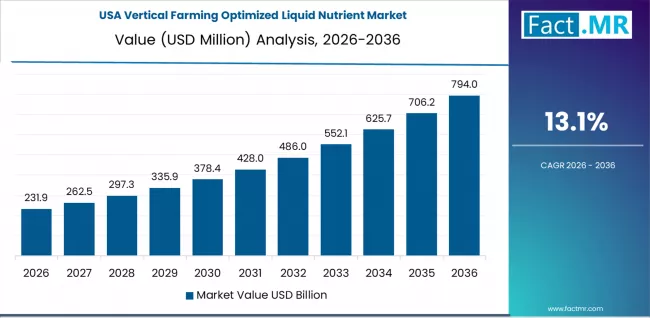
What is the Impact of the USA's Diverse and Investment-Heavy CEA Sector?
Vertical Farming Optimized Liquid Nutrient Market Country Value Analysis | Source: Fact.MR
Significant venture capital investment and a diverse market spanning large leafy green warehouses, boutique urban farms, and a massive legal cannabis industry shape the USA’s 13.1% growth.
This diversity fuels demand for a wide spectrum of products, from premium boutique nutrients to industrial-scale formulations. The presence of large technology players entering agriculture further accelerates innovation.
How is Japan's Space and Technology Focus Influencing the Market?
Japan’s 12.6% CAGR is rooted in its early adoption of plant factories to address limited arable land and an aging farmer population. Japanese research emphasizes automation and extreme resource efficiency.
The nutrient market reflects this, with demand for ultra-pure, consistent formulations that integrate seamlessly with robotic systems and enable production of premium-quality, high-value produce for discerning consumers.
Competitive Landscape of the Vertical Farming Optimized Liquid Nutrient Market
Vertical Farming Optimized Liquid Nutrient Market Analysis By Company | Source: Fact.MR
The competitive landscape blends established water-soluble fertilizer giants and specialized horticultural nutrition companies. Competition is fierce around formulation purity, consistency, and the provision of complete technical support packages including software and agronomic services.
Success hinges on deep partnerships with vertical farming equipment manufacturers to offer integrated solutions and on building a brand reputation for reliability that prevents costly crop failures in high-risk, capital-intensive CEA operations.
Key Players in the Vertical Farming Optimized Liquid Nutrient Market
ICL Group Ltd.
Haifa Group
Yara International ASA
Nutrien
EuroChem Group A.G.
Compass Minerals
Market Breakdown
Segmentation
Scope of Report
Items
Values
Quantitative Units
USD Billion
Crop
Greenhouse Vegetables, Orchards, Open Field Vegetables, Cannabis/Hemp
ICL Group Ltd., Haifa Group, Yara International ASA, Nutrien, EuroChem Group A.G., Compass Minerals
Additional Analysis
Analysis of ion-specific uptake in recirculating systems; impact of nutrient formula on taste and phytonutrient profiles; corrosion and clogging potential of different formulations; total cost of ownership models for nutrient solutions; benchmarking of sourcing and blending infrastructure for urban farms.
Source: Fact.MR analysis. Updated Apr 1, 2026
Market by Segments
Crop :
Greenhouse Vegetables
Orchards
Open Field Vegetables
Cannabis/Hemp
By Viscosity :
Clear Liquid
Suspension
Emulsion
Soluble Gel
Sales Channel :
Ag-Retailers
Direct-to-Farmer
Online Marketplaces
Cooperatives
Region :
North America
USA
Canada
Latin America
Brazil
Mexico
Argentina
Rest of Latin America
Western Europe
Germany
UK
France
Spain
Italy
Netherlands
BENELUX
Rest of Western Europe
Eastern Europe
Russia
Poland
Czech Republic
Rest of Eastern Europe
East Asia
China
Japan
South Korea
Rest of East Asia
South Asia & Pacific
India
ASEAN
Australia
Rest of South Asia & Pacific
MEA
Saudi Arabia
UAE
Turkiye
Rest of MEA
Questions Answered
Frequently Asked Questions
How big is the vertical farming optimized liquid nutrient market in 2026?
The global vertical farming optimized liquid nutrient market is estimated to be valued at USD 0.4 billion in 2026.
What will be the size of vertical farming optimized liquid nutrient market in 2036?
The market size for the vertical farming optimized liquid nutrient market is projected to reach USD 2.3 billion by 2036.
How much will be the vertical farming optimized liquid nutrient market growth between 2026 and 2036?
The vertical farming optimized liquid nutrient market is expected to grow at a 20.4% CAGR between 2026 and 2036.
What are the key product types in the vertical farming optimized liquid nutrient market?
The key product types in vertical farming optimized liquid nutrient market are greenhouse vegetables, orchards, open field vegetables and cannabis/hemp.
Which by viscosity segment to contribute significant share in the vertical farming optimized liquid nutrient market in 2026?
In terms of by viscosity, clear liquid segment to command 38.4% share in the vertical farming optimized liquid nutrient market in 2026.