Nutrient Recovery Chemicals for Sludge Processing Market
Nutrient Recovery Chemicals for Sludge Processing Market Size and Share Forecast Outlook 2026 to 2036
Nutrient recovery chemicals for sludge processing market is projected to grow from USD 390.0 million in 2026 to USD 975.4 million by 2036, at a CAGR of 9.6%. Struvite Precipitation Chemicals (MgCl₂, MgO, etc.) will dominate with a 34.0% market share, while phosphorus will lead the nutrient recovered segment with a 38.0% share.
Nutrient Recovery Chemicals for Sludge Processing Market Forecast and Outlook 2026 to 2036
The global market for nutrient recovery chemicals used in sludge processing is projected to reach USD 975.37 million by 2036. The market is valued at USD 390.00 million in 2026 and is set to rise at a 9.6% CAGR during the assessment period. By chemical type, struvite precipitation chemicals hold a leading 34% share. The recovery of phosphorus represents the dominant nutrient segment at 38%. The fertilizer and agriculture sector is the foremost end-use segment, accounting for a 44% share.
Key Takeaways from the Nutrient Recovery Chemicals for Sludge Processing Market
- Market Value for 2026: USD 390.00 Million
- Market Value for 2036: USD 975.37 Million
- Forecast CAGR (2026-2036): 9.6%
- Leading Chemical Type Share (2026): Struvite Precipitation Chemicals (MgCl₂, MgO, etc.) (34%)
- Leading Nutrient Recovered Share (2026): Phosphorus (P) (38%)
- Leading End-Use Sector Share (2026): Fertilizer & Agriculture (44%)
- Key Players in the Market: Ostara Nutrient Recovery Technologies, Veolia Environnement S.A., Suez Water Technologies, Kemira Oyj., Ecolab Inc.
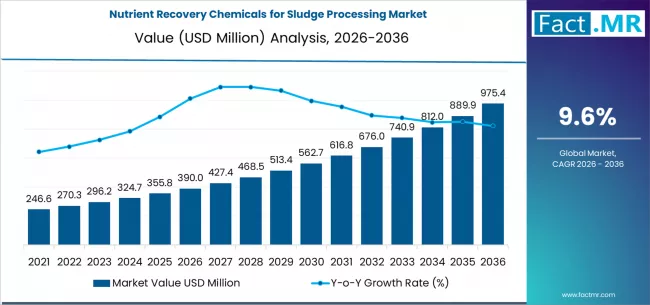
This growth is propelled by the urgent global shift toward a circular economy and the strategic need to secure nutrient supply chains. Wastewater sludge, once considered a disposal problem, is now recognized as a significant resource for recovering valuable nitrogen, phosphorus, and potassium, reducing reliance on energy-intensive and geopolitically sensitive mineral fertilizers.
Specialized recovery chemicals are the critical enablers that extract and purify these nutrients from complex sludge matrices. Their application transforms wastewater treatment plants into resource recovery facilities, supporting sustainable agriculture, reducing environmental pollution from nutrient discharge, and creating new revenue streams for utilities.
Nutrient Recovery Chemicals for Sludge Processing Market
| Metric | Value |
|---|---|
| Market Value (2026) | USD 390.00 Million |
| Market Forecast Value (2036) | USD 975.37 Million |
| Forecast CAGR (2026-2036) | 9.6% |
Category
| Category | Segments |
|---|---|
| Chemical Type | Struvite Precipitation Chemicals (MgCl₂, MgO, etc.), Ammonia Stripping & Capture Chemicals, Phosphate Recovery and Precipitation Agents, Bio-Based & Enzyme-Assisted Recovery Chemicals, Other Specialty Nutrient Recovery Chemicals |
| Nutrient Recovered | Phosphorus (P), Nitrogen (N), Potassium (K), Mixed NPK Recovery, Other Micro-Nutrient Recovery |
| End-Use Sector | Fertilizer & Agriculture, Industrial Chemical Feedstock, Wastewater & Sludge Treatment Utilities, Biogas & Bioenergy Plants, Other Circular Economy Applications |
| Region | North America, Latin America, Western Europe, Eastern Europe, East Asia, South Asia & Pacific, MEA |
Segmental Analysis
By Chemical Type, Which Process is Leading Commercial-Scale Nutrient Recovery?
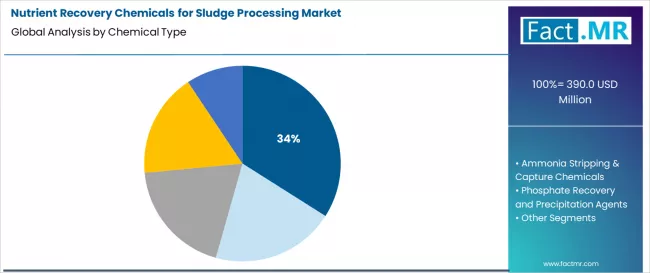
Struvite precipitation chemicals, primarily magnesium sources like magnesium chloride and magnesium oxide, lead the segment with a 34% share. This dominance is due to the commercial maturity and effectiveness of the struvite crystallization process.
It efficiently recovers both phosphorus and ammonia from sludge centrate or digestate, producing a high-value, slow-release fertilizer granule. The chemical reaction is controllable, and the end-product has a ready market, making it the most deployed chemical recovery pathway globally.
Which Nutrient is the Primary Focus of Recovery Efforts Due to Strategic Scarcity?
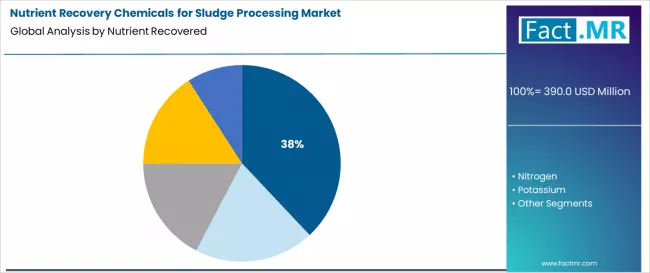
Phosphorus recovery commands the largest segment with a 38% share. Phosphorus is a non-renewable resource critical for global food security, with finite geological reserves concentrated in a few countries.
This strategic vulnerability, coupled with regulations limiting phosphorus discharge to protect waterways, creates a powerful dual incentive to recover phosphorus from wastewater. Recovering it as struvite or calcium phosphate closes the nutrient loop and creates a localized, sustainable fertilizer source.
Which Sector Provides the Strongest Market Pull for Recovered Nutrients?
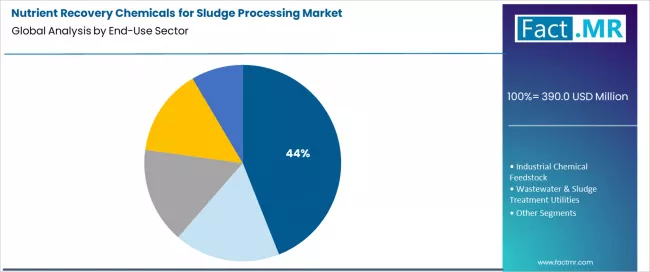
The fertilizer and agriculture sector leads the end-use segment with a 44% share. This sector is the natural and largest-volume outlet for recovered nutrients like struvite, ammonium sulfate, and recovered potassium salts.
The demand for sustainable, low-carbon footprint fertilizers is growing among food producers and consumers. Recovered nutrients, often with lower heavy metal content than some mined fertilizers, fit directly into this market, driving investment in recovery technologies.
What are the Drivers, Restraints, and Key Trends of the Nutrient Recovery Chemicals for Sludge Processing Market?
The fundamental market driver is the powerful convergence of circular economy policies, resource security concerns, and stringent nutrient discharge regulations. Legislation in the EU, North America, and parts of Asia is increasingly mandating or incentivizing nutrient recovery. The rising cost of synthetic fertilizers and their associated carbon footprint further enhances the economic viability of recovered nutrients, turning waste management into a resource-positive operation.
A primary restraint is the significant capital investment required for installing nutrient recovery systems and the ongoing cost of recovery chemicals. The economic case can be sensitive to local fertilizer prices and the scale of the wastewater treatment plant. Variability in sludge composition can also affect recovery efficiency and product purity, posing technical challenges that require skilled operation and potential process adjustments.
Key trends include the development of integrated processes that combine nutrient recovery with energy generation (biogas) and water recovery. There is strong innovation in modular and containerized recovery units that make the technology accessible to smaller treatment plants. The market is moving toward producing higher-purity, customized fertilizer blends to meet specific agricultural needs. Furthermore, digital twin and process optimization software are being used to maximize nutrient yield and minimize chemical consumption.
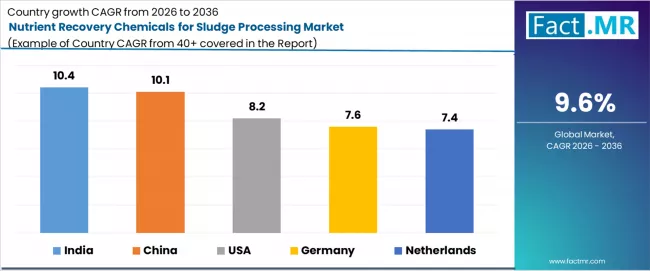
Analysis of the Nutrient Recovery Chemicals for Sludge Processing Market by Key Countries
| Country | CAGR (2026-2036) |
|---|---|
| India | 10.40% |
| China | 10.10% |
| USA | 8.20% |
| Germany | 7.60% |
| Netherlands | 7.40% |
How are India's Sanitation Mission and Agricultural Needs Driving Market Growth?
India's leading CAGR of 10.40% is fueled by its massive investments in sewage treatment infrastructure under the Jal Jeevan Mission and Namami Gange, coupled with a huge domestic demand for fertilizers. Recovering nutrients from the resulting sludge addresses both wastewater treatment goals and agricultural input needs, creating a powerful policy and economic driver for adopting recovery technologies and chemicals.
What is the Impact of China's Circular Economy and Agricultural Security Policies?
China's 10.10% growth is supported by its national Zero Waste and circular economy initiatives, which explicitly promote resource recovery from waste. As the world's largest fertilizer consumer, China's focus on securing domestic nutrient sources and reducing phosphate rock imports makes sludge-based recovery strategically important, driving state-backed research and deployment.
How do US Regulations and Utility Innovation Influence the Market?
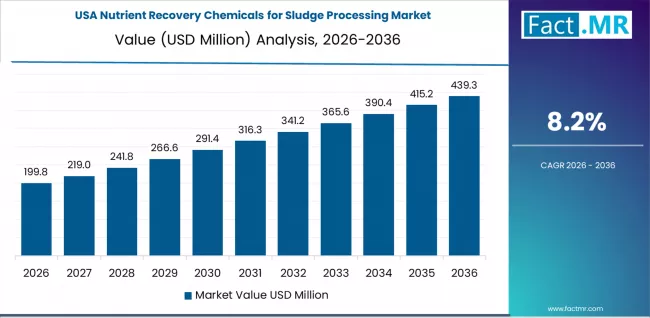
The USA's 8.20% growth is underpinned by a combination of nutrient discharge limits such as the Chesapeake Bay watershed and forward-thinking utility leadership. Water resource recovery facilities are increasingly adopting technologies like struvite recovery to reduce maintenance costs (preventing pipe scaling) and generate revenue, creating a steady demand for associated chemicals and services.
Why is Germany a Hub for Advanced Recovery Technology and Engineering?
Germany's 7.60% CAGR reflects its strong regulatory push for a circular economy under the German Sewage Sludge Ordinance, which mandates phosphorus recovery from larger plants. German engineering firms are global leaders in designing and exporting sophisticated nutrient recovery systems, creating a concentrated demand for high-performance, integrated chemical solutions.
What Role does the Netherlands' Leadership in Sustainable Agriculture Play?
The Netherlands' 7.40% growth is anchored in its world-leading, intensive agriculture sector that demands sustainable inputs and its progressive national waste-to-resource policies. Dutch expertise in water technology and horticulture fosters innovation in nutrient recovery, with a focus on producing high-quality, tailored fertilizer products from urban wastewater streams.
Competitive Landscape of the Nutrient Recovery Chemicals for Sludge Processing Market
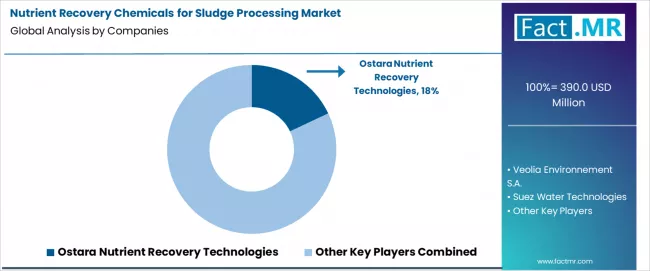
The competitive landscape includes specialized technology providers, global water management corporations, and chemical suppliers. Pioneers like Ostara compete with proprietary, process-integrated chemical solutions and fertilizer marketing.
Large players like Veolia and Suez offer comprehensive sludge treatment and resource recovery contracts that include chemical supply. Competition centers on the efficiency and cost-effectiveness of the chemical recovery process, the quality and marketability of the final nutrient product, and the ability to provide a complete, guaranteed solution from chemical feed to fertilizer offtake.
Key Players in the Nutrient Recovery Chemicals for Sludge Processing Market
- Ostara Nutrient Recovery Technologies
- Veolia Environnement S.A.
- Suez Water Technologies
- Kemira Oyj.
- Ecolab Inc.
Scope of Report
| Items | Values |
|---|---|
| Quantitative Units | USD Million |
| Chemical Type | Struvite Precipitation, Ammonia Stripping, Phosphate Recovery, Bio-Based, Other |
| Nutrient Recovered | Phosphorus, Nitrogen, Potassium, Mixed NPK, Other |
| End-Use Sector | Fertilizer/Agriculture, Industrial Feedstock, Utilities, Biogas Plants, Other |
| Key Countries | India, China, USA, Germany, Netherlands |
| Key Companies | Ostara, Veolia, Suez, Kemira, Ecolab |
| Additional Analysis | Analysis of chemical reaction stoichiometry and process control; quality standards for recovered fertilizer products; life cycle assessment (LCA) comparing recovered vs. synthetic nutrients; regulatory frameworks mandating nutrient recovery; economic models for return on investment in recovery plants. |
Market by Segments
-
Chemical Type :
- Struvite Precipitation Chemicals (MgCl₂, MgO, etc.)
- Ammonia Stripping & Capture Chemicals
- Phosphate Recovery and Precipitation Agents
- Bio-Based & Enzyme-Assisted Recovery Chemicals
- Other Specialty Nutrient Recovery Chemicals
-
Nutrient Recovered :
- Phosphorus
- Nitrogen
- Potassium
- Mixed NPK Recovery
- Other Micro-Nutrient Recovery
-
End-Use Sector :
- Fertilizer & Agriculture
- Industrial Chemical Feedstock
- Wastewater & Sludge Treatment Utilities
- Biogas & Bioenergy Plants
- Other Circular Economy Applications
-
Region :
- North America
- USA
- Canada
- Latin America
- Brazil
- Mexico
- Argentina
- Rest of Latin America
- Western Europe
- Germany
- UK
- France
- Spain
- Italy
- BENELUX
- Rest of Western Europe
- Eastern Europe
- Russia
- Poland
- Czech Republic
- Rest of Eastern Europe
- East Asia
- China
- Japan
- South Korea
- Rest of East Asia
- South Asia & Pacific
- India
- ASEAN
- Australia
- Rest of South Asia & Pacific
- MEA
- Saudi Arabia
- UAE
- Turkiye
- Rest of MEA
- North America
Table of Content
- Executive Summary
- Global Market Outlook
- Demand to side Trends
- Supply to side Trends
- Technology Roadmap Analysis
- Analysis and Recommendations
- Market Overview
- Market Coverage / Taxonomy
- Market Definition / Scope / Limitations
- Market Background
- Market Dynamics
- Drivers
- Restraints
- Opportunity
- Trends
- Scenario Forecast
- Demand in Optimistic Scenario
- Demand in Likely Scenario
- Demand in Conservative Scenario
- Opportunity Map Analysis
- Product Life Cycle Analysis
- Supply Chain Analysis
- Investment Feasibility Matrix
- Value Chain Analysis
- PESTLE and Porter’s Analysis
- Regulatory Landscape
- Regional Parent Market Outlook
- Production and Consumption Statistics
- Import and Export Statistics
- Market Dynamics
- Global Market Analysis 2021 to 2025 and Forecast, 2026 to 2036
- Historical Market Size Value (USD Million) Analysis, 2021 to 2025
- Current and Future Market Size Value (USD Million) Projections, 2026 to 2036
- Y to o to Y Growth Trend Analysis
- Absolute $ Opportunity Analysis
- Global Market Pricing Analysis 2021 to 2025 and Forecast 2026 to 2036
- Global Market Analysis 2021 to 2025 and Forecast 2026 to 2036, By Chemical Type
- Introduction / Key Findings
- Historical Market Size Value (USD Million) Analysis By Chemical Type, 2021 to 2025
- Current and Future Market Size Value (USD Million) Analysis and Forecast By Chemical Type, 2026 to 2036
- Struvite Precipitation Chemicals (MgCl₂, MgO, etc.)
- Ammonia Stripping & Capture Chemicals
- Phosphate Recovery and Precipitation Agents
- Bio-Based & Enzyme-Assisted Recovery Chemicals
- Other Specialty Nutrient Recovery Chemicals
- Struvite Precipitation Chemicals (MgCl₂, MgO, etc.)
- Y to o to Y Growth Trend Analysis By Chemical Type, 2021 to 2025
- Absolute $ Opportunity Analysis By Chemical Type, 2026 to 2036
- Global Market Analysis 2021 to 2025 and Forecast 2026 to 2036, By Nutrient Recovered
- Introduction / Key Findings
- Historical Market Size Value (USD Million) Analysis By Nutrient Recovered, 2021 to 2025
- Current and Future Market Size Value (USD Million) Analysis and Forecast By Nutrient Recovered, 2026 to 2036
- Phosphorus
- Nitrogen
- Potassium
- Mixed NPK Recovery
- Other Micro-Nutrient Recovery
- Phosphorus
- Y to o to Y Growth Trend Analysis By Nutrient Recovered, 2021 to 2025
- Absolute $ Opportunity Analysis By Nutrient Recovered, 2026 to 2036
- Global Market Analysis 2021 to 2025 and Forecast 2026 to 2036, By End-Use Sector
- Introduction / Key Findings
- Historical Market Size Value (USD Million) Analysis By End-Use Sector, 2021 to 2025
- Current and Future Market Size Value (USD Million) Analysis and Forecast By End-Use Sector, 2026 to 2036
- Fertilizer & Agriculture
- Industrial Chemical Feedstock
- Wastewater & Sludge Treatment Utilities
- Biogas & Bioenergy Plants
- Other Circular Economy Applications
- Fertilizer & Agriculture
- Y to o to Y Growth Trend Analysis By End-Use Sector, 2021 to 2025
- Absolute $ Opportunity Analysis By End-Use Sector, 2026 to 2036
- Global Market Analysis 2021 to 2025 and Forecast 2026 to 2036, By Region
- Introduction
- Historical Market Size Value (USD Million) Analysis By Region, 2021 to 2025
- Current Market Size Value (USD Million) Analysis and Forecast By Region, 2026 to 2036
- North America
- Latin America
- Western Europe
- Eastern Europe
- East Asia
- South Asia and Pacific
- Middle East & Africa
- Market Attractiveness Analysis By Region
- North America Market Analysis 2021 to 2025 and Forecast 2026 to 2036, By Country
- Historical Market Size Value (USD Million) Trend Analysis By Market Taxonomy, 2021 to 2025
- Market Size Value (USD Million) Forecast By Market Taxonomy, 2026 to 2036
- By Country
- USA
- Canada
- Mexico
- By Chemical Type
- By Nutrient Recovered
- By End-Use Sector
- By Country
- Market Attractiveness Analysis
- By Country
- By Chemical Type
- By Nutrient Recovered
- By End-Use Sector
- Key Takeaways
- Latin America Market Analysis 2021 to 2025 and Forecast 2026 to 2036, By Country
- Historical Market Size Value (USD Million) Trend Analysis By Market Taxonomy, 2021 to 2025
- Market Size Value (USD Million) Forecast By Market Taxonomy, 2026 to 2036
- By Country
- Brazil
- Chile
- Rest of Latin America
- By Chemical Type
- By Nutrient Recovered
- By End-Use Sector
- By Country
- Market Attractiveness Analysis
- By Country
- By Chemical Type
- By Nutrient Recovered
- By End-Use Sector
- Key Takeaways
- Western Europe Market Analysis 2021 to 2025 and Forecast 2026 to 2036, By Country
- Historical Market Size Value (USD Million) Trend Analysis By Market Taxonomy, 2021 to 2025
- Market Size Value (USD Million) Forecast By Market Taxonomy, 2026 to 2036
- By Country
- Germany
- UK
- Italy
- Spain
- France
- Nordic
- BENELUX
- Rest of Western Europe
- By Chemical Type
- By Nutrient Recovered
- By End-Use Sector
- By Country
- Market Attractiveness Analysis
- By Country
- By Chemical Type
- By Nutrient Recovered
- By End-Use Sector
- Key Takeaways
- Eastern Europe Market Analysis 2021 to 2025 and Forecast 2026 to 2036, By Country
- Historical Market Size Value (USD Million) Trend Analysis By Market Taxonomy, 2021 to 2025
- Market Size Value (USD Million) Forecast By Market Taxonomy, 2026 to 2036
- By Country
- Russia
- Poland
- Hungary
- Balkan & Baltic
- Rest of Eastern Europe
- By Chemical Type
- By Nutrient Recovered
- By End-Use Sector
- By Country
- Market Attractiveness Analysis
- By Country
- By Chemical Type
- By Nutrient Recovered
- By End-Use Sector
- Key Takeaways
- East Asia Market Analysis 2021 to 2025 and Forecast 2026 to 2036, By Country
- Historical Market Size Value (USD Million) Trend Analysis By Market Taxonomy, 2021 to 2025
- Market Size Value (USD Million) Forecast By Market Taxonomy, 2026 to 2036
- By Country
- China
- Japan
- South Korea
- By Chemical Type
- By Nutrient Recovered
- By End-Use Sector
- By Country
- Market Attractiveness Analysis
- By Country
- By Chemical Type
- By Nutrient Recovered
- By End-Use Sector
- Key Takeaways
- South Asia and Pacific Market Analysis 2021 to 2025 and Forecast 2026 to 2036, By Country
- Historical Market Size Value (USD Million) Trend Analysis By Market Taxonomy, 2021 to 2025
- Market Size Value (USD Million) Forecast By Market Taxonomy, 2026 to 2036
- By Country
- India
- ASEAN
- Australia & New Zealand
- Rest of South Asia and Pacific
- By Chemical Type
- By Nutrient Recovered
- By End-Use Sector
- By Country
- Market Attractiveness Analysis
- By Country
- By Chemical Type
- By Nutrient Recovered
- By End-Use Sector
- Key Takeaways
- Middle East & Africa Market Analysis 2021 to 2025 and Forecast 2026 to 2036, By Country
- Historical Market Size Value (USD Million) Trend Analysis By Market Taxonomy, 2021 to 2025
- Market Size Value (USD Million) Forecast By Market Taxonomy, 2026 to 2036
- By Country
- Kingdom of Saudi Arabia
- Other GCC Countries
- Turkiye
- South Africa
- Other African Union
- Rest of Middle East & Africa
- By Chemical Type
- By Nutrient Recovered
- By End-Use Sector
- By Country
- Market Attractiveness Analysis
- By Country
- By Chemical Type
- By Nutrient Recovered
- By End-Use Sector
- Key Takeaways
- Key Countries Market Analysis
- USA
- Pricing Analysis
- Market Share Analysis, 2025
- By Chemical Type
- By Nutrient Recovered
- By End-Use Sector
- Canada
- Pricing Analysis
- Market Share Analysis, 2025
- By Chemical Type
- By Nutrient Recovered
- By End-Use Sector
- Mexico
- Pricing Analysis
- Market Share Analysis, 2025
- By Chemical Type
- By Nutrient Recovered
- By End-Use Sector
- Brazil
- Pricing Analysis
- Market Share Analysis, 2025
- By Chemical Type
- By Nutrient Recovered
- By End-Use Sector
- Chile
- Pricing Analysis
- Market Share Analysis, 2025
- By Chemical Type
- By Nutrient Recovered
- By End-Use Sector
- Germany
- Pricing Analysis
- Market Share Analysis, 2025
- By Chemical Type
- By Nutrient Recovered
- By End-Use Sector
- UK
- Pricing Analysis
- Market Share Analysis, 2025
- By Chemical Type
- By Nutrient Recovered
- By End-Use Sector
- Italy
- Pricing Analysis
- Market Share Analysis, 2025
- By Chemical Type
- By Nutrient Recovered
- By End-Use Sector
- Spain
- Pricing Analysis
- Market Share Analysis, 2025
- By Chemical Type
- By Nutrient Recovered
- By End-Use Sector
- France
- Pricing Analysis
- Market Share Analysis, 2025
- By Chemical Type
- By Nutrient Recovered
- By End-Use Sector
- India
- Pricing Analysis
- Market Share Analysis, 2025
- By Chemical Type
- By Nutrient Recovered
- By End-Use Sector
- ASEAN
- Pricing Analysis
- Market Share Analysis, 2025
- By Chemical Type
- By Nutrient Recovered
- By End-Use Sector
- Australia & New Zealand
- Pricing Analysis
- Market Share Analysis, 2025
- By Chemical Type
- By Nutrient Recovered
- By End-Use Sector
- China
- Pricing Analysis
- Market Share Analysis, 2025
- By Chemical Type
- By Nutrient Recovered
- By End-Use Sector
- Japan
- Pricing Analysis
- Market Share Analysis, 2025
- By Chemical Type
- By Nutrient Recovered
- By End-Use Sector
- South Korea
- Pricing Analysis
- Market Share Analysis, 2025
- By Chemical Type
- By Nutrient Recovered
- By End-Use Sector
- Russia
- Pricing Analysis
- Market Share Analysis, 2025
- By Chemical Type
- By Nutrient Recovered
- By End-Use Sector
- Poland
- Pricing Analysis
- Market Share Analysis, 2025
- By Chemical Type
- By Nutrient Recovered
- By End-Use Sector
- Hungary
- Pricing Analysis
- Market Share Analysis, 2025
- By Chemical Type
- By Nutrient Recovered
- By End-Use Sector
- Kingdom of Saudi Arabia
- Pricing Analysis
- Market Share Analysis, 2025
- By Chemical Type
- By Nutrient Recovered
- By End-Use Sector
- Turkiye
- Pricing Analysis
- Market Share Analysis, 2025
- By Chemical Type
- By Nutrient Recovered
- By End-Use Sector
- South Africa
- Pricing Analysis
- Market Share Analysis, 2025
- By Chemical Type
- By Nutrient Recovered
- By End-Use Sector
- USA
- Market Structure Analysis
- Competition Dashboard
- Competition Benchmarking
- Market Share Analysis of Top Players
- By Regional
- By Chemical Type
- By Nutrient Recovered
- By End-Use Sector
- Competition Analysis
- Competition Deep Dive
- Ostara Nutrient Recovery Technologies
- Overview
- Product Portfolio
- Profitability by Market Segments (Product/Age /Sales Channel/Region)
- Sales Footprint
- Strategy Overview
- Marketing Strategy
- Product Strategy
- Channel Strategy
- Veolia Environnement S.A.
- Suez Water Technologies
- Kemira Oyj.
- Ecolab Inc.
- Ostara Nutrient Recovery Technologies
- Competition Deep Dive
- Assumptions & Acronyms Used
- Research Methodology
List Of Table
- Table 1: Global Market Value (USD Million) Forecast by Region, 2021 to 2036
- Table 2: Global Market Value (USD Million) Forecast by Chemical Type, 2021 to 2036
- Table 3: Global Market Value (USD Million) Forecast by Nutrient Recovered, 2021 to 2036
- Table 4: Global Market Value (USD Million) Forecast by End-Use Sector, 2021 to 2036
- Table 5: North America Market Value (USD Million) Forecast by Country, 2021 to 2036
- Table 6: North America Market Value (USD Million) Forecast by Chemical Type, 2021 to 2036
- Table 7: North America Market Value (USD Million) Forecast by Nutrient Recovered, 2021 to 2036
- Table 8: North America Market Value (USD Million) Forecast by End-Use Sector, 2021 to 2036
- Table 9: Latin America Market Value (USD Million) Forecast by Country, 2021 to 2036
- Table 10: Latin America Market Value (USD Million) Forecast by Chemical Type, 2021 to 2036
- Table 11: Latin America Market Value (USD Million) Forecast by Nutrient Recovered, 2021 to 2036
- Table 12: Latin America Market Value (USD Million) Forecast by End-Use Sector, 2021 to 2036
- Table 13: Western Europe Market Value (USD Million) Forecast by Country, 2021 to 2036
- Table 14: Western Europe Market Value (USD Million) Forecast by Chemical Type, 2021 to 2036
- Table 15: Western Europe Market Value (USD Million) Forecast by Nutrient Recovered, 2021 to 2036
- Table 16: Western Europe Market Value (USD Million) Forecast by End-Use Sector, 2021 to 2036
- Table 17: Eastern Europe Market Value (USD Million) Forecast by Country, 2021 to 2036
- Table 18: Eastern Europe Market Value (USD Million) Forecast by Chemical Type, 2021 to 2036
- Table 19: Eastern Europe Market Value (USD Million) Forecast by Nutrient Recovered, 2021 to 2036
- Table 20: Eastern Europe Market Value (USD Million) Forecast by End-Use Sector, 2021 to 2036
- Table 21: East Asia Market Value (USD Million) Forecast by Country, 2021 to 2036
- Table 22: East Asia Market Value (USD Million) Forecast by Chemical Type, 2021 to 2036
- Table 23: East Asia Market Value (USD Million) Forecast by Nutrient Recovered, 2021 to 2036
- Table 24: East Asia Market Value (USD Million) Forecast by End-Use Sector, 2021 to 2036
- Table 25: South Asia and Pacific Market Value (USD Million) Forecast by Country, 2021 to 2036
- Table 26: South Asia and Pacific Market Value (USD Million) Forecast by Chemical Type, 2021 to 2036
- Table 27: South Asia and Pacific Market Value (USD Million) Forecast by Nutrient Recovered, 2021 to 2036
- Table 28: South Asia and Pacific Market Value (USD Million) Forecast by End-Use Sector, 2021 to 2036
- Table 29: Middle East & Africa Market Value (USD Million) Forecast by Country, 2021 to 2036
- Table 30: Middle East & Africa Market Value (USD Million) Forecast by Chemical Type, 2021 to 2036
- Table 31: Middle East & Africa Market Value (USD Million) Forecast by Nutrient Recovered, 2021 to 2036
- Table 32: Middle East & Africa Market Value (USD Million) Forecast by End-Use Sector, 2021 to 2036
List Of Figures
- Figure 1: Global Market Pricing Analysis
- Figure 2: Global Market Value (USD Million) Forecast 2021 to 2036
- Figure 3: Global Market Value Share and BPS Analysis by Chemical Type, 2026 and 2036
- Figure 4: Global Market Y to o to Y Growth Comparison by Chemical Type, 2026 to 2036
- Figure 5: Global Market Attractiveness Analysis by Chemical Type
- Figure 6: Global Market Value Share and BPS Analysis by Nutrient Recovered, 2026 and 2036
- Figure 7: Global Market Y to o to Y Growth Comparison by Nutrient Recovered, 2026 to 2036
- Figure 8: Global Market Attractiveness Analysis by Nutrient Recovered
- Figure 9: Global Market Value Share and BPS Analysis by End-Use Sector, 2026 and 2036
- Figure 10: Global Market Y to o to Y Growth Comparison by End-Use Sector, 2026 to 2036
- Figure 11: Global Market Attractiveness Analysis by End-Use Sector
- Figure 12: Global Market Value (USD Million) Share and BPS Analysis by Region, 2026 and 2036
- Figure 13: Global Market Y to o to Y Growth Comparison by Region, 2026 to 2036
- Figure 14: Global Market Attractiveness Analysis by Region
- Figure 15: North America Market Incremental Dollar Opportunity, 2026 to 2036
- Figure 16: Latin America Market Incremental Dollar Opportunity, 2026 to 2036
- Figure 17: Western Europe Market Incremental Dollar Opportunity, 2026 to 2036
- Figure 18: Eastern Europe Market Incremental Dollar Opportunity, 2026 to 2036
- Figure 19: East Asia Market Incremental Dollar Opportunity, 2026 to 2036
- Figure 20: South Asia and Pacific Market Incremental Dollar Opportunity, 2026 to 2036
- Figure 21: Middle East & Africa Market Incremental Dollar Opportunity, 2026 to 2036
- Figure 22: North America Market Value Share and BPS Analysis by Country, 2026 and 2036
- Figure 23: North America Market Value Share and BPS Analysis by Chemical Type, 2026 and 2036
- Figure 24: North America Market Y to o to Y Growth Comparison by Chemical Type, 2026 to 2036
- Figure 25: North America Market Attractiveness Analysis by Chemical Type
- Figure 26: North America Market Value Share and BPS Analysis by Nutrient Recovered, 2026 and 2036
- Figure 27: North America Market Y to o to Y Growth Comparison by Nutrient Recovered, 2026 to 2036
- Figure 28: North America Market Attractiveness Analysis by Nutrient Recovered
- Figure 29: North America Market Value Share and BPS Analysis by End-Use Sector, 2026 and 2036
- Figure 30: North America Market Y to o to Y Growth Comparison by End-Use Sector, 2026 to 2036
- Figure 31: North America Market Attractiveness Analysis by End-Use Sector
- Figure 32: Latin America Market Value Share and BPS Analysis by Country, 2026 and 2036
- Figure 33: Latin America Market Value Share and BPS Analysis by Chemical Type, 2026 and 2036
- Figure 34: Latin America Market Y to o to Y Growth Comparison by Chemical Type, 2026 to 2036
- Figure 35: Latin America Market Attractiveness Analysis by Chemical Type
- Figure 36: Latin America Market Value Share and BPS Analysis by Nutrient Recovered, 2026 and 2036
- Figure 37: Latin America Market Y to o to Y Growth Comparison by Nutrient Recovered, 2026 to 2036
- Figure 38: Latin America Market Attractiveness Analysis by Nutrient Recovered
- Figure 39: Latin America Market Value Share and BPS Analysis by End-Use Sector, 2026 and 2036
- Figure 40: Latin America Market Y to o to Y Growth Comparison by End-Use Sector, 2026 to 2036
- Figure 41: Latin America Market Attractiveness Analysis by End-Use Sector
- Figure 42: Western Europe Market Value Share and BPS Analysis by Country, 2026 and 2036
- Figure 43: Western Europe Market Value Share and BPS Analysis by Chemical Type, 2026 and 2036
- Figure 44: Western Europe Market Y to o to Y Growth Comparison by Chemical Type, 2026 to 2036
- Figure 45: Western Europe Market Attractiveness Analysis by Chemical Type
- Figure 46: Western Europe Market Value Share and BPS Analysis by Nutrient Recovered, 2026 and 2036
- Figure 47: Western Europe Market Y to o to Y Growth Comparison by Nutrient Recovered, 2026 to 2036
- Figure 48: Western Europe Market Attractiveness Analysis by Nutrient Recovered
- Figure 49: Western Europe Market Value Share and BPS Analysis by End-Use Sector, 2026 and 2036
- Figure 50: Western Europe Market Y to o to Y Growth Comparison by End-Use Sector, 2026 to 2036
- Figure 51: Western Europe Market Attractiveness Analysis by End-Use Sector
- Figure 52: Eastern Europe Market Value Share and BPS Analysis by Country, 2026 and 2036
- Figure 53: Eastern Europe Market Value Share and BPS Analysis by Chemical Type, 2026 and 2036
- Figure 54: Eastern Europe Market Y to o to Y Growth Comparison by Chemical Type, 2026 to 2036
- Figure 55: Eastern Europe Market Attractiveness Analysis by Chemical Type
- Figure 56: Eastern Europe Market Value Share and BPS Analysis by Nutrient Recovered, 2026 and 2036
- Figure 57: Eastern Europe Market Y to o to Y Growth Comparison by Nutrient Recovered, 2026 to 2036
- Figure 58: Eastern Europe Market Attractiveness Analysis by Nutrient Recovered
- Figure 59: Eastern Europe Market Value Share and BPS Analysis by End-Use Sector, 2026 and 2036
- Figure 60: Eastern Europe Market Y to o to Y Growth Comparison by End-Use Sector, 2026 to 2036
- Figure 61: Eastern Europe Market Attractiveness Analysis by End-Use Sector
- Figure 62: East Asia Market Value Share and BPS Analysis by Country, 2026 and 2036
- Figure 63: East Asia Market Value Share and BPS Analysis by Chemical Type, 2026 and 2036
- Figure 64: East Asia Market Y to o to Y Growth Comparison by Chemical Type, 2026 to 2036
- Figure 65: East Asia Market Attractiveness Analysis by Chemical Type
- Figure 66: East Asia Market Value Share and BPS Analysis by Nutrient Recovered, 2026 and 2036
- Figure 67: East Asia Market Y to o to Y Growth Comparison by Nutrient Recovered, 2026 to 2036
- Figure 68: East Asia Market Attractiveness Analysis by Nutrient Recovered
- Figure 69: East Asia Market Value Share and BPS Analysis by End-Use Sector, 2026 and 2036
- Figure 70: East Asia Market Y to o to Y Growth Comparison by End-Use Sector, 2026 to 2036
- Figure 71: East Asia Market Attractiveness Analysis by End-Use Sector
- Figure 72: South Asia and Pacific Market Value Share and BPS Analysis by Country, 2026 and 2036
- Figure 73: South Asia and Pacific Market Value Share and BPS Analysis by Chemical Type, 2026 and 2036
- Figure 74: South Asia and Pacific Market Y to o to Y Growth Comparison by Chemical Type, 2026 to 2036
- Figure 75: South Asia and Pacific Market Attractiveness Analysis by Chemical Type
- Figure 76: South Asia and Pacific Market Value Share and BPS Analysis by Nutrient Recovered, 2026 and 2036
- Figure 77: South Asia and Pacific Market Y to o to Y Growth Comparison by Nutrient Recovered, 2026 to 2036
- Figure 78: South Asia and Pacific Market Attractiveness Analysis by Nutrient Recovered
- Figure 79: South Asia and Pacific Market Value Share and BPS Analysis by End-Use Sector, 2026 and 2036
- Figure 80: South Asia and Pacific Market Y to o to Y Growth Comparison by End-Use Sector, 2026 to 2036
- Figure 81: South Asia and Pacific Market Attractiveness Analysis by End-Use Sector
- Figure 82: Middle East & Africa Market Value Share and BPS Analysis by Country, 2026 and 2036
- Figure 83: Middle East & Africa Market Value Share and BPS Analysis by Chemical Type, 2026 and 2036
- Figure 84: Middle East & Africa Market Y to o to Y Growth Comparison by Chemical Type, 2026 to 2036
- Figure 85: Middle East & Africa Market Attractiveness Analysis by Chemical Type
- Figure 86: Middle East & Africa Market Value Share and BPS Analysis by Nutrient Recovered, 2026 and 2036
- Figure 87: Middle East & Africa Market Y to o to Y Growth Comparison by Nutrient Recovered, 2026 to 2036
- Figure 88: Middle East & Africa Market Attractiveness Analysis by Nutrient Recovered
- Figure 89: Middle East & Africa Market Value Share and BPS Analysis by End-Use Sector, 2026 and 2036
- Figure 90: Middle East & Africa Market Y to o to Y Growth Comparison by End-Use Sector, 2026 to 2036
- Figure 91: Middle East & Africa Market Attractiveness Analysis by End-Use Sector
- Figure 92: Global Market - Tier Structure Analysis
- Figure 93: Global Market - Company Share Analysis
- FAQs -
How big is the nutrient recovery chemicals for sludge processing market in 2026?
The global nutrient recovery chemicals for sludge processing market is estimated to be valued at USD 390.0 million in 2026.
What will be the size of nutrient recovery chemicals for sludge processing market in 2036?
The market size for the nutrient recovery chemicals for sludge processing market is projected to reach USD 975.4 million by 2036.
How much will be the nutrient recovery chemicals for sludge processing market growth between 2026 and 2036?
The nutrient recovery chemicals for sludge processing market is expected to grow at a 9.6% CAGR between 2026 and 2036.
What are the key product types in the nutrient recovery chemicals for sludge processing market?
The key product types in nutrient recovery chemicals for sludge processing market are struvite precipitation chemicals (mgcl₂, mgo, etc.), ammonia stripping & capture chemicals, phosphate recovery and precipitation agents, bio-based & enzyme-assisted recovery chemicals and other specialty nutrient recovery chemicals.
Which nutrient recovered segment to contribute significant share in the nutrient recovery chemicals for sludge processing market in 2026?
In terms of nutrient recovered, phosphorus segment to command 38.0% share in the nutrient recovery chemicals for sludge processing market in 2026.