Vertical Farming Optimized Liquid Nutrient Market

Vertical Farming Optimized Liquid Nutrient Market Size and Share Forecast Outlook 2026 to 2036

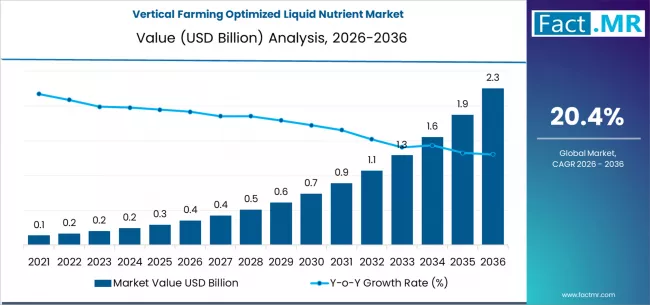
Vertical farming optimized liquid nutrient market is projected to grow from USD 0.4 billion in 2026 to USD 2.3 billion by 2036, at a CAGR of 20.4%. Greenhouse Vegetables will dominate with a 41.5% market share, while clear liquid will lead the by viscosity segment with a 38.4% share.

Vertical Farming Optimized Liquid Nutrient Market Forecast and Outlook 2026 to 2036

The global market for vertical farming optimized liquid nutrients is projected for exponential growth, surging from USD 0.35 billion in 2026 to USD 2.25 billion by 2036, advancing at a remarkable CAGR of 20.4%.

Key Takeaways from the Vertical Farming Optimized Liquid Nutrient Market

  • Market Value for 2026: USD 0.35 Billion
  • Market Value for 2036: USD 2.25 Billion
  • Forecast CAGR (2026-2036): 20.4%
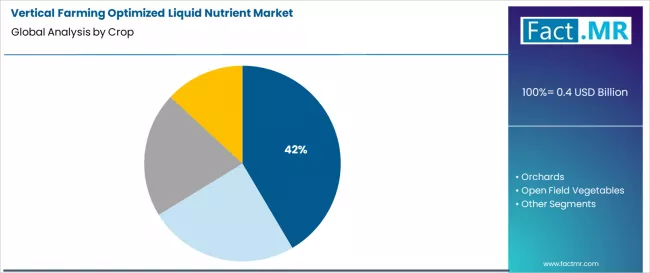
  • Leading Crop Segment (2026): Greenhouse Vegetables (42%)
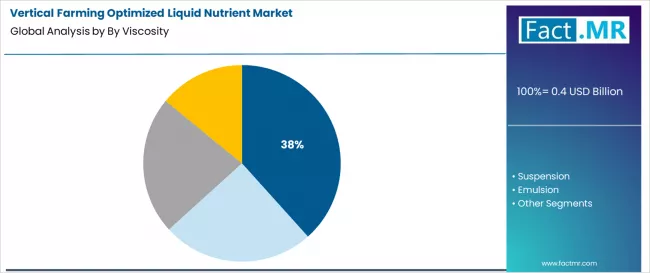
  • Leading Viscosity Segment (2026): Clear Liquid (38%)
  • Leading Sales Channel Segment (2026): Ag-Retailers (65%)
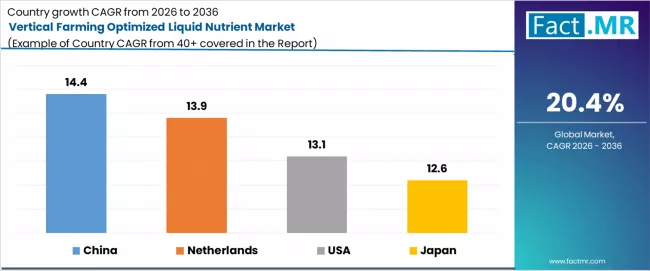
  • Key Growth Countries: China (14.4% CAGR), Netherlands (13.9% CAGR), USA (13.1% CAGR), Japan (12.6% CAGR)
  • Key Players in the Market: ICL Group Ltd., Haifa Group, Yara International ASA, Nutrien, EuroChem Group A.G., Compass Minerals

Vertical Farming Optimized Liquid Nutrient Market Market Value Analysis

This market is a cornerstone of the Controlled Environment Agriculture (CEA) revolution, providing the specialized nutritional foundation for soilless production systems that stack growth vertically. Unlike traditional field fertilizers, these products are precision-engineered solutions formulated for complete bioavailability in recirculating hydroponic, aeroponic, and aquaponic systems, where nutrient efficiency and system cleanliness are paramount.

Growth is driven by the rapid global expansion of urban vertical farms and high-tech greenhouses, fueled by demand for local, pesticide-free produce and the necessity of climate-resilient food production. These liquid nutrients are the lifeblood of CEA, enabling exact control over plant growth, flavor, and nutritional content.

The market’s expansion reflects a shift from agricultural chemistry to biosystem engineering, where nutrients are part of an integrated technological loop involving LED lighting, climate computers, and automated irrigation. Success depends on formulations that prevent salt buildup, maintain stable pH, and provide perfectly balanced ionic nutrition for fast-growing crops in artificial environments, maximizing yield per cubic foot of space.

Metric

Metric Value
Market Value (2026) USD 0.35 Billion
Market Forecast Value (2036) USD 2.25 Billion
Forecast CAGR (2026-2036) 20.4%

Category

Category Segments
Crop Greenhouse Vegetables, Orchards, Open Field Vegetables, Cannabis/Hemp
By Viscosity Clear Liquid, Suspension, Emulsion, Soluble Gel
Sales Channel Ag-Retailers, Direct-to-Farmer, Online Marketplaces, Cooperatives
Region North America, Latin America, Western Europe, Eastern Europe, East Asia, South Asia & Pacific, MEA

Segmental Analysis

By Crop, Which Segment Dominates Current CEA Production?

Vertical Farming Optimized Liquid Nutrient Market Analysis By Crop

Greenhouse vegetables command a 42% share, led by high-value crops like lettuce, leafy greens, herbs, and tomatoes. These crops have short cycles and high yield density in vertical systems, making them economically viable and technically mature for soilless production.

The nutrient formulas for these crops are highly refined, focusing on rapid uptake to support fast growth under continuous or near-continuous light, establishing this segment as the commercial backbone of the vertical farming industry.

By Viscosity, Which Type Ensures System Reliability?

Vertical Farming Optimized Liquid Nutrient Market Analysis By By Viscosity

Clear liquid formulations lead with a 38% share. In sensitive recirculating systems with fine drippers and misters, clarity is critical to prevent clogging and biofilm formation. Clear, fully chelated solutions ensure consistent nutrient delivery and easier monitoring of solution health. Large-scale vertical farm operators for whom system downtime equates to direct and significant revenue loss prioritize this operational reliability.

By Sales Channel, How are Technical Products Sourced?

Vertical Farming Optimized Liquid Nutrient Market Analysis By Sales Channel

Ag-Retailers specializing in horticulture and CEA supplies are the dominant channel at 65%. While some large farms procure direct, most operators rely on specialized retailers for technical support, just-in-time delivery, and access to a range of complementary inputs such as pH adjusters, beneficial microbes, and cleaning agents. The retailer acts as a crucial technical partner, not just a distributor.

What are the Drivers, Restraints, and Key Trends of the Vertical Farming Optimized Liquid Nutrient Market?

The primary driver is massive investment in urban and peri-urban vertical farming infrastructure worldwide, supported by food security and sustainability goals. The superior resource efficiency and year-round production capability of CEA create a compelling case. Consumer demand for hyper-local, clean-label produce and the legalization of cannabis for medical/adult use are creating additional, high-margin market segments that depend entirely on these optimized nutrients.

A key restraint is the high energy cost of vertical farming, which pressures overall operational economics and can limit expansion. The technical expertise required to manage complex nutrient recipes poses a barrier to entry for new growers. Furthermore, the capital intensity of vertical farms can slow the rate of new facility build-out, temporarily capping demand.

Key trends include the development of crop-specific and growth-stage-specific formulation lines, moving from generic greens formulas to varieties optimized for basil, strawberry, or microgreens. Integration with IoT and dosing systems allows for fully automated, data-driven nutrient management. There is also a strong trend toward sourcing organic-compliant or clean-mineral ingredients to meet the marketing demands of premium CEA produce.

Analysis of the Vertical Farming Optimized Liquid Nutrient Market by Key Countries

Vertical Farming Optimized Liquid Nutrient Market Cagr Analysis By Country

Country CAGR (2026-2036)
China 14.4%
Netherlands 13.9%
USA 13.1%
Japan 12.6%

How is China's Urbanization and Food Security Strategy Driving Growth?

China’s leading CAGR of 14.4% is fueled by national policies promoting plant factories with artificial light to secure vegetable supply for megacities and reduce agricultural land use. Massive government and corporate investments are creating the world's largest build-out of vertical farming capacity. This scale drives demand for bulk, cost-optimized liquid nutrients, with a strong focus on mastering the core technology of CEA production.

Why are the Netherlands a Global Hub for Innovation?

The Netherlands' 13.9% growth builds on its century-long leadership in greenhouse horticulture. Dutch companies are pioneers in transitioning high-tech greenhouse knowledge to full vertical farming systems.

The market is characterized by a demand for ultra-efficient, data-integrated nutrient solutions and a strong export orientation for both technology and the nutrient formulas themselves, setting global standards.

What is the Impact of the USA's Diverse and Investment-Heavy CEA Sector?

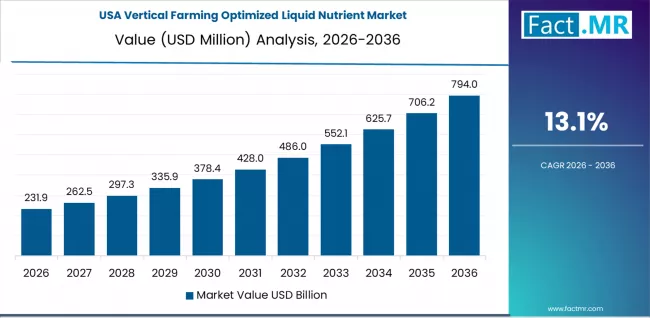
Vertical Farming Optimized Liquid Nutrient Market Country Value Analysis

Significant venture capital investment and a diverse market spanning large leafy green warehouses, boutique urban farms, and a massive legal cannabis industry shape the USA’s 13.1% growth.

This diversity fuels demand for a wide spectrum of products, from premium boutique nutrients to industrial-scale formulations. The presence of large technology players entering agriculture further accelerates innovation.

How is Japan's Space and Technology Focus Influencing the Market?

Japan’s 12.6% CAGR is rooted in its early adoption of plant factories to address limited arable land and an aging farmer population. Japanese research emphasizes automation and extreme resource efficiency.

The nutrient market reflects this, with demand for ultra-pure, consistent formulations that integrate seamlessly with robotic systems and enable production of premium-quality, high-value produce for discerning consumers.

Competitive Landscape of the Vertical Farming Optimized Liquid Nutrient Market

Vertical Farming Optimized Liquid Nutrient Market Analysis By Company

The competitive landscape blends established water-soluble fertilizer giants and specialized horticultural nutrition companies. Competition is fierce around formulation purity, consistency, and the provision of complete technical support packages including software and agronomic services.

Success hinges on deep partnerships with vertical farming equipment manufacturers to offer integrated solutions and on building a brand reputation for reliability that prevents costly crop failures in high-risk, capital-intensive CEA operations.

Key Players in the Vertical Farming Optimized Liquid Nutrient Market

  • ICL Group Ltd.
  • Haifa Group
  • Yara International ASA
  • Nutrien
  • EuroChem Group A.G.
  • Compass Minerals

Scope of Report

Items Values
Quantitative Units USD Billion
Crop Greenhouse Vegetables, Orchards, Open Field Vegetables, Cannabis/Hemp
By Viscosity Clear Liquid, Suspension, Emulsion, Soluble Gel
Sales Channel Ag-Retailers, Direct-to-Farmer, Online Marketplaces, Cooperatives
Key Countries Netherlands, China, USA, Japan
Key Companies ICL Group Ltd., Haifa Group, Yara International ASA, Nutrien, EuroChem Group A.G., Compass Minerals
Additional Analysis Analysis of ion-specific uptake in recirculating systems; impact of nutrient formula on taste and phytonutrient profiles; corrosion and clogging potential of different formulations; total cost of ownership models for nutrient solutions; benchmarking of sourcing and blending infrastructure for urban farms.

Market by Segments

  • Crop :

    • Greenhouse Vegetables
    • Orchards
    • Open Field Vegetables
    • Cannabis/Hemp
  • By Viscosity :

    • Clear Liquid
    • Suspension
    • Emulsion
    • Soluble Gel
  • Sales Channel :

    • Ag-Retailers
    • Direct-to-Farmer
    • Online Marketplaces
    • Cooperatives
  • Region :

    • North America

      • USA
      • Canada
    • Latin America

      • Brazil
      • Mexico
      • Argentina
      • Rest of Latin America
    • Western Europe

      • Germany
      • UK
      • France
      • Spain
      • Italy
      • Netherlands
      • BENELUX
      • Rest of Western Europe
    • Eastern Europe

      • Russia
      • Poland
      • Czech Republic
      • Rest of Eastern Europe
    • East Asia

      • China
      • Japan
      • South Korea
      • Rest of East Asia
    • South Asia & Pacific

      • India
      • ASEAN
      • Australia
      • Rest of South Asia & Pacific
    • MEA

      • Saudi Arabia
      • UAE
      • Turkiye
      • Rest of MEA

Table of Content

  1. Executive Summary
    • Global Market Outlook
    • Demand to side Trends
    • Supply to side Trends
    • Technology Roadmap Analysis
    • Analysis and Recommendations
  2. Market Overview
    • Market Coverage / Taxonomy
    • Market Definition / Scope / Limitations
  3. Market Background
    • Market Dynamics
      • Drivers
      • Restraints
      • Opportunity
      • Trends
    • Scenario Forecast
      • Demand in Optimistic Scenario
      • Demand in Likely Scenario
      • Demand in Conservative Scenario
    • Opportunity Map Analysis
    • Product Life Cycle Analysis
    • Supply Chain Analysis
    • Investment Feasibility Matrix
    • Value Chain Analysis
    • PESTLE and Porter’s Analysis
    • Regulatory Landscape
    • Regional Parent Market Outlook
    • Production and Consumption Statistics
    • Import and Export Statistics
  4. Global Market Analysis 2021 to 2025 and Forecast, 2026 to 2036
    • Historical Market Size Value (USD Million) Analysis, 2021 to 2025
    • Current and Future Market Size Value (USD Million) Projections, 2026 to 2036
      • Y to o to Y Growth Trend Analysis
      • Absolute $ Opportunity Analysis
  5. Global Market Pricing Analysis 2021 to 2025 and Forecast 2026 to 2036
  6. Global Market Analysis 2021 to 2025 and Forecast 2026 to 2036, By Crop
    • Introduction / Key Findings
    • Historical Market Size Value (USD Million) Analysis By Crop, 2021 to 2025
    • Current and Future Market Size Value (USD Million) Analysis and Forecast By Crop, 2026 to 2036
      • Greenhouse Vegetables
      • Orchards
      • Open Field Vegetables
      • Cannabis/Hemp
    • Y to o to Y Growth Trend Analysis By Crop, 2021 to 2025
    • Absolute $ Opportunity Analysis By Crop, 2026 to 2036
  7. Global Market Analysis 2021 to 2025 and Forecast 2026 to 2036, By By Viscosity
    • Introduction / Key Findings
    • Historical Market Size Value (USD Million) Analysis By By Viscosity, 2021 to 2025
    • Current and Future Market Size Value (USD Million) Analysis and Forecast By By Viscosity, 2026 to 2036
      • Clear Liquid
      • Suspension
      • Emulsion
      • Soluble Gel
    • Y to o to Y Growth Trend Analysis By By Viscosity, 2021 to 2025
    • Absolute $ Opportunity Analysis By By Viscosity, 2026 to 2036
  8. Global Market Analysis 2021 to 2025 and Forecast 2026 to 2036, By Sales Channel
    • Introduction / Key Findings
    • Historical Market Size Value (USD Million) Analysis By Sales Channel, 2021 to 2025
    • Current and Future Market Size Value (USD Million) Analysis and Forecast By Sales Channel, 2026 to 2036
      • Ag-Retailers
      • Direct-to-Farmer
      • Online Marketplaces
      • Cooperatives
    • Y to o to Y Growth Trend Analysis By Sales Channel, 2021 to 2025
    • Absolute $ Opportunity Analysis By Sales Channel, 2026 to 2036
  9. Global Market Analysis 2021 to 2025 and Forecast 2026 to 2036, By Region
    • Introduction
    • Historical Market Size Value (USD Million) Analysis By Region, 2021 to 2025
    • Current Market Size Value (USD Million) Analysis and Forecast By Region, 2026 to 2036
      • North America
      • Latin America
      • Western Europe
      • Eastern Europe
      • East Asia
      • South Asia and Pacific
      • Middle East & Africa
    • Market Attractiveness Analysis By Region
  10. North America Market Analysis 2021 to 2025 and Forecast 2026 to 2036, By Country
    • Historical Market Size Value (USD Million) Trend Analysis By Market Taxonomy, 2021 to 2025
    • Market Size Value (USD Million) Forecast By Market Taxonomy, 2026 to 2036
      • By Country
        • USA
        • Canada
        • Mexico
      • By Crop
      • By By Viscosity
      • By Sales Channel
    • Market Attractiveness Analysis
      • By Country
      • By Crop
      • By By Viscosity
      • By Sales Channel
    • Key Takeaways
  11. Latin America Market Analysis 2021 to 2025 and Forecast 2026 to 2036, By Country
    • Historical Market Size Value (USD Million) Trend Analysis By Market Taxonomy, 2021 to 2025
    • Market Size Value (USD Million) Forecast By Market Taxonomy, 2026 to 2036
      • By Country
        • Brazil
        • Chile
        • Rest of Latin America
      • By Crop
      • By By Viscosity
      • By Sales Channel
    • Market Attractiveness Analysis
      • By Country
      • By Crop
      • By By Viscosity
      • By Sales Channel
    • Key Takeaways
  12. Western Europe Market Analysis 2021 to 2025 and Forecast 2026 to 2036, By Country
    • Historical Market Size Value (USD Million) Trend Analysis By Market Taxonomy, 2021 to 2025
    • Market Size Value (USD Million) Forecast By Market Taxonomy, 2026 to 2036
      • By Country
        • Germany
        • UK
        • Italy
        • Spain
        • France
        • Nordic
        • BENELUX
        • Rest of Western Europe
      • By Crop
      • By By Viscosity
      • By Sales Channel
    • Market Attractiveness Analysis
      • By Country
      • By Crop
      • By By Viscosity
      • By Sales Channel
    • Key Takeaways
  13. Eastern Europe Market Analysis 2021 to 2025 and Forecast 2026 to 2036, By Country
    • Historical Market Size Value (USD Million) Trend Analysis By Market Taxonomy, 2021 to 2025
    • Market Size Value (USD Million) Forecast By Market Taxonomy, 2026 to 2036
      • By Country
        • Russia
        • Poland
        • Hungary
        • Balkan & Baltic
        • Rest of Eastern Europe
      • By Crop
      • By By Viscosity
      • By Sales Channel
    • Market Attractiveness Analysis
      • By Country
      • By Crop
      • By By Viscosity
      • By Sales Channel
    • Key Takeaways
  14. East Asia Market Analysis 2021 to 2025 and Forecast 2026 to 2036, By Country
    • Historical Market Size Value (USD Million) Trend Analysis By Market Taxonomy, 2021 to 2025
    • Market Size Value (USD Million) Forecast By Market Taxonomy, 2026 to 2036
      • By Country
        • China
        • Japan
        • South Korea
      • By Crop
      • By By Viscosity
      • By Sales Channel
    • Market Attractiveness Analysis
      • By Country
      • By Crop
      • By By Viscosity
      • By Sales Channel
    • Key Takeaways
  15. South Asia and Pacific Market Analysis 2021 to 2025 and Forecast 2026 to 2036, By Country
    • Historical Market Size Value (USD Million) Trend Analysis By Market Taxonomy, 2021 to 2025
    • Market Size Value (USD Million) Forecast By Market Taxonomy, 2026 to 2036
      • By Country
        • India
        • ASEAN
        • Australia & New Zealand
        • Rest of South Asia and Pacific
      • By Crop
      • By By Viscosity
      • By Sales Channel
    • Market Attractiveness Analysis
      • By Country
      • By Crop
      • By By Viscosity
      • By Sales Channel
    • Key Takeaways
  16. Middle East & Africa Market Analysis 2021 to 2025 and Forecast 2026 to 2036, By Country
    • Historical Market Size Value (USD Million) Trend Analysis By Market Taxonomy, 2021 to 2025
    • Market Size Value (USD Million) Forecast By Market Taxonomy, 2026 to 2036
      • By Country
        • Kingdom of Saudi Arabia
        • Other GCC Countries
        • Turkiye
        • South Africa
        • Other African Union
        • Rest of Middle East & Africa
      • By Crop
      • By By Viscosity
      • By Sales Channel
    • Market Attractiveness Analysis
      • By Country
      • By Crop
      • By By Viscosity
      • By Sales Channel
    • Key Takeaways
  17. Key Countries Market Analysis
    • USA
      • Pricing Analysis
      • Market Share Analysis, 2025
        • By Crop
        • By By Viscosity
        • By Sales Channel
    • Canada
      • Pricing Analysis
      • Market Share Analysis, 2025
        • By Crop
        • By By Viscosity
        • By Sales Channel
    • Mexico
      • Pricing Analysis
      • Market Share Analysis, 2025
        • By Crop
        • By By Viscosity
        • By Sales Channel
    • Brazil
      • Pricing Analysis
      • Market Share Analysis, 2025
        • By Crop
        • By By Viscosity
        • By Sales Channel
    • Chile
      • Pricing Analysis
      • Market Share Analysis, 2025
        • By Crop
        • By By Viscosity
        • By Sales Channel
    • Germany
      • Pricing Analysis
      • Market Share Analysis, 2025
        • By Crop
        • By By Viscosity
        • By Sales Channel
    • UK
      • Pricing Analysis
      • Market Share Analysis, 2025
        • By Crop
        • By By Viscosity
        • By Sales Channel
    • Italy
      • Pricing Analysis
      • Market Share Analysis, 2025
        • By Crop
        • By By Viscosity
        • By Sales Channel
    • Spain
      • Pricing Analysis
      • Market Share Analysis, 2025
        • By Crop
        • By By Viscosity
        • By Sales Channel
    • France
      • Pricing Analysis
      • Market Share Analysis, 2025
        • By Crop
        • By By Viscosity
        • By Sales Channel
    • India
      • Pricing Analysis
      • Market Share Analysis, 2025
        • By Crop
        • By By Viscosity
        • By Sales Channel
    • ASEAN
      • Pricing Analysis
      • Market Share Analysis, 2025
        • By Crop
        • By By Viscosity
        • By Sales Channel
    • Australia & New Zealand
      • Pricing Analysis
      • Market Share Analysis, 2025
        • By Crop
        • By By Viscosity
        • By Sales Channel
    • China
      • Pricing Analysis
      • Market Share Analysis, 2025
        • By Crop
        • By By Viscosity
        • By Sales Channel
    • Japan
      • Pricing Analysis
      • Market Share Analysis, 2025
        • By Crop
        • By By Viscosity
        • By Sales Channel
    • South Korea
      • Pricing Analysis
      • Market Share Analysis, 2025
        • By Crop
        • By By Viscosity
        • By Sales Channel
    • Russia
      • Pricing Analysis
      • Market Share Analysis, 2025
        • By Crop
        • By By Viscosity
        • By Sales Channel
    • Poland
      • Pricing Analysis
      • Market Share Analysis, 2025
        • By Crop
        • By By Viscosity
        • By Sales Channel
    • Hungary
      • Pricing Analysis
      • Market Share Analysis, 2025
        • By Crop
        • By By Viscosity
        • By Sales Channel
    • Kingdom of Saudi Arabia
      • Pricing Analysis
      • Market Share Analysis, 2025
        • By Crop
        • By By Viscosity
        • By Sales Channel
    • Turkiye
      • Pricing Analysis
      • Market Share Analysis, 2025
        • By Crop
        • By By Viscosity
        • By Sales Channel
    • South Africa
      • Pricing Analysis
      • Market Share Analysis, 2025
        • By Crop
        • By By Viscosity
        • By Sales Channel
  18. Market Structure Analysis
    • Competition Dashboard
    • Competition Benchmarking
    • Market Share Analysis of Top Players
      • By Regional
      • By Crop
      • By By Viscosity
      • By Sales Channel
  19. Competition Analysis
    • Competition Deep Dive
      • ICL Group Ltd.
        • Overview
        • Product Portfolio
        • Profitability by Market Segments (Product/Age /Sales Channel/Region)
        • Sales Footprint
        • Strategy Overview
          • Marketing Strategy
          • Product Strategy
          • Channel Strategy
      • Haifa Group
      • Yara International ASA
      • Nutrien
      • EuroChem Group A.G.
      • Compass Minerals
  20. Assumptions & Acronyms Used
  21. Research Methodology

List Of Table

  • Table 1: Global Market Value (USD Million) Forecast by Region, 2021 to 2036
  • Table 2: Global Market Value (USD Million) Forecast by Crop, 2021 to 2036
  • Table 3: Global Market Value (USD Million) Forecast by By Viscosity, 2021 to 2036
  • Table 4: Global Market Value (USD Million) Forecast by Sales Channel, 2021 to 2036
  • Table 5: North America Market Value (USD Million) Forecast by Country, 2021 to 2036
  • Table 6: North America Market Value (USD Million) Forecast by Crop, 2021 to 2036
  • Table 7: North America Market Value (USD Million) Forecast by By Viscosity, 2021 to 2036
  • Table 8: North America Market Value (USD Million) Forecast by Sales Channel, 2021 to 2036
  • Table 9: Latin America Market Value (USD Million) Forecast by Country, 2021 to 2036
  • Table 10: Latin America Market Value (USD Million) Forecast by Crop, 2021 to 2036
  • Table 11: Latin America Market Value (USD Million) Forecast by By Viscosity, 2021 to 2036
  • Table 12: Latin America Market Value (USD Million) Forecast by Sales Channel, 2021 to 2036
  • Table 13: Western Europe Market Value (USD Million) Forecast by Country, 2021 to 2036
  • Table 14: Western Europe Market Value (USD Million) Forecast by Crop, 2021 to 2036
  • Table 15: Western Europe Market Value (USD Million) Forecast by By Viscosity, 2021 to 2036
  • Table 16: Western Europe Market Value (USD Million) Forecast by Sales Channel, 2021 to 2036
  • Table 17: Eastern Europe Market Value (USD Million) Forecast by Country, 2021 to 2036
  • Table 18: Eastern Europe Market Value (USD Million) Forecast by Crop, 2021 to 2036
  • Table 19: Eastern Europe Market Value (USD Million) Forecast by By Viscosity, 2021 to 2036
  • Table 20: Eastern Europe Market Value (USD Million) Forecast by Sales Channel, 2021 to 2036
  • Table 21: East Asia Market Value (USD Million) Forecast by Country, 2021 to 2036
  • Table 22: East Asia Market Value (USD Million) Forecast by Crop, 2021 to 2036
  • Table 23: East Asia Market Value (USD Million) Forecast by By Viscosity, 2021 to 2036
  • Table 24: East Asia Market Value (USD Million) Forecast by Sales Channel, 2021 to 2036
  • Table 25: South Asia and Pacific Market Value (USD Million) Forecast by Country, 2021 to 2036
  • Table 26: South Asia and Pacific Market Value (USD Million) Forecast by Crop, 2021 to 2036
  • Table 27: South Asia and Pacific Market Value (USD Million) Forecast by By Viscosity, 2021 to 2036
  • Table 28: South Asia and Pacific Market Value (USD Million) Forecast by Sales Channel, 2021 to 2036
  • Table 29: Middle East & Africa Market Value (USD Million) Forecast by Country, 2021 to 2036
  • Table 30: Middle East & Africa Market Value (USD Million) Forecast by Crop, 2021 to 2036
  • Table 31: Middle East & Africa Market Value (USD Million) Forecast by By Viscosity, 2021 to 2036
  • Table 32: Middle East & Africa Market Value (USD Million) Forecast by Sales Channel, 2021 to 2036

List Of Figures

  • Figure 1: Global Market Pricing Analysis
  • Figure 2: Global Market Value (USD Million) Forecast 2021 to 2036
  • Figure 3: Global Market Value Share and BPS Analysis by Crop, 2026 and 2036
  • Figure 4: Global Market Y to o to Y Growth Comparison by Crop, 2026 to 2036
  • Figure 5: Global Market Attractiveness Analysis by Crop
  • Figure 6: Global Market Value Share and BPS Analysis by By Viscosity, 2026 and 2036
  • Figure 7: Global Market Y to o to Y Growth Comparison by By Viscosity, 2026 to 2036
  • Figure 8: Global Market Attractiveness Analysis by By Viscosity
  • Figure 9: Global Market Value Share and BPS Analysis by Sales Channel, 2026 and 2036
  • Figure 10: Global Market Y to o to Y Growth Comparison by Sales Channel, 2026 to 2036
  • Figure 11: Global Market Attractiveness Analysis by Sales Channel
  • Figure 12: Global Market Value (USD Million) Share and BPS Analysis by Region, 2026 and 2036
  • Figure 13: Global Market Y to o to Y Growth Comparison by Region, 2026 to 2036
  • Figure 14: Global Market Attractiveness Analysis by Region
  • Figure 15: North America Market Incremental Dollar Opportunity, 2026 to 2036
  • Figure 16: Latin America Market Incremental Dollar Opportunity, 2026 to 2036
  • Figure 17: Western Europe Market Incremental Dollar Opportunity, 2026 to 2036
  • Figure 18: Eastern Europe Market Incremental Dollar Opportunity, 2026 to 2036
  • Figure 19: East Asia Market Incremental Dollar Opportunity, 2026 to 2036
  • Figure 20: South Asia and Pacific Market Incremental Dollar Opportunity, 2026 to 2036
  • Figure 21: Middle East & Africa Market Incremental Dollar Opportunity, 2026 to 2036
  • Figure 22: North America Market Value Share and BPS Analysis by Country, 2026 and 2036
  • Figure 23: North America Market Value Share and BPS Analysis by Crop, 2026 and 2036
  • Figure 24: North America Market Y to o to Y Growth Comparison by Crop, 2026 to 2036
  • Figure 25: North America Market Attractiveness Analysis by Crop
  • Figure 26: North America Market Value Share and BPS Analysis by By Viscosity, 2026 and 2036
  • Figure 27: North America Market Y to o to Y Growth Comparison by By Viscosity, 2026 to 2036
  • Figure 28: North America Market Attractiveness Analysis by By Viscosity
  • Figure 29: North America Market Value Share and BPS Analysis by Sales Channel, 2026 and 2036
  • Figure 30: North America Market Y to o to Y Growth Comparison by Sales Channel, 2026 to 2036
  • Figure 31: North America Market Attractiveness Analysis by Sales Channel
  • Figure 32: Latin America Market Value Share and BPS Analysis by Country, 2026 and 2036
  • Figure 33: Latin America Market Value Share and BPS Analysis by Crop, 2026 and 2036
  • Figure 34: Latin America Market Y to o to Y Growth Comparison by Crop, 2026 to 2036
  • Figure 35: Latin America Market Attractiveness Analysis by Crop
  • Figure 36: Latin America Market Value Share and BPS Analysis by By Viscosity, 2026 and 2036
  • Figure 37: Latin America Market Y to o to Y Growth Comparison by By Viscosity, 2026 to 2036
  • Figure 38: Latin America Market Attractiveness Analysis by By Viscosity
  • Figure 39: Latin America Market Value Share and BPS Analysis by Sales Channel, 2026 and 2036
  • Figure 40: Latin America Market Y to o to Y Growth Comparison by Sales Channel, 2026 to 2036
  • Figure 41: Latin America Market Attractiveness Analysis by Sales Channel
  • Figure 42: Western Europe Market Value Share and BPS Analysis by Country, 2026 and 2036
  • Figure 43: Western Europe Market Value Share and BPS Analysis by Crop, 2026 and 2036
  • Figure 44: Western Europe Market Y to o to Y Growth Comparison by Crop, 2026 to 2036
  • Figure 45: Western Europe Market Attractiveness Analysis by Crop
  • Figure 46: Western Europe Market Value Share and BPS Analysis by By Viscosity, 2026 and 2036
  • Figure 47: Western Europe Market Y to o to Y Growth Comparison by By Viscosity, 2026 to 2036
  • Figure 48: Western Europe Market Attractiveness Analysis by By Viscosity
  • Figure 49: Western Europe Market Value Share and BPS Analysis by Sales Channel, 2026 and 2036
  • Figure 50: Western Europe Market Y to o to Y Growth Comparison by Sales Channel, 2026 to 2036
  • Figure 51: Western Europe Market Attractiveness Analysis by Sales Channel
  • Figure 52: Eastern Europe Market Value Share and BPS Analysis by Country, 2026 and 2036
  • Figure 53: Eastern Europe Market Value Share and BPS Analysis by Crop, 2026 and 2036
  • Figure 54: Eastern Europe Market Y to o to Y Growth Comparison by Crop, 2026 to 2036
  • Figure 55: Eastern Europe Market Attractiveness Analysis by Crop
  • Figure 56: Eastern Europe Market Value Share and BPS Analysis by By Viscosity, 2026 and 2036
  • Figure 57: Eastern Europe Market Y to o to Y Growth Comparison by By Viscosity, 2026 to 2036
  • Figure 58: Eastern Europe Market Attractiveness Analysis by By Viscosity
  • Figure 59: Eastern Europe Market Value Share and BPS Analysis by Sales Channel, 2026 and 2036
  • Figure 60: Eastern Europe Market Y to o to Y Growth Comparison by Sales Channel, 2026 to 2036
  • Figure 61: Eastern Europe Market Attractiveness Analysis by Sales Channel
  • Figure 62: East Asia Market Value Share and BPS Analysis by Country, 2026 and 2036
  • Figure 63: East Asia Market Value Share and BPS Analysis by Crop, 2026 and 2036
  • Figure 64: East Asia Market Y to o to Y Growth Comparison by Crop, 2026 to 2036
  • Figure 65: East Asia Market Attractiveness Analysis by Crop
  • Figure 66: East Asia Market Value Share and BPS Analysis by By Viscosity, 2026 and 2036
  • Figure 67: East Asia Market Y to o to Y Growth Comparison by By Viscosity, 2026 to 2036
  • Figure 68: East Asia Market Attractiveness Analysis by By Viscosity
  • Figure 69: East Asia Market Value Share and BPS Analysis by Sales Channel, 2026 and 2036
  • Figure 70: East Asia Market Y to o to Y Growth Comparison by Sales Channel, 2026 to 2036
  • Figure 71: East Asia Market Attractiveness Analysis by Sales Channel
  • Figure 72: South Asia and Pacific Market Value Share and BPS Analysis by Country, 2026 and 2036
  • Figure 73: South Asia and Pacific Market Value Share and BPS Analysis by Crop, 2026 and 2036
  • Figure 74: South Asia and Pacific Market Y to o to Y Growth Comparison by Crop, 2026 to 2036
  • Figure 75: South Asia and Pacific Market Attractiveness Analysis by Crop
  • Figure 76: South Asia and Pacific Market Value Share and BPS Analysis by By Viscosity, 2026 and 2036
  • Figure 77: South Asia and Pacific Market Y to o to Y Growth Comparison by By Viscosity, 2026 to 2036
  • Figure 78: South Asia and Pacific Market Attractiveness Analysis by By Viscosity
  • Figure 79: South Asia and Pacific Market Value Share and BPS Analysis by Sales Channel, 2026 and 2036
  • Figure 80: South Asia and Pacific Market Y to o to Y Growth Comparison by Sales Channel, 2026 to 2036
  • Figure 81: South Asia and Pacific Market Attractiveness Analysis by Sales Channel
  • Figure 82: Middle East & Africa Market Value Share and BPS Analysis by Country, 2026 and 2036
  • Figure 83: Middle East & Africa Market Value Share and BPS Analysis by Crop, 2026 and 2036
  • Figure 84: Middle East & Africa Market Y to o to Y Growth Comparison by Crop, 2026 to 2036
  • Figure 85: Middle East & Africa Market Attractiveness Analysis by Crop
  • Figure 86: Middle East & Africa Market Value Share and BPS Analysis by By Viscosity, 2026 and 2036
  • Figure 87: Middle East & Africa Market Y to o to Y Growth Comparison by By Viscosity, 2026 to 2036
  • Figure 88: Middle East & Africa Market Attractiveness Analysis by By Viscosity
  • Figure 89: Middle East & Africa Market Value Share and BPS Analysis by Sales Channel, 2026 and 2036
  • Figure 90: Middle East & Africa Market Y to o to Y Growth Comparison by Sales Channel, 2026 to 2036
  • Figure 91: Middle East & Africa Market Attractiveness Analysis by Sales Channel
  • Figure 92: Global Market - Tier Structure Analysis
  • Figure 93: Global Market - Company Share Analysis

- FAQs -

How big is the vertical farming optimized liquid nutrient market in 2026?

The global vertical farming optimized liquid nutrient market is estimated to be valued at USD 0.4 billion in 2026.

What will be the size of vertical farming optimized liquid nutrient market in 2036?

The market size for the vertical farming optimized liquid nutrient market is projected to reach USD 2.3 billion by 2036.

How much will be the vertical farming optimized liquid nutrient market growth between 2026 and 2036?

The vertical farming optimized liquid nutrient market is expected to grow at a 20.4% CAGR between 2026 and 2036.

What are the key product types in the vertical farming optimized liquid nutrient market?

The key product types in vertical farming optimized liquid nutrient market are greenhouse vegetables, orchards, open field vegetables and cannabis/hemp.

Which by viscosity segment to contribute significant share in the vertical farming optimized liquid nutrient market in 2026?

In terms of by viscosity, clear liquid segment to command 38.4% share in the vertical farming optimized liquid nutrient market in 2026.
Vertical Farming Optimized Liquid Nutrient Market