Carbon-Farming Compatible Herbicide Program Market
Carbon-Farming Compatible Herbicide Program Market Size and Share Forecast Outlook 2026 to 2036
Carbon-farming compatible herbicide program market is projected to grow from USD 0.3 billion in 2026 to USD 1.0 billion by 2036, at a CAGR of 11.5%. Reduced-Tillage Herbicide Programs will dominate with a 36.0% market share, while pre-emergent residual control will lead the herbicide strategy segment with a 38.0% share.
Carbon-Farming Compatible Herbicide Program Market Forecast and Outlook 2026 to 2036
The global carbon-farming compatible herbicide program market is projected to reach USD 1.01 billion by 2036. The market is valued at USD 0.34 billion in 2026 and is set to rise at a CAGR of 11.5% during the assessment period. By program type, reduced-tillage herbicide programs hold a leading 36% share. The pre-emergent residual control strategy represents a dominant 38% segment, while row crops account for a 47% market share.
Key Takeaways from the Carbon-Farming Compatible Herbicide Program Market
- Market Value for 2026: USD 0.34 Billion
- Market Value for 2036: USD 1.01 Billion
- Forecast CAGR (2026-2036): 11.5%
- Leading Program Type Share (2026): Reduced-Tillage Herbicide Programs (36%)
- Leading Herbicide Strategy Share (2026): Pre-Emergent Residual Control (38%)
- Leading Crop System Share (2026): Row Crops (47%)
- Key Players in the Market: Indigo Ag, Yara International (Carbon Solutions), Mosaic Company (Sustainable Ag Programs), Nutrien Ltd. (Low-Carbon Ag Solutions), Carbon Robotics (Ag-Tech Weed Control)
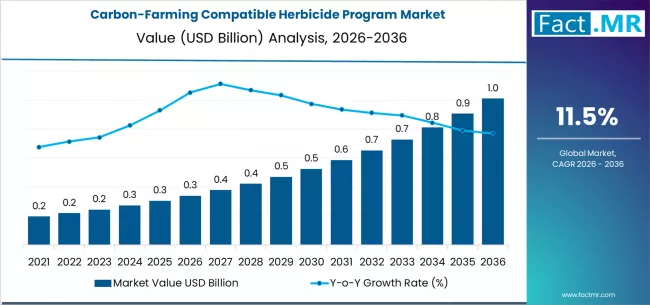
A core trend is the systematic redesign of weed management to support soil organic carbon accumulation and minimize soil disturbance. Programs are evolving to integrate longer-lasting residual herbicides that suppress weeds in no-till systems, paired with strategic cover crop termination protocols. Data-driven platforms are emerging to quantify and verify the carbon sequestration impact of specific herbicide strategies, linking agronomic practice to environmental credits.
Regulatory and voluntary carbon market frameworks are primary market catalysts. Government incentives for regenerative agriculture and corporate net-zero supply chain commitments create direct financial value for adopting compatible herbicide programs. Evolving pesticide regulations now increasingly consider a product's fit within low-disturbance, high-residue farming systems, favoring chemistries that support these soil health goals.
Carbon-Farming Compatible Herbicide Program Market
| Metric | Value |
|---|---|
| Market Value (2026) | USD 0.34 Billion |
| Market Forecast Value (2036) | USD 1.01 Billion |
| Forecast CAGR (2026-2036) | 11.5% |
Category
| Category | Segments |
|---|---|
| Program Type | Reduced-Tillage Herbicide Programs, Residue-Retention Compatible Programs, Cover-Crop Integrated Herbicide Programs, Low-Carbon Footprint Active Programs, Others |
| Herbicide Strategy | Pre-Emergent Residual Control, Sequential Low-Dose Post-Emergent, Mechanical + Chemical Hybrid Programs, Spot & Precision Herbicide Application, Others |
| Crop System | Row Crops (Corn, Soybean, Cotton), Cereals & Grains, Oilseeds & Pulses, Plantation & Specialty Crops, Others |
| Region | North America, Latin America, Western Europe, Eastern Europe, East Asia, South Asia & Pacific, MEA |
Segmental Analysis
By Program Type, Which Approach Forms the Foundation of Soil Carbon Sequestration?
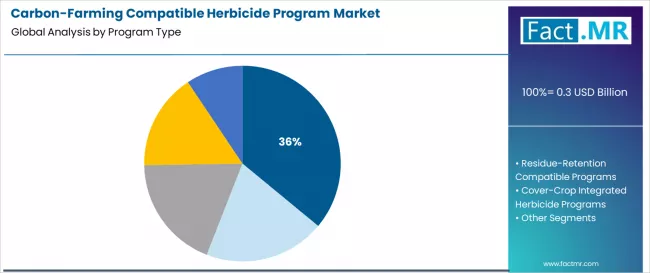
Reduced-tillage herbicide programs lead the segment with a 36% share. This dominance is fundamental; minimizing soil disturbance is the single most significant agronomic practice for protecting and building soil carbon. These programs rely on effective pre-emergent and burndown herbicide strategies to control weeds without tillage, making them the essential entry point for any carbon-farming system and the largest addressable market.
By Herbicide Strategy, Which Method Best Protects Soil Integrity?
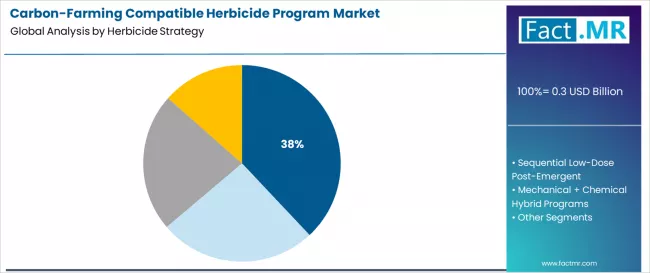
Pre-emergent residual control holds the largest strategic share at 38%. This approach provides extended weed suppression during the critical early growth stages without any need for post-planting soil disturbance. By preventing weed emergence, it preserves soil moisture and structure, reduces fuel consumption from cultivation passes, and maintains crop residue on the surface—all key contributors to a positive carbon balance.
By Crop System, Where is the Economic Scale for Carbon Programs Greatest?

Row crops command a 47% share. The vast acreage of corn, soybean, and cotton production represents the largest potential carbon sink in annual cropping. The economic value of these commodities justifies investment in sophisticated management programs. Furthermore, the well-established no-till and strip-till practices in these systems provide a ready platform for implementing and scaling compatible herbicide strategies.
What are the Drivers, Restraints, and Key Trends of the Carbon-Farming Compatible Herbicide Program Market?
Market growth is driven by the monetization of soil carbon through emerging voluntary and regulated markets, creating a new revenue stream for farmers who adopt qualifying practices. Major food companies demanding low-carbon grain for sustainable supply chains provide a powerful downstream pull. Increasing awareness of soil health benefits, including water infiltration and resilience, encourages adoption beyond direct carbon payments.
A primary restraint is the complexity and cost of measuring, reporting, and verifying carbon sequestration, which can be prohibitive for individual farmers. Reliance on specific herbicide chemistries raises concerns about resistance development in the long term. The initial yield risk perceived during transition from conventional tillage to a herbicide-dependent system can deter adoption without adequate technical and financial support.
Key trends include the bundling of herbicide recommendations with carbon credit verification software. Development of herbicide programs specifically designed for terminating cover crops without tillage is accelerating. Precision weed detection and spot-spray technologies are being integrated into programs to further reduce herbicide volume and fuel use, enhancing the overall carbon-negative footprint.
Analysis of the Carbon-Farming Compatible Herbicide Program Market by Key Countries
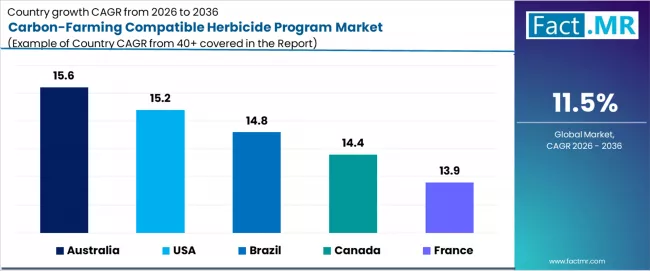
| Country | CAGR (2026-2036) |
|---|---|
| USA | 15.20% |
| Australia | 15.60% |
| Brazil | 14.80% |
| Canada | 14.40% |
| France | 13.90% |
How does the USA's Private Carbon Marketplace Fuel Program Adoption?
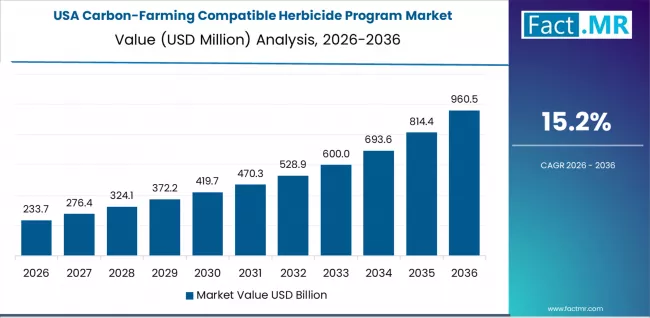
The USA exhibits a 15.20% CAGR, driven by a vibrant private-sector carbon marketplace connecting corporations with farmers. Major agribusinesses and tech startups offer programs that prescribe specific herbicide protocols as a condition for carbon contract eligibility. This direct financial incentive accelerates the shift towards no-till and cover crop systems in the Corn Belt and Great Plains, with compatible herbicide strategies as the enabling tool.
Why does Australia's Climate Reality Drive Leadership in Residue-Based Systems?
Australia leads with a 15.60% CAGR, underpinned by its need for moisture conservation and soil protection in arid climates. Carbon farming aligns perfectly with these survival goals. Australian grain growers are world leaders in residue-retention systems. Herbicide programs that control weeds without disturbing protective stubble are not just a carbon strategy but a core yield-protection practice, ensuring high adoption rates.
What Role does Brazil's Large-Scale No-Till Adoption Play?
Brazil's 14.80% growth builds upon its decades-long embrace of no-till farming across millions of hectares of soybean and corn fields. The market is evolving from basic no-till to optimized carbon-farming systems. Brazilian farmers are now fine-tuning herbicide programs to improve cover crop integration and reduce the carbon footprint of active ingredients, seeking to verify and monetize the sequestration they have already been practicing.
How is Canada's Evolving Policy Landscape Influencing Program Development?
Canada's 14.40% growth is supported by developing federal and provincial policies aimed at agricultural climate solutions. The Canadian prairies, with vast cereal and oilseed acreage, are a prime region for soil carbon storage. Ag-retail giants and co-operatives are developing low-carbon input programs, where herbicide recommendations are bundled with fertilizer management to offer farmers a verifiable reduction in overall field-level emissions.
What Factors Underpin France's Regulated Approach to Sustainable Agriculture?
France's 13.90% growth is channeled through its stringent national and EU-level agricultural environmental policies. The push for agroecology and reduced pesticide use creates a framework where herbicide programs must justify their place within a holistic system. French programs focus heavily on integrating mechanical weeding with precise chemical applications, a hybrid model designed to meet regulatory targets while improving soil carbon metrics.
Competitive Landscape of the Carbon-Farming Compatible Herbicide Program Market
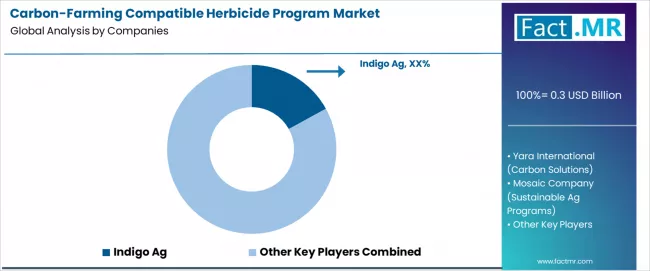
The landscape is uniquely shaped by a convergence of agri-tech platforms, fertilizer majors, and traditional input suppliers. Technology-first companies like Indigo Ag and Carbon Robotics compete by offering a full stack solution: proprietary analytics to model carbon impact, verified program protocols, and in the latter's case, robotic weeding hardware. Their currency is data and verified carbon credits.
Established nutrient companies like Yara International, Mosaic, and Nutrien compete by leveraging their existing agronomic networks and input supply chains. They are developing "low-carbon" or "sustainable" input programs that include compatible herbicide recommendations as part of a bundled offering. Their advantage lies in farmer trust, field agronomists, and the ability to provide a one-stop-shop for inputs linked to carbon market access.
Key Players in the Carbon-Farming Compatible Herbicide Program Market
- Indigo AG
- Yara International (Carbon Solutions)
- Mosaic Company (Sustainable Ag Programs)
- Nutrien Ltd. (Low-Carbon Ag Solutions)
- Carbon Robotics (Ag-Tech Weed Control)
Scope of Report
| Items | Values |
|---|---|
| Quantitative Units | USD Billion |
| Program Type | Reduced-Tillage Herbicide Programs, Residue-Retention Compatible Programs, Cover-Crop Integrated Herbicide Programs, Low-Carbon Footprint Active Programs, Others |
| Herbicide Strategy | Pre-Emergent Residual Control, Sequential Low-Dose Post-Emergent, Mechanical + Chemical Hybrid Programs, Spot & Precision Herbicide Application, Others |
| Crop System | Row Crops (Corn, Soybean, Cotton), Cereals & Grains, Oilseeds & Pulses, Plantation & Specialty Crops, Others |
| Key Countries | USA, Australia, Brazil, Canada, France |
| Key Companies | Indigo Ag, Yara International (Carbon Solutions), Mosaic Company (Sustainable Ag Programs), Nutrien Ltd. (Low-Carbon Ag Solutions), Carbon Robotics (Ag-Tech Weed Control) |
| Additional Analysis | Analysis of carbon quantification methodologies for herbicide programs, lifecycle assessment of herbicide active ingredients, integration with nitrogen management plans, and verification technology stack for carbon markets. |
Carbon-Farming Compatible Herbicide Program Market by Segments
-
Program Type :
- Reduced-Tillage Herbicide Programs
- Residue-Retention Compatible Programs
- Cover-Crop Integrated Herbicide Programs
- Low-Carbon Footprint Active Programs
- Others
-
Herbicide Strategy :
- Pre-Emergent Residual Control
- Sequential Low-Dose Post-Emergent
- Mechanical + Chemical Hybrid Programs
- Spot & Precision Herbicide Application
- Others
-
Crop System :
- Row Crops (Corn, Soybean, Cotton)
- Cereals & Grains
- Oilseeds & Pulses
- Plantation & Specialty Crops
- Others
-
Region :
-
North America
- USA
- Canada
-
Latin America
- Brazil
- Mexico
- Argentina
- Rest of Latin America
-
Western Europe
- Germany
- UK
- France
- Spain
- Italy
- BENELUX
- Rest of Western Europe
-
Eastern Europe
- Czech Republic
- Poland
- Russia
- Rest of Eastern Europe
-
East Asia
- China
- Japan
- South Korea
- Rest of East Asia
-
South Asia & Pacific
- India
- Indonesia
- Australia
- Rest of South Asia & Pacific
-
MEA
- GCC Countries
- Turkiye
- Saudi Arabia
- Rest of MEA
-
Table of Content
- Executive Summary
- Global Market Outlook
- Demand to side Trends
- Supply to side Trends
- Technology Roadmap Analysis
- Analysis and Recommendations
- Market Overview
- Market Coverage / Taxonomy
- Market Definition / Scope / Limitations
- Market Background
- Market Dynamics
- Drivers
- Restraints
- Opportunity
- Trends
- Scenario Forecast
- Demand in Optimistic Scenario
- Demand in Likely Scenario
- Demand in Conservative Scenario
- Opportunity Map Analysis
- Product Life Cycle Analysis
- Supply Chain Analysis
- Investment Feasibility Matrix
- Value Chain Analysis
- PESTLE and Porter’s Analysis
- Regulatory Landscape
- Regional Parent Market Outlook
- Production and Consumption Statistics
- Import and Export Statistics
- Market Dynamics
- Global Market Analysis 2021 to 2025 and Forecast, 2026 to 2036
- Historical Market Size Value (USD Million) Analysis, 2021 to 2025
- Current and Future Market Size Value (USD Million) Projections, 2026 to 2036
- Y to o to Y Growth Trend Analysis
- Absolute $ Opportunity Analysis
- Global Market Pricing Analysis 2021 to 2025 and Forecast 2026 to 2036
- Global Market Analysis 2021 to 2025 and Forecast 2026 to 2036, By Program Type
- Introduction / Key Findings
- Historical Market Size Value (USD Million) Analysis By Program Type, 2021 to 2025
- Current and Future Market Size Value (USD Million) Analysis and Forecast By Program Type, 2026 to 2036
- Reduced-Tillage Herbicide Programs
- Residue-Retention Compatible Programs
- Cover-Crop Integrated Herbicide Programs
- Low-Carbon Footprint Active Programs
- Others
- Reduced-Tillage Herbicide Programs
- Y to o to Y Growth Trend Analysis By Program Type, 2021 to 2025
- Absolute $ Opportunity Analysis By Program Type, 2026 to 2036
- Global Market Analysis 2021 to 2025 and Forecast 2026 to 2036, By Herbicide Strategy
- Introduction / Key Findings
- Historical Market Size Value (USD Million) Analysis By Herbicide Strategy, 2021 to 2025
- Current and Future Market Size Value (USD Million) Analysis and Forecast By Herbicide Strategy, 2026 to 2036
- Pre-Emergent Residual Control
- Sequential Low-Dose Post-Emergent
- Mechanical + Chemical Hybrid Programs
- Spot & Precision Herbicide Application
- Pre-Emergent Residual Control
- Y to o to Y Growth Trend Analysis By Herbicide Strategy, 2021 to 2025
- Absolute $ Opportunity Analysis By Herbicide Strategy, 2026 to 2036
- Global Market Analysis 2021 to 2025 and Forecast 2026 to 2036, By Crop System
- Introduction / Key Findings
- Historical Market Size Value (USD Million) Analysis By Crop System, 2021 to 2025
- Current and Future Market Size Value (USD Million) Analysis and Forecast By Crop System, 2026 to 2036
- Row Crops (Corn, Soybean, Cotton)
- Cereals & Grains
- Oilseeds & Pulses
- Plantation & Specialty Crops
- Others
- Row Crops (Corn, Soybean, Cotton)
- Y to o to Y Growth Trend Analysis By Crop System, 2021 to 2025
- Absolute $ Opportunity Analysis By Crop System, 2026 to 2036
- Global Market Analysis 2021 to 2025 and Forecast 2026 to 2036, By Region
- Introduction
- Historical Market Size Value (USD Million) Analysis By Region, 2021 to 2025
- Current Market Size Value (USD Million) Analysis and Forecast By Region, 2026 to 2036
- North America
- Latin America
- Western Europe
- Eastern Europe
- East Asia
- South Asia and Pacific
- Middle East & Africa
- Market Attractiveness Analysis By Region
- North America Market Analysis 2021 to 2025 and Forecast 2026 to 2036, By Country
- Historical Market Size Value (USD Million) Trend Analysis By Market Taxonomy, 2021 to 2025
- Market Size Value (USD Million) Forecast By Market Taxonomy, 2026 to 2036
- By Country
- USA
- Canada
- Mexico
- By Program Type
- By Herbicide Strategy
- By Crop System
- By Country
- Market Attractiveness Analysis
- By Country
- By Program Type
- By Herbicide Strategy
- By Crop System
- Key Takeaways
- Latin America Market Analysis 2021 to 2025 and Forecast 2026 to 2036, By Country
- Historical Market Size Value (USD Million) Trend Analysis By Market Taxonomy, 2021 to 2025
- Market Size Value (USD Million) Forecast By Market Taxonomy, 2026 to 2036
- By Country
- Brazil
- Chile
- Rest of Latin America
- By Program Type
- By Herbicide Strategy
- By Crop System
- By Country
- Market Attractiveness Analysis
- By Country
- By Program Type
- By Herbicide Strategy
- By Crop System
- Key Takeaways
- Western Europe Market Analysis 2021 to 2025 and Forecast 2026 to 2036, By Country
- Historical Market Size Value (USD Million) Trend Analysis By Market Taxonomy, 2021 to 2025
- Market Size Value (USD Million) Forecast By Market Taxonomy, 2026 to 2036
- By Country
- Germany
- UK
- Italy
- Spain
- France
- Nordic
- BENELUX
- Rest of Western Europe
- By Program Type
- By Herbicide Strategy
- By Crop System
- By Country
- Market Attractiveness Analysis
- By Country
- By Program Type
- By Herbicide Strategy
- By Crop System
- Key Takeaways
- Eastern Europe Market Analysis 2021 to 2025 and Forecast 2026 to 2036, By Country
- Historical Market Size Value (USD Million) Trend Analysis By Market Taxonomy, 2021 to 2025
- Market Size Value (USD Million) Forecast By Market Taxonomy, 2026 to 2036
- By Country
- Russia
- Poland
- Hungary
- Balkan & Baltic
- Rest of Eastern Europe
- By Program Type
- By Herbicide Strategy
- By Crop System
- By Country
- Market Attractiveness Analysis
- By Country
- By Program Type
- By Herbicide Strategy
- By Crop System
- Key Takeaways
- East Asia Market Analysis 2021 to 2025 and Forecast 2026 to 2036, By Country
- Historical Market Size Value (USD Million) Trend Analysis By Market Taxonomy, 2021 to 2025
- Market Size Value (USD Million) Forecast By Market Taxonomy, 2026 to 2036
- By Country
- China
- Japan
- South Korea
- By Program Type
- By Herbicide Strategy
- By Crop System
- By Country
- Market Attractiveness Analysis
- By Country
- By Program Type
- By Herbicide Strategy
- By Crop System
- Key Takeaways
- South Asia and Pacific Market Analysis 2021 to 2025 and Forecast 2026 to 2036, By Country
- Historical Market Size Value (USD Million) Trend Analysis By Market Taxonomy, 2021 to 2025
- Market Size Value (USD Million) Forecast By Market Taxonomy, 2026 to 2036
- By Country
- India
- ASEAN
- Australia & New Zealand
- Rest of South Asia and Pacific
- By Program Type
- By Herbicide Strategy
- By Crop System
- By Country
- Market Attractiveness Analysis
- By Country
- By Program Type
- By Herbicide Strategy
- By Crop System
- Key Takeaways
- Middle East & Africa Market Analysis 2021 to 2025 and Forecast 2026 to 2036, By Country
- Historical Market Size Value (USD Million) Trend Analysis By Market Taxonomy, 2021 to 2025
- Market Size Value (USD Million) Forecast By Market Taxonomy, 2026 to 2036
- By Country
- Kingdom of Saudi Arabia
- Other GCC Countries
- Turkiye
- South Africa
- Other African Union
- Rest of Middle East & Africa
- By Program Type
- By Herbicide Strategy
- By Crop System
- By Country
- Market Attractiveness Analysis
- By Country
- By Program Type
- By Herbicide Strategy
- By Crop System
- Key Takeaways
- Key Countries Market Analysis
- USA
- Pricing Analysis
- Market Share Analysis, 2025
- By Program Type
- By Herbicide Strategy
- By Crop System
- Canada
- Pricing Analysis
- Market Share Analysis, 2025
- By Program Type
- By Herbicide Strategy
- By Crop System
- Mexico
- Pricing Analysis
- Market Share Analysis, 2025
- By Program Type
- By Herbicide Strategy
- By Crop System
- Brazil
- Pricing Analysis
- Market Share Analysis, 2025
- By Program Type
- By Herbicide Strategy
- By Crop System
- Chile
- Pricing Analysis
- Market Share Analysis, 2025
- By Program Type
- By Herbicide Strategy
- By Crop System
- Germany
- Pricing Analysis
- Market Share Analysis, 2025
- By Program Type
- By Herbicide Strategy
- By Crop System
- UK
- Pricing Analysis
- Market Share Analysis, 2025
- By Program Type
- By Herbicide Strategy
- By Crop System
- Italy
- Pricing Analysis
- Market Share Analysis, 2025
- By Program Type
- By Herbicide Strategy
- By Crop System
- Spain
- Pricing Analysis
- Market Share Analysis, 2025
- By Program Type
- By Herbicide Strategy
- By Crop System
- France
- Pricing Analysis
- Market Share Analysis, 2025
- By Program Type
- By Herbicide Strategy
- By Crop System
- India
- Pricing Analysis
- Market Share Analysis, 2025
- By Program Type
- By Herbicide Strategy
- By Crop System
- ASEAN
- Pricing Analysis
- Market Share Analysis, 2025
- By Program Type
- By Herbicide Strategy
- By Crop System
- Australia & New Zealand
- Pricing Analysis
- Market Share Analysis, 2025
- By Program Type
- By Herbicide Strategy
- By Crop System
- China
- Pricing Analysis
- Market Share Analysis, 2025
- By Program Type
- By Herbicide Strategy
- By Crop System
- Japan
- Pricing Analysis
- Market Share Analysis, 2025
- By Program Type
- By Herbicide Strategy
- By Crop System
- South Korea
- Pricing Analysis
- Market Share Analysis, 2025
- By Program Type
- By Herbicide Strategy
- By Crop System
- Russia
- Pricing Analysis
- Market Share Analysis, 2025
- By Program Type
- By Herbicide Strategy
- By Crop System
- Poland
- Pricing Analysis
- Market Share Analysis, 2025
- By Program Type
- By Herbicide Strategy
- By Crop System
- Hungary
- Pricing Analysis
- Market Share Analysis, 2025
- By Program Type
- By Herbicide Strategy
- By Crop System
- Kingdom of Saudi Arabia
- Pricing Analysis
- Market Share Analysis, 2025
- By Program Type
- By Herbicide Strategy
- By Crop System
- Turkiye
- Pricing Analysis
- Market Share Analysis, 2025
- By Program Type
- By Herbicide Strategy
- By Crop System
- South Africa
- Pricing Analysis
- Market Share Analysis, 2025
- By Program Type
- By Herbicide Strategy
- By Crop System
- USA
- Market Structure Analysis
- Competition Dashboard
- Competition Benchmarking
- Market Share Analysis of Top Players
- By Regional
- By Program Type
- By Herbicide Strategy
- By Crop System
- Competition Analysis
- Competition Deep Dive
- Indigo Ag
- Overview
- Product Portfolio
- Profitability by Market Segments (Product/Age /Sales Channel/Region)
- Sales Footprint
- Strategy Overview
- Marketing Strategy
- Product Strategy
- Channel Strategy
- Yara International (Carbon Solutions)
- Mosaic Company (Sustainable Ag Programs)
- Nutrien Ltd. (Low-Carbon Ag Solutions)
- Carbon Robotics (Ag-Tech Weed Control)
- Indigo Ag
- Competition Deep Dive
- Assumptions & Acronyms Used
- Research Methodology
List Of Table
- Table 1: Global Market Value (USD Million) Forecast by Region, 2021 to 2036
- Table 2: Global Market Value (USD Million) Forecast by Program Type , 2021 to 2036
- Table 3: Global Market Value (USD Million) Forecast by Herbicide Strategy, 2021 to 2036
- Table 4: Global Market Value (USD Million) Forecast by Crop System, 2021 to 2036
- Table 5: North America Market Value (USD Million) Forecast by Country, 2021 to 2036
- Table 6: North America Market Value (USD Million) Forecast by Program Type , 2021 to 2036
- Table 7: North America Market Value (USD Million) Forecast by Herbicide Strategy, 2021 to 2036
- Table 8: North America Market Value (USD Million) Forecast by Crop System, 2021 to 2036
- Table 9: Latin America Market Value (USD Million) Forecast by Country, 2021 to 2036
- Table 10: Latin America Market Value (USD Million) Forecast by Program Type , 2021 to 2036
- Table 11: Latin America Market Value (USD Million) Forecast by Herbicide Strategy, 2021 to 2036
- Table 12: Latin America Market Value (USD Million) Forecast by Crop System, 2021 to 2036
- Table 13: Western Europe Market Value (USD Million) Forecast by Country, 2021 to 2036
- Table 14: Western Europe Market Value (USD Million) Forecast by Program Type , 2021 to 2036
- Table 15: Western Europe Market Value (USD Million) Forecast by Herbicide Strategy, 2021 to 2036
- Table 16: Western Europe Market Value (USD Million) Forecast by Crop System, 2021 to 2036
- Table 17: Eastern Europe Market Value (USD Million) Forecast by Country, 2021 to 2036
- Table 18: Eastern Europe Market Value (USD Million) Forecast by Program Type , 2021 to 2036
- Table 19: Eastern Europe Market Value (USD Million) Forecast by Herbicide Strategy, 2021 to 2036
- Table 20: Eastern Europe Market Value (USD Million) Forecast by Crop System, 2021 to 2036
- Table 21: East Asia Market Value (USD Million) Forecast by Country, 2021 to 2036
- Table 22: East Asia Market Value (USD Million) Forecast by Program Type , 2021 to 2036
- Table 23: East Asia Market Value (USD Million) Forecast by Herbicide Strategy, 2021 to 2036
- Table 24: East Asia Market Value (USD Million) Forecast by Crop System, 2021 to 2036
- Table 25: South Asia and Pacific Market Value (USD Million) Forecast by Country, 2021 to 2036
- Table 26: South Asia and Pacific Market Value (USD Million) Forecast by Program Type , 2021 to 2036
- Table 27: South Asia and Pacific Market Value (USD Million) Forecast by Herbicide Strategy, 2021 to 2036
- Table 28: South Asia and Pacific Market Value (USD Million) Forecast by Crop System, 2021 to 2036
- Table 29: Middle East & Africa Market Value (USD Million) Forecast by Country, 2021 to 2036
- Table 30: Middle East & Africa Market Value (USD Million) Forecast by Program Type , 2021 to 2036
- Table 31: Middle East & Africa Market Value (USD Million) Forecast by Herbicide Strategy, 2021 to 2036
- Table 32: Middle East & Africa Market Value (USD Million) Forecast by Crop System, 2021 to 2036
List Of Figures
- Figure 1: Global Market Pricing Analysis
- Figure 2: Global Market Value (USD Million) Forecast 2021 to 2036
- Figure 3: Global Market Value Share and BPS Analysis by Program Type, 2026 and 2036
- Figure 4: Global Market Y to o to Y Growth Comparison by Program Type, 2026 to 2036
- Figure 5: Global Market Attractiveness Analysis by Program Type
- Figure 6: Global Market Value Share and BPS Analysis by Herbicide Strategy, 2026 and 2036
- Figure 7: Global Market Y to o to Y Growth Comparison by Herbicide Strategy, 2026 to 2036
- Figure 8: Global Market Attractiveness Analysis by Herbicide Strategy
- Figure 9: Global Market Value Share and BPS Analysis by Crop System, 2026 and 2036
- Figure 10: Global Market Y to o to Y Growth Comparison by Crop System, 2026 to 2036
- Figure 11: Global Market Attractiveness Analysis by Crop System
- Figure 12: Global Market Value (USD Million) Share and BPS Analysis by Region, 2026 and 2036
- Figure 13: Global Market Y to o to Y Growth Comparison by Region, 2026 to 2036
- Figure 14: Global Market Attractiveness Analysis by Region
- Figure 15: North America Market Incremental Dollar Opportunity, 2026 to 2036
- Figure 16: Latin America Market Incremental Dollar Opportunity, 2026 to 2036
- Figure 17: Western Europe Market Incremental Dollar Opportunity, 2026 to 2036
- Figure 18: Eastern Europe Market Incremental Dollar Opportunity, 2026 to 2036
- Figure 19: East Asia Market Incremental Dollar Opportunity, 2026 to 2036
- Figure 20: South Asia and Pacific Market Incremental Dollar Opportunity, 2026 to 2036
- Figure 21: Middle East & Africa Market Incremental Dollar Opportunity, 2026 to 2036
- Figure 22: North America Market Value Share and BPS Analysis by Country, 2026 and 2036
- Figure 23: North America Market Value Share and BPS Analysis by Program Type, 2026 and 2036
- Figure 24: North America Market Y to o to Y Growth Comparison by Program Type, 2026 to 2036
- Figure 25: North America Market Attractiveness Analysis by Program Type
- Figure 26: North America Market Value Share and BPS Analysis by Herbicide Strategy, 2026 and 2036
- Figure 27: North America Market Y to o to Y Growth Comparison by Herbicide Strategy, 2026 to 2036
- Figure 28: North America Market Attractiveness Analysis by Herbicide Strategy
- Figure 29: North America Market Value Share and BPS Analysis by Crop System, 2026 and 2036
- Figure 30: North America Market Y to o to Y Growth Comparison by Crop System, 2026 to 2036
- Figure 31: North America Market Attractiveness Analysis by Crop System
- Figure 32: Latin America Market Value Share and BPS Analysis by Country, 2026 and 2036
- Figure 33: Latin America Market Value Share and BPS Analysis by Program Type, 2026 and 2036
- Figure 34: Latin America Market Y to o to Y Growth Comparison by Program Type, 2026 to 2036
- Figure 35: Latin America Market Attractiveness Analysis by Program Type
- Figure 36: Latin America Market Value Share and BPS Analysis by Herbicide Strategy, 2026 and 2036
- Figure 37: Latin America Market Y to o to Y Growth Comparison by Herbicide Strategy, 2026 to 2036
- Figure 38: Latin America Market Attractiveness Analysis by Herbicide Strategy
- Figure 39: Latin America Market Value Share and BPS Analysis by Crop System, 2026 and 2036
- Figure 40: Latin America Market Y to o to Y Growth Comparison by Crop System, 2026 to 2036
- Figure 41: Latin America Market Attractiveness Analysis by Crop System
- Figure 42: Western Europe Market Value Share and BPS Analysis by Country, 2026 and 2036
- Figure 43: Western Europe Market Value Share and BPS Analysis by Program Type, 2026 and 2036
- Figure 44: Western Europe Market Y to o to Y Growth Comparison by Program Type, 2026 to 2036
- Figure 45: Western Europe Market Attractiveness Analysis by Program Type
- Figure 46: Western Europe Market Value Share and BPS Analysis by Herbicide Strategy, 2026 and 2036
- Figure 47: Western Europe Market Y to o to Y Growth Comparison by Herbicide Strategy, 2026 to 2036
- Figure 48: Western Europe Market Attractiveness Analysis by Herbicide Strategy
- Figure 49: Western Europe Market Value Share and BPS Analysis by Crop System, 2026 and 2036
- Figure 50: Western Europe Market Y to o to Y Growth Comparison by Crop System, 2026 to 2036
- Figure 51: Western Europe Market Attractiveness Analysis by Crop System
- Figure 52: Eastern Europe Market Value Share and BPS Analysis by Country, 2026 and 2036
- Figure 53: Eastern Europe Market Value Share and BPS Analysis by Program Type, 2026 and 2036
- Figure 54: Eastern Europe Market Y to o to Y Growth Comparison by Program Type, 2026 to 2036
- Figure 55: Eastern Europe Market Attractiveness Analysis by Program Type
- Figure 56: Eastern Europe Market Value Share and BPS Analysis by Herbicide Strategy, 2026 and 2036
- Figure 57: Eastern Europe Market Y to o to Y Growth Comparison by Herbicide Strategy, 2026 to 2036
- Figure 58: Eastern Europe Market Attractiveness Analysis by Herbicide Strategy
- Figure 59: Eastern Europe Market Value Share and BPS Analysis by Crop System, 2026 and 2036
- Figure 60: Eastern Europe Market Y to o to Y Growth Comparison by Crop System, 2026 to 2036
- Figure 61: Eastern Europe Market Attractiveness Analysis by Crop System
- Figure 62: East Asia Market Value Share and BPS Analysis by Country, 2026 and 2036
- Figure 63: East Asia Market Value Share and BPS Analysis by Program Type, 2026 and 2036
- Figure 64: East Asia Market Y to o to Y Growth Comparison by Program Type, 2026 to 2036
- Figure 65: East Asia Market Attractiveness Analysis by Program Type
- Figure 66: East Asia Market Value Share and BPS Analysis by Herbicide Strategy, 2026 and 2036
- Figure 67: East Asia Market Y to o to Y Growth Comparison by Herbicide Strategy, 2026 to 2036
- Figure 68: East Asia Market Attractiveness Analysis by Herbicide Strategy
- Figure 69: East Asia Market Value Share and BPS Analysis by Crop System, 2026 and 2036
- Figure 70: East Asia Market Y to o to Y Growth Comparison by Crop System, 2026 to 2036
- Figure 71: East Asia Market Attractiveness Analysis by Crop System
- Figure 72: South Asia and Pacific Market Value Share and BPS Analysis by Country, 2026 and 2036
- Figure 73: South Asia and Pacific Market Value Share and BPS Analysis by Program Type, 2026 and 2036
- Figure 74: South Asia and Pacific Market Y to o to Y Growth Comparison by Program Type, 2026 to 2036
- Figure 75: South Asia and Pacific Market Attractiveness Analysis by Program Type
- Figure 76: South Asia and Pacific Market Value Share and BPS Analysis by Herbicide Strategy, 2026 and 2036
- Figure 77: South Asia and Pacific Market Y to o to Y Growth Comparison by Herbicide Strategy, 2026 to 2036
- Figure 78: South Asia and Pacific Market Attractiveness Analysis by Herbicide Strategy
- Figure 79: South Asia and Pacific Market Value Share and BPS Analysis by Crop System, 2026 and 2036
- Figure 80: South Asia and Pacific Market Y to o to Y Growth Comparison by Crop System, 2026 to 2036
- Figure 81: South Asia and Pacific Market Attractiveness Analysis by Crop System
- Figure 82: Middle East & Africa Market Value Share and BPS Analysis by Country, 2026 and 2036
- Figure 83: Middle East & Africa Market Value Share and BPS Analysis by Program Type, 2026 and 2036
- Figure 84: Middle East & Africa Market Y to o to Y Growth Comparison by Program Type, 2026 to 2036
- Figure 85: Middle East & Africa Market Attractiveness Analysis by Program Type
- Figure 86: Middle East & Africa Market Value Share and BPS Analysis by Herbicide Strategy, 2026 and 2036
- Figure 87: Middle East & Africa Market Y to o to Y Growth Comparison by Herbicide Strategy, 2026 to 2036
- Figure 88: Middle East & Africa Market Attractiveness Analysis by Herbicide Strategy
- Figure 89: Middle East & Africa Market Value Share and BPS Analysis by Crop System, 2026 and 2036
- Figure 90: Middle East & Africa Market Y to o to Y Growth Comparison by Crop System, 2026 to 2036
- Figure 91: Middle East & Africa Market Attractiveness Analysis by Crop System
- Figure 92: Global Market - Tier Structure Analysis
- Figure 93: Global Market - Company Share Analysis
- FAQs -
How big is the carbon-farming compatible herbicide program marke in 2026?
The global carbon-farming compatible herbicide program marke is estimated to be valued at USD 0.3 billion in 2026.
What will be the size of carbon-farming compatible herbicide program marke in 2036?
The market size for the carbon-farming compatible herbicide program marke is projected to reach USD 1.0 billion by 2036.
How much will be the carbon-farming compatible herbicide program marke growth between 2026 and 2036?
The carbon-farming compatible herbicide program marke is expected to grow at a 11.5% CAGR between 2026 and 2036.
What are the key product types in the carbon-farming compatible herbicide program marke?
The key product types in carbon-farming compatible herbicide program marke are reduced-tillage herbicide programs, residue-retention compatible programs, cover-crop integrated herbicide programs, low-carbon footprint active programs and others.
Which herbicide strategy segment to contribute significant share in the carbon-farming compatible herbicide program marke in 2026?
In terms of herbicide strategy, pre-emergent residual control segment to command 38.0% share in the carbon-farming compatible herbicide program marke in 2026.