- Forecast Value (2036): 161.8 Bn
- CAGR (2036): 8.1%
Video as A Sensor Market Forecast and Outlook 2026 to 2036
In 2025, the global video as a sensor market was valued at approximately USD 74.1 billion, moderately adjusted from baseline estimates. Based on Fact.MR analysis, demand for video as a sensor solution is estimated to reach around USD 80.2 billion in 2026 and expand to nearly USD 161.8 billion by 2036, reflecting a CAGR of 8.1% during the forecast period. Market progression reflects expansion of AI-enabled analytics across security, smart mobility, industrial automation, and healthcare monitoring. Growth is supported by edge-based processing architectures that reduce latency and bandwidth costs while enabling real-time decision support in distributed environments.
The market is projected to add roughly USD 87.7 billion in incremental value over the forecast window, reflecting strong compounding driven by software and analytics layers rather than hardware expansion alone. Early-period growth is supported by surveillance and public safety modernization. Mid-period expansion aligns with smart city traffic management, retail analytics, and industrial robotics adoption. In later years, value realization is increasingly shaped by cloud-edge hybrid deployments, AI model refinement, and integration with autonomous systems rather than camera density growth.
China leads growth at 10.9% CAGR, supported by smart city programs and industrial automation investment. India follows at 10.1%, driven by infrastructure digitization and urban surveillance expansion. Germany records 9.3%, reflecting Industry 4.0 integration. The United Kingdom grows at 7.7%, while the United States at 6.9% remains influenced by enterprise analytics deployment and public safety modernization initiatives.
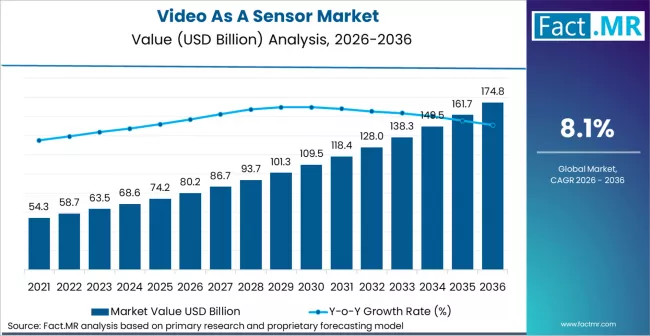
Video As A Sensor Market Market Value Analysis | Source: Fact.MR
Video as A Sensor Market
| Metric | Value |
|---|---|
| Market Value (2026) | USD 80.2 billion |
| Forecast Value (2036) | USD 161.8 billion |
| Forecast CAGR (2026-2036) | 8.1% |
Source: Fact.MR analysis. Updated Feb 28, 2026
Video As A Sensor Market Definition
The video as a sensor market covers systems that use video cameras combined with software analytics to detect, measure, and interpret physical events in real time. These systems convert visual data into actionable signals for monitoring traffic, security, industrial operations, and public infrastructure. Video feeds are processed using algorithms that identify motion, objects, or behavioral patterns without relying on traditional physical sensors. Deployment and data use are subject to surveillance, privacy, and cybersecurity regulations enforced by authorities such as the US Federal Trade Commission and cybersecurity guidance issued by the National Institute of Standards and Technology. [1]
Video As A Sensor Market Inclusions
The report provides global and regional market size estimates in volume and value with a forecast from 2026 to 2036. Segmentation includes deployment type such as edge based and cloud based processing, application across traffic monitoring, security surveillance, and industrial automation, and end use across public sector and private enterprises. Regional adoption patterns and pricing trends are included.
Video As A Sensor Market Exclusions
The scope excludes standalone CCTV cameras without analytics capability. Facial recognition databases, biometric identity platforms, and standalone artificial intelligence software not integrated with video input are not included. Consumer video streaming platforms and entertainment services are excluded. Consulting services, installation services, prototype research systems, and unrelated IT infrastructure are also outside the scope.
Video As A Sensor Market Research Methodology
- Primary Research: Interviews were conducted with analytics software providers, system integrators, municipal technology departments, and industrial automation managers.
- Desk Research: Desk research reviewed privacy and cybersecurity guidance issued by the US Federal Trade Commission and the National Institute of Standards and Technology, along with public procurement disclosures and company filings.
- Market Sizing and Forecasting: Estimates were developed using surveillance infrastructure deployment data, enterprise adoption rates, and analytics licensing models.
- Data Validation and Update Cycle: Data was cross checked against regulatory documentation, public contract records, trade statistics, and vendor disclosures before updates were finalized.
Summary of Video As A Sensor Market
- Market Definition
- The video as a sensor market comprises integrated camera, processing, and analytics systems that convert visual data into real-time actionable insights for monitoring, detection, and automated decision support across industrial, commercial, and public infrastructure environments.
- Demand Drivers
- Expansion of AI-enabled analytics in security, traffic management, and industrial automation is increasing demand for real-time video-based perception systems.
- Growth of edge computing architectures is enabling on-device processing, reducing latency and bandwidth costs for distributed monitoring networks.
- Smart city and enterprise digital transformation initiatives are driving integration of video feeds with IoT platforms and operational control systems.
- Key Segments Analyzed
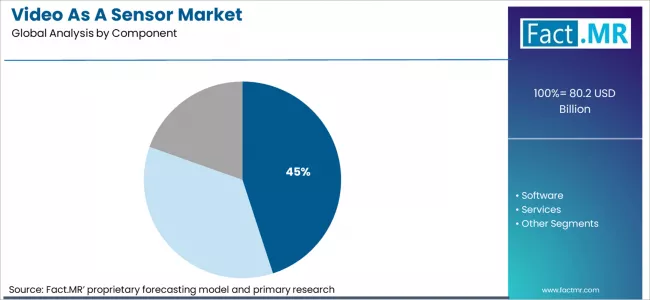
- Component: Hardware accounts for approximately 45% share, reflecting foundational investment in cameras, edge processors, and connectivity infrastructure.
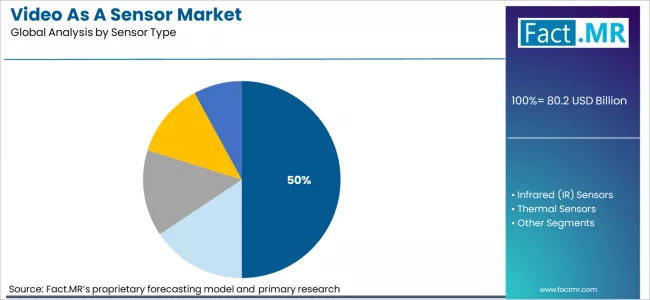
- Sensor type: RGB sensors lead adoption due to cost efficiency and compatibility across surveillance, retail analytics, and traffic monitoring applications.
- Geography: Asia Pacific is the fastest-growing region, led by China and India through smart city deployment and infrastructure digitization.
- Analyst Opinion at Fact.MR
- Shambhu Nath Jha, Principal Consultant at Fact.MR, opines, ‘CXOs will find this report useful for understanding how AI analytics layering, edge-cloud hybrid architectures, and regulatory data governance frameworks are redefining competitive positioning in the video as a sensor market.’
- Strategic Implications / Executive Takeaways
- Vendors should prioritize AI-integrated edge devices to enhance real-time analytics capability and reduce network dependency.
- Expansion strategies should focus on smart mobility, industrial automation, and regulated public safety programs in high-growth Asia Pacific markets.
- Strengthening cybersecurity and privacy compliance alignment will be critical for enterprise and municipal procurement success.
- Methodology
- Market estimates are derived from surveillance infrastructure deployment data, analytics licensing models, and enterprise adoption rates across application verticals.
- Regulatory and cybersecurity validation references.
Segmental Analysis
Video As A Sensor Market Analysis By Component
Video As A Sensor Market Analysis By Component | Source: Fact.MR
Based on Fact.MR analysis, consumption of hardware components is estimated to hold 45% share of the global video as a sensor market. Fact.MR analysts note hardware leads due to foundational role of cameras, edge processors, and connectivity equipment in data acquisition. As per Fact.MR, this component category addresses enterprise requirements for real-time visual data capture, on-device processing, and reliable transmission across surveillance, industrial monitoring, and smart infrastructure deployments worldwide today supporting scalable sensor network installations across regulated and commercial environments globally.
- Surveillance oversight: Deployment of video systems is influenced by national data privacy and surveillance regulations.[2]
- Infrastructure base: Fact.MR analysts note hardware investment precedes analytics software integration.
- Edge deployment: Processing units enable on-site analytics without centralized latency.
Video As A Sensor Market Analysis By Sensor Type
Video As A Sensor Market Analysis By Sensor Type | Source: Fact.MR
Based on Fact.MR analysis, consumption of RGB sensors holds a leading share within the global video as a sensor market due to widespread compatibility and cost efficiency. Fact.MR analysts note RGB sensors are preferred for general surveillance, traffic monitoring, and retail analytics applications. As per Fact.MR, this sensor type addresses requirements for high-resolution color imaging, integration with analytics platforms, and deployment across urban infrastructure, commercial buildings, and industrial facilities worldwide today under evolving digital infrastructure and cybersecurity standards globally.
- Cybersecurity framework: Government cybersecurity agencies provide guidance for secure deployment of connected sensor systems.[3]
- Market adoption: Fact.MR analysts note RGB cameras dominate installed surveillance bases.
- Compatibility range: RGB sensors integrate with most analytics and management platforms.
Video As A Sensor Market Drivers, Restraints, And Opportunities
Fact.MR analysis indicates that the video as a sensor market exists as a machine vision and perception segment within the broader sensor and automation technology landscape, where video capture devices function as core inputs for analytics, object detection, and monitoring systems. As per Fact.MR assessment, adoption of video-based sensing technologies is influenced by performance and data protection expectations embodied in regulatory and technical frameworks such as the U.S. National Institute of Standards and Technology (NIST) guidance on computer vision and cybersecurity for sensor networks, which provides best practice recommendations for secure integration and processing of visual-sensor data in enterprise and public systems.[4] Fact.MR analysts observe that the current market scale is supported by increasing use of video sensors across automotive advanced driver assistance systems (ADAS), industrial automation, smart retail analytics, building security systems, and robotics, where visual perception contributes to real-time decisions.
Fact.MR is of the opinion that current market dynamics reflect a transition from simple image capture to integrated sensor frameworks that combine video data with artificial intelligence, machine learning, and edge processing capabilities. Based on Fact.MR assessment, traditional surveillance cameras and basic machine vision systems remain prevalent due to cost familiarity and straightforward deployment, but growth in video as a sensor occurs where high-accuracy perception, predictive analytics, and contextual awareness are specified by end users. Advanced video-based sensing solutions typically carry higher per-unit pricing because of embedded processing, AI algorithm integration, and enhanced data security needs, meaning realised market value can grow even where unit shipments increase at a measured pace. Fact.MR analysis suggests that this interplay between evolving application depth and premium solution placement will shape near-term market progression.
- Regulated data and sensor security frameworks: Fact.MR analysts note that guidance such as the NIST cybersecurity guidelines influences how video sensor solutions are designed and deployed with secure data processing and risk management expectations in intelligent systems.
- Shift toward AI-driven perception: Based on Fact.MR assessment, increasing use of machine learning and edge AI with video capture supports demand for video as a sensor in applications such as ADAS, robotics, and smart facilities where context-aware analytics matter.
- Asia Pacific deployment growth: Fact.MR opines that expanding adoption of smart city solutions, industrial automation, and connected infrastructure in China, India, and Southeast Asia sustains regional uptake of video-based sensing technologies across commercial and public segments.
Regional Analysis
Based on regional assessment, the video as a sensor sector is analyzed across North America, Europe, East Asia, South Asia, and other advanced digital infrastructure markets, spanning more than 40 countries. Regional performance varies according to adoption of computer vision technologies, investment in smart city infrastructure, industrial automation deployment, and expansion of AI driven surveillance and monitoring systems.
Video As A Sensor Market CAGR Analysis by Country (2026-2036)
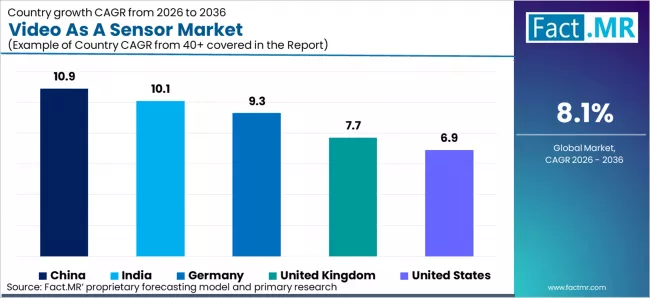
Video As A Sensor Market Cagr Analysis By Country | Source: Fact.MR
| Country | CAGR |
|---|---|
| China | 10.9% |
| India | 10.1% |
| Germany | 9.3% |
| United Kingdom | 7.7% |
| United States | 6.9% |
Source: Fact.MR analysis. Updated Feb 28, 2026
Source: Fact.MR analysis, based on proprietary forecasting models and primary research.
Outlook On Video As A Sensor Demand In Asia Pacific
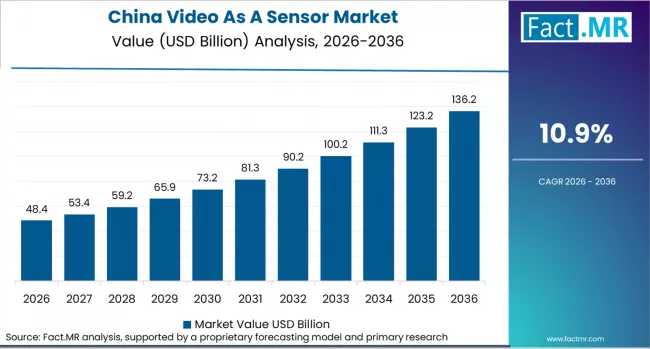
Video As A Sensor Market Country Value Analysis | Source: Fact.MR
Asia Pacific reflects strong demand for video as a sensor solutions driven by smart city deployment industrial automation and AI enabled surveillance. Adoption is shaped by integration of cameras with analytics platforms for traffic monitoring security and operational intelligence. China and India anchor regional momentum through urban infrastructure projects and enterprise digitization. Procurement emphasizes real time processing edge computing compatibility and scalable cloud integration. Market growth reflects expansion of intelligent monitoring systems across public infrastructure commercial facilities and manufacturing sites regionwide.
- China: Demand for video as a sensor solution in China is projected to rise at 10.9% CAGR through 2036. Growth reflects smart city projects and integration of AI driven video analytics across urban infrastructure, as per Fact.MR.
- India: Demand for video as a sensor solution in India is projected to rise at 10.1% CAGR through 2036. Adoption reflects expansion of surveillance networks and enterprise automation initiatives, according to Fact.MR.
Fact.MR’s analysis of the Video As A Sensor Market in Asia Pacific consists of country-wise assessment that includes China and India. Readers can find smart infrastructure and AI integration insights.
Analysis On Video As A Sensor Sales In Europe
Europe demonstrates structured demand for video as a sensor technologies shaped by data protection regulation industrial automation and public infrastructure monitoring. Germany and the United Kingdom contribute through factory automation transport systems and regulated surveillance deployment. Procurement emphasizes GDPR compliance edge analytics and cybersecurity safeguards. Adoption supports predictive maintenance crowd management and logistics optimization. Market growth reflects continued investment in AI enabled monitoring systems across manufacturing transportation and urban safety applications within regulated European environments.
- Germany: Demand for video as a sensor solutions in Germany is projected to rise at 9.3% CAGR through 2036. Usage reflects industrial automation and compliant surveillance deployment across manufacturing and transport sectors, as per Fact.MR.
- United Kingdom: Demand for video as a sensor solutions in the United Kingdom is projected to rise at 7.7% CAGR through 2036. Growth reflects public infrastructure monitoring and enterprise analytics integration, according to Fact.MR.
Fact.MR’s analysis of the Video as A Sensor Market in Europe consists of country-wise assessment that includes Germany and the United Kingdom. Readers can find regulatory alignment and industrial monitoring insights.
Demand for Video As A Sensor Solutions In North America
North America shows consistent demand for video as a sensor solutions supported by enterprise analytics adoption retail monitoring and transportation safety systems. Sales are driven by AI based image recognition integration with IoT platforms and cloud analytics services. The United States anchors regional volume through smart infrastructure initiatives and corporate security investments. Procurement emphasizes scalability data security and interoperability. Market growth reflects enterprise digital transformation and expanded use of video analytics across commercial and public sectors nationwide.
- United States: Demand for video as a sensor solution in the United States is projected to rise at 6.9% CAGR through 2036. Adoption reflects enterprise analytics deployment and integration of AI based surveillance platforms, as per Fact.MR.
Fact.MR’s analysis of the Video As A Sensor Market in North America consists of country-wise assessment that includes the United States. Readers can find enterprise adoption and smart infrastructure insights.
Competitive Landscape of Video As A Sensor Market
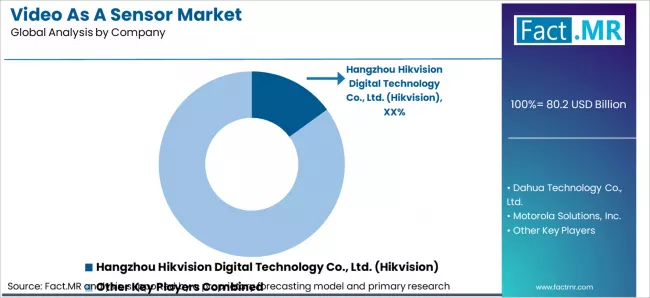
Video As A Sensor Market Analysis By Company | Source: Fact.MR
As per Fact.MR analysis, the 2026 video as a sensor market is defined by validated image processing accuracy, real-time analytics capability, and multi-platform integration, which determine competitive advantage. Hangzhou Hikvision Digital Technology Co., Ltd. (Hikvision) and Dahua Technology Co., Ltd. lead with high-resolution cameras and AI-enabled analytics, which strengthens adoption across security, industrial, and smart city applications. Motorola Solutions, Inc. and Honeywell International emphasize validated video management systems and multi-device compatibility, which improves situational awareness and operational efficiency. Bosch Security Systems GmbH and Axis Communications AB (Canon Group) provide tested networked camera solutions with verified reliability, which enhances adoption in enterprise and municipal deployments. Sony Corporation and Teledyne FLIR LLC focus on specialized sensors with validated low-light and thermal imaging capabilities, which expands industrial and defense applications. Panasonic Corporation and Hanwha Techwin Co., Ltd. deliver multi-region compliant video devices with documented durability, which strengthens adoption in global projects. Avigilon (Motorola Solutions), Genetec Inc., Milestone Systems A/S, Vicon Industries, Pelco, Cisco Systems, IBM, Microsoft, Amazon Web Services, and Google offer integrated software platforms with verified AI and cloud analytics, which improve scalability, remote monitoring, and decision-making efficiency. Across the market, validated sensor accuracy, system-level integration, and regulatory compliance form enduring competitive moats, reducing reliance on price or isolated device features.
Recent Industry Development
- Launch of Edge-AI "Invisible" Industrial Sensors (Feb 2026): MOBOTIX launched the S ONE Dual, a high-performance modular camera designed specifically to act as a sensor in environments where traditional cameras won't fit. It performs all AI analytics-such as detecting motion, direction of travel, and "suspicious loitering"-directly on the device without needing a cloud connection. This is a major step for Industry 5.0, where video sensors are embedded directly into industrial machinery and vehicles. [5]
- Motorola Solutions’ $4.4 Billion Acquisition of Silvus Technologies (May 2025): In one of the largest infrastructure deals recently, Motorola Solutions acquired Silvus Technologies. While Silvus is known for mesh networking, the acquisition was strategically aimed at strengthening the "Video as a Sensor" pipeline for first responders. By combining Silvus’s high-bandwidth transmission with Motorola's AI video analytics, they are creating a real-time "sensing net" for public safety that works in areas with zero cellular coverage. [6]
Key Players in Video As A Sensor Market
- Hangzhou Hikvision Digital Technology Co., Ltd. (Hikvision)
- Dahua Technology Co., Ltd.
- Motorola Solutions, Inc.
- Honeywell International Inc.
- Bosch Security Systems GmbH
- Axis Communications AB (Canon Group)
- Sony Corporation
- Teledyne FLIR LLC (Teledyne Technologies)
- Panasonic Corporation
- Hanwha Techwin Co., Ltd.
- Avigilon Corporation (Motorola Solutions)
- Genetec Inc.
- Milestone Systems A/S
- Vicon Industries, Inc.
- Pelco, Inc.
- Cisco Systems, Inc.
- IBM Corporation
- Microsoft Corporation
- Amazon Web Services, Inc.
- Google LLC
References
- [1] U.S. Federal Trade Commission. (2024). Privacy and security guidance for businesses. Federal Trade Commission.
National Institute of Standards and Technology. (2024). Cybersecurity Framework (CSF) resources and implementation guidance. U.S. Department of Commerce. - [2] U.S. Federal Trade Commission. (2024). Business guidance on privacy and data security practices. Federal Trade Commission.
- [3] National Institute of Standards and Technology. (2024). Cybersecurity Framework: Guidance for managing cybersecurity risk. U.S. Department of Commerce.
- [4] National Institute of Standards and Technology. (2024). Cybersecurity and privacy guidance for connected systems and data processing environments. U.S. Department of Commerce.
- [5] MOBOTIX AG. (2026). MOBOTIX launches new camera model: MOBOTIX S ONE Dual [Press release / product announcement]. MOBOTIX AG.
- [6] Motorola Solutions, Inc. (2025). Motorola Solutions to acquire Silvus Technologies [Press release]. Motorola Solutions, Inc.
This Report Addresses
- Market intelligence to enable structured strategic decision-making across security, smart mobility, industrial automation, and other video-analytics-led adoption arenas
- Global market size estimation and 10-year revenue forecasts from 2026 to 2036 (USD 80.2 billion in 2026 to USD 161.8 billion by 2036; CAGR 8.1%), with value decomposition across hardware, software, and services layers
- Growth opportunity mapping across components (cameras, edge/servers, connectivity, video analytics/VMS/AI platforms, and managed services), showing where analytics “attach rates” drive revenue expansion more than camera unit growth
- Segment and regional forecasts across sensor types (RGB, infrared, thermal, depth, multispectral) and deployments (on-premises, cloud, edge), highlighting edge-cloud hybrid architectures and latency-sensitive use cases
- Application-led revenue outlook covering surveillance, traffic monitoring, industrial automation/robotics, retail analytics, healthcare monitoring, environmental monitoring, and agriculture/livestock monitoring, with prioritization of high-ROI workflows
- Competitive strategy assessment benchmarking vendors and integrators on real-time inference performance, interoperability with VMS/IoT stacks, lifecycle support, and analytics model refresh capabilities
- Technology roadmap tracking including edge AI acceleration, cloud-edge orchestration, multi-sensor fusion, and computer-vision model governance (training, validation, drift monitoring) to sustain accuracy in production
- Regulatory, privacy, and cybersecurity impact analysis to support procurement readiness, aligned with common governance expectations and guidance such as FTC privacy/security principles and NIST cybersecurity framework references mentioned in the study
Segmentation
Scope of the Report
| Metric | Value |
|---|---|
| Quantitative Units | USD 80.2 billion (2026) to USD 161.8 billion (2036), CAGR 8.1% |
| Market Definition | The video as a sensor market covers systems that convert video feeds into actionable data for real-time monitoring, detection, and decision-making across industrial, commercial, and public infrastructure. These solutions combine cameras, processing units, connectivity, and analytics software to perform motion detection, object recognition, and behavioral analysis without reliance on traditional physical sensors. Deployment adheres to privacy, cybersecurity, and data protection regulations issued by authorities such as the US Federal Trade Commission and the National Institute of Standards and Technology. |
| Component Segmentation | Hardware (Cameras: RGB, Thermal, Multispectral; Processing Units: Edge Devices, Servers; Connectivity Equipment), Software (Video Analytics Software, Video Management Software, AI/ML Platforms), Services (Professional Services, Managed Services, Maintenance & Support) |
| Sensor Type Segmentation | RGB Sensors, Infrared Sensors, Thermal Sensors, Depth Sensors, Multispectral Sensors |
| Deployment Mode Segmentation | On-premises, Cloud-based, Edge-based |
| Connectivity Segmentation | Wireless (5G, Wi-Fi, Bluetooth), Wired (Ethernet, Fiber Optic) |
| Application Segmentation | Security & Surveillance, Traffic Monitoring & Smart Mobility, Industrial Automation & Robotics, Retail Analytics, Healthcare & Patient Monitoring, Environmental Monitoring, Agriculture & Livestock Monitoring, Others |
| Regions Covered | Asia Pacific, Europe, North America, Latin America, Middle East & Africa |
| Countries Covered | China, India, Japan, South Korea, Indonesia, Australia & New Zealand, Germany, Italy, France, United Kingdom, Spain, Benelux, Nordics, Central & Eastern Europe, United States, Canada, Mexico, Brazil, Argentina, Chile, Kingdom of Saudi Arabia, United Arab Emirates, South Africa, Turkey |
| Key Companies Profiled | Hangzhou Hikvision Digital Technology Co., Ltd. (Hikvision), Dahua Technology Co., Ltd., Motorola Solutions, Inc., Honeywell International Inc., Bosch Security Systems GmbH, Axis Communications AB (Canon Group), Sony Corporation, Teledyne FLIR LLC (Teledyne Technologies), Panasonic Corporation, Hanwha Techwin Co., Ltd., Avigilon Corporation (Motorola Solutions), Genetec Inc., Milestone Systems A/S, Vicon Industries, Inc., Pelco, Inc., Cisco Systems, Inc., IBM Corporation, Microsoft Corporation, Amazon Web Services, Inc., Google LLC |
| Forecast Period | 2026 to 2036 |
| Approach | Market sizing and forecasting based on deployment infrastructure, analytics adoption, AI/ML integration, and edge computing implementation. Data validated through interviews with software providers, system integrators, and procurement teams, cross-checked with public procurement records, regulatory compliance documentation, and industry disclosures. |
Source: Fact.MR analysis. Updated Feb 28, 2026
Analysis by Segments
-
Component :
- Hardware
- Cameras (RGB, Thermal, Multispectral)
- Processing Units (Edge Devices, Servers)
- Connectivity Equipment
- Software
- Video Analytics Software
- Video Management Software
- AI/ML Platforms
- Services
- Professional Services (Integration, Consulting)
- Managed Services
- Maintenance & Support
- Hardware
-
Sensor Type :
- RGB Sensors
- Infrared (IR) Sensors
- Thermal Sensors
- Depth Sensors
- Multispectral Sensors
-
Deployment Mode :
- On-premises
- Cloud-based
- Edge-based
-
Connectivity :
- Wireless (5G, Wi-Fi, Bluetooth)
- Wired (Ethernet, Fiber Optic)
-
Application :
- Security & Surveillance
- Public Safety
- Critical Infrastructure
- Commercial Security
- Traffic Monitoring & Smart Mobility
- Intelligent Transportation Systems
- Autonomous Vehicles
- Parking Management
- Industrial Automation & Robotics
- Quality Inspection
- Process Monitoring
- Robotic Guidance
- Retail Analytics
- Customer Behavior Analysis
- Inventory Management
- Loss Prevention
- Healthcare & Patient Monitoring
- Patient Observation
- Fall Detection
- Activity Monitoring
- Environmental Monitoring
- Weather Observation
- Pollution Tracking
- Wildlife Monitoring
- Agriculture & Livestock Monitoring
- Crop Health Assessment
- Livestock Tracking
- Automated Equipment
- Others
- Security & Surveillance
-
Region :
- Asia Pacific
- India
- China
- Japan
- South Korea
- Indonesia
- Australia & New Zealand
- ASEAN
- Rest of Asia Pacific
- Europe
- Germany
- Italy
- France
- United Kingdom
- Spain
- Benelux
- Nordics
- Central & Eastern Europe
- Rest of Europe
- North America
- United States
- Canada
- Mexico
- Latin America
- Brazil
- Argentina
- Chile
- Rest of Latin America
- Middle East & Africa
- Kingdom of Saudi Arabia
- United Arab Emirates
- South Africa
- Turkey
- Rest of Middle East & Africa
- Asia Pacific
Frequently Asked Questions
What is the market size for video as a sensor in 2026?
How large will the video as a sensor market be by 2036?
What CAGR is expected for 2026–2036?
What was the market valuation in 2025?
How much incremental value is expected to be created over the forecast window?
What is the core structural driver behind value capture in this market?
Which component bucket holds the largest share today?
Why does software matter so much if hardware has the biggest share?
Which sensor type leads adoption and why?
Which deployment approach is accelerating adoption in distributed environments?
What kinds of applications are driving early growth in the period?
What drives mid-period expansion?
What shapes later-stage value realization toward 2036?
Which countries are expected to grow fastest?
How does growth compare across other major markets?
Who worked on this report


Preview the report firsthand - request a free sample
Free SampleGet the brochure for pricing and purchase details
Download PDF