The Pre-treatment Cleaning Market is analyzed across its key product, application and end-use segments, with the study covering market dynamics, regional trends and demand outlook, forecast 2026 to 2036.
By Fact.MR Industrial Goods DeskLead analyst:
Shubham PatidarPublished :
Updated :
10 min read
Fact-checked under the Fact.MR editorial process
Pre-treatment Cleaning Market Forecast and Outlook 2026 to 2036
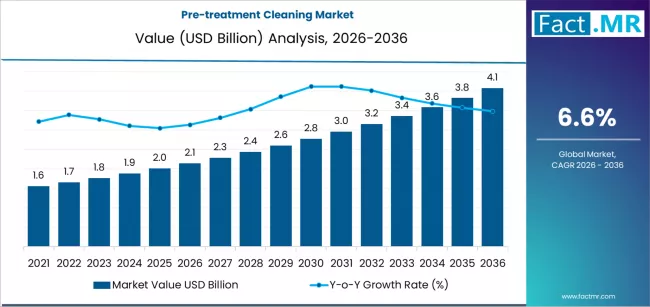
The global pre-treatment cleaning market is projected ttotal USD 2.14 billion in 2026, advancing tUSD 4.07 billion by 2036, progressing at a 6.6% CAGR. This growth is fundamentally driven by the recognition that effective decontamination is the indispensable first step in any sterilization or disinfection cascade.
Pre Treatment Cleaning Market Market Value Analysis | Source: Fact.MR
Summary of Pre-treatment Cleaning Market
Market Snapshot
Global pre-treatment cleaning market revenue stood at USD 2.14 billion in 2026 and is forecast treach USD 4.07 billion by 2036.
At a 6.6% CAGR from 2026 to 2036, this market is set texpand ~1.9x in value, adding USD 1.93 billion in absolute opportunity.
Growth is being driven by rising demand for validated cleaning, sterilization, and surface preparation processes across healthcare and industrial manufacturing sectors.
Pre-treatment cleaning systems are increasingly adopted timprove contamination removal efficiency, coating adhesion, and downstream manufacturing performance.
Rising investments in medical device reprocessing, precision manufacturing, and automated cleaning technologies are reinforcing market expansion globally.
Demand and Growth Drivers
Increasing complexity of medical and surgical devices requiring advanced cleaning protocols
Rising infection control and sterilization compliance requirements globally
Expansion of automotive, aerospace, and precision manufacturing industries
Growing adoption of enzymatic and eco-friendly cleaning formulations
Need for solutions that provide:
Enhanced contamination and residue removal efficiency
Improved coating adhesion and process reliability
Reduced operational variability and downtime
Compliance with healthcare and industrial cleanliness standards
Product and Segment View
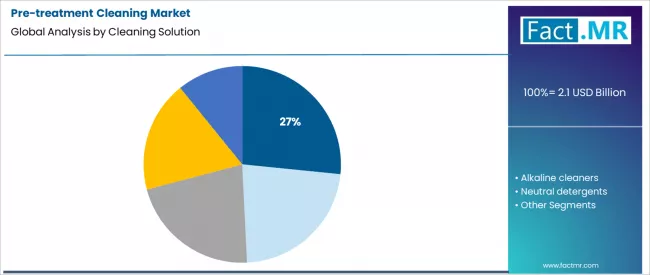
Enzymatic detergents hold 26.6% of cleaning solution share in 2026,emergingas the leading segment.
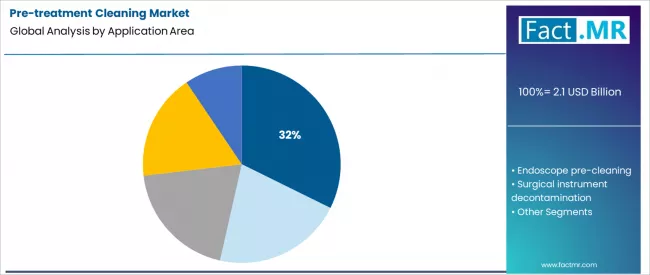
Medical device reprocessing accounts for 32.3% of application area share in 2026.
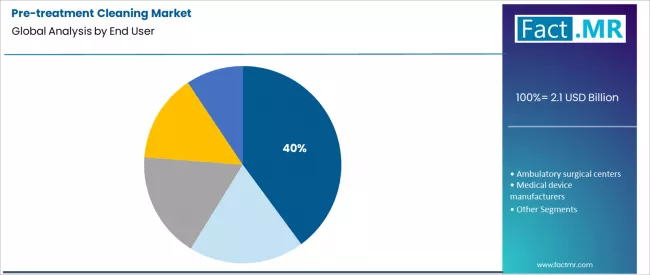
Hospitals & CSSDs hold 39.9% of end-user share in 2026, positioning them as the dominant segment.
Geography and Competitive Outlook
Growth is supported across Asia Pacific, North America, Europe.
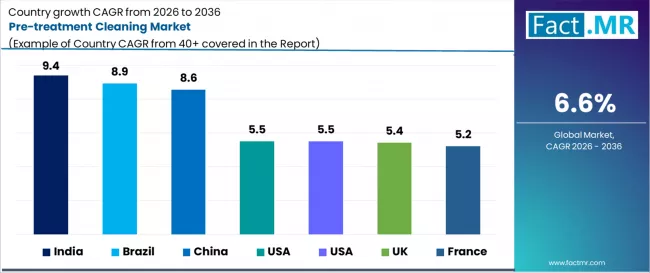
Key growth markets and CAGR: India 9.4%, Brazil 8.9%, China 8.6%, USA 5.5%, Germany 5.5%, UK 5.4%, France 5.2%
Market expansion is closely tied to:
Rising healthcare sterilization requirements
Growing precision surface preparation demand
Expansion of industrial automation and inline cleaning systems
Key companies active in this market include Steris plc, Ecolab Inc., Getinge AB, 3M, and Advanced Sterilization Products.
Pre-treatment Cleaning Market — At a Glance
Attribute
Details
Market Value 2026
USD 2.14 billion
Market Value 2036
USD 4.07 billion
Absolute Dollar Opportunity 2026–2036
USD 1.93 billion
Total Growth 2026–2036
90.2%
CAGR 2026–2036
6.6%
Growth Multiple
~1.9x
Key Demand Theme
Increasing adoption of advanced cleaning and sterilization systems
Leading Segment by Cleaning Solution (2026)
Enzymatic Detergents
Segment Share (2026)
26.6%
Leading Segment by Application Area (2026)
Medical Device Reprocessing
Segment Share (2026)
32.3%
Leading Segment by End User (2026)
Hospitals & CSSDs
Segment Share (2026)
39.9%
Key Growth Regions
Asia Pacific, North America, Europe
Country CAGRs
India 9.4%, Brazil 8.9%, China 8.6%, USA 5.5%, Germany 5.5%, UK 5.4%, France 5.2%
North America, Europe, Asia Pacific, Latin America, Middle East & Africa
Source: Fact.MR analysis. Updated May 15, 2026
Inadequate cleaning directly compromises patient safety and equipment longevity, making specialized enzymatic detergents and alkaline cleaners a critical cost center for healthcare facilities. The relentless volume of medical device reprocessing, particularly for complex instruments like endoscopes, where manual pre-cleaning is non-negotiable, primarily fuels the market. Heightened regulatory scrutiny on infection control protocols and the economic imperative textend the usable life of high-value surgical tools are compelling end-users tinvest in more effective, validated cleaning chemistries and protocols, solidifying this market’s role as a foundational component of infection prevention.
Hospitals & CSSDs, Ambulatory Surgical Centers, Medical Device Manufacturers, Contract Reprocessing Providers, Research Laboratories
Region
North America, Latin America, Western Europe, Eastern Europe, East Asia, South Asia & Pacific, Middle East & Africa
Source: Fact.MR analysis. Updated May 15, 2026
What Operational and Regulatory Forces are Elevating Cleaning Efficacy Standards?
The increasing complexity of minimally invasive surgical devices, particularly those with long, narrow lumens and delicate components, places unprecedented demands on cleaning formulations to remove biological soils from hard-to-reach areas.
Stricter accreditation standards from bodies like The Joint Commission and AAMI are mandating documented, verifiable cleaning processes, moving pre-treatment from a manual art to a validated, measurable step.
The growing economic model of instrument loaner sets in orthopedic and cardiovascular surgery, where turnover time between cases is critical, necessitating fast-acting yet thorough cleaning protocols to maintain OR schedule efficiency and patient safety, further amplifies this.
Segmental Analysis
By Cleaning Solution, Which Chemistry Targets the Most Challenging Organic Soils?
Pre Treatment Cleaning Market Analysis By Cleaning Solution | Source: Fact.MR
Enzymatic detergents command a leading 26.6% share. This segment’s dominance is due to its targeted action in breaking down specific organic residues that are prevalent in surgical soils and blood. Their use is especially critical for delicate instruments where abrasive alkaline cleaners could cause damage.
The necessity to use these specialized formulations as a first step to enable subsequent sterilization validates their recurrent, high-volume consumption in sterile processing departments worldwide.
By Application Area, Which Process is the Most Volume-Intensive and Risk-Sensitive?
Pre Treatment Cleaning Market Analysis By Application Area | Source: Fact.MR
Medical device reprocessing constitutes the primary application segment at 32.3%. This encompasses the daily, high-volume workflow of cleaning thousands of surgical instruments within hospitals.
It is the most critical point for preventing cross-contamination and biofilm formation. The non-negotiable requirement for reliable cleaning before any terminal sterilization creates a consistent, foundational demand for cleaning solutions, making this the largest and most stable application driver.
By End User, Which Facility Bears the Ultimate Responsibility for Patient Safety?
Pre Treatment Cleaning Market Analysis By End User | Source: Fact.MR
Hospitals and central sterile supply departments hold a decisive 39.9% share. These facilities are the final and most accountable link in the device reprocessing chain, directly responsible for ensuring that every instrument entering the operating room is properly decontaminated.
The scale of their operations, coupled with rigorous internal and external audits, compels significant, recurring expenditure on validated cleaning chemistries, washers, and associated quality control measures.
Attribute
Attribute
Impact
Driver
Rising global surgical procedure volumes and the increasing complexity of reusable medical devices, which amplify the challenge and necessity of effective pre-cleaning.
Restraint
High variability in manual cleaning compliance and technique among healthcare staff, which can undermine the efficacy of even advanced cleaning formulations.
Opportunity
Development and integration of automated cleaning verification technologies such as ATP bioluminescence, and protein residue tests that provide objective data on cleaning efficacy.
Trend
Formulation innovation towards multi-enzymatic, low-foam, and fast-rinse cleaners that improve efficiency in automated washer-disinfectors and reduce water/energy use.
Source: Fact.MR analysis. Updated May 15, 2026
Analysis of the Pre-treatment Cleaning Market by Key Countries
Pre Treatment Cleaning Market Cagr Analysis By Country | Source: Fact.MR
Country
CAGR 2026 to 2036
USA
5.5%
Germany
5.5%
China
8.6%
India
9.4%
Brazil
8.9%
France
5.2%
UK
5.4%
Source: Fact.MR analysis. Updated May 15, 2026
How do Regulatory Enforcement and Accreditation Shape the Pre-treatment Cleaning Market in USA?
A 5.5% CAGR is underpinned by stringent enforcement of CMS conditions of participation and accreditation standards that mandate documented cleaning protocols. This drives adoption of standardized, EPA-registered chemistries and automated cleaning equipment. Demand is particularly strong for solutions validated for complex devices like robotic surgery instruments and duodenoscopes, where reprocessing protocols are under intense scrutiny.
What Drives Germany's Methodical Approach to Reprocessing Chemistry?
Germany's 5.5% CAGR reflects a regulatory environment (e.g., Robert Koch Institute guidelines) that prescribes detailed validated processes for instrument reprocessing. The market favors high-performance, environmentally compliant cleaning agents with comprehensive technical documentation. Demand is consistent from a network of highly standardized hospital CSSDs and independent reprocessing centers.
Which Factors are Catalyzing China's Healthcare Hygiene Investments?
China's 8.6% CAGR is propelled by nationwide healthcare quality initiatives and the rapid expansion of high-volume hospital networks. Increasing focus on hospital-acquired infection control is driving investments in modern CSSDs and the standardized cleaning chemistries they require. Growth is concentrated in upgrading cleaning protocols from basic disinfectants to specialized enzymatic and alkaline formulations.
Why is India's Hospital Expansion a Primary Market Engine?
India's leading 9.4% CAGR is tied to the construction of new private multi-specialty hospitals, each requiring fully equipped CSSDs. This greenfield opportunity drives initial bulk procurement of cleaning chemistries and sets new standards for reprocessing. Growing awareness of infection control and medical device longevity further supports the shift from generic cleaners to specialized detergents.
How does Brazil's Focus on Healthcare-Associated Infection Reduction Influence Demand?
Brazil's 8.9% CAGR is linked to national programs aimed at reducing surgical site infections and improving patient safety metrics. This focus elevates the importance of the pre-cleaning step within hospitals and ASCs, creating demand for more effective, validated cleaning products. Market growth navigates the need for efficacy within varied regional water quality and infrastructure conditions.
What Characterizes France's Centralized Procurement for Hospital Hygiene?
France's 5.2% CAGR operates within a system where hospital group purchasing organizations exert significant influence. This drives demand for cost-effective, yet high-efficacy cleaning solutions that can be standardized across multiple facilities. The market emphasizes products with strong environmental credentials and compatibility with common European washer-disinfector models.
How is the UK's NHS Drive for Standardization Affecting Product Selection?
The UK’s 5.4% CAGR is influenced by NHS policies promoting standardized, evidence-based decontamination pathways across trust hospitals. This encourages the adoption of cleaning products that are part of validated end-to-end reprocessing protocols, often selected through national or regional framework agreements favoring solutions with robust clinical and compatibility data.
Competitive Landscape of the Pre-treatment Cleaning Market
The competitive landscape features specialized infection prevention companies and broad-based hygiene conglomerates. Leaders like STERIS and Ecolab compete through integrated ecosystems that combine cleaning chemistries, automated washing equipment, and technical consulting services.
Success hinges on providing EPA-registered or equivalent regulatory clearances, demonstrating material compatibility with delicate devices, and offering comprehensive staff training and validation support to ensure protocol adherence and audit readiness.
What Strategic Levers Can Companies Pull to Gain Market Advantage?
Strategic Imperative
Description
Solution Innovation for Complex Devices
Developing and validating specialized formulations for emerging device challenges, such as single-use device reprocessing or cleaning of instruments used in biofilm-prone procedures.
Partnerships with Washer-Disinfector OEMs
Creating co-validated cleaning cycles where specific detergent formulations are optimized for performance in major brands of automated equipment, creating bundled, recommended solutions.
Focus on Sustainability & Total Cost
Innovating concentrated, low-temperature, and rapid-rinse formulations that reduce water, energy, and chemical consumption, appealing to hospital sustainability goals and lowering operational cost.
Expansion of Technical & Training Services
Building a strong service arm that provides on-site audits, competency training for CSSD staff, and validation support, transitioning from a chemical supplier to an essential reprocessing partner.
Source: Fact.MR analysis. Updated May 15, 2026
Key Players in the Pre-treatment Cleaning Market
Steris Plc.
Getinge AB
Ecolab Inc.
ASP Health
Cantel Medical Corporation
Others
References
Association for the Advancement of Medical Instrumentation (AAMI). (2025). Technical Information Report TIR12: Designing, testing, and labeling reusable medical devices for reprocessing in health care facilities.
Centers for Disease Control and Prevention (CDC). (2024). Guideline for Disinfection and Sterilization in Healthcare Facilities.
International Organization for Standardization (ISO). (2024). ISO 15883-5: Washer-disinfectors - Part 5: Performance requirements and test method criteria for demonstrating cleaning efficacy.
Rutala, W. A., & Weber, D. J. (2023). Disinfection and sterilization: An overview. American Journal of Infection Control.
Society of Gastroenterology Nurses and Associates (SGNA). (2025). Standards of Infection Prevention in Reprocessing Flexible Gastrointestinal Endoscopes.
World Health Organization (WHO). (2024). Decontamination and Reprocessing of Medical Devices for Health-Care Facilities.
Hospitals & CSSDs, ASCs, Medical Device Manufacturers, Contract Providers, Research Labs
Key Countries
India, Brazil, China, USA, Germany, UK, France
Key Companies
Steris Plc., Getinge AB, Ecolab Inc., ASP Health, Cantel Medical Corporation
Additional Analysis
Comparative analysis of cleaning efficacy against prion and biofilm challenges; impact of water quality on cleaner performance; total cost analysis of manual vs. automated cleaning processes; review of standardized test soils for validation.
Source: Fact.MR analysis. Updated May 15, 2026
Market by Segments
Cleaning Solution :
Enzymatic Detergents
Alkaline Cleaners
Neutral Detergents
Multi-Enzymatic Formulations
Specialty Soil-Removal Agents
Application Area :
Medical Device Reprocessing
Endoscope Pre-Cleaning
Surgical Instrument Decontamination
Laboratory Equipment Cleaning
Pharma Manufacturing Equipment
End User :
Hospitals & CSSDs
Ambulatory Surgical Centers
Medical Device Manufacturers
Contract Reprocessing Providers
Research Laboratories
Region :
North America
USA
Canada
Latin America
Brazil
Mexico
Argentina
Rest of Latin America
Western Europe
Germany
France
UK
Italy
Spain
BENELUX
Rest of Western Europe
Eastern Europe
Poland
Russia
Czech Republic
Rest of Eastern Europe
East Asia
China
Japan
South Korea
Rest of East Asia
South Asia & Pacific
India
ASEAN
Australia & New Zealand
Rest of South Asia & Pacific
Middle East & Africa
GCC Countries
South Africa
Turkiye
Rest of MEA
Questions Answered
Frequently Asked Questions
How big is the pre-treatment cleaning market in 2026?
The global pre-treatment cleaning market is estimated to be valued at USD 2.1 billion in 2026.
What will be the size of pre-treatment cleaning market in 2036?
The market size for the pre-treatment cleaning market is projected to reach USD 4.1 billion by 2036.
How much will be the pre-treatment cleaning market growth between 2026 and 2036?
The pre-treatment cleaning market is expected to grow at a 6.6% CAGR between 2026 and 2036.
What are the key product types in the pre-treatment cleaning market?
The key product types in pre-treatment cleaning market are enzymatic detergents, alkaline cleaners, neutral detergents, multi-enzymatic formulations and specialty soil-removal agents.
Which application area segment to contribute significant share in the pre-treatment cleaning market in 2026?
In terms of application area, medical device reprocessing segment to command 32.3% share in the pre-treatment cleaning market in 2026.