- Market Value (2025): USD 2.2 Bn
- Estimated Value (2026): USD 2.5 Bn
- Forecast Value (2036): USD 9.0 Bn
- CAGR (2026-2036): 13.7%
What is the VLEO Capable Satellite Buses Market forecast to be worth by 2036?
USD 2.5 billion in 2026 to USD 9.0 billion by 2036 at a 13.7% CAGR.
- As per Fact.MR analysis, the VLEO Capable Satellite Buses Market reached USD 2.2 billion in 2025.
- Demand is forecast to increase from USD 2.5 billion in 2026 to USD 9.0 billion by 2036.
- The market is forecast to record 13.7% CAGR from 2026 to 2036.
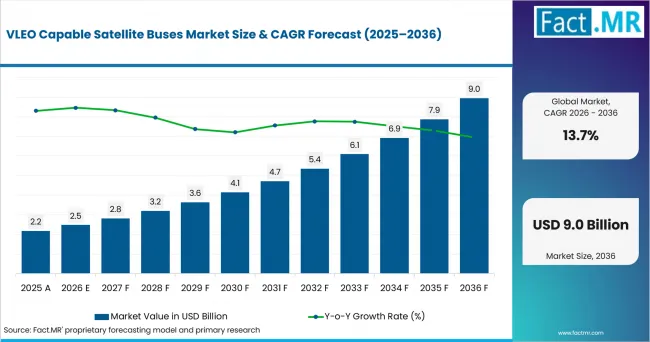
Vleo Capable Satellite Buses Market Value Analysis | Source: Fact.MR
What are the defining numbers behind VLEO Capable Satellite Buses Market growth?
USD 6.5 billion absolute opportunity by 2036 led by <50 kg buses and low-drag structures with Earth imaging payloads.
- Demand Drivers in the Market
- Earth imaging missions need satellite buses that stay stable at lower altitudes despite air drag. The European Space Agency stated in March 2026 that VLEO altitudes are typically 250–350 km [1]. These lower altitudes help Earth observation systems capture clearer images.
- Defence missions need satellite buses that can change position and send data quickly to the ground. VLEO supports frequent coverage and fast communication.
- Satellite makers need materials that can handle atomic oxygen in the upper atmosphere. Protective surfaces help prevent damage to exposed satellite parts.
- Satellite operators need buses that can use the same design across many satellites. Smaller payloads and compact electric propulsion systems make this easier while leaving space for sensors.
- Key Segments Analyzed
- By Bus Mass: <50 kg is expected to hold a 29.0% share in 2026 because smaller satellite buses work well for technology testing and lower-cost missions.
- By VLEO Design: Low-drag structures are anticipated to hold a 35.0% share in 2026 because the shape of the satellite affects air drag and the effort needed to stay in orbit.
- By Altitude: 120–180 km leads with 31.0% share in 2026 because being closer to Earth helps sensing missions.
- By Payload: EO holds 38.0% share in 2026 because optical and radar systems can capture better images when satellites operate closer to Earth.
- Analyst Opinion at Fact.MR
- Shambhu Nath Jha of Fact.MR states, “VLEO satellite buses need to stay stable and work for long periods at low altitudes. They need to reduce air drag, use reliable propulsion, and protect surfaces from atomic oxygen. Suppliers also need buses that can carry different payloads and keep them stable during civil, defence, and private missions.”
- Strategic Implications
- Bus makers should provide data on air drag and the power needed to keep satellites in orbit at different heights. This helps mission teams compare how long each bus can work.
- Propulsion companies should make systems that can regularly adjust the satellite’s orbit. VLEO satellites need these changes because air drag pushes them to lower heights.
- Payload companies should test if cameras and sensors stay steady when air drag affects the satellite. This helps keep images clear and location data accurate.
- Mission teams should plan safe re-entry and disposal from the start. The European Space Agency said in April 2025 that about 40,000 objects were being tracked in Earth orbit [2]. Satellite design also needs to consider collision risks during the mission.
The USA is expected to grow at 14.4% CAGR through 2036, followed by Germany at 14.1% and France at 13.8%. Japan is expected to grow at 12.3%, while the UK records 10.7%. Demand in each country depends on defence and sensing programs, along with small-satellite and LEO communication projects.
How does the VLEO Capable Satellite Buses Market break down by segment?
<50 kg leads Bus Mass at 29.0%; low-drag structure leads VLEO Design at 35.0%; 120-180 km leads Altitude at 31.0%; EO leads Payload at 38.0%.
Which Bus Mass segment dominates?
<50 kg is expected to hold 29.0% share in 2026.
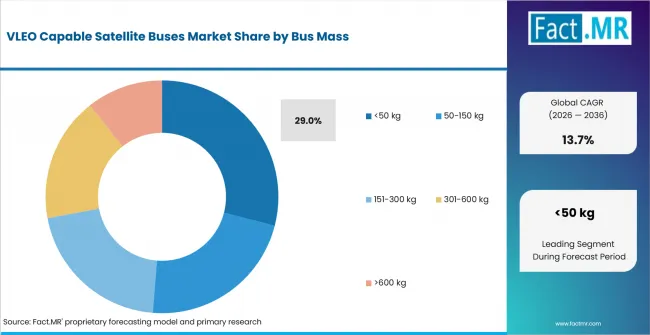
Vleo Capable Satellite Buses Market Analysis By Bus Mass | Source: Fact.MR
The <50 kg class is expected to hold a 29.0% share because smaller satellite buses work well for sensing and technology tests. The 50–150 kg and 151–300 kg classes provide more power and space for payloads, while heavier buses can carry larger instruments. All bus sizes need testing before launch, which supports the use of small satellite environmental test systems.
What leads the VLEO Design segment?
Low-drag structure is forecast to account for 35.0% share in 2026.
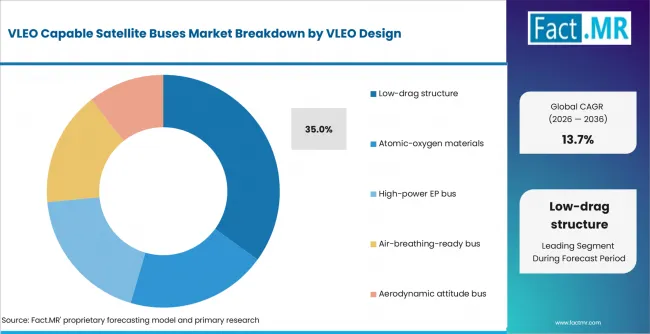
Vleo Capable Satellite Buses Market Analysis By Vleo Design | Source: Fact.MR
Low-drag structures are forecast to lead because a smaller front area reduces air drag. Protective surfaces help protect the satellite from atomic oxygen, while stronger propulsion and air-breathing systems help keep it in orbit. Satellites can also change their position during the mission to reduce air drag.
How does Altitude shape demand?
120-180 km is forecast to capture 31.0% share in 2026.
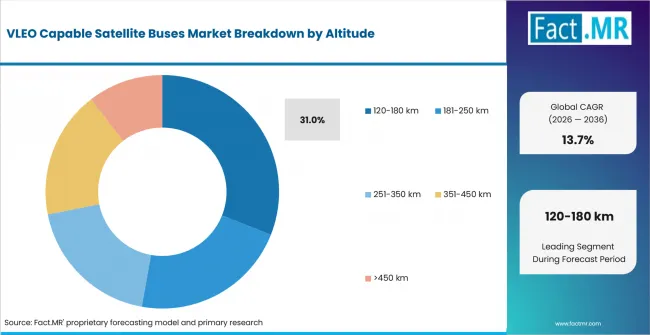
Vleo Capable Satellite Buses Market Analysis By Altitude | Source: Fact.MR
The 120–180 km range is expected to hold a 31.0% share because satellites operate closer to Earth. The 181–250 km and 251–350 km ranges still support closer sensing with less air drag. At higher altitudes, satellites need fewer orbit adjustments but operate closer to normal LEO conditions.
What supports EO within Payload?
EO is estimated to represent 38.0% share in 2026.
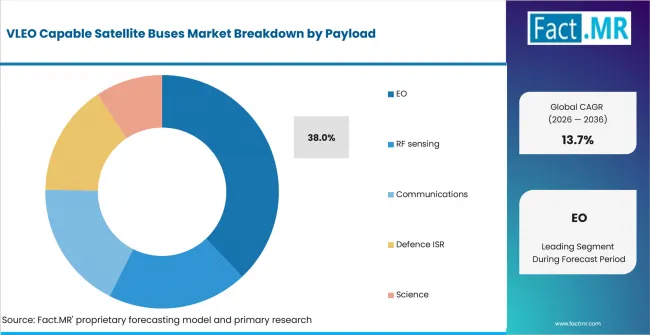
Vleo Capable Satellite Buses Market Analysis By Payload | Source: Fact.MR
Earth observation is forecast to represent at 38.0% payload share because lower orbits allow satellites to capture clearer images. RF sensing and defence ISR also benefit from being closer to targets, while communication missions get shorter signal paths.
What is accelerating VLEO Capable Satellite Buses Market adoption, and what is holding it back?
Demand for closer sensing and fast-response missions increases use, while air drag, atomic oxygen, and crowded orbits create challenges.
Drivers Impact Analysis
| DRIVER | (~) % IMPACT ON CAGR | GEOGRAPHIC RELEVANCE | IMPACT TIMELINE |
|---|---|---|---|
| Higher-resolution Earth observation from lower altitude | +2.0% | North America, Western Europe, East Asia | Short term (<= 2 years) |
| Responsive defence and ISR mission demand | +1.6% | USA, France, UK | Short term (<= 2 years) |
| Electric drag-compensation development | +1.3% | Europe, USA, Japan | Medium term (2-4 years) |
| Smaller modular spacecraft production | +0.9% | Global | Medium term (2-4 years) |
| Low-latency communication and RF sensing use | +0.7% | North America, Europe, East Asia | Long term (>= 4 years) |
Opportunity Impact Analysis
| OPPORTUNITY | (~) % IMPACT ON CAGR | GEOGRAPHIC RELEVANCE | IMPACT TIMELINE |
|---|---|---|---|
| Air-breathing-ready bus integration | +1.2% | Europe, USA | Medium term (2-4 years) |
| Defence ISR constellations below conventional LEO | +1.0% | USA, France, UK | Medium term (2-4 years) |
| VLEO video and persistent observation platforms | +0.8% | Europe, Japan, USA | Long term (>= 4 years) |
| Radiation and atomic-oxygen material packages | +0.6% | Global | Short term (<= 2 years) |
Restraints Impact Analysis
| RESTRAINT | (~) % IMPACT ON CAGR | GEOGRAPHIC RELEVANCE | IMPACT TIMELINE |
|---|---|---|---|
| Continuous atmospheric drag and orbit decay | -1.0% | Global | Short term (<= 2 years) |
| Atomic-oxygen erosion and materials qualification | -0.7% | Global | Medium term (2-4 years) |
| Congested LEO traffic and conjunction management | -0.6% | Global | Short term (<= 2 years) |
| Power and thermal burden of sustained propulsion | -0.5% | Global | Medium term (2-4 years) |
Which countries are scaling the VLEO Capable Satellite Buses Market through 2036?
- The country comparison spans 3.7 percentage points between the USA at 14.4% and the UK at 10.7% through 2036.
- The USA remains 0.3 percentage point above Germany as quick-response space programs support repeatable small-spacecraft build.
- Germany remains 0.3 percentage point above France as public space funding supports satellite tech and platform work.
- France remains 1.5 percentage points above Japan as sovereign sensing programs sustain local spacecraft design and payload integration.
- Japan remains 1.6 percentage points above the UK as small-satellite tests broaden flight experience for new bus tech.
- The UK closes the displayed range as public LEO link programs support local satellite platforms and subsystem work.
Comparable CAGRs create different entry conditions because VLEO missions depend on propulsion maturity, mission height and national program timing.
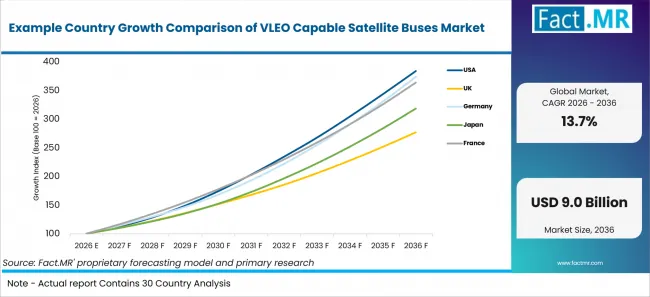
Example Country Growth Comparison Of Vleo Capable Satellite Buses Market | Source: Fact.MR
| Country | CAGR (2026-2036) |
|---|---|
| United States | 14.4% |
| Germany | 14.1% |
| France | 13.8% |
| Japan | 12.3% |
| United Kingdom | 10.7% |
What supports USA adoption?
14.4% CAGR, backed by responsive-space design and lower-orbit sensing needs.
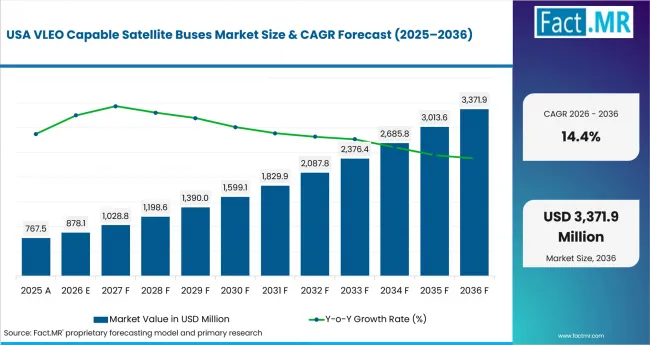
Vleo Capable Satellite Buses Market Country Value Analysis | Source: Fact.MR
U.S. demand is expected to grow for small satellites that can be built in the same design and used for fast-response missions. Space Systems Command said in September 2025 that one launch placed 21 Tranche 1 transport satellites into orbit [3]. This supports satellite buses with common designs and parts that can be built for frequent launches.
What supports Germany's adoption?
14.1% CAGR, backed by national space investment and small-satellite engineering capability.
Germany’s satellite industry is expected to benefit from continued public spending on European space programs. The German Aerospace Center said in November 2025 that Germany committed about EUR 5.4 billion to ESA programs [4]. The funding covers Earth imaging, telecommunications, and space technology, supporting work on satellite propulsion and surface protection.
How is France developing demand?
13.8% CAGR, backed by sovereign imaging systems and low-orbit defence links.
Demand in France is anticipated to grow for smaller Earth observation satellites and national sensing programs. CNES stated in May 2025 that the CO3D mission uses four mini-satellites for 3D Earth imaging [5]. The program gives France experience in building smaller imaging satellites and keeping their sensors stable during missions.
How does Japan perform?
12.3% CAGR, backed by small-satellite tests and compact spacecraft tech programs.
Demand in Japan forecast to expand as more satellite technologies are tested in space. JAXA announced in October 2025 that RAISE-4, part of the Innovative Satellite Technology Demonstration-4, was scheduled to carry eight technologies for on-orbit demonstration [6]. These programs allow companies and research teams to test small satellite parts and systems in orbit.
What supports United Kingdom growth?
10.7% CAGR, backed by LEO communications funding and an established space supply base.
Demand in the UK is expected to grow with public funding for low-orbit communication satellites and large satellite networks. The UK Space Agency announced £30 million in funding in March 2026 through the second call of its Connectivity in Low Earth Orbit programme [7]. The program supports technology for future satellite networks.
Who leads the VLEO Capable Satellite Buses Market?
Redwire develops VLEO satellite platforms through SabreSat and Phantom. Phantom also supports ESA’s Skimsat program.
Thales Alenia Space build satellites, payloads, and related systems. They also work on secure communication systems linked with sovereign defence SATCOM platforms. York Space Systems supplies satellites for government and national-security missions and introduced its LX/V-CLASS VLEO platform in September 2026.
Which companies are the key providers?
Key companies include Thales Alenia Space; Redwire; and York Space Systems.
- Thales Alenia Space
- Redwire
- York Space Systems
Bibliography
- [1] European Space Agency. (2026, March 17). ESA seeks scalable VLEO platforms for satellite video.
- [2] European Space Agency. (2025, April 1). ESA Space Environment Report 2025.
- [3] Space Systems Command. (2025, September 10). Space Systems Command, Space Development Agency complete successful launch of first Tranche 1 satellites.
- [4] German Aerospace Center (DLR). (2025, November 28). Germany invests 5.4 billion euros in the future of European space.
- [5] CNES. (2025, May 27). Les Mardis de l'espace : CO3D, notre Terre en carte maxi 3D.
- [6] Japan Aerospace Exploration Agency. (2025, October 10).[Launch of Innovative Satellite Technology Demonstration-4].
- [7] UK Space Agency. (2026, March 4). UK sets sights on £40 billion satellite communications market with fresh investment.
- [8] RTX. (2025, August 4). RTX's Blue Canyon Technologies announces new, larger spacecraft.
This Report Answers
- The report explains how VLEO-capable satellite buses are selected across bus mass and design as well as orbit height and payload.
- Segment review identifies the 2026 share leaders and explains the engineering reasons behind their position.
- Country analysis compares the USA and Germany with France, Japan and the UK using the 2036 CAGR values and current official program evidence.
- Competitive review covers current spacecraft providers and separates direct VLEO activity from broader small-satellite bus capability.
- Application analysis considers drag and atomic oxygen with propulsion. It also covers pointing control and payload economics when mission teams select a platform.
What does the VLEO Capable Satellite Buses Market cover?
The market covers integrated spacecraft buses built for sustained or mission-relevant use at very low Earth heights. It includes spacecraft structure and power systems. It also covers avionics and attitude control plus thermal control and propulsion when these elements are sold as part of the bus. Linked demand from VLEO satellite platforms and low-height drag-resistant platforms helps frame how mission teams compare bus design at lower orbit heights.
The assessment also considers tech links to propulsion where propulsion affects how long a VLEO bus can remain in its intended band. Lower-height links missions overlap with satellite internet systems when bus design is tied to constellation links and low-latency service.
What is included in the scope?
Included sales covers complete buses and integrated platform value for Earth imaging and RF sensing. It also covers communications plus defence ISR and science missions. It includes low-drag structures and atomic-oxygen-compatible surfaces with bus-level propulsion fit. The same boundary is linked to commercial small launch rockets where spacecraft mass and launch configuration affect deployment choices but launch sales remains outside this market.
Mission context includes civil sensing and secure government use. Adjacent software-defined defence satellites and sovereign defence SATCOM platforms are relevant where the same bus design carries reconfigurable or protected payloads. Earth observation systems provide downstream context for the EO payload segment.
What is excluded from the scope?
The scope excludes launch vehicles and services plus ground stations. Stand-alone payload instruments and downstream image analytics are excluded when sold separately. Conventional LEO buses qualify only when configured for sustained VLEO use. Space situational awareness sensor test systems remain linked infrastructure outside spacecraft-bus sales.
Satellite-data subscriptions and generic cloud processing are outside scope. Spectrum services and terrestrial communications equipment are also excluded.
How Was the Analysis Built?
The analysis draws on 120+ sources, 35+ company portfolios, 25+ countries, and more than 20 industry interviews.
- Primary Research: Primary research includes discussions with manufacturers, service providers, technology developers, distributors, end users, and subject-matter experts. These conversations examine purchasing priorities, product adoption, operational challenges, approval requirements, competitive positioning, and the factors that influence wider market acceptance.
- Desk Research: Desk research covers government statistics, regulatory publications, company filings, trade data, technical studies, industry associations, standards, public policy, and other authoritative sources. Every source used in the analysis is documented in the bibliography.
- Market Sizing and Forecasting: Market estimates combine historical performance, demand indicators, pricing and volume trends, segment shares, company participation, country-level growth, adoption patterns, investment activity, and barriers to market expansion.
- Data Validation and Update Cycle: Findings are validated by comparing primary interviews with public data, company activity, regulatory changes, trade patterns, and industry developments. Regular updates review new product launches, capacity changes, partnerships, approvals, and shifts in commercial adoption.
What is the report’s scope and coverage?
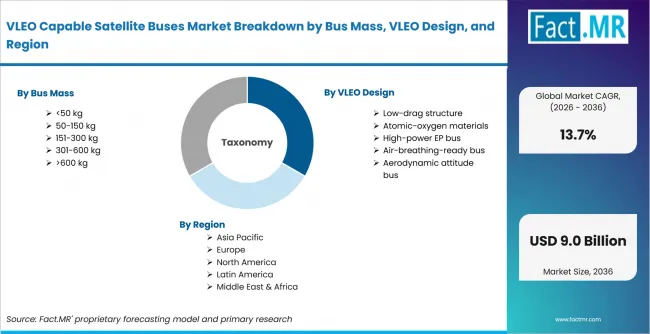
Vleo Capable Satellite Buses Market Breakdown By Bus Mass, Vleo Design, And Region | Source: Fact.MR
| Attribute | Details |
|---|---|
| Quantitative Units | USD billion |
| Market Definition | Satellite buses and integrated spacecraft platforms designed for operation in very low Earth orbit where drag, atomic oxygen, propulsion, attitude control and thermal management materially shape mission life. |
| Bus Mass | <50 kg; 50-150 kg; 151-300 kg; 301-600 kg; >600 kg |
| VLEO Design | Low-drag structure; Atomic-oxygen materials; High-power EP bus; Air-breathing-ready bus; Aerodynamic attitude bus |
| Altitude | 120-180 km; 181-250 km; 251-350 km; 351-450 km; >450 km |
| Payload | EO; RF sensing; Communications; Defence ISR; Science |
| Regions Covered | North America; Latin America; Western Europe; Eastern Europe; East Asia; South Asia & Pacific; Middle East & Africa |
| Countries Covered | United States; Germany; France; Japan; United Kingdom |
| Companies Profiled | Thales Alenia Space; Redwire; York Space Systems |
| Forecast Period | 2026 to 2036 |
| Approach | Hybrid top-down and bottom-up approach using spacecraft program activity, bus mass, VLEO design requirements, altitude trade-offs, payload demand, country programs and provider portfolios. |
How is the market segmented?
-
By Bus Mass:
- <50 kg
- 50-150 kg
- 151-300 kg
- 301-600 kg
- >600 kg
-
By VLEO Design:
- Low-drag structure
- Atomic-oxygen materials
- High-power EP bus
- Air-breathing-ready bus
- Aerodynamic attitude bus
-
By Altitude:
- 120-180 km
- 181-250 km
- 251-350 km
- 351-450 km
- >450 km
-
By Payload:
- EO
- RF sensing
- Communications
- Defence ISR
- Science
-
By Region:
- North America
- Latin America
- Western Europe
- Eastern Europe
- East Asia
- South Asia & Pacific
- Middle East & Africa