- Market Value (2025): USD 11.3 Bn
- Estimated Value (2026): USD 12.8 Bn
- Forecast Value (2036): USD 43.8 Bn
- CAGR (2026-2036): 13.1%
What is the Sovereign Defence SATCOM Platforms Market forecast to be worth by 2036?
USD 12.8 billion in 2026 to USD 43.8 billion by 2036, at a 13.1% CAGR.
- The market is valued at USD 11.3 billion in 2025.
- Demand is projected to increase from USD 12.8 billion in 2026 to USD 43.8 billion by 2036.
- The market is forecast to record a 13.1% CAGR from 2026 to 2036 as governments expand protected satellite communications, sovereign capacity and resilient command links.
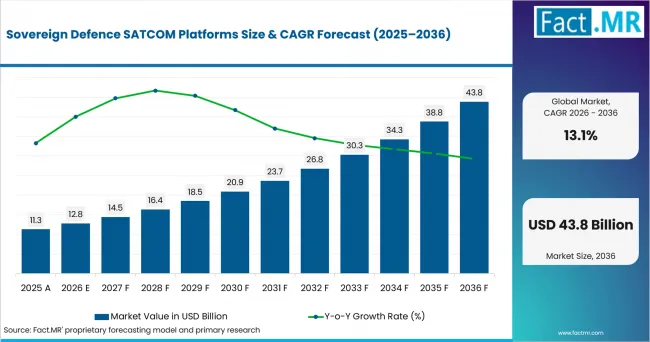
Sovereign Defence Satcom Platforms Value Analysis | Source: Fact.MR
What are the defining numbers behind Sovereign Defence SATCOM Platforms Market growth?
The market is projected to create an absolute dollar opportunity of USD 31.0 billion between 2026 and 2036.
- Demand Drivers in the Market
- Governments are building secure satellite-communication capacity that can be controlled for defence, crisis response and other protected public-sector missions.
- Resilience requirements are pushing defence planners toward architectures that combine protected payloads with multiple orbital layers rather than relying on a single communications path.
- European secure-SATCOM programmes are creating a common procurement and accreditation framework for government-controlled connectivity while national systems remain central to sovereignty.
- Spectrum coordination and orbital registration remain essential because sovereign control of a platform does not remove the need to operate within international radio-regulation rules.
- Key Segments Analyzed
- By Orbit: GEO accounts for 41.0% share in 2026, reflecting its established role in persistent wide-area military communications.
- By Payload: Protected Ka-band holds 31.0% share in 2026, supported by demand for higher-capacity protected communications links.
- By Sovereignty Model: National-owned constellation represents 39.0% share in 2026, showing the importance governments place on direct control of strategic communications assets.
- By Mission: Strategic communications accounts for 34.0% share in 2026, making it the leading mission category.
- Analyst Opinion at Fact.MR
- Shambhu Nath Jha, Senior Consultant, Fact.MR, notes that sovereign defence SATCOM investment is increasingly about control over the communications chain rather than satellite capacity alone. Governments are weighing who owns the asset, who controls the payload, how spectrum is secured and how quickly capacity can be restored or redirected during a crisis.
- He adds that the strongest programmes will combine sovereign control with interoperability. National systems still need to connect with allied networks and multi-orbit architectures, so procurement decisions will increasingly balance autonomy against operational compatibility.
- Strategic Implications
- Defence buyers should evaluate sovereignty at the system level, including spacecraft control, payload access, ground infrastructure and encryption authority.
- Programme teams should treat orbit selection as an architecture decision because GEO, LEO and MEO layers solve different persistence, latency and resilience requirements.
- Governments using hosted or commercial capacity need contractual controls that preserve priority access and mission assurance during periods of congestion or conflict.
- Suppliers serving sovereign programmes need to plan spectrum and orbital coordination early because international registration can constrain deployment schedules even when national funding is available.
The USA is forecast to grow at 13.2% CAGR from 2026 to 2036, France at 12.0%, the UK at 12.3%, Germany at 12.8% and Australia at 13.6%. The country outlook is better understood through the sovereignty mechanism behind procurement rather than through a simple growth ranking.
How does the Sovereign Defence SATCOM Platforms Market break down by segment?
The Sovereign Defence SATCOM Platforms Market is segmented by Orbit into GEO, LEO, MEO and HEO / other; by Payload into Protected Ka-band, X-band, UHF, Multi-band digital payload and Optical / hybrid links; by Sovereignty Model into National-owned constellation, Dedicated hosted payload, Government-commercial hybrid, Allied shared sovereign system and Rapidly deployable tactical layer; and by Mission into Strategic communications, Tactical beyond-line-of-sight, Nuclear / national command support, Maritime / airborne SATCOM and Coalition interoperability.
Which Orbit dominates?
GEO holds 41.0% share in 2026.
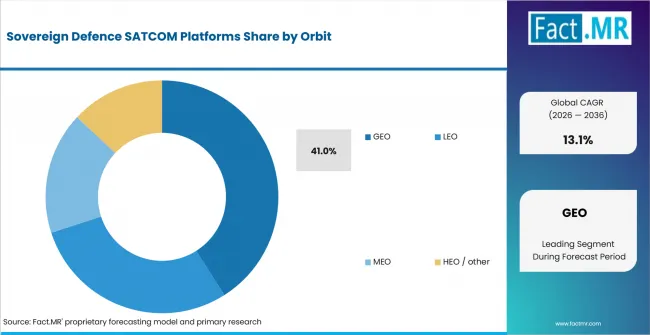
Sovereign Defence Satcom Platforms Analysis By Orbit | Source: Fact.MR
GEO leads the Orbit category because defence communications still depend heavily on persistent coverage and established ground infrastructure. Non-geostationary systems are expanding the architecture, but GEO remains important for missions that require continuous wide-area links and mature spectrum coordination.
Which Payload dominates?
Protected Ka-band holds 31.0% share in 2026.
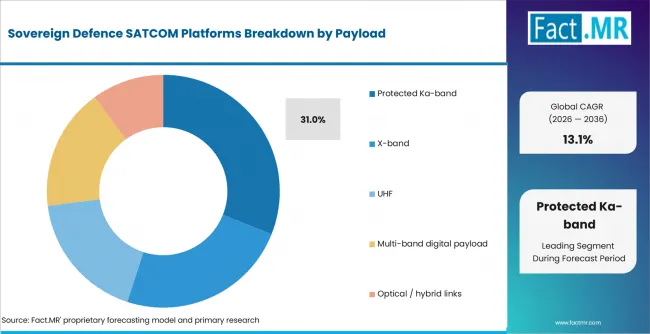
Sovereign Defence Satcom Platforms Analysis By Payload | Source: Fact.MR
Protected Ka-band leads the Payload category as defence users seek higher-capacity links with security features designed for contested operating environments. Payload selection increasingly sits within a broader multi-band architecture so governments can balance capacity, protection and interoperability across mission types.
Which Sovereignty Model dominates?
National-owned constellation holds 39.0% share in 2026.
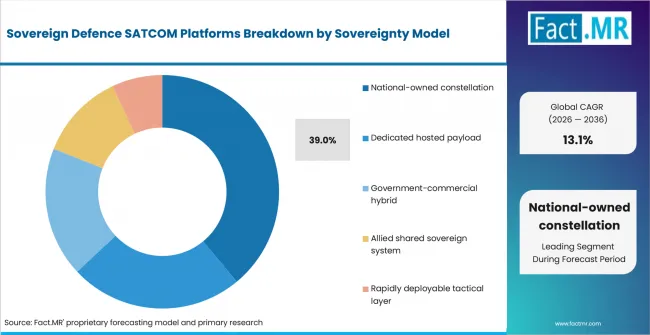
Sovereign Defence Satcom Platforms Analysis By Sovereignty Model | Source: Fact.MR
National-owned constellations lead the Sovereignty Model category because they give governments direct control over asset tasking, access policy and long-term capability planning. Hosted payloads and government-commercial hybrids remain relevant where faster deployment or additional capacity is required, but they introduce different control and assurance considerations.
Which Mission leads demand?
Strategic communications accounts for 34.0% share in 2026.
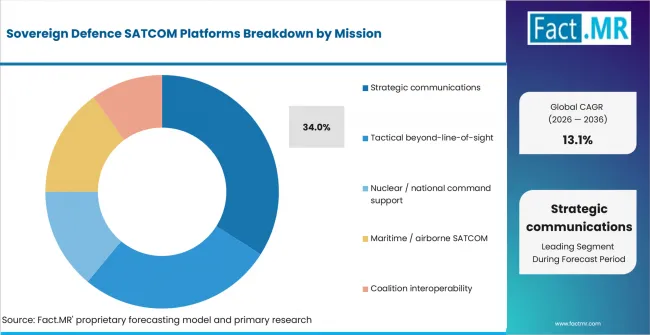
Sovereign Defence Satcom Platforms Analysis By Mission | Source: Fact.MR
Strategic communications leads Mission demand because sovereign SATCOM is primarily justified by the need to maintain secure national command links over long distances. Tactical and platform-specific missions extend that requirement into deployed forces, maritime operations and coalition environments.
What is accelerating Sovereign Defence SATCOM Platforms Market adoption, and what is holding it back?
Secure communications programmes, defence funding and resilience requirements support adoption; acquisition complexity, spectrum coordination and long development cycles can slow deployment.
Drivers Impact Analysis
| DRIVER | (~) % IMPACT ON CAGR | GEOGRAPHIC RELEVANCE | IMPACT TIMELINE |
|---|---|---|---|
| Secure government SATCOM programmes | +1.5% | Europe, Global | Short term (<= 2 years) |
| Multi-orbit resilience requirements | +1.2% | USA, Europe, Australia | Medium term (2-4 years) |
| Defence capability investment | +0.9% | Europe, USA | Short term (<= 2 years) |
| Protected communications modernization | +0.7% | Global | Long term (>= 4 years) |
Source: Fact.MR analysis. Updated Sep 15, 2026
- Secure government SATCOM programmes: EUSPA secure-communications activity, including GOVSATCOM and IRIS2, shows how public-sector demand is being organized around accredited government access rather than general commercial connectivity.
- Multi-orbit resilience: Defence planners are combining orbital layers to reduce dependence on a single communications path and improve continuity under disruption.
- Defence capability investment: European defence-capability programmes provide a funding base for protected communications and related space infrastructure.
- Protected communications modernization: National space and defence organisations are updating communications architectures as data requirements and operational threats increase.
Opportunity Impact Analysis
| OPPORTUNITY | (~) % IMPACT ON CAGR | GEOGRAPHIC RELEVANCE | IMPACT TIMELINE |
|---|---|---|---|
| Multi-band digital payloads | +0.9% | Europe, Global | Medium term (2-4 years) |
| Government-commercial hybrid capacity | +0.7% | USA, Europe, Australia | Short term (<= 2 years) |
| Allied shared sovereign systems | +0.6% | Europe, Australia | Medium term (2-4 years) |
| Rapidly deployable tactical layers | +0.4% | Global | Long term (>= 4 years) |
Source: Fact.MR analysis. Updated Sep 15, 2026
- Multi-band digital payloads: Reconfigurable payloads can give governments more flexibility to allocate capacity across changing mission requirements without replacing the complete platform.
- Government-commercial hybrid capacity: Hybrid architectures can add capacity or accelerate deployment when governments retain appropriate control over priority access and security.
- Allied shared systems: Shared sovereign capacity can spread programme costs while preserving dedicated government access for participating states.
- Rapid tactical layers: Deployable communications layers can extend sovereign networks into operational areas where fixed national infrastructure is unavailable or contested.
Restraints Impact Analysis
| RESTRAINT | (~) % IMPACT ON CAGR | GEOGRAPHIC RELEVANCE | IMPACT TIMELINE |
|---|---|---|---|
| Long acquisition and qualification cycles | -0.9% | USA, Europe | Short term (<= 2 years) |
| Spectrum and orbital coordination | -0.7% | Global | Medium term (2-4 years) |
| High programme integration burden | -0.5% | Global | Medium term (2-4 years) |
| Interoperability and security certification | -0.3% | Europe, Allied markets | Long term (>= 4 years) |
Source: Fact.MR analysis. Updated Sep 15, 2026
- Acquisition cycles: Sovereign defence satellites move through complex procurement, testing and acceptance processes, which can delay fielding even when strategic demand is clear.
- Spectrum and orbital coordination: ITU filing and coordination requirements apply to both geostationary and non-geostationary networks, making regulatory preparation part of deployment planning.
- Programme integration: Spacecraft, payloads, ground systems and secure user terminals have to operate as one architecture, increasing technical and programme-management complexity.
- Interoperability and certification: Sovereign systems still need to work with allied networks while maintaining national security controls, creating additional validation requirements.
Which countries are scaling Sovereign Defence SATCOM Platforms Market through 2036?
- USA: 13.2% CAGR, with acquisition oversight and programme discipline influencing the pace of military satellite deployment.
- France: 12.0% CAGR, supported by a national space agency that operates across defence, telecommunications and other public-policy missions.
- UK: 12.3% CAGR, with national space strategy and public investment strengthening secure satellite-communication capability.
- Germany: 12.8% CAGR, with the German Space Agency and DLR security research supporting sovereign communications capability.
- Australia: 13.6% CAGR, with national science and space-adjacent capability supporting participation in secure and allied communications architectures.
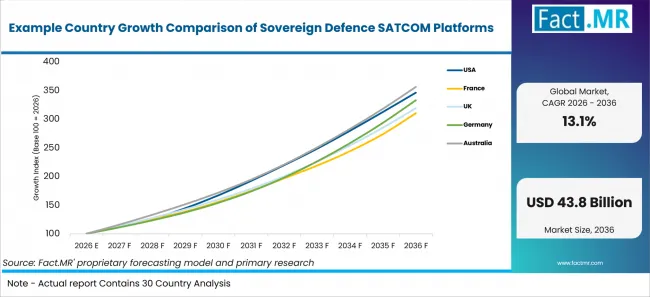
Example Country Growth Comparison Of Sovereign Defence Satcom Platforms | Source: Fact.MR
| Country | CAGR |
|---|---|
| USA | 13.2% |
| France | 12.0% |
| UK | 12.3% |
| Germany | 12.8% |
| Australia | 13.6% |
Source: Fact.MR analysis. Updated Sep 15, 2026
What supports USA adoption?
13.2% CAGR through 2036, shaped by acquisition oversight and programme execution.
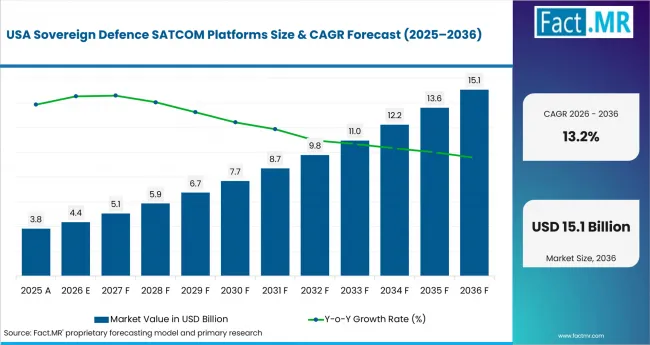
Sovereign Defence Satcom Platforms Country Value Analysis | Source: Fact.MR
The USA market is forecast to expand at 13.2% CAGR from 2026 to 2036. GAO oversight of major defence and space acquisitions keeps cost, schedule and testing discipline central to programme delivery. For sovereign SATCOM, the requirement is not only to field capacity but to do so through systems that meet military assurance and acceptance requirements.
What supports France growth?
12.0% CAGR through 2036, shaped by national control of space capability.
France is forecast to expand at 12.0% CAGR from 2026 to 2036. CNES operates as a national programme agency and space operator across defence and telecommunications, giving France an institutional base for sovereign capability rather than positioning it only as a buyer of external capacity.
What supports the UK outlook?
12.3% CAGR through 2036, shaped by defence-focused space strategy and SATCOM investment.
The UK market is forecast to expand at 12.3% CAGR from 2026 to 2036. The UK Space Agency has placed stronger emphasis on defence resilience and next-generation satellite communications, supporting a procurement environment in which secure connectivity is treated as part of national space capability.
How is Germany scaling demand?
12.8% CAGR through 2036, shaped by national space management and security research.
Germany is forecast to expand at 12.8% CAGR from 2026 to 2036. DLR hosts the German Space Agency and maintains security and defence research alongside communications and navigation work. That institutional structure supports technical development and programme management for sovereign space capability.
What supports Australia adoption?
13.6% CAGR through 2036, shaped by domestic technical capability and secure communications needs.
Australia is forecast to expand at 13.6% CAGR from 2026 to 2036. CSIRO provides a national research base for space-adjacent technologies and security-focused innovation. In this market, that capability supports participation in secure communications architectures without implying that all capacity must be nationally owned.
Who leads the Sovereign Defence SATCOM Platforms Market?
Lockheed Martin, Airbus Defence and Space and Thales Alenia Space are among the major suppliers participating in defence satellite and secure communications programmes. Competition is shaped by spacecraft integration, protected payload capability, ground-system compatibility and the ability to work within national security and acquisition frameworks.
Boeing Defense, Space & Security, Northrop Grumman and L3Harris also participate across military space, communications payloads and secure network technologies. Supplier positioning depends on programme fit and sovereign-control requirements rather than on commercial satellite capacity alone.
Which companies are the key providers?
Key companies include Lockheed Martin, Airbus Defence and Space, Thales Alenia Space, Boeing Defense, Space & Security, Northrop Grumman and L3Harris.
- Lockheed Martin
- Airbus Defence and Space
- Thales Alenia Space
- Boeing Defense, Space & Security
- Northrop Grumman
- L3Harris
Bibliography
- EU Agency for the Space Programme. Secure SATCOM and EU GOVSATCOM materials.
- European Defence Agency. Space capability and EU SatCom Market materials.
- UK Space Agency. National space strategy and satellite-communications programme materials.
- U.S. Government Accountability Office. Defence and space acquisition oversight publications.
- Centre national d'études spatiales. French space strategy and programme materials.
- German Aerospace Center. German Space Agency, security and defence research materials.
- Commonwealth Scientific and Industrial Research Organisation. Space-adjacent research and national science programmes.
- European Space Agency. Connectivity, secure communications and space-safety programmes.
- International Telecommunication Union, Space Services Department. Radio Regulations and space-network coordination materials.
This Report Answers
- The report explains sovereign defence SATCOM demand across Orbit, Payload, Sovereignty Model and Mission.
- Segment analysis identifies the leading category within each market segment and explains the operational reasons behind adoption.
- Country analysis examines the USA, France, UK, Germany and Australia without treating CAGR as a proxy for market size.
- Competitive analysis reviews leading defence-space suppliers without disclosing company market shares.
- Regulatory and programme analysis covers secure government communications, acquisition oversight, spectrum coordination and national space capability.
- The forecast covers 2026 to 2036 across the defined market segments and country markets.
What does the Sovereign Defence SATCOM Platforms Market cover?
The Sovereign Defence SATCOM Platforms Market covers satellite-communication platforms and controlled capacity used by national governments and defence organisations for protected, strategic and mission-critical communications.
The market includes sovereign spacecraft, protected payloads, hosted government capacity, hybrid government-commercial architectures and allied systems where governments retain defined access or control. Coverage extends across strategic command links, tactical beyond-line-of-sight communications, maritime and airborne connectivity and coalition interoperability.
What is included in the scope?
The scope includes GEO, LEO, MEO and other defence-relevant orbital layers together with protected radio-frequency and hybrid communications payloads.
It covers national-owned constellations, hosted payloads, government-commercial hybrids, allied shared sovereign systems and rapidly deployable tactical layers. Ground and control elements are included where they are integral to sovereign access, tasking, security or mission assurance.
What is excluded from the scope?
The scope excludes general commercial satellite capacity sold without a sovereign defence requirement, civilian broadband constellations and standalone user terminals supplied outside a defence SATCOM platform.
Non-communications military satellites are outside the market boundary unless communications capability is the primary programme function. Commercial claims about coverage, resilience or performance are not treated as market evidence unless supported by an authoritative public source.
How Was the Analysis Built?
The analysis covers market size, segment structure, country growth, secure communications programmes, acquisition oversight and international spectrum requirements relevant to sovereign defence SATCOM.
- Primary Research: Research inputs consider procurement priorities, sovereignty requirements, mission assurance, interoperability and deployment constraints across relevant defence and space stakeholders.
- Desk Research: Public evidence includes national space agencies, defence capability bodies, audit institutions, EU secure-SATCOM programmes, public research organisations and ITU space-network rules.
- Market Sizing and Forecasting: The assessment covers market value, segment structure, country growth and the operating factors influencing adoption from 2026 to 2036.
- Data Validation and Update Cycle: Findings are reviewed against public programme activity, budget direction, acquisition oversight, spectrum coordination and national capability development.
Segmentation
What is the report’s scope and coverage?
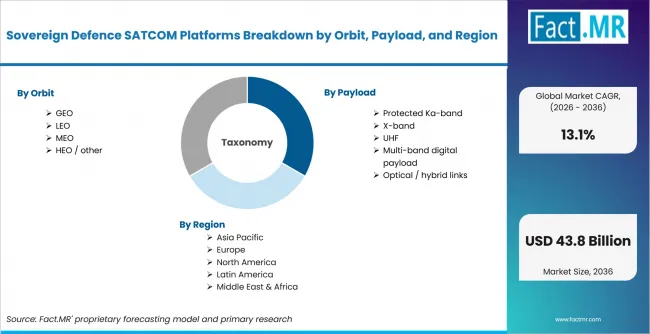
Sovereign Defence Satcom Platforms Breakdown By Orbit, Payload, And Region | Source: Fact.MR
| Attribute | Details |
|---|---|
| Quantitative Units | USD billion |
| Market Definition | Satellite-communication platforms and controlled capacity used by governments and defence organisations for protected, strategic and mission-critical communications. |
| Orbit | GEO; LEO; MEO; HEO / other |
| Payload | Protected Ka-band; X-band; UHF; Multi-band digital payload; Optical / hybrid links |
| Sovereignty Model | National-owned constellation; Dedicated hosted payload; Government-commercial hybrid; Allied shared sovereign system; Rapidly deployable tactical layer |
| Mission | Strategic communications; Tactical beyond-line-of-sight; Nuclear / national command support; Maritime / airborne SATCOM; Coalition interoperability |
| Regions Covered | North America; Latin America; Western Europe; Eastern Europe; East Asia; South Asia & Pacific; Middle East & Africa |
| Countries Covered | USA; France; UK; Germany; Australia |
| Key Companies Profiled | Lockheed Martin; Airbus Defence and Space; Thales Alenia Space; Boeing Defense, Space & Security; Northrop Grumman; L3Harris |
| Forecast Period | 2026 to 2036 |
| Approach | Market sizing, segment analysis and country growth assessment, with coverage of sovereignty models, secure communications programmes, acquisition oversight and spectrum requirements. |
Source: Fact.MR analysis. Updated Sep 15, 2026
How is the market segmented?
-
By Orbit
- GEO
- LEO
- MEO
- HEO / other
-
By Payload
- Protected Ka-band
- X-band
- UHF
- Multi-band digital payload
- Optical / hybrid links
-
By Sovereignty Model
- National-owned constellation
- Dedicated hosted payload
- Government-commercial hybrid
- Allied shared sovereign system
- Rapidly deployable tactical layer
-
By Mission
- Strategic communications
- Tactical beyond-line-of-sight
- Nuclear / national command support
- Maritime / airborne SATCOM
- Coalition interoperability
-
By Region
- North America
- Latin America
- Western Europe
- Eastern Europe
- East Asia
- South Asia & Pacific
- Middle East & Africa
Frequently Asked Questions
How big is the Sovereign Defence SATCOM Platforms Market in 2026?
What is the CAGR of the Sovereign Defence SATCOM Platforms Market from 2026 to 2036?
Which orbit leads the Sovereign Defence SATCOM Platforms Market?
Which sovereignty model leads the Sovereign Defence SATCOM Platforms Market?
Who are the leading companies in the Sovereign Defence SATCOM Platforms Market?
Who worked on this report


Preview the report firsthand - request a free sample
Free SampleGet the brochure for pricing and purchase details
Download PDF