- Market Value (2025): USD 2.15 Bn
- Estimated Value (2026): USD 2.32 Bn
- Forecast Value (2036): USD 5.01 Bn
- CAGR (2026-2036):8.0%
What is the Water Pipeline Leak Detection System (LDS) Market forecast to be worth by 2036?
USD 2.32 billion in 2026 to USD 5.01 billion by 2036 at an 8.0% CAGR.
- The water pipeline leak detection system market reached USD 2.15 billion in 2025 as utilities invested in pipe inspection and loss detection.
- Industry revenue is projected to reach from USD 2.32 billion in 2026 to USD 5.01 billion by 2036 as water network operators expand monitoring beyond periodic field surveys.
- The forecast CAGR of 8.0% applies from 2026 to 2036, supported by utility work on hidden leaks and pipe condition monitoring.
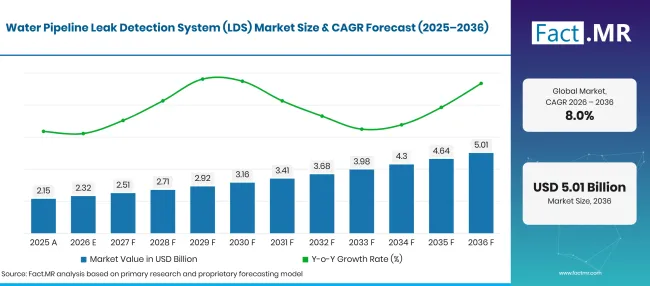
Water Pipeline Leak Detection System Lds Market Forecast Global | Source: Fact.MR
| Year | Basis | Market Value (USD billion) |
|---|---|---|
| 2025 | Actual | 2.15 |
| 2026 | Estimate | 2.32 |
| 2036 | Forecast | 5.01 |
| CAGR 2026 to 2036 | Forecast period | 8.0% |
Source: Fact.MR analysis. Updated Nov 5, 2026
What are the main figures behind Water Pipeline Leak Detection System (LDS) Market growth?
The projected increase is USD 2.7 billion in annual value by 2036. Acoustic detection, portable inspection equipment, metallic pipelines and municipal utilities lead their respective market segments.
- Demand Drivers in the Market
- Distribution utilities need dependable leak locations before opening roads. Acoustic surveys can narrow the search area before repairs begin, reducing unnecessary excavation and service disruption.
- Japan’s Ministry of Land, Infrastructure, Transport and Tourism stated in February 2025 that about 24% of water pipes had exceeded their statutory service life at the end of fiscal 2022 [2]. Buried assets need targeted inspection because surface signs often appear late.
- Listening surveys are most useful when crews know the pipe layout, its material and the expected pressure. Matching the equipment to those conditions helps operators distinguish a possible leak from surrounding noise before planning further investigation.
- Key Segments Analyzed
- By Technology: Acoustic systems account for 52.8% of 2026 value where listening surveys are suited to pressurized underground mains.
- By Equipment Type: Portable systems represent 59.8% of 2026 revenue because utilities move inspection teams between suspected leak locations.
- By Pipe Material: Metallic pipelines contribute 58.8% of 2026 demand; acoustic propagation and older buried metal networks make them central survey targets.
- By End-User: Municipal networks capture 38.5% of 2026 revenue, reflecting the scale of public distribution mains and routine repair responsibility.
- Strategic Implications
- Municipal utility engineers should map pipe material and valve boundaries before choosing acoustic sensor placements. Surveyed pipe length should guide equipment allocation.
- Equipment distributors should offer operator training that covers traffic noise and weak signals on plastic mains. Demonstration surveys support comparison across pipe types.
- System integrators should connect pressure records and leak alarms to the water utility’s existing control screens. Alarm records need practical locations for field response.
- Service contractors should document repair outcomes so utilities can compare false alarms with confirmed field leaks. Repeatable records help evaluate survey results.
Germany is projected to record an 8.6% CAGR through 2036, helped by tighter loss assessment duties. Brazil follows at 7.9% as public water providers address distribution losses. The USA carries a 7.1% forecast CAGR amid pipe renewal and utility monitoring. The UK is projected at 6.4% as regulated companies work toward leakage targets. Japan follows at 5.6% because aging mains keep inspection on maintenance schedules.
How does the Water Pipeline Leak Detection System (LDS) Market break down by segment?
Acoustic technology holds 52.8%; portable equipment holds 59.8%; metallic pipes account for 58.8%; municipal end-users represent 38.5%.
Which Technology dominates?
Acoustic represents 52.8% of 2026 market value.
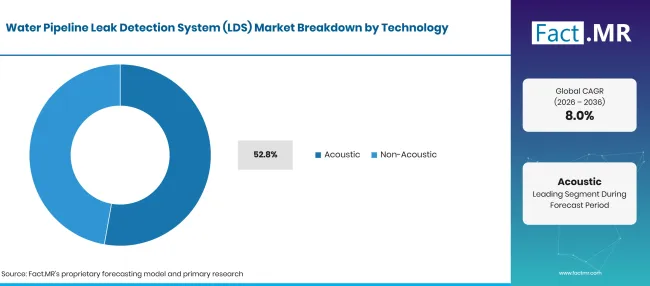
Water Pipeline Leak Detection System Lds Market Breakdown Technology | Source: Fact.MR
| Technology | Share (2026) |
|---|---|
| Acoustic (Leading segment) | 52.8% |
| Other segments combined | 47.2% |
| Total | 100.0% |
Source: Fact.MR analysis. Updated Nov 5, 2026
Acoustic equipment leads the technology segment because escaping water can create a detectable signal in pressurized mains. Survey crews listen at valves or hydrants and compare readings to narrow the section requiring repair. Correlators can help on metallic pipes where vibration travels over useful distances, while ground microphones support checks near accessible sections. Flow and pressure analysis provide complementary methods for detecting wider network changes. The choice depends on pipe material, background noise and the accuracy of existing network records.
What leads Equipment Type?
Portable captures 59.8% of 2026 market value.
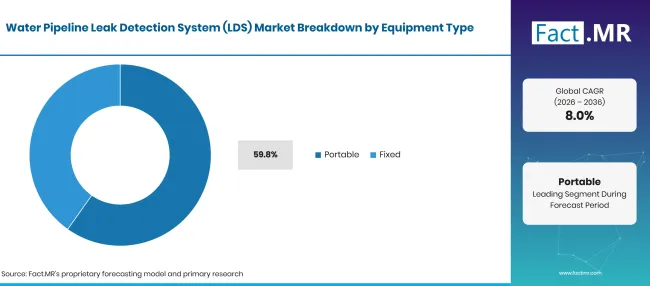
Water Pipeline Leak Detection System Lds Market Breakdown Equipment Type | Source: Fact.MR
| Equipment Type | Share (2026) |
|---|---|
| Portable (Leading segment) | 59.8% |
| Other segments combined | 40.2% |
| Total | 100.0% |
Source: Fact.MR analysis. Updated Nov 5, 2026
Portable systems lead equipment spending because field teams can move them between neighborhoods and investigate new complaints without permanent installation. Handheld devices support initial listening checks, while portable correlators compare signals from separate access points to improve location estimates. Fixed monitors serve mains where repeated faults or difficult access justify regular measurement. Many utilities use both approaches, placing permanent sensors at important locations and bringing portable equipment to areas flagged for investigation.
How does Pipe Material shape demand?
Metallic holds 58.8% of 2026 market value.
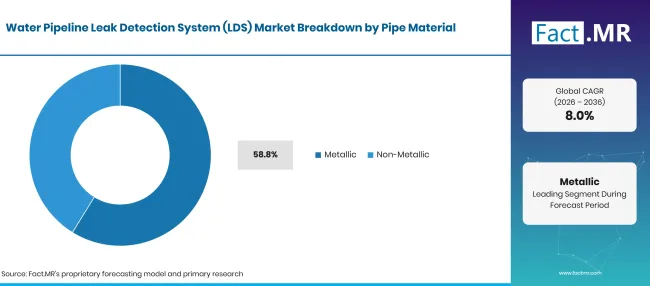
Water Pipeline Leak Detection System Lds Market Breakdown Pipe Material | Source: Fact.MR
| Pipe Material | Share (2026) |
|---|---|
| Metallic (Leading segment) | 58.8% |
| Other segments combined | 41.2% |
| Total | 100.0% |
Source: Fact.MR analysis. Updated Nov 5, 2026
Metallic pipelines account for the largest pipe-material share because their acoustic response allows survey teams to compare leak noise over useful distances. Cast iron and steel mains are common in established networks where accurate location information can guide repairs. Plastic pipes transmit vibration differently, requiring crews to adjust listening positions or combine acoustic evidence with pressure records. Mixed-material networks need particular care when interpreting a signal across joints and material changes.
Which End-User accounts for more spending?
Municipal leads with 38.5% of 2026 market value.
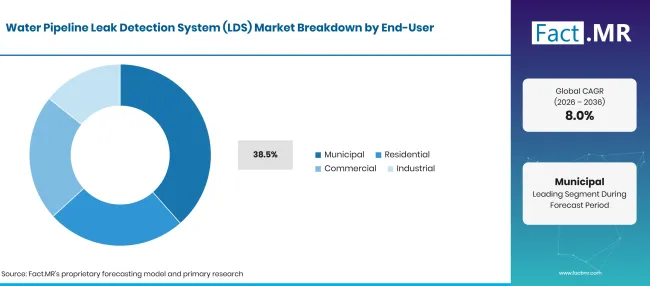
Water Pipeline Leak Detection System Lds Market Breakdown End User | Source: Fact.MR
| End-User | Share (2026) |
|---|---|
| Municipal (Leading segment) | 38.5% |
| Other segments combined | 61.5% |
| Total | 100.0% |
Source: Fact.MR analysis. Updated Nov 5, 2026
Municipal utilities form the largest end-user group because their distribution networks cover many streets and service connections. Engineers need leak information that helps direct crews to the correct location while limiting interruptions for customers. Commercial premises may also require rapid investigation where water loss affects daily operations, while industrial facilities sometimes connect pipe monitoring to existing plant systems. Residential work usually involves smaller service branches or building connections. Municipal buyers place particular value on systems that connect field findings with records of completed repairs and continuing network performance.
What is accelerating Water Pipeline Leak Detection System (LDS) Market adoption, and what is holding it back?
Adoption will grow through utility leak-reduction targets, aging-pipe inspection, portable acoustic surveys and connected network monitoring. Limited inspection budgets, weak acoustic signals, system-integration complexity and the need for field confirmation will constrain how quickly deployments expand.
Drivers Impact Analysis
| DRIVER | (~) % IMPACT ON CAGR | GEOGRAPHIC RELEVANCE | IMPACT TIMELINE |
|---|---|---|---|
| Utility leak-reduction targets | +1.2% | UK, Germany, Brazil | Medium term |
| Aging distribution mains | +1.0% | Japan, USA, Germany | Long term |
| Repair-ready acoustic locations | +0.9% | Global | Short term |
| Digital water monitoring | +0.7% | Europe, North America | Medium term |
| Network pressure analysis | +0.5% | Global | Medium term |
Source: Fact.MR analysis. Updated Nov 5, 2026
Opportunity Impact Analysis
| OPPORTUNITY | (~) % IMPACT ON CAGR | GEOGRAPHIC RELEVANCE | IMPACT TIMELINE |
|---|---|---|---|
| Permanent monitoring of critical mains | +0.7% | Europe, Japan | Long term |
| Mixed-material pipe inspection | +0.6% | Global | Medium term |
| Connected leak analytics | +0.5% | USA, UK, Germany | Medium term |
| Targeted field detection services | +0.4% | Brazil, USA | Short term |
Source: Fact.MR analysis. Updated Nov 5, 2026
Restraints Impact Analysis
| RESTRAINT | INDICATIVE CAGR EFFECT | GEOGRAPHIC RELEVANCE | IMPACT TIMELINE |
|---|---|---|---|
| Limited inspection budgets | -0.7% | Brazil, smaller utilities | Short term |
| Weak acoustic signals | -0.6% | Mixed pipe networks | Medium term |
| Complex system integration | -0.5% | Global | Medium term |
| Excavation and confirmation effort | -0.4% | Urban networks | Short term |
Source: Fact.MR analysis. Updated Nov 5, 2026
Which countries are scaling the Water Pipeline Leak Detection System (LDS) Market through 2036?
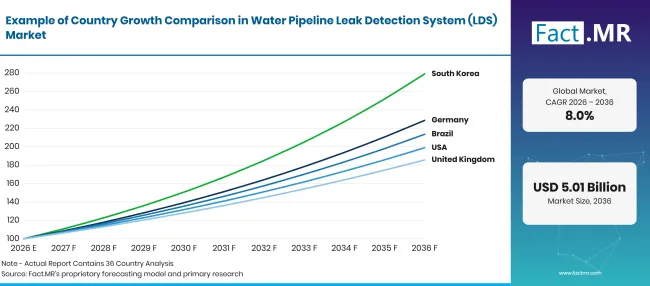
Water Pipeline Leak Detection System Lds Market Growth Index | Source: Fact.MR
| Country | CAGR (2026 to 2036) |
|---|---|
| Germany | 8.6% |
| Brazil | 7.9% |
| USA | 7.1% |
| UK | 6.4% |
| Japan | 5.6% |
Source: Fact.MR analysis. Updated Nov 5, 2026
What supports Germany’s water pipeline monitoring outlook?
8.6% CAGR, linked to water-network loss management.
Germany’s water utilities are expected to focus on checking underground mains before repair teams open streets. The Federal Environment Agency published an assessment of water losses in September 2026 [6].
How is Brazil addressing distribution losses?
7.9% CAGR, linked to water-network loss management.
Brazilian operators are anticipated to expand leak investigations where distribution losses put pressure on water service performance. The Ministry of Cities published SINISA 2025 results in December 2025 using water-supply information for the 2024 reference year [7]. A Goiás government announcement in November 2025 discussed a national distribution-loss figure of 40.3% [8].
What supports adoption in the USA?
7.1% CAGR, linked to water-network loss management.
US water utilities are expected to use leak detection alongside renewal of aging distribution mains. The Environmental Protection Agency’s infrastructure assessment identifies USD 422.9 billion in distribution and transmission improvement needs [9]. A November 2025 EPA update describes the national inventory of lead service lines and related replacement activity [1].
How are UK utilities investing in leak detection?
6.4% CAGR, linked to water-network loss management.
Water utilities in the United Kingdom are expected to emphasize repair-ready leak locations under regulated performance programs. Ofwat reported leakage of 2,869 megalitres a day across England and Wales in 2024–25 [5]. The regulator set a further reduction target of 457.3 megalitres per day for 2025–30, around 17% against the 2024–25 baseline.
Why does Japan continue to inspect aging water mains?
5.6% CAGR, linked to water-network loss management.
Japan’s water utilities are increasing inspection activity as a growing share of buried pipes exceeds its expected service life. Portable acoustic tools and fixed monitors help operators locate hidden losses before repair work begins. Aging infrastructure, pipe-material differences and demanding urban excavation conditions keep leak detection central to maintenance planning.
Who leads the Water Pipeline Leak Detection System (LDS) Market?
ABB, Siemens, Xylem and Mueller Water Products offer direct water-network leak detection capabilities.
ABB supplies water-network leakage monitoring and localization within Symphony Plus, while Siemens lists a pipeline leak detection software application that uses flow and pressure readings to generate alarms [4][15]. Xylem’s SmartBall technology travels inside pressurized mains to listen for acoustic anomalies. Mueller Water Products offers Echologics acoustic solutions designed to pinpoint underground losses. These businesses approach the same utility problem through different combinations of field instrumentation and software.
Schneider Electric introduced its Water Advisor Leak Insight module in June 2026 [3]. Badger Meter participates in connected water management and network monitoring, although its January 2025 SmartCover purchase focused on wastewater collection monitoring rather than drinking-water-main leaks [16]. Honeywell’s broader automation activities do not by themselves establish a dedicated water-pipeline LDS product.
Bibliography
- [1] U.S. Environmental Protection Agency. (2025, November). 2025 update to the 7th Drinking Water Infrastructure Needs Survey and Assessment (DWINSA).
- [2] Ministry of Land, Infrastructure, Transport and Tourism. (2025, February 14). Ministerial press conference transcript. Government of Japan.
- [3] Schneider Electric. (2026, June 30). Schneider Electric launches EcoStruxure Water Advisor to enhance visibility and performance of water infrastructure.
- [4] ABB. (2026, September 8). ABB launches digital platform for optimizing operation of water networks.
- [5] Ofwat. (2025, October 23). Water Company Performance Report 2024–25.
- [6] Statistisches Bundesamt (Destatis). (2025, April 15). Withdrawal of water from the environment and discharge of water into the environment as well as exports and imports of water.
- [7] Saneamento de Goiás S.A. (2025). Relatório da Administração: 1T2025.
- [8] Ministry of Land, Infrastructure, Transport and Tourism. (2025).[Current status and challenges of aging water supply and sewerage pipelines]. Government of Japan.
- [9] Siemens. (n.d.). Leak Detection System for Pipelines: Tender specifications.
This Report Answers
- How acoustic and non-acoustic technologies fit different pipe materials and network conditions.
- Why portable equipment accounts for more spending than fixed monitoring devices in 2026.
- How municipal end-users decide between routine survey programs and permanent alerts.
- What network loss assessments mean for Germany, Brazil, USA, UK and Japan.
- How equipment manufacturers differ in acoustic localization and connected monitoring.
- How leak detection performance depends on alarm quality and practical repair access.
What does the Water Pipeline Leak Detection System (LDS) Market cover?
This market covers equipment and software whose primary purpose is detecting or locating losses from pressurized water mains and connected service pipelines. Acoustic systems listen for escaping water, while non-acoustic systems compare pressure or flow behavior to identify abnormal events.
What is included in the scope?
Portable acoustic correlators, listening devices, fixed acoustic sensors and dedicated pipeline leak analytics form the central categories.
Systems linked to existing supervisory controls are included where they identify losses in water distribution mains. Municipal distribution networks and private industrial water pipelines are covered.
What is excluded from the scope?
Simple room-level flood alarms, domestic appliance shutoff devices and building water-damage sensors are outside the central pipeline scope.
General-purpose meters and supervisory software are excluded when sold without a dedicated leak-detection function. Repair pipe, valves and excavation services are excluded unless bundled as a clearly defined detection service.
How Was the Analysis Built?
The analysis draws on 120+ sources, 35+ company portfolios, 25+ countries, and more than 20 industry interviews.
- Primary Research: Primary research includes discussions with manufacturers, service providers, technology developers, distributors, end users, and subject-matter experts. These conversations examine purchasing priorities, product adoption, operational challenges, approval requirements, competitive positioning, and the factors that influence wider market acceptance.
- Desk Research: Desk research covers government statistics, regulatory publications, company filings, trade data, technical studies, industry associations, standards, public policy, and other authoritative sources. Every source used in the analysis is documented in the bibliography.
- Market Sizing and Forecasting: Market estimates combine historical performance, demand indicators, pricing and volume trends, segment shares, company participation, country-level growth, adoption patterns, investment activity, and barriers to market expansion.
- Data Validation and Update Cycle: Findings are validated by comparing primary interviews with public data, company activity, regulatory changes, trade patterns, and industry developments. Regular updates review new product launches, capacity changes, partnerships, approvals, and shifts in commercial adoption.
Which companies are the key providers?
Key companies include ABB Ltd.; Siemens AG; Xylem Inc.; Badger Meter Inc.; Honeywell International Inc.; Schneider Electric SE; and Mueller Water Products Inc.
- ABB Ltd.
- Siemens AG
- Xylem Inc.
- Badger Meter Inc.
- Honeywell International Inc.
- Schneider Electric SE
- Mueller Water Products Inc.
Segmentation
What is the report’s scope and coverage?
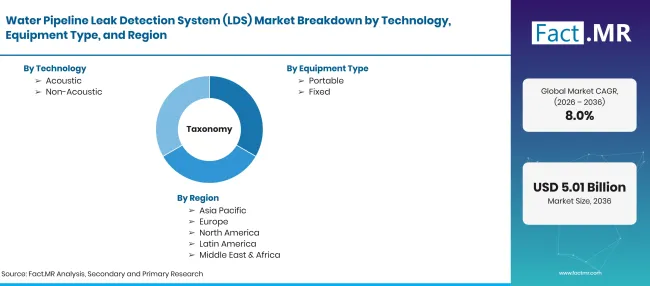
Water Pipeline Leak Detection System Lds Market Taxonomy | Source: Fact.MR
| Attribute | Details |
|---|---|
| Quantitative Units | USD billion |
| Market Definition | Hardware and dedicated software for finding and locating leaks in pressurized water pipelines |
| Technology | Acoustic; Non-Acoustic |
| Equipment Type | Portable; Fixed |
| Pipe Material | Metallic; Non-Metallic |
| End-User | Municipal; Residential; Commercial; Industrial |
| Regions Covered | North America; Latin America; Western Europe; Eastern Europe; East Asia; South Asia & Pacific; Middle East & Africa |
| Countries Covered | Germany; Brazil; USA; UK; Japan |
| Companies Profiled | ABB Ltd.; Siemens AG; Xylem Inc.; Badger Meter Inc.; Honeywell International Inc.; Schneider Electric SE; and Mueller Water Products Inc. |
| Forecast Period | 2026 to 2036 |
| Approach | Network asset coverage; pipe material; utility leak controls; equipment application and service needs |
Source: Fact.MR analysis. Updated Nov 5, 2026
How is the market segmented?
-
By Technology
- Acoustic
- Non-Acoustic
-
By Equipment Type
- Portable
- Fixed
-
By Pipe Material
- Metallic
- Non-Metallic
-
By End-User
- Municipal
- Residential
- Commercial
- Industrial
-
By Region
- North America
- Latin America
- Western Europe
- Eastern Europe
- East Asia
- South Asia & Pacific
- Middle East & Africa
Frequently Asked Questions
How big is the water pipeline leak detection system market in 2026?
What CAGR applies to this market between 2026 and 2036?
Which detection technology has the highest share?
Which equipment type leads sales?
Who supplies pipeline leak-detection solutions?
Who worked on this report


Preview the report firsthand - request a free sample
Free SampleGet the brochure for pricing and purchase details
Download PDF