- Market Value (2025): USD 4.71 Bn
- Estimated Value (2026): USD 5.07 Bn
- Forecast Value (2036): USD 10.6 Bn
- CAGR (2026-2036): 7.7%
What is the SCADA in Process Industries Market forecast to be worth by 2036?
USD 5.1 billion in 2026 to USD 10.6 billion by 2036 at a 7.7% CAGR.
- As per Fact.MR analysis, the SCADA in process industries market was valued at USD 4.71 billion in 2025.
- Demand will grow from USD 5.07 billion in 2026 to USD 10.6 billion by 2036.
- The forecast represents a 7.7% CAGR from 2026 to 2036, supported by industrial automation and the growing need for centralized process monitoring.
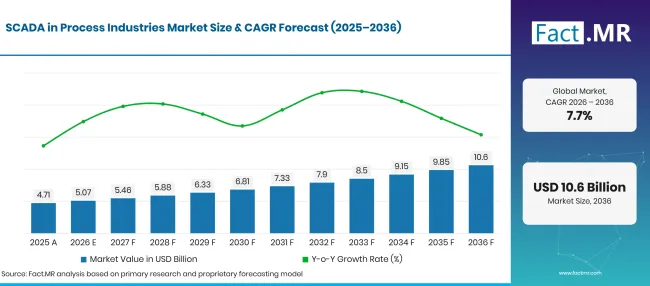
Scada In Process Industries Market Forecast Global | Source: Fact.MR
| Year | Basis | Market Value (USD billion) |
|---|---|---|
| 2025 | Actual | 4.71 |
| 2026 | Estimate | 5.07 |
| 2036 | Forecast | 10.6 |
| CAGR 2026 to 2036 | Forecast period | 7.7% |
Source: Fact.MR analysis. Updated Nov 5, 2026
What are the defining numbers behind SCADA in Process Industries Market growth?
USD 5.5 billion absolute opportunity between 2026 and 2036.
- Demand Drivers in the Market
- Growing industrial automation across process facilities is increasing the need for centralised monitoring and control. Oil and gas operators, chemical manufacturers and other process-industry participants use SCADA platforms to obtain real-time operational information, supervise equipment and improve visibility across production sites.
- Increasing emphasis on operational efficiency and plant reliability is encouraging investment in industrial monitoring systems. SCADA platforms help operators track process conditions, identify abnormal operating patterns and coordinate responses to equipment issues. These capabilities can support production continuity and reduce avoidable operational interruptions.
- Modernisation of legacy industrial control infrastructure is creating opportunities for SCADA providers. Many facilities need to connect older equipment with newer automation platforms and enterprise applications. Scalable software and open communication interfaces can help operators improve data access without replacing every installed control asset.
- Growing attention to industrial cybersecurity and remote operations is influencing SCADA investment decisions. Connected process facilities need secure access controls and reliable communication between field devices and supervisory systems. Vendors that support resilient architectures and controlled remote access can address these requirements across geographically distributed operations.
- Key Segments Analyzed
- By Component: Hardware will account for 42.5% of the market in 2026, reflecting the role of servers, operator stations, communication equipment and field interfaces in SCADA deployments.
- By Application: Oil & Gas will hold 28.3% share in 2026, supported by the need to monitor production assets, pipelines and processing facilities.
- By Deployment Mode: On-Premises systems will represent 71.8% share in 2026, reflecting the importance of local control, data governance and integration with plant infrastructure.
- By Enterprise Size: Large Enterprises leads with 64.3% share in 2026, driven by their operation of complex facilities and multi-site industrial networks.
- Analyst Opinion at Fact.MR
- Shambhu Nath Jha, Principal Consultant at Fact.MR, states, “SCADA adoption in process industries is increasingly linked to the need for dependable operational visibility across complex facilities. Providers need to demonstrate secure connectivity, reliable data acquisition and compatibility with existing control infrastructure while helping operators modernise systems without disrupting production.”
- Strategic Implications
- SCADA providers should demonstrate compatibility with installed PLCs, RTUs, sensors and industrial communication protocols.
- Industrial operators need to assess cybersecurity, system redundancy and disaster-recovery capabilities before selecting a deployment architecture.
- Technology vendors should provide migration pathways that allow facilities to modernize legacy systems while maintaining operational continuity.
- System integrators can support adoption by tailoring SCADA interfaces and reporting functions to the operating requirements of each process industry.
Germany is projected to register a 7.0% CAGR through 2036. Brazil is set to record 8.1%, followed by the USA at 9.2%. The UK is projected to advance at 7.6%, while Japan is forecast to grow at 8.6%.
How does the SCADA in Process Industries Market break down by segment?
Fact.MR finds that Hardware leads Component at 42.5%; Oil & Gas leads Application at 28.3%; On-Premises leads Deployment Mode at 71.8%; and Large Enterprises lead Enterprise Size at 64.3%.
Which Component segment dominates?
Hardware is set to hold 42.5% share in 2026.
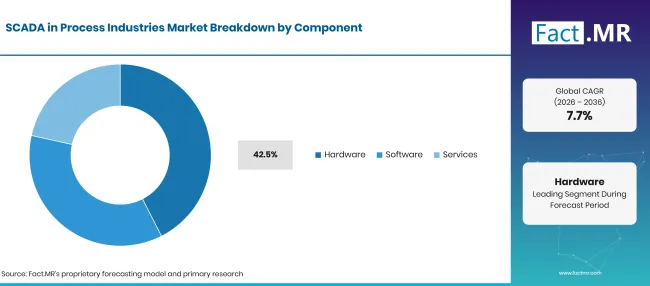
Scada In Process Industries Market Breakdown Component | Source: Fact.MR
| Component | Share (2026) |
|---|---|
| Hardware (Leading segment) | 42.5% |
| Other segments combined | 57.5%* |
| Total | 100.0% |
Source: Fact.MR analysis. Updated Nov 5, 2026
Hardware includes the physical infrastructure required to collect, transmit and display operational data. Servers, industrial computers, operator workstations and communication devices support the functioning of SCADA platforms. Software and services remain important because they provide supervisory applications, system configuration, integration and ongoing technical support. Hardware requirements depend on facility size, network architecture and the number of monitored assets.
Which Application segment leads?
Oil & Gas is set to represent 28.3% share in 2026.
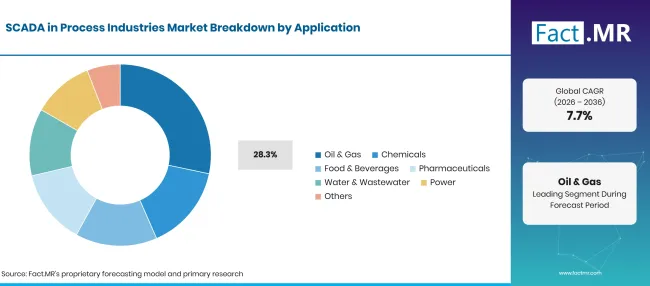
Scada In Process Industries Market Breakdown Application | Source: Fact.MR
| Application | Share (2026) |
|---|---|
| Oil & Gas (Leading segment) | 28.3% |
| Other segments combined | 71.7%* |
| Total | 100.0% |
Source: Fact.MR analysis. Updated Nov 5, 2026
Oil and gas facilities require continuous monitoring of production equipment and processing operations. SCADA systems help operators supervise pipelines, pumping stations and geographically distributed assets while collecting information from field devices. Chemicals, food and beverages and pharmaceuticals also require process monitoring to support production consistency. Water and wastewater facilities and power operations represent additional application areas.
How does Deployment Mode shape demand?
On-Premises deployment is likely to account for 71.8% share in 2026.
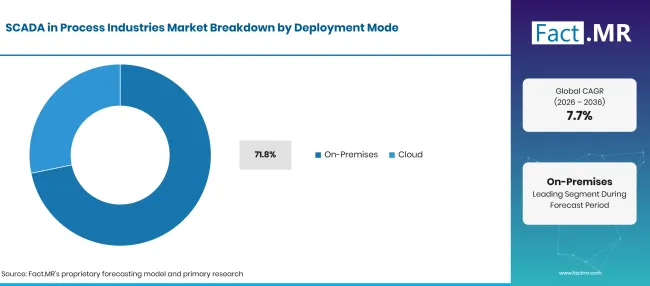
Scada In Process Industries Market Breakdown Deployment Mode | Source: Fact.MR
| Deployment Mode | Share (2026) |
|---|---|
| On-Premises (Leading segment) | 71.8% |
| Other segments combined | 28.2%* |
| Total | 100.0% |
Source: Fact.MR analysis. Updated Nov 5, 2026
On-premises SCADA deployments allow industrial operators to maintain supervisory infrastructure within their own facilities or private networks. This approach can support local control requirements and integration with existing operational technology environments. Cloud deployment provides opportunities for remote data access and centralised analytics, although implementation depends on cybersecurity policies, connectivity and the criticality of the monitored process.
Which Enterprise Size dominates?
Large Enterprises are set to hold 64.3% share in 2026.
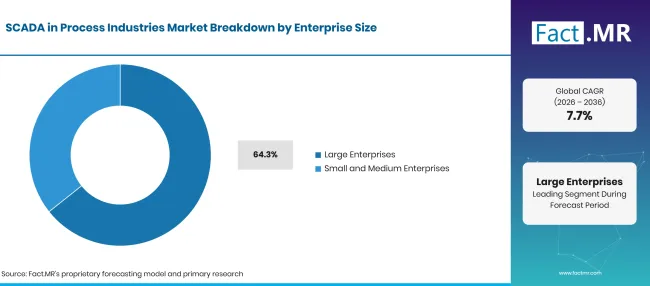
Scada In Process Industries Market Breakdown Enterprise Size | Source: Fact.MR
| Enterprise Size | Share (2026) |
|---|---|
| Large Enterprises (Leading segment) | 64.3% |
| Other segments combined | 35.7%* |
| Total | 100.0% |
Source: Fact.MR analysis. Updated Nov 5, 2026
Large enterprises account for the leading share because they commonly operate complex process facilities and multiple production locations. Their SCADA requirements can involve extensive data acquisition, centralised monitoring and integration with existing control systems. Small and medium enterprises also use SCADA to improve operational visibility, although their deployments may be more limited in scale and functionality.
What is accelerating SCADA in Process Industries Market adoption, and what is holding it back?
Industrial digitalization and the need for reliable process monitoring support demand, while cybersecurity exposure, integration complexity and high implementation costs can slow adoption.
Drivers Impact Analysis
| DRIVER | (~) % IMPACT ON CAGR | GEOGRAPHIC RELEVANCE | IMPACT TIMELINE |
|---|---|---|---|
| Industrial automation and process digitization | +1.2% | Global | Medium term (2–4 years) |
| Demand for real-time process monitoring and operational visibility | +1.0% | Global | Short term (≤2 years) |
| Modernization of ageing industrial control infrastructure | +0.8% | Europe, Americas | Medium term (2–4 years) |
| Integration of SCADA with industrial IoT and advanced analytics | +0.7% | Global | Long term (≥4 years) |
| Expansion of process industries and infrastructure projects | +0.5% | Asia, Americas | Long term (≥4 years) |
Source: Fact.MR analysis. Updated Nov 5, 2026
Opportunity Impact Analysis
| OPPORTUNITY | (~) % IMPACT ON CAGR | GEOGRAPHIC RELEVANCE | IMPACT TIMELINE |
|---|---|---|---|
| Integration of SCADA with AI-enabled predictive maintenance | +0.9% | Global | Medium term (2–4 years) |
| Cloud-based and hybrid SCADA deployment | +0.7% | Americas, Europe, Asia | Medium term (2–4 years) |
| Cybersecurity-enhanced SCADA platforms | +0.6% | Global | Short term (≤2 years) |
| Remote monitoring and centralized plant operations | +0.5% | Global | Medium term (2–4 years) |
| SCADA upgrades in water, wastewater and energy infrastructure | +0.4% | Asia, Americas | Long term (≥4 years) |
Source: Fact.MR analysis. Updated Nov 5, 2026
Restraints Impact Analysis
| RESTRAINT | (~) % IMPACT ON CAGR | GEOGRAPHIC RELEVANCE | IMPACT TIMELINE |
|---|---|---|---|
| High initial deployment and integration costs | -0.9% | Global | Short term (≤2 years) |
| Cybersecurity risks and exposure of industrial networks | -0.7% | Global | Medium term (2–4 years) |
| Compatibility issues with legacy equipment and control systems | -0.6% | Europe, Americas | Medium term (2–4 years) |
| Shortage of skilled industrial automation professionals | -0.5% | Global | Medium term (2–4 years) |
| Operational disruption and downtime during system upgrades | -0.4% | Global | Short term (≤2 years) |
Source: Fact.MR analysis. Updated Nov 5, 2026
Which countries are scaling the SCADA in Process Industries Market through 2036?
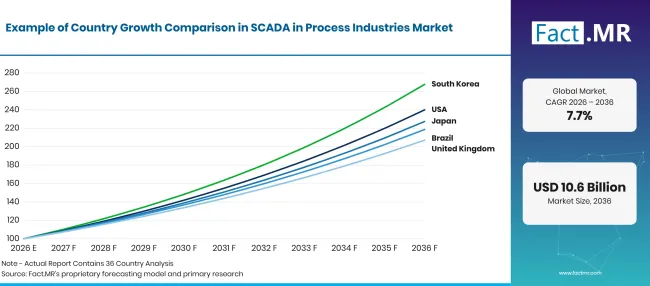
Scada In Process Industries Market Growth Index | Source: Fact.MR
| Country | CAGR (2026–2036) |
|---|---|
| Germany | 7.0% |
| Brazil | 8.1% |
| USA | 9.2% |
| UK | 7.6% |
| Japan | 8.6% |
Source: Fact.MR analysis. Updated Nov 5, 2026
What supports Germany adoption?
7.0% CAGR, supported by advanced manufacturing and the modernization of industrial control infrastructure.
Germany's process industries include chemicals, pharmaceuticals, food processing and industrial manufacturing, where operators require reliable monitoring of production assets. Destatis reported that industrial production increased by 2.0% in August 2026 compared with the previous month. Modernisation of plant infrastructure and the need to integrate production data with supervisory systems can support SCADA investment across industrial facilities [1].
How is Brazil developing SCADA adoption?
8.1% CAGR, led by industrial automation and monitoring requirements across process-intensive sectors.
Brazil's industrial base includes oil and gas, chemicals, food processing and power generation. These operations require monitoring of equipment and production processes across both centralised facilities and distributed assets. The Brazilian Ministry of Finance, citing IBGE's Monthly Industrial Survey, reported that industrial production increased by 0.2% in July 2026 compared with June. Continued investment in process efficiency and operational visibility can support demand for SCADA platforms [2].
What supports United States adoption?
9.2% CAGR, backed by industrial digitalization and investment in process automation.
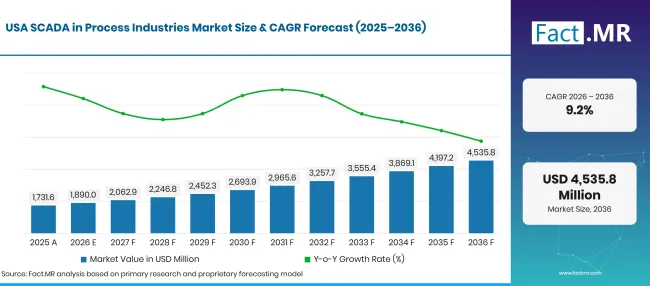
Scada In Process Industries Market Forecast Usa | Source: Fact.MR
The United States has a broad process-industry base covering oil and gas, chemicals, pharmaceuticals, food processing and power. SCADA systems help operators monitor production conditions and coordinate activities across complex facilities. The Federal Reserve reported that total industrial production increased by 0.7% in September 2026 compared with August, while manufacturing capacity utilisation reached 75.9%. These industrial activities provide a broad operating environment for supervisory monitoring and automation solutions [3].
How is the United Kingdom building adoption?
7.6% CAGR, shaped by process automation requirements across manufacturing and critical infrastructure.
The UK market includes chemical production, pharmaceuticals, food processing, energy and water infrastructure. Operators need dependable monitoring to manage production conditions and support operational continuity. The Office for National Statistics reported that production output increased by 0.8% in August 2026, with manufacturing output rising by 1.2% during the month. Investment in industrial monitoring and modernization can support SCADA demand across process facilities [4].
What supports Japan adoption?
8.6% CAGR, driven by advanced manufacturing and demand for precise industrial process control.
Japan's industrial base includes chemicals, pharmaceuticals, food processing, power and advanced manufacturing. These industries require reliable supervisory systems to monitor production equipment and maintain consistent operating conditions. The Ministry of Economy, Trade and Industry maintains monthly industrial production and manufacturing statistics covering sectors such as chemicals, machinery, electrical equipment and petroleum products. These data provide an important basis for tracking industrial activity and the operating environment for SCADA solutions [5].
Who leads the SCADA in Process Industries Market?
Fact.MR profiles Siemens AG, ABB Ltd., Schneider Electric SE, Honeywell International Inc. and Rockwell Automation Inc. alongside Emerson Electric Co., GE Vernova Inc., Yokogawa Electric Corporation and Mitsubishi Electric Corporation across industrial automation and supervisory control markets.
Siemens AG offers SIMATIC WinCC, a scalable SCADA platform used for industrial visualisation, monitoring and control. Its product range supports applications ranging from operator interfaces to complex supervisory systems [6]. ABB Ltd. participates through its automation portfolio, including Compact HMI, a PC-based SCADA platform that provides plant monitoring, alarm management and remote access capabilities. ABB's System 800xA also supports integrated process control and supervisory operations [7].
Schneider Electric SE offers EcoStruxure Geo SCADA Expert for telemetry and remote monitoring across geographically distributed infrastructure. Honeywell International Inc. provides Experion SCADA and Experion HS platforms for supervisory control and industrial monitoring. Rockwell Automation Inc. markets FactoryTalk View Site Edition, an HMI/SCADA solution designed for distributed industrial environments and process applications [8] [9] [10].
Emerson Electric Co. incorporates SCADA capabilities into its DeltaV Automation Platform, which combines process control with supervisory monitoring and operations management. Yokogawa Electric Corporation offers FAST/TOOLS, a SCADA software environment supporting data acquisition, alarm management and real-time operational monitoring. Mitsubishi Electric Corporation provides MC Works64 for plant-wide monitoring and supervisory control [11] [12] [13].
Which companies are the key providers?
Key company set for the SCADA in Process Industries Market includes:
- Siemens AG
- ABB Ltd.
- Schneider Electric SE
- Honeywell International Inc.
- Rockwell Automation Inc.
- Emerson Electric Co.
- GE Vernova Inc.
- Yokogawa Electric Corporation
- Mitsubishi Electric Corporation
Bibliography
- [1] Statistisches Bundesamt (Destatis). (2026, October 7). Production in August 2026: +2.0% on the previous month.
- [2] Ministério da Fazenda. (2026, September 2). Informativo Econômico - PIM de julho/26.
- [3] Board of Governors of the Federal Reserve System. (2026, October 16). Industrial production and capacity utilization - G.17.
- [4] Office for National Statistics. (2026, October 15). GDP monthly estimate, UK: August 2026.
- [5] Ministry of Economy, Trade and Industry. (n.d.). Indices of industrial production.
- [6] Siemens. (n.d.). SIMATIC WinCC.
- [7] ABB. (n.d.). Operator interfaces.
- [8] Schneider Electric. (n.d.). SCADA & telemetry software.
- [9] Honeywell. (n.d.). SCADA
- [10] Rockwell Automation. (n.d.). FactoryTalk View Site Edition software.
- [11] Emerson. (2024, March 26). Emerson’s new comprehensive automation platform empowers decisive action from plant to enterprise.
- [12] Yokogawa Electric Corporation. (n.d.). FAST/TOOLS.
- [13] Mitsubishi Electric Corporation. (n.d.). Factory Automation Systems.
This Report Answers
- The report examines demand for SCADA systems across the specified process-industry applications.
- Component analysis evaluates hardware, software and services within industrial supervisory control systems.
- Deployment analysis compares on-premises and cloud-based SCADA architectures.
- Enterprise-size analysis examines adoption across large enterprises and small and medium enterprises.
- Country analysis discusses Germany, Brazil, the USA, the UK and Japan alongside industrial activity and automation requirements.
- The competitive overview profiles the nine companies included in the company set.
What does the SCADA in Process Industries Market cover?
The market covers supervisory control and data acquisition systems used to monitor and manage industrial processes. These systems collect information from field equipment and control devices, allowing operators to view process conditions and respond to operational changes. The analysis considers hardware, software and services across the specified applications and deployment modes.
What is included in the scope?
Included products and solutions comprise SCADA hardware, supervisory software and associated services used for process-industry monitoring and control.
The scope covers on-premises and cloud deployment models where they support industrial SCADA functions. Applications include oil and gas, chemicals, food and beverages, pharmaceuticals, water and wastewater and power operations.
What is excluded from the scope?
The analysis excludes standalone automation equipment that does not provide SCADA functionality.
General-purpose enterprise IT software and business intelligence platforms without supervisory control or data acquisition capabilities are outside the defined market. Standalone sensors, PLCs and control devices are excluded when sold independently without forming part of a SCADA system or solution. General-purpose cybersecurity products and unrelated industrial software are also excluded.
How Was the Analysis Built?
The analysis draws on 120+ sources, 35+ company portfolios, 25+ countries, and more than 20 industry interviews.
- Primary Research: Primary research includes discussions with manufacturers, service providers, technology developers, distributors, end users, and subject-matter experts. These conversations examine purchasing priorities, product adoption, operational challenges, approval requirements, competitive positioning, and the factors that influence wider market acceptance.
- Desk Research: Desk research covers government statistics, regulatory publications, company filings, trade data, technical studies, industry associations, standards, public policy, and other authoritative sources. Every source used in the analysis is documented in the bibliography.
- Market Sizing and Forecasting: Market estimates combine historical performance, demand indicators, pricing and volume trends, segment shares, company participation, country-level growth, adoption patterns, investment activity, and barriers to market expansion.
- Data Validation and Update Cycle: Findings are validated by comparing primary interviews with public data, company activity, regulatory changes, trade patterns, and industry developments. Regular updates review new product launches, capacity changes, partnerships, approvals, and shifts in commercial adoption.
Segmentation
What is the report’s scope and coverage?
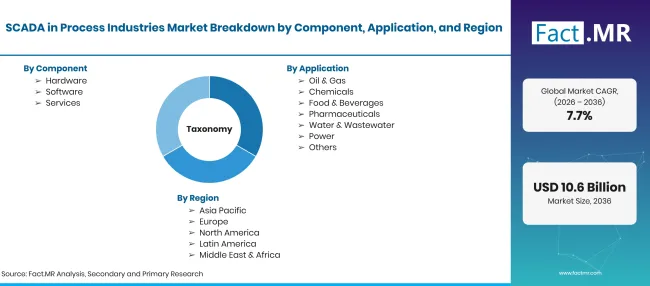
Scada In Process Industries Market Taxonomy | Source: Fact.MR
| Attribute | Details |
|---|---|
| Quantitative Units | USD billion in 2026 to USD billion by 2036, at CAGR |
| Market Definition | The SCADA in process industries market comprises hardware and software systems used to monitor, supervise and control industrial operations through real-time data acquisition and visualization. These solutions collect and process information from sensors, instruments and plant equipment to provide centralized operational visibility. |
| Component | Hardware; Software; Services |
| Application | Oil & Gas; Chemicals; Food & Beverages; Pharmaceuticals; Water & Wastewater; Power; Others |
| Deployment Mode | On-Premises; Cloud |
| Enterprise Size | Large Enterprises; Small and Medium Enterprises |
| Regions Covered | North America; Latin America; Western Europe; Eastern Europe; East Asia; South Asia & Pacific; Middle East & Africa |
| Countries Covered | Germany; Brazil; USA; UK; Japan |
| Companies Profiled | Siemens AG; ABB Ltd.; Schneider Electric SE; Honeywell International Inc.; Rockwell Automation Inc.; Emerson Electric Co.; GE Vernova Inc.; Yokogawa Electric Corporation; Mitsubishi Electric Corporation |
| Forecast Period | 2026 to 2036 |
| Approach | Market segmentation and scenario-based analysis supported by industrial statistics, company product portfolios and automation industry developments |
Source: Fact.MR analysis. Updated Nov 5, 2026
How is the market segmented?
-
By Component
- Hardware
- Software
- Services
-
By Application
- Oil & Gas
- Chemicals
- Food & Beverages
- Pharmaceuticals
- Water & Wastewater
- Power
- Others
-
By Deployment Mode
- On-Premises
- Cloud
-
By Enterprise Size
- Large Enterprises
- Small and Medium Enterprises
-
By Region
- North America
- Latin America
- Western Europe
- Eastern Europe
- East Asia
- South Asia & Pacific
- Middle East & Africa
Frequently Asked Questions
How big is the SCADA in Process Industries Market in 2026?
What is the CAGR from 2026 to 2036?
Which component segment has the largest share?
Which application segment leads?
Which deployment mode leads the market?
Which enterprise-size segment has the largest share?
Which companies are covered?
Who worked on this report


Preview the report firsthand - request a free sample
Free SampleGet the brochure for pricing and purchase details
Download PDF