- Market Value (2025): USD 480.1 Mn
- Estimated Value (2026): USD 519.1 Mn
- Forecast Value (2036): USD 1133.3 Mn
- CAGR (2026-2036): 8.1%
What is the FIR-Far Infrared Ray Lens Market forecast to be worth by 2036?
USD 519.1 million in 2026 to USD 1133.3 million by 2036, at an 8.1% CAGR.
- Fact.MR estimates the market at USD 480.1 million in 2025, reflecting sales of optical assemblies for thermal imaging equipment.
- Revenue is expected to reach from USD 519.1 million in 2026 to USD 1133.3 million by 2036 as manufacturers purchase fixed-focus and adjustable-field-of-view optics for thermal cameras.
- The 8.1% CAGR projected for 2026 to 2036 reflects demand from security surveillance, industrial inspection and defense imaging applications.
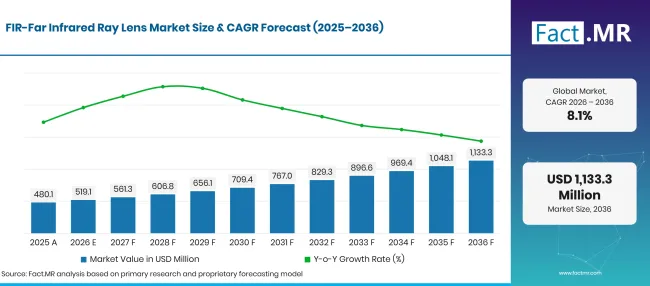
Fir Far Infrared Ray Lens Market Forecast Global | Source: Fact.MR
| Year | Basis | Market Value (USD million) |
|---|---|---|
| 2025 | Actual | 480.1 |
| 2026 | Estimate | 519.1 |
| 2036 | Forecast | 1133.3 |
| CAGR 2026 to 2036 | Forecast period | 8.1% |
Source: Fact.MR analysis. Updated Nov 5, 2026
What are the defining numbers behind FIR-Far Infrared Ray Lens Market growth?
Between 2026 and 2036, the market is expected to add USD 614.2 million in annual value. Zoom lenses account for 60.0% of product revenue in 2026.
- Demand Drivers in the Market
- Security camera integrators specify infrared lenses that maintain usable image detail in darkness. Long-range viewing and wide-area coverage create different field-of-view requirements, making lens selection central to the camera design.
- Thermal camera developers are extending the range of compact imaging modules. Teledyne FLIR OEM announced radiometric Boson+ and Hadron 640R+ thermal-visible modules in March 2025, aimed at defense and industrial integration [2].
- Defense equipment designers specify lens assemblies against operating temperatures and vibration loads. Optical suppliers compete on coating quality, accurate alignment and qualification records that help integrators retain image performance outside controlled laboratory conditions.
- Industrial system builders use infrared imaging to inspect equipment without making physical contact. Lens selection depends on working distance and the size of the object being observed, so a standard camera module cannot serve every installation.
- Key Segments Analyzed
- By Product Type: Zoom Lens accounts for 60.0% of 2026 value as adjustable viewing angles suit multi-distance observation.
- By Application: Surveillance accounts for 38.5% of 2026 demand due to continuous thermal observation in security systems.
- By Material: Germanium represents 55.0% of 2026 material value through its established use in long-wave infrared optics.
- By End-User: Military and Defense represents 34.0% of 2026 spending, reflecting specialist imaging requirements.
- Analyst Opinion at Fact.MR
- Shambhu Nath Jha, Principal Consultant at Fact.MR, states, “FIR lens demand depends on how precisely optics match detector size, viewing distance and operating conditions. Buyers compare field of view, coating durability, material choice and qualification requirements before approving a design. Suppliers that combine repeatable optical performance with reliable material access and clear technical documentation are better placed to secure repeat orders.”
- Strategic Implications
- Lens manufacturers should supply repeatable optical specifications and coating test records to help camera developers compare products and complete qualification.
- Imaging-module developers should define detector dimensions and lens interfaces early, reducing mechanical redesign when moving into volume production.
- Defense integrators should evaluate the origin and availability of optical materials alongside imaging performance, as component shortages can delay finished systems.
- Industrial camera distributors should establish the working distance and area requiring inspection before proposing fixed-focus or zoom optics.
Germany is projected to lead the five-country outlook with a 9.8% CAGR through 2036, supported by precision optics and industrial imaging. Japan follows at 8.6%, drawing on established camera and optical-component manufacturing. The USA is forecast at 8.2%, Brazil at 7.9% and the UK at 6.2%, reflecting different security, industrial and specialist imaging requirements.
How does the FIR-Far Infrared Ray Lens Market break down by segment?
In 2026, Zoom Lens leads Product Type with 60.0%, Surveillance leads Application with 38.5%, Germanium leads Material with 55.0%, and Military and Defense leads End-User with 34.0%.
Which Product Type dominates?
Zoom Lens represents 60.0% of market value in 2026.
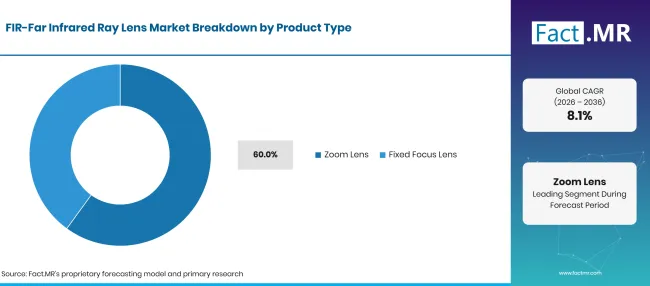
Fir Far Infrared Ray Lens Market Breakdown Product Type | Source: Fact.MR
| Product Type | Share (2026) |
|---|---|
| Zoom Lens (Leading segment) | 60.0% |
| Other segments combined | 40.0% |
| Total | 100.0% |
Source: Fact.MR analysis. Updated Nov 5, 2026
Zoom lenses change the field of view without moving the camera. Security teams can survey an entire site and then examine a smaller area using the same installation. The moving optical elements must maintain focus and alignment across the zoom range. Fixed-focus lenses suit compact housings and stable viewing distances. Engineers weigh this simpler construction against the flexibility, additional mass and cost of zoom optics.
What leads the Application segment?
Surveillance leads with 38.5% of market value in 2026.
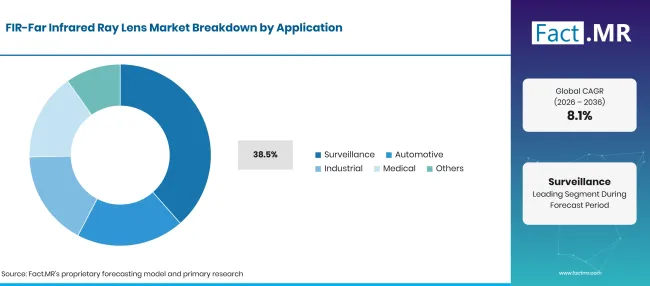
Fir Far Infrared Ray Lens Market Breakdown Application | Source: Fact.MR
| Application | Share (2026) |
|---|---|
| Surveillance (Leading segment) | 38.5% |
| Other segments combined | 61.5% |
| Total | 100.0% |
Source: Fact.MR analysis. Updated Nov 5, 2026
Surveillance cameras use thermal optics to monitor outdoor areas at night and in changing conditions. Unlike visible-light cameras, they detect thermal radiation, although weather and temperature contrast still affect image quality. Automotive applications require compact packaging and tolerance of wide temperature ranges. Industrial inspection uses known working distances, while medical imaging places greater emphasis on calibration.
How does Material shape purchasing?
Germanium accounts for 55.0% of market value in 2026.
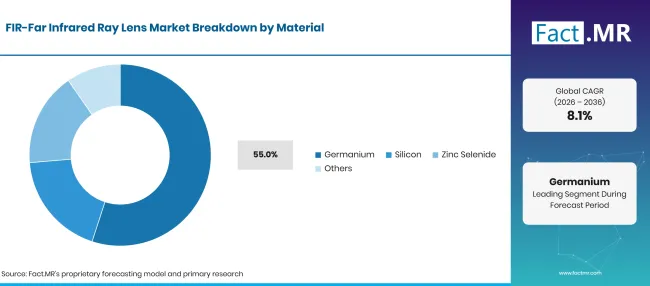
Fir Far Infrared Ray Lens Market Breakdown Material | Source: Fact.MR
| Material | Share (2026) |
|---|---|
| Germanium (Leading segment) | 55.0% |
| Other segments combined | 45.0% |
| Total | 100.0% |
Source: Fact.MR analysis. Updated Nov 5, 2026
Germanium is widely used for long-wave infrared optics, but its price and limited supply can complicate lens production. Manufacturers examine material efficiency during cutting and finishing. Silicon and zinc selenide are alternatives for selected designs when their transmission and physical properties meet the intended operating requirements.
Which End-User accounts for the main share?
Military and Defense hold 34.0% of market value in 2026.
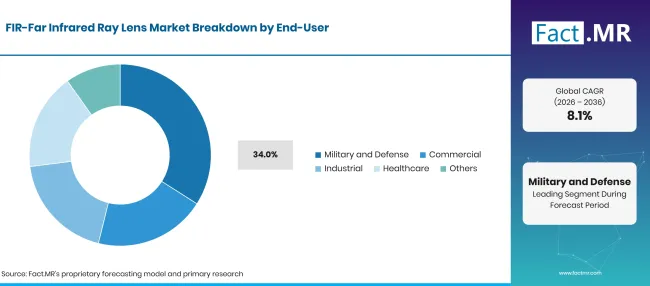
Fir Far Infrared Ray Lens Market Breakdown End User | Source: Fact.MR
| End-User | Share (2026) |
|---|---|
| Military and Defense (Leading segment) | 34.0% |
| Other segments combined | 66.0% |
| Total | 100.0% |
Source: Fact.MR analysis. Updated Nov 5, 2026
Military and defense buyers typically require defined durability and imaging tests before approving optical assemblies. The lens must match its detector and retain performance under expected operating conditions, supported by repeatable quality records. Security installers compare coverage and total installation cost. Industrial customers focus on reliable views of equipment, while healthcare buyers must also address calibration and intended use. These distinctions create different technical requirements even for lenses made from similar materials.
What is accelerating FIR-Far Infrared Ray Lens Market adoption, and what is holding it back?
Thermal-camera deployment in security and industry supports lens demand. Germanium costs and qualification requirements also influence purchasing schedules.
Drivers Impact Analysis
| DRIVER | (~) % IMPACT ON CAGR | GEOGRAPHIC RELEVANCE | IMPACT TIMELINE |
|---|---|---|---|
| Thermal surveillance installations | +1.1% | USA; Europe; Brazil | Medium term |
| Detector module integration | +0.9% | USA; Japan; Germany | Short term |
| Defense imaging specifications | +0.7% | USA; UK; Germany | Long term |
| Industrial condition monitoring | +0.6% | Germany; Japan | Medium term |
| Configurable zoom assemblies | +0.4% | Global | Long term |
Source: Fact.MR analysis. Updated Nov 5, 2026
Opportunity Impact Analysis
| OPPORTUNITY | (~) % IMPACT ON CAGR | GEOGRAPHIC RELEVANCE | IMPACT TIMELINE |
|---|---|---|---|
| Germanium-efficient optical designs | +0.7% | USA; Germany | Medium term |
| Infrared optics for industrial inspection | +0.5% | Germany; Japan | Medium term |
| Compact surveillance camera integration | +0.4% | Global | Short term |
| Thermal camera aftermarket replacement | +0.3% | Global | Long term |
Source: Fact.MR analysis. Updated Nov 5, 2026
Restraints Impact Analysis
| RESTRAINT | (~) % IMPACT ON CAGR | GEOGRAPHIC RELEVANCE | IMPACT TIMELINE |
|---|---|---|---|
| Germanium supply concentration | -0.8% | Global | Short term |
| High optical finishing cost | -0.6% | Global | Medium term |
| Integration and qualification time | -0.5% | USA; Europe; Japan | Medium term |
| Application-specific design requirements | -0.3% | Global | Long term |
Source: Fact.MR analysis. Updated Nov 5, 2026
Which countries are scaling the FIR-Far Infrared Ray Lens Market through 2036?
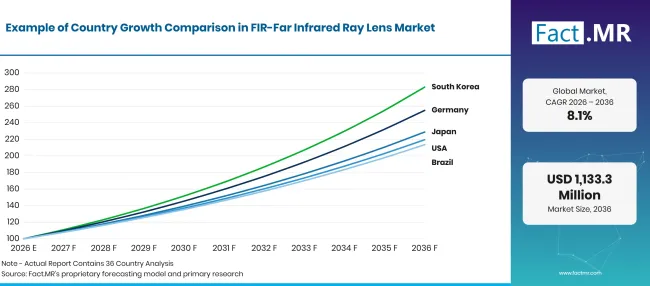
Fir Far Infrared Ray Lens Market Growth Index | Source: Fact.MR
| Country | CAGR (2026 to 2036) |
|---|---|
| Germany | 9.8% |
| Japan | 8.6% |
| USA | 8.2% |
| Brazil | 7.9% |
| UK | 6.2% |
Source: Fact.MR analysis. Updated Nov 5, 2026
What supports Germany’s FIR-Far Infrared Ray Lens Market?
9.8% CAGR, linked to industrial inspection and specialist thermal optics.
German optical and imaging companies supply industrial customers that need dependable thermal inspection. Engineers assess detector compatibility, transmission and field of view before approving a factory lens. Destatis reported in March 2026 that German production of computer, electronic and optical products declined 6.8% month over month in January [4].
How is Japan developing its FIR-Far Infrared Ray Lens Market?
8.6% CAGR, connected with camera engineering and optical component production.
Japanese camera manufacturers design infrared optics around the detectors used in thermal imaging equipment. Focal length sets the observed area and helps determine the detail available for industrial measurement. METI's June 2026 final release reported April production indicators for electronic parts and devices [5], a broader category than infrared lenses.
What shapes the USA’s FIR-Far Infrared Ray Lens Market?
8.2% CAGR, associated with defense imaging and industrial thermal inspection.
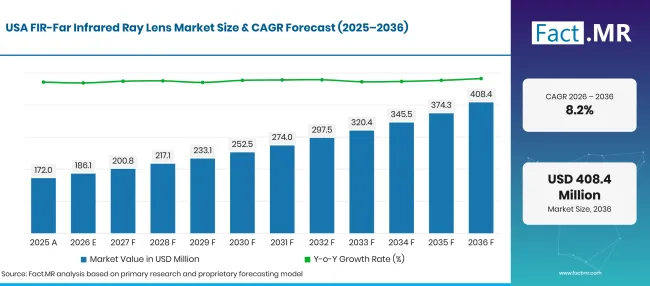
Fir Far Infrared Ray Lens Market Forecast Usa | Source: Fact.MR
The U.S. infrared imaging industry serves security surveillance and factory inspection alongside defense applications. Longer-distance monitoring requires different optics from temperature measurement at a fixed workstation. The U.S. Geological Survey identified germanium as an infrared optics material in February 2026 and discussed the risks surrounding its supply [1].
How is Brazil expanding its FIR-Far Infrared Ray Lens Market?
7.9% CAGR, tied to selective industrial monitoring and security applications.
Brazilian thermal imaging buyers weigh viewing requirements against installation expense. Industrial facilities use thermal cameras to inspect equipment, while security projects specify coverage according to site layout. IBGE reported in July 2026 that production of computer, electronic and optical products declined 2.0% in May compared with April [6].
What shapes the UK’s FIR-Far Infrared Ray Lens Market?
6.2% CAGR, connected with specialist surveillance and defence system requirements.
UK thermal imaging projects often require optical components tailored to their camera housings and operating conditions. Integrators assess focus and image detail across expected temperatures, especially for specialist surveillance and defense systems. The UK Ministry of Defence estimated equipment expenditure at GBP 27.4 billion in 2024/25 [3], covering a much wider equipment category than infrared lenses.
Who leads the FIR-Far Infrared Ray Lens Market?
The competitive landscape spans lens designers, optical-material suppliers and finished thermal-camera manufacturers. Jenoptik, LightPath Technologies, Edmund Optics and Resolve Optics supply relevant lens engineering and manufacturing capabilities.
Umicore operates upstream in optical materials, while MKS Instruments offers infrared optics through Ophir. Teledyne FLIR and InfraTec primarily participate in complete thermal imaging systems. Customers should distinguish these roles when comparing suppliers. Lens compatibility, manufacturing lead times, optical repeatability and technical support all influence repeat orders.
Which companies are the key providers?
Key companies include Teledyne FLIR, Jenoptik AG, MKS Instruments, Inc. (Ophir Infrared Optics), Umicore, LightPath Technologies, Inc., Edmund Optics Inc., InfraTec GmbH, and Resolve Optics Ltd.
- Teledyne FLIR
- Jenoptik AG
- MKS Instruments, Inc. (Ophir Infrared Optics)
- Umicore
- LightPath Technologies, Inc.
- Edmund Optics Inc.
- InfraTec GmbH
- Resolve Optics Ltd.
Bibliography
- [1] U.S. Geological Survey. (2026, February). Mineral commodity summaries 2026: Germanium.
- [2] Teledyne FLIR OEM. (2025, March 11). Radiometric thermal Boson+ and Hadron 640R+ dual thermal-visible camera modules now available.
- [3] UK Ministry of Defence. (2026, January 15). MOD departmental resources: 2025.
- [4] Statistisches Bundesamt (Destatis). (2026, March 9). Production in January 2026: -0.5% on the previous month.
- [5] Ministry of Economy, Trade and Industry. (2026, June). Indices of industrial production: April 2026 final results.
- [6] Instituto Brasileiro de Geografia e Estatística. (2026, July 3). Produção industrial varia -0,2% em maio.
This Report Answers
- The report distinguishes zoom from fixed-focus optics and explains how each fits into a thermal imaging system.
- It describes the lens requirements of surveillance, automotive and industrial imaging applications.
- It examines germanium supply and the suitability of silicon and zinc selenide for selected optical designs.
- It compares the conditions affecting demand in Germany, Japan, the USA, Brazil and the UK.
- It separates lens manufacturers and materials suppliers from producers of complete thermal cameras.
What does the FIR-Far Infrared Ray Lens Market cover?
The market includes far-infrared lenses and optical assemblies that direct thermal radiation onto imaging sensors. Only the optical component's revenue is counted; the value of a complete camera is included solely where the lens portion can be identified. Thermal imaging systems also contain detectors, electronics and software, making component compatibility important to the market boundary.
What is included in the scope?
The scope covers zoom and fixed-focus lenses qualified for far-infrared imaging.
Germanium, silicon and zinc selenide are included when their optical properties suit the intended wavelength and application. The analysis examines optics supplied for surveillance, industrial inspection and other thermal camera systems, while excluding the value of the complete device.
What is excluded from the scope?
The scope excludes visible-light photography lenses, detector chips, camera software and finished display equipment.
Components designed solely for other wavelength ranges are excluded unless they also qualify for far-infrared use. Complete thermal scanners are treated as finished imaging products; their total selling price falls outside the lens-only market.
How Was the Analysis Built?
The analysis draws on 120+ sources, 35+ company portfolios, 25+ countries, and more than 20 industry interviews.
- Primary Research: Primary research includes discussions with manufacturers, service providers, technology developers, distributors, end users, and subject-matter experts. These conversations examine purchasing priorities, product adoption, operational challenges, approval requirements, competitive positioning, and the factors that influence wider market acceptance.
- Desk Research: Desk research covers government statistics, regulatory publications, company filings, trade data, technical studies, industry associations, standards, public policy, and other authoritative sources. Every source used in the analysis is documented in the bibliography.
- Market Sizing and Forecasting: Market estimates combine historical performance, demand indicators, pricing and volume trends, segment shares, company participation, country-level growth, adoption patterns, investment activity, and barriers to market expansion.
- Data Validation and Update Cycle: Findings are validated by comparing primary interviews with public data, company activity, regulatory changes, trade patterns, and industry developments. Regular updates review new product launches, capacity changes, partnerships, approvals, and shifts in commercial adoption.
Segmentation
What is the report’s scope and coverage?
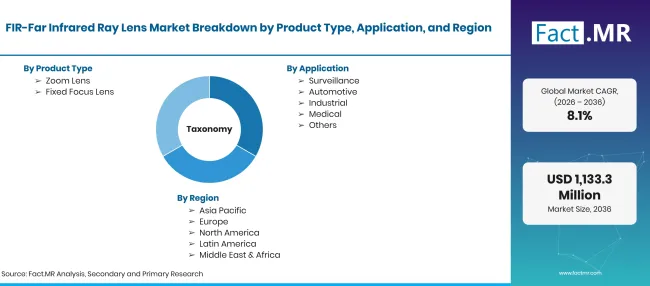
Fir Far Infrared Ray Lens Market Taxonomy | Source: Fact.MR
| Attribute | Details |
|---|---|
| Quantitative Units | USD million |
| Market Definition | Lenses designed to transmit far-infrared radiation in thermal imaging and monitoring systems. |
| Product Type | Zoom Lens; Fixed Focus Lens |
| Application | Surveillance; Automotive; Industrial; Medical; Others |
| Material | Germanium; Silicon; Zinc Selenide; Others |
| End-User | Military and Defense; Commercial; Industrial; Healthcare; Others |
| Regions Covered | North America; Latin America; Western Europe; Eastern Europe; East Asia; South Asia and Pacific; Middle East and Africa |
| Countries Covered | Germany; Japan; USA; Brazil; UK |
| Companies Profiled | Teledyne FLIR, Jenoptik AG, MKS Instruments, Inc. (Ophir Infrared Optics), Umicore, LightPath Technologies, Inc., Edmund Optics Inc., InfraTec GmbH, and Resolve Optics Ltd. |
| Forecast Period | 2026 to 2036 |
| Approach | Lens application mapping, component specifications, material supply review and end-user demand assessment |
Source: Fact.MR analysis. Updated Nov 5, 2026
How is the market segmented?
-
By Product Type
- Zoom Lens
- Fixed Focus Lens
-
By Application
- Surveillance
- Automotive
- Industrial
- Medical
- Others
-
By Material
- Germanium
- Silicon
- Zinc Selenide
- Others
-
By End-User
- Military and Defense
- Commercial
- Industrial
- Healthcare
- Others
-
By Region
- North America
- Latin America
- Western Europe
- Eastern Europe
- East Asia
- South Asia and Pacific
- Middle East and Africa
Frequently Asked Questions
How big is the FIR-Far Infrared Ray Lens Market in 2026?
What is the CAGR of the FIR-Far Infrared Ray Lens Market from 2026 to 2036?
Which product type leads the FIR-Far Infrared Ray Lens Market?
Which application leads the FIR-Far Infrared Ray Lens Market?
Who are the leading companies in the FIR-Far Infrared Ray Lens Market?
Who worked on this report


Preview the report firsthand - request a free sample
Free SampleGet the brochure for pricing and purchase details
Download PDF