Industrial Absorbent Market (2026 - 2036)

Industrial Absorbent Market is segmented by type into organic, inorganic, and synthetic materials, and by material including clay, diatomaceous earth, cellulose, polypropylene, and others, with regional analysis covering 2026 to 2036.

Core Findings

    Industrial Absorbent Market Forecast and Outlook 2026 to 2036

    The market was valued at USD 4.8 billion in 2025 and is projected to reach USD 4.9 billion in 2026 and USD 7.0 billion by 2036, reflecting a CAGR of 3.7%. The USD 2.1 billion incremental growth is steady, supported by tighter OSHA and EPA spill regulations, though pricing pressure remains high in commodity clay and mineral segments where switching costs are low.

    Daniel S. Jaffee, President and CEO of Oil-Dri Corporation of America, emphasized that the company continues to deliver strong customer-focused solutions that are translating into solid financial performance, while maintaining a clear priority on long-term business sustainability. The statement underscores Oil-Dri’s strategy of reinvesting in innovation, operational strength, and product development to secure durable growth in the industrial absorbents market.

    Country level growth reflects differences in industrial expansion, environmental enforcement, and energy sector investment. China leads at 4.5 % CAGR due to petrochemical construction and stricter spill enforcement. South Korea grows at 4.0 % from semiconductor and LNG demand. The United States and United Kingdom post 4.1 %, driven by OSHA and COSHH compliance. Japan records 3.9 % amid slower heavy industry output.
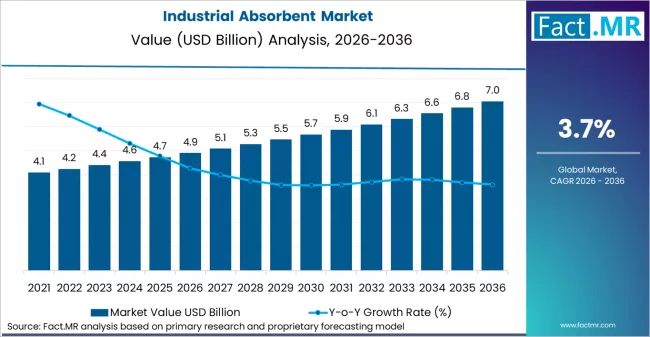
    Industrial Absorbent Market Market Value Analysis

    Market Definition

    Industrial absorbents are materials such as granules, pads, rolls, and socks used to contain and clean spills of oil, chemicals, and other liquids in industrial settings. They prevent environmental contamination and worker exposure. The market includes organic, mineral, and synthetic sorbents used by maintenance and safety teams as regularly replenished operational consumables.

    Market Inclusions

    The report covers global market sizing from 2026 to 2036, segmented by type, material, end use industries, and region. It analyses pricing by product format, disposal cost considerations, and regulatory compliance impacts that influence purchasing decisions across oil and gas, chemicals, manufacturing, transportation, and food processing sectors worldwide.

    Market Exclusions

    The study excludes household spill products, retail automotive pads, and personal hygiene absorbents. It also omits large scale emergency oil spill response projects managed by government agencies and laboratory desiccants used in analytical chemistry, focusing strictly on recurring industrial maintenance and compliance driven absorbent demand.

    Research Methodology

    • Primary Research: Primary research involved structured interviews with environmental health and safety managers at oil refineries, chemical plants, and automotive manufacturing facilities, as well as procurement specialists at industrial safety distributors including Grainger, Fastenal, and RS Group.
    • Desk Research: Desk research synthesized data from U.S. Environmental Protection Agency spill incident databases, OSHA inspection citation records, European Chemicals Agency REACH compliance registrations, and disclosed segment revenues from publicly listed safety product manufacturers.
    • Market-Sizing and Forecasting: Market sizing employed a bottom-up approach, building from industrial facility counts by sector and region, average sorbent consumption per facility by type and hazard classification, and unit price benchmarks validated against distributor catalog pricing and large-account contract disclosures.
    • Data Validation and Update Cycle: Outputs were cross-validated against annual reports from Kimberly-Clark Professional, 3M Personal Safety Division, and Johnson Matthey environmental catalyst segments, and reconciled quarterly with new product launch announcements and regulatory update publications from OSHA, EPA, and the European Environment Agency.

    Key Takeaways

    • Market Definition
      • Industrial absorbents are consumable sorbent materials in granular, pad, roll, sock, and pillow formats deployed across manufacturing, energy, and transportation facilities to contain and remediate oil, chemical, and water spills in compliance with occupational safety and environmental discharge regulations.
    • Demand Drivers
      • OSHA HAZWOPER standard (29 CFR 1910.120) requirements for spill response kits at all U.S. hazardous waste handling sites and EPA Spill Prevention, Control, and Countermeasure (SPCC) regulations mandating secondary containment and sorbent deployment at facilities with oil storage above 1,320 gallons create non-discretionary compliance demand across 140,000+ regulated U.S. facilities.
      • Expansion of petrochemical refining and LNG terminal infrastructure in Asia-Pacific and Middle East generates sustained new sorbent deployment at greenfield facilities where chemical spill containment programs are established from commissioning rather than retrofitted, producing 5-7-year ramp-up demand curves independent of mature market replacement cycles.
      • Shift from reactive spill cleanup to proactive leak detection and prevention programs at automotive and food processing manufacturers is expanding sorbent consumption per facility by 25-40% as maintenance teams deploy permanent sorbent socks and drip pads at machine bases, reducing environmental incident liability and product contamination losses.
    • Key Segments Analyzed
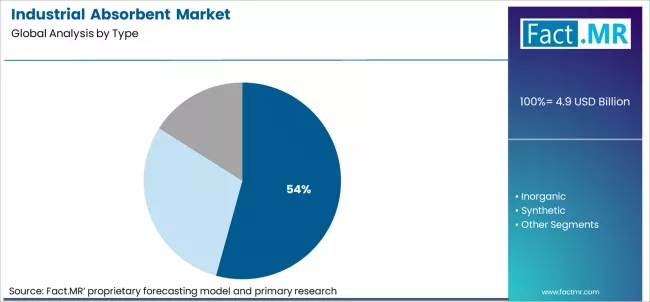
      • By Type, Organic absorbents command 54.3% share, reflecting their dominance in general manufacturing and food-grade applications where natural fiber cellulosic materials offer cost-effective oil-only or universal absorption without the silica dust health hazard associated with clay granular sorbents targeted by NIOSH respiratory exposure guidelines.
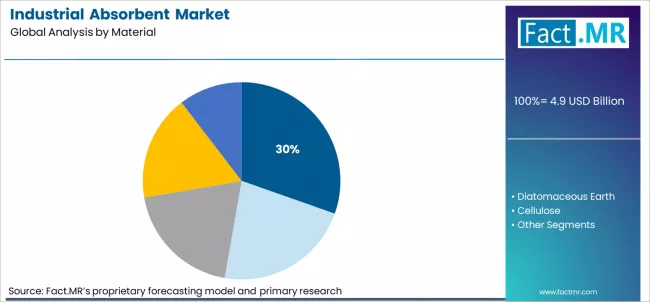
      • By Material, Clay holds 30.4% share as the most widely deployed loose granular format in automotive workshops, municipal maintenance depots, and small industrial facilities where low unit cost and familiarity among maintenance personnel sustain market presence despite emerging regulatory pressure on crystalline silica dust exposure.
      • By Region, North America leads with the highest per-facility sorbent expenditure driven by OSHA and EPA compliance mandates, while Asia-Pacific posts the fastest volume growth as petrochemical and manufacturing capacity additions generate greenfield sorbent program deployments at 4.5% annual clip in China.
    • Analyst Opinion at FACT.MR
      • Sudip Saha, Managing Director at Future Market Insights, opines, 'CXOs will find this report valuable for understanding how regulatory evolution from prescriptive spill response requirements toward performance-based environmental management systems is reshaping sorbent procurement from lowest-unit-cost clay granular formats toward engineered synthetic and bio-based systems.
    • Strategic Implications / Executive Takeaways
      • Industrial absorbent manufacturers should move beyond selling products and offer complete spill management programs that include site audits, kit design, placement planning, replenishment scheduling, and disposal documentation. This service led approach helps differentiate from low cost competitors and can generate significantly higher margins than product only sales.
      • Distributors serving oil and gas, chemicals, and automotive clients should invest in digital inventory tracking systems that monitor sorbent usage and automate reordering. This reduces stockout risk for customers while creating predictable recurring revenue and strengthening long term account retention.
      • Material innovators should accelerate development of bio based sorbents made from hemp, rice husks, or coconut fibers that match polypropylene performance while enabling compostable or zero landfill disposal, especially for European markets focused on circular economy compliance.
    • Methodology
      • Market sizing was developed using bottom up facility level consumption models across multiple industrial sectors and countries, calibrated with OSHA, EPA, and European Environment Agency facility databases to estimate regulated site populations and hazard exposure.
      • Unit pricing was benchmarked using catalog data from major distributors across standardized product formats, capturing quarterly pricing trends and input cost pass through effects linked to polypropylene and clay feedstock cycles.
      • Regulatory demand modeling incorporated OSHA citation data, EPA spill prevention penalties, and EU compliance investment surveys to quantify the baseline, non-discretionary absorbent demand that persists even during economic slowdowns.

    Segmental Analysis

    Industrial Absorbent Market Analysis by Type
    Industrial Absorbent Market Analysis By Type

    Organic absorbents hold 54.3 percent share in 2025 due to biodegradability, absence of silica dust, and compatibility with food and pharmaceutical standards. They align with sustainability programs and avoid hazardous waste complications under EPA guidelines.

    • Kimberly Clark invested USD 85 million in 2024 to expand cellulosic absorbent production in Tennessee, adding 120 million square feet annually and improving oil absorption performance for regulated industries [4].
    • Monarch Green launched coconut coir based CoirSorb in 2024, certified under USDA BioPreferred standards, targeting federal facilities seeking bio based alternatives with competitive absorption performance [5].
    • Survey data from the National Safety Council in 2024 shows 67 percent of manufacturers prefer organic formats due to composting and energy recovery disposal pathways that reduce hazardous waste classification risk [6].

    Industrial Absorbent Market Analysis by Material
    Industrial Absorbent Market Analysis By Material

    Clay absorbents hold 30.4 percent share in 2025 because they offer the lowest cost per liter absorbed and provide slip resistance in large volume outdoor or well ventilated areas.

    • TOLSA announced a EUR 28 million expansion in Spain in 2024 to increase absorbent clay output, emphasizing low crystalline silica content compliant with EU safety directives [7].
    • EP Minerals introduced a certified diatomaceous earth grade in 2024 designed for chemical plants requiring neutral pH spill response materials [8].
    • North American melt blown polypropylene production grew 9.2 percent in early 2024, driven by pipeline operators replacing clay with compliant sorbent kits under PHMSA rules [9].

    Drivers, Restraints, and Opportunities

    The industrial absorbent market is resilient because demand is tied to regulatory compliance rather than optional spending. Every new plant or terminal must maintain spill response capability to retain operating permits.

    • Clay granular absorbents lead in volume but face pressure from silica exposure rules under OSHA 29 CFR 1910.1053 [1]. Facilities increasingly shift to polypropylene pads and rolls, which cost more per unit yet reduce health compliance risks and long term liability.
    • China’s petrochemical expansion under the 14th Five Year Plan [2] and refinery upgrades in India are creating significant new sorbent demand at large complexes, each requiring thousands of pads monthly once operational.
    • The revised EU Industrial Emissions Directive strengthens spill documentation requirements across 12,000 installations, favoring branded synthetic sorbents that provide traceable compliance support over unbranded mineral products. [3]

    Regional Analysis

    The industrial absorbent market is analyzed across North America, Europe, Asia-Pacific, Latin America, and Middle East and Africa. Regional adoption of specific absorbent types is shaped by industrial sector composition, occupational safety regulatory frameworks, disposal infrastructure availability, and environmental liability exposure levels. The report offers detailed market attractiveness analysis comparing compliance-driven demand intensity, product format preferences, and distributor channel concentration by region.
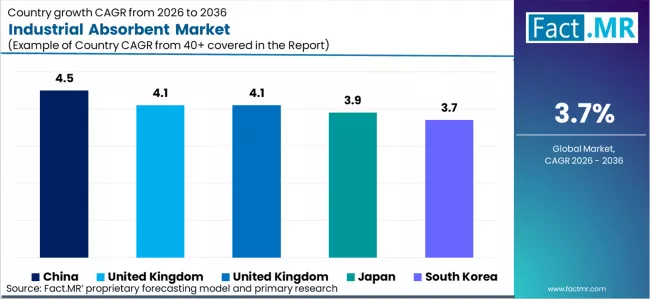
    Industrial Absorbent Market Cagr Analysis By Country

    Country CAGR%
    China 4.5%
    United Kingdom 4.1%
    United States 4.1%
    Japan 3.9%
    South Korea 3.7%

    Source: Fact.MR (FACT.MR) analysis, based on proprietary forecasting model and primary research

    North America Industrial Absorbent Market Analysis

    North America sets the global compliance benchmark for industrial absorbents, driven by strict OSHA, EPA SPCC, and state containment rules. Premium brands such as Kimberly Clark and 3M dominate through strong distributor networks, while private label suppliers compete in commodity clay segments. High per facility spending reflects documentation and liability driven purchasing rather than lowest cost sourcing.

    • United States: Demand for industrial absorbents in the United States is projected to rise at 4.1% CAGR through 2036. OSHA silica enforcement and expanded EPA SPCC coverage are shifting facilities from clay toward polypropylene and cellulosic formats. Capacity expansions by 3M and BioPreferred certification for Kimberly Clark products are strengthening premium synthetic and bio based adoption across oil, chemical, and federal facilities.
    • United Kingdom: Demand in the United Kingdom is projected to grow at 4.1% CAGR through 2036. Updated COSHH silica limits and Environmental Permitting Regulations require documented spill plans and inventory tracking, favoring branded synthetic sorbents with digital compliance systems. Automotive and chemical manufacturers are steadily replacing clay with polypropylene and cellulosic spill kits to meet inspection standards.

    FACT.MR’s analysis of the industrial absorbent market in North America includes the United States, Canada, and Mexico, detailing compliance driven format migration, SPCC expansion impacts, and distributor channel dynamics.

    Asia-Pacific Industrial Absorbent Market Analysis

    Asia-Pacific represents the primary volume growth region, supported by petrochemical expansion, semiconductor manufacturing, and tightening safety standards. Multinational brands compete with domestic mineral suppliers, with premium synthetic formats gaining share in globally managed facilities while clay remains prevalent in cost sensitive segments.

    • China: Demand in China is projected to rise at 4.5% CAGR through 2036. Updated emergency response standards require higher sorbent capacity at chemical facilities, creating restocking demand. Large refiners such as Sinopec are expanding polypropylene spill kit deployment, and upcoming design code revisions are expected to accelerate synthetic sorbent adoption at new complexes.
    • Japan: Demand in Japan is projected to grow at 3.9% CAGR through 2036. Stricter water pollution enforcement and corporate zero discharge policies are driving permanent polypropylene sock installations at automotive and manufacturing plants, with strong emphasis on cleanroom compliant and contamination controlled sorbent systems.
    • South Korea: Demand in South Korea is projected to rise at 3.7% CAGR through 2036. Amendments to the Chemical Control Act require higher on site spill response capacity, while semiconductor fabs and petrochemical projects specify high purity polypropylene systems, supporting premium synthetic sorbent growth.

    FACT.MR’s analysis of the industrial absorbent market in Asia-Pacific includes China, Japan, South Korea, India, Australia, and Southeast Asia, covering regulatory timelines, petrochemical expansion demand, and domestic versus imported sorbent positioning.

    Competitive Aligners for Market Players
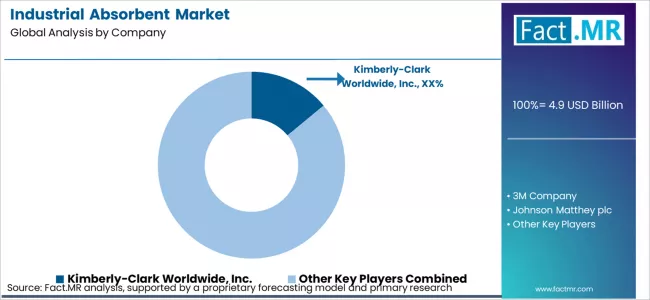
    Industrial Absorbent Market Analysis By Company

    The industrial absorbent market combines a recognizable branded tier with a wide base of small regional commodity suppliers. Companies such as Kimberly Clark Professional, 3M, and Brady Worldwide lead the premium segment by offering full product ranges supported by compliance documentation and on site audit support. In this tier, competition is less about price and more about service. Suppliers that help facilities design spill response programs, maintain OSHA records, and manage disposal paperwork create meaningful switching barriers, even if competitors offer slightly lower unit pricing.

    In contrast, the clay and diatomaceous earth segment remains highly fragmented, with numerous regional mineral processors competing primarily on delivered cost. Here, brand influence is limited and pricing drives purchasing decisions.

    Distribution reach is a key structural advantage. Global brands leverage partnerships with large industrial distributors to maintain presence across most regulated facilities without building their own logistics networks. Some specialty chemical companies bundle absorbents with broader technical service offerings, reinforcing customer loyalty. Buyers at highly regulated sites prioritize total program cost and compliance risk, while smaller facilities tend to focus on upfront catalog pricing.

    Key Players

    • Kimberly-Clark Worldwide, Inc.
    • 3M Company
    • Johnson Matthey plc
    • Ansell Limited
    • Brady Worldwide, Inc.
    • Monarch Green, Inc.
    • Decorus Europe
    • Meltblown Technologies, Inc.
    • TOLSA Group

    Industrial Absorbent Market by Segment

    • By Type

      • Organic
      • Inorganic
      • Synthetic
    • By Material

      • Clay
      • Diatomaceous Earth
      • Cellulose
      • Polypropylene
      • Others
    • Region

      • Asia Pacific
        • China
        • Japan
        • South Korea
        • Australia & New Zealand
        • India
        • ASEAN
        • Rest of Asia Pacific
      • Europe
        • Norway
        • Germany
        • United Kingdom
        • France
        • Spain
        • Netherlands
        • Nordics
        • Rest of Europe
      • North America
        • United States
        • Canada
        • Mexico
      • Latin America
        • Brazil
        • Chile
        • Ecuador
        • Rest of Latin America
      • Middle East & Africa
        • Kingdom of Saudi Arabia
        • United Arab Emirates
        • South Africa
        • Turkey
        • Rest of Middle East & Africa

    Report Address

    • Market intelligence for strategic planning with analysis of sorbent migration from clay to synthetic and organic formats.
    • Market size and forecast showing valuation of USD 4.8 billion in 2025 and projected USD 7.0 billion by 2036 at 3.7% CAGR.
    • Growth opportunity mapping across polypropylene melt blown, bio based sorbents, and turnkey spill management services.
    • Segment and regional forecasts covering major countries with type and material level breakdowns.
    • Competition strategy assessment of leading brands and regional suppliers including distribution and service differentiation.
    • Product and compliance tracking of OSHA silica rules, EPA SPCC expansion, and EU Industrial Emissions Directive requirements.
    • Total cost of ownership analysis comparing clay, polypropylene, and organic sorbent programs.
    • Report delivery in Excel, PowerPoint, and PDF formats with validated data and sources.

    Table of Content

    1. Executive Summary
      • Global Market Outlook
      • Demand to side Trends
      • Supply to side Trends
      • Technology Roadmap Analysis
      • Analysis and Recommendations
    2. Market Overview
      • Market Coverage / Taxonomy
      • Market Definition / Scope / Limitations
    3. Research Methodology
      • Chapter Orientation
      • Analytical Lens and Working Hypotheses
        • Market Structure, Signals, and Trend Drivers
        • Benchmarking and Cross-market Comparability
        • Market Sizing, Forecasting, and Opportunity Mapping
      • Research Design and Evidence Framework
        • Desk Research Programme (Secondary Evidence)
          • Company Annual and Sustainability Reports
          • Peer-reviewed Journals and Academic Literature
          • Corporate Websites, Product Literature, and Technical Notes
          • Earnings Decks and Investor Briefings
          • Statutory Filings and Regulatory Disclosures
          • Technical White Papers and Standards Notes
          • Trade Journals, Industry Magazines, and Analyst Briefs
          • Conference Proceedings, Webinars, and Seminar Materials
          • Government Statistics Portals and Public Data Releases
          • Press Releases and Reputable Media Coverage
          • Specialist Newsletters and Curated Briefings
          • Sector Databases and Reference Repositories
          • FMR Internal Proprietary Databases and Historical Market Datasets
          • Subscription Datasets and Paid Sources
          • Social Channels, Communities, and Digital Listening Inputs
          • Additional Desk Sources
        • Expert Input and Fieldwork (Primary Evidence)
          • Primary Modes
            • Qualitative Interviews and Expert Elicitation
            • Quantitative Surveys and Structured Data Capture
            • Blended Approach
          • Why Primary Evidence is Used
          • Field Techniques
            • Interviews
            • Surveys
            • Focus Groups
            • Observational and In-context Research
            • Social and Community Interactions
          • Stakeholder Universe Engaged
            • C-suite Leaders
            • Board Members
            • Presidents and Vice Presidents
            • R&D and Innovation Heads
            • Technical Specialists
            • Domain Subject-matter Experts
            • Scientists
            • Physicians and Other Healthcare Professionals
          • Governance, Ethics, and Data Stewardship
            • Research Ethics
            • Data Integrity and Handling
        • Tooling, Models, and Reference Databases
      • Data Engineering and Model Build
        • Data Acquisition and Ingestion
        • Cleaning, Normalisation, and Verification
        • Synthesis, Triangulation, and Analysis
      • Quality Assurance and Audit Trail
    4. Market Background
      • Market Dynamics
        • Drivers
        • Restraints
        • Opportunity
        • Trends
      • Scenario Forecast
        • Demand in Optimistic Scenario
        • Demand in Likely Scenario
        • Demand in Conservative Scenario
      • Opportunity Map Analysis
      • Product Life Cycle Analysis
      • Supply Chain Analysis
      • Investment Feasibility Matrix
      • Value Chain Analysis
      • PESTLE and Porter’s Analysis
      • Regulatory Landscape
      • Regional Parent Market Outlook
      • Production and Consumption Statistics
      • Import and Export Statistics
    5. Global Market Analysis 2021 to 2025 and Forecast, 2026 to 2036
      • Historical Market Size Value (USD Million) Analysis, 2021 to 2025
      • Current and Future Market Size Value (USD Million) Projections, 2026 to 2036
        • Y to o to Y Growth Trend Analysis
        • Absolute $ Opportunity Analysis
    6. Global Market Pricing Analysis 2021 to 2025 and Forecast 2026 to 2036
    7. Global Market Analysis 2021 to 2025 and Forecast 2026 to 2036, By Type
      • Introduction / Key Findings
      • Historical Market Size Value (USD Million) Analysis By Type , 2021 to 2025
      • Current and Future Market Size Value (USD Million) Analysis and Forecast By Type , 2026 to 2036
        • Organic
        • Inorganic
        • Synthetic
      • Y to o to Y Growth Trend Analysis By Type , 2021 to 2025
      • Absolute $ Opportunity Analysis By Type , 2026 to 2036
    8. Global Market Analysis 2021 to 2025 and Forecast 2026 to 2036, By Material
      • Introduction / Key Findings
      • Historical Market Size Value (USD Million) Analysis By Material, 2021 to 2025
      • Current and Future Market Size Value (USD Million) Analysis and Forecast By Material, 2026 to 2036
        • Clay
        • Diatomaceous Earth
        • Cellulose
        • Polypropylene
        • Others
      • Y to o to Y Growth Trend Analysis By Material, 2021 to 2025
      • Absolute $ Opportunity Analysis By Material, 2026 to 2036
    9. Global Market Analysis 2021 to 2025 and Forecast 2026 to 2036, By Region
      • Introduction
      • Historical Market Size Value (USD Million) Analysis By Region, 2021 to 2025
      • Current Market Size Value (USD Million) Analysis and Forecast By Region, 2026 to 2036
        • North America
        • Latin America
        • Western Europe
        • Eastern Europe
        • East Asia
        • South Asia and Pacific
        • Middle East & Africa
      • Market Attractiveness Analysis By Region
    10. North America Market Analysis 2021 to 2025 and Forecast 2026 to 2036, By Country
      • Historical Market Size Value (USD Million) Trend Analysis By Market Taxonomy, 2021 to 2025
      • Market Size Value (USD Million) Forecast By Market Taxonomy, 2026 to 2036
        • By Country
          • USA
          • Canada
          • Mexico
        • By Type
        • By Material
      • Market Attractiveness Analysis
        • By Country
        • By Type
        • By Material
      • Key Takeaways
    11. Latin America Market Analysis 2021 to 2025 and Forecast 2026 to 2036, By Country
      • Historical Market Size Value (USD Million) Trend Analysis By Market Taxonomy, 2021 to 2025
      • Market Size Value (USD Million) Forecast By Market Taxonomy, 2026 to 2036
        • By Country
          • Brazil
          • Chile
          • Rest of Latin America
        • By Type
        • By Material
      • Market Attractiveness Analysis
        • By Country
        • By Type
        • By Material
      • Key Takeaways
    12. Western Europe Market Analysis 2021 to 2025 and Forecast 2026 to 2036, By Country
      • Historical Market Size Value (USD Million) Trend Analysis By Market Taxonomy, 2021 to 2025
      • Market Size Value (USD Million) Forecast By Market Taxonomy, 2026 to 2036
        • By Country
          • Germany
          • UK
          • Italy
          • Spain
          • France
          • Nordic
          • BENELUX
          • Rest of Western Europe
        • By Type
        • By Material
      • Market Attractiveness Analysis
        • By Country
        • By Type
        • By Material
      • Key Takeaways
    13. Eastern Europe Market Analysis 2021 to 2025 and Forecast 2026 to 2036, By Country
      • Historical Market Size Value (USD Million) Trend Analysis By Market Taxonomy, 2021 to 2025
      • Market Size Value (USD Million) Forecast By Market Taxonomy, 2026 to 2036
        • By Country
          • Russia
          • Poland
          • Hungary
          • Balkan & Baltic
          • Rest of Eastern Europe
        • By Type
        • By Material
      • Market Attractiveness Analysis
        • By Country
        • By Type
        • By Material
      • Key Takeaways
    14. East Asia Market Analysis 2021 to 2025 and Forecast 2026 to 2036, By Country
      • Historical Market Size Value (USD Million) Trend Analysis By Market Taxonomy, 2021 to 2025
      • Market Size Value (USD Million) Forecast By Market Taxonomy, 2026 to 2036
        • By Country
          • China
          • Japan
          • South Korea
        • By Type
        • By Material
      • Market Attractiveness Analysis
        • By Country
        • By Type
        • By Material
      • Key Takeaways
    15. South Asia and Pacific Market Analysis 2021 to 2025 and Forecast 2026 to 2036, By Country
      • Historical Market Size Value (USD Million) Trend Analysis By Market Taxonomy, 2021 to 2025
      • Market Size Value (USD Million) Forecast By Market Taxonomy, 2026 to 2036
        • By Country
          • India
          • ASEAN
          • Australia & New Zealand
          • Rest of South Asia and Pacific
        • By Type
        • By Material
      • Market Attractiveness Analysis
        • By Country
        • By Type
        • By Material
      • Key Takeaways
    16. Middle East & Africa Market Analysis 2021 to 2025 and Forecast 2026 to 2036, By Country
      • Historical Market Size Value (USD Million) Trend Analysis By Market Taxonomy, 2021 to 2025
      • Market Size Value (USD Million) Forecast By Market Taxonomy, 2026 to 2036
        • By Country
          • Kingdom of Saudi Arabia
          • Other GCC Countries
          • Turkiye
          • South Africa
          • Other African Union
          • Rest of Middle East & Africa
        • By Type
        • By Material
      • Market Attractiveness Analysis
        • By Country
        • By Type
        • By Material
      • Key Takeaways
    17. Key Countries Market Analysis
      • USA
        • Pricing Analysis
        • Market Share Analysis, 2025
          • By Type
          • By Material
      • Canada
        • Pricing Analysis
        • Market Share Analysis, 2025
          • By Type
          • By Material
      • Mexico
        • Pricing Analysis
        • Market Share Analysis, 2025
          • By Type
          • By Material
      • Brazil
        • Pricing Analysis
        • Market Share Analysis, 2025
          • By Type
          • By Material
      • Chile
        • Pricing Analysis
        • Market Share Analysis, 2025
          • By Type
          • By Material
      • Germany
        • Pricing Analysis
        • Market Share Analysis, 2025
          • By Type
          • By Material
      • UK
        • Pricing Analysis
        • Market Share Analysis, 2025
          • By Type
          • By Material
      • Italy
        • Pricing Analysis
        • Market Share Analysis, 2025
          • By Type
          • By Material
      • Spain
        • Pricing Analysis
        • Market Share Analysis, 2025
          • By Type
          • By Material
      • France
        • Pricing Analysis
        • Market Share Analysis, 2025
          • By Type
          • By Material
      • India
        • Pricing Analysis
        • Market Share Analysis, 2025
          • By Type
          • By Material
      • ASEAN
        • Pricing Analysis
        • Market Share Analysis, 2025
          • By Type
          • By Material
      • Australia & New Zealand
        • Pricing Analysis
        • Market Share Analysis, 2025
          • By Type
          • By Material
      • China
        • Pricing Analysis
        • Market Share Analysis, 2025
          • By Type
          • By Material
      • Japan
        • Pricing Analysis
        • Market Share Analysis, 2025
          • By Type
          • By Material
      • South Korea
        • Pricing Analysis
        • Market Share Analysis, 2025
          • By Type
          • By Material
      • Russia
        • Pricing Analysis
        • Market Share Analysis, 2025
          • By Type
          • By Material
      • Poland
        • Pricing Analysis
        • Market Share Analysis, 2025
          • By Type
          • By Material
      • Hungary
        • Pricing Analysis
        • Market Share Analysis, 2025
          • By Type
          • By Material
      • Kingdom of Saudi Arabia
        • Pricing Analysis
        • Market Share Analysis, 2025
          • By Type
          • By Material
      • Turkiye
        • Pricing Analysis
        • Market Share Analysis, 2025
          • By Type
          • By Material
      • South Africa
        • Pricing Analysis
        • Market Share Analysis, 2025
          • By Type
          • By Material
    18. Market Structure Analysis
      • Competition Dashboard
      • Competition Benchmarking
      • Market Share Analysis of Top Players
        • By Regional
        • By Type
        • By Material
    19. Competition Analysis
      • Competition Deep Dive
        • Kimberly-Clark Worldwide, Inc.
          • Overview
          • Product Portfolio
          • Profitability by Market Segments (Product/Age /Sales Channel/Region)
          • Sales Footprint
          • Strategy Overview
            • Marketing Strategy
            • Product Strategy
            • Channel Strategy
        • 3M Company
        • Johnson Matthey plc
        • Ansell Limited
        • Brady Worldwide, Inc.
        • Monarch Green, Inc.
        • Decorus Europe
        • Meltblown Technologies, Inc.
        • TOLSA Group
    20. Assumptions & Acronyms Used

    List Of Table

    • Table 1: Global Market Value (USD Million) Forecast by Region, 2021 to 2036
    • Table 2: Global Market Value (USD Million) Forecast by Type, 2021 to 2036
    • Table 3: Global Market Value (USD Million) Forecast by Material, 2021 to 2036
    • Table 4: North America Market Value (USD Million) Forecast by Country, 2021 to 2036
    • Table 5: North America Market Value (USD Million) Forecast by Type, 2021 to 2036
    • Table 6: North America Market Value (USD Million) Forecast by Material, 2021 to 2036
    • Table 7: Latin America Market Value (USD Million) Forecast by Country, 2021 to 2036
    • Table 8: Latin America Market Value (USD Million) Forecast by Type, 2021 to 2036
    • Table 9: Latin America Market Value (USD Million) Forecast by Material, 2021 to 2036
    • Table 10: Western Europe Market Value (USD Million) Forecast by Country, 2021 to 2036
    • Table 11: Western Europe Market Value (USD Million) Forecast by Type, 2021 to 2036
    • Table 12: Western Europe Market Value (USD Million) Forecast by Material, 2021 to 2036
    • Table 13: Eastern Europe Market Value (USD Million) Forecast by Country, 2021 to 2036
    • Table 14: Eastern Europe Market Value (USD Million) Forecast by Type, 2021 to 2036
    • Table 15: Eastern Europe Market Value (USD Million) Forecast by Material, 2021 to 2036
    • Table 16: East Asia Market Value (USD Million) Forecast by Country, 2021 to 2036
    • Table 17: East Asia Market Value (USD Million) Forecast by Type, 2021 to 2036
    • Table 18: East Asia Market Value (USD Million) Forecast by Material, 2021 to 2036
    • Table 19: South Asia and Pacific Market Value (USD Million) Forecast by Country, 2021 to 2036
    • Table 20: South Asia and Pacific Market Value (USD Million) Forecast by Type, 2021 to 2036
    • Table 21: South Asia and Pacific Market Value (USD Million) Forecast by Material, 2021 to 2036
    • Table 22: Middle East & Africa Market Value (USD Million) Forecast by Country, 2021 to 2036
    • Table 23: Middle East & Africa Market Value (USD Million) Forecast by Type, 2021 to 2036
    • Table 24: Middle East & Africa Market Value (USD Million) Forecast by Material, 2021 to 2036

    List Of Figures

    • Figure 1: Global Market Pricing Analysis
    • Figure 2: Global Market Value (USD Million) Forecast 2021-2036
    • Figure 3: Global Market Value Share and BPS Analysis by Type, 2026 and 2036
    • Figure 4: Global Market Y to o to Y Growth Comparison by Type, 2026 to 2036
    • Figure 5: Global Market Attractiveness Analysis by Type
    • Figure 6: Global Market Value Share and BPS Analysis by Material, 2026 and 2036
    • Figure 7: Global Market Y to o to Y Growth Comparison by Material, 2026 to 2036
    • Figure 8: Global Market Attractiveness Analysis by Material
    • Figure 9: Global Market Value (USD Million) Share and BPS Analysis by Region, 2026 and 2036
    • Figure 10: Global Market Y to o to Y Growth Comparison by Region, 2026 to 2036
    • Figure 11: Global Market Attractiveness Analysis by Region
    • Figure 12: North America Market Incremental Dollar Opportunity, 2026 to 2036
    • Figure 13: Latin America Market Incremental Dollar Opportunity, 2026 to 2036
    • Figure 14: Western Europe Market Incremental Dollar Opportunity, 2026 to 2036
    • Figure 15: Eastern Europe Market Incremental Dollar Opportunity, 2026 to 2036
    • Figure 16: East Asia Market Incremental Dollar Opportunity, 2026 to 2036
    • Figure 17: South Asia and Pacific Market Incremental Dollar Opportunity, 2026 to 2036
    • Figure 18: Middle East & Africa Market Incremental Dollar Opportunity, 2026 to 2036
    • Figure 19: North America Market Value Share and BPS Analysis by Country, 2026 and 2036
    • Figure 20: North America Market Value Share and BPS Analysis by Type, 2026 and 2036
    • Figure 21: North America Market Y to o to Y Growth Comparison by Type, 2026 to 2036
    • Figure 22: North America Market Attractiveness Analysis by Type
    • Figure 23: North America Market Value Share and BPS Analysis by Material, 2026 and 2036
    • Figure 24: North America Market Y to o to Y Growth Comparison by Material, 2026 to 2036
    • Figure 25: North America Market Attractiveness Analysis by Material
    • Figure 26: Latin America Market Value Share and BPS Analysis by Country, 2026 and 2036
    • Figure 27: Latin America Market Value Share and BPS Analysis by Type, 2026 and 2036
    • Figure 28: Latin America Market Y to o to Y Growth Comparison by Type, 2026 to 2036
    • Figure 29: Latin America Market Attractiveness Analysis by Type
    • Figure 30: Latin America Market Value Share and BPS Analysis by Material, 2026 and 2036
    • Figure 31: Latin America Market Y to o to Y Growth Comparison by Material, 2026 to 2036
    • Figure 32: Latin America Market Attractiveness Analysis by Material
    • Figure 33: Western Europe Market Value Share and BPS Analysis by Country, 2026 and 2036
    • Figure 34: Western Europe Market Value Share and BPS Analysis by Type, 2026 and 2036
    • Figure 35: Western Europe Market Y to o to Y Growth Comparison by Type, 2026 to 2036
    • Figure 36: Western Europe Market Attractiveness Analysis by Type
    • Figure 37: Western Europe Market Value Share and BPS Analysis by Material, 2026 and 2036
    • Figure 38: Western Europe Market Y to o to Y Growth Comparison by Material, 2026 to 2036
    • Figure 39: Western Europe Market Attractiveness Analysis by Material
    • Figure 40: Eastern Europe Market Value Share and BPS Analysis by Country, 2026 and 2036
    • Figure 41: Eastern Europe Market Value Share and BPS Analysis by Type, 2026 and 2036
    • Figure 42: Eastern Europe Market Y to o to Y Growth Comparison by Type, 2026 to 2036
    • Figure 43: Eastern Europe Market Attractiveness Analysis by Type
    • Figure 44: Eastern Europe Market Value Share and BPS Analysis by Material, 2026 and 2036
    • Figure 45: Eastern Europe Market Y to o to Y Growth Comparison by Material, 2026 to 2036
    • Figure 46: Eastern Europe Market Attractiveness Analysis by Material
    • Figure 47: East Asia Market Value Share and BPS Analysis by Country, 2026 and 2036
    • Figure 48: East Asia Market Value Share and BPS Analysis by Type, 2026 and 2036
    • Figure 49: East Asia Market Y to o to Y Growth Comparison by Type, 2026 to 2036
    • Figure 50: East Asia Market Attractiveness Analysis by Type
    • Figure 51: East Asia Market Value Share and BPS Analysis by Material, 2026 and 2036
    • Figure 52: East Asia Market Y to o to Y Growth Comparison by Material, 2026 to 2036
    • Figure 53: East Asia Market Attractiveness Analysis by Material
    • Figure 54: South Asia and Pacific Market Value Share and BPS Analysis by Country, 2026 and 2036
    • Figure 55: South Asia and Pacific Market Value Share and BPS Analysis by Type, 2026 and 2036
    • Figure 56: South Asia and Pacific Market Y to o to Y Growth Comparison by Type, 2026 to 2036
    • Figure 57: South Asia and Pacific Market Attractiveness Analysis by Type
    • Figure 58: South Asia and Pacific Market Value Share and BPS Analysis by Material, 2026 and 2036
    • Figure 59: South Asia and Pacific Market Y to o to Y Growth Comparison by Material, 2026 to 2036
    • Figure 60: South Asia and Pacific Market Attractiveness Analysis by Material
    • Figure 61: Middle East & Africa Market Value Share and BPS Analysis by Country, 2026 and 2036
    • Figure 62: Middle East & Africa Market Value Share and BPS Analysis by Type, 2026 and 2036
    • Figure 63: Middle East & Africa Market Y to o to Y Growth Comparison by Type, 2026 to 2036
    • Figure 64: Middle East & Africa Market Attractiveness Analysis by Type
    • Figure 65: Middle East & Africa Market Value Share and BPS Analysis by Material, 2026 and 2036
    • Figure 66: Middle East & Africa Market Y to o to Y Growth Comparison by Material, 2026 to 2036
    • Figure 67: Middle East & Africa Market Attractiveness Analysis by Material
    • Figure 68: Global Market - Tier Structure Analysis
    • Figure 69: Global Market - Company Share Analysis

    - FAQs -

    How large is the industrial absorbent market in 2025?

    The industrial absorbent market was valued at USD 4.8 billion in 2025.

    What will the market size be in 2026?

    The market is estimated to grow to USD 4.9 billion in 2026.

    What is the projected market size by 2036?

    The market is projected to reach USD 7.0 billion by 2036.

    What is the expected CAGR for the forecast period 2026 to 2036?

    FACT.MR projects a CAGR of 3.7% from 2026 to 2036.

    Which Type segment holds the largest market share?

    Organic absorbents lead the Type segment with 54.3% global share in 2026.

    Which Material sub-segment dominates in 2025?

    Clay-based absorbents hold 30.4% material market share in 2025.

    Which country shows the fastest CAGR?

    China projects the fastest country-level CAGR at 4.5% through 2036.

    How significant are the United States and United Kingdom markets?

    United States and United Kingdom post 4.1% - CAGR through 2036.

    What drives demand in the oil and gas end-use sector?

    Oil and gas is the highest per-facility expenditure sector, driven by EPA SPCC 40 CFR Part 112 secondary containment requirements.

    What is the absolute dollar growth from 2026 to 2036?

    The absolute dollar growth from 2026 to 2036 represents an incremental gain of USD 2.1 billion.

    What growth rate does Japan project?

    Japan projects 3.9% - CAGR through 2036, the slowest among tracked Asia-Pacific markets, reflecting mature industrial base stability.

    How is South Korea performing?

    South Korea registers 3.8% - CAGR through 2036, driven by the amended Chemical Control Act.

    Industrial Absorbent Market