- Market Value (2025): USD 2.2 Bn
- Estimated Value (2026): USD 2.3 Bn
- Forecast Value (2036): USD 5.0 Bn
- CAGR (2026-2036): 7.9%
What is the Waterborne Mobility Topcoats Market forecast to be worth by 2036?
USD 2.3 billion in 2026 to USD 5.0 billion by 2036 at a 7.9% CAGR.
- The Waterborne Mobility Topcoats Market reached approximately USD 2.2 billion in 2025.
- Demand is projected to increase from USD 2.3 billion in 2026 to USD 5.0 billion by 2036.
- The market is forecast to record 7.9% CAGR from 2026 to 2036 as paint shops shift toward lower-solvent processes, coat more mixed-material parts and reduce bake intensity.
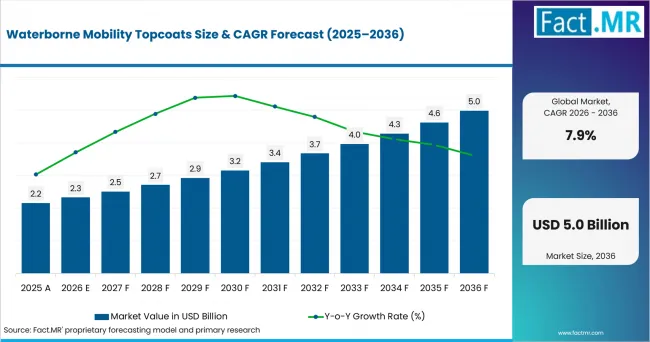
Waterborne Mobility Topcoats Value Analysis | Source: Fact.MR
What are the defining numbers behind Waterborne Mobility Topcoats Market growth?
An absolute opportunity of approximately USD 2.7 billion is expected between 2026 and 2036.
- Demand Drivers in the Market
- Vehicle coating plants face continuing pressure to reduce solvent emissions. U.S. EPA rules cover VOC and hazardous-air-pollutant emissions from automobile and light-duty truck coating operations, while the EU Industrial Emissions Directive sets solvent-emission limits for vehicle coating installations. Waterborne topcoats help plants lower solvent loading without abandoning familiar spray processes.
- Paint-shop energy use is pushing OEMs toward shorter process routes. Axalta's water-based 3-Wet system allows successive coating layers to be applied with only a minimal flash between coats. That gives waterborne systems a stronger place in OEM paint lines where line speed and oven demand are part of the coating decision.
- More visible plastic and mixed-material parts are being coated outside the traditional metal body shell. AkzoNobel lists current waterborne topcoats for polyolefins, ABS, PC, PA, steel and aluminum. This broadens demand inside OEM coatings because one vehicle program can require several substrate-specific coating solutions.
- Finish expectations remain high even when chemistry changes. High-gloss, matte and effect finishes still have to meet colour, scratch and weathering targets. Waterborne systems gain specification when they can deliver those surface requirements without forcing manufacturers back to a more solvent-intensive route.
- Key Segments Analyzed
- By Resin: Waterborne polyurethane holds 33.0% share in 2026, supported by its flexibility, adhesion and resistance profile across mobility substrates.
- By Mobility Segment: Automotive components account for 34.0% share in 2026 because coated bumpers, mirrors, trim and interior parts create recurring demand across vehicle programs.
- By Finish: High-gloss represents 31.0% share in 2026 as visible exterior surfaces continue to require smooth levelling and durable gloss retention.
- By Cure: Low-bake accounts for 34.0% share in 2026 because plastic and composite parts often need lower thermal exposure than a conventional body-shop bake cycle.
- Analyst Opinion at Fact.MR
- Shambhu Nath Jha, Principal Consultant, Fact.MR, states, "The important question for a mobility coating buyer is whether the waterborne system fits the actual production window. A formulation has to level properly, match colour across different substrates and reach the required hardness without slowing the line. Supplier capability is tested at that point."
- Strategic Implications
- Resin suppliers need to formulate around substrate limits. A topcoat that performs well on steel may still be unsuitable for a plastic part if the cure temperature is too high.
- Component coaters need tight colour control across plants and materials. A bumper and a metal body panel may be coated in different locations, yet the vehicle reaches the customer as one visual surface.
- Coating suppliers that can reduce bake demand have a clearer route into OEM discussions because paint-shop energy use is a direct operating cost.
- Waterborne systems also place more importance on formulation control. Coating additives influence flow, wetting and defect control when water release becomes a larger part of the application window.
How does the Waterborne Mobility Topcoats Market break down by segment?
The market is segmented by Resin, Mobility Segment, Finish and Cure.
Why does Waterborne polyurethane lead Resin?
Waterborne polyurethane accounts for 33.0% of Resin in 2026.
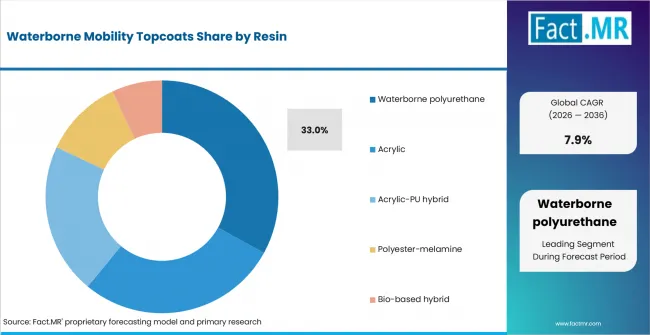
Waterborne Mobility Topcoats Analysis By Resin | Source: Fact.MR
Its advantage comes from the mix of properties required on mobility surfaces. BASF's Basonol PU 1035 W is a water-based aliphatic polyurethane dispersion developed for coating systems on plastic and metal substrates, while Covestro's Bayhydrol UH 2305 is a polyester-polyurethane dispersion used in flexible two-component polyurethane topcoats.
That range matters because mobility coatings rarely face a single performance test. The same part may need flexibility during assembly, adhesion to a difficult substrate and resistance after cure. Waterborne acrylic and acrylic-PU hybrids remain relevant where drying behaviour, cost or colour development carries more weight.
Why do Automotive components lead Mobility Segment?
Automotive components account for 34.0% of Mobility Segment in 2026.
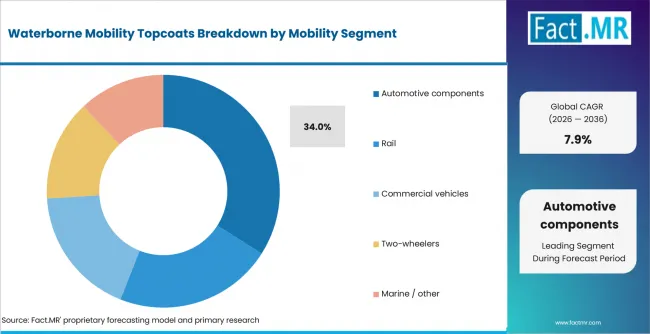
Waterborne Mobility Topcoats Analysis By Mobility Segment | Source: Fact.MR
The segment is broad because coated parts extend well beyond the vehicle body. Current AkzoNobel waterborne topcoats are qualified for several plastic families and for steel or aluminum, while PPG supplies automotive coating systems used across OEM production.
For a Tier supplier, coating selection is often decided at the part level. Geometry, substrate, colour target and cure tolerance can differ from the main body shop. That creates repeated specification work and gives established waterborne systems a recurring role across component programs.
Why does High-gloss lead Finish?
High-gloss accounts for 31.0% of Finish in 2026.
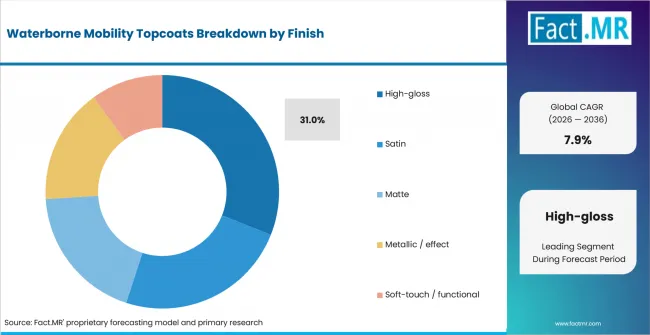
Waterborne Mobility Topcoats Analysis By Finish | Source: Fact.MR
High-gloss finishes remain common on exterior and other visible parts because colour depth and surface smoothness are immediately noticeable. Waterborne polyurethane and acrylic-polyol systems can be formulated for high-gloss 2K coatings while retaining scratch and chemical resistance.
The difficult part is process control. Water has to leave the film cleanly before cure while the coating still levels enough to avoid orange peel or surface defects. Booth conditions and rheology therefore become part of the finish decision, especially on visible parts.
Why does Low-bake lead Cure?
Low-bake accounts for 34.0% of Cure in 2026.
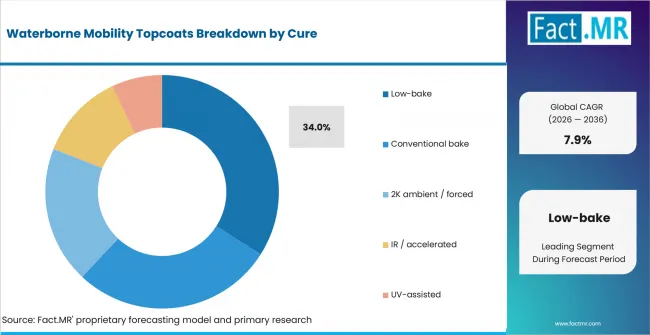
Waterborne Mobility Topcoats Analysis By Cure | Source: Fact.MR
Plastic and composite components cannot always tolerate the temperatures used for a metal body shell. Axalta has described low-bake systems for plastic and composite substrates, and its Harmonized Coating Technologies reduce the number or temperature of bake steps in waterborne processes.
Low-bake therefore solves two operating problems at once: it protects heat-sensitive parts and can reduce oven demand. PPG's compact paint systems follow the same process logic by eliminating intermediate heated dehydration in some configurations. The same shift is visible across paints and coatings where manufacturers are trying to shorten energy-intensive production stages.
What is accelerating Waterborne Mobility Topcoats Market adoption, and what is holding it back?
Waterborne topcoats are gaining ground because solvent-emission limits, lower-bake process design and the wider use of coated plastics all point toward lower-solvent production. Manufacturers still expect the same visual standard from the finished vehicle, so waterborne adoption depends on matching appearance while changing the process chemistry.
The trade-off is process sensitivity. Water release changes with booth temperature and humidity, while high-gloss work leaves little room for levelling defects. Qualification can also be slow because colour, adhesion and cure behaviour have to be checked across individual substrates and production sites.
Drivers Impact Analysis
| DRIVER | (~) % IMPACT ON CAGR | GEOGRAPHIC RELEVANCE | IMPACT TIMELINE |
|---|---|---|---|
| VOC and solvent-emission compliance in mobility coating lines | +1.4% | EU, UK, USA | Short term (<= 2 years) |
| Low-bake and wet-on-wet paint process conversion | +1.2% | Germany, USA, Japan, France | Medium term (2-4 years) |
| Growth in coated plastic and mixed-material vehicle components | +1.0% | North America, Europe, Japan | Medium term (2-4 years) |
| Demand for durable gloss and effect finishes | +0.7% | Global mobility manufacturing | Long term (>= 4 years) |
Opportunity Impact Analysis
| OPPORTUNITY | (~) % IMPACT ON CAGR | GEOGRAPHIC RELEVANCE | IMPACT TIMELINE |
|---|---|---|---|
| Low-temperature waterborne topcoats for plastic components | +0.9% | Germany, Japan, USA | Short term (<= 2 years) |
| Waterborne systems for rail and commercial vehicle refurbishment | +0.7% | Europe, UK, Japan | Medium term (2-4 years) |
| Bio-based and hybrid resin formulations with OEM-grade finish | +0.5% | Europe, Japan | Long term (>= 4 years) |
Restraints Impact Analysis
| RESTRAINT | (~) % IMPACT ON CAGR | GEOGRAPHIC RELEVANCE | IMPACT TIMELINE |
|---|---|---|---|
| Humidity and water-release sensitivity during application | -0.5% | Humid and high-throughput paint environments | Short term (<= 2 years) |
| Long OEM colour, adhesion and cure qualification cycles | -0.4% | Global automotive and rail programs | Medium term (2-4 years) |
| Drying energy and flash-space requirements for some waterborne systems | -0.3% | Existing solvent-oriented coating lines | Medium term (2-4 years) |
Which countries are scaling the Waterborne Mobility Topcoats Market through 2036?
- Germany: Vehicle production and a high electric-model share keep coating qualification active across bodies and components. EU solvent rules also make waterborne chemistry relevant to paint-line planning.
- USA: EPA controls on VOC and hazardous-air-pollutant emissions make coating chemistry part of compliance whenever plants modify or add automobile coating capacity.
- Japan: Domestic automotive coating production remains close to OEM and component demand, supporting local qualification and technical-service work for waterborne systems.
- France: Vehicle-platform renewal is changing the mix of materials and parts produced locally, increasing the number of components requiring fresh colour, adhesion and cure validation.
- UK: A changing production mix toward electrified models keeps coating systems under review across vehicle bodies and outsourced component programs.
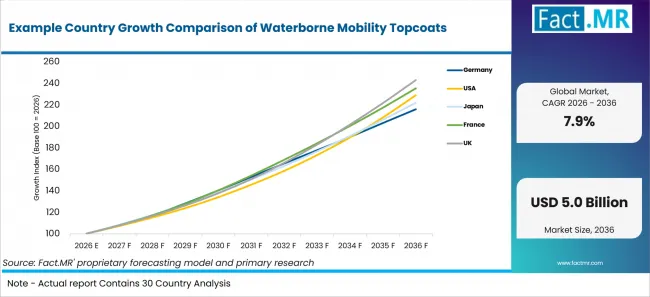
Example Country Growth Comparison Of Waterborne Mobility Topcoats | Source: Fact.MR
Country CAGR (2026-2036)
| Country | CAGR (2026-2036) |
|---|---|
| Germany | 8.0% |
| USA | 8.6% |
| Japan | 8.3% |
| France | 8.9% |
| UK | 9.3% |
What is driving Germany's growth through 2036?
Germany is projected to record an 8.0% CAGR from 2026 to 2036.
VDA reported 4.15 million passenger cars produced in Germany in 2025. Detailed production data released in February 2026 showed that electric models accounted for 40% of domestic passenger-car output. Each new or revised platform creates coating work across bodies, bumpers, trim and other visible parts.
The local opportunity is therefore tied to process change inside an established manufacturing base. Waterborne topcoats are useful where plants need to manage solvent emissions while continuing to meet OEM expectations for gloss, colour stability and durability.
What is driving USA growth through 2036?
USA is projected to record an 8.6% CAGR from 2026 to 2036.
EPA standards for automobile and light-duty truck coating operations keep VOC and hazardous-air-pollutant emissions inside the paint-shop compliance equation. When a plant changes a coating system or adds capacity, emissions performance has to be considered alongside coating performance.
That gives waterborne systems a practical route into new and modified lines. The opportunity is especially relevant for component plants coating plastic exterior parts, where lower-solvent chemistry still has to meet OEM colour and weathering requirements.
What is driving Japan's growth through 2036?
Japan is projected to record an 8.3% CAGR from 2026 to 2036.
Japan retains a domestic vehicle-production base and an automotive coating supply chain positioned close to OEM plants. Nippon Paint Automotive Coatings' Okayama plant produces automotive topcoat, water-borne primer and plastic-parts paints, with stated production capacity of 4,500 tons per year.
That proximity matters when a coating has to be tuned for a specific substrate or cure window. Local production can shorten the loop between formulation adjustment, trial coating and OEM approval.
What is driving France's growth through 2036?
France is projected to record an 8.9% CAGR from 2026 to 2036.
Insee reported that more than half of passenger vehicles produced in France in 2025 used fully or partly electric powertrains. That shift changes vehicle platforms and, with them, the mix of plastic, metal and decorative components entering production.
For coating suppliers, the opportunity comes from requalification. New parts need colour matching, adhesion testing and cure validation, which gives waterborne topcoats a route into programs even when overall vehicle output changes gradually.
What is driving UK's growth through 2036?
UK is projected to record a 9.3% CAGR from 2026 to 2036.
SMMT reports that more than 717,000 cars were built in the UK in 2025. Its August 27, 2026 manufacturing release showed that electrified models represented four in ten cars built in July 2026.
Every model transition brings coating work across bodies and outsourced component lines. Waterborne systems become more attractive where suppliers need to manage plastic substrates, lower bake temperatures and OEM finish requirements within the same program.
Who Leads the Waterborne Mobility Topcoats Market?
Key players in the Waterborne Mobility Topcoats Market include PPG, Surventis (formerly BASF Coatings), Axalta, AkzoNobel, Kansai Paint and Nippon Paint. Competition depends on OEM approvals, colour capability, resin and application know-how, and the ability to support plant trials across different substrates.
PPG and Axalta bring broad automotive process portfolios, including compact paint approaches. Surventis carries the former BASF Coatings automotive OEM coatings business after the June 30, 2026 transaction with Carlyle. AkzoNobel has current waterborne topcoat products across several automotive substrates, while Kansai Paint and Nippon Paint remain established participants in vehicle-coating programs.
Which companies are the key providers?
PPG, Surventis, Axalta, AkzoNobel, Kansai Paint and Nippon Paint are the key providers included in the market analysis.
- PPG
- Surventis
- Axalta
- AkzoNobel
- Kansai Paint
- Nippon Paint
Bibliography
- U.S. Environmental Protection Agency. (n.d.). Surface Coating of Automobiles and Light-Duty Trucks: National Emission Standards for Hazardous Air Pollutants. U.S. EPA.
- U.S. Environmental Protection Agency. (n.d.). Automobile and Light-Duty Truck Surface Coating Operations: New Source Performance Standards. U.S. EPA.
- European Union. (2010). Directive 2010/75/EU on industrial emissions. Official Journal of the European Union.
- BASF. (n.d.). Basonol PU 1035 W. BASF.
- Covestro. (n.d.). Bayhydrol UH 2305. Covestro.
- AkzoNobel Automotive Coatings. (n.d.). Waterborne automotive topcoats. AkzoNobel.
- Axalta Coating Systems. (n.d.). Harmonized Coating Technologies. Axalta.
- PPG. (n.d.). Compact Paint Systems. PPG Automotive OEM Coatings.
- Verband der Automobilindustrie. (2026, January 5). Passenger car production in 2025 slightly above previous year's level. VDA.
- Verband der Automobilindustrie. (2026, February 3). New record: 40% electric share of passenger car production in 2025. VDA.
- Japan Automobile Manufacturers Association. (2025). The Motor Industry of Japan 2025. JAMA.
- Nippon Paint Holdings Co., Ltd. (2023, February 7). Notice of Completion of Okayama Plant. Nippon Paint Holdings.
- Institut national de la statistique et des études économiques. (2026, March 24). Construction automobile: la production de véhicules électriques sur les sites français monte en charge. Insee.
- Society of Motor Manufacturers and Traders. (2026, February 20). SMMT Motor Industry Facts 2026. SMMT.
- Society of Motor Manufacturers and Traders. (2026, August 27). UK vehicle production down as pressures persist. SMMT.
- BASF. (2026, July 1). BASF and Carlyle complete coatings transaction. BASF.
This Report Answers
- The report explains why lower-solvent paint systems are being specified in mobility manufacturing.
- Segment analysis explains how resin, substrate, finish and cure conditions affect topcoat selection.
- Country analysis separates the demand mechanisms in Germany, USA, Japan, France and UK.
- Competitive analysis reviews the current provider set while identifying the BASF Coatings transition to Surventis.
- Application analysis examines how appearance, bake limits and mixed-material parts affect supplier qualification.
What does the Waterborne Mobility Topcoats Market cover?
The market counts formulated waterborne topcoats sold as the final visible or functional coating layer on mobility surfaces. The commercial boundary includes topcoats used on automotive components, rail equipment, commercial vehicles, two-wheelers and other transport-related applications.
Both metal and polymer substrates are included where the waterborne topcoat is part of the coating system. The analysis follows Resin, Mobility Segment, Finish and Cure.
What is included in the scope?
The scope includes waterborne polyurethane, acrylic, acrylic-PU hybrid, polyester-melamine and bio-based hybrid resin systems. Applications cover automotive components, rail, commercial vehicles, two-wheelers and marine or other mobility use.
Finish categories include high-gloss, satin, matte, metallic or effect and soft-touch or functional topcoats. Cure routes cover low-bake, conventional bake, 2K ambient or forced cure, IR or accelerated cure and UV-assisted cure.
What is excluded from the scope?
Primers, electrocoats and basecoats sold without the topcoat layer are outside the market. Architectural coatings, non-mobility industrial coatings and raw formulation inputs such as standalone resins or additives are also excluded.
Automotive refinish products used mainly in bodyshops are treated separately from OEM and component production. Powder coatings and solvent-borne topcoats are adjacent technologies and are not included in waterborne mobility topcoat revenue.
How Was the Analysis Built?
- Primary Research: Discussions focus on coating formulators, OEM paint teams, Tier suppliers, rail and commercial-vehicle manufacturers, component coaters, application-equipment specialists and resin or additive suppliers. The research tests how substrate, finish target and cure window affect specification.
- Desk Research: The analysis draws on environmental regulation, vehicle-production statistics, coating-technology documents, plant announcements and first-party technical literature relevant to waterborne mobility coating demand.
- Market Sizing and Forecasting: Sizing uses topcoat revenue, mobility production, coated component content, waterborne penetration, resin mix, finish mix and cure technology. Forecasting considers vehicle and component output, paint-line conversion, refurbishment demand, price/mix and the pace of substitution away from solvent-borne systems.
- Data Validation and Update Cycle: The market view is checked against vehicle production, regulatory changes, coating-line revisions, product introductions, coating-plant investment and changes in substrate or cure technology.
What is the report's scope and coverage?
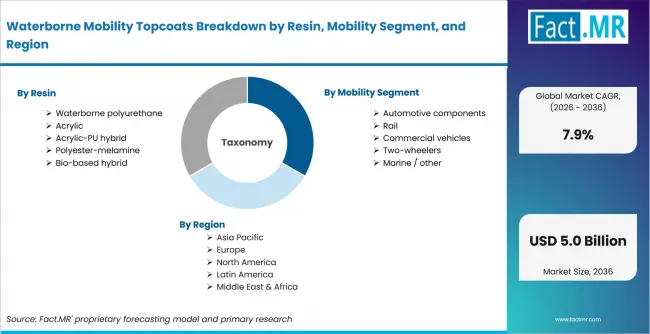
Waterborne Mobility Topcoats Breakdown By Resin, Mobility Segment, And Region | Source: Fact.MR
| Attribute | Details |
|---|---|
| Quantitative Units | USD Billion |
| Market Definition | Waterborne topcoat systems used as the final visible or functional coating layer on mobility components and vehicle surfaces. |
| Resin | Waterborne polyurethane; Acrylic; Acrylic-PU hybrid; Polyester-melamine; Bio-based hybrid |
| Mobility Segment | Automotive components; Rail; Commercial vehicles; Two-wheelers; Marine / other |
| Finish | High-gloss; Satin; Matte; Metallic / effect; Soft-touch / functional |
| Cure | Low-bake; Conventional bake; 2K ambient / forced; IR / accelerated; UV-assisted |
| Countries Covered | Germany; USA; Japan; France; UK |
| Key Companies | PPG; Surventis; Axalta; AkzoNobel; Kansai Paint; Nippon Paint |
| Forecast Period | 2026-2036 |
| Base Year | 2026 |
| Market Value, 2026 | USD 2.3 billion |
| Market Value, 2036 | USD 5.0 billion |
| CAGR, 2026-2036 | 7.9% |
| Absolute Opportunity | Approximately USD 2.7 billion |
| Approach | Demand-side and supplier-side triangulation using mobility production, coated component intensity, waterborne penetration, resin/finish mix and cure-process adoption. |
How is the market segmented?
-
By Resin
- Waterborne polyurethane
- Acrylic
- Acrylic-PU hybrid
- Polyester-melamine
- Bio-based hybrid
-
By Mobility Segment
- Automotive components
- Rail
- Commercial vehicles
- Two-wheelers
- Marine / other
-
By Finish
- High-gloss
- Satin
- Matte
- Metallic / effect
- Soft-touch / functional
-
By Cure
- Low-bake
- Conventional bake
- 2K ambient / forced
- IR / accelerated
- UV-assisted