- Market Value (2025): USD 211.9 Mn
- Estimated Value (2026): USD 225.0 Mn
- Forecast Value (2036): USD 410.0 Mn
- CAGR (2026-2036): 6.2%
What is the Waterborne Anti-Block Additives Market forecast to be worth by 2036?
USD 225.0 million, climbing to USD 410.0 million by 2036 at a 6.2% CAGR.
- The waterborne anti-block additives market reached USD 211.9 million in 2025 and was already part of label-converter approval programs for anti-block additives and film additives. Buyers are looking for consistent release without unwanted changes in haze or drying performance.
- The market is set to add USD 185.0 million through 2036 as silica and flexible packaging gain more defined applications. The additive must remain evenly dispersed during drying and prevent surfaces from sticking once the web is wound or stacked.
- The 6.2% CAGR is supported by continued technical review of label release and wash water load. Film-handling results also need to be assessed alongside sorter reading, and the intended recycling route.
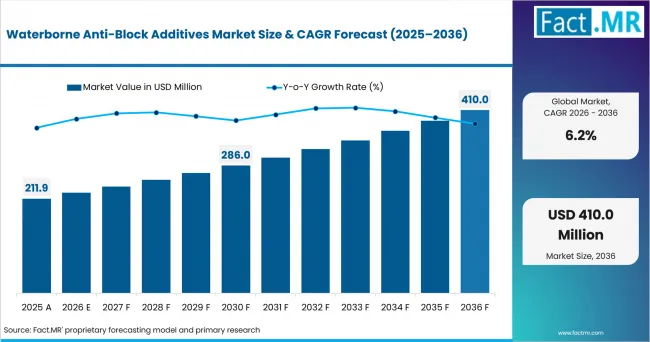
Waterborne Anti Block Additives Market Market Value Analysis | Source: Fact.MR
What are the defining numbers behind Waterborne Anti-Block Additives Market growth?
The absolute opportunity comes to USD 185.0 million by 2036, led by flexible packaging films. Flexible packaging holds 44% share in 2026, worth USD 99.0 million. Silica holds 35%,
- Demand Drivers in the Market
- Flexible packaging is a natural testing ground because film surfaces remain in contact during winding. The waterborne layer must dry properly before those surfaces are pressed together. Testing then shows whether the additive reduces tack without pushing slip, haze, or gloss outside the acceptable range. Purchasing decisions move faster when the material clearly reduces waste or rework.
- PE attracts interest wherever retail packaging waste is part of the review process. The anti-block system must remain compatible with the waterborne binder and coated surface. Wash water load is also considered, so a grade may perform well on the production line but remain under review until the recycling route is approved.
- Demand for Low haze comes from the need to improve surface separation without affecting visual clarity. Additive distribution and migration all influence appearance across the web. Sorter reading adds another layer to qualification, so anti-block performance is weighed against haze and overall film quality.
- Film producers see the earliest process results because they follow the material through binder incorporation and final release. Problems become visible quickly when distribution is uneven or surface slip begins to affect printing, recoating, or lamination. This makes production-line qualification a direct driver of demand.
- Key Segments Analyzed
- By Additive Type: With a 35% share in 2026, silica remains the leading choice. Its effectiveness depends heavily on how evenly it spreads across the surface. Local buildup can increase haze, while weak surface coverage may leave tack when layers are pressed together.
- By Application: Flexible packaging accounts for 44% share in 2026, reflecting how clearly anti-block performance shows up during winding, storage and lamination. The surface must also remain suitable for recycling review after these steps.
- By Substrate: A 33% share in 2026 places PE at the front of the substrate segment. The additive must blend well with the waterborne binder, form an even coating, dry within the available line window, and release consistently after winding. Retail packaging waste also shapes approval decisions.
- By Performance: Low haze represents 32% share in 2026. The challenge is straightforward: reduce surface contact and tack without making the film look cloudy or uneven.
- By End User: Film producers account for 40% share in 2026. They can follow the material from additive mixing and coating through drying, winding, storage, and release, making it easier to see whether laboratory results hold up in normal plant use.
- Analyst Opinion at Fact.MR
- Shambhu Nath Jha, Senior Analyst at Fact.MR, states that as a focused market where film and coating performance decide whether an additive is accepted. The material must prevent coated surfaces from sticking together without changing haze, gloss, slip, printability, recoating, lamination, or the clarity of the finished film. Silica leads the additive type segment, but its chemistry alone is not enough to secure approval. Performance has to be proven after the additive is dispersed in the selected waterborne binder, dried, wound under production conditions, stored, and tested for release. Label release then show whether those production results also meet the relevant recycling requirements
- Strategic Implications
- Silica suppliers will have an advantage if they can demonstrate performance under production conditions rather than controlled laboratory testing. Customers are increasingly looking for evidence generated with their own waterborne binder, coating process, dryer settings, and winding conditions because blocking often appears only after stored rolls have been exposed to heat and pressure.
- Material selection is becoming broader than release performance alone. Grades that maintain haze and wash water load alongside anti-block performance are more likely to move through qualification than products optimized around a single property.
- Consistent additive distribution is emerging as a key differentiator. Even small variations during mixing or coating can create uneven release, visible appearance differences, or inconsistent downstream performance, making process control just as important as additive chemistry.
- Qualification records are becoming part of the commercial process rather than just technical documentation. Clear links between formulation, storage conditions, unwind behavior, and label release make it easier to repeat successful trials, resolve unexpected results, and shorten future approval cycles.
How does the Waterborne Anti-Block Additives Market break down by segment?
Silica leads Additive Type at 35%, Flexible packaging tops Application at 44%,
Where is Additive Type demand strongest?
Silica holds 35% share in 2026.
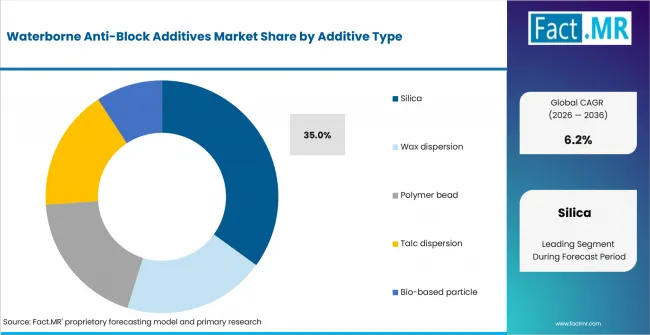
Waterborne Anti Block Additives Market Analysis By Additive Type | Source: Fact.MR
Silica leads because its anti-block value is easy to check in ordinary film and coating trials. The target is controlled surface contact: enough silica has to sit at the interface to cut tack when coated layers are pressed together, but distribution needs to stay uniform or release force and appearance will drift across the roll. Wax dispersion, Polymer bead, Talc dispersion, and Bio-based particle round out the Additive Type list, giving formulators other ways to balance handling against cost. Whichever one is picked still has to fit the waterborne binder, survive drying or cure without migrating where it shouldn't, and hold onto the gloss, haze, printability, and lamination response the finished construction demands.
What supports Application adoption?
Flexible packaging holds 44% share in 2026.
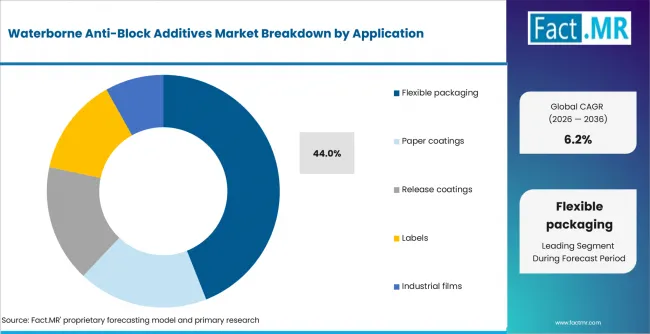
Waterborne Anti Block Additives Market Analysis By Application | Source: Fact.MR
Flexible packaging leads because blocking turns into a real converting problem the moment freshly coated film gets wound and adjacent surfaces stay under pressure. Residual heat or incomplete drying pushes tack up, while too much surface modification can throw off slip or get in the way of printing and lamination. Qualification has to follow the web past the initial coating step. Teams unwind stored rolls, compare release force, check clarity and surface marking, and confirm the next operation still runs smoothly. Paper coatings, Release coatings, Labels, and Industrial films fill out the Application list, each running the same purchased anti-block function through a different handling sequence. Wider adoption comes down to whether the chosen grade survives normal plant handling and clears the relevant recycling review.
Which Substrate dominates?
PE holds 33% share in 2026.
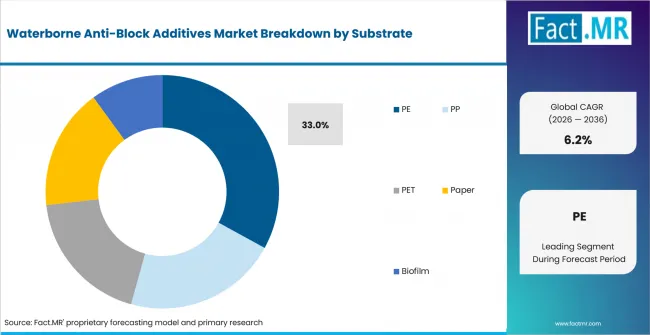
Waterborne Anti Block Additives Market Analysis By Substrate | Source: Fact.MR
PE stays out front because it sits right next to the retail packaging waste problem and gives customers a direct qualification path. The coating package has to wet and dry as expected on the PE construction, stay compatible with its waterborne binder, and leave a repeatable surface after winding. From there the buyer checks whether release gets better without hurting slip, haze, gloss, printing, recoating, or lamination. PP, PET, Paper, and Biofilm round out the substrate list, keeping substrate fit central to formulation choice rather than letting anyone assume one additive package transfers unchanged. Brand owners only widen buying once routine storage and plant use reproduce the handling and recycling results they expect.
What leads the Performance segment?
Low haze holds 32% share in 2026.
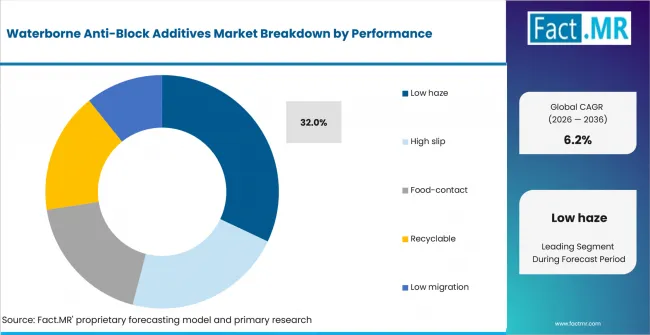
Waterborne Anti Block Additives Market Analysis By Performance | Source: Fact.MR
Low haze leads because film clarity has to survive the same surface engineering meant to stop blocking. An additive can cut close contact and still leave the coating looking uneven if particle distribution is poor or the surface level is off. The grade worth using gets release without giving up the visual field across the web. High slip, Food-contact, Recyclable, and Low migration round out Performance, framing adjacent qualification needs rather than replacing the anti-block function itself. High slip changes web handling, and migration affects how consistently the surface takes ink or another layer. Customer teams end up comparing clarity, release, slip, and downstream conversion after normal drying, stacking, or roll storage before they widen approval.
How does End User shape demand?
Film producers hold 40% share in 2026.
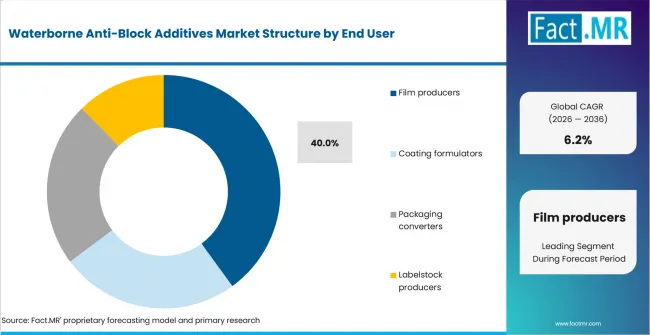
Waterborne Anti Block Additives Market Analysis By End User | Source: Fact.MR
Film producers lead because they see the whole chain, from formulation to wound-roll behavior. They disperse the additive into the waterborne system, apply and dry the layer, control the web, and check release once surfaces have sat in contact. That vantage point lets them tell a binder compatibility problem apart from a drying problem or an anti-block level that just isn't distributed evenly. Coating formulators, Packaging converters, and Labelstock producers make up the rest of End User, and their requirements all converge at qualification, where the grade has to cut blocking without destabilizing gloss, haze, slip, printability, recoating, or lamination. Packaging labs treat repeat storage and plant-use results as the gate before wider purchasing opens up.
What is accelerating Waterborne Anti-Block Additives Market adoption, and what is holding it back?
Label release testing is the strongest reason to adopt. What slows conversion down is qualification cost and process fit.
Label converters move faster when they can confirm release and recycling behavior without tearing apart an approved construction. Distribution, waterborne binder compatibility, drying, contact pressure, storage heat, slip, and downstream conversion all weigh on the decision.
Drivers Impact Analysis
| DRIVER | (~) % IMPACT ON CAGR | GEOGRAPHIC RELEVANCE | IMPACT TIMELINE |
|---|---|---|---|
| Label release testing | +0.6% | Europe and North America | Short term (<= 2 years) |
| Flexible packaging films approval programs | +0.5% | Asia Pacific | Medium term (2-4 years) |
| Local support near label converters | +0.4% | Global | Long term (>= 4 years) |
Source: Fact.MR analysis. Updated Jul 15, 2026
- Label release testing: A measurable interface gives teams a better test than a broad additive claim. They can condition the construction and observe whether it separates consistently. Wash water load remains part of the final review, so release behavior alone does not complete qualification.
- Flexible packaging films approval programs: Structured checks can span coating, drying, winding, storage, unwinding, print or lamination work, and recycling review. This makes the customer problem clear and creates a repeatable route from a candidate grade to regular purchasing.
- Local support near label converters: Nearby service speeds the response when release force, haze, slip, or drying changes. Teams can locate the issue in dispersion, binder compatibility, application, storage, or the label construction.
Opportunity Impact Analysis
| OPPORTUNITY | (~) % IMPACT ON CAGR | GEOGRAPHIC RELEVANCE | IMPACT TIMELINE |
|---|---|---|---|
| Grades tuned for Flexible packaging films | +0.5% | Global | Medium term (2-4 years) |
| Application labs for Flexible packaging | +0.4% | Asia Pacific and Europe | Short term (<= 2 years) |
| Rule-ready documentation | +0.4% | Europe and United Kingdom | Medium term (2-4 years) |
Source: Fact.MR analysis. Updated Jul 15, 2026
- Grades tuned for Flexible packaging films: The opening lies in matching surface separation to the film construction. A tuned grade should release after winding and storage while maintaining the required haze, gloss, slip, printing, recoating, and lamination response. Simple notes make those tradeoffs easier to verify.
- Application labs for Flexible packaging: Useful laboratory work imitates the plant sequence. Dispersion and coating lead into drying, contact, conditioning, and release review. The result must transfer to the customer's line without a different blocking pattern or visual variation.
- Rule-ready documentation: Clear records connect the tested waterborne formulation with packaging and recycling review. A usable file preserves the conditions for label release and sorter reading, allowing customer teams to reproduce the work through normal handling.
Restraints Impact Analysis
| RESTRAINT | (~) % IMPACT ON CAGR | GEOGRAPHIC RELEVANCE | IMPACT TIMELINE |
|---|---|---|---|
| Qualification cost | -0.4% | Global processors | Medium term (2-4 years) |
| Fit limits in Flexible packaging | -0.3% | Global | Short term (<= 2 years) |
| Documentation burden | -0.3% | Europe and North America | Medium term (2-4 years) |
| Scale-up risk | -0.2% | High-volume plants | Long term (>= 4 years) |
Source: Fact.MR analysis. Updated Jul 15, 2026
- Qualification cost: Changing an approved grade consumes formulation work, line time, finished rolls, storage checks, and converting attention. Customers carry the risk, so a candidate needs enough evidence to justify release, appearance, print, lamination, and recycling tests.
- Fit limits in Flexible packaging: Tack control is insufficient if slip, haze, gloss, ink acceptance, or lamination changes. The anti-block package interacts with the binder, drying response, wound-roll pressure, and later converting steps, making approved recipes costly to alter.
- Documentation burden: Buyers need a traceable account of the tested grade, formulation, substrate, application and drying path, storage condition, release result, and recycling checks. Missing detail can force repetition even when the initial handling result was favorable.
- Scale-up risk: A laboratory film does not reproduce every high-volume distribution, drying, and winding condition. Uneven additive placement or changed contact history can create blocking in part of a production roll, with variation appearing only during unwinding or conversion.
Which countries are scaling Waterborne Anti-Block Additives Market fastest?
Germany at 7.1%, Brazil at 6.5%, and the United States at 5.9%.
North America, Europe, and Asia Pacific fall within the regional view, alongside Central and South America and the Middle East and Africa. Manufacturing depth, customer testing, and local support shape how these countries compare through 2036.
.webp "Top Country Growth Comparison Waterborne Anti Block Additives Market Cagr (2026 2036)")
Top Country Growth Comparison Waterborne Anti Block Additives Market Cagr (2026 2036) | Source: Fact.MR
| COUNTRY | CAGR |
|---|---|
| Germany | 7.1% |
| Brazil | 6.5% |
| United States | 5.9% |
Source: Fact.MR analysis. Updated Jul 15, 2026
What is driving Germany's growth through 2036?
Germany is anticipated to grow at 7.1% CAGR through 2036.
Germany's 7.1% trajectory reflects manufacturing activity and customer testing around anti-block additives and film additives. The market gains when buyers and material suppliers can compare line evidence directly, particularly for Flexible packaging and Labels that have to clear both converting and documentation review. A side-by-side trial can show whether a new grade cuts blocking after stored contact while holding onto Low haze, stable slip, and a surface still fit for printing or another coating. Rule-ready documentation carries particular weight in Europe, helping the technical feedback loop produce an approval record that can be repeated rather than a good result with a murky preparation history.
How is Brazil scaling demand?
Brazil waterborne anti-block additives market is anticipated to grow at 6.5% CAGR through 2036.
Brazil's 6.5% course ties back to manufacturing activity, local customer work, and supplier support alongside processors. That combination can speed up qualification when plant conditions diverge from an initial lab screen. Teams can check how the additive dispersed, whether the waterborne layer dried evenly, how the roll held up under contact pressure, and whether release stayed steady after storage. Demand scales once a product controls tack on the converting line and leaves test notes customers can reproduce in their own handling and recycling processes.
What supports the United States outlook?
The United States is expected to record 5.9% CAGR through 2036.
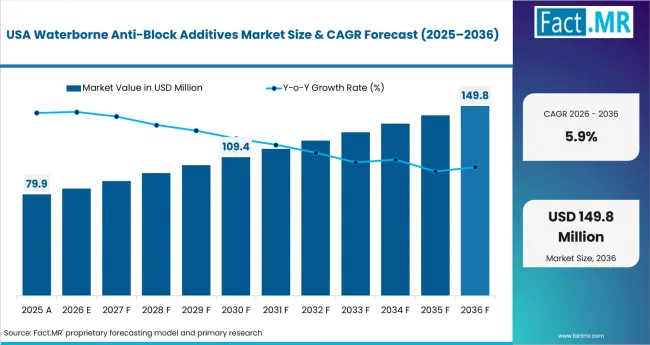
Waterborne Anti Block Additives Market Country Value Analysis | Source: Fact.MR
The 5.9% United States outlook rests on manufacturing activity and customer testing around anti-block additives and film additives. Plant trials and supplier service both have a clear home base, which counts for more once evaluation goes past a simple block test. Film producers and converters can check coating uniformity, drying, roll release, haze, gloss, slip, and downstream printing or lamination within one qualification path. Packaging data and chemical criteria add to the document review. A solid trial record separates additive performance from whatever substrate, binder fit, storage history, or unwind and inspection conditions might otherwise be blamed for.
Who leads the Waterborne Anti-Block Additives Market?
Evonik, BYK, Imerys, Croda, Michelman, and Clariant are among the leading companies in this market. Their position depends on how well their products perform in customer applications, and how reliably they can supply them.
Success in this market comes from proving that the additive works consistently in real production. Suppliers need to help customers prevent blocking without creating new problems in appearance and lamination. Reliable supply and quick technical support also matter, especially when a customer is considering a change to an approved formulation.
Which companies are the key providers?
- Evonik
- BYK
- Imerys
- Croda
- Michelman
- Clariant
Bibliography
- BYK-Chemie GmbH. (2025, March 24). AQUACER 2650 [Technical data sheet].
- Clariant. (2025, January 4). Ceridust™ 8020.
- Evonik Operations GmbH. (2025, October 26). AEROSIL® TT 600 [Technical data sheet].
- Clariant. (2026, April 1). Ceridust™ 9615 A.
This Report Addresses
- Strategic intelligence spans Additive Type and Application choices, interpreted through surface contact, tack, release, waterborne binder fit, drying, and finished-web handling.
- Segment analysis covers silica and flexible packaging, with PE, Low haze, and Film producers leading their respective categories.
- Country analysis for Germany, Brazil, and the United States, together with the complete regional scope.
- Competitive analysis profiles Evonik and BYK, followed by Imerys, Croda, Michelman, and Clariant, without adding unsupported company descriptions.
- Use-case assessment covers Flexible packaging films and adjacent Anti-Block Additives / Film Additives applications, including release, appearance, printing, recoating, lamination, and recycling review.
What does the Waterborne Anti-Block Additives Market cover?
The market covers waterborne systems purchased to cut blocking in films, coatings, paper coatings, and flexible packaging layers, with Silica, Flexible packaging, and Flexible packaging films as the leading reference points.
Commercial value comes from controlled separation between contacting surfaces. The additive is judged only after it's been dispersed into a waterborne binder, applied, dried or cured, and put through pressure during stacking or winding. Release force, tack, slip, haze, gloss, clarity, printability, recoating, lamination, distribution, and migration are the qualification tradeoffs that sit around that purchased function.
This isn't a broad chemical basket. A product stays inside the boundary only when it's sold for the specified anti-block role in a named application. The packaging recycling route keeps label release and wash water load relevant right alongside sorter reading.
What is included in the scope?
Included products are waterborne additive systems that reduce blocking in films, coatings, paper coatings, and flexible packaging layers, spanning Silica, Flexible packaging, and Flexible packaging films along with every option in the stated segmentation taxonomy.
Included demand tracks qualified material, application support, and continuing supply for the named function. The analysis follows how a grade moves from formulation and customer trial into regular purchasing once film handling and relevant recycling evidence are accepted.
What is excluded from the scope?
Broad parent chemicals without the named anti-block function fall outside the scope, as do equipment-only sales. Commodity materials don't count unless they're sold within the waterborne anti-block additives market for a named application.
This exclusion keeps the analysis focused on the additive function rather than every input that goes into a film or coating. Binders, substrates, printing materials, laminate layers, and processing equipment come up only where they form the qualification setting around the purchased anti-block system.
How was the analysis built?
The analysis combines the listed public references with national activity, segment logic, company mapping, and model review. Growth rates, impact figures, shares, providers, segmentation, scope, and forecast period stay unchanged, while the technical interpretation follows the coating and converting path where blocking shows up.
- Primary Research:
- Primary research draws on conversations with suppliers, formulators, buyers, distributors, and application teams working with anti-block additives and film additives, covering distribution, waterborne binder compatibility, drying, contact blocking, release, visual properties, downstream conversion, recycling checks, and repeat supply.
- Desk Research:
- Desk research works through policy records, technical publications, government data, packaging information, chemical criteria, and design-for-recycling guidance.
- Market-Sizing and Forecasting:
- Segment shares and country logic set the sizing frame, 2026 value, 2036 value, CAGR, and provider presence. Review keeps the anti-block additives and film additives route consistent with the stated definition and qualification path.
- Data Validation and Update Cycle:
- Company reach, policy movement, factory signals, and approval exposure get revisited during validation. Process interpretation follows additive incorporation, coating application, drying or cure, stacking or winding, stored contact, release, print or lamination work, and the applicable recycling review.
Segmentation
What is the report's scope and coverage?
The report covers waterborne additive systems that reduce blocking in films, coatings, paper coatings, and flexible packaging layers, tracking the purchased anti-block function across Additive Type, Application, Substrate, Performance, End User, and Region. Products are considered through their handling effect after coating and drying, with recycling evidence carried along wherever the analysis calls for it.
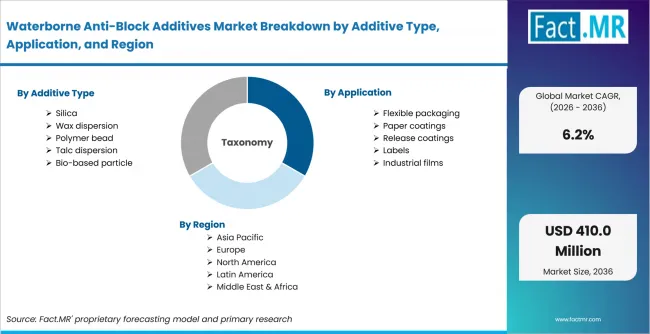
Waterborne Anti Block Additives Market Breakdown By Additive Type, Application, And Region | Source: Fact.MR
| Attribute | Details |
|---|---|
| Quantitative Units | USD Million in 2026 to USD Million by 2036 at CAGR |
| Market Definition | Waterborne additive systems that reduce blocking in films, coatings, paper coatings, and flexible packaging layers. |
| Additive Type | Silica, Wax dispersion, Polymer bead, Talc dispersion, Bio-based particle |
| Application | Flexible packaging, Paper coatings, Release coatings, Labels, Industrial films |
| Substrate | PE, PP, PET, Paper, Biofilm |
| Performance | Low haze, High slip, Food-contact, Recyclable, Low migration |
| End User | Film producers, Coating formulators, Packaging converters, Labelstock producers |
| Regions Covered | North America, Europe, Asia Pacific, Central and South America, Middle East and Africa |
| Countries Covered | Germany, Brazil, United States |
| Key Companies Profiled | Evonik, BYK, Imerys, Croda, Michelman, Clariant |
| Forecast Period | 2026 to 2036 |
| Approach | Hybrid top-down and bottom-up approach using Anti-Block Additives / Film Additives, segment shares, country growth, supplier mapping, and technical validation |
Source: Fact.MR analysis. Updated Jul 15, 2026
How is the market segmented?
-
By Additive Type:
- Silica
- Wax dispersion
- Polymer bead
- Talc dispersion
- Bio-based particle
-
By Application:
- Flexible packaging
- Paper coatings
- Release coatings
- Labels
- Industrial films
-
By Substrate:
- PE
- PP
- PET
- Paper
- Biofilm
-
By Performance:
- Low haze
- High slip
- Food-contact
- Recyclable
- Low migration
-
By End User:
- Film producers
- Coating formulators
- Packaging converters
- Labelstock producers
-
By Region:
- North America
- United States
- Canada
- Europe
- Germany
- United Kingdom
- France
- Italy
- Spain
- Asia Pacific
- Japan
- South Korea
- Australia
- Central & South America
- Brazil
- Argentina
- Mexico
- Chile
- Middle East & Africa
- UAE
- Saudi Arabia
- South Africa
- North America
Frequently Asked Questions
Which Additive Type leads the Waterborne Anti-Block Additives Market?
Which Application leads the Waterborne Anti-Block Additives Market?
Which Substrate leads the Waterborne Anti-Block Additives Market?
Which Performance leads the Waterborne Anti-Block Additives Market?
Which End User leads the Waterborne Anti-Block Additives Market?
Which country records the highest CAGR in the Waterborne Anti-Block Additives Market?
What is the main restraint in the Waterborne Anti-Block Additives Market?
Why is Silica important?
Why do buyers continue testing waterborne anti-block additives?
Who worked on this report


Preview the report firsthand - request a free sample
Free SampleGet the brochure for pricing and purchase details
Download PDF