- Market Value (2025): USD 3.3 Bn
- Estimated Value (2026): USD 3.5 Bn
- Forecast Value (2036): USD 6.2 Bn
- CAGR (2026-2036): 5.8%
What is the Wetting Agent Dispersants Market forecast to be worth by 2036?
USD 3.5 billion in 2026 to USD 6.2 billion by 2036 at a 5.8% CAGR.
- 2025 Market Value: USD 3.3 billion.
- 2026 to 2036 Market Progression: USD 3.5 billion to USD 6.2 billion.
- Forecast CAGR (2026-2036): 5.8%.
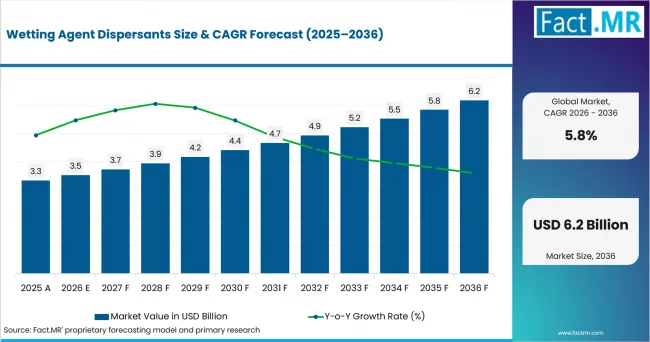
Wetting Agent Dispersants Value Analysis | Source: Fact.MR
What are the defining numbers behind Wetting Agent Dispersants Market growth?
The market creates an absolute opportunity of USD 2.7 billion between 2026 and 2036.
- Demand Drivers in the Market
- Waterborne reformulation increases the technical burden on pigment stabilization. The European Commission revised EU Ecolabel criteria for paints and varnishes in 2025, with tighter limits for volatile and semi-volatile organic compounds. In the United States, EPA architectural-coating rules continue to limit VOC content. As formulators reduce solvent use, dispersants must maintain pigment wetting, low viscosity, color strength, and film performance in more polar aqueous media, creating qualification demand for water-compatible chemistries.
- Higher pigment loading makes dispersion efficiency an operating-cost issue. Lubrizol states that its aqueous polymeric dispersants are designed to support higher solids loading, reduced viscosity, smaller particle size, and improved milling efficiency. These effects let formulators move more pigment through a mill or pigment-concentrate process without allowing viscosity to rise beyond pumpable or printable limits.
- Color consistency and anti-flocculation requirements support recurring additive use in coatings and inks. BYK explains that deflocculation can reduce viscosity, raise color strength, improve gloss, and keep color more stable during storage. This links dispersant selection to batch acceptance, tinting accuracy, and the ability to avoid corrective rework after a pigment concentrate has been produced.
- Printing and industrial formulations are widening the performance window expected from one additive package. Evonik introduced TEGO Dispers 695 in 2026 for radiation-curing and solventborne polyurethane inks, while current supplier portfolios span waterborne, solventborne, and solvent-free systems. Formulators therefore purchase dispersants against specific pigment surfaces and binder environments rather than treating wetting chemistry as a generic surfactant input.
- Key Segments Analyzed
- Polymeric dispersants account for 37.0% of Chemistry in 2026 because pigment-affinic anchor groups and polymeric stabilizing chains can keep particles separated at high solids loading across demanding coating and ink systems.
- Organic pigments represent 26.0% of Target Solid in 2026 because small particle size and high surface area make wetting, viscosity control, and protection against re-flocculation central to color-strength development.
- Waterborne coatings hold 34.0% of Formulation in 2026 as lower-VOC formulation shifts increase the need to stabilize organic pigments, inorganic pigments, and fillers in aqueous media.
- Viscosity reduction accounts for 28.0% of Function in 2026 because lower mill-base viscosity supports higher pigment loading, easier pumping, faster grinding, and more stable application behavior.
- Analyst Opinion at Fact.MR
- Shambhu Nath Jha, Principal Consultant, Fact.MR, states, “A dispersant earns its place in a formulation when it changes the economics of the grind and preserves that result during storage and application. Pigment surface, binder chemistry, solids loading, and the final coating or ink all matter. Suppliers that can reduce viscosity while protecting color strength and preventing re-flocculation have a clearer route into repeat production formulations.”
- Strategic Implications
- Additive suppliers should document performance by pigment family and formulation medium rather than positioning one chemistry as universally interchangeable. This is particularly important where formulators compare polymeric technologies with lower-molecular-weight systems within the broader coating additives category.
- Coatings producers should qualify dispersants against practical mill-base targets such as viscosity at specified solids, color strength, gloss, storage drift, and milling time. A lower treat rate is not automatically lower cost if the formulation requires longer grinding or corrective additions to reach specification.
- Pigment-concentrate producers can reduce formulation complexity by building compatibility maps across organic pigments, titanium dioxide, carbon black, and fillers. This creates a direct connection with the pigment dispersion supply chain, where stability and transfer into different let-down systems determine the usefulness of a concentrate.
- Waterborne development teams should test foam response, pH sensitivity, resin compatibility, and water resistance alongside dispersion quality. The shift toward aqueous systems increases overlap with pigment wetting additives used to control particle wetting and storage stability.
- Ink formulators should treat dispersion stability as a print-process variable because particle size and viscosity influence flow through flexographic, gravure, and digital systems. Supplier support therefore becomes more valuable in the printing ink market where formulation windows differ by printing process.
- Formulators comparing nonionic and anionic chemistries should also separate general surface-activity needs from pigment-stabilization performance. This distinction matters when products drawn from the broader surfactants market are screened for a dispersion-specific role.
How does the Wetting Agent Dispersants Market break down by segment?
The market is segmented by Chemistry, Target Solid, Formulation, and Function.
Why do Polymeric dispersants lead Chemistry?
Polymeric dispersants account for 37.0% of Chemistry in 2026.
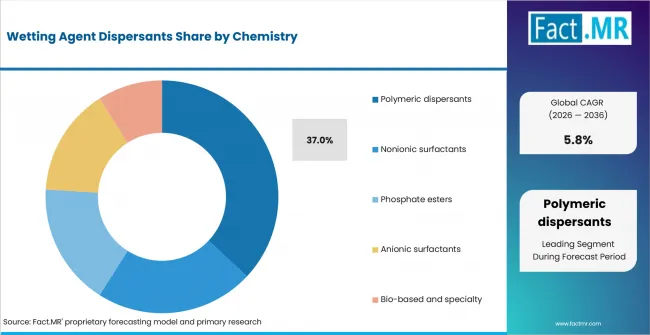
Wetting Agent Dispersants Analysis By Chemistry | Source: Fact.MR
Polymeric dispersants combine a pigment-affinic anchoring portion with solvated polymer chains that create steric separation between particles. Lubrizol describes this architecture as a route to higher solids, lower viscosity, and improved particle-size and viscosity stability compared with resin-only or lower-molecular-weight dispersant approaches.
The chemistry is valuable where formulators need one additive to stay attached to difficult pigment surfaces through grinding, storage, and let-down. BYK likewise describes wetting and dispersing additives as systems that stabilize organic and inorganic pigments as well as fillers through electrostatic or steric mechanisms. That operating range supports repeat qualification across coatings, pigment concentrates, and inks.
Why do Organic pigments lead Target Solid?
Organic pigments represent 26.0% of Target Solid in 2026.
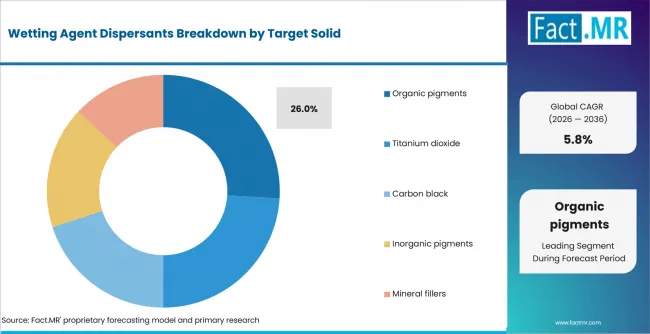
Wetting Agent Dispersants Analysis By Target Solid | Source: Fact.MR
Organic pigments often have fine particle sizes and high surface area, so insufficient wetting can create flocculation, high viscosity, weak color development, or unstable shade. BYK notes that complete deflocculation increases color strength and can improve gloss, while persistent flocculation can produce color change during storage.
Supplier product design reflects this requirement. Evonik positions TEGO Dispers 658 around pigment wetting and color-strength development for organic pigments, while Elementis supplies polymeric wetting and dispersing agents for organic pigments and carbon black in waterborne coatings and inks. Buyers therefore evaluate surface affinity and stabilization efficiency before treat rate alone.
Why do Waterborne coatings lead Formulation?
Waterborne coatings hold 34.0% of Formulation in 2026.
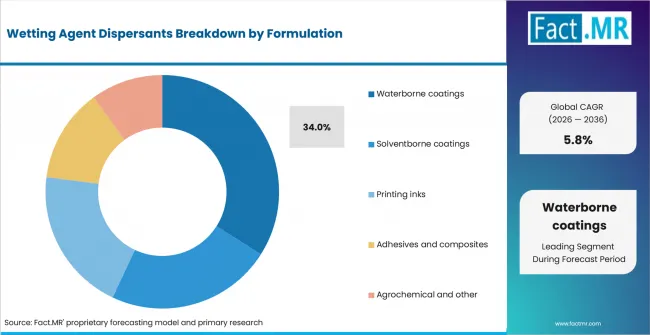
Wetting Agent Dispersants Analysis By Formulation | Source: Fact.MR
Aqueous systems reduce reliance on organic solvent but create different interfacial conditions around pigments, fillers, binders, and co-solvents. Lubrizol identifies pH, particle surface, grind-resin presence, and formulation compatibility as key selection variables for aqueous dispersants, which makes additive choice central to stable waterborne pigment concentrates and paints.
Regulation reinforces the formulation direction. The European Commission’s current EU Ecolabel criteria reduce permitted VOC and SVOC content across decorative and performance coatings, while EPA maintains national VOC standards for architectural coatings in the United States. These requirements increase the value of dispersants that preserve pigment loading and film performance in lower-solvent systems.
Why does Viscosity reduction lead Function?
Viscosity reduction accounts for 28.0% of Function in 2026.
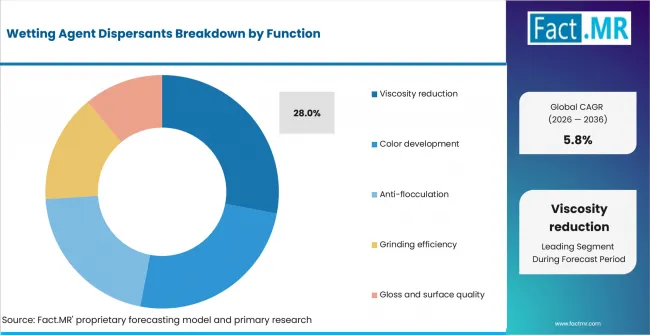
Wetting Agent Dispersants Analysis By Function | Source: Fact.MR
Viscosity determines how much pigment can be processed, pumped, milled, and incorporated before the concentrate becomes operationally difficult to handle. BYK explains that deflocculation produces more Newtonian flow and generally lower viscosity, allowing higher pigment loading. BASF similarly positions Dispex and Efka dispersants around viscosity reduction, pigment stabilization, and color development.
The buyer benefit appears during production as well as in the finished formulation. Lower grind viscosity can increase mill throughput and reduce energy or time per batch, while stable viscosity after storage reduces the risk of hard settling or rework. That combination gives viscosity reduction a direct link to manufacturing cost and batch consistency.
What is accelerating Wetting Agent Dispersants Market adoption, and what is holding it back?
Adoption is being supported by waterborne and lower-VOC reformulation, higher pigment-loading targets, tighter color control, and the need to reduce milling time. The main restraints are formulation specificity, qualification time, and performance trade-offs.
Drivers Impact Analysis
| Factor | (~) % Impact on CAGR | Geographic Relevance | Impact Timeline |
|---|---|---|---|
| Waterborne and lower-VOC coating reformulation | +1.2% | Europe; USA; Japan | Near to mid term |
| Higher pigment loading with controlled mill-base viscosity | +1.0% | Global | Near term |
| Color consistency and anti-flocculation requirements | +0.8% | Global | Near term |
| Specialty ink and pigment-concentrate formulation needs | +0.6% | USA; Germany; Japan; UK | Mid term |
Opportunity Impact Analysis
| Factor | (~) % Impact on CAGR | Geographic Relevance | Impact Timeline |
|---|---|---|---|
| Polymeric dispersants for high-solids aqueous concentrates | +0.9% | Europe; USA; Japan | Mid term |
| Titanium dioxide and pigment-use efficiency programs | +0.7% | Global | Near to mid term |
| Bio-based and specialty dispersant chemistries | +0.5% | Germany; France; UK; USA | Long term |
| Multi-application platforms for coatings, inks, and adhesives | +0.4% | Global | Mid term |
Restraints Impact Analysis
| Factor | (~) % Impact on CAGR | Geographic Relevance | Impact Timeline |
|---|---|---|---|
| Formulation-specific compatibility and requalification burden | -0.8% | Global | Near term |
| Specialty polymer and surfactant cost exposure | -0.6% | Global | Near to mid term |
| Foam, water-resistance, or film-property trade-offs | -0.4% | Waterborne coating markets | Mid term |
| Long customer qualification cycles for established formulations | -0.3% | USA; Europe; Japan | Mid term |
Which countries are scaling the Wetting Agent Dispersants Market through 2036?
- USA: VOC limits for architectural coatings and a broad industrial coatings base keep lower-solvent formulation and pigment-efficiency work active, supporting qualification of water-compatible and high-solids dispersants.
- Germany: A substantial domestic paints and printing-inks manufacturing base supports recurring pigment-grind and reformulation work, while EU environmental criteria increase attention to lower-VOC additive systems.
- Japan: Domestic paint production, shipment, trade, and demand monitoring reflects an established formulation base where waterborne and industrial coating systems require controlled pigment dispersion and repeat batch quality.
- UK: Local paint and ink manufacturing, export activity, and sector sustainability programs create demand for additive packages that can support regulatory compliance without compromising application performance.
- France: Paint, ink, adhesive, and resin production provides several formulation routes for dispersants, while current manufacturing activity and EU product criteria sustain work on aqueous and lower-emission systems.
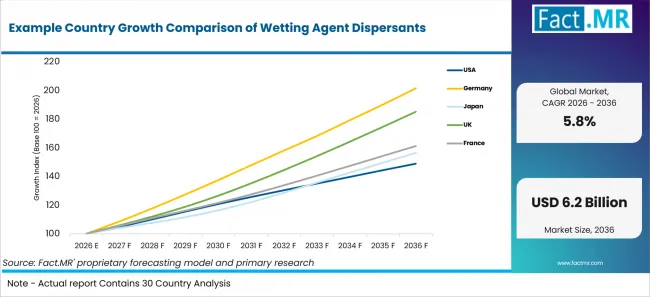
Example Country Growth Comparison Of Wetting Agent Dispersants | Source: Fact.MR
Country CAGR (2026-2036)
| Country | CAGR (2026-2036) |
|---|---|
| USA | 4.1% |
| Germany | 7.3% |
| Japan | 4.6% |
| UK | 6.4% |
| France | 4.9% |
What is driving USA's growth through 2036?
The USA is projected to record a 4.1% CAGR from 2026 to 2036.
U.S. formulation demand is influenced by longstanding VOC controls on architectural coatings. EPA states that national architectural-coating standards require manufacturers and importers to limit VOC content because coating emissions contribute to ground-level ozone. Lower-solvent formulations can change pigment wetting and binder compatibility, creating a recurring need to requalify dispersants rather than simply remove solvent from an existing recipe.
The technical supply base is also broad. BYK lists North America-specific dispersants for titanium dioxide and inorganic pigments, while Lubrizol supplies aqueous and non-aqueous polymeric dispersants across industrial, protective, transportation, and printing applications. Buyers can therefore qualify additives against local coating and ink production requirements with direct technical support.
What is driving Germany's growth through 2036?
Germany is projected to record a 7.3% CAGR from 2026 to 2036.
The Verband der deutschen Lack- und Druckfarbenindustrie reported about 1.4 million tonnes of paints, coatings, and printing inks sold in Germany in 2025. It also reported 168,000 tonnes of printing inks. Even with weaker downstream volumes, this manufacturing base creates recurring pigment-grind, colorant, and reformulation work where dispersant choice affects throughput and finished-product consistency.
Germany also operates within the revised EU Ecolabel framework for decorative and performance coatings. Lower VOC and SVOC limits raise the formulation value of water-compatible dispersants that allow pigment loading and color development to be preserved while solvent content is reduced.
What is driving Japan's growth through 2036?
Japan is projected to record a 4.6% CAGR from 2026 to 2036.
The Japan Paint Manufacturers Association maintains current production, shipment, inventory, trade, and demand statistics, including 2025 annual data and a 2026 demand outlook. This points to an established domestic coating-production base with several resin and application systems rather than a single formulation route.
For dispersant suppliers, the mechanism is formulation consistency. Waterborne coatings, industrial finishes, and pigment concentrates require controlled particle size, viscosity, and storage stability. Japanese buyers with repeat manufacturing processes therefore have a reason to retain technically qualified additives and to test new chemistries when coatings move toward lower emissions or different pigment packages.
What is driving UK's growth through 2036?
The UK is projected to record a 6.4% CAGR from 2026 to 2036.
The British Coatings Federation states that its members represent 95% of UK sales of paints, coatings, printing inks, and wallcoverings. It also reports that three out of four cans of paint sold in the UK are manufactured domestically and that 30% of UK production is exported. This local manufacturing and export base supports formulation work that must meet several customer and regulatory requirements.
BCF’s 2026 net-zero roadmap keeps raw-material and formulation efficiency on the sector agenda. Dispersants that allow higher pigment loading, lower solvent content, or shorter milling can support these programs when the finished coating still meets gloss, color, durability, and storage requirements.
What is driving France's growth through 2036?
France is projected to record a 4.9% CAGR from 2026 to 2036.
INSEE tracks monthly turnover for French manufacturers of paints, varnishes, inks, and mastics, with the April 2026 index at 121.75 on a 2021 base of 100. FIPEC separately represents companies across paints, inks, adhesives, and resins. These categories create multiple downstream formulation routes for wetting agent dispersants rather than dependence on one coating application.
French manufacturers also operate under the revised EU Ecolabel criteria for decorative and performance coatings. Formulators working toward lower VOC and hazardous-substance content need dispersants that can stabilize pigments in aqueous or reduced-solvent systems without creating foam, water-resistance, or finish-quality problems.
Who Leads the Wetting Agent Dispersants Market?
Key players in the Wetting Agent Dispersants Market include BYK, Evonik, Lubrizol, BASF, Clariant, and Elementis.
Competition is shaped by pigment-surface coverage, compatibility across waterborne and solventborne media, viscosity reduction, and technical support during formulation trials. BYK positions DISPERBYK around stabilization of organic and inorganic pigments and fillers. Evonik offers TEGO Dispers chemistries for waterborne colorants, inorganic particles, and specialty inks. Lubrizol competes through Solsperse polymeric dispersants for aqueous and non-aqueous systems.
BASF supplies Dispex and Efka dispersants across aqueous, solvent-based, high-solids, and solvent-free formulations. Clariant’s Dispersogen portfolio spans organic pigments, inorganic pigments, and carbon black in waterborne and solventborne preparations. Elementis supplies NUOSPERSE products for colorant dispersions, including waterborne and solventborne systems. Supplier differentiation therefore depends on application data and formulation support as much as product breadth.
Which companies are the key providers?
Key providers include BYK, Evonik, Lubrizol, BASF, Clariant, and Elementis.
- BYK
- Evonik
- Lubrizol
- BASF
- Clariant
- Elementis
Bibliography
- U.S. Environmental Protection Agency. (2026). Architectural Coatings: National Volatile Organic Compounds Emission Standards. U.S. EPA.
- European Commission. (2026). EU Ecolabel: Paints and Varnishes. Directorate-General for Environment.
- European Commission. (2026). A Fresh Coat: EU Ecolabel Levels Up for Paints & Varnishes. Directorate-General for Environment.
- Verband der deutschen Lack- und Druckfarbenindustrie. (2026). Der Markt für Lacke, Farben und Druckfarben in 2025. VdL.
- British Coatings Federation. (n.d.). Industry Statistics. British Coatings Federation.
- British Coatings Federation. (2026). Net Zero Roadmap, Second Edition. British Coatings Federation.
- Institut national de la statistique et des études économiques. (2026). Turnover Index: Manufacture of Paints, Varnishes, Inks and Mastics. INSEE.
- Fédération des Industries des Peintures, Encres, Couleurs, Colles et Adhésifs. (2026). 2025 Industry Results and 2026 Outlook. FIPEC.
- Japan Paint Manufacturers Association. (2026). Paint Production, Trade and Demand Statistics. JPMA.
- BYK. (n.d.). DISPERBYK Wetting and Dispersing Additives. BYK.
- Evonik Industries. (2026). TEGO Dispers 695 for Inks. Evonik Coating Additives.
- Evonik Industries. (n.d.). TEGO Dispers 658 and TEGO Dispers 651 Product Information. Evonik Coating Additives.
- The Lubrizol Corporation. (2026). Aqueous Dispersants and Solsperse Hyperdispersants. Lubrizol.
- BASF SE. (n.d.). Dispex and Efka Dispersing Agents. BASF.
- Clariant. (2026). Dispersogen ECS and Dispersing Agents for Pigment Preparations. Clariant.
- Elementis plc. (n.d.). Colorant Dispersions and NUOSPERSE Wetting and Dispersing Agents. Elementis.
This Report Answers
- How is revenue distributed across chemistry, target solid, formulation, and function in the Wetting Agent Dispersants Market?
- Why do polymeric dispersants account for 37.0% of Chemistry in 2026?
- How do waterborne reformulation and VOC requirements change dispersant qualification?
- Why are organic pigments a substantial target for wetting, grinding, and anti-flocculation additives?
- How do viscosity reduction and grinding efficiency affect the economics of pigment concentrates?
- How do the USA, Germany, Japan, UK, and France differ in the mechanisms supporting dispersant demand?
- Which capabilities distinguish BYK, Evonik, Lubrizol, BASF, Clariant, and Elementis?
What does the Wetting Agent Dispersants Market cover?
The Wetting Agent Dispersants Market covers commercial sales of specialty additive chemistries used to wet and disperse solid particles in liquid formulations. Revenue is counted when the additive is sold for pigment or filler wetting, particle separation, dispersion stabilization, viscosity control, color development, anti-flocculation, grinding efficiency, or surface-quality improvement within the defined formulation categories.
The market follows the additive through the specified Chemistry, Target Solid, Formulation, and Function categories. It includes products used with organic pigments, titanium dioxide, carbon black, inorganic pigments, and mineral fillers in waterborne coatings, solventborne coatings, printing inks, adhesives and composites, and agrochemical or other specified formulations.
What is included in the scope?
The scope includes polymeric dispersants, nonionic surfactants, phosphate esters, anionic surfactants, and bio-based or specialty chemistries when they are sold to perform wetting or dispersing functions. It includes products used during direct grind, pigment-concentrate manufacture, let-down, and related formulation steps where the additive stabilizes solid particles or reduces process viscosity.
Functional coverage includes viscosity reduction, color development, anti-flocculation, grinding efficiency, and gloss or surface quality. The market includes both aqueous and non-aqueous dispersant products where they fall within the stated formulation taxonomy.
What is excluded from the scope?
The scope excludes pigments, titanium dioxide, carbon black, mineral fillers, resins, solvents, and finished paints, coatings, inks, adhesives, composites, or agrochemical products when sold separately. Their downstream value is not counted as wetting agent dispersant revenue.
Substrate-wetting or leveling additives are excluded when they are sold only to improve spreading on a finished substrate and do not perform pigment, filler, or solid-particle dispersion within the formulation. Stand-alone grinding mills, mixers, dosing equipment, testing instruments, and formulation services are also excluded unless their value is inseparable from the additive sale.
How Was the Analysis Built?
- Primary Research: Primary research is structured around coating and ink formulators, pigment-concentrate producers, additive suppliers, formulation chemists, milling and production teams, adhesive and composite formulators, procurement managers, and technical-service specialists. Discussions focus on dosage, pigment compatibility, grind viscosity, milling time, storage stability, color development, foam, water resistance, and supplier qualification.
- Desk Research: Desk research uses environmental rules, national coating and ink statistics, technical association material, supplier product documentation, and current company information. These sources are used to explain formulation mechanisms, country activity, and competitive capability.
- Market Sizing and Forecasting: Sizing considers coating and ink production, pigment and filler loading, dispersant dosage by particle surface and chemistry, waterborne versus solventborne formulation mix, pigment-concentrate use, application mix, and selling-price differences across polymeric, surfactant, phosphate-ester, and specialty systems.
- Data Validation and Update Cycle: Validation reviews downstream coating and ink activity, regulation, active supplier portfolios, formulation changes, and product launches that can alter dispersant selection or dosage. Company names and ownership status are checked alongside current product families before publication.
What is the report's scope and coverage?
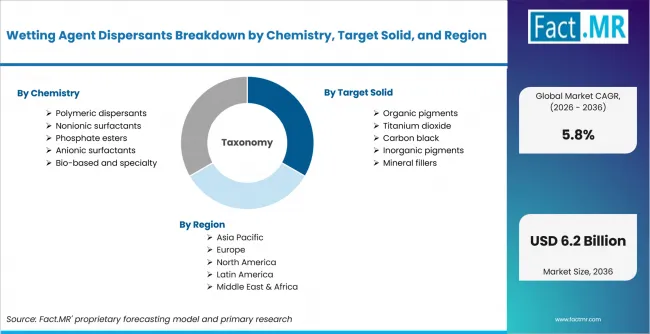
Wetting Agent Dispersants Breakdown By Chemistry, Target Solid, And Region | Source: Fact.MR
| Attribute | Details |
|---|---|
| Quantitative Units | USD 3.5 billion in 2026 to USD 6.2 billion by 2036 at a 5.8% CAGR |
| Market Definition | Specialty additives sold to wet, disperse, and stabilize pigments, fillers, and other solid particles in the defined liquid formulations. |
| Segments Covered | Chemistry; Target Solid; Formulation; Function |
| Regions Covered | North America; Latin America; Europe; East Asia; South Asia and Pacific; Middle East and Africa |
| Countries Covered | USA; Germany; Japan; UK; France |
| Key Companies Profiled | BYK; Evonik; Lubrizol; BASF; Clariant; Elementis |
| Forecast Period | 2026 to 2036 |
| Base Year | 2025 |
| Market Value, 2026 | USD 3.5 billion |
| Market Value, 2036 | USD 6.2 billion |
| CAGR, 2026-2036 | 5.8% |
| Absolute Opportunity | USD 2.7 billion |
| Approach | Hybrid top-down and bottom-up assessment using downstream formulation activity, pigment and filler loading, additive dosage, chemistry mix, application mix, and country-level demand development. |
How is the market segmented?
-
By Chemistry
- Polymeric dispersants
- Nonionic surfactants
- Phosphate esters
- Anionic surfactants
- Bio-based and specialty
-
By Target Solid
- Organic pigments
- Titanium dioxide
- Carbon black
- Inorganic pigments
- Mineral fillers
-
By Formulation
- Waterborne coatings
- Solventborne coatings
- Printing inks
- Adhesives and composites
- Agrochemical and other
-
By Function
- Viscosity reduction
- Color development
- Anti-flocculation
- Grinding efficiency
- Gloss and surface quality