Pigment Dispersion Market (2026 - 2036)

The Pigment Dispersion Market is segmented by Pigment Type (Inorganic Pigments and Organic Pigments), Application (Coatings, Inks, Plastics, and Adhesives & Sealants), Dispersion Type (Water-based and Solvent-based), and Region. Forecast for 2026 to 2036.

FACT.MR opines that the pigment dispersion market is undergoing a clear formulation transition, where traditional solvent-based systems are steadily losing share to water-based and high-performance dispersion technologies. This shift is being driven by tightening global VOC regulations and increasing sustainability expectations from end users. As regulatory pressure intensifies across coatings, inks, and plastics applications, manufacturers are reformulating toward low-emission and environmentally compliant solutions.

Pigment Dispersion Market Forecast and Outlook By Fact.MR

In 2025, the pigment dispersion market was valued at USD 27.6 billion. Based on Fact.MR analysis, demand for pigment dispersions is estimated to grow to USD 28.8 billion in 2026 and USD 44.7 billion by 2036. FACT.MR projects a CAGR of 4.5% during the forecast period.
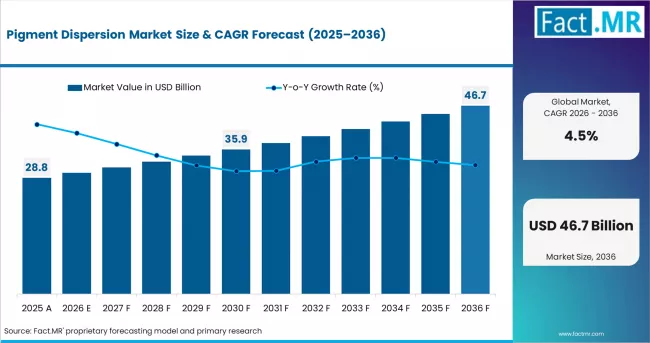
Pigment Dispersion Market Market Value Analysis

Metric Value
Estimated Value in 2026 USD 28.8 billion
Forecast Value in 2036 USD 44.7 billion
Forecast CAGR (2026 to 2036) 4.5%

Summary of the Pigment Dispersion Market

  • Market Definition
    • Market covers overs inorganic and organic pigment dispersions in water- and solvent-based systems for coatings, inks, plastics, and adhesives.
  • Demand Drivers
    • India’s construction activity is increasing coatings output, supporting dispersion uptake across manufacturers.
    • China’s packaging and plastics industries are expanding, raising demand for compliant pigment dispersions.
    • EU VOC regulations are pushing formulators toward water-based systems, replacing solvent-based products.
  • Key Segments Analyzed
    • By Pigment Type: Inorganic pigments lead with 58% share due to cost efficiency and durability.
    • By Application: Coatings dominate with 32% share across architectural and industrial uses.
    • By Dispersion Type: Water-based holds 55% share, driven by compliance needs.
    • By Geography: India leads with 6.2% CAGR, supported by construction and packaging growth.
  • Analyst Opinion at FACT.MR
    • Shambhu Nath Jha notes demand is splitting between low-margin commodity dispersions and premium specialty grades for advanced applications.
  • Strategic Implications
    • Expand water-based dispersion capacity to meet VOC compliance requirements.
    • Develop high-performance organic pigments for digital printing and packaging.
    • Secure raw material supply such as titanium dioxide and iron oxide.
  • Methodology
    • Based on producer revenues and application-level volumes validated with recent financial and procurement data.
    • Supported by EU REACH, U.S. EPA VOC data, and India construction statistics.
    • Forecasts incorporate coatings demand, packaging trends, and water-based adoption insights.

The market is projected to generate USD 15.9 billion in absolute dollar opportunity between 2026 and 2036. Growth is steady and structurally supported. Demand is anchored in coatings, inks, and plastics across construction, packaging, and automotive sectors. However, raw material cost volatility and tightening VOC emission standards constrain margins for commodity dispersion producers.

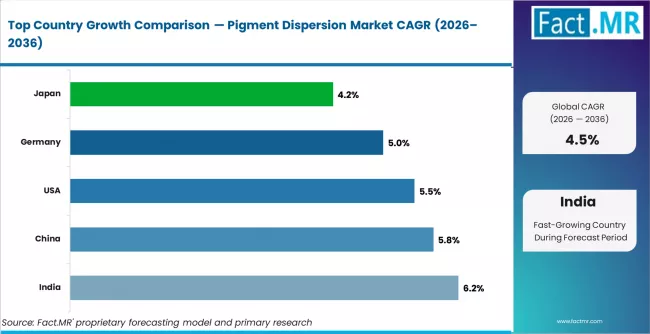
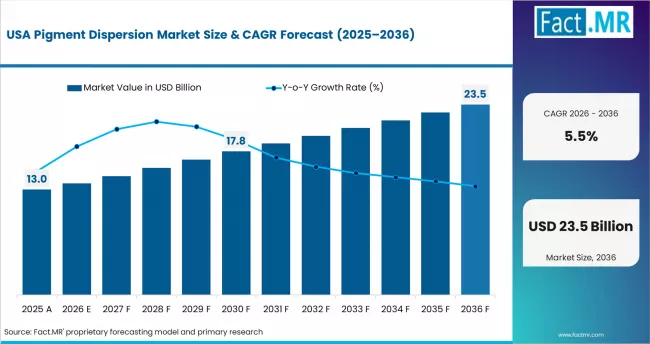
India leads growth at 6.2% CAGR, driven by rapid construction expansion, surging domestic paints and coatings output, and growing packaging demand from e-commerce and FMCG sectors. China follows at 5.8% CAGR, anchored by its dominance as the world's largest pigment producer and consumer. The United States records 5.5% CAGR, supported by stable demand from automotive OEM coatings and industrial applications. Germany grows at 5.0% CAGR, driven by high-performance coatings in precision engineering and specialty manufacturing. Japan records 4.2% CAGR, focused on advanced functional pigment materials for electronics and specialty inks. Western European markets generate replacement demand rather than new volume growth, constrained by mature coatings sectors and strict REACH compliance costs.

Segmental Anlaysis

Pigment Dispersion Market Analysis by Pigment Type
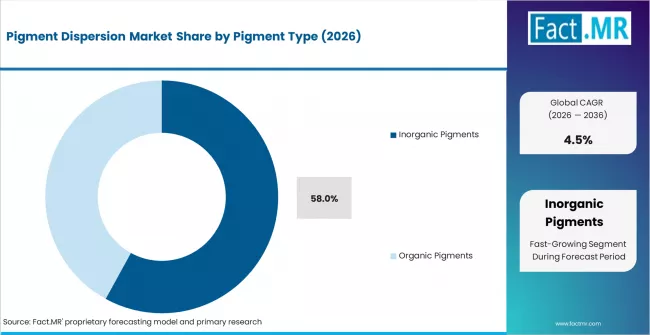
Pigment Dispersion Market Analysis By Pigment Type

Based on Fact.MR's pigment dispersion market report, inorganic pigments are estimated to hold 58% share in 2026. They dominate due to superior opacity, UV resistance, and cost efficiency in architectural coatings and plastics, where no organic alternative delivers comparable performance at comparable price points at volume scale.

  • BASF Investment: BASF expanded its inorganic pigment dispersion production capacity at its Ludwigshafen facility in 2024. The investment targets high-opacity titanium dioxide dispersions for European architectural coatings manufacturers requiring REACH-compliant formulations. [4]
  • Heubach Development: Heubach GmbH launched a new range of low-VOC inorganic pigment dispersions in early 2025. Products meet EU Directive VOC targets and are designed for water-based industrial coatings in automotive OEM and refinish applications. [5]
  • Demand Trend: Inorganic pigment dispersion demand in construction coatings grew as India and China increased architectural project volumes through 2024. Titanium dioxide-based dispersions from Tronox and Chemours saw stronger procurement from Asia-Pacific coatings buyers. [6]

Pigment Dispersion Market Analysis by Application
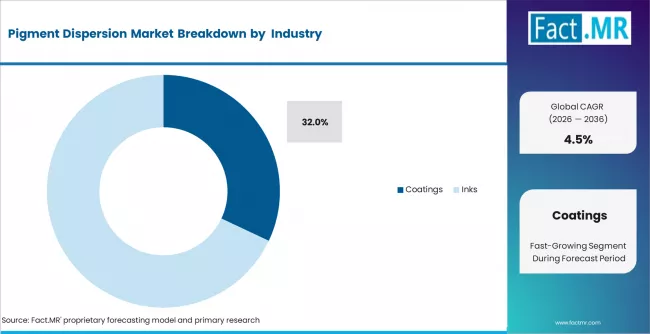
Pigment Dispersion Market Analysis By Application

Based on Fact.MR's pigment dispersion market report, coatings applications are estimated to hold 32% share in 2026. Coatings dominate because architectural, automotive, and industrial segments all require pre-dispersed pigment inputs for colour consistency, hiding power, and durability performance across large-volume production runs.

  • Clariant Partnership: Clariant AG entered a supply agreement with a leading European automotive OEM coatings producer in 2024 to supply high-performance organic pigment dispersions for water-based automotive topcoat systems meeting OEM colour matching and durability standards. [1]
  • DIC Corporation Expansion: DIC Corporation announced expanded capacity for packaging ink pigment dispersions at its Singapore facility in 2025. The investment targets ASEAN flexible packaging growth driven by e-commerce and FMCG demand. [3]
  • Industrial Coatings Growth: Industrial coatings demand for corrosion-resistant iron oxide pigment dispersions increased across infrastructure projects in India and the Middle East through 2024. Lanxess reported increased procurement volumes from construction coatings buyers in these regions. [7]

Drivers, Restraints, and Opportunities
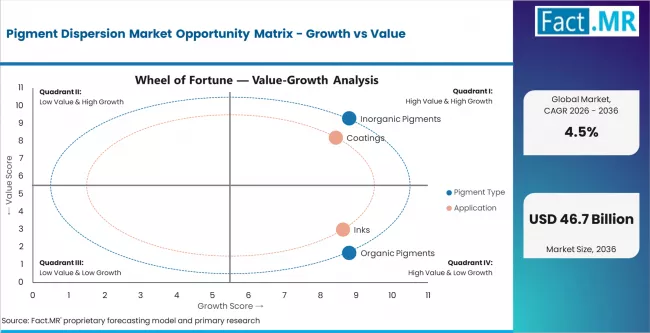
Pigment Dispersion Market Opportunity Matrix Growth Vs Value

Fact.MR analysis shows the pigment dispersion market has grown at a consistent pace underpinned by demand from the architectural coatings, packaging inks, and automotive sectors. The market exists at its current scale because pigment dispersions are a critical intermediate no formulator produces finished coatings or inks without pre-dispersed pigment inputs.

The core shift underway is the transition from solvent-based to water-based dispersions. Traditional solvent systems face regulatory headwinds as EU VOC directives and U.S. EPA standards tighten acceptable emission limits.

  • VOC Regulatory Pressure: EU Directive 2004/42/EC and its 2024 revision targets are forcing reformulation across architectural and automotive coatings in Europe. Manufacturers unable to deliver sub-50g/litre VOC dispersions risk losing qualification for major European coatings tenders. This directly accelerates water-based dispersion adoption.
  • Asia-Pacific Construction Boom: India's PM Gati Shakti infrastructure programme and housing expansion under the Pradhan Mantri Awas Yojana scheme are driving double-digit growth in architectural coatings. Pigment dispersion demand from Indian domestic paint producers Asian Paints and Berger Paints expanded materially through 2024–2025.
  • Packaging and Digital Print Growth: E-commerce packaging expansion across China and Southeast Asia is generating sustained demand for high-performance organic pigment dispersions in flexible packaging inks. DIC Corporation expanded its water-based packaging ink pigment dispersion output in 2025 to address demand from Asian packaging converters. [3]

Regional Analysis

The pigment dispersion market is assessed across North America, Europe, Asia Pacific, Latin America, and the Middle East and Africa. Each region is evaluated by demand structure, end-use concentration, regulatory environment, and competitive dynamics. Full market attractiveness analysis is available in the complete report.

Top Country Growth Comparison Pigment Dispersion Market Cagr (2026 2036)

Country CAGR (2026 to 2036)
India 6.2%
China 5.8%
United States 5.5%
Germany 5.0%
Japan 4.2%

Source: Fact.MR (FACT.MR) analysis, based on proprietary forecasting model and primary research
Pigment Dispersion Market Cagr Analysis By Country

Asia Pacific Pigment Dispersion Market
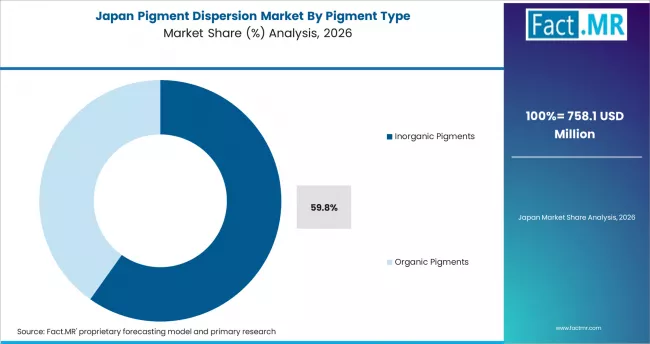
Pigment Dispersion Market Japan Market Share Analysis By Pigment Type

Asia Pacific stands at the centre of pigment dispersion activity, supported by strong coatings, plastics, and packaging manufacturing ecosystems. Regional suppliers such as DIC Corporation, Sudarshan Chemical Industries, and Flint Group benefit from integrated supply chains and proximity to end-use industries.

  • India: Growth in India is projected to register a CAGR of 6.2% through 2036. Infrastructure development and housing expansion are sustaining coatings consumption. Capacity additions at Asian Paints and Berger Paints are strengthening domestic production. Growth in flexible packaging is increasing ink dispersion usage. BIS standards are encouraging a transition toward water-based systems.
  • China: China is expected to record a CAGR of 5.8% through 2036. The country remains central to global pigment and dispersion supply chains. Industrial policy is supporting advanced coatings for EVs and transport sectors. Domestic capacity expansion aligns with automotive and packaging requirements. VOC regulations are accelerating the adoption of low-emission dispersions.
  • Japan: In Japan, a CAGR of 4.2% is projected through 2036. Electronics and advanced materials define usage patterns. Government-backed innovation programmes support functional coatings development. Conventional architectural coatings remain stable due to a mature construction base.

FACT.MR’s analysis of the pigment dispersion market in Asia Pacific includes India, China, Japan, South Korea, ASEAN, and Australia & New Zealand. Readers can find infrastructure-led coatings demand trends, VOC compliance adoption rates, and packaging dispersion procurement benchmarks.

Europe Pigment Dispersion Market
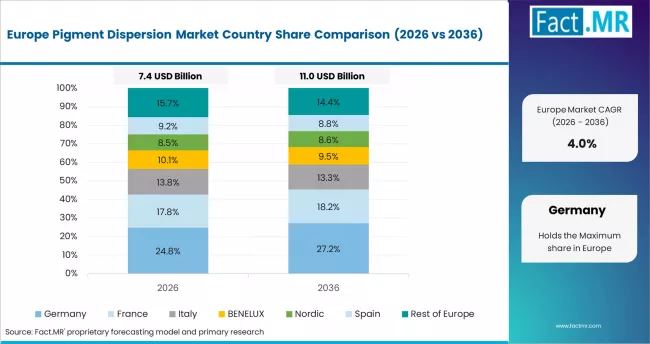
Pigment Dispersion Market Europe Country Market Share Analysis, 2026 & 2036

Europe functions as a regulatory benchmark where compliance frameworks influence formulation strategies. BASF, Clariant, Lanxess, and Heubach GmbH lead with REACH-aligned and low-VOC portfolios.

  • Germany: Germany is anticipated to grow at a CAGR of 5.0% through 2036. Automotive coatings and precision engineering drive requirements for specialty dispersions. DIN standards and strict colour consistency norms shape procurement. BASF’s Ludwigshafen expansion supports compliant supply. Energy retrofit programmes continue to sustain coatings demand.

FACT.MR’s analysis of the pigment dispersion market in Europe includes Germany, France, the UK, Italy, Spain, and Rest of Europe. Readers can find regulatory compliance trends, REACH alignment data, and specialty coatings demand benchmarks.

North America Pigment Dispersion Market
Pigment Dispersion Market Country Value Analysis

North America represents a mature and technically advanced landscape supported by strong OEM presence and regulatory enforcement. BASF, Cabot Corporation, and Flint Group maintain leadership through technical service capabilities and long-term supply agreements.

  • United States: The United States is forecast to expand at a CAGR of 5.5% through 2036. Automotive OEM and refinish coatings remain key application areas. EV manufacturing is increasing requirements for high-performance dispersions. United States Environmental Protection Agency regulations are accelerating the shift toward water-based alternatives. Packaging and digital printing continue to support steady consumption.

FACT.MR’s analysis of the pigment dispersion market in North America includes the United States, Canada, and Mexico. Readers can find EPA-driven VOC transition data, automotive coatings demand trends, and packaging dispersion consumption benchmarks.

Key Players

  • BASF SE
  • Clariant AG
  • DIC Corporation
  • Cabot Corporation
  • Lanxess AG
  • Heubach GmbH
  • Sudarshan Chemical Industries

Bibliography

  • [1] Clariant AG. (2024). Annual Report 2024: Sustainable Solutions for Coatings and Specialty Chemicals Including Pigment Dispersion Supply Agreements for Automotive OEM Water-Based Coatings Under EU VOC Compliance Requirements. 2024. clariant.com/investor-relations
  • [3] DIC Corporation. (2025). Operations Update: Packaging Ink Pigment Dispersion Capacity Expansion at Singapore Manufacturing Facility Targeting ASEAN Flexible Packaging Market Growth from E-Commerce and FMCG Demand. Q2 2025. dic-global.com/investor-relations
  • [4] BASF SE. (2024). Operations Update: REACH-Compliant Inorganic Pigment Dispersion Capacity Expansion at Ludwigshafen Chemical Complex Targeting European Architectural and Automotive Coatings Manufacturers Under EU VOC and Green Deal Procurement Requirements. Q3 2024. basf.com/investor-relations
  • [5] Heubach GmbH. (2025). Product Launch: Low-VOC Inorganic Pigment Dispersion Range for Automotive Water-Based Coatings Meeting EU Directive Emission Targets for OEM and Refinish Applications. January 2025. heubach.com
  • [6] Tronox Holdings. (2024). Annual Report 2024: Titanium Dioxide Pigment Dispersion Procurement Trends in Asia Pacific Architectural Coatings Sector Including Volume Growth from India and China Construction Markets. 2024. tronox.com/investors
  • [7] Lanxess AG. (2024). Performance Report: Iron Oxide Pigment Dispersion Procurement Growth from Infrastructure and Construction Coatings Buyers in India and Middle East Driven by Anti-Corrosion Coatings Demand. 2024. lanxess.com/investors

This Report Addresses

  • Strategic intelligence on pigment dispersion demand across architectural coatings, packaging inks, automotive OEM, industrial coatings, and plastics compounding applications globally.
  • Market forecast from USD 28.8 billion in 2026 to USD 44.7 billion by 2036 at a CAGR of 4.5%.
  • Growth opportunity mapping across India construction-driven coatings demand, China packaging expansion, U.S. VOC compliance-led water-based adoption, Germany automotive coatings, and Japan specialty material sourcing.
  • Segment analysis by pigment type (inorganic, organic), application (coatings, inks, plastics, adhesives), and dispersion type (water-based, solvent-based).
  • Regional outlook covering Asia Pacific production and consumption leadership, North America compliance-driven substitution, and Europe regulatory pressure on solvent-based reformulation.
  • Competitive landscape of BASF, Clariant, DIC Corporation, Cabot, Lanxess, Heubach, Sudarshan Chemical, and Flint Group, focused on VOC compliance capability, feedstock integration, and specialty grade positioning.
  • Regulatory impact analysis covering EU VOC Directive revisions, U.S. EPA NESHAP surface coating updates, China national VOC emission standards for coatings, and India BIS compliance for water-based systems.
  • Report delivery in PDF, Excel datasets, and presentation formats supported by primary interviews, producer revenue data, EU regulatory reports, and coatings procurement benchmarks.

Pigment Dispersion Market Definition

The pigment dispersion market covers pre-dispersed pigment concentrates supplied to coatings, inks, plastics, and adhesives. Pigments are stabilised in water, solvent, or resin systems for consistent colour and performance.

Pigment Dispersion Market Inclusions

Includes global and regional forecasts from 2026 to 2036 by pigment type, application, and dispersion type. Covers inorganic and organic dispersions across coatings, inks, plastics, and adhesives.

Pigment Dispersion Market Exclusions

Excludes dry pigments, masterbatches, and finished paints. Also omits dye-based colorants and cosmetic effect pigments. Focus remains on industrial liquid dispersions.

Pigment Dispersion Market Research Methodology

  • Primary Research: Interviews with dispersion producers, coatings and ink buyers, plastics compounders, and distributors across key regions.
  • Desk Research: Analysis of BASF, Clariant, DIC Corporation, and Cabot reports, along with EU REACH and U.S. EPA VOC data
  • Market-Sizing and Forecasting: Hybrid model using producer revenues and application-level volume estimates by dispersion type and end use.
  • Data Validation and Update Cycle: Validated through producer data, coatings procurement benchmarks, compliance records, and expert interviews.

Scope of the Report

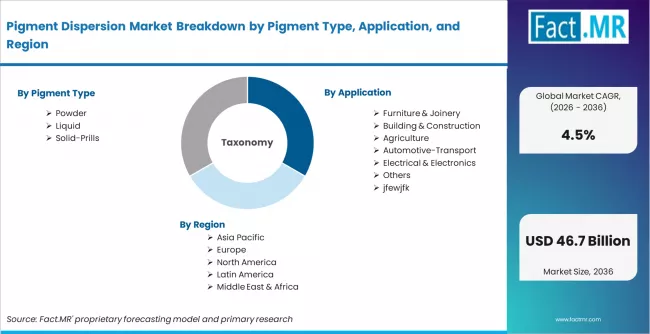
Pigment Dispersion Market Breakdown By Pigment Type, Application, And Region

Attribute Details
Quantitative Units USD 28.8 billion (2026) to USD 44.7 billion (2036), at a CAGR of 4.5%
Market Definition Inorganic and organic pigment dispersions in water-based and solvent-based carrier systems supplying coatings, inks, plastics, and adhesives manufacturers globally.
Pigment Type Segmentation Inorganic Pigments, Organic Pigments
Application Segmentation Coatings, Inks, Plastics, Adhesives & Sealants
Dispersion Type Segmentation Water-based, Solvent-based
Application Coverage Architectural coatings, automotive OEM and refinish coatings, packaging inks, industrial coatings, plastics compounding, and adhesive and sealant formulation.
Regions Covered North America, Europe, Asia Pacific, Latin America, Middle East and Africa
Countries Covered USA, Canada, Mexico, Germany, UK, France, Italy, Spain, Nordic, BENELUX, China, Japan, South Korea, India, ASEAN, Australia and New Zealand, Brazil, Argentina, Chile, Saudi Arabia, GCC, Turkey, South Africa, Rest of MEA
Key Companies Profiled BASF SE, Clariant AG, DIC Corporation, Cabot Corporation, Lanxess AG, Heubach GmbH, Sudarshan Chemical Industries, Flint Group
Forecast Period 2026 to 2036
Approach Hybrid top-down and bottom-up model using pigment dispersion producer revenues, application-level volume forecasts by dispersion type and end use, average selling prices by pigment grade, coatings procurement benchmarks, and primary interviews with dispersion producers and coatings formulation managers.

Pigment Dispersion Market by Segments

  • By Pigment Type:

    • Inorganic Pigments
    • Organic Pigments
  • By Application:

    • Coatings
    • Inks
    • Plastics
    • Adhesives & Sealants
  • By Dispersion Type:

    • Water-based
    • Solvent-based
  • By Region:

    • North America

      • United States
      • Canada
      • Mexico
    • Latin America

      • Brazil
      • Argentina
      • Chile
      • Rest of Latin America
    • Western Europe

      • Germany
      • United Kingdom
      • France
      • Italy
      • Spain
      • Nordic Countries
      • BENELUX
      • Rest of Western Europe
    • Eastern Europe

      • Russia
      • Poland
      • Hungary
      • Balkan and Baltic
      • Rest of Eastern Europe
    • East Asia

      • China
      • Japan
      • South Korea
    • South Asia and Pacific

      • India
      • ASEAN
      • Australia and New Zealand
      • Rest of South Asia and Pacific
    • Middle East and Africa

      • Kingdom of Saudi Arabia
      • Other GCC Countries
      • Turkey
      • South Africa
      • Rest of Middle East and Africa

Table of Content

  1. Executive Summary
    • Global Market Outlook
    • Demand to side Trends
    • Supply to side Trends
    • Technology Roadmap Analysis
    • Analysis and Recommendations
  2. Market Overview
    • Market Coverage / Taxonomy
    • Market Definition / Scope / Limitations
  3. Research Methodology
    • Chapter Orientation
    • Analytical Lens and Working Hypotheses
      • Market Structure, Signals, and Trend Drivers
      • Benchmarking and Cross-market Comparability
      • Market Sizing, Forecasting, and Opportunity Mapping
    • Research Design and Evidence Framework
      • Desk Research Programme (Secondary Evidence)
        • Company Annual and Sustainability Reports
        • Peer-reviewed Journals and Academic Literature
        • Corporate Websites, Product Literature, and Technical Notes
        • Earnings Decks and Investor Briefings
        • Statutory Filings and Regulatory Disclosures
        • Technical White Papers and Standards Notes
        • Expert Input and Fieldwork (Primary Evidence)
          • Primary Modes
            • Qualitative Interviews and Expert Elicitation
            • Quantitative Surveys and Structured Data Capture
            • Blended Approach
          • Why Primary Evidence is Used
          • Field Techniques
            • Interviews
            • Surveys
            • Focus Groups
            • Observational and In-context Research
            • Social and Community Interactions
          • Stakeholder Universe Engaged
            • C-suite Leaders
            • Board Members
            • Presidents and Vice Presidents
            • R&D and Innovation Heads
            • Technical Specialists
            • Domain Subject-matter Experts
            • Scientists
            • Physicians and Other Healthcare Professionals
          • Governance, Ethics, and Data Stewardship
            • Research Ethics
            • Data Integrity and Handling
        • Tooling, Models, and Reference Databases
      • Data Engineering and Model Build
        • Data Acquisition and Ingestion
        • Cleaning, Normalisation, and Verification
        • Synthesis, Triangulation, and Analysis
      • Quality Assurance and Audit Trail
    • Market Background
      • Market Dynamics
        • Drivers
        • Restraints
        • Opportunity
        • Trends
      • Scenario Forecast
        • Demand in Optimistic Scenario
        • Demand in Likely Scenario
        • Demand in Conservative Scenario
      • Opportunity Map Analysis
      • Product Life Cycle Analysis
      • Supply Chain Analysis
      • Investment Feasibility Matrix
      • Value Chain Analysis
      • PESTLE and Porter’s Analysis
      • Regulatory Landscape
      • Regional Parent Market Outlook
      • Production and Consumption Statistics
      • Import and Export Statistics
    • Global Market Analysis 2021 to 2025 and Forecast, 2026 to 2036
      • Historical Market Size Value (USD Million) Analysis, 2021 to 2025
      • Current and Future Market Size Value (USD Million) Projections, 2026 to 2036
        • Y to o to Y Growth Trend Analysis
        • Absolute $ Opportunity Analysis
    • Global Market Pricing Analysis 2021 to 2025 and Forecast 2026 to 2036
    • Global Market Analysis 2021 to 2025 and Forecast 2026 to 2036, By Pigment Type
      • Introduction / Key Findings
      • Historical Market Size Value (USD Million) Analysis By Pigment Type , 2021 to 2025
      • Current and Future Market Size Value (USD Million) Analysis and Forecast By Pigment Type , 2026 to 2036
        • Inorganic Pigments
        • Organic Pigments
      • Y to o to Y Growth Trend Analysis By Pigment Type , 2021 to 2025
      • Absolute $ Opportunity Analysis By Pigment Type , 2026 to 2036
    • Global Market Analysis 2021 to 2025 and Forecast 2026 to 2036, By Application
      • Introduction / Key Findings
      • Historical Market Size Value (USD Million) Analysis By Application, 2021 to 2025
      • Current and Future Market Size Value (USD Million) Analysis and Forecast By Application, 2026 to 2036
        • Coatings
        • Inks
        • Plastics
        • Adhesives & Sealants
      • Y to o to Y Growth Trend Analysis By Application, 2021 to 2025
      • Absolute $ Opportunity Analysis By Application, 2026 to 2036
    • Global Market Analysis 2021 to 2025 and Forecast 2026 to 2036, By Region
      • Introduction
      • Historical Market Size Value (USD Million) Analysis By Region, 2021 to 2025
      • Current Market Size Value (USD Million) Analysis and Forecast By Region, 2026 to 2036
        • North America
        • Latin America
        • Western Europe
        • Eastern Europe
        • East Asia
        • South Asia and Pacific
        • Middle East & Africa
      • Market Attractiveness Analysis By Region
    • North America Market Analysis 2021 to 2025 and Forecast 2026 to 2036, By Country
      • Historical Market Size Value (USD Million) Trend Analysis By Market Taxonomy, 2021 to 2025
      • Market Size Value (USD Million) Forecast By Market Taxonomy, 2026 to 2036
        • By Country
          • USA
          • Canada
          • Mexico
        • By Pigment Type
        • By Application
      • Market Attractiveness Analysis
        • By Country
        • By Pigment Type
        • By Application
      • Key Takeaways
    • Latin America Market Analysis 2021 to 2025 and Forecast 2026 to 2036, By Country
      • Historical Market Size Value (USD Million) Trend Analysis By Market Taxonomy, 2021 to 2025
      • Market Size Value (USD Million) Forecast By Market Taxonomy, 2026 to 2036
        • By Country
          • Brazil
          • Chile
          • Rest of Latin America
        • By Pigment Type
        • By Application
      • Market Attractiveness Analysis
        • By Country
        • By Pigment Type
        • By Application
      • Key Takeaways
    • Western Europe Market Analysis 2021 to 2025 and Forecast 2026 to 2036, By Country
      • Historical Market Size Value (USD Million) Trend Analysis By Market Taxonomy, 2021 to 2025
      • Market Size Value (USD Million) Forecast By Market Taxonomy, 2026 to 2036
        • By Country
          • Germany
          • UK
          • Italy
          • Spain
          • France
          • Nordic
          • BENELUX
          • Rest of Western Europe
        • By Pigment Type
        • By Application
      • Market Attractiveness Analysis
        • By Country
        • By Pigment Type
        • By Application
      • Key Takeaways
    • Eastern Europe Market Analysis 2021 to 2025 and Forecast 2026 to 2036, By Country
      • Historical Market Size Value (USD Million) Trend Analysis By Market Taxonomy, 2021 to 2025
      • Market Size Value (USD Million) Forecast By Market Taxonomy, 2026 to 2036
        • By Country
          • Russia
          • Poland
          • Hungary
          • Balkan & Baltic
          • Rest of Eastern Europe
        • By Pigment Type
        • By Application
      • Market Attractiveness Analysis
        • By Country
        • By Pigment Type
        • By Application
      • Key Takeaways
    • East Asia Market Analysis 2021 to 2025 and Forecast 2026 to 2036, By Country
      • Historical Market Size Value (USD Million) Trend Analysis By Market Taxonomy, 2021 to 2025
      • Market Size Value (USD Million) Forecast By Market Taxonomy, 2026 to 2036
        • By Country
          • China
          • Japan
          • South Korea
        • By Pigment Type
        • By Application
      • Market Attractiveness Analysis
        • By Country
        • By Pigment Type
        • By Application
      • Key Takeaways
    • South Asia and Pacific Market Analysis 2021 to 2025 and Forecast 2026 to 2036, By Country
      • Historical Market Size Value (USD Million) Trend Analysis By Market Taxonomy, 2021 to 2025
      • Market Size Value (USD Million) Forecast By Market Taxonomy, 2026 to 2036
        • By Country
          • India
          • ASEAN
          • Australia & New Zealand
          • Rest of South Asia and Pacific
        • By Pigment Type
        • By Application
      • Market Attractiveness Analysis
        • By Country
        • By Pigment Type
        • By Application
      • Key Takeaways
    • Middle East & Africa Market Analysis 2021 to 2025 and Forecast 2026 to 2036, By Country
      • Historical Market Size Value (USD Million) Trend Analysis By Market Taxonomy, 2021 to 2025
      • Market Size Value (USD Million) Forecast By Market Taxonomy, 2026 to 2036
        • By Country
          • Kingdom of Saudi Arabia
          • Other GCC Countries
          • Turkiye
          • South Africa
          • Other African Union
          • Rest of Middle East & Africa
        • By Pigment Type
        • By Application
      • Market Attractiveness Analysis
        • By Country
        • By Pigment Type
        • By Application
      • Key Takeaways
    • Key Countries Market Analysis
      • USA
        • Pricing Analysis
        • Market Share Analysis, 2025
          • By Pigment Type
          • By Application
      • Canada
        • Pricing Analysis
        • Market Share Analysis, 2025
          • By Pigment Type
          • By Application
      • Mexico
        • Pricing Analysis
        • Market Share Analysis, 2025
          • By Pigment Type
          • By Application
      • Brazil
        • Pricing Analysis
        • Market Share Analysis, 2025
          • By Pigment Type
          • By Application
      • Chile
        • Pricing Analysis
        • Market Share Analysis, 2025
          • By Pigment Type
          • By Application
      • Germany
        • Pricing Analysis
        • Market Share Analysis, 2025
          • By Pigment Type
          • By Application
      • UK
        • Pricing Analysis
        • Market Share Analysis, 2025
          • By Pigment Type
          • By Application
      • Italy
        • Pricing Analysis
        • Market Share Analysis, 2025
          • By Pigment Type
          • By Application
      • Spain
        • Pricing Analysis
        • Market Share Analysis, 2025
          • By Pigment Type
          • By Application
      • France
        • Pricing Analysis
        • Market Share Analysis, 2025
          • By Pigment Type
          • By Application
      • India
        • Pricing Analysis
        • Market Share Analysis, 2025
          • By Pigment Type
          • By Application
      • ASEAN
        • Pricing Analysis
        • Market Share Analysis, 2025
          • By Pigment Type
          • By Application
      • Australia & New Zealand
        • Pricing Analysis
        • Market Share Analysis, 2025
          • By Pigment Type
          • By Application
      • China
        • Pricing Analysis
        • Market Share Analysis, 2025
          • By Pigment Type
          • By Application
      • Japan
        • Pricing Analysis
        • Market Share Analysis, 2025
          • By Pigment Type
          • By Application
      • South Korea
        • Pricing Analysis
        • Market Share Analysis, 2025
          • By Pigment Type
          • By Application
      • Russia
        • Pricing Analysis
        • Market Share Analysis, 2025
          • By Pigment Type
          • By Application
      • Poland
        • Pricing Analysis
        • Market Share Analysis, 2025
          • By Pigment Type
          • By Application
      • Hungary
        • Pricing Analysis
        • Market Share Analysis, 2025
          • By Pigment Type
          • By Application
      • Kingdom of Saudi Arabia
        • Pricing Analysis
        • Market Share Analysis, 2025
          • By Pigment Type
          • By Application
      • Turkiye
        • Pricing Analysis
        • Market Share Analysis, 2025
          • By Pigment Type
          • By Application
      • South Africa
        • Pricing Analysis
        • Market Share Analysis, 2025
          • By Pigment Type
          • By Application
    • Market Structure Analysis
      • Competition Dashboard
      • Competition Benchmarking
      • Market Share Analysis of Top Players
        • By Regional
        • By Pigment Type
        • By Application
    • Competition Analysis
      • Competition Deep Dive
        • BASF SE
          • Overview
          • Product Portfolio
          • Profitability by Market Segments (Product/Age /Sales Channel/Region)
          • Sales Footprint
          • Strategy Overview
            • Marketing Strategy
            • Product Strategy
            • Channel Strategy
        • Clariant AG
        • DIC Corporation
        • Cabot Corporation
        • Lanxess AG
        • Heubach GmbH
        • Sudarshan Chemical Industries
  4. Assumptions & Acronyms Used

List Of Table

  • Table 1: Global Market Value (USD Million) Forecast by Region, 2021 to 2036
  • Table 2: Global Market Value (USD Million) Forecast by Pigment Type , 2021 to 2036
  • Table 3: Global Market Value (USD Million) Forecast by Application, 2021 to 2036
  • Table 4: North America Market Value (USD Million) Forecast by Country, 2021 to 2036
  • Table 5: North America Market Value (USD Million) Forecast by Pigment Type , 2021 to 2036
  • Table 6: North America Market Value (USD Million) Forecast by Application, 2021 to 2036
  • Table 7: Latin America Market Value (USD Million) Forecast by Country, 2021 to 2036
  • Table 8: Latin America Market Value (USD Million) Forecast by Pigment Type , 2021 to 2036
  • Table 9: Latin America Market Value (USD Million) Forecast by Application, 2021 to 2036
  • Table 10: Western Europe Market Value (USD Million) Forecast by Country, 2021 to 2036
  • Table 11: Western Europe Market Value (USD Million) Forecast by Pigment Type , 2021 to 2036
  • Table 12: Western Europe Market Value (USD Million) Forecast by Application, 2021 to 2036
  • Table 13: Eastern Europe Market Value (USD Million) Forecast by Country, 2021 to 2036
  • Table 14: Eastern Europe Market Value (USD Million) Forecast by Pigment Type , 2021 to 2036
  • Table 15: Eastern Europe Market Value (USD Million) Forecast by Application, 2021 to 2036
  • Table 16: East Asia Market Value (USD Million) Forecast by Country, 2021 to 2036
  • Table 17: East Asia Market Value (USD Million) Forecast by Pigment Type , 2021 to 2036
  • Table 18: East Asia Market Value (USD Million) Forecast by Application, 2021 to 2036
  • Table 19: South Asia and Pacific Market Value (USD Million) Forecast by Country, 2021 to 2036
  • Table 20: South Asia and Pacific Market Value (USD Million) Forecast by Pigment Type , 2021 to 2036
  • Table 21: South Asia and Pacific Market Value (USD Million) Forecast by Application, 2021 to 2036
  • Table 22: Middle East & Africa Market Value (USD Million) Forecast by Country, 2021 to 2036
  • Table 23: Middle East & Africa Market Value (USD Million) Forecast by Pigment Type , 2021 to 2036
  • Table 24: Middle East & Africa Market Value (USD Million) Forecast by Application, 2021 to 2036

List Of Figures

  • Figure 1: Global Market Pricing Analysis
  • Figure 2: Global Market Value (USD Million) Forecast 2021-2036
  • Figure 3: Global Market Value Share and BPS Analysis by Pigment Type, 2026 and 2036
  • Figure 4: Global Market Y-o-Y Growth Comparison by Pigment Type, 2026 to 2036
  • Figure 5: Global Market Attractiveness Analysis by Pigment Type
  • Figure 6: Global Market Value Share and BPS Analysis by Application, 2026 and 2036
  • Figure 7: Global Market Y-o-Y Growth Comparison by Application, 2026 to 2036
  • Figure 8: Global Market Attractiveness Analysis by Application
  • Figure 9: Global Market Value (USD Million) Share and BPS Analysis by Region, 2026 and 2036
  • Figure 10: Global Market Y-o-Y Growth Comparison by Region, 2026 to 2036
  • Figure 11: Global Market Attractiveness Analysis by Region
  • Figure 12: North America Market Incremental Dollar Opportunity, 2026 to 2036
  • Figure 13: Latin America Market Incremental Dollar Opportunity, 2026 to 2036
  • Figure 14: Western Europe Market Incremental Dollar Opportunity, 2026 to 2036
  • Figure 15: Eastern Europe Market Incremental Dollar Opportunity, 2026 to 2036
  • Figure 16: East Asia Market Incremental Dollar Opportunity, 2026 to 2036
  • Figure 17: South Asia and Pacific Market Incremental Dollar Opportunity, 2026 to 2036
  • Figure 18: Middle East & Africa Market Incremental Dollar Opportunity, 2026 to 2036
  • Figure 19: North America Market Value Share and BPS Analysis by Country, 2026 and 2036
  • Figure 20: North America Market Value Share and BPS Analysis by Pigment Type, 2026 and 2036
  • Figure 21: North America Market Y-o-Y Growth Comparison by Pigment Type, 2026 to 2036
  • Figure 22: North America Market Attractiveness Analysis by Pigment Type
  • Figure 23: North America Market Value Share and BPS Analysis by Application, 2026 and 2036
  • Figure 24: North America Market Y-o-Y Growth Comparison by Application, 2026 to 2036
  • Figure 25: North America Market Attractiveness Analysis by Application
  • Figure 26: Latin America Market Value Share and BPS Analysis by Country, 2026 and 2036
  • Figure 27: Latin America Market Value Share and BPS Analysis by Pigment Type, 2026 and 2036
  • Figure 28: Latin America Market Y-o-Y Growth Comparison by Pigment Type, 2026 to 2036
  • Figure 29: Latin America Market Attractiveness Analysis by Pigment Type
  • Figure 30: Latin America Market Value Share and BPS Analysis by Application, 2026 and 2036
  • Figure 31: Latin America Market Y-o-Y Growth Comparison by Application, 2026 to 2036
  • Figure 32: Latin America Market Attractiveness Analysis by Application
  • Figure 33: Western Europe Market Value Share and BPS Analysis by Country, 2026 and 2036
  • Figure 34: Western Europe Market Value Share and BPS Analysis by Pigment Type, 2026 and 2036
  • Figure 35: Western Europe Market Y-o-Y Growth Comparison by Pigment Type, 2026 to 2036
  • Figure 36: Western Europe Market Attractiveness Analysis by Pigment Type
  • Figure 37: Western Europe Market Value Share and BPS Analysis by Application, 2026 and 2036
  • Figure 38: Western Europe Market Y-o-Y Growth Comparison by Application, 2026 to 2036
  • Figure 39: Western Europe Market Attractiveness Analysis by Application
  • Figure 40: Eastern Europe Market Value Share and BPS Analysis by Country, 2026 and 2036
  • Figure 41: Eastern Europe Market Value Share and BPS Analysis by Pigment Type, 2026 and 2036
  • Figure 42: Eastern Europe Market Y-o-Y Growth Comparison by Pigment Type, 2026 to 2036
  • Figure 43: Eastern Europe Market Attractiveness Analysis by Pigment Type
  • Figure 44: Eastern Europe Market Value Share and BPS Analysis by Application, 2026 and 2036
  • Figure 45: Eastern Europe Market Y-o-Y Growth Comparison by Application, 2026 to 2036
  • Figure 46: Eastern Europe Market Attractiveness Analysis by Application
  • Figure 47: East Asia Market Value Share and BPS Analysis by Country, 2026 and 2036
  • Figure 48: East Asia Market Value Share and BPS Analysis by Pigment Type, 2026 and 2036
  • Figure 49: East Asia Market Y-o-Y Growth Comparison by Pigment Type, 2026 to 2036
  • Figure 50: East Asia Market Attractiveness Analysis by Pigment Type
  • Figure 51: East Asia Market Value Share and BPS Analysis by Application, 2026 and 2036
  • Figure 52: East Asia Market Y-o-Y Growth Comparison by Application, 2026 to 2036
  • Figure 53: East Asia Market Attractiveness Analysis by Application
  • Figure 54: South Asia and Pacific Market Value Share and BPS Analysis by Country, 2026 and 2036
  • Figure 55: South Asia and Pacific Market Value Share and BPS Analysis by Pigment Type, 2026 and 2036
  • Figure 56: South Asia and Pacific Market Y-o-Y Growth Comparison by Pigment Type, 2026 to 2036
  • Figure 57: South Asia and Pacific Market Attractiveness Analysis by Pigment Type
  • Figure 58: South Asia and Pacific Market Value Share and BPS Analysis by Application, 2026 and 2036
  • Figure 59: South Asia and Pacific Market Y-o-Y Growth Comparison by Application, 2026 to 2036
  • Figure 60: South Asia and Pacific Market Attractiveness Analysis by Application
  • Figure 61: Middle East & Africa Market Value Share and BPS Analysis by Country, 2026 and 2036
  • Figure 62: Middle East & Africa Market Value Share and BPS Analysis by Pigment Type, 2026 and 2036
  • Figure 63: Middle East & Africa Market Y-o-Y Growth Comparison by Pigment Type, 2026 to 2036
  • Figure 64: Middle East & Africa Market Attractiveness Analysis by Pigment Type
  • Figure 65: Middle East & Africa Market Value Share and BPS Analysis by Application, 2026 and 2036
  • Figure 66: Middle East & Africa Market Y-o-Y Growth Comparison by Application, 2026 to 2036
  • Figure 67: Middle East & Africa Market Attractiveness Analysis by Application
  • Figure 68: Global Market - Tier Structure Analysis
  • Figure 69: Global Market - Company Share Analysis

- Frequently Asked Questions -

How large is the global pigment dispersion market in 2025?

The global pigment dispersion market was valued at USD 27.6 billion in 2025.

What will the market size be in 2026?

Based on Fact.MR analysis, demand for pigment dispersions is estimated to grow to USD 28.8 billion in 2026.

What is the projected market size by 2036?

The market is projected to reach USD 44.7 billion by 2036, generating USD 15.9 billion in absolute dollar opportunity over the forecast period.

What is the expected CAGR from 2026 to 2036?

FACT.MR projects a CAGR of 4.5% for the global pigment dispersion market during the 2026 to 2036 forecast period.

Which pigment type segment is poised to lead the market?

Inorganic Pigments lead with approximately 58% share in 2026.

Which application segment holds the largest share?

Coatings leads with approximately 32% share in 2026, driven by architectural, automotive, and industrial demand.

Which dispersion type dominates the market?

Water-based dispersions hold 55% share in 2026, supported by VOC compliance requirements and sustainability procurement mandates across Europe and North America.

Which country shows the fastest growth?

India leads at 6.2% CAGR through 2036, driven by construction boom, domestic paints and coatings expansion, and packaging sector growth.

What is driving demand for pigment dispersions?

Demand is driven by architectural coatings growth in Asia Pacific, packaging ink expansion, automotive OEM coating requirements, and regulatory substitution of solvent-based systems.

What is the key challenge in this market?

Raw material cost volatility in titanium dioxide and organic pigment feedstocks, combined with reformulation costs of VOC compliance, constrains margins for commodity dispersion producers.

Pigment Dispersion Market