- Market Value (2025): USD 1.1 Bn
- Estimated Value (2026): USD 1.2 Bn
- Forecast Value (2036): USD 2.5 Bn
- CAGR (2026-2036): 7.6%
What is the Wicking Performance Polymer Additives Market forecast to be worth by 2036?
USD 1.2 billion in 2026 to USD 2.5 billion by 2036 at a 7.6% CAGR.
- The wicking performance polymer additives market was valued at USD 1.1 billion in 2025.
- Demand is forecast to rise from USD 1.2 billion in 2026 to USD 2.5 billion by 2036.
- The market is forecast to grow at a 7.6% CAGR from 2026 to 2036. Nonwoven and fiber makers are testing additives that improve water flow.
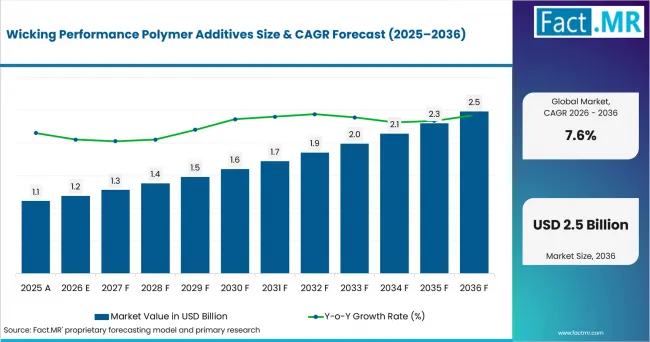
Wicking Performance Polymer Additives Value Analysis | Source: Fact.MR
What are the defining numbers behind Wicking Performance Polymer Additives Market growth?
The market offers a USD 1.3 billion absolute gain by 2036. The lead areas are migratory surfactant masterbatch, PP, webs, and wicking speed.
- Demand Drivers in the Market
- Nonwoven producers need predictable liquid transfer in polypropylene webs. EDANA said in March 2025 that webs output in Greater Europe reached 2,976,400 tonnes in 2024, providing a substantial output base for nonwoven webs and related additive technologies. For wetting additive firms, this established output base creates chances for use testing across established nonwoven process routes.
- Polyolefin processors favor masterbatches that work with current dosing equipment. Melt-added systems also let plants adjust dosage and test wicking under normal output heat.
- Hygiene and medical converters test fluid movement through topsheets and absorbent layers. Strike-through and surface wetting are key measures for materials that touch the skin.
- Fiber and industrial-textile makers need water flow that stays stable after spinning and conversion. Additives must work with the polymer and provide measurable wicking in the final materials.
- Key Segments Analyzed
- By Additive Platform: Migratory surfactant masterbatch is forecast to hold a 34.0% share in 2026. It can be added during normal melt handling, and the dose can be changed during tests.
- By Host Polymer: PP is forecast to hold a 37.0% share in 2026. It is widely used in spunbond and meltblown materials that need better surface wetting.
- By Application: Webs are forecast to hold a 39.0% share in 2026. Liquid flow can be measured in hygiene, medical, wipe, and technical fabrics.
- By Performance: Wicking speed is forecast to hold a 34.0% share in 2026. It shows how fast water moves through the treated material.
- Analyst Opinion at Fact.MR
- Shambhu Nath Jha, Principal Consultant at Fact.MR, states, “Testing focuses on steady water flow after real polymer process. Buyers will favor systems that give fast wicking, stable runs, and low extractables. Clear use data can support repeat orders.”
- Strategic Implications
- Additive formulators should document wetting behavior at the recommended let-down range. U.S. Census Bureau benchmark data released in May 2025 placed first-quarter 2025 textile-mill shipments at USD 5.937 billion, providing a measurable domestic output base for targeted textile chemicals testing..
- Nonwoven producers should test additives after the same heat cycle used on spunbond or meltblown lines. Other masterbatches can provide a useful benchmark for dose control and polymer fit.
- Hygiene converters should evaluate strike-through and rewet alongside softness. Demand linked to tissue and hygiene products makes water-flow results commercially relevant when the treated layer sits close to the user.
- Fiber processors should match additive movement to the required product life. They should also test whether moisture handling stays stable after conversion.
South Korea is forecast at 9.0% CAGR through 2036. The USA follows at 8.4%, Germany at 7.7%, Japan at 7.2%, and Austria at 5.6%. Each market has a different mix of nonwoven, textile, and care uses.
How does the Wicking Performance Polymer Additives Market break down by segment?
Webs lead Use at a 39.0% share in 2026. PP leads Host Polymer at 37.0%.
Which Additive Platform dominates?
Migratory surfactant masterbatch holds a 34.0% share in 2026.
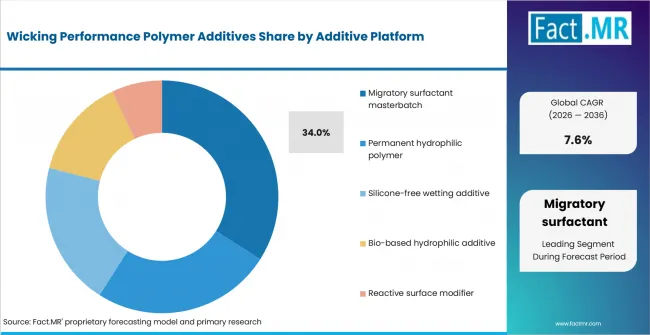
Wicking Performance Polymer Additives Analysis By Additive Platform | Source: Fact.MR
Migratory surfactant masterbatch is forecast to lead because the additive moves toward the polymer surface and helps water spread more easily. Permanent hydrophilic polymers serve products needing a longer-lasting effect. Silicone-free and bio-based systems address mix preferences. Reactive surface modifiers serve uses where the functional group is designed to remain anchored. The segment overlaps with wetting and dispersing agents when surface-tension control becomes part of the results target.
What leads the Host Polymer segment?
PP holds a 37.0% share in 2026.
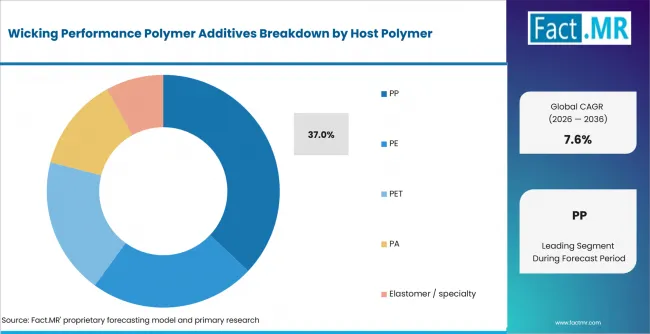
Wicking Performance Polymer Additives Analysis By Host Polymer | Source: Fact.MR
PP is forecast to lead because it is widely used in spunbond and meltblown hygiene products. Its surface resists water, so additives are often needed to help liquid spread or pass through the layer. PE follows in soft structures. PET and PA require different chemistry because polarity and process temperature change additive behavior. Adjacent polyolefin compounds illustrate the importance of matching functional packages to the carrier resin.
How does Application shape demand?
Webs lead with a 39.0% share in 2026.
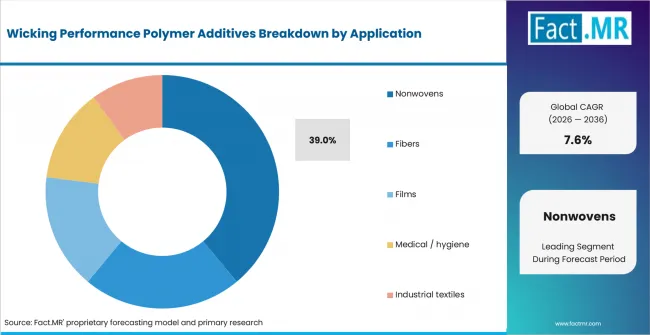
Wicking Performance Polymer Additives Analysis By Application | Source: Fact.MR
Webs are forecast to lead because liquid transfer can be measured directly in hygiene and medical layers. Fibers use hydrophilic chemistry for capillary transport. Films use wetting additives where surface spreading supports downstream handling. Medical and hygiene structures place greater weight on extractables and skin-contact suitability. Industrial textiles favor longer-lasting effects. Related medical disposables create an adjacent use base where materials behavior and documentation are evaluated together.
What supports Wicking Speed within Performance?
Wicking speed holds a 34.0% share in 2026.
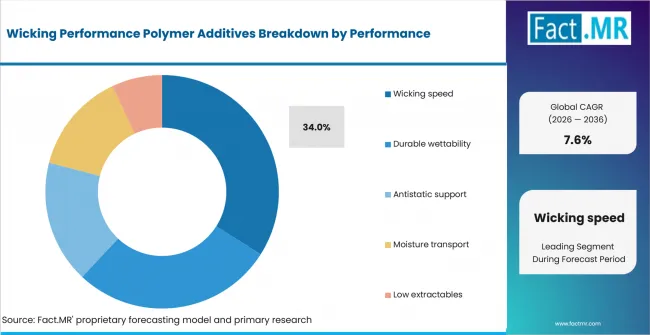
Wicking Performance Polymer Additives Analysis By Performance | Source: Fact.MR
Wicking speed leads because it shows how fast water moves through or along a treated material. Lasting wetting matters when the effect must remain after aging or repeated use. Antistatic support can also help fiber processing. Medical and hygiene uses pay close attention to low extractables.
What is accelerating Wicking Performance Polymer Additives Market adoption, and what is holding it back?
Fluid-management needs support demand. Durability and product-design trade-offs can slow use.
Drivers Impact Analysis
| DRIVER | (~) % IMPACT ON CAGR | GEOGRAPHIC RELEVANCE | IMPACT TIMELINE |
|---|---|---|---|
| Hydrophilic modification of PP nonwovens | +1.5% | Global | Short term (<= 2 years) |
| Hygiene and medical fluid-management needs | +1.2% | North America, Europe, East Asia | Medium term (2-4 years) |
| Moisture-management textiles | +0.9% | Global | Medium term (2-4 years) |
| Masterbatch-based process integration | +0.7% | Global | Short term (<= 2 years) |
Opportunity Impact Analysis
| OPPORTUNITY | (~) % IMPACT ON CAGR | GEOGRAPHIC RELEVANCE | IMPACT TIMELINE |
|---|---|---|---|
| Durable hydrophilic systems | +1.0% | Europe, Japan, South Korea | Medium term (2-4 years) |
| Low-extractables medical and hygiene grades | +0.8% | USA, Germany, Japan | Medium term (2-4 years) |
| Bio-based wetting chemistries | +0.6% | Europe, North America | Long term (>= 4 years) |
| Application-specific fiber additives | +0.5% | Global | Long term (>= 4 years) |
Restraints Impact Analysis
| RESTRAINT | (~) % IMPACT ON CAGR | GEOGRAPHIC RELEVANCE | IMPACT TIMELINE |
|---|---|---|---|
| Surface migration over extended use | -0.6% | Global | Short term (<= 2 years) |
| Bonding and softness trade-offs | -0.5% | Global | Medium term (2-4 years) |
| Medical and skin-contact qualification | -0.4% | USA, Europe, Japan | Medium term (2-4 years) |
| Polymer-specific compatibility limits | -0.3% | Global | Long term (>= 4 years) |
Which countries are scaling the Wicking Performance Polymer Additives Market through 2036?
- South Korea is 0.6 point above the USA. Its polymer and hygiene base supports demand.
- The USA is 0.7 point above Germany. Medical and nonwoven uses support a larger test base.
- Germany is 0.5 point above Japan. Tech textiles and niche chemicals support demand.
- Japan is 1.6 points above Austria. Aging-care uses support moisture-management needs.
- Austria closes the range through niche textile and polymer process.
The country rates reflect different end uses and polymer-process bases. The report covers North America, Latin America, Western Europe, Eastern Europe, East Asia, South Asia & Pacific, and Middle East & Africa.
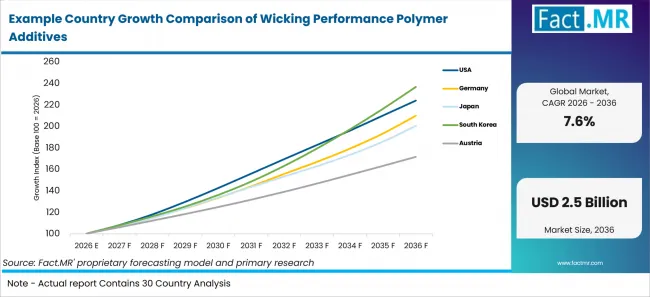
Example Country Growth Comparison Of Wicking Performance Polymer Additives | Source: Fact.MR
| Country | CAGR (2026-2036) |
|---|---|
| South Korea | 9.0% |
| United States | 8.4% |
| Germany | 7.7% |
| Japan | 7.2% |
| Austria | 5.6% |
What supports USA adoption?
8.4% CAGR, supported by nonwoven process and medical-hygiene uses.
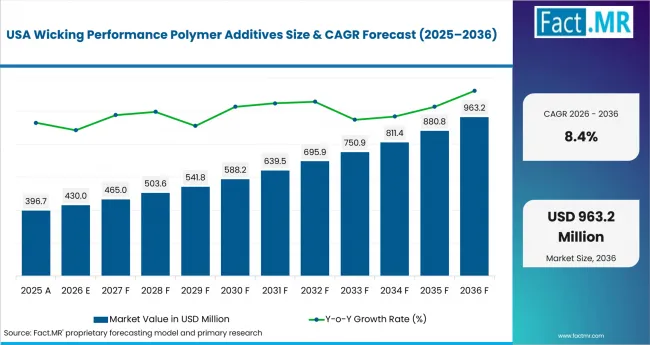
Wicking Performance Polymer Additives Country Value Analysis | Source: Fact.MR
U.S. converters have a large domestic base for textiles and disposable health materials. The CDC National Center for Health Statistics said in April 2026 that the provisional number of U.S. births was 3,606,400 in 2025. That scale keeps infant-care materials commercially relevant while adult-care and health uses widen the addressable base. Wetting additives can support liquid-transfer layers when PP surfaces require controlled wetting. Adjacent medical nonwoven disposables provide a useful benchmark for materials testing in healthcare uses.
How is Germany scaling demand?
7.7% CAGR, shaped by tech textiles and niche chemical skills.
Germany has a strong tech-textile and niche-chemical base. Destatis said in February 2026 that German plant output in 2025 was 1.1% below 2024 after calendar adjustment. Buyers therefore favor additives with a clear process or product benefit. Wicking systems can gain use when they show stable water flow and good polymer fit.
What supports Japan adoption?
7.2% CAGR, supported by aging-care needs and high-spec material processing.
Japan places strong focus on care uses and tight material control. The Statistics Bureau reported 36.24 million people aged 65 or older in 2024. This supports adult-care and medical absorbent products. Firms can compete through steady wicking and clear fit data for PP, PET, and specialty fibers.
How is South Korea developing demand?
9.0% CAGR, backed by polymer process and hygiene output.
South Korea has a clear base for hygiene materials. The Ministry of Data and Statistics reported 254.5 thousand live births in 2025, up 6.8% from 2024. This supports infant-care demand and adds to medical and textile uses. Wetting additives can help PP nonwovens move liquid faster.
What supports Austria?
5.6% CAGR, led by niche tech-textile and polymer process.
Austria has a focused base in technical textiles and converted polymer products. Statistics Austria reported 76,067 live births in 2025. Hygiene, medical, and industrial textile uses support demand. Durable wetting systems can help where wicking must last after storage or repeated handling.
Who leads the Wicking Performance Polymer Additives Market?
Firms compete on polymer fit and steady wetting after process. Techmer PM markets TechSurf® melt-blendable additives for hydrophilic polyolefin fibers and nonwoven webs. Croda offers Cirrasol PP842 as a durable hydrophilic finish and wicking agent for polyolefin webs.
Avient participates through fiber and nonwoven additive platforms with use-specific technical support, including solutions that provide hydrophilic effects in nonwoven uses. Supplier choice is forecast to depend on effective dosage, polymer fit, wetting durability, process stability, and technical support during use trials. The adjacent reactive-extrusion additives market provides a useful comparison for polymer-specific additive technologies designed to maintain targeted functionality through demanding melt-process conditions.
Which companies are the key providers?
Firms profiled include Avient, Americhem, Fine Organic Industries, Croda, and Techmer PM.
- Avient
- Americhem
- Fine Organic Industries
- Croda
- Techmer PM
Bibliography
- EDANA. (2025, March 31). In 2024, European nonwovens production increased by 2.6%.
- U.S. Census Bureau. (2025, May 2). Monthly full report on manufacturers’ shipments, inventories and orders: March 2025.
- Avient Corporation. (2025, February 4). New non-fluorine stain-resistant concentrates for polyester textiles from Avient.
- National Center for Health Statistics. (2026, April 9). U.S. births down 1% in 2025.
- Federal Statistical Office (Destatis). (2026, February 6). Production in December 2025: -1.9% on the previous month.
- Statistics Bureau, Ministry of Internal Affairs and Communications. (2025, September). Statistical handbook of Japan 2025.
- Ministry of Data and Statistics. (2026, February 25). Preliminary results of birth and death statistics in 2025.
This Report Answers
- The report shows where wicking additives are used by additive platform and host polymer. It also covers use and results needs.
- Segment analysis shows the leading subsegments and the process reasons behind their 2026 positions.
- Country analysis covers the USA, Germany, Japan, South Korea, and Austria. It uses the stated CAGRs and one official data point for each country.
- Competitive analysis reviews the profiled firms across masterbatch, fiber-additive, wetting-agent, and durable-finish products.
- Use analysis reviews wicking speed, lasting wetting, water flow, and extractables.
What does the Wicking Performance Polymer Additives Market cover?
The market covers additives and fiber-finish chemistries that improve wetting and capillary transport in synthetic materials. It includes melt-added masterbatches and relevant finishes used on fibers or webs where the commercial objective is water flow. The assessment links directly with nonwoven webs and broader polyolefin process where untreated surfaces require functional modification.
Coverage spans PP, PE, PET, PA, and specialty polymers. It includes nonwovens, fibers, films, medical or hygiene materials, and industrial textiles when wetting or water flow is a stated need.
What is included in the scope?
The scope includes migratory surfactant masterbatches and permanent hydrophilic polymer systems. It also includes silicone-free, bio-based, and reactive wetting additives. The results view covers wicking speed, lasting wetting, antistatic support, water flow, and low extractables.
The review includes line-ready additive packs for spunbond and meltblown webs. Fiber uses are included when chemistry is added during spinning or as a finish. Film uses are included when wetting changes liquid spread. Medical and hygiene uses are included when fluid flow or surface wetting matters.
What is excluded from the scope?
The scope excludes superabsorbent polymers whose main role is bulk liquid storage. General surfactants are outside the market when they are sold with no polymer or fiber use. Finished hygiene products are end uses, not additive sales.
General compounding aids are outside the market when their main role is melt flow or basic process. Binders are adjacent unless they change water flow. Finished textiles are treated as end-use demand. The market stays focused on chemistry that changes liquid contact at the polymer or fiber surface.
How Was the Analysis Built?
The analysis uses 120+ sources, 35+ company portfolios, 25+ countries, and more than 20 industry interviews.
- Primary Research: The study uses interviews with makers, service firms, distributors, users, and industry experts. These talks cover buying needs, product use, operating issues, approvals, competition, and market use.
- Desk Research: The study reviews government data, rules, company filings, trade data, technical studies, industry groups, standards, and public policy. All sources appear in the bibliography.
- Market Sizing and Forecasting: Market estimates use past results, demand, prices, volumes, segment shares, company activity, country growth, and investment trends.
- Data Validation and Update Cycle: The study checks interview findings against public data, company activity, rule changes, trade patterns, and industry trends. Updates track launches, capacity, partnerships, approvals, and market use.
What is the report’s scope and coverage?
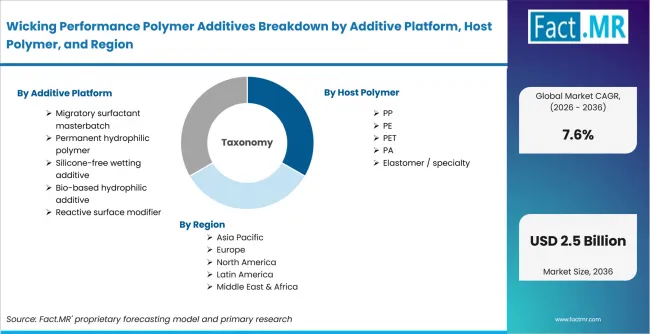
Wicking Performance Polymer Additives Breakdown By Additive Platform, Host Polymer, And Region | Source: Fact.MR
| Attribute | Details |
|---|---|
| Quantitative Units | USD billion |
| Market Definition | Additives and fiber-finish chemistries used to increase hydrophilicity, wetting, capillary transport, or wicking in synthetic polymer fibers, webs, films, and related structures. |
| Additive Platform | Migratory surfactant masterbatch; Permanent hydrophilic polymer; Silicone-free wetting additive; Bio-based wetting additive; Reactive surface modifier |
| Host Polymer | PP; PE; PET; PA; Elastomer / niche |
| Application | Webs; Fibers; Films; Medical / hygiene; Plant textiles |
| Performance | Wicking speed; Lasting wetting; Antistatic support; Water flow; Low extractables |
| Regions Covered | North America; Latin America; Western Europe; Eastern Europe; East Asia; South Asia & Pacific; Middle East & Africa |
| Countries Covered | United States; Germany; Japan; South Korea; Austria |
| Key Companies Profiled | Avient; Americhem; Fine Organic Industries; Croda; Techmer PM |
| Forecast Period | 2026 to 2036 |
| Approach | Hybrid top-down and bottom-up approach using polymer-process demand, nonwoven and fiber uses, segment shares, country growth, provider portfolios, and technical validation. |
How is the market segmented?
-
By Additive Platform
- Migratory surfactant masterbatch
- Permanent hydrophilic polymer
- Silicone-free wetting additive
- Bio-based hydrophilic additive
- Reactive surface modifier
-
By Host Polymer
- PP
- PE
- PET
- PA
- Elastomer / specialty
-
By Application
- Nonwovens
- Fibers
- Films
- Medical / hygiene
- Industrial textiles
-
By Performance
- Wicking speed
- Durable wettability
- Antistatic support
- Moisture transport
- Low extractables
-
By Region
- North America
- Latin America
- Western Europe
- Eastern Europe
- East Asia
- South Asia & Pacific
- Middle East & Africa