- Base Value(2025): 8.1 Bn
- Estimated Value(2026): 8.7 Bn
- Forecast Value (2036): 18.1 Bn
- CAGR (2026 - 2036): 7.6%
Tissue and Hygiene Products Market Forecast and Outlook By Fact.MR
In 2025, the tissue and hygiene products market was valued at USD 8.1 billion. Based on Fact.MR analysis, demand for tissue and hygiene products is estimated to grow to USD 8.7 billion in 2026 and USD 18.1 billion by 2036. FACT.MR projects a CAGR of 7.6% during the forecast period.
During this period, the industry is expected to generate USD 9.4 billion in new revenue opportunities. Growth will largely come from rising consumption of hygiene products in underpenetrated markets, expanding urban populations, and increasing diaper usage. Meanwhile, sustainability initiatives and eco-friendly packaging innovations are creating higher-value product segments. Challenges remain in the form of raw material price volatility, plastic packaging restrictions in Europe, and affordability barriers in price-sensitive regions.
Country growth reflects population structure, hygiene penetration rates, and modern retail channel development. Russia leads at 11.3% CAGR, driven by import substitution policies following Western brand exits that accelerated domestic tissue and hygiene product manufacturing investment. South Africa follows at 10.8%, supported by expanding urban retail coverage and rising disposable income enabling first-time diaper and feminine hygiene adoption in peri-urban communities. China posts 10.4% as premium diaper and wipe penetration deepens among the post-90s parenting generation in tier 1 and tier 2 cities. India grows at 9.8% driven by urbanization, FMCG distribution expansion in rural markets, and rising feminine hygiene awareness among working women. Brazil registers 8.5%, anchored by premium diaper and adult incontinence product adoption through hypermarket and e-commerce channels as middle-class purchasing power expands.
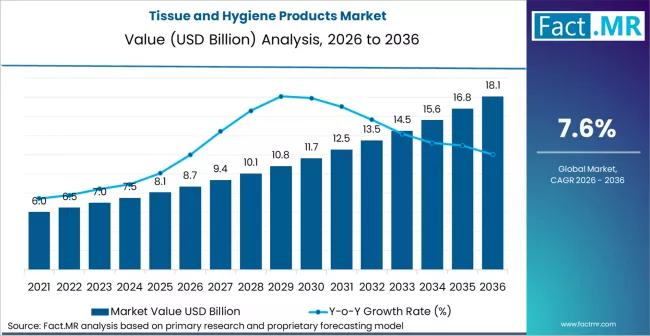
Tissue And Hygiene Products Market Market Value Analysis | Source: Fact.MR
| Metric | Value |
|---|---|
| Estimated Value in 2026 | USD 8.7 billion |
| Forecast Value in 2036 | USD 18.1 billion |
| Forecast CAGR (2026 to 2036) | 7.6% |
Source: Fact.MR analysis. Updated Mar 12, 2026
Market Definition
The tissue and hygiene products market includes disposable personal care and paper-based hygiene products used for household and personal hygiene. Key products include diapers, sanitary protection, adult incontinence items, toilet tissue, wipes, kitchen towels, cotton pads, and paper tableware. These products are distributed through supermarkets, pharmacies, convenience stores, and e-commerce channels worldwide.
Market Inclusions
Includes global and regional revenue forecasts from 2026 to 2036 by age group, product type, and packaging format. Covers major tissue and hygiene product categories sold through modern retail, pharmacy, convenience, and online channels globally.
Market Exclusions
Excludes reusable cloth diapers, washable feminine hygiene products, and industrial wiping textiles. Also excludes medical wound dressings, institutional bulk tissue supply, and non-disposable personal care products.
Research Methodology
- Primary Research: Interviews with FMCG hygiene brand managers, retail buyers, pharmacy distributors, e-commerce platform managers, and packaging suppliers.
- Desk Research: Sources include Euromonitor retail data, EDANA nonwoven production statistics, OEM reports, EU plastics directive updates, and national retail and population data.
- Market Sizing and Forecasting: Hybrid model using per-capita hygiene consumption, birth rates, female population data, retail penetration, and average product pricing.
- Data Validation and Update Cycle : Forecasts validated with OEM revenue disclosures, retail sales data, EDANA industry statistics, and official demographic data.
Summary
- Market Definition
- Tissue and hygiene products include disposable personal care items such as diapers, sanitary protection, adult incontinence products, tissues, wipes, kitchen towels, cotton pads, and paper tableware.
- Demand Drivers
- Rising birth rates and diaper adoption in emerging markets are increasing baby care product demand.
- Domestic manufacturing investment in Russia has expanded local tissue and hygiene production capacity.
- Premium diaper and wipe demand in China is rising due to younger parents and e-commerce distribution.
- Key Segments Analyzed
- By Age Group: Baby care holds about 46% share in 2026 due to growing diaper usage and premium baby care adoption.
- By Product: Diapers and nappies lead with about 30% share in 2026 due to high repeat purchase demand.
- By Packaging: Flexible packaging dominates with around 62% share in 2026 because of lower cost and material efficiency.
- By Geography: Asia Pacific Lead the market.
- Analyst Opinion at FACT.MR
- Shambhu Nath Jha Principal Consultant at Fact.MR states that, market growth will be driven by rising hygiene product penetration in emerging markets and premium eco-friendly product demand in developed regions.
- Strategic Implications
- Companies should introduce affordable small-pack formats to increase hygiene product adoption in price-sensitive markets.
- Brands should invest in biodegradable materials and sustainable packaging to meet European regulations.
- Firms should expand subscription-based e-commerce for premium diapers and wipes in China and South Korea.
- Methodology
- Market sizing used hygiene consumption data, birth rate statistics, and retail sales volumes validated with OEM revenue disclosures.
- Regulatory data, retail distribution trends, and industry production statistics supported demand analysis.
- Forecasts incorporated urbanization trends, retail penetration growth, packaging cost changes, and expert interviews.
Segmental Analysis
Tissue and Hygiene Products Market Analysis by Age Group
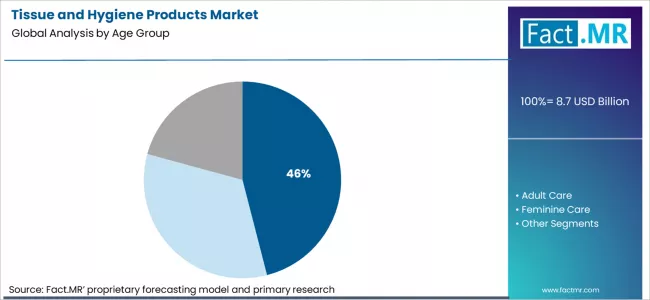
Tissue And Hygiene Products Market Analysis By Age Group | Source: Fact.MR
Based on FACT.MR’s report, baby care is projected to hold about 46% share in 2026. Diapers and baby wipes dominate due to high purchase frequency and strong parental demand for premium products.
- Procter & Gamble Pampers Premium Investment: In 2025, Procter & Gamble expanded its Pampers Premium Protection diaper line in China with new ultra-thin absorbent technology targeting urban parents. [5]
- Essity Feminine Care Technology Development: Essity launched a hybrid reusable and disposable absorbent product line targeting premium adult care and feminine hygiene segments. [6]
- Adult Care Segment Growth Trend: Adult incontinence products are growing rapidly due to aging populations and increasing online purchase through subscription services. [7]
Tissue and Hygiene Products Market Analysis by Product
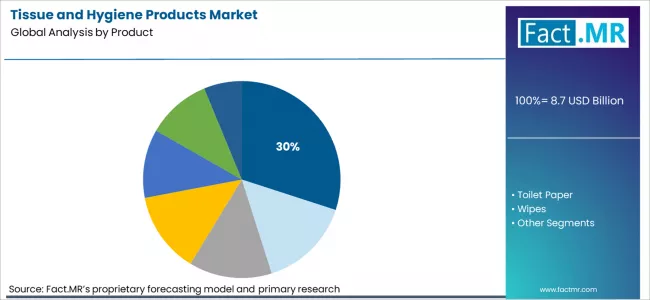
Tissue And Hygiene Products Market Analysis By Product | Source: Fact.MR
Based on FACT.MR’s report, diapers and nappies are expected to hold around 30% share in 2026. The segment leads due to high daily replacement demand and strong innovation in premium diaper technology.
- Unicharm China Diaper Market Investment: Unicharm expanded production capacity for its MamyPoko premium diapers in China to meet rising demand from young parents. [8]
- Hengan Wipes Technology Development: Hengan launched biodegradable plant-fibre wet wipes targeting eco-conscious consumers and premium retail channels. [9]
- Toilet Paper Market Expansion Trend: Tissue brands are expanding toilet paper distribution in emerging markets as urbanization and retail penetration increase household adoption. [10]
Drivers, Restraints, and Opportunities
FACT.MR analysts observe that the tissue and hygiene products market is driven by rising hygiene product adoption in emerging markets and premium product demand in developed economies. Growth in countries such as China, India, Brazil, and South Africa reflects increasing disposable income, improved retail access, and greater consumer awareness of hygiene products.
The industry is also experiencing a transition toward sustainable materials and packaging. Regulations targeting plastic waste are encouraging brands to adopt biodegradable and recyclable materials. While these changes increase production costs, they also enable premium product positioning in environmentally conscious markets.
- EU Single-Use Plastics Directive Enforcement: EU regulations are accelerating adoption of recyclable and compostable packaging for hygiene products, prompting major brands to invest in sustainable packaging solutions. [2]
- Russia Import Substitution Hygiene Investment: Russia has expanded support for domestic hygiene product manufacturing to replace Western brand supply following market exits, creating opportunities for local producers. [3]
- India Rural FMCG Distribution Expansion: FMCG companies are expanding rural distribution networks in India, increasing availability of baby and feminine hygiene products in previously underserved regions. [4]
Regional Analysis
The tissue and hygiene products market is analysed across Asia Pacific, Europe, North America, Latin America, and Middle East and Africa, covering 40+ countries with demand profiles shaped by population structure, birth rates, hygiene penetration levels, modern retail development, and sustainability regulatory frameworks. The full report offers market attractiveness analysis based on per-capita hygiene product consumption trajectories and retail channel expansion timelines.
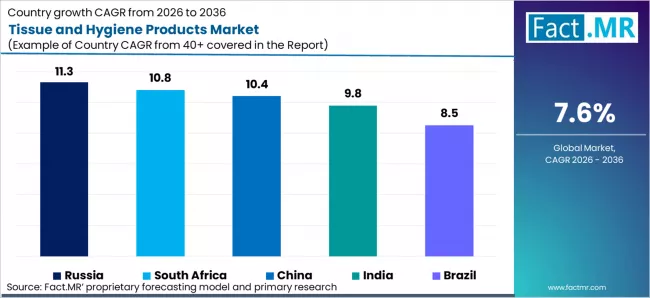
Tissue And Hygiene Products Market Cagr Analysis By Country | Source: Fact.MR
| Country | CAGR (2026-2036) |
|---|---|
| Russia | 11.3% |
| South Africa | 10.8% |
| China | 10.4% |
| India | 9.8% |
| Brazil | 8.5% |
Source: Fact.MR analysis. Updated Mar 12, 2026
Source: Fact.MR (FACT.MR) analysis, based on proprietary forecasting model and primary research
Asia Pacific Tissue and Hygiene Products Market Analysis
Asia Pacific is the largest and fastest-growing tissue and hygiene products region. Growth is supported by premium diaper demand in China and rising feminine hygiene and baby care penetration in India. Global FFG companies compete with regional manufacturers across retail and e-commerce channels.
- China: China’s tissue and hygiene products market is projected to grow at a 10.4% CAGR through 2036. Higher spending on personal care is increasing demand for premium diapers and wipes. Unicharm expanded MamyPoko diaper production in Suzhou in 2025, adding 1.8 billion units annually. Hengan also launched biodegradable wipes under GB green certification through Tmall and JD.com mother-and-baby channels.
- India: India’s tissue and hygiene sector is expected to expand at a 9.8% CAGR through 2036. Government programmes increased sanitary napkin availability through 10,000 Jan Aushadhi Kendras. Hindustan Unilever’s Stayfree and Procter & Gamble’s Whisper brands expanded rural distribution networks in 2025 with more than 200,000 new retail touchpoints.
FACT.MR’s Asia Pacific analysis of the tissue and hygiene products market covers China, Japan, South Korea, India, Australia and New Zealand, ASEAN, and Rest of South Asia and Pacific. Readers can find country CAGR forecasts, per-capita consumption trends, e-commerce penetration data, and brand competition by product category.
Europe Tissue and Hygiene Products Market Analysis
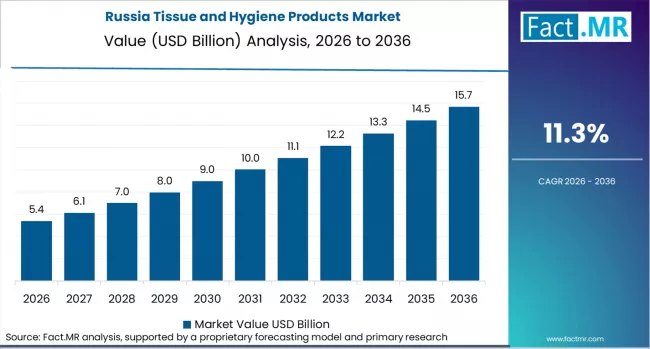
Tissue And Hygiene Products Market Country Value Analysis | Source: Fact.MR
Europe is a mature market influenced by sustainability regulations and packaging standards. Manufacturers are investing in recyclable materials and eco-friendly packaging to meet EU environmental requirements.
- Russia: Russia’s tissue and hygiene products market is forecast to grow at an 11.3% CAGR through 2036. Domestic manufacturers such as Evrazia and Papyrus Group expanded production after Western brand exits. Government import substitution policies also increased procurement of locally produced hygiene products in public hospitals and maternity facilities.
FACT.MR’s European analysis of the tissue and hygiene products market covers Germany, France, the United Kingdom, Italy, Spain, Nordic countries, BENELUX, Russia, Poland, Hungary, Balkan and Baltic, and Rest of Western Europe. Readers can find EU packaging regulation data, sustainability material adoption trends, import substitution policy impact, and country-level forecasts by product and age group.
North America Tissue and Hygiene Products Market Analysis
North America is the highest-value market due to strong demand for premium diapers, adult incontinence products, and eco-certified hygiene items. Leading brands maintain strong retail partnerships and subscription-based sales channels.
- United States: The United States market is expected to grow steadily through 2036. The EPA’s 2024 Sustainable Materials Management programme encouraged retailers such as Walmart and Target to expand eco-certified hygiene product offerings. Kimberly-Clark expanded its Huggies Special Delivery plant-based diaper range to 8,000 additional U.S. retail locations in 2025.
FACT.MR’s North American analysis of the tissue and hygiene products market covers the United States, Canada, and Mexico. Readers can find EPA sustainability programme data, eco-certified diaper adoption trends, adult incontinence subscription sales data, and country-level forecasts by product and packaging type.
Latin America Tissue and Hygiene Products Market Analysis
Latin America is a growing hygiene products market supported by expanding retail infrastructure and rising urban middle-class consumption.
- Brazil: Brazil’s tissue and hygiene products market is projected to grow at an 8.5% CAGR through 2036. Grupo Pão de Açúcar expanded its Qualité private-label hygiene range in 2025, adding 14 new tissue and diaper SKUs. Kimberly-Clark Brasil also invested BRL 250 million in its Mogi das Cruzes facility to expand production of Huggies diapers and Kleenex tissues.
FACT.MR’s Latin American analysis of the tissue and hygiene products market covers Brazil, Chile, Ecuador, and Rest of Latin America. Readers can find retail channel expansion trends, private label growth data, manufacturing investment timelines, and country-level forecasts by product type and packaging format.
Middle East and Africa Tissue and Hygiene Products Market Analysis
Middle East and Africa is a high-growth region driven by urbanization, rising hygiene awareness, and expanding formal retail access.
- South Africa: South Africa’s tissue and hygiene products market is expected to grow at a 10.8% CAGR through 2036. Shoprite Checkers expanded its Usave store network by 180 locations in 2025 across township and peri-urban areas. Kimberly-Clark also expanded Huggies and Kotex distribution to 6,000 additional retail outlets through Pick n Pay’s regional network.
FACT.MR’s Middle East and Africa analysis of the tissue and hygiene products market covers the Kingdom of Saudi Arabia, Other GCC Countries, Turkey, South Africa, Other African Union, and Rest of Middle East and Africa. Readers can find retail formalization trends, hygiene penetration data, premium baby care adoption insights, and country-level forecasts by product and age group.
Competitive Aligners for Market Players
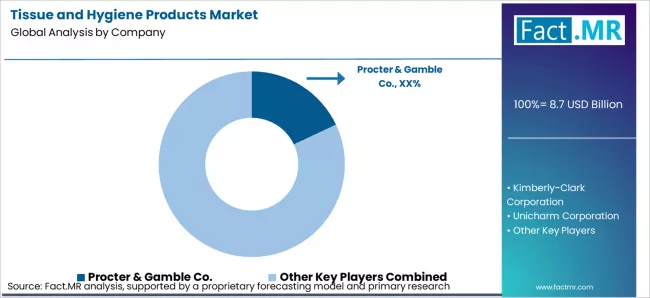
Tissue And Hygiene Products Market Analysis By Company | Source: Fact.MR
The global tissue and hygiene products market is competitive but led by a few major companies in premium categories. Procter & Gamble and Kimberly-Clark hold significant market share in baby care and feminine hygiene through strong brand recognition, continuous product innovation, and long-standing partnerships with large retailers. Essity AB leads the adult incontinence segment with its TENA brand, which is widely trusted in healthcare and pharmacy channels. In Asia Pacific, companies such as Unicharm and Hengan International maintain strong positions by combining local consumer insight with large-scale manufacturing and competitive pricing.
Large manufacturers also benefit from integrated supply chains. Companies like Procter & Gamble and Kimberly-Clark produce their own nonwoven fabrics and maintain long-term agreements for pulp supply, helping them manage raw material costs more effectively. Essity’s vertical integration from forest resources to finished tissue products also provides a cost advantage in tissue categories.
Retailers such as Walmart, Carrefour, REWE, and Shoprite balance branded and private-label hygiene products to manage pricing and supplier dependence. While private labels compete strongly in basic tissue and diaper categories, premium products such as advanced diapers, clinical incontinence products, and eco-certified hygiene items continue to benefit from strong consumer brand loyalty.
Key Players
- Procter & Gamble Co.
- Kimberly-Clark Corporation
- Unicharm Corporation
- Hengan International Group Co., Ltd.
- Essity AB
Bibliography
- [1] European Commission. (2024). Single-Use Plastics Directive 2019/904 Progress Review: Member State Extended Producer Responsibility Transposition Status and Hygiene Product Packaging Compliance Timeline. December 2024. ec.europa.eu
- [2] Ministry of Industry and Trade, Russian Federation. (2024). Domestic Hygiene Product Manufacturing Support Programme: Concessional Financing for Diaper and Tissue Production Line Investment Under Import Substitution Industrial Policy. October 2024. minpromtorg.gov.ru
- [3] Hindustan Unilever Limited. (2025). Annual Report 2024-25: Project Shakti Rural Distribution Network Expansion, New Rural Retail Touchpoints, and Feminine Hygiene Market Access Programme. March 2025. hul.co.in
- [4] Procter & Gamble Company. (2025). Product Launch Release: Pampers Premium Protection Ultra-Thin 12-Layer Core Diaper Range for China Tier 1 City Market via JD.com and Tmall Parenting Channels. January 2025. pg.com
- [5] Essity AB. (2024). Product Launch Announcement: TENA Silhouette Washable Reusable Textile with Disposable Absorbent Liner for European Pharmacy and H&M Retail Distribution. August 2024. essity.com
- [6] Kimberly-Clark Corporation. (2025). Investor Day Presentation: Depend and Poise Adult Care Segment as Fastest-Growing Personal Care Category in North America and Europe. February 2025. investor.kimberly-clark.com
- [7] Unicharm Corporation. (2025). Production Capacity Expansion Announcement: MamyPoko Premium Ultra-Thin Diaper Manufacturing Scale-Up at Suzhou Facility for China Market. January 2025. unicharm.co.jp
- [8] Hengan International Group Co., Ltd. (2024). Product Launch Release: Hearttex Biodegradable Plant-Fibre Wet Wipe Range Under China GB Green Product Certification for E-Commerce and Mother-and-Baby Store Channels. September 2024. hengan.com
- [9] Essity AB. (2025). Annual Report 2024: Emerging Market Tissue Revenue Growth in India and South Africa and Tork and Lotus Branded Tissue Expansion Into Tier 2 City Organised Retail. March 2025. essity.com
This Report Addresses
- Strategic insights on EU plastic regulations, Russia’s import substitution, India’s rural FMCG expansion, and China’s premium diaper adoption.
- Market forecast from USD 8.7 billion in 2026 to USD 18.1 billion by 2036 at a 7.6% CAGR.
- Growth opportunities across China’s diaper e-commerce, India’s Jan Aushadhi hygiene programme, Russia’s manufacturing investment, South Africa retail expansion, and Brazil private label growth.
- Country outlook with CAGR: Russia 11.3%, South Africa 10.8%, China 10.4%, India 9.8%, Brazil 8.5%.
- Competitive analysis of Procter & Gamble, Kimberly-Clark, Unicharm, Hengan International, and Essity.
- Technology trends including ultra-thin diapers, plant-based wipes, compostable packaging, and biodegradable hygiene products.
- Regulatory coverage including EU plastics directive, UK packaging rules, India BIS standards, China GB certification, and Russia manufacturing policy.
- Report delivered in PDF, Excel, PowerPoint, and dashboard formats with OEM revenue and retail data.
Segmentation
Scope of Report
| Metric | Value |
|---|---|
| Quantitative Units | USD 8.7 billion (2026) to USD 18.1 billion (2036), at a CAGR of 7.6% |
| Market Definition | Tissue and absorbent hygiene products including diapers, wipes, toilet paper, sanitary protection, kitchen towels, and cotton pads sold across baby, feminine, and adult care segments. |
| Age Group Segmentation | Baby Care, Feminine Care, Adult Care |
| Product Segmentation | Diapers/Nappies, Toilet Paper, Wipes, Sanitary Protection, Kitchen Towels, Paper Tableware, Cotton Pads and Buds |
| Packaging Segmentation | Flexible (62%), Rigid |
| Application Coverage | Infant diapering, feminine hygiene, adult incontinence management, household cleaning and hygiene, personal care, and foodservice paper tableware. |
| Regions Covered | Asia Pacific, Europe, North America, Latin America, Middle East and Africa |
| Countries Covered | China, Japan, South Korea, India, Australia and New Zealand, ASEAN, Rest of South Asia and Pacific, Germany, UK, France, Italy, Spain, Nordic, BENELUX, Rest of Western Europe, Russia, Poland, Hungary, Balkan and Baltic, USA, Canada, Mexico, Brazil, Chile, Ecuador, Rest of Latin America, Saudi Arabia, GCC, Turkey, South Africa, Rest of MEA |
| Key Companies Profiled | Procter & Gamble, Kimberly-Clark, Unicharm, Hengan International, Essity AB |
| Forecast Period | 2026 to 2036 |
| Approach | Hybrid top-down and bottom-up model using per-capita hygiene product consumption, birth rate data, retail sales volumes by product category, packaging cost trends, and primary interviews with brand managers and retail buyers. |
Source: Fact.MR analysis. Updated Mar 12, 2026
Tissue and Hygiene Products Market by Segments
-
By Age Group:
- Adult Care
- Feminine Care
- Baby Care
-
By Product:
- Nappies
- Diapers
- Toilet Paper
- Wipes
- Sanitary Protection
- Kitchen Towels
- Paper Tableware
- Cotton Pads and Buds
-
By Packaging:
- Rigid
- Flexible
-
By Region:
- North America
- United States
- Canada
- Mexico
- Latin America
- Brazil
- Chile
- Ecuador
- Rest of Latin America
- Western Europe
- Germany
- United Kingdom
- France
- Italy
- Spain
- Nordic
- BENELUX
- Rest of Western Europe
- Eastern Europe
- Russia
- Poland
- Hungary
- Balkan and Baltic
- Rest of Eastern Europe
- East Asia
- China
- Japan
- South Korea
- South Asia and Pacific
- India
- ASEAN
- Australia and New Zealand
- Rest of South Asia and Pacific
- Middle East and Africa
- Kingdom of Saudi Arabia
- Other GCC Countries
- Turkey
- South Africa
- Other African Union
- Rest of Middle East and Africa
- North America
Frequently Asked Questions
How large is the tissue and hygiene products market in 2025?
What will the market size be in 2026?
What is the projected market size by 2036?
What is the expected CAGR?
Which age group segment leads the market?
Which product segment dominates?
Which packaging type leads?
Which country shows the fastest growth?
What is the primary restraint?
Who worked on this report


Preview the report firsthand - request a free sample
Free SampleGet the brochure for pricing and purchase details
Download PDF