Corrosion-Safe Chemicals for Wind Turbine Maintenance Market

Corrosion-Safe Chemicals for Wind Turbine Maintenance Market Size and Share Forecast Outlook 2026 to 2036

Corrosion-safe chemicals for wind turbine maintenance market is projected to grow from USD 0.5 billion in 2026 to USD 1.1 billion by 2036, at a CAGR of 8.8%. Maintenance touch-up coatings repair lacquers will dominate with a 28.0% market share, while tower & tower internals (corrosion control) will lead the application zone on turbine segment with a 30.0% share.

Corrosion-Safe Chemicals for Wind Turbine Maintenance Market Forecast and Outlook 2026 to 2036

The global corrosion-safe chemicals for wind turbine maintenance market is projected to reach USD 1.12 billion by 2036. The market is valued at USD 0.48 billion in 2026 and is set to rise at a CAGR of 8.8% during the assessment period.

By product type, maintenance touch-up coatings & repair lacquers hold a leading 28% share. The tower & tower internals (corrosion control) zone represents the dominant application at 30%, while the O&M service provider supplied model is the primary delivery model, accounting for 55.00% market share.

Key Takeaways from the Corrosion-Safe Chemicals for Wind Turbine Maintenance Market

  • Market Value for 2026: USD 0.48 Billion
  • Market Value for 2036: USD 1.12 Billion
  • Forecast CAGR (2026-2036): 8.8%
  • Leading Product Type Share (2026): Maintenance Touch-up Coatings & Repair Lacquers (28%)
  • Leading Application Zone Share (2026): Tower & Tower Internals (corrosion control) (30%)
  • Leading Delivery Model Share (2026): O&M Service Provider Supplied (55.00%)
  • Key Players in the Market: Jotun, Hempel, AkzoNobel, Sherwin-Williams, CRC
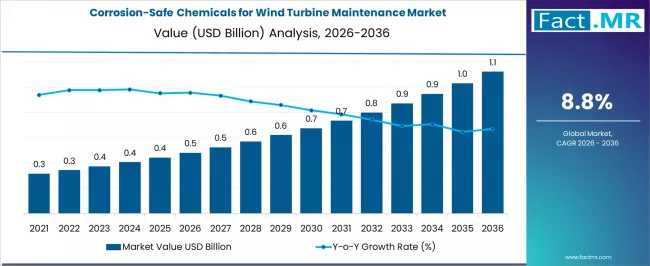
Corrosion Safe Chemicals For Wind Turbine Maintenance Market Market Value Analysis

Defining trends involve the development of high-performance, low-VOC, and often biodegradable chemical systems that provide long-term protection in harsh onshore and offshore environments without harming surrounding ecosystems. Innovation is rapidly advancing in smart, indicator-enabled coatings and inhibitor-laden greases that provide corrosion protection while also signaling when maintenance is needed. Integration of these specialized chemicals with digital twin and predictive maintenance platforms is becoming critical for optimizing service schedules and extending asset life.

Regulatory frameworks enforcing stricter environmental protection, particularly in offshore maritime settings, and policies promoting the longevity and safety of renewable energy assets are primary market drivers. The economic imperative to maximize the operational life of wind turbines against costly corrosion-driven failures acts as a significant catalyst, positioning these specialized chemicals as essential for the levelized cost of energy (LCOE) and reliability of wind power.

Corrosion-Safe Chemicals for Wind Turbine Maintenance Market

Metric Value
Market Value (2026) USD 0.48 Billion
Market Forecast Value (2036) USD 1.12 Billion
Forecast CAGR (2026-2036) 8.8%

Category

Category Segments
Product Type Maintenance touch-up coatings & repair lacquers, Corrosion inhibitor liquids & sprays (on-site), Surface cleaning & de-contamination chemistries, Inhibitor-laden greases & lubricants, Cathodic protection consumables & inhibitor dosing reagents, Monitoring & Test Reagents, Specialty Biodegradable Products
Application Zone on Turbine Tower & tower internals (corrosion control), Nacelle & drivetrain protection, Blade root & attachment interfaces, Foundation & monopile & substructure (offshore), Electrical connectors & BOP (coatings & inhibitors)
Delivery Model O&M service provider supplied, OEM & turbine manufacturer approved consumables, Direct purchase by asset owner and site maintenance teams
Region North America, Latin America, Western Europe, Eastern Europe, East Asia, South Asia & Pacific, MEA

Segmental Analysis

By Product Type, Which Solution Addresses the Most Frequent and Widespread Maintenance Need?
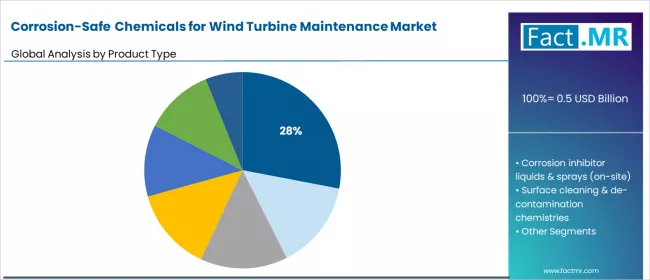
Corrosion Safe Chemicals For Wind Turbine Maintenance Market Analysis By Product Type

Maintenance touch-up coatings & repair lacquers lead the segment with a 28% share. This dominance is due to the constant need to repair coating damage caused by UV exposure, abrasion, and impact on every external surface of the turbine. These products are formulated for easy field application (often in challenging weather), rapid curing, and must seamlessly integrate with the original OEM coating system to restore the integrity of the primary corrosion barrier, making them a high-volume, recurring consumable.

By Application Zone, Which Area is Most Extensive and Continuously Exposed to the Elements?
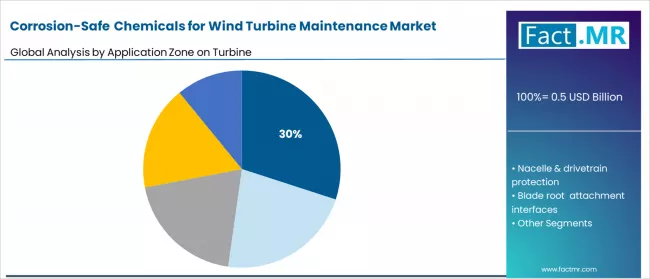
Corrosion Safe Chemicals For Wind Turbine Maintenance Market Analysis By Application Zone On Turbine

The tower & tower internals (corrosion control) zone commands the largest application share at 30%. The tower represents the greatest surface area of the turbine and is subjected to constant environmental stress from moisture, salt (onshore and offshore), and temperature fluctuations. Internal areas face condensation and potential chemical exposure. Protecting this vast steel structure from both external and internal corrosion is foundational to structural integrity and accounts for the largest volume of protective chemicals.

By Delivery Model, Who is the Key Intermediary and Specifier for Most Wind Assets?
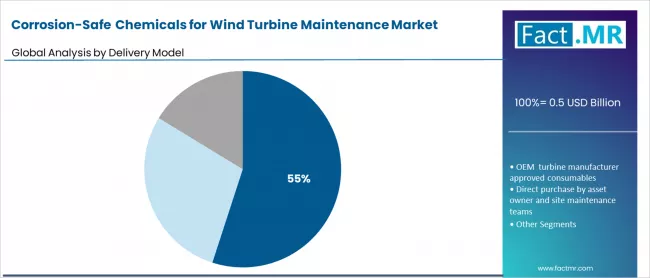
Corrosion Safe Chemicals For Wind Turbine Maintenance Market Analysis By Delivery Model

The O&M service provider supplied model is the dominant delivery model at 55.00%. Most wind farm owners outsource full operations and maintenance to specialized service companies. These O&M providers are responsible for selecting, stocking, and applying all maintenance chemicals as part of their service contracts. Their preference drives bulk purchasing, and they demand products that ensure reliability, simplify application, and minimize downtime, making them the central channel to market.

What are the Drivers, Restraints, and Key Trends of the Corrosion-Safe Chemicals for Wind Turbine Maintenance Market?

Market growth is driven by the accelerating global deployment of wind power, especially in corrosive offshore environments. The aging fleet of installed turbines requires increasingly intensive maintenance to prevent failures. Stringent environmental regulations, particularly for offshore operations, are banning historically effective but toxic chemicals (e.g., certain heavy-metal based pigments, biocides), forcing a shift to safer, certified alternatives. The high cost of turbine downtime and major structural repairs makes preventive chemical maintenance a high-ROI activity.

A significant restraint is the extreme difficulty of application and maintenance in the field—high altitudes, limited weather windows, and remote locations—which limits the types of chemistries that can be practically used. The long qualification cycles and stringent approval processes from turbine OEMs for new chemicals can slow innovation adoption. Furthermore, the pressure to reduce O&M costs can lead to the selection of less effective, cheaper products, risking long-term asset health.

Key trends include the development of multi-functional products (e.g., cleaner+primer+coating in one) to reduce application time and complexity. There is a strong shift towards bio-based, non-toxic inhibitors and biodegradable greases. The integration of sensor technology with coatings (smart coatings that change color to indicate corrosion) is emerging. Furthermore, chemical management is becoming part of digital O&M platforms, enabling predictive replenishment and performance tracking.

Analysis of the Corrosion-Safe Chemicals for Wind Turbine Maintenance Market by Key Countries
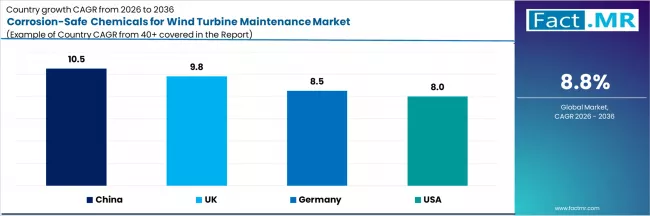
Corrosion Safe Chemicals For Wind Turbine Maintenance Market Cagr Analysis By Country

Country CAGR (2026-2036)
China 10.50%
UK 9.80%
Germany 8.50%
USA 8.00%
Netherlands 7.50%

How does China's Massive Wind Capacity Expansion and Fleet Aging Drive Market Leadership?

China leads with a 10.50% CAGR, driven by the world's largest installed base of onshore and growing offshore wind capacity. As its earliest installations reach mid-life, the demand for corrosion maintenance chemicals surges. Domestic production of coatings and chemicals supports this demand, and national standards are increasingly emphasizing product performance and environmental safety, particularly for offshore projects in the Bohai Sea and South China Sea.

Why is the UK's Advanced Offshore Wind Sector and Stringent Marine Regulations a Key Driver?

The UK's 9.80% growth is fueled by its leadership in offshore wind, operating in one of the world's most corrosive marine environments. The UK's strict Health and Safety Executive (HSE) and environmental regulations for offshore operations mandate the use of high-performance, often environmentally certified chemicals. This creates a sophisticated, innovation-driven market for advanced coatings, inhibitors, and cathodic protection systems for monopiles and substations.

What Role does Germany's Engineering Precision and Onshore Fleet Maintenance Play?

Germany's 8.50% growth reflects its vast installed onshore wind base and precision engineering ethos. The focus is on extending the life of existing assets through meticulous maintenance. German engineering standards demand high-quality, durable repair systems and condition monitoring. The growing repowering market also creates demand for specialized decommissioning and surface preparation chemistries during component replacement.

How does the USA's Diverse Climate and Growing Offshore Pipeline Influence the Market?
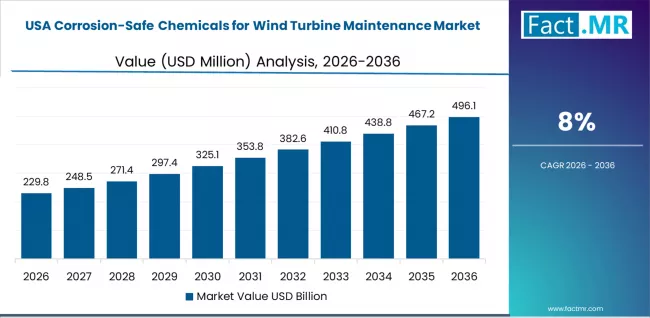
Corrosion Safe Chemicals For Wind Turbine Maintenance Market Country Value Analysis

A large, geographically diverse fleet facing everything from desert dryness to coastal salt spray underpins the USA’s 8.00% growth. The nascent but rapidly growing offshore wind sector on the East Coast is adopting the latest, most stringent environmental and performance standards from day one, driving demand for premium, corrosion-safe chemical systems. The mature service provider market also pushes for efficient, reliable products.

What Factors Underpin the Netherlands' Role as an Offshore Hub and Innovation Center?

The Netherlands' 7.50% growth is anchored in its status as a major North Sea offshore wind hub and home to leading marine coating companies. The Dutch market is a testbed for innovative, sustainable corrosion protection technologies, including biodegradable products and advanced application methods for offshore environments. Its central role in European wind logistics also makes it a key distribution and service center for maintenance chemicals.

Competitive Landscape of the Corrosion-Safe Chemicals for Wind Turbine Maintenance Market
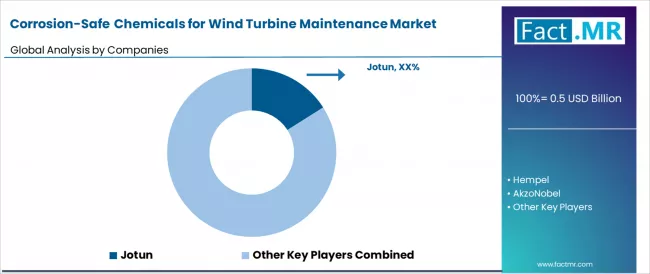
Corrosion Safe Chemicals For Wind Turbine Maintenance Market Analysis By Company

Global industrial coating giants who offer comprehensive corrosion protection systems dominate the competitive landscape. Leaders like Jotun, Hempel, and AkzoNobel compete by providing full-system solutions from surface preparation cleaners and primers to topcoats and specialized repair lacquers that are often pre-approved by major turbine OEMs.

Companies like Sherwin-Williams and CRC (a brand of ITW) compete with strong distribution networks and portfolios of maintenance-focused products like sprays, inhibitors, and greases. Competition intensifies around securing long-term frame agreements with major global O&M service providers and wind farm owners, providing extensive technical support and training, and developing environmentally compliant products without sacrificing field performance in harsh conditions.

Key Players in the Corrosion-Safe Chemicals for Wind Turbine Maintenance Market

  • Jotun
  • Hempel
  • AkzoNobel
  • Sherwin-Williams
  • CRC

Scope of Report

Items Values
Quantitative Units USD Billion
Product Type Maintenance touch-up coatings & repair lacquers, Corrosion inhibitor liquids & sprays, Surface cleaning chemistries, Inhibitor-laden greases & lubricants, Cathodic protection consumables, Monitoring & Test Reagents, Specialty Biodegradable Products
Application Zone on Turbine Tower & tower internals, Nacelle & drivetrain, Blade root & interfaces, Foundation & monopile & substructure, Electrical connectors & BOP
Delivery Model O&M service provider supplied, OEM approved consumables, Direct purchase by asset owner
Key Countries China, UK, Germany, USA, Netherlands
Key Companies Jotun, Hempel, AkzoNobel, Sherwin-Williams, CRC
Additional Analysis Analysis of chemical compatibility with OEM coatings, performance in splash vs. immersion zones (offshore), application time & cure time under field conditions, environmental certification (e.g., Blue Angel, EU Ecolabel), and total cost-in-use including labor.

Corrosion-Safe Chemicals for Wind Turbine Maintenance Market by Segments

  • Product Type :

    • Maintenance touch-up coatings & repair lacquers
    • Corrosion inhibitor liquids & sprays (on-site)
    • Surface cleaning & de-contamination chemistries
    • Inhibitor-laden greases & lubricants
    • Cathodic protection consumables & inhibitor dosing reagents
    • Monitoring & Test Reagents
    • Specialty Biodegradable Products
  • Application Zone on Turbine :

    • Tower & tower internals (corrosion control)
    • Nacelle & drivetrain protection
    • Blade root & attachment interfaces
    • Foundation & monopile & substructure (offshore)
    • Electrical connectors & BOP (coatings & inhibitors)
  • Delivery Model :

    • O&M service provider supplied
    • OEM & turbine manufacturer approved consumables
    • Direct purchase by asset owner and site maintenance teams
  • Region :

    • North America

      • USA
      • Canada
    • Latin America

      • Brazil
      • Mexico
      • Rest of Latin America
    • Western Europe

      • UK
      • Germany
      • Netherlands
      • Denmark
      • France
      • BENELUX
      • Rest of Western Europe
    • Eastern Europe

      • Poland
      • Turkey
      • Rest of Eastern Europe
    • East Asia

      • China
      • Taiwan
      • Japan
      • Rest of East Asia
    • South Asia & Pacific

      • India
      • Australia
      • Rest of South Asia & Pacific
    • MEA

      • Saudi Arabia
      • South Africa
      • Rest of MEA

Table of Content

  1. Executive Summary
    • Global Market Outlook
    • Demand to side Trends
    • Supply to side Trends
    • Technology Roadmap Analysis
    • Analysis and Recommendations
  2. Market Overview
    • Market Coverage / Taxonomy
    • Market Definition / Scope / Limitations
  3. Market Background
    • Market Dynamics
      • Drivers
      • Restraints
      • Opportunity
      • Trends
    • Scenario Forecast
      • Demand in Optimistic Scenario
      • Demand in Likely Scenario
      • Demand in Conservative Scenario
    • Opportunity Map Analysis
    • Product Life Cycle Analysis
    • Supply Chain Analysis
    • Investment Feasibility Matrix
    • Value Chain Analysis
    • PESTLE and Porter’s Analysis
    • Regulatory Landscape
    • Regional Parent Market Outlook
    • Production and Consumption Statistics
    • Import and Export Statistics
  4. Global Market Analysis 2021 to 2025 and Forecast, 2026 to 2036
    • Historical Market Size Value (USD Million) Analysis, 2021 to 2025
    • Current and Future Market Size Value (USD Million) Projections, 2026 to 2036
      • Y to o to Y Growth Trend Analysis
      • Absolute $ Opportunity Analysis
  5. Global Market Pricing Analysis 2021 to 2025 and Forecast 2026 to 2036
  6. Global Market Analysis 2021 to 2025 and Forecast 2026 to 2036, By Product Type
    • Introduction / Key Findings
    • Historical Market Size Value (USD Million) Analysis By Product Type, 2021 to 2025
    • Current and Future Market Size Value (USD Million) Analysis and Forecast By Product Type, 2026 to 2036
      • Maintenance touch-up coatings repair lacquers
      • Corrosion inhibitor liquids & sprays (on-site)
      • Surface cleaning & de-contamination chemistries
      • Inhibitor-laden greases & lubricants
      • Cathodic protection consumables & inhibitor dosing reagents
      • Monitoring & Test Reagents
      • Specialty Biodegradable Products
    • Y to o to Y Growth Trend Analysis By Product Type, 2021 to 2025
    • Absolute $ Opportunity Analysis By Product Type, 2026 to 2036
  7. Global Market Analysis 2021 to 2025 and Forecast 2026 to 2036, By Application Zone on Turbine
    • Introduction / Key Findings
    • Historical Market Size Value (USD Million) Analysis By Application Zone on Turbine, 2021 to 2025
    • Current and Future Market Size Value (USD Million) Analysis and Forecast By Application Zone on Turbine, 2026 to 2036
      • Tower & tower internals (corrosion control)
      • Nacelle & drivetrain protection
      • Blade root attachment interfaces
      • Foundation monopile substructure (offshore)
      • Electrical connectors & BOP (coatings inhibitors)
    • Y to o to Y Growth Trend Analysis By Application Zone on Turbine, 2021 to 2025
    • Absolute $ Opportunity Analysis By Application Zone on Turbine, 2026 to 2036
  8. Global Market Analysis 2021 to 2025 and Forecast 2026 to 2036, By Delivery Model
    • Introduction / Key Findings
    • Historical Market Size Value (USD Million) Analysis By Delivery Model, 2021 to 2025
    • Current and Future Market Size Value (USD Million) Analysis and Forecast By Delivery Model, 2026 to 2036
      • O&M service provider supplied
      • OEM turbine manufacturer approved consumables
      • Direct purchase by asset owner and site maintenance teams
    • Y to o to Y Growth Trend Analysis By Delivery Model, 2021 to 2025
    • Absolute $ Opportunity Analysis By Delivery Model, 2026 to 2036
  9. Global Market Analysis 2021 to 2025 and Forecast 2026 to 2036, By Region
    • Introduction
    • Historical Market Size Value (USD Million) Analysis By Region, 2021 to 2025
    • Current Market Size Value (USD Million) Analysis and Forecast By Region, 2026 to 2036
      • North America
      • Latin America
      • Western Europe
      • Eastern Europe
      • East Asia
      • South Asia and Pacific
      • Middle East & Africa
    • Market Attractiveness Analysis By Region
  10. North America Market Analysis 2021 to 2025 and Forecast 2026 to 2036, By Country
    • Historical Market Size Value (USD Million) Trend Analysis By Market Taxonomy, 2021 to 2025
    • Market Size Value (USD Million) Forecast By Market Taxonomy, 2026 to 2036
      • By Country
        • USA
        • Canada
        • Mexico
      • By Product Type
      • By Application Zone on Turbine
      • By Delivery Model
    • Market Attractiveness Analysis
      • By Country
      • By Product Type
      • By Application Zone on Turbine
      • By Delivery Model
    • Key Takeaways
  11. Latin America Market Analysis 2021 to 2025 and Forecast 2026 to 2036, By Country
    • Historical Market Size Value (USD Million) Trend Analysis By Market Taxonomy, 2021 to 2025
    • Market Size Value (USD Million) Forecast By Market Taxonomy, 2026 to 2036
      • By Country
        • Brazil
        • Chile
        • Rest of Latin America
      • By Product Type
      • By Application Zone on Turbine
      • By Delivery Model
    • Market Attractiveness Analysis
      • By Country
      • By Product Type
      • By Application Zone on Turbine
      • By Delivery Model
    • Key Takeaways
  12. Western Europe Market Analysis 2021 to 2025 and Forecast 2026 to 2036, By Country
    • Historical Market Size Value (USD Million) Trend Analysis By Market Taxonomy, 2021 to 2025
    • Market Size Value (USD Million) Forecast By Market Taxonomy, 2026 to 2036
      • By Country
        • Germany
        • UK
        • Italy
        • Spain
        • France
        • Nordic
        • BENELUX
        • Rest of Western Europe
      • By Product Type
      • By Application Zone on Turbine
      • By Delivery Model
    • Market Attractiveness Analysis
      • By Country
      • By Product Type
      • By Application Zone on Turbine
      • By Delivery Model
    • Key Takeaways
  13. Eastern Europe Market Analysis 2021 to 2025 and Forecast 2026 to 2036, By Country
    • Historical Market Size Value (USD Million) Trend Analysis By Market Taxonomy, 2021 to 2025
    • Market Size Value (USD Million) Forecast By Market Taxonomy, 2026 to 2036
      • By Country
        • Russia
        • Poland
        • Hungary
        • Balkan & Baltic
        • Rest of Eastern Europe
      • By Product Type
      • By Application Zone on Turbine
      • By Delivery Model
    • Market Attractiveness Analysis
      • By Country
      • By Product Type
      • By Application Zone on Turbine
      • By Delivery Model
    • Key Takeaways
  14. East Asia Market Analysis 2021 to 2025 and Forecast 2026 to 2036, By Country
    • Historical Market Size Value (USD Million) Trend Analysis By Market Taxonomy, 2021 to 2025
    • Market Size Value (USD Million) Forecast By Market Taxonomy, 2026 to 2036
      • By Country
        • China
        • Japan
        • South Korea
      • By Product Type
      • By Application Zone on Turbine
      • By Delivery Model
    • Market Attractiveness Analysis
      • By Country
      • By Product Type
      • By Application Zone on Turbine
      • By Delivery Model
    • Key Takeaways
  15. South Asia and Pacific Market Analysis 2021 to 2025 and Forecast 2026 to 2036, By Country
    • Historical Market Size Value (USD Million) Trend Analysis By Market Taxonomy, 2021 to 2025
    • Market Size Value (USD Million) Forecast By Market Taxonomy, 2026 to 2036
      • By Country
        • India
        • ASEAN
        • Australia & New Zealand
        • Rest of South Asia and Pacific
      • By Product Type
      • By Application Zone on Turbine
      • By Delivery Model
    • Market Attractiveness Analysis
      • By Country
      • By Product Type
      • By Application Zone on Turbine
      • By Delivery Model
    • Key Takeaways
  16. Middle East & Africa Market Analysis 2021 to 2025 and Forecast 2026 to 2036, By Country
    • Historical Market Size Value (USD Million) Trend Analysis By Market Taxonomy, 2021 to 2025
    • Market Size Value (USD Million) Forecast By Market Taxonomy, 2026 to 2036
      • By Country
        • Kingdom of Saudi Arabia
        • Other GCC Countries
        • Turkiye
        • South Africa
        • Other African Union
        • Rest of Middle East & Africa
      • By Product Type
      • By Application Zone on Turbine
      • By Delivery Model
    • Market Attractiveness Analysis
      • By Country
      • By Product Type
      • By Application Zone on Turbine
      • By Delivery Model
    • Key Takeaways
  17. Key Countries Market Analysis
    • USA
      • Pricing Analysis
      • Market Share Analysis, 2025
        • By Product Type
        • By Application Zone on Turbine
        • By Delivery Model
    • Canada
      • Pricing Analysis
      • Market Share Analysis, 2025
        • By Product Type
        • By Application Zone on Turbine
        • By Delivery Model
    • Mexico
      • Pricing Analysis
      • Market Share Analysis, 2025
        • By Product Type
        • By Application Zone on Turbine
        • By Delivery Model
    • Brazil
      • Pricing Analysis
      • Market Share Analysis, 2025
        • By Product Type
        • By Application Zone on Turbine
        • By Delivery Model
    • Chile
      • Pricing Analysis
      • Market Share Analysis, 2025
        • By Product Type
        • By Application Zone on Turbine
        • By Delivery Model
    • Germany
      • Pricing Analysis
      • Market Share Analysis, 2025
        • By Product Type
        • By Application Zone on Turbine
        • By Delivery Model
    • UK
      • Pricing Analysis
      • Market Share Analysis, 2025
        • By Product Type
        • By Application Zone on Turbine
        • By Delivery Model
    • Italy
      • Pricing Analysis
      • Market Share Analysis, 2025
        • By Product Type
        • By Application Zone on Turbine
        • By Delivery Model
    • Spain
      • Pricing Analysis
      • Market Share Analysis, 2025
        • By Product Type
        • By Application Zone on Turbine
        • By Delivery Model
    • France
      • Pricing Analysis
      • Market Share Analysis, 2025
        • By Product Type
        • By Application Zone on Turbine
        • By Delivery Model
    • India
      • Pricing Analysis
      • Market Share Analysis, 2025
        • By Product Type
        • By Application Zone on Turbine
        • By Delivery Model
    • ASEAN
      • Pricing Analysis
      • Market Share Analysis, 2025
        • By Product Type
        • By Application Zone on Turbine
        • By Delivery Model
    • Australia & New Zealand
      • Pricing Analysis
      • Market Share Analysis, 2025
        • By Product Type
        • By Application Zone on Turbine
        • By Delivery Model
    • China
      • Pricing Analysis
      • Market Share Analysis, 2025
        • By Product Type
        • By Application Zone on Turbine
        • By Delivery Model
    • Japan
      • Pricing Analysis
      • Market Share Analysis, 2025
        • By Product Type
        • By Application Zone on Turbine
        • By Delivery Model
    • South Korea
      • Pricing Analysis
      • Market Share Analysis, 2025
        • By Product Type
        • By Application Zone on Turbine
        • By Delivery Model
    • Russia
      • Pricing Analysis
      • Market Share Analysis, 2025
        • By Product Type
        • By Application Zone on Turbine
        • By Delivery Model
    • Poland
      • Pricing Analysis
      • Market Share Analysis, 2025
        • By Product Type
        • By Application Zone on Turbine
        • By Delivery Model
    • Hungary
      • Pricing Analysis
      • Market Share Analysis, 2025
        • By Product Type
        • By Application Zone on Turbine
        • By Delivery Model
    • Kingdom of Saudi Arabia
      • Pricing Analysis
      • Market Share Analysis, 2025
        • By Product Type
        • By Application Zone on Turbine
        • By Delivery Model
    • Turkiye
      • Pricing Analysis
      • Market Share Analysis, 2025
        • By Product Type
        • By Application Zone on Turbine
        • By Delivery Model
    • South Africa
      • Pricing Analysis
      • Market Share Analysis, 2025
        • By Product Type
        • By Application Zone on Turbine
        • By Delivery Model
  18. Market Structure Analysis
    • Competition Dashboard
    • Competition Benchmarking
    • Market Share Analysis of Top Players
      • By Regional
      • By Product Type
      • By Application Zone on Turbine
      • By Delivery Model
  19. Competition Analysis
    • Competition Deep Dive
      • Jotun
        • Overview
        • Product Portfolio
        • Profitability by Market Segments (Product/Age /Sales Channel/Region)
        • Sales Footprint
        • Strategy Overview
          • Marketing Strategy
          • Product Strategy
          • Channel Strategy
      • Hempel
      • AkzoNobel
      • Sherwin-Williams
      • CRC
  20. Assumptions & Acronyms Used
  21. Research Methodology

List Of Table

  • Table 1: Global Market Value (USD Million) Forecast by Region, 2021 to 2036
  • Table 2: Global Market Value (USD Million) Forecast by Product Type, 2021 to 2036
  • Table 3: Global Market Value (USD Million) Forecast by Application Zone on Turbine, 2021 to 2036
  • Table 4: Global Market Value (USD Million) Forecast by Delivery Model, 2021 to 2036
  • Table 5: North America Market Value (USD Million) Forecast by Country, 2021 to 2036
  • Table 6: North America Market Value (USD Million) Forecast by Product Type, 2021 to 2036
  • Table 7: North America Market Value (USD Million) Forecast by Application Zone on Turbine, 2021 to 2036
  • Table 8: North America Market Value (USD Million) Forecast by Delivery Model, 2021 to 2036
  • Table 9: Latin America Market Value (USD Million) Forecast by Country, 2021 to 2036
  • Table 10: Latin America Market Value (USD Million) Forecast by Product Type, 2021 to 2036
  • Table 11: Latin America Market Value (USD Million) Forecast by Application Zone on Turbine, 2021 to 2036
  • Table 12: Latin America Market Value (USD Million) Forecast by Delivery Model, 2021 to 2036
  • Table 13: Western Europe Market Value (USD Million) Forecast by Country, 2021 to 2036
  • Table 14: Western Europe Market Value (USD Million) Forecast by Product Type, 2021 to 2036
  • Table 15: Western Europe Market Value (USD Million) Forecast by Application Zone on Turbine, 2021 to 2036
  • Table 16: Western Europe Market Value (USD Million) Forecast by Delivery Model, 2021 to 2036
  • Table 17: Eastern Europe Market Value (USD Million) Forecast by Country, 2021 to 2036
  • Table 18: Eastern Europe Market Value (USD Million) Forecast by Product Type, 2021 to 2036
  • Table 19: Eastern Europe Market Value (USD Million) Forecast by Application Zone on Turbine, 2021 to 2036
  • Table 20: Eastern Europe Market Value (USD Million) Forecast by Delivery Model, 2021 to 2036
  • Table 21: East Asia Market Value (USD Million) Forecast by Country, 2021 to 2036
  • Table 22: East Asia Market Value (USD Million) Forecast by Product Type, 2021 to 2036
  • Table 23: East Asia Market Value (USD Million) Forecast by Application Zone on Turbine, 2021 to 2036
  • Table 24: East Asia Market Value (USD Million) Forecast by Delivery Model, 2021 to 2036
  • Table 25: South Asia and Pacific Market Value (USD Million) Forecast by Country, 2021 to 2036
  • Table 26: South Asia and Pacific Market Value (USD Million) Forecast by Product Type, 2021 to 2036
  • Table 27: South Asia and Pacific Market Value (USD Million) Forecast by Application Zone on Turbine, 2021 to 2036
  • Table 28: South Asia and Pacific Market Value (USD Million) Forecast by Delivery Model, 2021 to 2036
  • Table 29: Middle East & Africa Market Value (USD Million) Forecast by Country, 2021 to 2036
  • Table 30: Middle East & Africa Market Value (USD Million) Forecast by Product Type, 2021 to 2036
  • Table 31: Middle East & Africa Market Value (USD Million) Forecast by Application Zone on Turbine, 2021 to 2036
  • Table 32: Middle East & Africa Market Value (USD Million) Forecast by Delivery Model, 2021 to 2036

List Of Figures

  • Figure 1: Global Market Pricing Analysis
  • Figure 2: Global Market Value (USD Million) Forecast 2021 to 2036
  • Figure 3: Global Market Value Share and BPS Analysis by Product Type, 2026 and 2036
  • Figure 4: Global Market Y to o to Y Growth Comparison by Product Type, 2026 to 2036
  • Figure 5: Global Market Attractiveness Analysis by Product Type
  • Figure 6: Global Market Value Share and BPS Analysis by Application Zone on Turbine, 2026 and 2036
  • Figure 7: Global Market Y to o to Y Growth Comparison by Application Zone on Turbine, 2026 to 2036
  • Figure 8: Global Market Attractiveness Analysis by Application Zone on Turbine
  • Figure 9: Global Market Value Share and BPS Analysis by Delivery Model, 2026 and 2036
  • Figure 10: Global Market Y to o to Y Growth Comparison by Delivery Model, 2026 to 2036
  • Figure 11: Global Market Attractiveness Analysis by Delivery Model
  • Figure 12: Global Market Value (USD Million) Share and BPS Analysis by Region, 2026 and 2036
  • Figure 13: Global Market Y to o to Y Growth Comparison by Region, 2026 to 2036
  • Figure 14: Global Market Attractiveness Analysis by Region
  • Figure 15: North America Market Incremental Dollar Opportunity, 2026 to 2036
  • Figure 16: Latin America Market Incremental Dollar Opportunity, 2026 to 2036
  • Figure 17: Western Europe Market Incremental Dollar Opportunity, 2026 to 2036
  • Figure 18: Eastern Europe Market Incremental Dollar Opportunity, 2026 to 2036
  • Figure 19: East Asia Market Incremental Dollar Opportunity, 2026 to 2036
  • Figure 20: South Asia and Pacific Market Incremental Dollar Opportunity, 2026 to 2036
  • Figure 21: Middle East & Africa Market Incremental Dollar Opportunity, 2026 to 2036
  • Figure 22: North America Market Value Share and BPS Analysis by Country, 2026 and 2036
  • Figure 23: North America Market Value Share and BPS Analysis by Product Type, 2026 and 2036
  • Figure 24: North America Market Y to o to Y Growth Comparison by Product Type, 2026 to 2036
  • Figure 25: North America Market Attractiveness Analysis by Product Type
  • Figure 26: North America Market Value Share and BPS Analysis by Application Zone on Turbine, 2026 and 2036
  • Figure 27: North America Market Y to o to Y Growth Comparison by Application Zone on Turbine, 2026 to 2036
  • Figure 28: North America Market Attractiveness Analysis by Application Zone on Turbine
  • Figure 29: North America Market Value Share and BPS Analysis by Delivery Model, 2026 and 2036
  • Figure 30: North America Market Y to o to Y Growth Comparison by Delivery Model, 2026 to 2036
  • Figure 31: North America Market Attractiveness Analysis by Delivery Model
  • Figure 32: Latin America Market Value Share and BPS Analysis by Country, 2026 and 2036
  • Figure 33: Latin America Market Value Share and BPS Analysis by Product Type, 2026 and 2036
  • Figure 34: Latin America Market Y to o to Y Growth Comparison by Product Type, 2026 to 2036
  • Figure 35: Latin America Market Attractiveness Analysis by Product Type
  • Figure 36: Latin America Market Value Share and BPS Analysis by Application Zone on Turbine, 2026 and 2036
  • Figure 37: Latin America Market Y to o to Y Growth Comparison by Application Zone on Turbine, 2026 to 2036
  • Figure 38: Latin America Market Attractiveness Analysis by Application Zone on Turbine
  • Figure 39: Latin America Market Value Share and BPS Analysis by Delivery Model, 2026 and 2036
  • Figure 40: Latin America Market Y to o to Y Growth Comparison by Delivery Model, 2026 to 2036
  • Figure 41: Latin America Market Attractiveness Analysis by Delivery Model
  • Figure 42: Western Europe Market Value Share and BPS Analysis by Country, 2026 and 2036
  • Figure 43: Western Europe Market Value Share and BPS Analysis by Product Type, 2026 and 2036
  • Figure 44: Western Europe Market Y to o to Y Growth Comparison by Product Type, 2026 to 2036
  • Figure 45: Western Europe Market Attractiveness Analysis by Product Type
  • Figure 46: Western Europe Market Value Share and BPS Analysis by Application Zone on Turbine, 2026 and 2036
  • Figure 47: Western Europe Market Y to o to Y Growth Comparison by Application Zone on Turbine, 2026 to 2036
  • Figure 48: Western Europe Market Attractiveness Analysis by Application Zone on Turbine
  • Figure 49: Western Europe Market Value Share and BPS Analysis by Delivery Model, 2026 and 2036
  • Figure 50: Western Europe Market Y to o to Y Growth Comparison by Delivery Model, 2026 to 2036
  • Figure 51: Western Europe Market Attractiveness Analysis by Delivery Model
  • Figure 52: Eastern Europe Market Value Share and BPS Analysis by Country, 2026 and 2036
  • Figure 53: Eastern Europe Market Value Share and BPS Analysis by Product Type, 2026 and 2036
  • Figure 54: Eastern Europe Market Y to o to Y Growth Comparison by Product Type, 2026 to 2036
  • Figure 55: Eastern Europe Market Attractiveness Analysis by Product Type
  • Figure 56: Eastern Europe Market Value Share and BPS Analysis by Application Zone on Turbine, 2026 and 2036
  • Figure 57: Eastern Europe Market Y to o to Y Growth Comparison by Application Zone on Turbine, 2026 to 2036
  • Figure 58: Eastern Europe Market Attractiveness Analysis by Application Zone on Turbine
  • Figure 59: Eastern Europe Market Value Share and BPS Analysis by Delivery Model, 2026 and 2036
  • Figure 60: Eastern Europe Market Y to o to Y Growth Comparison by Delivery Model, 2026 to 2036
  • Figure 61: Eastern Europe Market Attractiveness Analysis by Delivery Model
  • Figure 62: East Asia Market Value Share and BPS Analysis by Country, 2026 and 2036
  • Figure 63: East Asia Market Value Share and BPS Analysis by Product Type, 2026 and 2036
  • Figure 64: East Asia Market Y to o to Y Growth Comparison by Product Type, 2026 to 2036
  • Figure 65: East Asia Market Attractiveness Analysis by Product Type
  • Figure 66: East Asia Market Value Share and BPS Analysis by Application Zone on Turbine, 2026 and 2036
  • Figure 67: East Asia Market Y to o to Y Growth Comparison by Application Zone on Turbine, 2026 to 2036
  • Figure 68: East Asia Market Attractiveness Analysis by Application Zone on Turbine
  • Figure 69: East Asia Market Value Share and BPS Analysis by Delivery Model, 2026 and 2036
  • Figure 70: East Asia Market Y to o to Y Growth Comparison by Delivery Model, 2026 to 2036
  • Figure 71: East Asia Market Attractiveness Analysis by Delivery Model
  • Figure 72: South Asia and Pacific Market Value Share and BPS Analysis by Country, 2026 and 2036
  • Figure 73: South Asia and Pacific Market Value Share and BPS Analysis by Product Type, 2026 and 2036
  • Figure 74: South Asia and Pacific Market Y to o to Y Growth Comparison by Product Type, 2026 to 2036
  • Figure 75: South Asia and Pacific Market Attractiveness Analysis by Product Type
  • Figure 76: South Asia and Pacific Market Value Share and BPS Analysis by Application Zone on Turbine, 2026 and 2036
  • Figure 77: South Asia and Pacific Market Y to o to Y Growth Comparison by Application Zone on Turbine, 2026 to 2036
  • Figure 78: South Asia and Pacific Market Attractiveness Analysis by Application Zone on Turbine
  • Figure 79: South Asia and Pacific Market Value Share and BPS Analysis by Delivery Model, 2026 and 2036
  • Figure 80: South Asia and Pacific Market Y to o to Y Growth Comparison by Delivery Model, 2026 to 2036
  • Figure 81: South Asia and Pacific Market Attractiveness Analysis by Delivery Model
  • Figure 82: Middle East & Africa Market Value Share and BPS Analysis by Country, 2026 and 2036
  • Figure 83: Middle East & Africa Market Value Share and BPS Analysis by Product Type, 2026 and 2036
  • Figure 84: Middle East & Africa Market Y to o to Y Growth Comparison by Product Type, 2026 to 2036
  • Figure 85: Middle East & Africa Market Attractiveness Analysis by Product Type
  • Figure 86: Middle East & Africa Market Value Share and BPS Analysis by Application Zone on Turbine, 2026 and 2036
  • Figure 87: Middle East & Africa Market Y to o to Y Growth Comparison by Application Zone on Turbine, 2026 to 2036
  • Figure 88: Middle East & Africa Market Attractiveness Analysis by Application Zone on Turbine
  • Figure 89: Middle East & Africa Market Value Share and BPS Analysis by Delivery Model, 2026 and 2036
  • Figure 90: Middle East & Africa Market Y to o to Y Growth Comparison by Delivery Model, 2026 to 2036
  • Figure 91: Middle East & Africa Market Attractiveness Analysis by Delivery Model
  • Figure 92: Global Market - Tier Structure Analysis
  • Figure 93: Global Market - Company Share Analysis

- FAQs -

How big is the corrosion-safe chemicals for wind turbine maintenance market in 2026?

The global corrosion-safe chemicals for wind turbine maintenance market is estimated to be valued at USD 0.5 billion in 2026.

What will be the size of corrosion-safe chemicals for wind turbine maintenance market in 2036?

The market size for the corrosion-safe chemicals for wind turbine maintenance market is projected to reach USD 1.1 billion by 2036.

How much will be the corrosion-safe chemicals for wind turbine maintenance market growth between 2026 and 2036?

The corrosion-safe chemicals for wind turbine maintenance market is expected to grow at a 8.8% CAGR between 2026 and 2036.

What are the key product types in the corrosion-safe chemicals for wind turbine maintenance market?

The key product types in corrosion-safe chemicals for wind turbine maintenance market are maintenance touch-up coatings repair lacquers, corrosion inhibitor liquids & sprays (on-site), surface cleaning & de-contamination chemistries, inhibitor-laden greases & lubricants, cathodic protection consumables & inhibitor dosing reagents, monitoring & test reagents and specialty biodegradable products.

Which application zone on turbine segment to contribute significant share in the corrosion-safe chemicals for wind turbine maintenance market in 2026?

In terms of application zone on turbine, tower & tower internals (corrosion control) segment to command 30.0% share in the corrosion-safe chemicals for wind turbine maintenance market in 2026.

Corrosion-Safe Chemicals for Wind Turbine Maintenance Market