- Market Value (2025): USD 6.5 Bn
- Estimated Value (2026): USD 7.7 Bn
- Forecast Value (2036): USD 44.6 Bn
- CAGR (2026-2036): 19.2%
What are the defining numbers behind Zero-Click Vehicle Diagnostics Market growth?
USD 44.6 billion by 2036 at a 19.2% CAGR.
- The zero-click vehicle diagnostics market reached USD 6.5 billion in 2025.
- Demand is projected to increase from USD 7.7 billion in 2026 to USD 44.6 billion by 2036.
- The market is forecast to expand at a 19.2% CAGR from 2026 to 2036.
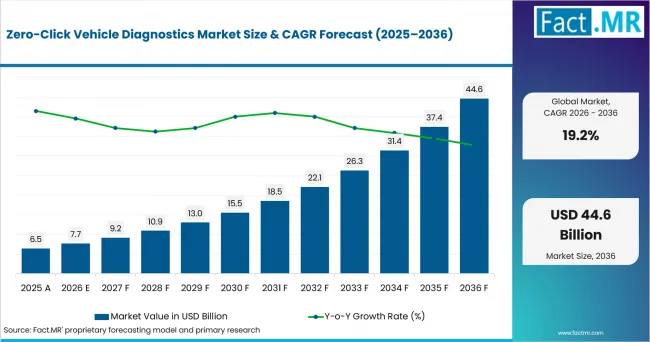
Zero Click Vehicle Diagnostics Market Value Analysis | Source: Fact.MR
What are the defining numbers behind Zero-Click Vehicle Diagnostics Market growth?
An absolute opportunity of USD 36.9 billion is expected between 2026 and 2036.
- Demand Drivers in the Market
- Connected vehicles generate diagnostic and operating data continuously, allowing faults to be assessed before a driver requests service. Bosch describes cloud diagnostics as a process in which vehicle data is transferred for remote fault identification, criticality assessment and recommended next steps. This shifts diagnostics from a workshop-only event toward continuous vehicle-health monitoring.
- Software-defined vehicle functions are increasing the need for remote fault identification after launch. UN Regulation No. 156 establishes requirements for vehicle software updates and software update management systems, while UN Regulation No. 155 addresses vehicle cybersecurity. Diagnostic platforms become more valuable when manufacturers must identify software-related faults, determine affected functions and support controlled remediation.
- Predictive maintenance creates a direct fleet use case. Continuous analysis can identify component deterioration before it causes an unplanned stop, giving fleet operators time to combine repairs with scheduled maintenance. This links diagnostic software spending to vehicle availability and maintenance planning rather than to fault-code reading alone.
- Access to connected-product data is broadening the service ecosystem. European Commission guidance on the Data Act explains how vehicle users can access generated data and share it with third parties, including aftermarket repair providers. Wider data access can support independent diagnostic services and new maintenance applications beyond the vehicle manufacturer.
- Remote remedies are becoming a practical part of vehicle service. NHTSA tracks safety recalls remedied through over-the-air updates, while its 2025 vehicle-safety resources record 997 vehicle recalls affecting more than 29 million vehicles. Software-led fault management increases the value of systems that can identify the affected vehicle, diagnose the issue and route the appropriate service or update action.
- Key Segments Analyzed
- Passenger Vehicles account for 56.2% of the Vehicle Type segment in 2026, supported by factory connectivity and the volume of software-controlled comfort, powertrain and safety functions in modern cars.
- Wi-Fi holds 66.4% of the Communication Technology segment in 2026 because it provides a practical local connection for data transfer, workshop synchronization and software or diagnostic interactions without a wired interface.
- Predictive Diagnostics represents 48.1% of the Diagnostics Type segment in 2026 as OEMs and fleets seek early warnings that allow maintenance before a component failure interrupts vehicle operation.
- Engine And Powertrain Health accounts for 41.2% of the Application segment in 2026 because propulsion faults can directly affect drivability, fuel or energy use, emissions performance and vehicle uptime.
- Analyst Opinion at Fact.MR
- Shambhu Nath Jha, Principal Consultant at Fact.MR, states, “Zero-click diagnostics changes the timing of vehicle service decisions. The useful outcome is not another fault code; it is an earlier decision about whether a vehicle can continue operating, needs maintenance or requires a software intervention. Suppliers that combine reliable vehicle data access with accurate fault interpretation and secure remote workflows are positioned to gain deeper OEM and fleet integration as the market expands.”
- Strategic Implications
- OEMs should connect diagnostic alerts with service scheduling so that detected faults translate into a repair action instead of another driver notification.
- Fleet platforms should prioritize severity ranking and remaining-use guidance because dispatchers need to know which vehicle requires attention first.
- Diagnostic suppliers should design for secure data handling and software-update governance because remote access expands the cybersecurity surface around vehicle service.
- Aftermarket providers should prepare for greater access to connected-vehicle data in jurisdictions where data-sharing rules allow vehicle owners to authorize third-party service use.
How does the Zero-Click Vehicle Diagnostics Market break down by segment?
The market is segmented by Vehicle Type, Communication Technology, Diagnostics Type and Application.
Why do Passenger Vehicles lead Vehicle Type?
Passenger Vehicles are projected to account for a 56.2% share in 2026.
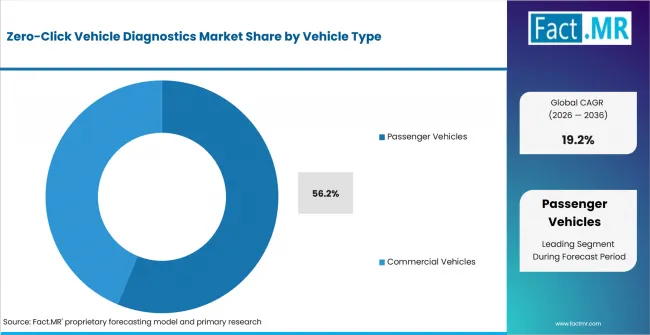
Zero Click Vehicle Diagnostics Market Analysis By Vehicle Type | Source: Fact.MR
Passenger vehicles lead because connected electronic systems are now distributed across propulsion, infotainment, safety and comfort functions. Remote health monitoring can therefore create value across many subsystems within the same vehicle rather than serving one isolated component.
The consumer service model also supports automated diagnostics. Drivers may not recognize early component degradation, while connected platforms can evaluate data in the background and surface a service recommendation only when action is needed. This reduces dependence on the driver initiating a scan or interpreting a warning light.
Why does Wi-Fi lead Communication Technology?
Wi-Fi is projected to account for a 66.4% share in 2026.
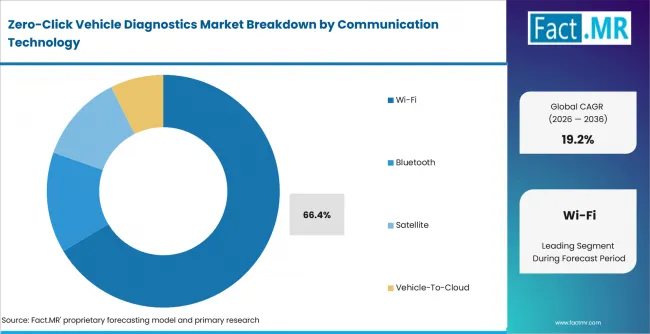
Zero Click Vehicle Diagnostics Market Analysis By Communication Technology | Source: Fact.MR
Wi-Fi leads because it provides high-throughput local connectivity for diagnostic data transfer without requiring a physical cable. It is useful when vehicles are at home, in a depot or in a workshop and can connect to a trusted network for report synchronization or software-related service activity.
Snap-on uses Wi-Fi to upload vehicle system reports and diagnostic images to its cloud environment. That workflow illustrates why local wireless connectivity remains important even as cellular and vehicle-to-cloud links expand: diagnostic files can move automatically when the vehicle or tool reaches a known network.
Why does Predictive Diagnostics lead Diagnostics Type?
Predictive Diagnostics are projected to account for a 48.1% share in 2026.
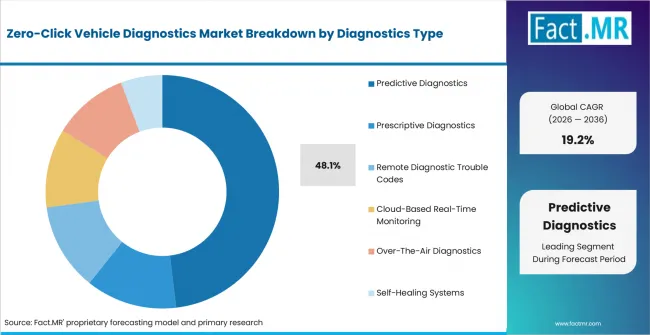
Zero Click Vehicle Diagnostics Market Analysis By Diagnostics Type | Source: Fact.MR
Predictive diagnostics lead because the commercial value is highest when the system identifies deterioration before a vehicle becomes unavailable. This gives an OEM or fleet operator time to plan maintenance, order parts or combine the repair with another scheduled visit.
Bosch states that its predictive diagnostics continuously monitors component and system conditions and uses connected-vehicle data to predict faults. The workflow directly matches zero-click use: the diagnostic process runs in the background and generates an intervention when the evidence crosses a useful threshold.
Why does Engine And Powertrain Health lead Application?
Engine And Powertrain Health is projected to account for a 41.2% share in 2026.
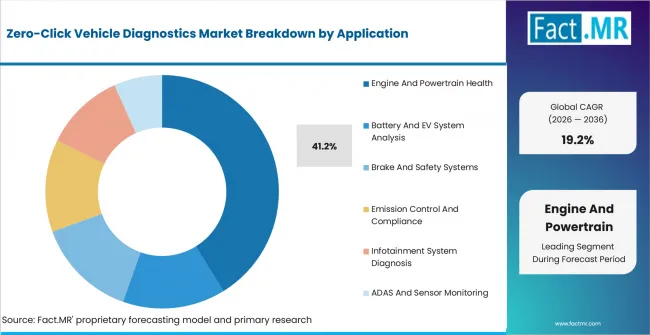
Zero Click Vehicle Diagnostics Market Analysis By Application | Source: Fact.MR
Engine and powertrain health leads because propulsion-system degradation has an immediate relationship with vehicle availability and operating cost. Faults in injection, thermal management, transmission, electric drive or related controls can reduce performance or cause a breakdown if they remain unresolved.
Connected powertrain services can combine onboard diagnostic information with cloud analysis to assess system health and identify anomalies. This supports earlier intervention and gives workshops more targeted information before the vehicle arrives.
What is accelerating Zero-Click Vehicle Diagnostics Market adoption, and what is holding it back?
Adoption is accelerating as vehicles become continuously connected and software-managed, while data access, cybersecurity requirements and diagnostic accuracy remain the main constraints on unattended decision-making.
Drivers Impact Analysis
| Factor | (~) % Impact on CAGR | Geographic Relevance | Impact Timeline |
|---|---|---|---|
| Factory-connected vehicle architectures | +3.4% | Global | Short term (≤ 2 years) |
| Predictive maintenance and uptime requirements | +3.0% | USA; Germany; Japan | Short term (≤ 2 years) |
| OTA software and remote service workflows | +2.5% | Europe; Japan; USA | Medium term (2–4 years) |
| Vehicle-data access for service applications | +1.9% | European Union; Global spillover | Medium term (2–4 years) |
| Cloud analytics across vehicle fleets | +1.4% | Global | Long term (≥ 4 years) |
Opportunity Impact Analysis
| Factor | (~) % Impact on CAGR | Geographic Relevance | Impact Timeline |
|---|---|---|---|
| Battery and EV health diagnostics | +2.2% | China-linked supply chains; USA; Europe; Japan | Medium term (2–4 years) |
| Third-party connected repair services | +1.7% | European Union | Medium term (2–4 years) |
| Fleet-wide health scoring | +1.5% | USA; ASEAN; Europe | Medium term (2–4 years) |
| Self-healing and automated remediation | +1.1% | Global | Long term (≥ 4 years) |
Restraints Impact Analysis
| Factor | (~) % Impact on CAGR | Geographic Relevance | Impact Timeline |
|---|---|---|---|
| Cybersecurity and remote-access risk | -2.4% | Global | Short term (≤ 2 years) |
| Fragmented vehicle data and interfaces | -1.8% | Aftermarket-intensive markets | Short term (≤ 2 years) |
| False positives and diagnostic liability | -1.4% | Global | Medium term (2–4 years) |
| Connectivity gaps and data-transfer cost | -1.0% | ASEAN; rural and cross-border fleets | Long term (≥ 4 years) |
Which countries are scaling the Zero-Click Vehicle Diagnostics Market through 2036?
- ASEAN: The source workbook identifies ASEAN as the fastest-growing listed country group, at a 26.4% CAGR from 2026 to 2036.
- USA: NHTSA operates digital recall and manufacturer-communication datasets and tracks over-the-air recall remedies. The combination of connected service infrastructure and large vehicle fleets supports remote fault identification and software-led service workflows.
- Germany: The Federal Motor Transport Authority requires vehicle manufacturers to operate in line with harmonized rules including UN R155 and R156. Secure software-update management strengthens the institutional framework around remote vehicle data and software-based diagnostics.
- Japan: The Ministry of Land, Infrastructure, Transport and Tourism has addressed scan-tool inspection and electronic-control-device repair as vehicle technology becomes more complex. Connected diagnostics can extend this process by identifying faults before a workshop visit.
- France: EU vehicle-data guidance under the Data Act supports user-authorized sharing of connected-product data with third-party service providers. This can broaden the commercial base for remote diagnostics beyond OEM-owned service channels.
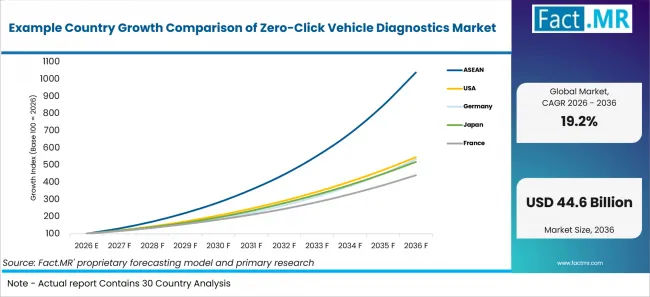
Example Country Growth Comparison Of Zero Click Vehicle Diagnostics Market | Source: Fact.MR
Country CAGR (2026-2036)
| Country | CAGR (2026-2036) |
|---|---|
| ASEAN | 26.4% |
| USA | 18.5% |
| Germany | 18.2% |
| Japan | 17.9% |
| France | 16.0% |
What is ASEAN’s forecast through 2036?
ASEAN is forecast to expand at a 26.4% CAGR from 2026 to 2036.
What is driving USA’s growth through 2036?
The USA is forecast to expand at an 18.5% CAGR from 2026 to 2036.
The U.S. market is supported by large-scale digital safety and service infrastructure. NHTSA provides recall data through searchable tools and APIs, while manufacturers increasingly use software updates as part of recall remedies. This creates a practical environment for diagnostic systems that identify affected vehicles remotely and connect fault detection with service action.
Fleet operators also have a clear economic incentive to use predictive diagnostics because a warning delivered before a breakdown can reduce unplanned downtime and allow maintenance to be scheduled around operating needs.
What is driving Germany’s growth through 2036?
Germany is forecast to expand at an 18.2% CAGR from 2026 to 2036.
Germany combines a large automotive engineering base with formal cybersecurity and software-update governance. KBA states that manufacturers must produce in compliance with harmonized regulations including UN R155 and UN R156 and continuously ensure the required management systems.
This supports demand for diagnostic platforms that can distinguish hardware faults from software conditions and maintain a secure chain between vehicle data, cloud analysis and any remote remediation.
What is driving Japan’s growth through 2036?
Japan is forecast to expand at a 17.9% CAGR from 2026 to 2036.
Japan has been preparing its inspection and repair framework for more electronically controlled vehicles. MLIT materials discuss scan-tool inspection, access to technical information needed for maintenance and cybersecurity requirements facing vehicle manufacturers.
As electronic control expands across propulsion and safety systems, remote diagnostic tools can reduce the time spent reproducing intermittent faults in a workshop and give technicians more complete condition data before service begins.
What is driving France’s growth through 2036?
France is forecast to expand at a 16.0% CAGR from 2026 to 2036.
France benefits from the EU framework for connected-product data. European Commission guidance for the automotive sector explains how vehicle data covered by the Data Act can be accessed by users and shared with third-party service providers, including aftermarket repair businesses.
This creates room for independent diagnostic and maintenance services that can operate on authorized vehicle data, provided they meet cybersecurity and data-protection requirements. The result is a broader service ecosystem around remote vehicle health information.
Who Leads the Zero-Click Vehicle Diagnostics Market?
Robert Bosch GmbH, Continental AG, Snap-on, workM8, Vidiwave, UDIAG, OnStar LLC, KPIT Technologies, Autel, AVL DiTEST, and Delphi Technologies.
Bosch’s position is supported by a portfolio that spans vehicle communication interfaces, remote diagnostics, cloud diagnostics and predictive diagnostics. Its connected services can read and clear diagnostic trouble codes remotely, assess fault criticality and use cloud algorithms to predict component deterioration, giving it coverage across several of the market’s core workflows.
Continental competes through connected vehicle electronics and software capabilities. Snap-on participates through diagnostic tools and cloud-based report workflows, while OnStar brings an embedded connected-service channel. KPIT Technologies competes through automotive software engineering, and Autel and AVL DiTEST serve professional diagnostic and workshop applications.
Supplier selection depends on vehicle-system coverage, data access, fault interpretation accuracy and cybersecurity. Platforms that can integrate with OEM back ends have an advantage in factory-connected vehicles, while diagnostic-tool suppliers remain relevant where workshops need multi-brand access and service documentation.
Delphi Technologies remains in the supplied company list as a legacy market name. BorgWarner completed its acquisition of Delphi Technologies in 2020, so current activity associated with the former business sits within BorgWarner.
Which companies are the key providers?
Key companies profiled include Robert Bosch GmbH; Continental AG; Snap-on; workM8; Vidiwave; UDIAG; OnStar LLC; KPIT Technologies; Autel; AVL DiTEST; and Delphi Technologies.
- Robert Bosch GmbH
- Continental AG
- Snap-on
- workM8
- Vidiwave
- UDIAG
- OnStar LLC
- Kpit Technologies
- Autel
- AVL Ditest
- Delphi Technologies
Bibliography
- United Nations Economic Commission for Europe. (2021). UN Regulation No. 155: Cyber security and cyber security management system. UNECE.
- United Nations Economic Commission for Europe. (2021). UN Regulation No. 156: Software update and software update management system. UNECE.
- United Nations Economic Commission for Europe. (2026). Reference documents for cyber security and software updates. UNECE WP.29.
- European Commission. (2025). Guidance on vehicle data, accompanying the Data Act. Directorate-General for Communications Networks, Content and Technology.
- European Commission. (2026). Data Act. Shaping Europe’s Digital Future.
- National Highway Traffic Safety Administration. (2026). Vehicle Safety Resources. U.S. Department of Transportation.
- National Highway Traffic Safety Administration. (2026). NHTSA Datasets and APIs. U.S. Department of Transportation.
- National Highway Traffic Safety Administration. (2022). Recall Annual Report: Vehicles remedied by over-the-air updates. U.S. Department of Transportation.
- Kraftfahrt-Bundesamt. (2026). Cyber-Security & Software Update. Federal Motor Transport Authority, Germany.
- Ministry of Land, Infrastructure, Transport and Tourism, Japan. (2021). Advanced Automotive Maintenance Technology Review materials. Government of Japan.
- ASEAN NCAP. (2023). ASEAN NCAP Roadmap 2026–2030. Malaysian Institute of Road Safety Research.
- Robert Bosch GmbH. (2026). Cloud and Predictive Diagnostics. Bosch Mobility.
- Robert Bosch GmbH. (2026). Vehicle Connectivity Services. Bosch Mobility.
- Snap-on Incorporated. (2026). The Snap-on Cloud. Snap-on Diagnostics.
- BorgWarner Inc. (2020). BorgWarner completes acquisition of Delphi Technologies. BorgWarner Inc.
This Report Answers
- How zero-click diagnostics is used across passenger and commercial vehicles.
- How wireless and cloud connectivity changes vehicle-health monitoring and service workflows.
- Why predictive diagnostics holds the leading position among the covered diagnostic approaches.
- How remote diagnostics supports powertrain, battery, safety and software-related service decisions.
- Which competitive capabilities matter as diagnostics moves from workshop initiation toward continuous monitoring.
What does the Zero-Click Vehicle Diagnostics Market cover?
The market covers commercial software and connected services that identify vehicle faults, health conditions or maintenance requirements with minimal manual initiation. It includes solutions that use onboard diagnostic data, connected vehicle telemetry and cloud analysis to generate fault information or service recommendations.
Revenue is counted when diagnostic software, analytics, connectivity-enabled diagnostic services or related platforms are sold or licensed within the supplied segmentation. The market covers passenger and commercial vehicles across the listed communication technologies, diagnostic approaches and applications.
What is included in the scope?
The scope includes predictive and prescriptive diagnostics, remote diagnostic trouble-code analysis, cloud-based real-time monitoring, over-the-air diagnostics and self-healing diagnostic functions. Vehicle communication can use Wi-Fi, Bluetooth, satellite or vehicle-to-cloud connectivity.
Applications include engine and powertrain health, battery and EV system analysis, brake and safety systems, emission control and compliance, infotainment diagnosis, and ADAS or sensor monitoring. Buyers include vehicle manufacturers, connected-service providers, fleets and professional service organizations using the covered diagnostic capability.
What is excluded from the scope?
The scope excludes standalone mechanical inspection equipment that does not use connected or automated diagnostic capability. Conventional scan tools used only through technician-initiated local sessions are outside the market when they do not provide the covered remote, cloud or zero-click functions.
General telematics services are excluded when they provide only location, navigation, entertainment or driver tracking without vehicle-health diagnostics. Standalone software-update delivery is also excluded when it does not include diagnostic detection, assessment or fault-resolution functionality.
How Was the Analysis Built?
The analysis draws on more than 120 sources, over 35 company portfolios and more than 20 industry interviews across at least 25 countries.
- Primary Research: Interviews with automotive OEM engineers, diagnostic-software providers, fleet maintenance teams, workshop technology specialists and connected-service providers examine fault-detection workflows, data access and purchasing priorities.
- Desk Research: The review covers vehicle cybersecurity and software-update regulations, connected-data policy, recall information, diagnostic standards, company product documentation and vehicle-service frameworks. Sources used in the article are recorded in the bibliography.
- Market Sizing and Forecasting: Estimates combine connected-vehicle penetration, diagnostic software and service revenue, vehicle parc, OEM integration, fleet adoption, communication mix and the share of maintenance workflows that can be performed remotely.
- Data Validation and Update Cycle: Findings are cross-checked against company activity, regulatory changes and connected-service adoption. Updates account for changes in vehicle architecture, data-access rules, software-update requirements and remote diagnostic capability.
What is the report's scope and coverage?
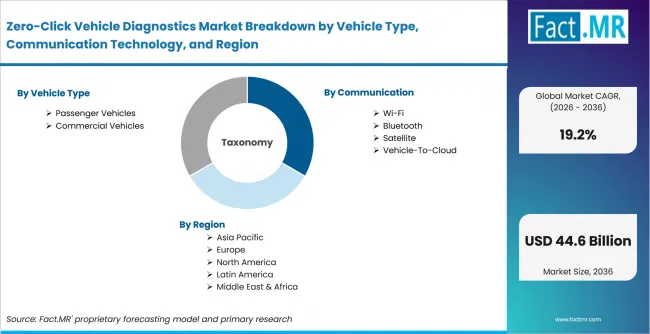
Zero Click Vehicle Diagnostics Market Breakdown By Vehicle Type, Communication Technology, And Region | Source: Fact.MR
| Attribute | Details |
|---|---|
| Quantitative Units | USD billion |
| Market Definition | Connected software and services that identify, interpret or predict vehicle faults with minimal manual initiation |
| Segments Covered | Vehicle Type; Communication Technology; Diagnostics Type; Application |
| Regions Covered | North America; Latin America; Europe; East Asia; South Asia and Pacific; Middle East and Africa |
| Countries Covered | ASEAN; USA; Germany; Japan; France |
| Key Companies Profiled | Robert Bosch GmbH; Continental AG; Snap-on; workM8; Vidiwave; UDIAG; OnStar LLC; Kpit Technologies; Autel; AVL Ditest; Delphi Technologies |
| Forecast Period | 2026 to 2036 |
| Base Year | 2026 |
| Market Value, 2026 | USD 7.7 billion |
| Market Value, 2036 | USD 44.6 billion |
| CAGR, 2026-2036 | 19.2% |
| Absolute Opportunity | USD 36.9 billion |
| Approach | Hybrid top-down and bottom-up approach using connected-vehicle penetration, diagnostic service revenue, vehicle parc, OEM integration, communication mix and remote-maintenance adoption |
How is the market segmented?
-
By Vehicle Type
- Passenger Vehicles
- Hatchback
- Sedan
- SUV
- Commercial Vehicles
- Light Commercial Vehicles
- Medium And Heavy Commercial Vehicles
- Buses And Coaches
- Passenger Vehicles
-
By Communication Technology
- Wi-Fi
- Local Wireless Connectivity
- Bluetooth
- Short-Range Connectivity
- Satellite
- Satellite-Based Connectivity
- Vehicle-To-Cloud
- Direct Cloud Connectivity
- Wi-Fi
-
By Diagnostics Type
- Predictive Diagnostics
- Component Failure Prediction
- Prescriptive Diagnostics
- Action Recommendation Systems
- Remote Diagnostic Trouble Codes
- Fault Code Analysis
- Cloud-Based Real-Time Monitoring
- Continuous Vehicle Monitoring
- Over-The-Air Diagnostics
- Remote Software Diagnostics
- Self-Healing Systems
- Autonomous Issue Resolution
- Predictive Diagnostics
-
By Application
- Engine And Powertrain Health
- Engine Performance Monitoring
- Battery And EV System Analysis
- Battery Health Monitoring
- Brake And Safety Systems
- Brake Performance Monitoring
- Emission Control And Compliance
- Emission System Monitoring
- Infotainment System Diagnosis
- Connectivity Diagnostics
- ADAS And Sensor Monitoring
- Sensor Performance Diagnostics
- Engine And Powertrain Health