- Base Value(2025): 5.4 Bn
- Estimated Value(2026): 6.0 Bn
- Forecast Value (2036): 15.6 Bn
- CAGR (2026 - 2036): 10.0%
Remote Vehicle Diagnostic Gateway Devices Market Forecast and Outlook By Fact.MR
- In 2025, the remote vehicle diagnostic gateway devices market was valued at USD 5.4 billion.
- Based on Fact.MR analysis, demand for remote vehicle diagnostic gateway devices is estimated to grow to USD 6.0 billion in 2026 and USD 15.6 billion by 2036.
- Fact.MR projects a CAGR of 10.0% during the forecast period.
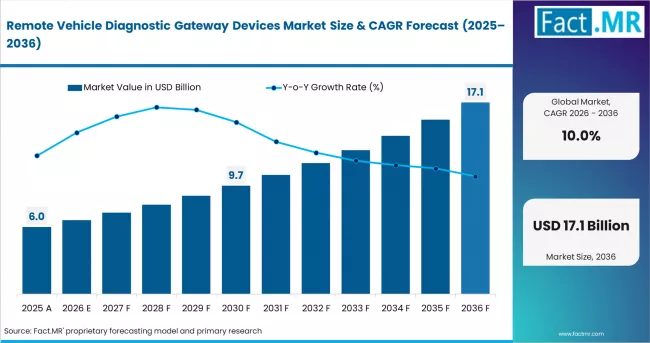
Remote Vehicle Diagnostic Gateway Devices Market Market Value Analysis | Source: Fact.MR
| Metric | Details |
|---|---|
| Industry Size (2026) | USD 6.0 billion |
| Industry Value (2036) | USD 15.6 billion |
| CAGR (2026 to 2036) | 10.0% |
Source: Fact.MR analysis. Updated May 12, 2026
Summary of Remote Vehicle Diagnostic Gateway Devices Market
- Market Definition
- The market includes onboard gateway devices that collect and transmit vehicle diagnostic data to remote systems so fleets, OEMs, and service networks can monitor vehicle health and respond to faults without waiting for in-bay diagnostics.
- Demand Drivers
- Remote diagnostics is becoming more valuable in fleet operations because fault data can be interpreted before a breakdown or workshop visit. [2]
- Modern gateway devices are increasingly expected to support remote diagnostics, software updates, and secure vehicle communication in one platform.
- Connected-vehicle ecosystems are expanding, which increases the amount of onboard data available for remote health monitoring and service decisioning.
- Key Segments Analyzed
- By Component, Gateway Hardware is expected to hold 43.8% share in 2026, supported by the central role of the physical in-vehicle node that bridges onboard networks and remote services.
- By Vehicle Type, Heavy Commercial Vehicles are projected to account for 31.6% share in 2026 because downtime cost and service urgency make remote diagnostics especially valuable in this segment.
- By Geography, China is expected to be the fastest-growing country in this study at 11.1% CAGR through 2036, supported by connected-vehicle scale and broader electronics integration.
- Analyst Opinion at Fact.MR
- Shambhu Nath Jha, Senior Analyst at Fact.MR, notes that this market is no longer about whether a device can read data from the vehicle. It is about whether the gateway can convert onboard access into reliable service action. The strongest platforms reduce diagnostic delay, improve maintenance prioritization, and keep fleets or OEM service teams inside one remote workflow long enough to make the data commercially useful. A gateway that only transmits data is becoming less valuable than one that supports secure interpretation, integration, and action.
- Strategic Implications
- Device vendors should strengthen security, protocol support, and cloud integration instead of competing on connectivity hardware alone.
- Fleet buyers need to prioritize gateways that support fault interpretation and maintenance action, not just code capture.
- Providers that combine onboard gateway capability with health reporting, alerts, and remote service workflows are better positioned than vendors selling passive telematics devices.
- Methodology
- Focus on buyers responsible for uptime, connected service design, and remote maintenance workflows.
- Uses official gateway, standards, and connected-vehicle sources rather than generalized telematics market estimates.
- Connects connected-vehicle adoption, fleet remote-monitoring demand, and gateway-device value.
- Cross-checks product positioning against public gateway functions, remote diagnostics use cases, and secure-access standards.
The market is projected to generate an absolute opportunity of USD 9.6 billion between 2026 and 2036, supported by the growing role of remote diagnostics in connected vehicle and fleet operations. Remote diagnostics is no longer treated as an optional capability. It is becoming a standard layer within vehicle-service ecosystems, particularly where uptime, predictive maintenance, and operational efficiency are critical. Vehicle gateways are evolving beyond basic data access functions. They are now expected to manage communication across multiple in-vehicle networks while supporting remote diagnostics, over-the-air software updates, and embedded security features. Functions such as firewalls and intrusion detection are becoming integral, reflecting the need to secure increasingly connected vehicle architectures. Bosch aligns its gateway positioning with this shift, emphasizing integrated connectivity and system-level control. [1]
China leads with a projected CAGR of 11.1% through 2036, driven by rapid expansion of connected-vehicle ecosystems and increasing integration of advanced electronics supporting remote diagnostics. India follows at 10.7%, supported by growing telematics adoption and rising demand for remote vehicle health monitoring across fleet operations. South Korea grows at 10.2%, underpinned by strong vehicle electronics capabilities and high connected-service penetration. Germany records 9.8%, with growth anchored in structured vehicle-data access frameworks and increasing reliance on secure gateway architectures. The United States grows at 9.4%, driven by mature fleet telematics adoption and rising need for secure remote diagnostics workflows.
Segmental Analysis
Remote Vehicle Diagnostic Gateway Devices Market Analysis by Component
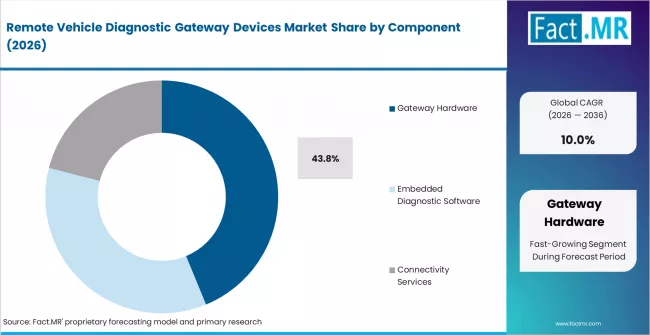
Remote Vehicle Diagnostic Gateway Devices Market Analysis By Component | Source: Fact.MR
Gateway hardware forms the foundation of remote diagnostics by enabling communication between in-vehicle systems and external platforms. It interfaces with vehicle buses, translates data, manages connectivity, and ensures secure data transfer. Gateway hardware is expected to account for 43.8% share in 2026. This role extends beyond basic communication, as modern gateways also support over-the-air updates, diagnostics, and embedded security functions such as firewalls and intrusion detection. [5]
- Architecture anchor: Hardware leads because remote diagnostics begins with an onboard gateway capable of accessing internal communication networks.
- Security role: The physical gateway increasingly carries firewall and intrusion-related responsibilities, which raises its strategic importance.
- Upgrade base: Software and analytics value still depend on the installed hardware node remaining active, connected, and protocol-capable over time.
Remote Vehicle Diagnostic Gateway Devices Market Analysis by Vehicle Type
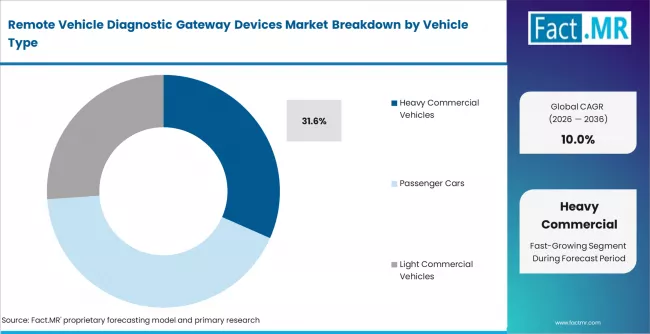
Remote Vehicle Diagnostic Gateway Devices Market Analysis By Vehicle Type | Source: Fact.MR
Heavy commercial vehicles continue to play a critical role in remote diagnostics adoption due to their high utilization and cost sensitivity to downtime. Fleet operators prioritize uptime, making early fault detection and preventive maintenance essential to avoid route disruption and revenue loss. Maintenance operations are typically centralized, allowing faster decision-making and coordinated service interventions. Heavy commercial vehicles are projected to account for 31.6% share in 2026. Operational value from remote diagnostics is more direct in fleet environments compared to private vehicle use. Real-time insights into vehicle health allow operators to schedule maintenance before failures occur, improving asset utilization and reducing unexpected breakdowns. This creates a stronger business case for investment in connected diagnostics platforms.
- Downtime sensitivity: Heavy commercial fleets gain stronger value from early fault visibility because service disruption is costlier.
- Fleet control: Centralized maintenance workflows make remote diagnostics easier to turn into action in commercial operations.
- Telematics fit: Commercial vehicles already rely heavily on connected monitoring, which supports gateway-device adoption.
Remote Vehicle Diagnostic Gateway Devices Market Analysis by End Use
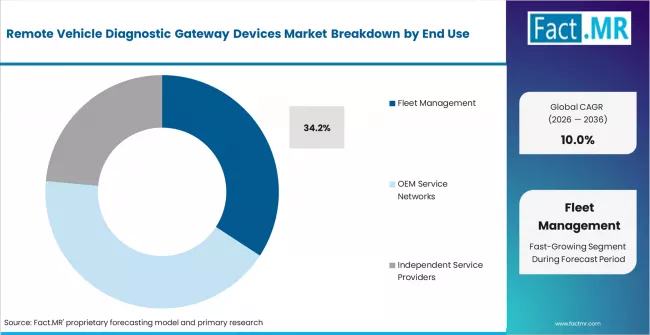
Remote Vehicle Diagnostic Gateway Devices Market Analysis By End Use | Source: Fact.MR
Fleet Management is expected to account for 34.2% share in 2026, as remote diagnostics becomes most commercially valuable when one team is responsible for many vehicles, recurring uptime decisions, and maintenance scheduling. Geotab’s broader connected-vehicle and remote diagnostics positioning supports this directly by linking device-level data with centralized fleet management and fault prioritization. In this market, fleet operators do not buy gateway devices simply to know that a code exists. They buy them to decide what needs attention first, which vehicle can remain in service, and which issue requires intervention before it affects operations.
- Central visibility: Fleet managers use gateway devices to consolidate diagnostic data across many vehicles instead of reacting vehicle by vehicle.
- Prioritization value: Remote diagnostics helps distinguish urgent maintenance from noncritical issues, which improves workshop planning.
- Utilization impact: Better fault visibility supports higher vehicle availability and fewer avoidable service interruptions.
Remote Vehicle Diagnostic Gateway Devices Market Drivers, Restraints, and Opportunities
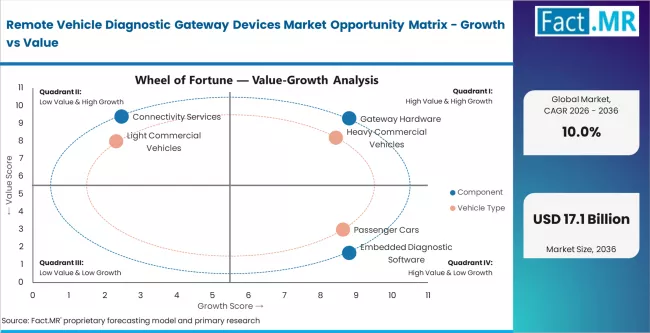
Remote Vehicle Diagnostic Gateway Devices Market Opportunity Matrix Growth Vs Value | Source: Fact.MR
A key driver is the continued expansion of connected-vehicle capability. Bosch’s current gateway architecture and Geotab’s connected-vehicle platform both show that vehicles are increasingly designed or equipped to deliver richer operational data outside the vehicle. That expands the role of gateway devices in diagnostics because remote access becomes more valuable when fleets and service networks are already relying on telematics, alerts, and cloud workflows. OICA’s 2024 vehicle production data also reinforces the continued scale of the global vehicle base entering service over time, which broadens the long-run addressable opportunity for remote diagnostics.
The main restraint is secure access and control complexity. Remote diagnostics requires privileged interaction with vehicle systems, and recent U.S. policy developments around connected vehicles show that governments are increasingly attentive to the risks tied to direct or indirect remote access. SAE’s secure diagnostic-port access work also reflects how important controlled access has become at the standards level. This means gateway vendor must do more than connect the vehicle. They must support secure architecture and trusted access pathways, which raises technical and compliance demands. [3]
Opportunities in the Remote Vehicle Diagnostic Gateway Devices Market
- Commercial truck diagnostics: Geotab’s current truck-focused remote diagnostics positioning shows continued room for growth in commercial-vehicle uptime management.
- Gateway-centered connected services: Bosch’s central gateway positioning suggests opportunity for vendors that combine remote diagnostics with OTA and broader connected services.
- Secure standards alignment: SAE secure-access work creates room for gateway vendors that can turn standards alignment into easier deployment and broader service trust.
Remote Vehicle Diagnostic Gateway Devices Market Drivers, Restraints, and Opportunities
Based on the regional analysis, the Remote Vehicle Diagnostic Gateway Devices Market is segmented into Asia Pacific, Europe, North America, Latin America, and Middle East & Africa across 40 plus countries.
.webp "Top Country Growth Comparison Remote Vehicle Diagnostic Gateway Devices Market Cagr (2026 2036)")
Top Country Growth Comparison Remote Vehicle Diagnostic Gateway Devices Market Cagr (2026 2036) | Source: Fact.MR
| Country | CAGR (2026 to 2036) |
|---|---|
| China | 11.1% |
| India | 10.7% |
| South Korea | 10.2% |
| Germany | 9.8% |
| United States | 9.4% |
Source: Fact.MR analysis. Updated May 12, 2026
Source: Fact.MR analysis, based on proprietary forecasting model and primary research.
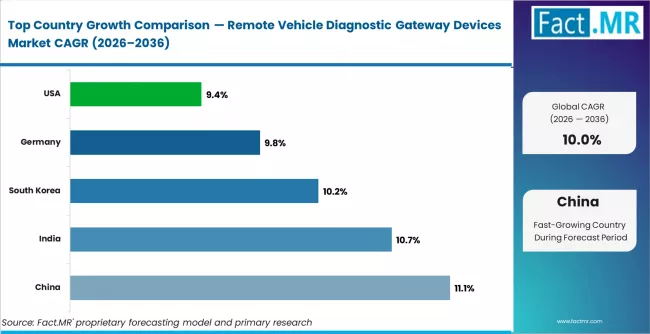
Remote Vehicle Diagnostic Gateway Devices Market Cagr Analysis By Country | Source: Fact.MR
Asia Pacific Remote Vehicle Diagnostic Gateway Devices Market Analysis
Asia Pacific is the fastest-growing region, supported by high vehicle production, expanding connected-vehicle ecosystems, and rising telematics adoption across both passenger and commercial segments. The region’s strength lies in its combination of manufacturing scale and increasing integration of electronics and software into vehicles. Demand is driven not only by current connectivity levels but also by the growing installed base of vehicles requiring remote diagnostics over time. [4]
- China: China continues to lead regional demand as connected-vehicle deployment expands across multiple segments. The market is projected to grow at an 11.1% CAGR, supported by strong integration of vehicle electronics and increasing use of remote diagnostics for both consumer and fleet applications. OEMs are embedding gateway devices to support advanced telematics and service functions.
- India: India is witnessing steady growth as telematics ecosystems expand and connected vehicle features become more common. With a CAGR of 10.7%, demand is driven by increasing adoption of vehicle diagnostics, fleet monitoring, and digital service platforms. Growth is further supported by expanding commercial vehicle connectivity and aftermarket telematics solutions.
- South Korea: South Korea reflects strong adoption driven by advanced automotive electronics and high connectivity penetration. The market is expected to record a 10.2% CAGR, supported by mature connected-service ecosystems and integration of gateway devices into modern vehicle architectures.
Fact.MR’s Asia Pacific analysis also includes Japan and Southeast Asia, where adoption is influenced by vehicle technology levels and the pace of connected-service deployment.
Europe Remote Vehicle Diagnostic Gateway Devices Market Analysis
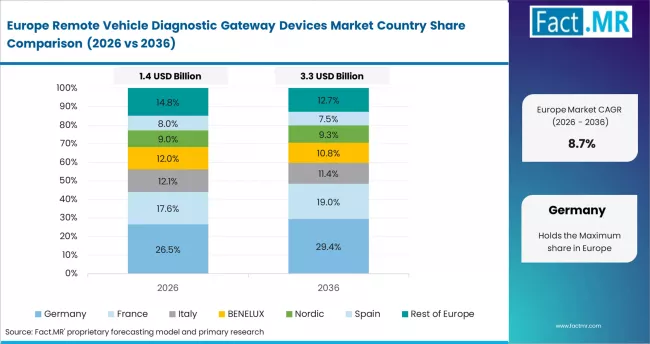
Remote Vehicle Diagnostic Gateway Devices Market Europe Country Market Share Analysis, 2026 & 2036 | Source: Fact.MR
Europe operates as a standards- and architecture-driven market, where secure vehicle data access and structured communication frameworks play a central role. The region has long emphasized regulated access to in-vehicle data, making gateway devices critical for enabling compliant and secure remote diagnostics.
- Germany: Germany remains the leading market in the region, supported by its strong automotive electronics ecosystem and large connected-vehicle base. Growth is expected at a 9.8% CAGR, reflecting increasing demand for secure gateway functions and advanced diagnostic capabilities. As vehicles become more software-driven, OEMs and suppliers are focusing on architectures that enable controlled remote access and high-value service offerings.
Across Europe, demand is less about initial telematics adoption and more about enhancing security, reliability, and functionality within existing connected-vehicle frameworks.
North America Remote Vehicle Diagnostic Gateway Devices Market Analysis
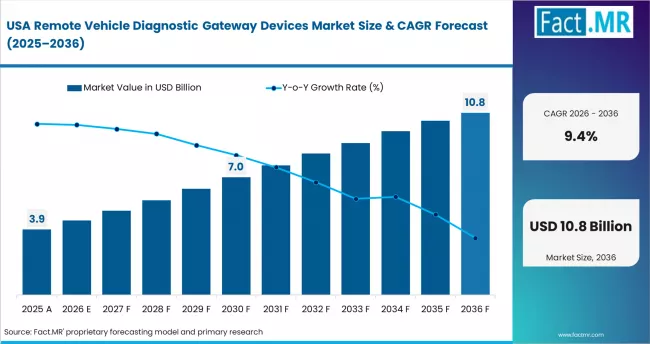
Remote Vehicle Diagnostic Gateway Devices Market Country Value Analysis | Source: Fact.MR
North America remains commercially significant due to its mature telematics environment and strong adoption of remote diagnostics in fleet operations. The region benefits from well-established logistics networks and increasing focus on vehicle health monitoring and predictive maintenance.
- United States: The United States anchors regional demand, with the market projected to grow at a 9.4% CAGR. Growth is driven by widespread use of telematics in fleet management and increasing reliance on remote diagnostics to improve operational efficiency. Secure connected-vehicle infrastructure and evolving policy frameworks are also reinforcing the need for advanced gateway devices.
Demand in North America is further supported by integration of diagnostic systems with fleet management platforms, enabling real-time monitoring and proactive maintenance strategies.
Competitive Aligners for Market Players
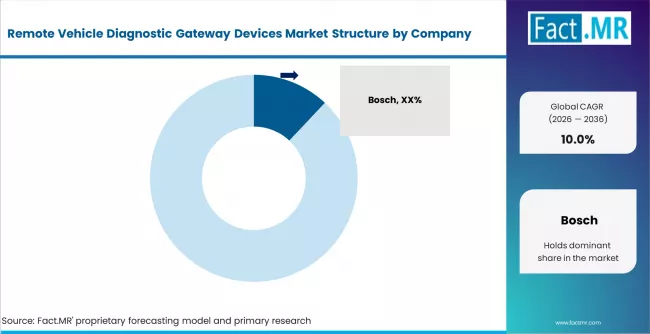
Remote Vehicle Diagnostic Gateway Devices Market Analysis By Company | Source: Fact.MR
The market is moderately concentrated, with a smaller group of established telematics, automotive-electronics, and gateway-platform providers shaping the more advanced end of the category. Bosch remains important because of its central gateway and remote diagnostics positioning. Geotab is visible through its fleet-oriented remote diagnostics and connected-vehicle platform. In adjacent or complementary roles, broader connected-vehicle and remote-diagnostics ecosystems also involve embedded telematics and OEM-linked service architectures. Competitive advantage is defined less by simple data transmission and more by whether the gateway can support secure remote diagnostics, actionable health workflows, and scalable integration into fleet or service operations.
Buyers increasingly distinguish between devices that collect vehicle data and devices that make remote maintenance commercially useful. That difference rests on protocol support, security, cloud integration, and the ability to convert onboard diagnostics into service decisions. As policy and standards attention to secure access rises, this difference is likely to matter even more through 2036.
Key Players in Remote Vehicle Diagnostic Gateway Devices Market
- Bosch
- Geotab
- Continental
- ZF
- Cummins
- Danlaw
- ACTIA
Bibliography
- [1] Bosch Mobility. Central gateway.
- [2] Geotab. Remote diagnostics for commercial trucks.
- [3] SAE. OBD-II Secure Diagnostic Port Access to In-Vehicle Networks.
- [4] ACMA & Grant Thornton. Telematics Ecosystem in India.
- [5] Bosch Remote Diagnostics. Bosch Remote Diagnostics.
This Report Addresses
- Strategic outlook for remote vehicle diagnostic gateway device demand.
- Forecast trajectory from USD 6.0 billion in 2026 to USD 15.6 billion by 2036.
- Why secure gateway architecture is becoming more important than raw connectivity alone.
- Segment analysis by component, vehicle type, connectivity type, end use, and diagnostic function.
- Regional demand patterns across Asia Pacific, Europe, North America, and Latin America.
- Competitive positioning of gateway, telematics, and remote diagnostics providers.
- The role of security, remote health reporting, and fleet workflows in market expansion.
- Why the category is shifting from simple telematics hardware toward secure remote-service infrastructure.
Remote Vehicle Diagnostic Gateway Devices Market Definition
The market covers onboard gateway devices and associated embedded software used to collect, interpret, and transmit vehicle diagnostic and health data from internal vehicle networks to remote systems for monitoring, analysis, and service action. These devices typically sit between vehicle communication buses and external connectivity layers, enabling remote access to diagnostic trouble codes, vehicle health information, and service-related data while supporting security and protocol translation.
Remote Vehicle Diagnostic Gateway Devices Market Inclusions
Market scope includes dedicated diagnostic gateway hardware, integrated telematics gateways with remote diagnostics functionality, embedded diagnostic firmware, secure communication modules, remote fault monitoring tools, and related connectivity services that allow vehicle health and fault data to be transmitted to back-office, fleet, or service environments. It includes platforms used in fleet management, OEM service ecosystems, and commercial vehicle monitoring where remote diagnostics is part of the operating proposition.
Remote Vehicle Diagnostic Gateway Devices Market Exclusions
The scope excludes generic GPS trackers that do not provide diagnostic-gateway functionality, consumer-grade OBD dongles without professional remote service workflows, and workshop diagnostic testers that require direct physical connection but do not operate as remote onboard gateway devices. It also excludes standalone cloud analytics services sold without an in-vehicle gateway or embedded remote diagnostic interface.
Remote Vehicle Diagnostic Gateway Devices Market Research Methodology
- Primary Research:Interviews with fleet maintenance managers, telematics integration heads, OEM connected-service teams, commercial vehicle service providers, and gateway-device distributors.
- Desk Research:Review of official Bosch and Geotab gateway and diagnostics materials, OICA vehicle production data, SAE diagnostic-access standards, and current connected-vehicle policy developments.
- Market-Sizing and Forecasting:Hybrid model based on connected-vehicle hardware penetration, remote diagnostics adoption in fleet and OEM ecosystems, and software-plus-connectivity value layered onto gateway devices.
- Data Validation and Update Cycle:Validation against current gateway functionality, remote diagnostics workflows, and evolving standards or policy pressure around secure access to in-vehicle networks.
Segmentation
Scope of the Report
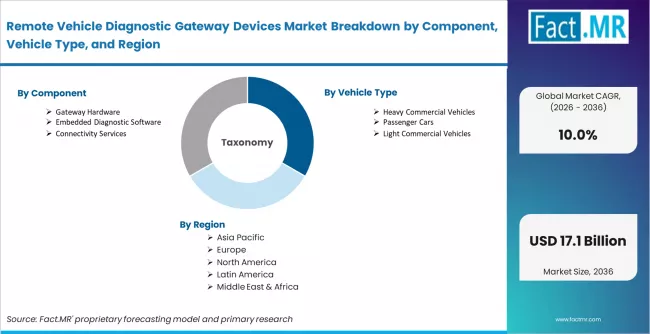
Remote Vehicle Diagnostic Gateway Devices Market Breakdown By Component, Vehicle Type, And Region | Source: Fact.MR
| Attribute | Details |
|---|---|
| Quantitative Units | USD 6.0 billion (2026) to USD 15.6 billion (2036), at a CAGR of 10.0% |
| Market Definition | Onboard gateway devices and related embedded software used to collect, translate, secure, and transmit vehicle diagnostic data for remote monitoring and service action |
| Component Segmentation | Gateway Hardware, Embedded Diagnostic Software, Connectivity Services |
| Vehicle Type Segmentation | Passenger Cars, Light Commercial Vehicles, Heavy Commercial Vehicles, Off-Highway Vehicles |
| Connectivity Type Segmentation | Cellular, Bluetooth/Wi-Fi, Hybrid Connectivity |
| End Use Segmentation | Fleet Management, OEM Service Networks, Independent Service Providers, Leasing & Rental, Others |
| Diagnostic Function Segmentation | Fault Code Monitoring, Predictive Maintenance, Remote Troubleshooting, Over-the-Air Diagnostic Support, Vehicle Health Reporting |
| Regions Covered | Asia Pacific, Europe, North America, Latin America, Middle East & Africa |
| Countries Covered | China, India, South Korea, Germany, United States, Japan, Brazil, and 40+ countries |
| Key Companies Profiled | Bosch, Geotab, Continental, ZF, Cummins, Danlaw, ACTIA |
| Forecast Period | 2026 to 2036 |
| Approach | Hybrid sizing based on connected-vehicle penetration, fleet remote diagnostics demand, and gateway-device value across hardware, software, and services |
Source: Fact.MR analysis. Updated May 12, 2026
Remote Vehicle Diagnostic Gateway Devices Market by Segments
-
By Component:
- Gateway Hardware
- Embedded Diagnostic Software
- Connectivity Services
-
By Vehicle Type:
- Passenger Cars
- Light Commercial Vehicles
- Heavy Commercial Vehicles
- Off-Highway Vehicles
-
By Region:
- North America
- United States
- Canada
- Mexico
- Latin America
- Brazil
- Argentina
- Chile
- Rest of Latin America
- Western Europe
- Germany
- France
- United Kingdom
- Italy
- Spain
- Nordic Countries
- BENELUX
- Rest of Western Europe
- Eastern Europe
- Russia
- Poland
- Hungary
- Balkan and Baltic
- Rest of Eastern Europe
- East Asia
- China
- Japan
- South Korea
- South Asia and Pacific
- India
- ASEAN
- Australia and New Zealand
- Rest of South Asia and Pacific
- Middle East and Africa
- Kingdom of Saudi Arabia
- Other GCC Countries
- Turkey
- South Africa
- Rest of Middle East and Africa
- North America
Frequently Asked Questions
How large is the Remote Vehicle Diagnostic Gateway Devices Market in 2025?
What will the market size be in 2026?
What is the projected market size by 2036?
What is the expected CAGR from 2026 to 2036?
Which component segment is poised to lead the market?
Which vehicle type holds the largest share?
Which end-use segment dominates the market?
Which diagnostic function segment leads the market?
Which country shows the fastest growth?
What is driving demand in this market?
What is the key challenge in this market?
Who worked on this report


Preview the report firsthand - request a free sample
Free SampleGet the brochure for pricing and purchase details
Download PDF