- Market Value (2025): USD 41.8 Mn
- Estimated Value (2026): USD 44.2 Mn
- Forecast Value (2036): USD 76.8 Mn
- CAGR (2026-2036): 5.7%
What is the 1,4-Butane Sultone Market forecast to be worth by 2036?
USD 44.2 million in 2026 to USD 76.8 million by 2036 at a 5.7% CAGR.
- According to Fact.MR, the 1,4-Butane Sultone market reached USD 41.8 million in 2025.
- Sales are projected to increase from USD 44.2 million in 2026 to USD 76.8 million in 2036.
- Fact.MR forecasts a 5.7% CAGR between 2026 and 2036, reflecting research and specialist chemical purchases associated with formulation testing.
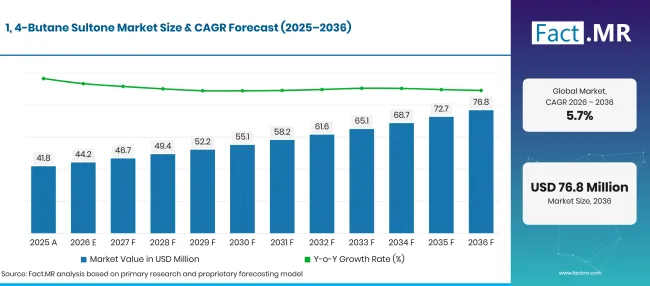
1 4 Butane Sultone Market Forecast Global | Source: Fact.MR
| Year | Basis | Market Value (USD million) |
|---|---|---|
| 2025 | Actual | 41.8 |
| 2026 | Estimate | 44.2 |
| 2036 | Forecast | 76.8 |
| CAGR 2026 to 2036 | Forecast period | 5.7% |
Source: Fact.MR analysis. Updated Oct 30, 2026
What are the defining numbers behind 1,4-Butane Sultone Market growth?
The forecast represents USD 32.6 million in additional annual revenue by 2036. Electrolyte additives and automotive are the largest stated application and end-use segments for 2026.
- Demand Drivers in the Market
- Electrolyte researchers require verified chemical composition before comparing additive performance between formulations.
- Chemical synthesis laboratories need documented purity and handling information. Merck lists a synthesis-grade material with an assay of at least 98.0% by gas chromatography. Laboratories can use such specifications to compare raw material suitability for a defined reaction and to plan testing before repeat orders [3].
- Industrial customers must assess worker safety before extending laboratory chemistry to plant operations. Thermo Fisher Scientific revised its safety data sheet for 1,4-butanesultone in September 2025 and identifies moisture sensitivity and hazard controls [4].
- Key Segments Analyzed
- By Application: Electrolyte Additives is forecast to account for 38.5% of 2026 revenue as battery formulation work creates a specialist application for cyclic sulfonate chemistry.
- By End-Use Industry: Automotive is projected to represent 43.8% of 2026 revenue as vehicle battery development provides a commercial reason to study additive performance.
- Analyst Opinion at Fact.MR
- Shambhu Nath Jha, Principal Consultant at Fact.MR, states, “The commercial challenge is moving from the sale of a documented chemical to its qualification in a customer formulation. A high-purity product and an accessible safety file help laboratories start testing. Repeat industrial orders depend on results from the customer’s own process and on safe handling at the intended scale. Reliable product identification and consistent specifications help customers assess repeat orders.”
- Strategic Implications
- Chemical distributors should keep lot certificates accessible so customers can compare material quality between sample and repeat orders.
- Battery researchers should assess whether electrolyte behavior justifies adding this compound within a specific formulation.
- Plant safety teams should assess handling requirements early. A chemical suitable for controlled laboratory work may require different safeguards at industrial scale.
- Specialty chemical vendors should explain package size, storage conditions and assay method clearly during technical discussions.
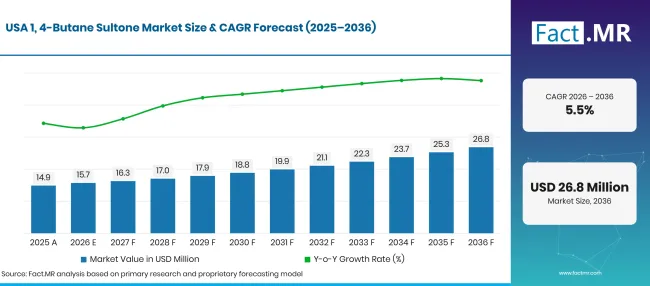
Germany is forecast to record 6.7% CAGR through 2036 as battery and chemical research support specialty material evaluations. Brazil follows at 6.1% as automotive electrification creates more formulation questions. The USA is projected at 5.5%; the UK at 4.9%; and Japan at 4.4%, reflecting distinct testing and purchasing conditions.
How does the 1,4-Butane Sultone Market break down by segment?
Electrolyte Additives account for 38.5% of Application; Automotive accounts for 43.8% of End-Use Industry in 2026.
Which Application dominates?
Electrolyte Additives account for 38.5% share in 2026.
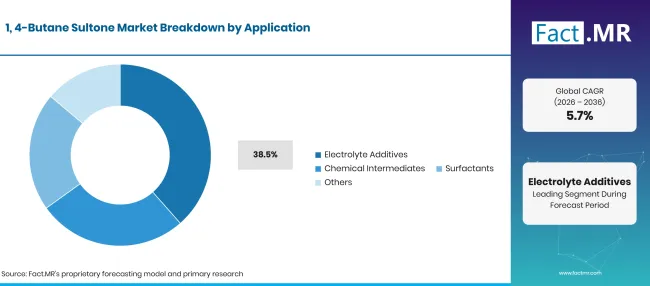
1 4 Butane Sultone Market Breakdown Application | Source: Fact.MR
| Application | Share (2026) |
|---|---|
| Electrolyte Additives (Leading segment) | 38.5% |
| Other applications combined | 61.5% |
| Total | 100.0% |
Source: Fact.MR analysis. Updated Oct 30, 2026
Battery electrolyte formulation is an application in which small chemical additions can alter electrode interface behavior. Each candidate must be tested against the complete formulation. For 1,4-butanesultone, laboratory catalog listings provide evidence of material availability, not proof of a universal performance benefit. Researchers are likely to compare its chemical behavior with other additives under controlled cycling and storage conditions. Chemical Intermediates remains a separate application in synthesis work.
How does End-Use Industry shape demand?
Automotive represents 43.8% of 2026 value.
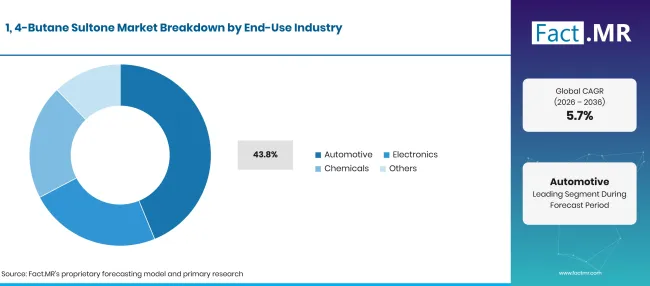
1 4 Butane Sultone Market Breakdown End Use Industry | Source: Fact.MR
| End-Use Industry | Share (2026) |
|---|---|
| Automotive (Leading segment) | 43.8% |
| Other industries combined | 56.2% |
| Total | 100.0% |
Source: Fact.MR analysis. Updated Oct 30, 2026
Automotive demand is linked to the research and qualification work carried out around rechargeable battery systems. A formulation researcher purchasing small trial quantities has different needs from a production operator ordering a routine ingredient. The latter expects reproducible purity and stable transport conditions. Electronics applications share some electrolyte research questions but can differ in cell design and operating requirements. The International Energy Agency stated that electric cars accounted for one in four new cars sold worldwide in 2025 [2].
What is accelerating 1,4-Butane Sultone Market adoption, and what is holding it back?
Adoption will grow through electrolyte additive screening, documented high-purity grades and repeat supply after successful qualification. Hazard-management requirements, application-specific approval and moisture-sensitive storage conditions will limit how quickly laboratory trials convert into routine industrial orders.
Drivers Impact Analysis
| DRIVER | (~) % IMPACT ON CAGR | GEOGRAPHIC RELEVANCE | IMPACT TIMELINE |
|---|---|---|---|
| Electrolyte additive screening | +5.7% | Germany, USA, Japan | Medium term |
| Purity-led research purchasing | +5.7% | Global | Short term |
| Specialty synthesis work | +5.7% | Global | Medium term |
| Battery development activity | +5.7% | Europe, Americas | Long term |
Source: Fact.MR analysis. Updated Oct 30, 2026
Opportunity Impact Analysis
| OPPORTUNITY | (~) % IMPACT ON CAGR | GEOGRAPHIC RELEVANCE | IMPACT TIMELINE |
|---|---|---|---|
| Documented high-purity grades | +5.7% | Global | Short term |
| Repeat supply after qualification | +5.7% | Germany, Japan, USA | Long term |
| Smaller packs for early research | +5.7% | Global | Medium term |
Source: Fact.MR analysis. Updated Oct 30, 2026
Restraints Impact Analysis
| RESTRAINT | (~) % IMPACT ON CAGR | GEOGRAPHIC RELEVANCE | IMPACT TIMELINE |
|---|---|---|---|
| Hazard management and worker controls | Restraining 5.7% | Global | Short term |
| Application-specific approval | Restraining 5.7% | Global | Long term |
| Storage and moisture sensitivity | Restraining 5.7% | Global | Medium term |
Source: Fact.MR analysis. Updated Oct 30, 2026
Which countries are scaling the 1,4-Butane Sultone Market through 2036?
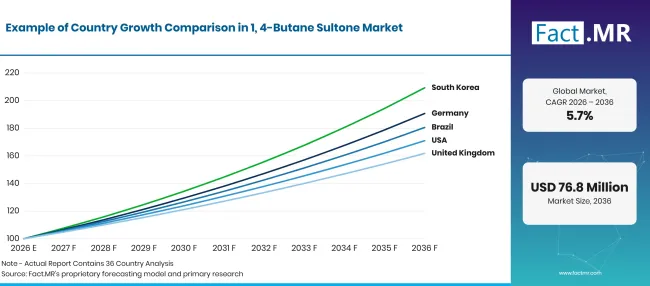
1 4 Butane Sultone Market Growth Index | Source: Fact.MR
| Country | CAGR (2026 to 2036) |
|---|---|
| Germany | 6.7% |
| Brazil | 6.1% |
| USA | 5.5% |
| UK | 4.9% |
| Japan | 4.4% |
Source: Fact.MR analysis. Updated Oct 30, 2026
What supports adoption in Germany?
6.7% CAGR, with battery research and specialty chemistry influencing qualification.
Germany’s specialist chemical laboratories assess 1,4-butanesultone against defined purity and handling requirements before using it in electrolyte trials. The Federal Ministry for Economic Affairs and Energy reported in January 2026 that battery-electric cars represented 19.1% of Germany’s new car registrations in 2025 [5]. That vehicle mix forms part of the wider setting for battery research, while the individual compound still requires separate testing. Chemical intermediates provide another possible route for qualified reagent sales.
What supports adoption in Brazil?
6.1% CAGR, reflecting automotive electrification and chemical laboratory needs.
Brazil’s 1,4-butanesultone outlook is tied to chemical research and the evaluation of electrolyte ingredients for rechargeable batteries. The Brazilian Electric Vehicle Association reported in January 2026 that 223,912 electrified light vehicles were sold in Brazil during 2025 [6]. Import channels and specialist laboratory distributors can connect researchers with smaller packs and technical documents.
What supports adoption in the USA?
5.5% CAGR, linked to battery evaluation and established reagent distribution.
1 4 Butane Sultone Market Forecast Usa | Source: Fact.MR
In the USA, laboratory evaluation and chemical synthesis create different purchasing routes for 1,4-butanesultone. The U.S. Energy Information Administration reported in August 2026 that operational utility-scale battery storage reached 43.6 GW at the end of 2025 [7]. Workplace hazard controls influence laboratory planning.
What supports adoption in the UK?
4.9% CAGR, supported by battery evaluation and chemical supply channels.
United Kingdom demand centers on specialist laboratories working with chemical intermediates and potential electrolyte additives. The Society of Motor Manufacturers and Traders reported in January 2026 that 473,348 battery-electric cars were registered in the UK during 2025 [8]. Researchers can obtain reagent grades through established chemical distributors and review safety information before conducting controlled trials.
What supports adoption in Japan?
4.4% CAGR, centered on precise chemical specifications and battery research.
Japan’s market outlook reflects the role of laboratory-grade chemicals in materials research and established chemical synthesis work. The Institute for Sustainable Energy Policies’ EV statistics platform recorded 55,430 new battery-electric vehicle registrations in Japan during 2025 [9]. Vehicle registrations indicate the wider automotive environment, while demand for 1,4-butanesultone depends on its performance in individual applications.
Who leads the 1,4-Butane Sultone Market?
Supplier competition is visible most clearly in the availability of chemical reagents and their documentation.
Tokyo Chemical Industry lists 1,4-butanesultone under product code B0136, with a purity specification above 99.0% by GC. These product listings support direct participation in reagent supply [1].
Companies working in this area compete on the form in which the material is delivered and the evidence available with each batch. A customer buying for initial research values package flexibility. One assessing industrial supply focuses more heavily on material consistency and handling procedures. Public catalog evidence is more specific than a general corporate statement about specialty chemicals, so the company list concentrates on suppliers for which a product connection is documented.
Which companies are the key providers?
Key companies include Tokyo Chemical Industry Co., Ltd., Merck KGaA (Sigma-Aldrich), Thermo Fisher Scientific Inc., Santa Cruz Biotechnology, Inc., FUJIFILM Wako Pure Chemical Corporation, Spectrum Chemical Mfg. Corp., Alfa Chemistry, and LGC Standards (Toronto Research Chemicals).
- Tokyo Chemical Industry Co., Ltd.
- Merck KGaA (Sigma-Aldrich)
- Thermo Fisher Scientific Inc.
- Santa Cruz Biotechnology, Inc.
- FUJIFILM Wako Pure Chemical Corporation
- Spectrum Chemical Mfg. Corp.
- Alfa Chemistry
- LGC Standards (Toronto Research Chemicals)
What is the report’s scope and coverage?
1 4 Butane Sultone Market Taxonomy 1 | Source: Fact.MR
| Attribute | Details |
|---|---|
| Quantitative Units | USD million in 2026 to USD million by 2036, at CAGR |
| Market Definition | Sales of 1,4-butanesultone (CAS 1633-83-6) for specified chemical applications |
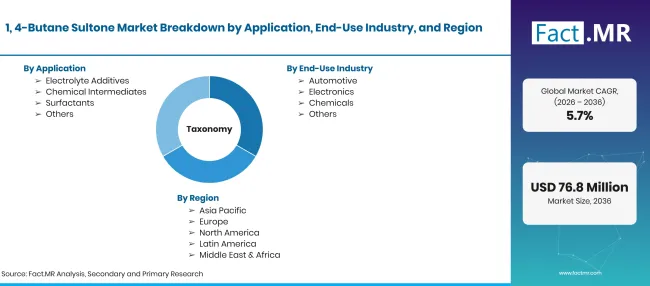
| Application | Electrolyte Additives; Chemical Intermediates; Surfactants; Others |
| End-Use Industry | Automotive; Electronics; Chemicals; Others |
| Regions Covered | North America; Latin America; Western Europe; Eastern Europe; East Asia; South Asia & Pacific; Middle East & Africa |
| Countries Covered | Germany; Brazil; USA; UK; Japan |
| Companies Profiled | Tokyo Chemical Industry Co., Ltd., Merck KGaA (Sigma-Aldrich), Thermo Fisher Scientific Inc., Santa Cruz Biotechnology, Inc., FUJIFILM Wako Pure Chemical Corporation, Spectrum Chemical Mfg. Corp., Alfa Chemistry, and LGC Standards (Toronto Research Chemicals) |
| Forecast Period | 2026 to 2036 |
| Approach | Market segmentation by application and end use; supplier and product documentation review |
Source: Fact.MR analysis. Updated Oct 30, 2026
How is the market segmented?
-
By Application
- Electrolyte Additives
- Chemical Intermediates
- Surfactants
- Others
-
By End-Use Industry
- Automotive
- Electronics
- Chemicals
- Others
-
By Region
- North America
- Latin America
- Western Europe
- Eastern Europe
- East Asia
- South Asia & Pacific
- Middle East & Africa
Bibliography
- [1] Tokyo Chemical Industry. (n.d.). 1,4-Butanesultone (Product No. B0136).
- [2] International Energy Agency. (2026, May 20). Global EV Outlook 2026: Trends in electric cars.
- [3] Merck. (n.d.). 1,4-Butanesultone for synthesis (Product No. 820665).
- [4] Thermo Fisher Scientific. (2025, September 7). 1,4-Butanesultone: Safety data sheet (Version 5).
- [5] Federal Ministry for Economic Affairs and Energy. (2026, January 27). Great prospects for electric mobility.
- [6] Associação Brasileira do Veículo Elétrico. (2026, January 6). Eletrificados crescem dez vezes mais do que o conjunto do mercado, e vendas chegam a 224 mil veículos em 2025. [7] U.S. Energy Information Administration. (2026, August 7). Battery storage capacity averaged 70% growth over the last three years.
- [8] Society of Motor Manufacturers and Traders. (2026, January 6). UK new car market breaches two million as almost one in four buyers go electric.
- [9] Institute for Sustainable Energy Policies. (n.d.). Statistics dashboard. ISEP EV Information Platform.
This Report Answers
- How electrolyte additive testing shapes the leading application share.
- How automotive research differs from chemical synthesis purchases.
- Why purity and safety files influence the approval of reagent suppliers.
- How country growth assumptions differ across Germany, Brazil, USA, UK and Japan.
- Which suppliers have directly identifiable 1,4-butanesultone catalog products.
What does the 1,4-Butane Sultone Market cover?
The market covers sales of 1,4-butanesultone for its defined chemical applications. Its research and industrial customers may purchase different grades and package sizes. The scope separates the compound from the wider class of battery electrolyte additives because materials in that class are not interchangeable. Adjacent coverage includes the lithium and lithium-ion battery electrolyte market and the battery electrolyte additives market.
What is included in the scope?
Reagent and suitable industrial grades of 1,4-butanesultone are included when sold for electrolyte additive evaluation, synthesis, surfactant-related chemical processes or other qualified chemical applications. Automotive and electronics refer to the intended downstream end use, while chemical industry customers may use the substance as a process intermediate.
What is excluded from the scope?
Other cyclic sultones, finished battery cells and general electrolyte blends are excluded unless the relevant revenue is specifically attributable to 1,4-butanesultone. Revenue from unrelated chemical products sold by the listed companies is outside the boundary. End-market electric vehicle sales are not counted as this chemical’s revenue.
How Was the Analysis Built?
The analysis draws on 120+ sources, 35+ company portfolios, 25+ countries, and more than 20 industry interviews.
- Primary Research: Primary research includes discussions with manufacturers, service providers, technology developers, distributors, end users, and subject-matter experts. These conversations examine purchasing priorities, product adoption, operational challenges, approval requirements, competitive positioning, and the factors that influence wider market acceptance.
- Desk Research: Desk research covers government statistics, regulatory publications, company filings, trade data, technical studies, industry associations, standards, public policy, and other authoritative sources. Every source used in the analysis is documented in the bibliography.
- Market Sizing and Forecasting: Market estimates combine historical performance, demand indicators, pricing and volume trends, segment shares, company participation, country-level growth, adoption patterns, investment activity, and barriers to market expansion.
- Data Validation and Update Cycle: Findings are validated by comparing primary interviews with public data, company activity, regulatory changes, trade patterns, and industry developments. Regular updates review new product launches, capacity changes, partnerships, approvals, and shifts in commercial adoption.
Frequently Asked Questions
How big is the 1,4-Butane Sultone Market in 2026?
What is the CAGR of the 1,4-Butane Sultone Market from 2026 to 2036?
Which application leads the 1,4-Butane Sultone Market?
Which end-use industry leads the 1,4-Butane Sultone Market?
Who are the leading companies in the 1,4-Butane Sultone Market?
Who worked on this report


Preview the report firsthand - request a free sample
Free SampleGet the brochure for pricing and purchase details
Download PDF