100 Percent Juice Market Size, Share, Growth and Forecast (2026 - 2036)

The 100 Percent Juice Market is segmented by Fruit Type, by Processing Type, by Packaging, by Distribution Channel, and by End User, and Region. Forecast for 2026 to 2036.

Fact.MR notes that 100 percent juice demand is moving toward clean-label beverage choices with clear fruit identity. Households want juice products that avoid added sugars. Retailers need shelf-stable and refrigerated formats that can serve breakfast use and daily beverage occasions.

100 Percent Juice Market Size, Market Forecast and Outlook by Fact.MR

  • The 100 percent juice market surpassed a value of USD 72.6 billion in 2025.
  • Demand is expected to rise from USD 75.8 billion in 2026 to USD 112.9 billion by 2036.
  • The market is forecast to record 4.1% CAGR during 2026 to 2036 as households shift toward fruit-based beverages with clearer ingredient statements.
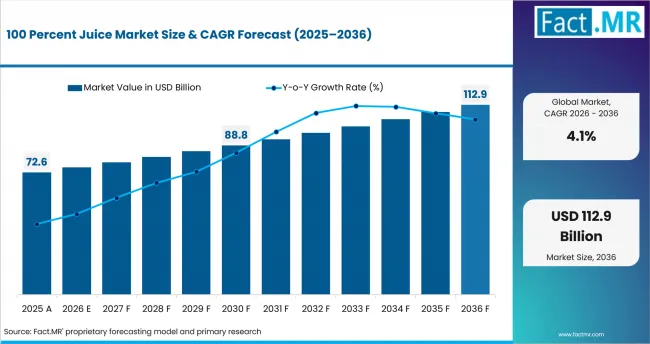
100 Percent Juice Market Value Analysis

Metric Value
Industry Size 2026 USD 75.8 billion
Industry Value 2036 USD 112.9 billion
CAGR 2026 to 2036 4.1%

Summary of the 100 Percent Juice Market

  • Demand Drivers in the Market
    • Label Clarity: Households choose 100 percent juice because it offers fruit-based positioning without added sugar claims.
    • Breakfast Use: Retailers benefit from juice formats tied to morning consumption and family beverage routines.
    • Packaging Access: Cartons and PET bottles help brands serve household stock-up and single-serve needs.
  • Key Segments Analyzed
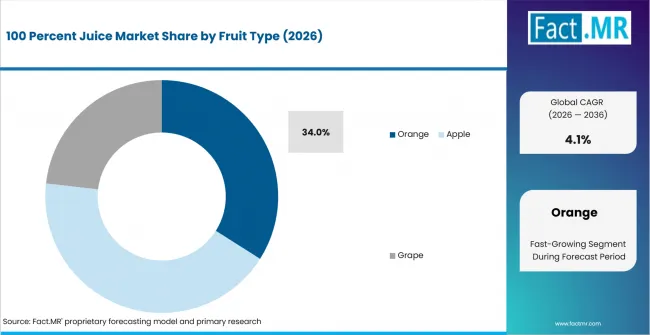
    • By Fruit Type: Orange juice is expected to hold 34.0% share in 2026 because breakfast use and vitamin C positioning support repeat consumption.
    • By Processing Type: Not from concentrate juice is likely to account for 48.0% share in 2026 as shoppers associate it with fresher taste.
    • By Packaging: Cartons are projected to hold 39.0% share in 2026 because family-size packs support shelf efficiency and home use.
    • By Distribution Channel: Supermarkets and hypermarkets are anticipated to capture 42.0% share in 2026 since shoppers compare juice brands during grocery trips.
    • By End User: Households are expected to hold 61.0% share in 2026 because 100 percent juice is mainly used for breakfast and daily refreshment.
    • By Geography: India is projected to record 6.5% CAGR through 2036 as urban retail access and packaged beverage demand expand.
  • Analyst Opinion at Fact.MR
    • Shambhunath Jha, Principal Consultant at Fact.MR, states, “100 percent juice is moving into a sharper label discipline cycle. We see retailers separating juice from sugar-added drinks more clearly. Suppliers that protect fruit taste and sourcing reliability will gain better shelf access.”
  • Strategic Implications
    • Fruit Supply: Juice processors need secure sourcing to manage flavor and price volatility.
    • Label Discipline: Brand teams must keep 100 percent juice claims clear and easy to verify.
    • Pack Mix: Retailers should balance family cartons with single-serve bottles to serve different use occasions.

100 percent juice demand is becoming more label focused. Retailers need products that can stand apart from juice drinks and sugar-added beverages. Brand owners need fruit sourcing and packaging formats that protect taste. This makes the market more dependent on fruit supply reliability and cold-chain discipline.

Consumption patterns are changing across breakfast and on-the-go beverage occasions. Carton formats support family use because they offer value and shelf efficiency. PET bottles support single-serve consumption. Cold-pressed juice holds a smaller but higher-value role because wellness-led shoppers look for fresh taste and less processed positioning.

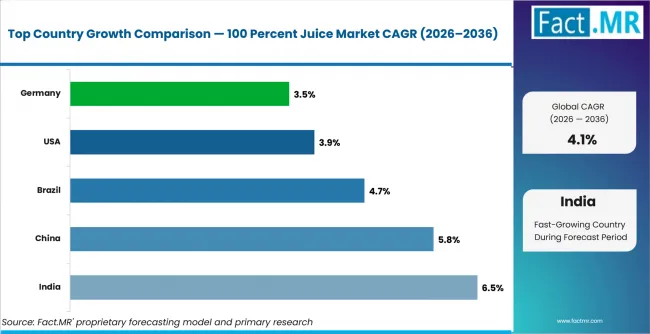
India is projected to record 6.5% CAGR by 2036 as urban retail access and packaged beverage demand expand. China is likely to post 5.8% CAGR as premium fruit beverage choices gain more shelf space. Brazil is expected to register 4.7% CAGR because local fruit production supports juice processing. The United States is forecast to advance at 3.9% CAGR as no-added-sugar positioning supports household demand. Germany is set to record 3.5% CAGR as quality-focused retail and breakfast consumption sustain sales.

Segmental Analysis

100 Percent Juice Market Analysis by Fruit Type
100 Percent Juice Market Analysis By Fruit Type

Orange juice is expected to hold 34.0% share in 2026 because breakfast use and vitamin C positioning support repeat consumption. Apple juice follows because it suits family packs and school beverage use. Grape juice serves flavor-led consumption and selected premium products. Pineapple juice supports tropical blends and foodservice use. Mixed fruit juice helps brands balance taste and fruit supply. USDA FAS stated that global orange juice production for 2025/26 is forecast at 1.4 million tons. [1] Juice processors that manage citrus supply well can protect taste and shelf continuity.

  • Orange Base: Orange juice benefits from strong breakfast use and familiar nutritional positioning.
  • Apple Reach: Apple juice supports family packs because taste acceptance is wide.
  • Blend Flexibility: Mixed fruit juice helps processors balance flavor and sourcing risk.

100 Percent Juice Market Analysis by Processing Type
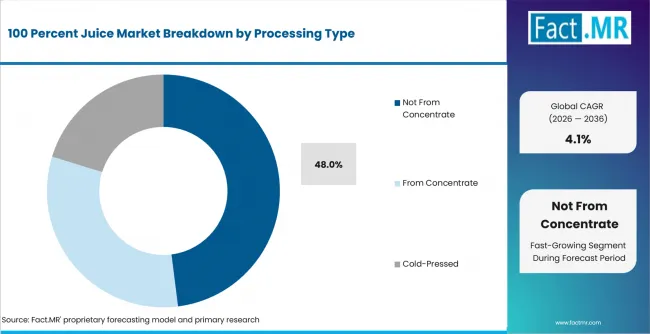
100 Percent Juice Market Analysis By Processing Type

Not from concentrate juice is likely to account for 48.0% share in 2026 as shoppers associate it with fresher taste. From concentrate juice remains important because it supports lower-cost production and easier storage. Cold-pressed juice serves premium chilled shelves and wellness-led shoppers. Pasteurized products hold a large base because they support food safety and wider distribution. Processing choice depends on taste expectation and shelf-life needs. Brands that price not from concentrate too high may lose households to value-oriented juice formats.

  • Fresh Taste: Not from concentrate juice supports premium shelf positioning.
  • Cost Control: From concentrate juice helps processors manage storage and seasonal fruit supply.
  • Chilled Premium: Cold-pressed juice serves shoppers seeking fresher flavor cues.

100 Percent Juice Market Analysis by Packaging
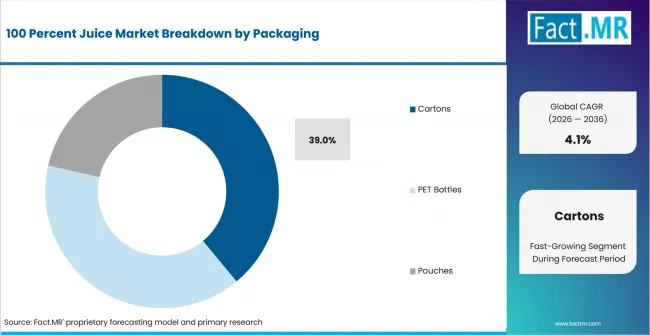
100 Percent Juice Market Analysis By Packaging

Cartons are projected to hold 39.0% share in 2026 because family-size packs support shelf efficiency and home use. PET bottles serve chilled and on-the-go consumption. Glass bottles hold premium value because they signal quality and suit specialty juices. Pouches serve smaller packs and children’s lunchbox use. Packaging selection depends on retail placement and consumption occasion.

  • Family Stock-Up: Cartons support home use because they offer shelf efficiency and pack value.
  • Single Serve: PET bottles support chilled and on-the-go consumption.
  • Premium Cue: Glass bottles help specialty juices signal quality on retail shelves.

100 Percent Juice Market Analysis by Distribution Channel
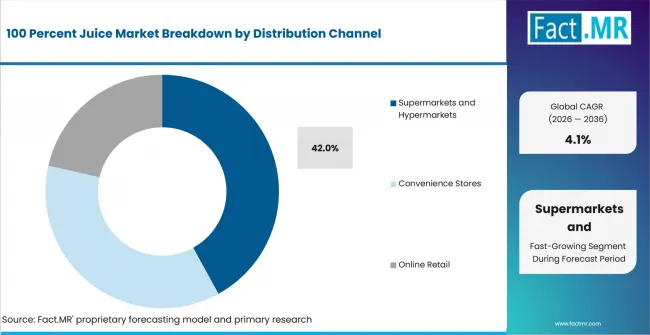
100 Percent Juice Market Analysis By Distribution Channel

Supermarkets and hypermarkets are anticipated to capture 42.0% share in 2026 since shoppers compare juice brands during grocery trips. Convenience stores support single-serve bottles and impulse beverage sales. Online retail is gaining relevance for family packs and subscription-style grocery orders. Foodservice uses 100 percent juice in breakfast menus and travel catering. The strongest channel advantage comes from visibility near breakfast foods and chilled beverage sections.

  • Grocery Base: Supermarkets and hypermarkets help shoppers compare pack size and fruit type.
  • Chilled Access: Convenience stores support single-serve juice for immediate consumption.
  • Digital Refill: Online retail supports repeat family-pack orders.

100 Percent Juice Market Analysis by End User
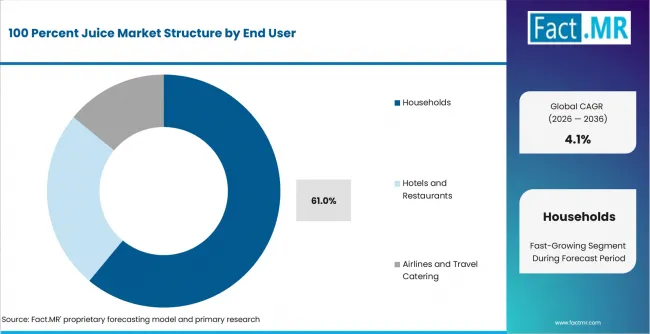
100 Percent Juice Market Analysis By End User

Households are expected to hold 61.0% share in 2026 because 100 percent juice is mainly used for breakfast and daily refreshment. Hotels and restaurants use juice in breakfast service and beverage menus. Schools and institutions buy smaller packs when product rules support juice service. Airlines and travel catering use portion packs for passenger meals. Household demand leads because families use juice across morning routines and children’s meals. Brand owners that improve pack affordability can defend repeat use during price-sensitive grocery trips.

  • Home Routine: Households use 100 percent juice for breakfast and family refreshment.
  • Menu Use: Hotels and restaurants use juice in breakfast service and buffet menus.
  • Portion Control: Schools and travel catering need smaller packs for managed serving sizes.

100 Percent Juice Market Drivers, Restraints, and Opportunities

100 Percent Juice Market Opportunity Matrix Growth Vs Value

Clean-label demand and added sugar awareness support 100 percent juice positioning. FDA explains that added sugars are listed on the Nutrition Facts label so shoppers can make informed choices. [2] This supports demand for beverage labels that distinguish 100 percent juice from sugar-added drinks. Retailers can use this distinction to guide shelf placement and shopper education.

Fruit cost and crop variability can restrain growth. Orange and apple supply can shift with weather and disease pressure. Premium juice formats need cold-chain control and higher packaging quality. Price-sensitive households may switch to lower-cost beverages if juice prices rise too quickly.

Opportunities in the 100 Percent Juice Market

  • Not From Concentrate: Brands can target shoppers who associate this format with fresher taste.
  • Portion Packs: Suppliers can serve schools and travel channels with smaller controlled servings.
  • Premium Blends: Processors can use mixed fruit formulations to manage flavor and sourcing risk.

Regional Analysis

Based on regional analysis, the 100 percent juice market is segmented into North America, Latin America, Europe, East Asia, South Asia and Pacific, and Middle East and Africa.

Top Country Growth Comparison 100 Percent Juice Market Cagr (2026 2036)

Country CAGR (2026 to 2036)
India 6.5%
China 5.8%
Brazil 4.7%
United States 3.9%
Germany 3.5%

100 Percent Juice Market Cagr Analysis By Country

South Asia and East Asia 100 Percent Juice Market Analysis

South Asia and East Asia demand comes from urban grocery expansion and packaged beverage adoption. India leads the outlook because modern retail and online grocery platforms improve access. China has premium demand through urban households and fruit-based beverage positioning. The region favors brands that can combine fruit taste with clear label claims.

  • India: India is projected to record a 6.5% CAGR through 2036 as urban retail access and packaged beverage demand expand. Supermarkets and online grocery platforms are improving juice availability in large cities. Local fruit processing gives brands room to develop mango and apple formats. Price sensitivity still affects family pack decisions. Smaller cartons and value packs can help brands reach middle-income households. Suppliers with regional distribution and cold-chain discipline will gain better reach.
  • China: China has steady demand as premium fruit beverage choices gain more shelf space. The China 100 percent juice market is likely to post 5.8% CAGR from 2026 to 2036. Urban households are showing interest in better-for-you beverages with clear ingredient statements. Imported juice and domestic blends compete for chilled shelf space. E-commerce can support multipack purchases and premium discovery. Local fruit sourcing helps reduce price pressure. Brand owners that balance premium positioning with everyday pack sizes will be better placed.

Latin America 100 Percent Juice Market Analysis

Latin America demand benefits from fruit availability and juice processing depth. Brazil leads because citrus and tropical fruit supply supports juice manufacturing. Domestic processors can serve both local packaged juice demand and export-linked operations. Retail competition still requires careful pack sizing because household incomes vary across cities and regions.

  • Brazil: Brazil is expected to register 4.7% CAGR through 2036 because local fruit production supports juice processing. Fundecitrus estimated the 2025-2026 orange crop for the São Paulo and West-Southwest Minas Gerais citrus belt at 294.81 million 40.8-kg boxes [3]. Citrus supply gives processors a solid base for orange juice. Tropical fruits support blended juice offerings across retail and foodservice. Supermarkets remain important for family packs. Export processing capability helps strengthen supplier know-how. Price-sensitive households may choose value cartons over chilled premium bottles. Processors with stable fruit sourcing and retail supply will gain better shelf continuity.

North America 100 Percent Juice Market Analysis

100 Percent Juice Market Country Value Analysis

North America demand is led by the United States because retail shelves carry a wide range of chilled and shelf-stable juice formats. The market is more replacement-led than volume-led because shoppers already understand 100 percent juice.

  • United States: The United States is forecast to register 3.9% CAGR from 2026 to 2036 as no-added-sugar positioning supports household demand. Breakfast use and children’s beverage occasions keep 100 percent juice in grocery baskets. Chilled juice faces competition from flavored water and functional drinks. Retailers are refining shelf space toward brands that show clear label value. Single-serve packs support convenience outlets. Suppliers that protect orange flavor and manage crop-linked cost swings will hold stronger retail positions.

Europe 100 Percent Juice Market Analysis

100 Percent Juice Market Europe Country Market Share Analysis, 2026 & 2036

Europe has steady demand through breakfast routines and quality-focused retail. Germany leads the regional view because households continue to use juice in morning meals and foodservice channels. Retailers place strong attention on product origin and pack quality. Price competition remains important because private-label juice has a strong shelf role.

  • Germany: Germany is set to record 3.5% CAGR through 2036 as quality-focused retail and breakfast consumption sustain sales. Supermarkets and discounters give households wide access to orange and apple juice. Private-label competition keeps price pressure high. Glass bottles and cartons both serve established shopping habits. Foodservice demand adds support through hotels and breakfast menus. Suppliers with stable taste profiles and clear fruit origin communication can defend premium shelf space.

Competitive Aligners for Market Suppliers

100 Percent Juice Market Analysis By Company

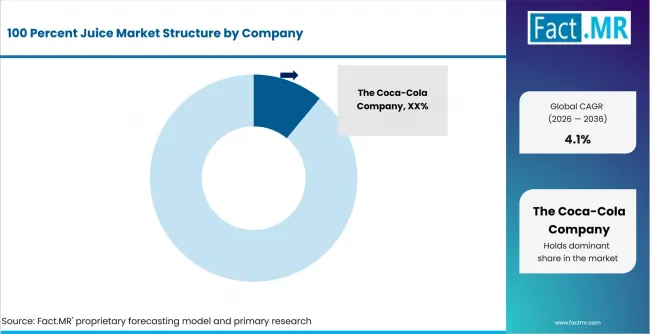
Beverage majors and fruit processors serve the 100 percent juice market. The Coca-Cola Company competes through Minute Maid and Simply. Keurig Dr Pepper Inc. states that its portfolio includes Mott’s and Snapple across its wider beverage business. [4] Tropicana Brands Group supports retail competition through established juice brands and store access. Ocean Spray Cranberries Inc. and Welch Foods Inc. compete through fruit-based portfolios and trusted retail presence.

Private label suppliers compete through carton packs and everyday pricing. Branded suppliers need steady taste quality and clear fruit content claims. Retailers compare suppliers on delivery reliability. Packaging range can influence shelf placement. Cold-chain strength is more important in chilled juice. Shelf stable juice depends on carton quality and better rotation planning.

Fruit sourcing and pack economics will guide competition. Processors with secure fruit supply can manage cost swings better through 2036. Brands with clear 100 percent juice labeling can protect consumer trust. Suppliers that offer family packs and small packs can serve more drinking occasions.

Key Companies in 100 Percent Juice Market

  • The Coca-Cola Company
  • Tropicana Brands Group
  • Keurig Dr Pepper Inc.
  • Ocean Spray Cranberries, Inc.
  • Welch Foods Inc.

Bibliography

  • [1] U.S. Department of Agriculture, Foreign Agricultural Service. (2026, January). Citrus: World markets and trade. U.S. Department of Agriculture.
  • [2] U.S. Food and Drug Administration. (2026, March 4). Added sugars on the Nutrition Facts label. U.S. Food and Drug Administration.
  • [3] Fundecitrus. (2025, December 10). 2025-2026 orange crop forecast update for the São Paulo and West-Southwest Minas Gerais citrus belt. Fundecitrus.
  • [4] Keurig Dr Pepper Inc. (2026, February 24). Keurig Dr Pepper reports Q4 and full year 2025 results and provides 2026 outlook. Keurig Dr Pepper Inc.

This Report Addresses

  • Strategic intelligence on 100 percent juice demand across fruit type, processing type, packaging, distribution channel, and end user.
  • Forecast mapping from USD 75.8 billion in 2026 to USD 112.9 billion by 2036.
  • Segment analysis covering orange juice, not from concentrate juice, cartons, supermarkets and hypermarkets, and households.
  • Regional outlook covering India, China, Brazil, the United States, and Germany.
  • Competitive analysis of The Coca-Cola Company, Tropicana Brands Group, Keurig Dr Pepper Inc., Ocean Spray Cranberries, Inc., Welch Foods Inc.
  • Product assessment covering orange juice, apple juice, mixed fruit juice, cold-pressed juice, and pasteurized juice.
  • Channel assessment covering supermarkets and hypermarkets, convenience stores, online retail, and foodservice.
  • Primary interviews, supplier checks, official source review, and packaged beverage channel validation support the forecast.

100 Percent Juice Market Definition

The 100 percent juice market covers packaged beverages made entirely from fruit juice without added sugars or non-juice fillers. Products can be from concentrate or not from concentrate. The market differs from juice drinks because qualifying products must contain only juice as the core liquid base.

100 Percent Juice Market Inclusions

The scope includes apple juice and mixed fruit juice sold as 100 percent juice. It includes not from concentrate and from concentrate products. Pasteurized and shelf-stable products are included when the product meets 100 percent juice labeling.

100 Percent Juice Market Exclusions

The scope excludes nectar and smoothies with dairy or added sweeteners. Juice powders and syrups are excluded unless sold as 100 percent juice reconstitution products. Freshly squeezed juice sold without packaging is excluded from packaged market sizing.

100 Percent Juice Market Research Methodology

  • Primary Research
    • Primary research includes interviews with beverage category managers and juice brand sales heads. It includes input from fruit processors and retail beverage merchandisers.
  • Desk Research
    • Desk research reviews beverage company filings and food labeling rules. It covers fruit crop supply reports and packaged beverage retail signals.
  • Market-Sizing and Forecasting
    • Forecasting uses fruit type demand and processing mix. Packaging formats and channel movement help assess future sales direction.
  • Data Validation and Update Cycle
    • Forecasts are validated through supplier checks and retail feedback. Fruit crop availability and juice import signals help confirm demand direction.

Scope of the Report

100 Percent Juice Market Breakdown By Fruit Type, Processing Type, And Region

Attribute Details
Quantitative Units USD 75.8 billion in 2026 to USD 112.9 billion by 2036 at 4.1% CAGR
Market Definition Packaged beverages made entirely from fruit juice without added sugars or non-juice fillers
Fruit Type Orange, Apple, Grape, Pineapple, Mixed Fruit
Processing Type Not From Concentrate, From Concentrate, Cold-Pressed, Pasteurized
Packaging Cartons, PET Bottles, Glass Bottles, Pouches
Distribution Channel Supermarkets and Hypermarkets, Convenience Stores, Online Retail, Foodservice
End User Households, Hotels and Restaurants, Schools and Institutions, Airlines and Travel Catering
Regions Covered North America, Latin America, Europe, East Asia, South Asia and Pacific, Middle East and Africa
Countries Covered India, China, Brazil, United States, Germany
Key Companies Profiled The Coca-Cola Company, Tropicana Brands Group, Keurig Dr Pepper Inc., Ocean Spray Cranberries, Inc., Welch Foods Inc.
Forecast Period 2026 to 2036
Approach Hybrid top-down and bottom-up approach using fruit type demand, processing mix, packaging movement, channel demand, end-user uptake, and regional validation

100 Percent Juice Market Analysis by Segments

  • By Fruit Type:

    • Orange
    • Apple
    • Grape
    • Pineapple
    • Mixed Fruit
  • By Processing Type:

    • Not From Concentrate
    • From Concentrate
    • Cold-Pressed
    • Pasteurized
  • By Packaging:

    • Cartons
    • PET Bottles
    • Glass Bottles
    • Pouches
  • By Distribution Channel:

    • Supermarkets and Hypermarkets
    • Convenience Stores
    • Online Retail
    • Foodservice
  • By End User:

    • Households
    • Hotels and Restaurants
    • Schools and Institutions
    • Airlines and Travel Catering
  • Region:

    • North America
      • United States
      • Canada
    • Europe
      • Germany
      • United Kingdom
      • France
      • Italy
      • Spain
    • Asia Pacific
      • China
      • Japan
      • South Korea
      • Taiwan
      • Singapore
    • Latin America
      • Brazil
      • Mexico
      • Argentina
    • Middle East & Africa
      • GCC Countries
      • South Africa
      • Israel

- Frequently Asked Questions -

What is the 100 Percent Juice Market size in 2026?

The 100 percent juice market is estimated to reach USD 75.8 billion in 2026.

What will the 100 Percent Juice Market be worth by 2036?

The 100 percent juice market is projected to reach USD 112.9 billion by 2036 as packaged fruit-based beverage consumption grows.

What CAGR is projected for the 100 Percent Juice Market?

The 100 percent juice market is forecast to record 4.1% CAGR from 2026 to 2036.

Which fruit type leads the 100 Percent Juice Market?

Orange juice leads with 34.0% share in 2026 because breakfast use and vitamin C positioning support repeat consumption.

Which country expands faster in the 100 Percent Juice Market?

India is projected to record 6.5% CAGR through 2036 as urban retail access and packaged beverage demand expand.

How does China perform in the 100 Percent Juice Market?

China is likely to post 5.8% CAGR through 2036 as premium fruit beverage choices gain more shelf space.

How does the United States perform in the 100 Percent Juice Market?

The United States is forecast to register 3.9% CAGR as no-added-sugar positioning supports household demand.

What is the primary driver in the 100 Percent Juice Market?

The primary driver is clean-label beverage demand. Households want fruit-based drinks without added sugars.

What is the main restraint in the 100 Percent Juice Market?

The main restraint is fruit cost volatility. Crop shifts can affect juice pricing and flavor consistency.

Why is orange juice important in the 100 Percent Juice Market?

Orange juice is important because it has strong breakfast use and familiar vitamin C positioning.

Why are cartons important in the 100 Percent Juice Market?

Cartons are important because they support family packs and shelf-stable juice distribution.

Table of Content

  1. Executive Summary
    • Global Market Outlook
    • Demand to side Trends
    • Supply to side Trends
    • Technology Roadmap Analysis
    • Analysis and Recommendations
  2. Market Overview
    • Market Coverage / Taxonomy
    • Market Definition / Scope / Limitations
  3. Research Methodology
    • Chapter Orientation
    • Analytical Lens and Working Hypotheses
      • Market Structure, Signals, and Trend Drivers
      • Benchmarking and Cross-market Comparability
      • Market Sizing, Forecasting, and Opportunity Mapping
    • Research Design and Evidence Framework
      • Desk Research Programme (Secondary Evidence)
        • Company Annual and Sustainability Reports
        • Peer-reviewed Journals and Academic Literature
        • Corporate Websites, Product Literature, and Technical Notes
        • Earnings Decks and Investor Briefings
        • Statutory Filings and Regulatory Disclosures
        • Technical White Papers and Standards Notes
        • Trade Journals, Industry Magazines, and Analyst Briefs
        • Conference Proceedings, Webinars, and Seminar Materials
        • Government Statistics Portals and Public Data Releases
        • Press Releases and Reputable Media Coverage
        • Specialist Newsletters and Curated Briefings
        • Sector Databases and Reference Repositories
        • Fact.MR Internal Proprietary Databases and Historical Market Datasets
        • Subscription Datasets and Paid Sources
        • Social Channels, Communities, and Digital Listening Inputs
        • Additional Desk Sources
      • Expert Input and Fieldwork (Primary Evidence)
        • Primary Modes
          • Qualitative Interviews and Expert Elicitation
          • Quantitative Surveys and Structured Data Capture
          • Blended Approach
        • Why Primary Evidence is Used
        • Field Techniques
          • Interviews
          • Surveys
          • Focus Groups
          • Observational and In-context Research
          • Social and Community Interactions
        • Stakeholder Universe Engaged
          • C-suite Leaders
          • Board Members
          • Presidents and Vice Presidents
          • R&D and Innovation Heads
          • Technical Specialists
          • Domain Subject-matter Experts
          • Scientists
          • Physicians and Other Healthcare Professionals
        • Governance, Ethics, and Data Stewardship
          • Research Ethics
          • Data Integrity and Handling
      • Tooling, Models, and Reference Databases
    • Data Engineering and Model Build
      • Data Acquisition and Ingestion
      • Cleaning, Normalisation, and Verification
      • Synthesis, Triangulation, and Analysis
    • Quality Assurance and Audit Trail
  4. Market Background
    • Market Dynamics
      • Drivers
      • Restraints
      • Opportunity
      • Trends
    • Scenario Forecast
      • Demand in Optimistic Scenario
      • Demand in Likely Scenario
      • Demand in Conservative Scenario
    • Opportunity Map Analysis
    • Product Life Cycle Analysis
    • Supply Chain Analysis
    • Investment Feasibility Matrix
    • Value Chain Analysis
    • PESTLE and Porter’s Analysis
    • Regulatory Landscape
    • Regional Parent Market Outlook
    • Production and Consumption Statistics
    • Import and Export Statistics
  5. Global Market Analysis 2021 to 2025 and Forecast, 2026 to 2036
    • Historical Market Size Value (USD Million) Analysis, 2021 to 2025
    • Current and Future Market Size Value (USD Million) Projections, 2026 to 2036
      • Y to o to Y Growth Trend Analysis
      • Absolute $ Opportunity Analysis
  6. Global Market Pricing Analysis 2021 to 2025 and Forecast 2026 to 2036
  7. Global Market Analysis 2021 to 2025 and Forecast 2026 to 2036, By Component
    • Introduction / Key Findings
    • Historical Market Size Value (USD Million) Analysis By Component , 2021 to 2025
    • Current and Future Market Size Value (USD Million) Analysis and Forecast By Component , 2026 to 2036
      • Software
      • Hardware
      • Services
    • Y to o to Y Growth Trend Analysis By Component , 2021 to 2025
    • Absolute $ Opportunity Analysis By Component , 2026 to 2036
  8. Global Market Analysis 2021 to 2025 and Forecast 2026 to 2036, By Deployment
    • Introduction / Key Findings
    • Historical Market Size Value (USD Million) Analysis By Deployment, 2021 to 2025
    • Current and Future Market Size Value (USD Million) Analysis and Forecast By Deployment, 2026 to 2036
      • Cloud
      • On-Premise
    • Y to o to Y Growth Trend Analysis By Deployment, 2021 to 2025
    • Absolute $ Opportunity Analysis By Deployment, 2026 to 2036
  9. Global Market Analysis 2021 to 2025 and Forecast 2026 to 2036, By Organization Size
    • Introduction / Key Findings
    • Historical Market Size Value (USD Million) Analysis By Organization Size, 2021 to 2025
    • Current and Future Market Size Value (USD Million) Analysis and Forecast By Organization Size, 2026 to 2036
      • Large Enterprises
      • Small and Medium-sized Enterprises (SMEs)
    • Y to o to Y Growth Trend Analysis By Organization Size, 2021 to 2025
    • Absolute $ Opportunity Analysis By Organization Size, 2026 to 2036
  10. Global Market Analysis 2021 to 2025 and Forecast 2026 to 2036, By End Use
    • Introduction / Key Findings
    • Historical Market Size Value (USD Million) Analysis By End Use, 2021 to 2025
    • Current and Future Market Size Value (USD Million) Analysis and Forecast By End Use, 2026 to 2036
      • Healthcare and Life Sciences
      • Architecture and Construction
      • Media and Entertainment
      • Security & Surveillance
      • Automotive and Transportation
      • Manufacturing
    • Y to o to Y Growth Trend Analysis By End Use, 2021 to 2025
    • Absolute $ Opportunity Analysis By End Use, 2026 to 2036
  11. Global Market Analysis 2021 to 2025 and Forecast 2026 to 2036, By Technology Type
    • Introduction / Key Findings
    • Historical Market Size Value (USD Million) Analysis By Technology Type, 2021 to 2025
    • Current and Future Market Size Value (USD Million) Analysis and Forecast By Technology Type, 2026 to 2036
      • 3D Medical Imaging
      • 3D Machine Vision
      • 3D Scanning
      • 3D Modeling and Rendering
      • 3D Visualization Systems
    • Y to o to Y Growth Trend Analysis By Technology Type, 2021 to 2025
    • Absolute $ Opportunity Analysis By Technology Type, 2026 to 2036
  12. Global Market Analysis 2021 to 2025 and Forecast 2026 to 2036, By Region
    • Introduction
    • Historical Market Size Value (USD Million) Analysis By Region, 2021 to 2025
    • Current Market Size Value (USD Million) Analysis and Forecast By Region, 2026 to 2036
      • North America
      • Latin America
      • Western Europe
      • Eastern Europe
      • East Asia
      • South Asia and Pacific
      • Middle East & Africa
    • Market Attractiveness Analysis By Region
  13. North America Market Analysis 2021 to 2025 and Forecast 2026 to 2036, By Country
    • Historical Market Size Value (USD Million) Trend Analysis By Market Taxonomy, 2021 to 2025
    • Market Size Value (USD Million) Forecast By Market Taxonomy, 2026 to 2036
      • By Country
        • USA
        • Canada
        • Mexico
      • By Component
      • By Deployment
      • By Organization Size
      • By End Use
      • By Technology Type
    • Market Attractiveness Analysis
      • By Country
      • By Component
      • By Deployment
      • By Organization Size
      • By End Use
      • By Technology Type
    • Key Takeaways
  14. Latin America Market Analysis 2021 to 2025 and Forecast 2026 to 2036, By Country
    • Historical Market Size Value (USD Million) Trend Analysis By Market Taxonomy, 2021 to 2025
    • Market Size Value (USD Million) Forecast By Market Taxonomy, 2026 to 2036
      • By Country
        • Brazil
        • Chile
        • Rest of Latin America
      • By Component
      • By Deployment
      • By Organization Size
      • By End Use
      • By Technology Type
    • Market Attractiveness Analysis
      • By Country
      • By Component
      • By Deployment
      • By Organization Size
      • By End Use
      • By Technology Type
    • Key Takeaways
  15. Western Europe Market Analysis 2021 to 2025 and Forecast 2026 to 2036, By Country
    • Historical Market Size Value (USD Million) Trend Analysis By Market Taxonomy, 2021 to 2025
    • Market Size Value (USD Million) Forecast By Market Taxonomy, 2026 to 2036
      • By Country
        • Germany
        • UK
        • Italy
        • Spain
        • France
        • Nordic
        • BENELUX
        • Rest of Western Europe
      • By Component
      • By Deployment
      • By Organization Size
      • By End Use
      • By Technology Type
    • Market Attractiveness Analysis
      • By Country
      • By Component
      • By Deployment
      • By Organization Size
      • By End Use
      • By Technology Type
    • Key Takeaways
  16. Eastern Europe Market Analysis 2021 to 2025 and Forecast 2026 to 2036, By Country
    • Historical Market Size Value (USD Million) Trend Analysis By Market Taxonomy, 2021 to 2025
    • Market Size Value (USD Million) Forecast By Market Taxonomy, 2026 to 2036
      • By Country
        • Russia
        • Poland
        • Hungary
        • Balkan & Baltic
        • Rest of Eastern Europe
      • By Component
      • By Deployment
      • By Organization Size
      • By End Use
      • By Technology Type
    • Market Attractiveness Analysis
      • By Country
      • By Component
      • By Deployment
      • By Organization Size
      • By End Use
      • By Technology Type
    • Key Takeaways
  17. East Asia Market Analysis 2021 to 2025 and Forecast 2026 to 2036, By Country
    • Historical Market Size Value (USD Million) Trend Analysis By Market Taxonomy, 2021 to 2025
    • Market Size Value (USD Million) Forecast By Market Taxonomy, 2026 to 2036
      • By Country
        • China
        • Japan
        • South Korea
      • By Component
      • By Deployment
      • By Organization Size
      • By End Use
      • By Technology Type
    • Market Attractiveness Analysis
      • By Country
      • By Component
      • By Deployment
      • By Organization Size
      • By End Use
      • By Technology Type
    • Key Takeaways
  18. South Asia and Pacific Market Analysis 2021 to 2025 and Forecast 2026 to 2036, By Country
    • Historical Market Size Value (USD Million) Trend Analysis By Market Taxonomy, 2021 to 2025
    • Market Size Value (USD Million) Forecast By Market Taxonomy, 2026 to 2036
      • By Country
        • India
        • ASEAN
        • Australia & New Zealand
        • Rest of South Asia and Pacific
      • By Component
      • By Deployment
      • By Organization Size
      • By End Use
      • By Technology Type
    • Market Attractiveness Analysis
      • By Country
      • By Component
      • By Deployment
      • By Organization Size
      • By End Use
      • By Technology Type
    • Key Takeaways
  19. Middle East & Africa Market Analysis 2021 to 2025 and Forecast 2026 to 2036, By Country
    • Historical Market Size Value (USD Million) Trend Analysis By Market Taxonomy, 2021 to 2025
    • Market Size Value (USD Million) Forecast By Market Taxonomy, 2026 to 2036
      • By Country
        • Kingdom of Saudi Arabia
        • Other GCC Countries
        • Turkiye
        • South Africa
        • Other African Union
        • Rest of Middle East & Africa
      • By Component
      • By Deployment
      • By Organization Size
      • By End Use
      • By Technology Type
    • Market Attractiveness Analysis
      • By Country
      • By Component
      • By Deployment
      • By Organization Size
      • By End Use
      • By Technology Type
    • Key Takeaways
  20. Key Countries Market Analysis
    • USA
      • Pricing Analysis
      • Market Share Analysis, 2025
        • By Component
        • By Deployment
        • By Organization Size
        • By End Use
        • By Technology Type
    • Canada
      • Pricing Analysis
      • Market Share Analysis, 2025
        • By Component
        • By Deployment
        • By Organization Size
        • By End Use
        • By Technology Type
    • Mexico
      • Pricing Analysis
      • Market Share Analysis, 2025
        • By Component
        • By Deployment
        • By Organization Size
        • By End Use
        • By Technology Type
    • Brazil
      • Pricing Analysis
      • Market Share Analysis, 2025
        • By Component
        • By Deployment
        • By Organization Size
        • By End Use
        • By Technology Type
    • Chile
      • Pricing Analysis
      • Market Share Analysis, 2025
        • By Component
        • By Deployment
        • By Organization Size
        • By End Use
        • By Technology Type
    • Germany
      • Pricing Analysis
      • Market Share Analysis, 2025
        • By Component
        • By Deployment
        • By Organization Size
        • By End Use
        • By Technology Type
    • UK
      • Pricing Analysis
      • Market Share Analysis, 2025
        • By Component
        • By Deployment
        • By Organization Size
        • By End Use
        • By Technology Type
    • Italy
      • Pricing Analysis
      • Market Share Analysis, 2025
        • By Component
        • By Deployment
        • By Organization Size
        • By End Use
        • By Technology Type
    • Spain
      • Pricing Analysis
      • Market Share Analysis, 2025
        • By Component
        • By Deployment
        • By Organization Size
        • By End Use
        • By Technology Type
    • France
      • Pricing Analysis
      • Market Share Analysis, 2025
        • By Component
        • By Deployment
        • By Organization Size
        • By End Use
        • By Technology Type
    • India
      • Pricing Analysis
      • Market Share Analysis, 2025
        • By Component
        • By Deployment
        • By Organization Size
        • By End Use
        • By Technology Type
    • ASEAN
      • Pricing Analysis
      • Market Share Analysis, 2025
        • By Component
        • By Deployment
        • By Organization Size
        • By End Use
        • By Technology Type
    • Australia & New Zealand
      • Pricing Analysis
      • Market Share Analysis, 2025
        • By Component
        • By Deployment
        • By Organization Size
        • By End Use
        • By Technology Type
    • China
      • Pricing Analysis
      • Market Share Analysis, 2025
        • By Component
        • By Deployment
        • By Organization Size
        • By End Use
        • By Technology Type
    • Japan
      • Pricing Analysis
      • Market Share Analysis, 2025
        • By Component
        • By Deployment
        • By Organization Size
        • By End Use
        • By Technology Type
    • South Korea
      • Pricing Analysis
      • Market Share Analysis, 2025
        • By Component
        • By Deployment
        • By Organization Size
        • By End Use
        • By Technology Type
    • Russia
      • Pricing Analysis
      • Market Share Analysis, 2025
        • By Component
        • By Deployment
        • By Organization Size
        • By End Use
        • By Technology Type
    • Poland
      • Pricing Analysis
      • Market Share Analysis, 2025
        • By Component
        • By Deployment
        • By Organization Size
        • By End Use
        • By Technology Type
    • Hungary
      • Pricing Analysis
      • Market Share Analysis, 2025
        • By Component
        • By Deployment
        • By Organization Size
        • By End Use
        • By Technology Type
    • Kingdom of Saudi Arabia
      • Pricing Analysis
      • Market Share Analysis, 2025
        • By Component
        • By Deployment
        • By Organization Size
        • By End Use
        • By Technology Type
    • Turkiye
      • Pricing Analysis
      • Market Share Analysis, 2025
        • By Component
        • By Deployment
        • By Organization Size
        • By End Use
        • By Technology Type
    • South Africa
      • Pricing Analysis
      • Market Share Analysis, 2025
        • By Component
        • By Deployment
        • By Organization Size
        • By End Use
        • By Technology Type
  21. Market Structure Analysis
    • Competition Dashboard
    • Competition Benchmarking
    • Market Share Analysis of Top Players
      • By Regional
      • By Component
      • By Deployment
      • By Organization Size
      • By End Use
      • By Technology Type
  22. Competition Analysis
    • Competition Deep Dive
      • Alphatec Holdings, Inc.
        • Overview
        • Product Portfolio
        • Profitability by Market Segments (Product/Age /Sales Channel/Region)
        • Sales Footprint
        • Strategy Overview
          • Marketing Strategy
          • Product Strategy
          • Channel Strategy
      • eCential Robotics
      • FARO
      • GE HealthCare
      • Intrasense
  23. Assumptions & Acronyms Used

List Of Table

  • Table 1: Global Market Value (USD Million) Forecast by Region, 2021 to 2036
  • Table 2: Global Market Value (USD Million) Forecast by Component, 2021 to 2036
  • Table 3: Global Market Value (USD Million) Forecast by Deployment, 2021 to 2036
  • Table 4: Global Market Value (USD Million) Forecast by Organization Size, 2021 to 2036
  • Table 5: Global Market Value (USD Million) Forecast by End Use, 2021 to 2036
  • Table 6: Global Market Value (USD Million) Forecast by Technology Type, 2021 to 2036
  • Table 7: North America Market Value (USD Million) Forecast by Country, 2021 to 2036
  • Table 8: North America Market Value (USD Million) Forecast by Component, 2021 to 2036
  • Table 9: North America Market Value (USD Million) Forecast by Deployment, 2021 to 2036
  • Table 10: North America Market Value (USD Million) Forecast by Organization Size, 2021 to 2036
  • Table 11: North America Market Value (USD Million) Forecast by End Use, 2021 to 2036
  • Table 12: North America Market Value (USD Million) Forecast by Technology Type, 2021 to 2036
  • Table 13: Latin America Market Value (USD Million) Forecast by Country, 2021 to 2036
  • Table 14: Latin America Market Value (USD Million) Forecast by Component, 2021 to 2036
  • Table 15: Latin America Market Value (USD Million) Forecast by Deployment, 2021 to 2036
  • Table 16: Latin America Market Value (USD Million) Forecast by Organization Size, 2021 to 2036
  • Table 17: Latin America Market Value (USD Million) Forecast by End Use, 2021 to 2036
  • Table 18: Latin America Market Value (USD Million) Forecast by Technology Type, 2021 to 2036
  • Table 19: Western Europe Market Value (USD Million) Forecast by Country, 2021 to 2036
  • Table 20: Western Europe Market Value (USD Million) Forecast by Component, 2021 to 2036
  • Table 21: Western Europe Market Value (USD Million) Forecast by Deployment, 2021 to 2036
  • Table 22: Western Europe Market Value (USD Million) Forecast by Organization Size, 2021 to 2036
  • Table 23: Western Europe Market Value (USD Million) Forecast by End Use, 2021 to 2036
  • Table 24: Western Europe Market Value (USD Million) Forecast by Technology Type, 2021 to 2036
  • Table 25: Eastern Europe Market Value (USD Million) Forecast by Country, 2021 to 2036
  • Table 26: Eastern Europe Market Value (USD Million) Forecast by Component, 2021 to 2036
  • Table 27: Eastern Europe Market Value (USD Million) Forecast by Deployment, 2021 to 2036
  • Table 28: Eastern Europe Market Value (USD Million) Forecast by Organization Size, 2021 to 2036
  • Table 29: Eastern Europe Market Value (USD Million) Forecast by End Use, 2021 to 2036
  • Table 30: Eastern Europe Market Value (USD Million) Forecast by Technology Type, 2021 to 2036
  • Table 31: East Asia Market Value (USD Million) Forecast by Country, 2021 to 2036
  • Table 32: East Asia Market Value (USD Million) Forecast by Component, 2021 to 2036
  • Table 33: East Asia Market Value (USD Million) Forecast by Deployment, 2021 to 2036
  • Table 34: East Asia Market Value (USD Million) Forecast by Organization Size, 2021 to 2036
  • Table 35: East Asia Market Value (USD Million) Forecast by End Use, 2021 to 2036
  • Table 36: East Asia Market Value (USD Million) Forecast by Technology Type, 2021 to 2036
  • Table 37: South Asia and Pacific Market Value (USD Million) Forecast by Country, 2021 to 2036
  • Table 38: South Asia and Pacific Market Value (USD Million) Forecast by Component, 2021 to 2036
  • Table 39: South Asia and Pacific Market Value (USD Million) Forecast by Deployment, 2021 to 2036
  • Table 40: South Asia and Pacific Market Value (USD Million) Forecast by Organization Size, 2021 to 2036
  • Table 41: South Asia and Pacific Market Value (USD Million) Forecast by End Use, 2021 to 2036
  • Table 42: South Asia and Pacific Market Value (USD Million) Forecast by Technology Type, 2021 to 2036
  • Table 43: Middle East & Africa Market Value (USD Million) Forecast by Country, 2021 to 2036
  • Table 44: Middle East & Africa Market Value (USD Million) Forecast by Component, 2021 to 2036
  • Table 45: Middle East & Africa Market Value (USD Million) Forecast by Deployment, 2021 to 2036
  • Table 46: Middle East & Africa Market Value (USD Million) Forecast by Organization Size, 2021 to 2036
  • Table 47: Middle East & Africa Market Value (USD Million) Forecast by End Use, 2021 to 2036
  • Table 48: Middle East & Africa Market Value (USD Million) Forecast by Technology Type, 2021 to 2036

List Of Figures

  • Figure 1: Global Market Pricing Analysis
  • Figure 2: Global Market Value (USD Million) Forecast 2021-2036
  • Figure 3: Global Market Value Share and BPS Analysis by Component, 2026 and 2036
  • Figure 4: Global Market Y-o-Y Growth Comparison by Component, 2026 to 2036
  • Figure 5: Global Market Attractiveness Analysis by Component
  • Figure 6: Global Market Value Share and BPS Analysis by Deployment, 2026 and 2036
  • Figure 7: Global Market Y-o-Y Growth Comparison by Deployment, 2026 to 2036
  • Figure 8: Global Market Attractiveness Analysis by Deployment
  • Figure 9: Global Market Value Share and BPS Analysis by Organization Size, 2026 and 2036
  • Figure 10: Global Market Y-o-Y Growth Comparison by Organization Size, 2026 to 2036
  • Figure 11: Global Market Attractiveness Analysis by Organization Size
  • Figure 12: Global Market Value Share and BPS Analysis by End Use, 2026 and 2036
  • Figure 13: Global Market Y-o-Y Growth Comparison by End Use, 2026 to 2036
  • Figure 14: Global Market Attractiveness Analysis by End Use
  • Figure 15: Global Market Value Share and BPS Analysis by Technology Type, 2026 and 2036
  • Figure 16: Global Market Y-o-Y Growth Comparison by Technology Type, 2026 to 2036
  • Figure 17: Global Market Attractiveness Analysis by Technology Type
  • Figure 18: Global Market Value (USD Million) Share and BPS Analysis by Region, 2026 and 2036
  • Figure 19: Global Market Y-o-Y Growth Comparison by Region, 2026 to 2036
  • Figure 20: Global Market Attractiveness Analysis by Region
  • Figure 21: North America Market Incremental Dollar Opportunity, 2026 to 2036
  • Figure 22: Latin America Market Incremental Dollar Opportunity, 2026 to 2036
  • Figure 23: Western Europe Market Incremental Dollar Opportunity, 2026 to 2036
  • Figure 24: Eastern Europe Market Incremental Dollar Opportunity, 2026 to 2036
  • Figure 25: East Asia Market Incremental Dollar Opportunity, 2026 to 2036
  • Figure 26: South Asia and Pacific Market Incremental Dollar Opportunity, 2026 to 2036
  • Figure 27: Middle East & Africa Market Incremental Dollar Opportunity, 2026 to 2036
  • Figure 28: North America Market Value Share and BPS Analysis by Country, 2026 and 2036
  • Figure 29: North America Market Value Share and BPS Analysis by Component, 2026 and 2036
  • Figure 30: North America Market Y-o-Y Growth Comparison by Component, 2026 to 2036
  • Figure 31: North America Market Attractiveness Analysis by Component
  • Figure 32: North America Market Value Share and BPS Analysis by Deployment, 2026 and 2036
  • Figure 33: North America Market Y-o-Y Growth Comparison by Deployment, 2026 to 2036
  • Figure 34: North America Market Attractiveness Analysis by Deployment
  • Figure 35: North America Market Value Share and BPS Analysis by Organization Size, 2026 and 2036
  • Figure 36: North America Market Y-o-Y Growth Comparison by Organization Size, 2026 to 2036
  • Figure 37: North America Market Attractiveness Analysis by Organization Size
  • Figure 38: North America Market Value Share and BPS Analysis by End Use, 2026 and 2036
  • Figure 39: North America Market Y-o-Y Growth Comparison by End Use, 2026 to 2036
  • Figure 40: North America Market Attractiveness Analysis by End Use
  • Figure 41: North America Market Value Share and BPS Analysis by Technology Type, 2026 and 2036
  • Figure 42: North America Market Y-o-Y Growth Comparison by Technology Type, 2026 to 2036
  • Figure 43: North America Market Attractiveness Analysis by Technology Type
  • Figure 44: Latin America Market Value Share and BPS Analysis by Country, 2026 and 2036
  • Figure 45: Latin America Market Value Share and BPS Analysis by Component, 2026 and 2036
  • Figure 46: Latin America Market Y-o-Y Growth Comparison by Component, 2026 to 2036
  • Figure 47: Latin America Market Attractiveness Analysis by Component
  • Figure 48: Latin America Market Value Share and BPS Analysis by Deployment, 2026 and 2036
  • Figure 49: Latin America Market Y-o-Y Growth Comparison by Deployment, 2026 to 2036
  • Figure 50: Latin America Market Attractiveness Analysis by Deployment
  • Figure 51: Latin America Market Value Share and BPS Analysis by Organization Size, 2026 and 2036
  • Figure 52: Latin America Market Y-o-Y Growth Comparison by Organization Size, 2026 to 2036
  • Figure 53: Latin America Market Attractiveness Analysis by Organization Size
  • Figure 54: Latin America Market Value Share and BPS Analysis by End Use, 2026 and 2036
  • Figure 55: Latin America Market Y-o-Y Growth Comparison by End Use, 2026 to 2036
  • Figure 56: Latin America Market Attractiveness Analysis by End Use
  • Figure 57: Latin America Market Value Share and BPS Analysis by Technology Type, 2026 and 2036
  • Figure 58: Latin America Market Y-o-Y Growth Comparison by Technology Type, 2026 to 2036
  • Figure 59: Latin America Market Attractiveness Analysis by Technology Type
  • Figure 60: Western Europe Market Value Share and BPS Analysis by Country, 2026 and 2036
  • Figure 61: Western Europe Market Value Share and BPS Analysis by Component, 2026 and 2036
  • Figure 62: Western Europe Market Y-o-Y Growth Comparison by Component, 2026 to 2036
  • Figure 63: Western Europe Market Attractiveness Analysis by Component
  • Figure 64: Western Europe Market Value Share and BPS Analysis by Deployment, 2026 and 2036
  • Figure 65: Western Europe Market Y-o-Y Growth Comparison by Deployment, 2026 to 2036
  • Figure 66: Western Europe Market Attractiveness Analysis by Deployment
  • Figure 67: Western Europe Market Value Share and BPS Analysis by Organization Size, 2026 and 2036
  • Figure 68: Western Europe Market Y-o-Y Growth Comparison by Organization Size, 2026 to 2036
  • Figure 69: Western Europe Market Attractiveness Analysis by Organization Size
  • Figure 70: Western Europe Market Value Share and BPS Analysis by End Use, 2026 and 2036
  • Figure 71: Western Europe Market Y-o-Y Growth Comparison by End Use, 2026 to 2036
  • Figure 72: Western Europe Market Attractiveness Analysis by End Use
  • Figure 73: Western Europe Market Value Share and BPS Analysis by Technology Type, 2026 and 2036
  • Figure 74: Western Europe Market Y-o-Y Growth Comparison by Technology Type, 2026 to 2036
  • Figure 75: Western Europe Market Attractiveness Analysis by Technology Type
  • Figure 76: Eastern Europe Market Value Share and BPS Analysis by Country, 2026 and 2036
  • Figure 77: Eastern Europe Market Value Share and BPS Analysis by Component, 2026 and 2036
  • Figure 78: Eastern Europe Market Y-o-Y Growth Comparison by Component, 2026 to 2036
  • Figure 79: Eastern Europe Market Attractiveness Analysis by Component
  • Figure 80: Eastern Europe Market Value Share and BPS Analysis by Deployment, 2026 and 2036
  • Figure 81: Eastern Europe Market Y-o-Y Growth Comparison by Deployment, 2026 to 2036
  • Figure 82: Eastern Europe Market Attractiveness Analysis by Deployment
  • Figure 83: Eastern Europe Market Value Share and BPS Analysis by Organization Size, 2026 and 2036
  • Figure 84: Eastern Europe Market Y-o-Y Growth Comparison by Organization Size, 2026 to 2036
  • Figure 85: Eastern Europe Market Attractiveness Analysis by Organization Size
  • Figure 86: Eastern Europe Market Value Share and BPS Analysis by End Use, 2026 and 2036
  • Figure 87: Eastern Europe Market Y-o-Y Growth Comparison by End Use, 2026 to 2036
  • Figure 88: Eastern Europe Market Attractiveness Analysis by End Use
  • Figure 89: Eastern Europe Market Value Share and BPS Analysis by Technology Type, 2026 and 2036
  • Figure 90: Eastern Europe Market Y-o-Y Growth Comparison by Technology Type, 2026 to 2036
  • Figure 91: Eastern Europe Market Attractiveness Analysis by Technology Type
  • Figure 92: East Asia Market Value Share and BPS Analysis by Country, 2026 and 2036
  • Figure 93: East Asia Market Value Share and BPS Analysis by Component, 2026 and 2036
  • Figure 94: East Asia Market Y-o-Y Growth Comparison by Component, 2026 to 2036
  • Figure 95: East Asia Market Attractiveness Analysis by Component
  • Figure 96: East Asia Market Value Share and BPS Analysis by Deployment, 2026 and 2036
  • Figure 97: East Asia Market Y-o-Y Growth Comparison by Deployment, 2026 to 2036
  • Figure 98: East Asia Market Attractiveness Analysis by Deployment
  • Figure 99: East Asia Market Value Share and BPS Analysis by Organization Size, 2026 and 2036
  • Figure 100: East Asia Market Y-o-Y Growth Comparison by Organization Size, 2026 to 2036
  • Figure 101: East Asia Market Attractiveness Analysis by Organization Size
  • Figure 102: East Asia Market Value Share and BPS Analysis by End Use, 2026 and 2036
  • Figure 103: East Asia Market Y-o-Y Growth Comparison by End Use, 2026 to 2036
  • Figure 104: East Asia Market Attractiveness Analysis by End Use
  • Figure 105: East Asia Market Value Share and BPS Analysis by Technology Type, 2026 and 2036
  • Figure 106: East Asia Market Y-o-Y Growth Comparison by Technology Type, 2026 to 2036
  • Figure 107: East Asia Market Attractiveness Analysis by Technology Type
  • Figure 108: South Asia and Pacific Market Value Share and BPS Analysis by Country, 2026 and 2036
  • Figure 109: South Asia and Pacific Market Value Share and BPS Analysis by Component, 2026 and 2036
  • Figure 110: South Asia and Pacific Market Y-o-Y Growth Comparison by Component, 2026 to 2036
  • Figure 111: South Asia and Pacific Market Attractiveness Analysis by Component
  • Figure 112: South Asia and Pacific Market Value Share and BPS Analysis by Deployment, 2026 and 2036
  • Figure 113: South Asia and Pacific Market Y-o-Y Growth Comparison by Deployment, 2026 to 2036
  • Figure 114: South Asia and Pacific Market Attractiveness Analysis by Deployment
  • Figure 115: South Asia and Pacific Market Value Share and BPS Analysis by Organization Size, 2026 and 2036
  • Figure 116: South Asia and Pacific Market Y-o-Y Growth Comparison by Organization Size, 2026 to 2036
  • Figure 117: South Asia and Pacific Market Attractiveness Analysis by Organization Size
  • Figure 118: South Asia and Pacific Market Value Share and BPS Analysis by End Use, 2026 and 2036
  • Figure 119: South Asia and Pacific Market Y-o-Y Growth Comparison by End Use, 2026 to 2036
  • Figure 120: South Asia and Pacific Market Attractiveness Analysis by End Use
  • Figure 121: South Asia and Pacific Market Value Share and BPS Analysis by Technology Type, 2026 and 2036
  • Figure 122: South Asia and Pacific Market Y-o-Y Growth Comparison by Technology Type, 2026 to 2036
  • Figure 123: South Asia and Pacific Market Attractiveness Analysis by Technology Type
  • Figure 124: Middle East & Africa Market Value Share and BPS Analysis by Country, 2026 and 2036
  • Figure 125: Middle East & Africa Market Value Share and BPS Analysis by Component, 2026 and 2036
  • Figure 126: Middle East & Africa Market Y-o-Y Growth Comparison by Component, 2026 to 2036
  • Figure 127: Middle East & Africa Market Attractiveness Analysis by Component
  • Figure 128: Middle East & Africa Market Value Share and BPS Analysis by Deployment, 2026 and 2036
  • Figure 129: Middle East & Africa Market Y-o-Y Growth Comparison by Deployment, 2026 to 2036
  • Figure 130: Middle East & Africa Market Attractiveness Analysis by Deployment
  • Figure 131: Middle East & Africa Market Value Share and BPS Analysis by Organization Size, 2026 and 2036
  • Figure 132: Middle East & Africa Market Y-o-Y Growth Comparison by Organization Size, 2026 to 2036
  • Figure 133: Middle East & Africa Market Attractiveness Analysis by Organization Size
  • Figure 134: Middle East & Africa Market Value Share and BPS Analysis by End Use, 2026 and 2036
  • Figure 135: Middle East & Africa Market Y-o-Y Growth Comparison by End Use, 2026 to 2036
  • Figure 136: Middle East & Africa Market Attractiveness Analysis by End Use
  • Figure 137: Middle East & Africa Market Value Share and BPS Analysis by Technology Type, 2026 and 2036
  • Figure 138: Middle East & Africa Market Y-o-Y Growth Comparison by Technology Type, 2026 to 2036
  • Figure 139: Middle East & Africa Market Attractiveness Analysis by Technology Type
  • Figure 140: Global Market - Tier Structure Analysis
  • Figure 141: Global Market - Company Share Analysis

100 Percent Juice Market