- Market Value (2025): USD 316.1 Mn
- Estimated Value (2026): USD 329.1 Mn
- Forecast Value (2036): USD 546.6 Mn
- CAGR (2026-2036): 4.1%
What is the Apricot Juice Concentrate Market forecast to be worth by 2036?
USD 329.1 million in 2026 to USD 546.6 million by 2036 at 4.1% CAGR.
- The apricot juice concentrate market reached USD 316.1 million in 2025 as food and beverage buyers used concentrate formats for easier recipe control.
- Demand is projected to increase from USD 329.1 million in 2026 to USD 546.6 million by 2036.
- The market is forecast to record 4.1% CAGR from 2026 to 2036.
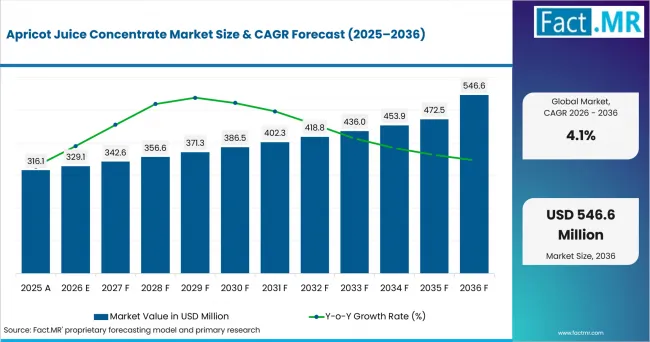
Apricot Juice Concentrate Market Value Analysis | Source: Fact.MR
What are the defining numbers behind Apricot Juice Concentrate Market growth?
USD 217.6 million absolute opportunity is expected between 2026 and 2036. Brix 30° and Wine and Beverages lead the market.
- Demand Drivers in the Market
- Concentrate formats are expected to help manufacturers manage flavor and storage in processed fruit products.
- Wine and Beverages gives the market its largest application use as apricot concentrate supports flavor and sweetness in liquid products.
- Foodservice distribution and retail routes are expected to widen access for commercial buyers that need varied pack sizes.
- Supplier selection is expected to depend on Brix level and sensory consistency. Packaging reliability adds a separate buying check for processed fruit products.
- Key Segments Analyzed
- By Type: Brix 30° is expected to hold 42.5% share in 2026 because it offers a practical concentration level for beverage and food use.
- By Application: Wine and Beverages is projected to lead with 30.0% share in 2026 as beverage formulation creates the clearest recurring use case.
- Analyst Opinion at Fact.MR
- Shambhu Nath Jha, Principal Consultant at Fact.MR, states, “Apricot juice concentrate demand is expected to develop around product fit. Buyers are likely to compare Brix level and flavor behavior before they approve a supplier. Suppliers gain preference when they explain which concentrate format works best and keep product quality predictable across production lots.”
- Strategic Implications
- Food and beverage manufacturers can reduce trial risk by matching Brix level with the intended recipe before larger sourcing commitments.
- Suppliers may improve conversion by presenting application guidance and shelf-life details during the same buyer discussion.
- Channel teams need to separate industrial buyers from smaller retail accounts. Each group reviews price and delivery through a different foodservice distribution routine.
The UK records the highest country CAGR at 7.0%, followed by Australia at 6.4%. Canada advances at 5.6% through 2036. The USA is projected at 5.2% and Germany is forecast to expand at 4.2%.
How does the Apricot Juice Concentrate Market break down by segment?
Brix 30° leads Type with 42.5% share in 2026. Wine and Beverages leads Application with 30.0% share in 2026.
Why does Brix 30° lead Type?
Brix 30° is projected to account for 42.5% share in 2026.
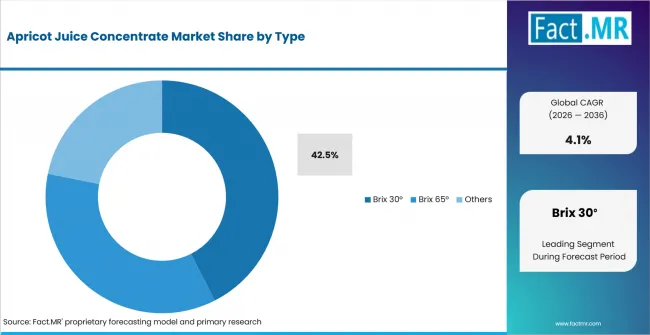
Apricot Juice Concentrate Market Analysis By Type | Source: Fact.MR
Brix 30° gives buyers a workable balance between concentration and handling. It supports drink mixes and food applications without heavy process adjustment. Brix 65° is useful when shipping efficiency matters most. Other formats serve smaller needs with tighter recipe conditions.
Why does Wine and Beverages lead Application?
Wine and Beverages is projected to account for 30.0% share in 2026.
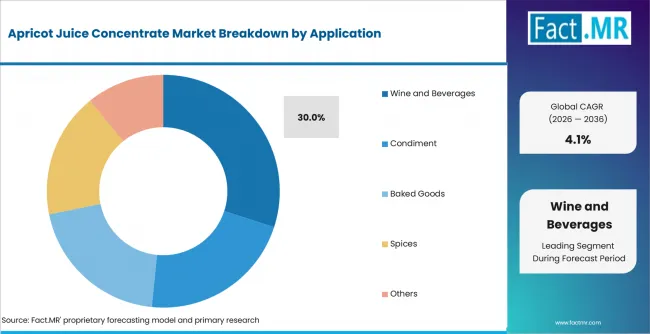
Apricot Juice Concentrate Market Analysis By Application | Source: Fact.MR
Wine and Beverages leads because liquid applications use apricot concentrate as a flavor and sweetness base. Beverage makers review color behavior before adding a concentrate to repeat recipes. Condiment and bakery ingredients create smaller demand with more recipe-specific use.
What is accelerating Apricot Juice Concentrate Market adoption, and what is holding it back?
Demand is expected to grow through beverage use and ready-to-use concentrate formats. Wider sales channels may support growth. Limited fruit supply and labeling requirements could slow supplier changes.
Drivers Impact Analysis
| DRIVER | (~) % IMPACT ON CAGR | GEOGRAPHIC RELEVANCE | IMPACT TIMELINE |
|---|---|---|---|
| Brix 30° formulation fit | Qualitative | UK; Australia; USA; Canada; Germany | Short term (<= 2 years) |
| Wine and Beverages application use | Qualitative | Beverage manufacturing markets | Short term (<= 2 years) |
| Retail and online access | Qualitative | Developed distribution channels | Medium term (2-4 years) |
| Consistent sourcing and processing | Qualitative | Global supplier networks | Medium term (2-4 years) |
| Pack-size flexibility | Qualitative | Foodservice and smaller buyers | Long term (>= 4 years) |
Source: Fact.MR analysis. Updated Aug 4, 2026
- Brix 30° formulation fit: A mid-concentration format is expected to support trial and repeat use when buyers need manageable processing behavior.
- Wine and Beverages application use: Beverage producers are expected to remain the main demand anchor as functional beverages and flavored drink formats create recurring purchases.
- Consistent sourcing and processing: Buyers are expected to prefer suppliers that provide clear specifications and stable product performance across production lots.
Opportunity Impact Analysis
| OPPORTUNITY | (~) % IMPACT ON CAGR | GEOGRAPHIC RELEVANCE | IMPACT TIMELINE |
|---|---|---|---|
| Application guidance for formulators | Qualitative | Food and beverage producers | Short term (<= 2 years) |
| Online grocery channels and smaller pack routes | Qualitative | Retail-led markets | Medium term (2-4 years) |
| Condiment and baked goods use | Qualitative | Food processing clusters | Medium term (2-4 years) |
| Premium and natural-positioned recipes | Qualitative | Urban consumer markets | Long term (>= 4 years) |
Source: Fact.MR analysis. Updated Aug 4, 2026
- Application guidance for formulators: Suppliers that explain Brix level and recipe fit are expected to reduce buyer uncertainty during product trials.
- Smaller pack routes: Online grocery channels are expected to support smaller buyers that cannot buy through large industrial contracts.
- Condiment and baked goods use: Secondary food applications are expected to create added demand when apricot flavor improves finished recipes.
Restraints Impact Analysis
| RESTRAINT | (~) % IMPACT ON CAGR | GEOGRAPHIC RELEVANCE | IMPACT TIMELINE |
|---|---|---|---|
| Input price and fruit availability | Qualitative | Global | Short term (<= 2 years) |
| Regulatory and labeling variation | Qualitative | Export and multi-country supply | Short term (<= 2 years) |
| Established application preferences | Qualitative | Mature food and beverage accounts | Medium term (2-4 years) |
| Specification mismatch risk | Qualitative | Industrial users | Long term (>= 4 years) |
Source: Fact.MR analysis. Updated Aug 4, 2026
- Input price and fruit availability: Apricot supply and processing costs may affect quotation stability for buyers that need repeated shipment schedules.
- Regulatory and labeling variation: Multi-market sales may require different documents. This can slow approval for new customers.
- Established application preferences: Recipe owners may continue with familiar ingredients until a substitute proves equal taste and processing performance.
Which countries are scaling Apricot Juice Concentrate Market fastest?
- The country comparison spans 2.8 percentage points across the forecast period.
- The UK remains 0.6 percentage point above Australia as channel readiness supports faster beverage adoption.
- Australia remains 0.8 percentage point above Canada through food and beverage use cases that favor processed fruit inputs.
- Canada remains 0.4 percentage point above the USA through steadier demand across the displayed country set.
- The USA remains 1.0 percentage point above Germany due to a larger foodservice route.
- Germany closes the displayed range with a mature demand profile.
Comparable CAGRs can create different entry conditions due to application mix and buyer concentration. Full report coverage includes North America and Latin America. Europe and East Asia are included. South Asia and Oceania follows the same regional view. Middle East and Africa completes the coverage.
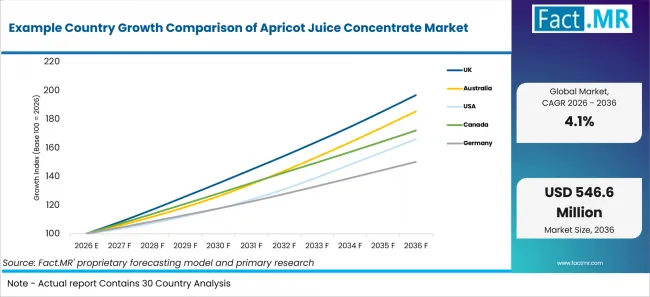
Example Country Growth Comparison Of Apricot Juice Concentrate Market | Source: Fact.MR
| Country | CAGR (2026-2036) |
|---|---|
| UK | 7.0% |
| Australia | 6.4% |
| Canada | 5.6% |
| USA | 5.2% |
| Germany | 4.2% |
Source: Fact.MR analysis. Updated Aug 4, 2026
What supports UK adoption?
7.0% CAGR, led by beverage formulation and channel fit.
UK demand reflects a market where beverage producers review flavor consistency before approving a concentrate for repeat use. Brix 30° suits trials that need manageable sweetness and stable handling. Suppliers can gain account access when documentation explains origin and storage in plain buyer terms.
How is Australia scaling demand?
6.4% CAGR, supported by beverage use and packaged food applications.
Australia’s growth is shaped by recipes that need controlled fruit inputs across beverage and packaged food formats. Distance from some sourcing bases can raise delivered cost. Suppliers that show stable taste and practical pack options are better placed during qualification.
What supports Canada’s growth?
5.6% CAGR, backed by diversified beverage and food use.
Canada advances through buyers that value storage convenience during seasonal planning. Beverage use gives the market a regular purchasing route. Import exposure can affect price and availability, so reliable shipment planning becomes a supplier advantage.
What is driving the USA’s growth from 2026 to 2036?
5.2% CAGR, shaped by application breadth and foodservice reach.
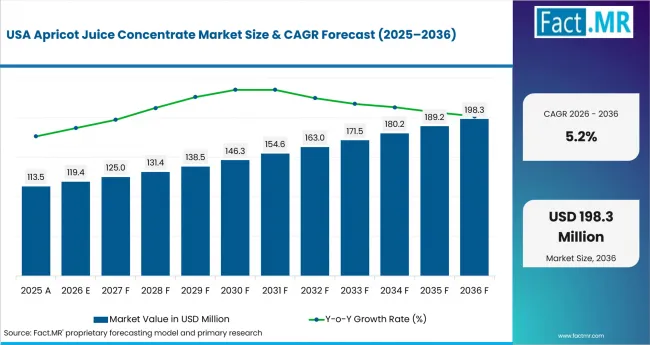
Apricot Juice Concentrate Market Country Value Analysis | Source: Fact.MR
The USA benefits from broad food and beverage application coverage. Foodservice buyers may support demand when pack-size flexibility and repeat delivery matter. Supplier approval can still take time in large food ingredients accounts.
How does Germany perform?
4.2% CAGR, shaped by mature demand and careful supplier qualification.
Germany grows through steady beverage and processed food use. Manufacturers review Brix level and product documents before wider approval. Mature buyer routines may slow new formats, so consistent quality control becomes the main route into repeat purchasing.
Who leads the Apricot Juice Concentrate Market?
Coloma Frozen Foods and Lemon Concentrate hold prominent positions in the supplier group. Muhtaroğlu Holding, Solufruit and Tunay Gida add further competition across processed-fruit ingredient channels.
Coloma Frozen Foods addresses buyers seeking apricot-based ingredients for repeat food production. Lemon Concentrate serves formulation requirements where concentration strength and product consistency affect purchasing. Muhtaroğlu Holding adds regional sourcing and processing presence. Solufruit broadens the available supplier choice for food and beverage manufacturers. Tunay Gida completes the named group with relevance to fruit concentrate applications. Market preference is likely to depend on dependable apricot sourcing, accurate Brix specifications, stable sensory quality and shipment reliability.
Which companies are the key providers?
Companies include Coloma Frozen Foods; Lemon Concentrate; Muhtaroğlu Holding A.Ş.; Solufruit; Tunay Gida.
- Coloma Frozen Foods
- Lemon Concentrate
- Muhtaroğlu Holding A.Ş.
- Solufruit
- Tunay Gida
Bibliography
- Weber, C., Wakefield, H., and Wechsler, S. J. (2025). Fruit and tree nuts outlook: July 2025 (Report No. FTS-382). U.S. Department of Agriculture, Economic Research Service.
- U.S. Department of Agriculture, Economic Research Service. (2025, June 12). Fruit and tree nuts data—Documentation.
- U.S. Food and Drug Administration. (2025, January). Guidance for industry: Questions and answers regarding food allergen labeling (Edition 5).
This Report Answers
- The report provides strategic intelligence on the Apricot Juice Concentrate Market across Type and Application choices that shape juice concentrates sourcing.
- Segment analysis covers Brix 30° and Wine and Beverages as the share leaders within the 2026 market.
- Country outlook evaluates the UK and Australia alongside Canada. The USA and Germany complete the growth comparison across profiled markets.
- Competitive analysis profiles Coloma Frozen Foods and Lemon Concentrate alongside Muhtaroğlu Holding A.Ş.. Solufruit complete the main supplier view.
Application assessment covers Wine and Beverages with Condiment and Baked Goods.
What does the Apricot Juice Concentrate Market cover?
Apricot juice concentrate products are used when buyers need a fruit input that is easier to store and dose than fresh apricot material.
The Apricot Juice Concentrate Market covers Brix 30° and Brix 65° formats. Other concentrate formats are included when they serve the same product-use boundary. Coverage extends to Wine and Beverages plus Condiment. Baked Goods and Spices are included. Other applications are covered when the product is sold as apricot juice concentrate. The market includes industrial and retail routes. Foodservice and online routes are included under the same product-use rule.
What is included in the scope?
Commercial apricot concentrate supply is included when the product is sold for use in food or beverage applications.
The scope includes Type and Application alongside Region. It covers Brix 30° and Brix 65° formats. Other concentrate formats are included when they meet the same product-use boundary. Wine and Beverages leads the application view. Condiment and Baked Goods complete part of the assessed scope. Spices and other applications complete the remaining view.
What is excluded from the scope?
Fresh apricots and unrelated fruit products remain outside the scope of this market.
The scope excludes products that are not sold as apricot juice concentrate. It excludes unrelated fruit flavors and fresh fruit retail sales. Broad beverage or bakery sales are included only when apricot juice concentrate is the relevant input. Company revenue is excluded when it lacks a clear connection to the assessed concentrate categories.
How Was the Analysis Built?
The analysis draws on 120+ sources, 35+ company portfolios, 25+ countries, and more than 20 industry interviews.
- Primary Research: Primary research includes discussions with manufacturers, service providers, technology developers, distributors, end users, procurement teams, and subject-matter experts. These conversations examine purchasing priorities, product adoption, operational challenges, approval requirements, competitive positioning, and the factors that influence wider market acceptance.
- Desk Research: Desk research covers government statistics, regulatory publications, company filings, trade data, technical studies, industry associations, standards, public policy, and other authoritative sources. Every source used in the analysis is documented in the bibliography.
- Market Sizing and Forecasting: Market estimates combine historical performance, demand indicators, pricing and volume trends, segment shares, company participation, country-level growth, adoption patterns, investment activity, and barriers to market expansion.
- Data Validation and Update Cycle: Findings are validated by comparing primary interviews with public data, company activity, regulatory changes, trade patterns, and industry developments. Regular updates review new product launches, capacity changes, partnerships, approvals, procurement trends, and shifts in commercial adoption.
Segmentation
What is the report’s scope and coverage?
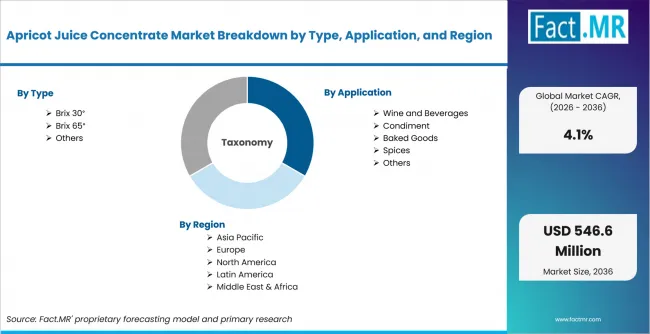
Apricot Juice Concentrate Market Breakdown By Type, Application, And Region | Source: Fact.MR
| Attribute | Details |
|---|---|
| Quantitative Units | USD million in 2026 to USD million by 2036 at CAGR |
| Market Definition | Commercial apricot juice concentrate sold across Brix-based product types and application categories where formulation fit, concentration level, flavor consistency and supply reliability shape purchasing decisions |
| Type | Brix 30°; Brix 65°; Others |
| Application | Wine and Beverages; Condiment; Baked Goods; Spices; Others |
| Regions Covered | North America; Latin America; Europe; East Asia; South Asia and Oceania; Middle East and Africa |
| Countries Covered | UK; Australia; Canada; USA; Germany |
| Key Companies Profiled | Coloma Frozen Foods; Lemon Concentrate; Muhtaroğlu Holding A.Ş.; Solufruit; Tunay Gida |
| Forecast Period | 2026 to 2036 |
| Approach | Hybrid top-down and bottom-up approach using product type demand; application fit; channel access; supplier participation; country growth; company portfolio review and buyer qualification checks |
Source: Fact.MR analysis. Updated Aug 4, 2026
How is the market segmented?
-
By Type
- Brix 30°
- Brix 65°
- Others
-
By Application
- Wine and Beverages
- Condiment
- Baked Goods
- Spices
- Others
-
By Region
- North America
- Latin America
- Europe
- East Asia
- South Asia and Oceania
- Middle East and Africa
Frequently Asked Questions
Which type leads the Apricot Juice Concentrate Market?
Which application leads the market?
Which country records the fastest growth?
What is the primary driver in this market?
What is the main restraint?
Which companies are included in the market assessment?
Who worked on this report


Preview the report firsthand - request a free sample
Free SampleGet the brochure for pricing and purchase details
Download PDF