- Market Value (2025): USD 280.1 Mn
- Estimated Value (2026): USD 300.0 Mn
- Forecast Value (2036): USD 595.7 Mn
- CAGR (2026-2036): 7.1%
What is the Pygeum Bark Extract Market forecast to be worth by 2036?
USD 300.0 million in 2026 and USD 595.7 million by 2036, implying a 7.1% CAGR.
- The Pygeum Bark Extract Market reached USD 280.1 million in 2025 as herbal supplement formulators kept prostate and urinary wellness blends active.
- Demand is projected to increase from USD 300.0 million in 2026 to USD 595.7 million by 2036.
- The market is forecast to record 7.1% CAGR from 2026 to 2036 owing to standardized extracts, powder formats and direct B2B supply programs.
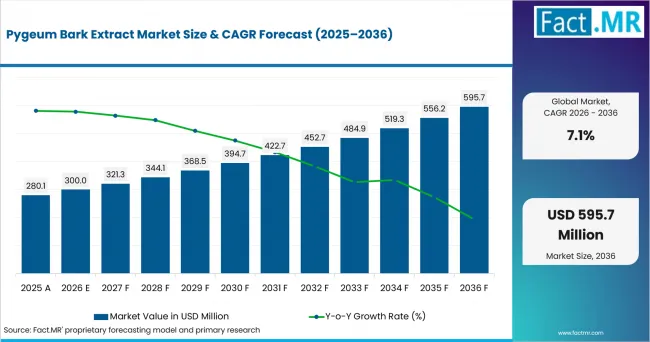
Pygeum Bark Extract Market Value Analysis | Source: Fact.MR
What are the defining numbers behind Pygeum Bark Extract Market growth?
USD 295.7 million absolute opportunity by 2036, led by Standardized Pygeum Bark Extract and Dietary Supplements alongside Nutraceutical Manufacturers.
- Demand Drivers in the Market
- Supplement brands need standardized bark extract because label files depend on verified plant identity, repeatable assay values and clear supplier documents.
- Nutraceutical manufacturers use pygeum in men's wellness blends where capsules remain a familiar daily format for aging consumers.
- CDC’s National Center for Health Statistics reported in May 2026 that 60.2% of U.S. adults age 20 and older used a dietary supplement in the past 30 days during August 2021–August 2023.
- Key Segments Analyzed
- By Product: Standardized Pygeum Bark Extract is expected to hold 63.70% share in 2026 due to defined bark identity and active-content control.
- By Application: Dietary Supplements are projected to account for 48.20% share in 2026 as brands position pygeum mainly in men's wellness capsules.
- By End Use: Nutraceutical Manufacturers are anticipated to capture 72.40% share in 2026 owing to bulk ingredient use in capsule and tablet production.
- By Technology: Solvent Extraction Technology is estimated to represent 39.60% share in 2026 since ethanol and hydroalcoholic routes support consistent extraction yield.
- By Formulation: Powder Formulations are forecast to hold 56.80% share in 2026 as they fit direct compression blends and encapsulation lines.
- By Distribution Channel: Direct B2B Supply is expected to account for 44.50% share in 2026 because supplier documents usually decide repeat ingredient orders.
- Analyst Opinion at Fact.MR
- Shambhu Nath Jha, Principal Consultant at Fact.MR, states, “Pygeum bark extract is a qualification-led botanical. Plant identity, extraction strength and paperwork decide whether a brand can use it safely. Suppliers are expected to win repeat orders by pairing clean assay files with practical powder support.”
- Strategic Implications
- Ingredient suppliers should keep batch-level identity records ready before price talks, since botanical buyers screen documents early in qualification.
- Supplement brands should keep disease-treatment language separate from permitted supplement claims. In August 2025, Anvisa reported enforcement action against supplements advertised with therapeutic and/or medicinal, functional, or health claims that are not permitted for dietary supplements.
- Contract manufacturers should test flow, microbial limits and heavy metals before scale-up because powder extracts move through several blending and filling steps.
- Solaray states that its quality program performs about 15,000 tests per month and tests ingredients for potency and purity.
Germany is projected to record 8.2% CAGR through supplement use and consumer-risk communication. Brazil is expected to post 7.5% CAGR as Anvisa rules improve supplier screening. The USA is anticipated to advance at 6.8% CAGR through supplement routines and cGMP documentation. The UK is estimated to reach 6.0% CAGR as label surveillance remains active. Japan is forecast to record 5.3% CAGR as aging consumers shape demand.
How does the Pygeum Bark Extract Market break down by segment?
Standardized Pygeum Bark Extract leads at 63.70%; Dietary Supplements lead at 48.20%.
Which product dominates?
Standardized Pygeum Bark Extract is projected to account for 63.7% share in 2026.
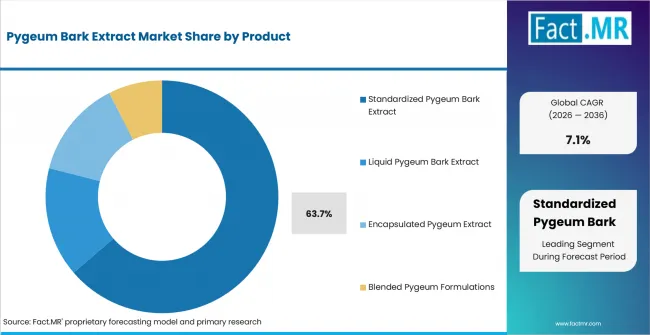
Pygeum Bark Extract Market Analysis By Product | Source: Fact.MR
Standardized Pygeum Bark Extract is expected to lead Product because brands need defined bark identity and repeatable active-content profiles. Powdered and granulated extracts serve dry handling needs. Liquid and blended forms remain smaller. Solaray’s current product page lists a 50 mg Pygeum Bark Extract containing 13% phytosterols.
What leads the Application segment?
Dietary Supplements are expected to hold 48.2% share in 2026.
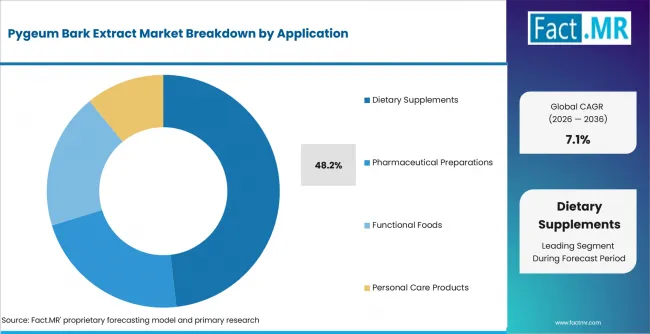
Pygeum Bark Extract Market Analysis By Application | Source: Fact.MR
Dietary Supplements are projected to lead Application since pygeum is mainly used in men's wellness and urinary-comfort products. Pharmaceutical preparations require tighter claim control. Functional food and personal care uses remain selective. NOW Foods lists Pygeum & Saw Palmetto Softgels and describes the product as supporting healthy prostate and urinary-tract function.
How does End Use shape demand?
Nutraceutical Manufacturers are anticipated to lead with 72.4% share in 2026.
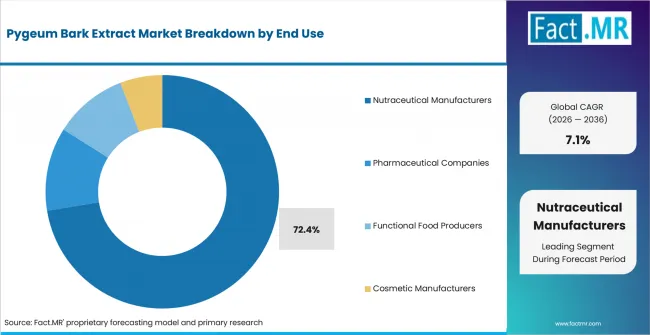
Pygeum Bark Extract Market Analysis By End Use | Source: Fact.MR
Nutraceutical Manufacturers are anticipated to lead End Use because pygeum usually enters the market as a bulk ingredient before capsule or tablet filling. Contract manufacturers convert powder into finished forms, while pharmaceutical and food producers use smaller volumes. Nutraceuticals places botanicals inside supplement and functional food programs.
What supports Solvent Extraction Technology?
Solvent Extraction Technology is estimated to represent 39.6% share in 2026.
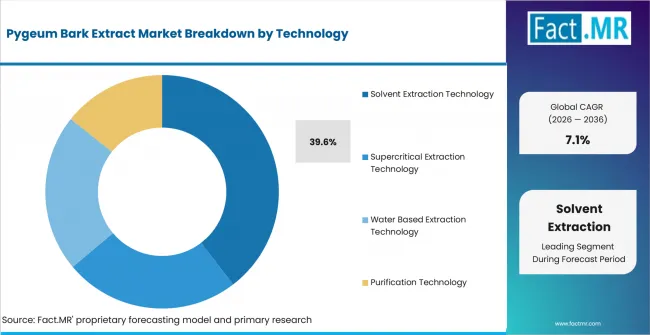
Pygeum Bark Extract Market Analysis By Technology | Source: Fact.MR
Solvent Extraction Technology is estimated to hold the largest Technology share because ethanol and hydroalcoholic systems help control extract strength. Supercritical extraction suits lower-solvent positioning but costs more. Water-based and purification routes remain useful where target chemistry and contaminant limits require them.
What formulation carries the largest share?
Powder Formulations are forecast to hold 56.8% share in 2026.
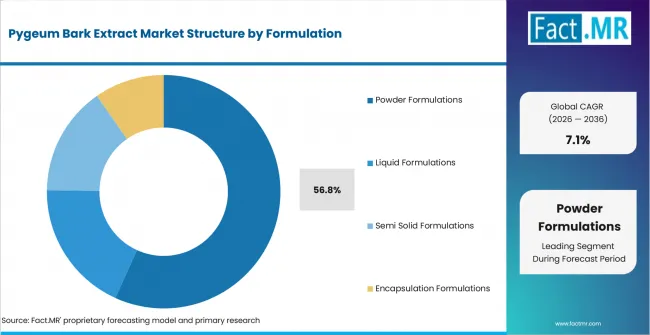
Pygeum Bark Extract Market Analysis By Formulation | Source: Fact.MR
Powder Formulations are forecast to lead Formulation because capsules and tablets use dry blends efficiently. Direct compression blends reduce extra handling when flow and hardness remain stable.
How does Distribution Channel affect purchasing?
Direct B2B Supply is expected to account for 44.5% share in 2026.
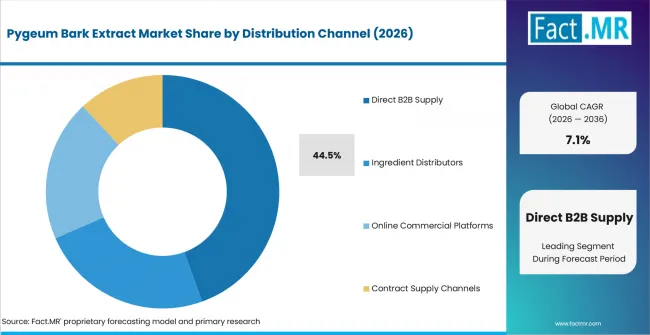
Pygeum Bark Extract Market Analysis By Distribution Channel | Source: Fact.MR
Direct B2B Supply is expected to lead Distribution Channel because pygeum buyers ask for supplier files before repeat orders. Manufacturer agreements provide specifications and sourcing records. Distributors support smaller brands, while online platforms rarely replace qualification work.
What is accelerating Pygeum Bark Extract Market adoption, and what is holding it back?
Standardized supplement use drives it; sourcing and claim risk restrain it.
Drivers Impact Analysis
| DRIVER | (~) % IMPACT ON CAGR | GEOGRAPHIC RELEVANCE | IMPACT TIMELINE |
|---|---|---|---|
| Standardized extract demand | +1.7% | Germany, USA, Brazil | Short term (<= 2 years) |
| Men's health supplement portfolios | +1.4% | USA, Germany, Japan | Short term (<= 2 years) |
| Powder-format manufacturing fit | +1.1% | Global supplement manufacturing hubs | Medium term (2-4 years) |
| Traceable botanical sourcing | +0.8% | Europe, USA, Brazil | Medium term (2-4 years) |
| Direct B2B qualification | +0.6% | Ingredient-distribution networks | Long term (>= 4 years) |
- Standardized extract demand: Brands need specifications for bark identity and extract strength. Defined standards are expected to lower label-review risk before finished supplement launches.
- Men's health supplement portfolios: Pygeum fits prostate and urinary wellness formulas when brands avoid treatment language. Portfolio refreshes are projected to support repeat demand.
- Powder-format manufacturing fit: Dry pygeum extracts move into capsules and tablets with fewer handling steps. Powder formats are anticipated to keep formulation work efficient.
- Traceable botanical sourcing: Prunus africana origin files affect supplier approval because the bark is tied to regulated botanical trade. Organized B2B suppliers are expected to benefit.
- Direct B2B qualification: Finished-product brands prefer direct contact when assay files or origin questions appear. Direct supply agreements are forecast to retain the largest distribution role.
Opportunity Impact Analysis
| OPPORTUNITY | (~) % IMPACT ON CAGR | GEOGRAPHIC RELEVANCE | IMPACT TIMELINE |
|---|---|---|---|
| Verified bark-origin programs | +0.9% | Europe and North America | Medium term (2-4 years) |
| Men's wellness blend refreshes | +0.8% | USA, Germany, Japan | Short term (<= 2 years) |
| Private-label capsule programs | +0.7% | USA, UK, Brazil | Medium term (2-4 years) |
| Specification-led distributors | +0.5% | Global B2B networks | Long term (>= 4 years) |
- Verified bark-origin programs: Suppliers that document plant species and harvest controls are expected to gain trust from importers. These records help brands answer quality questions quickly.
- Men's wellness blend refreshes: Brands are projected to update older prostate-support formulas with cleaner labels. Growth depends on careful wording that avoids disease-treatment claims.
- Private-label capsule programs: Powder grades are expected to support private-label launches because capsule filling is familiar to contract manufacturers. Standardized inputs reduce reformulation work.
- Specification-led distributors: Distributors with technical files are anticipated to win recurring B2B accounts. Documentation depth shapes comparisons around identity and contaminant controls.
Restraints Impact Analysis
| RESTRAINT | (~) % IMPACT ON CAGR | GEOGRAPHIC RELEVANCE | IMPACT TIMELINE |
|---|---|---|---|
| Bark sourcing risk | -0.9% | Africa-linked supply chains | Short term (<= 2 years) |
| Disease-claim restrictions | -0.8% | USA, Europe, Brazil | Short term (<= 2 years) |
| Testing cost | -0.6% | Global manufacturing base | Medium term (2-4 years) |
| Small product base | -0.4% | Japan, UK and niche channels | Long term (>= 4 years) |
- Bark sourcing risk: Missing origin records can stop supplier approval even when extract quality appears acceptable. Supply checks are expected to slow some small suppliers.
- Disease-claim restrictions: Pygeum labels must avoid treatment language near prostate and urinary positioning. Brands are anticipated to keep wording conservative.
- Small product base: Pygeum has narrower consumer awareness than broader botanicals such as saw palmetto. Retailers are expected to allocate limited shelf space to better-known products.
Which countries are scaling Pygeum Bark Extract Market fastest?
- The country comparison spans 2.9 percentage points across the forecast period.
- Germany remains 0.7 percentage point above Brazil through high supplement use and stricter consumer-risk communication.
- Brazil remains 0.7 percentage point above the USA as Anvisa notification rules make regularized suppliers easier to screen.
- The USA remains 0.8 percentage point above the UK through established supplement routines and cGMP documentation.
- The UK remains 0.7 percentage point above Japan as food supplement guidance and label surveillance support compliant brands.
- Japan closes the displayed range through aging demographics and careful health-food claim control.
Comparable CAGRs create different entry conditions due to supplement habits and regulator expectations. Coverage includes North America, Latin America, Europe, East Asia, South Asia and Pacific, Middle East and Africa.
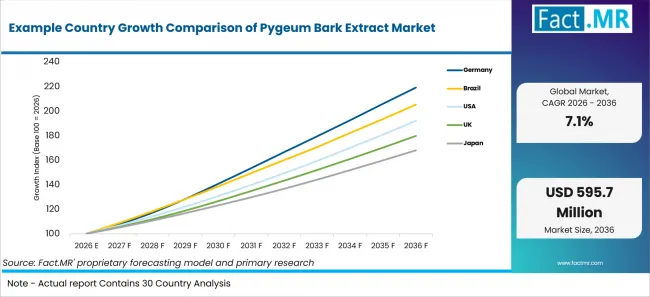
Example Country Growth Comparison Of Pygeum Bark Extract Market | Source: Fact.MR
| Country | CAGR (2026-2036) |
|---|---|
| Germany | 8.2% |
| Brazil | 7.5% |
| USA | 6.8% |
| UK | 6.0% |
| Japan | 5.3% |
What supports Germany adoption?
8.2% CAGR, supported by supplement use and consumer-risk communication.
Germany is projected to record 8.2% CAGR, supported by established supplement use and consumer awareness around health risks. Demand for standardized pygeum blends is expected to benefit from a supplement base, while clear product information and risk communication may further support adoption among German consumers.
How is Brazil scaling demand?
7.5% CAGR, driven by regularized supplement supply and distributor screening.
Brazil is expected to post 7.5% CAGR as supplement notification rules make compliant products easier to verify. Anvisa updated its supplement Q&A in January 2025 and highlighted RDC 843/2024 and IN 281/2024. The shift is anticipated to favor suppliers with fast identity and import documentation.
What underpins USA demand?
6.8% CAGR, led by established supplement habits and cGMP documentation.
The USA is anticipated to advance at 6.8% CAGR because supplement users already accept capsule and tablet formats. FDA guidance identifies 21 CFR part 111 as the current good manufacturing practice requirements applicable to the manufacturing, packaging, labeling, and holding of dietary supplements. FDA’s framework establishes CGMP requirements for dietary-supplement manufacturing, packaging, labeling and holding.
What supports the UK outlook?
6.0% CAGR, shaped by food supplement guidance and label surveillance.
The UK is estimated to reach 6.0% CAGR as food supplement guidance keeps dose form and label wording visible to brands. The Food Standards Agency published current food-supplement guidance on June 25, 2026 covering safe use, label instructions and authorized health claims. UK brands are expected to screen pygeum documents closely for online and specialty channels.
How does Japan perform?
5.3% CAGR, backed by aging demographics and health-food claim control.
Japan is forecast to record 5.3% CAGR as older consumers keep daily wellness products relevant. The Statistics Bureau reported in June 2026 that Japan had 36.189 million residents aged 65 and over on January 1, 2026. Consumer Affairs Agency guidance is expected to keep health-food claims conservative.
Which profiled companies have direct product relevance to the Pygeum Bark Extract Market?
Key companies include Better Being Co., NOW Foods and Life Extension as having finished-product relevance, while Nutra Green Biotechnology and Natural Field have bulk botanical-supply relevance.
Better Being Co. supports the market through Solaray Pygeum Bark Extract products in 50 mg and 100 mg capsule formats. NOW Foods lists Pygeum and Saw Palmetto Softgels as a men’s health supplement. Life Extension adds natural health supplement relevance through men's urinary-health formulas.
Nutra Green Biotechnology and Natural Field strengthen bulk supply through Prunus africana and Pygeum Africanum extract listings. Natural Field states that its pygeum extract is supported by CITES certification and CITES-compliant sourcing documentation. Competition is expected to depend on specification depth, traceable supply and powder performance.
Which companies are the key providers?
Better Being Co. and NOW Foods are key providers. Life Extension and Nutra Green Biotechnology Co. Ltd. are also profiled. Xi'an Natural Field Bio-Technique Co. Ltd. completes the company set.
- Better Being Co.
- NOW Health Group, Inc.
- Life Extension
- Nutra Green Biotechnology Co. Ltd.
- Xi'an Natural Field Bio-Technique Co. Ltd.
Bibliography
- Agência Nacional de Vigilância Sanitária. (2025, January 16). Anvisa atualiza perguntas e respostas sobre suplementos alimentares.
- Agência Nacional de Vigilância Sanitária. (2025, August 26). Anvisa determina recolhimento e apreensão de suplementos alimentares irregulares.
- Stierman, B., Couch, C. A., Gahche, J. J., & Mishra, S. (2026, May 21). Dietary supplement use: United States, August 2021–August 2023 (NCHS Data Brief No. 561). National Center for Health Statistics.
- German Federal Institute for Risk Assessment. (2025, July 18). Between hype and misconception: Common misunderstandings about food supplements.
- Food Standards Agency. (2026, June 25). Food supplements guidance. GOV.UK.
This Report Answers
- The report provides strategic intelligence on the Pygeum Bark Extract Market across Product and Application choices that shape supplement formulation.
- Segment analysis covers Standardized Pygeum Bark Extract and Dietary Supplements as the share leaders within the 2026 market.
- Country outlook evaluates Germany and Brazil alongside the USA, the UK and Japan across the listed CAGR range.
- Competitive analysis profiles Better Being Co., NOW Foods and Life Extension alongside Nutra Green Biotechnology and Natural Field.
- Process and distribution assessment covers solvent extraction, powder formulation and direct B2B supply as the main commercial routes.
What does the Pygeum Bark Extract Market cover?
Prunus africana bark-derived extracts used in supplement, pharmaceutical, food and personal care formulations.
The Pygeum Bark Extract Market covers standardized and non-standardized ingredients made from Prunus africana bark. Coverage includes powder dietary supplements, liquid dietary supplements, encapsulated forms and blended extracts. It also covers B2B supply channels where plant identity and supplier documents guide purchasing.
What is included in the scope?
Standardized extracts, powder formulations, solvent extraction and B2B supply for pygeum-containing products.
The scope includes pygeum bark extract sold to nutraceutical manufacturers, nutraceutical supplements brands, contract manufacturers and pharmaceutical companies. It covers standardized pygeum, liquid extract, capsules and blended botanical formulas. Direct supply and distributors are included when the product remains tied to Prunus africana bark extract.
What is excluded from the scope?
Unrelated bark extracts, non-pygeum supplements, animal nutrition and crop-care uses remain outside scope.
The scope excludes herbal supplement products that do not list pygeum or Prunus africana as an ingredient. Isolated drugs without pygeum content are outside the boundary. General plant extracts, OTC herbal products and softgel dietary supplements are excluded unless they use pygeum bark extract.
How Was the Analysis Built?
The analysis draws on 120+ sources, 35+ company portfolios, 25+ countries, and more than 20 industry interviews.
- Primary Research: Primary research includes discussions with manufacturers, service providers, technology developers, distributors, end users, procurement teams, and subject-matter experts. These conversations examine purchasing priorities, product adoption, operational challenges, approval requirements, competitive positioning, and the factors that influence wider market acceptance.
- Desk Research: Desk research covers government statistics, regulatory publications, company filings, trade data, technical studies, industry associations, standards, public policy, and other authoritative sources. Every source used in the analysis is documented in the bibliography.
- Market Sizing and Forecasting: Market estimates combine historical performance, demand indicators, pricing and volume trends, segment shares, company participation, country-level growth, adoption patterns, investment activity, and barriers to market expansion.
- Data Validation and Update Cycle: Findings are validated by comparing primary interviews with public data, company activity, regulatory changes, trade patterns, and industry developments. Regular updates review new product launches, capacity changes, partnerships, approvals, procurement trends, and shifts in commercial adoption.
What is the report’s scope and coverage?
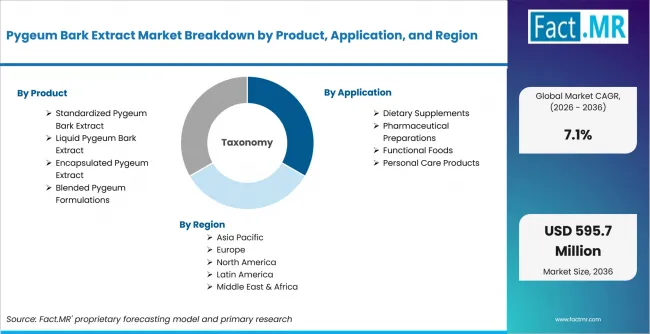
Pygeum Bark Extract Market Breakdown By Product, Application, And Region | Source: Fact.MR
| Attribute | Details |
|---|---|
| Quantitative Units | USD million |
| Market Definition | Prunus africana bark-derived extracts used in dietary supplements, pharmaceutical preparations, functional foods and personal care products where plant identity, extract strength and sourcing records shape supplier qualification |
| Product | Standardized Pygeum Bark Extract; Liquid Pygeum Bark Extract; Encapsulated Pygeum Extract; Blended Pygeum Formulations |
| Application | Dietary Supplements; Pharmaceutical Preparations; Functional Foods; Personal Care Products |
| End Use | Nutraceutical Manufacturers; Pharmaceutical Companies; Functional Food Producers; Cosmetic Manufacturers |
| Technology | Solvent Extraction Technology; Supercritical Extraction Technology; Water Based Extraction Technology; Purification Technology |
| Formulation | Powder Formulations; Liquid Formulations; Semi Solid Formulations; Encapsulation Formulations |
| Distribution Channel | Direct B2B Supply; Ingredient Distributors; Online Commercial Platforms; Contract Supply Channels |
| Regions Covered | North America; Latin America; Europe; East Asia; South Asia and Pacific; Middle East and Africa |
| Countries Covered | Germany; Brazil; USA; UK; Japan |
| Key Companies Profiled | Better Being Co.; NOW Health Group, Inc.; Life Extension; Nutra Green Biotechnology Co. Ltd.; Xi'an Natural Field Bio-Technique Co. Ltd. |
| Forecast Period | 2026 to 2036 |
| Approach | Hybrid top-down and bottom-up approach using supplied market values; segment shares; country CAGRs; official supplement-use evidence; regulator updates; company product verification; and B2B supply-chain review |
How is the market segmented?
-
By Product:
- Standardized Pygeum Bark Extract
- Powdered Extracts
- Granulated Extracts
- Liquid Pygeum Bark Extract
- Aqueous Extracts
- Hydroalcoholic Extracts
- Encapsulated Pygeum Extract
- Hard Capsule Products
- Softgel Products
- Blended Pygeum Formulations
- Single Herb Blends
- Multi Botanical Blends
- Standardized Pygeum Bark Extract
-
By Application:
- Dietary Supplements
- Men's Health Supplements
- General Wellness Supplements
- Pharmaceutical Preparations
- Prescription Products
- OTC Products
- Functional Foods
- Fortified Foods
- Functional Beverages
- Personal Care Products
- Cosmeceutical Products
- Hair Care Products
- Dietary Supplements
-
By End Use:
- Nutraceutical Manufacturers
- Dietary Supplement Companies
- Contract Manufacturers
- Pharmaceutical Companies
- Branded Drug Manufacturers
- Generic Manufacturers
- Functional Food Producers
- Food Ingredient Companies
- Beverage Companies
- Cosmetic Manufacturers
- Skin Care Companies
- Hair Care Companies
- Nutraceutical Manufacturers
-
By Technology:
- Solvent Extraction Technology
- Ethanol Extraction Systems
- Hydroalcoholic Extraction Systems
- Supercritical Extraction Technology
- CO2 Extraction Systems
- Hybrid Extraction Systems
- Water Based Extraction Technology
- Hot Water Systems
- Steam Assisted Systems
- Purification Technology
- Filtration Systems
- Chromatographic Systems
- Solvent Extraction Technology
-
By Formulation:
- Powder Formulations
- Direct Compression Blends
- Instant Mix Systems
- Liquid Formulations
- Concentrated Solutions
- Suspension Systems
- Semi Solid Formulations
- Gel Systems
- Paste Systems
- Encapsulation Formulations
- Microencapsulated Systems
- Lipid Encapsulation Systems
- Powder Formulations
-
By Distribution Channel:
- Direct B2B Supply
- Manufacturer Supply Agreements
- OEM Supply Networks
- Ingredient Distributors
- Regional Distributors
- Global Distributors
- Online Commercial Platforms
- Digital B2B Portals
- Manufacturer Portals
- Contract Supply Channels
- Private Label Supply
- Custom Manufacturing Networks
- Direct B2B Supply
-
By Region:
- North America
- Latin America
- Europe
- East Asia
- South Asia and Oceania
- Middle East and Africa