- Market Value (2025): USD 21.1 Bn
- Estimated Value (2026): USD 22.5 Bn
- Forecast Value (2036): USD 41.8 Bn
- CAGR (2026-2036): 6.4%
What is the Lawn Care Chemicals Market forecast to be worth by 2036?
USD 22.5 billion in 2026 to USD 41.8 billion by 2036 at 6.4% CAGR.
- The lawn care chemicals market at USD 21.1 billion in 2025 as residential inputs and turf-service procurement broadened.
- Demand is projected to increase from USD 22.5 billion in 2026 to USD 41.8 billion by 2036.
- The market is forecast to record 6.4% CAGR from 2026 to 2036 as contractors, golf-course teams and homeowners shift toward targeted lawn treatment.
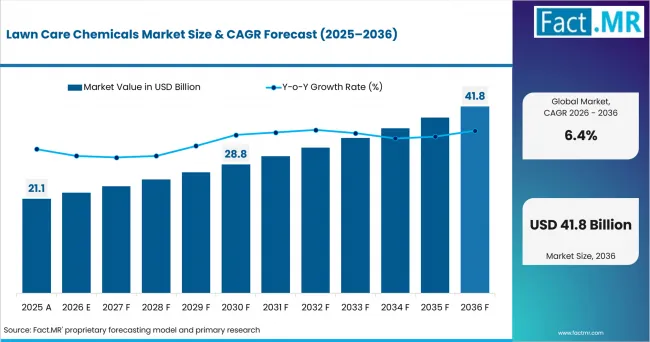
Lawn Care Chemicals Market Value Analysis | Source: Fact.MR
What are the defining numbers behind Lawn Care Chemicals Market growth?
USD 19.3 billion absolute opportunity by 2036, led by Herbicides and Residential Lawn Care alongside Professional Lawn Care Companies.
- Demand Drivers in the Market
- Lawn-care contractors need reliable weed control as repeat service plans depend on visible turf recovery after treatment.
- Homeowners need simple liquid formats as small-area spot spraying shifts more purchases toward ready-to-use herbicides.
- Golf-course superintendents need disease-control tools because turf damage directly affects playability and maintenance schedules.
- Garden retailers need clear product labels so consumers match herbicides, fertilizers and fungicides to local lawn problems.
- Key Segments Analyzed
- By Product: Herbicides are expected to hold 78.6% share in 2026 due to persistent broadleaf and grass-weed pressure in maintained turf.
- By Application: Residential Lawn Care is projected to account for 46.9% share in 2026 as home gardens remain the widest use base.
- By End Use: Professional Lawn Care Companies are anticipated to capture 71.8% share in 2026 owing to recurring treatment contracts.
- By Technology: Precision Chemical Delivery Systems are estimated to represent 63.4% share in 2026 as applicators tighten dose control.
- By Formulation: Liquid Formulations are forecast to hold 52.6% share in 2026 as users prefer fast mixing and even coverage.
- By Distribution Channel: Agricultural & Garden Retail Stores are expected to account for 39.8% share in 2026 due to local advice and product availability.
- Analyst Opinion at Fact.MR
- Shambhu Nath Jha of Fact.MR states, "Lawn chemicals are judged at the surface, where weeds, brown patches and thin turf are visible within days. Product selection is expected to depend on label clarity, safety windows and repeatable treatment results. Providers should combine formulation depth with retailer education and professional applicator support."
- Strategic Implications
- Manufacturers should align labels with residential lawns, golf courses and commercial landscapes instead of promoting one broad product message.
- Retailers should train store teams on selective herbicide use, pet re-entry guidance and season-specific lawn problems.
- Contractors should document treatment intervals and weather limits before expanding subscription lawn-care services.
- Investors should separate direct turf-care exposure from broader agricultural crop-protection revenue.
Germany is projected to record 7.4% CAGR through 2036 as regulated garden retail supports use. Brazil is expected to post 6.7% as registration systems formalise supply. The USA is anticipated to advance at 6.1% through broad residential lawns. The UK is estimated at 5.4% as amenity rules shape use. Japan is forecast at 4.8% through golf-course turf care.
How does the Lawn Care Chemicals Market break down by segment?
Herbicides lead Product at 78.6%; Residential Lawn Care leads Application at 46.9%.
Which product dominates?
Herbicides are projected to account for 78.6% share in 2026.
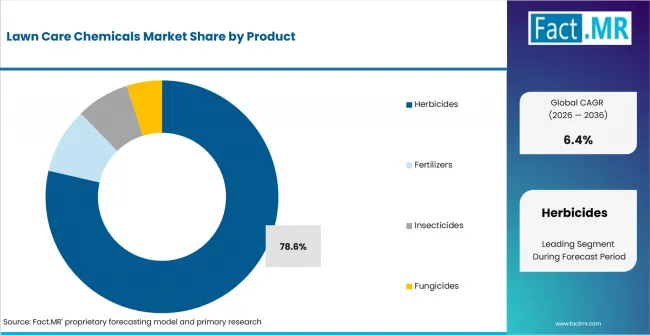
Lawn Care Chemicals Market Analysis By Product | Source: Fact.MR
Herbicides are projected to hold the main Product share because visible weeds trigger fast treatment in residential and professional turf. Fertilizers support recovery programs after mowing stress and seasonal thinning. Insecticides and fungicides are expected to add seasonal value when pests or fungal patches reduce playability. MAFF reported herbicide shipments of 89,190 t-kL for Japan's 2024 pesticide year, providing national herbicide-market context.
What leads the Application segment?
Residential Lawn Care is expected to hold 46.9% share in 2026.
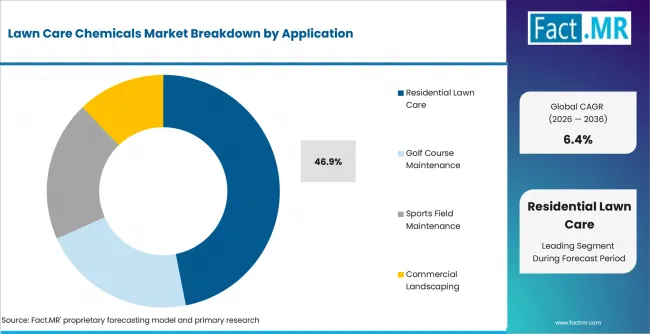
Lawn Care Chemicals Market Analysis By Application | Source: Fact.MR
Residential Lawn Care is expected to hold the main Application share as homeowners treat weeds and bare patches with retail products. Golf courses need fungicides and nutrient programs that protect greens and fairways. Sports fields and commercial landscapes require predictable turf appearance because poor surfaces affect use and maintenance schedules.
How does End Use shape demand?
Professional Lawn Care Companies are anticipated to capture 71.8% share in 2026.
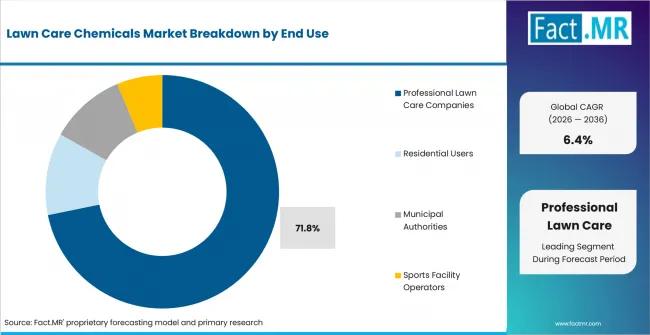
Lawn Care Chemicals Market Analysis By End Use | Source: Fact.MR
Professional Lawn Care Companies are anticipated to capture the main End Use share as recurring service routes require dependable inputs. Residential users buy smaller packs for spot treatment and seasonal feeding. Municipal authorities are expected to prefer products with clear application limits near parks, schools and public paths.
What supports Technology adoption?
Precision Chemical Delivery Systems are estimated to hold 63.4% share in 2026.
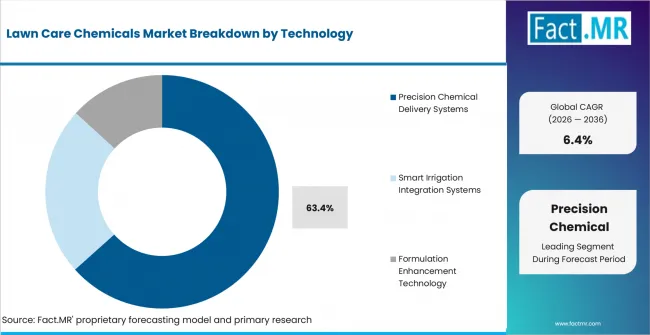
Lawn Care Chemicals Market Analysis By Technology | Source: Fact.MR
Precision Chemical Delivery Systems are estimated to hold the main Technology share because contractors need accurate dose control and spray placement. Controlled-release technology is expected to fit fertilizer programs where longer nutrient availability reduces repeat visits. Targeted application systems support patch treatment when weeds or disease remain concentrated in small areas.
What leads Formulation demand?
Liquid Formulations are forecast to account for 52.6% share in 2026.
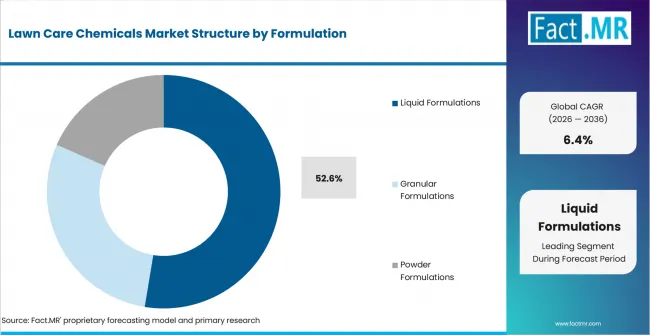
Lawn Care Chemicals Market Analysis By Formulation | Source: Fact.MR
Liquid Formulations are forecast to hold the main Formulation share through even spray coverage and fast contact with weed foliage. Granular formulations fit feeding programs where applicators want slower nutrient movement. Powder systems remain relevant for storage-led and dilution-based uses.
Which Distribution Channel leads?
Agricultural & Garden Retail Stores are expected to hold 39.8% share in 2026.
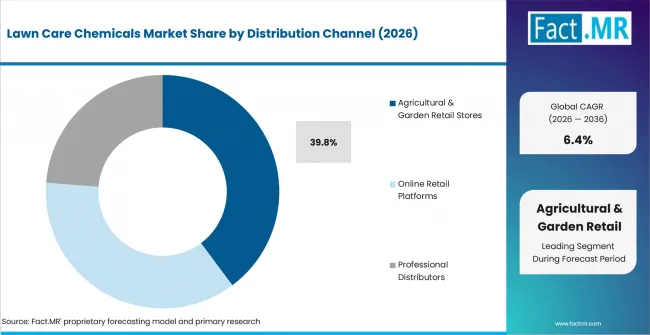
Lawn Care Chemicals Market Analysis By Distribution Channel | Source: Fact.MR
Agricultural and Garden Retail Stores are expected to hold the main channel share because consumers value local advice before buying herbicides or fertilizers. Specialty stores support higher-service purchases for turf problems. Online platforms are expected to widen repeat access for familiar brands and subscription lawn-care inputs.
What is accelerating Lawn Care Chemicals Market adoption, and what is holding it back?
Residential lawn treatment drives it; pesticide-use controls restrain it.
| DRIVER | (~) IMPACT ON CAGR | GEOGRAPHIC RELEVANCE | IMPACT TIMELINE |
|---|---|---|---|
| Residential lawn maintenance | +1.7% | USA, Germany, UK | Short term (<= 2 years) |
| Professional service contracts | +1.4% | USA, Brazil, Germany | Short term (<= 2 years) |
| Golf-course disease control | +1.1% | Japan, USA, UK | Medium term (2-4 years) |
| Selective herbicide demand | +0.9% | USA, Brazil, Germany | Medium term (2-4 years) |
| Retail channel advice | +0.7% | Residential markets | Long term (>= 4 years) |
Source: Fact.MR analysis. Updated Aug 14, 2026
- Residential lawn maintenance: Homeowners are expected to keep buying herbicides and fertilizers where lawn appearance remains visible from streets and living areas.
- Turf herbicide launch: Syngenta Turf & Landscape Australia launched ESTATE® Herbicide in January 2025 for broadleaf weed control in professional turf.
- Selective herbicide demand: EPA’s 2025 F7214 RTU Herbicide label lists 0.021% sulfentrazone and 0.058% quinclorac.
Opportunity Impact Analysis
| OPPORTUNITY | (~) IMPACT ON CAGR | GEOGRAPHIC RELEVANCE | IMPACT TIMELINE |
|---|---|---|---|
| Low-drift and spot-spray formats | +0.8% | USA, UK, Germany | Short term (<= 2 years) |
| Natural lawn-care ranges | +0.7% | USA, UK | Medium term (2-4 years) |
| Golf-course fungicide launches | +0.6% | Japan, USA | Medium term (2-4 years) |
| Digital retail replenishment | +0.5% | USA, Germany, UK | Long term (>= 4 years) |
Source: Fact.MR analysis. Updated Aug 14, 2026
- Low-drift and spot-spray formats: Applicators need products that limit off-target movement near borders and garden beds, especially where labels require tighter buffer control.
- Natural lawn-care ranges: The Scotts Miracle-Gro Company introduced its new O.M. Scott & Sons lawn-care brand in April 2025, featuring natural fertilizers and grass seeds.
- Golf-course fungicide launches: BASF Japan launched Pure-Star Flowable in February 2025 for golf-course lawns.
Restraints Impact Analysis
| RESTRAINT | (~) IMPACT ON CAGR | GEOGRAPHIC RELEVANCE | IMPACT TIMELINE |
|---|---|---|---|
| Pesticide-use restrictions | -1.0% | UK, Germany, USA | Short term (<= 2 years) |
| Runoff and drift controls | -0.8% | USA, Japan | Short term (<= 2 years) |
| Turf-type injury risk | -0.5% | Global | Medium term (2-4 years) |
Source: Fact.MR analysis. Updated Aug 14, 2026
- Pesticide-use restrictions: The UK Pesticides National Action Plan 2025 sets three objectives: encouraging integrated pest management, establishing timetables and targets to reduce pesticide use, and strengthening compliance to improve safety and environmental outcomes.
- Runoff and drift controls: EPA’s 2025 F7214 RTU Herbicide label for residential lawns states that the product may affect surface-water quality through runoff or spray drift.
Which countries are scaling Lawn Care Chemicals Market fastest?
- The country comparison spans 2.6 percentage points and forms three practical growth bands across the forecast period.
- Germany remains 0.7 percentage point above Brazil through regulated garden retail and professional landscaping use.
- Brazil remains 0.6 percentage point above the USA as pesticide registration systems formalise product supply.
- The USA remains 0.7 percentage point above the UK through residential lawn size and service-route depth.
- The UK remains 0.6 percentage point above Japan as amenity-pesticide oversight shapes professional use.
- Japan closes the displayed range through golf-course turf care and residue-monitoring discipline.
Comparable CAGRs can create different entry conditions due to label rules, service depth and garden retail behaviour. Full report coverage includes North America, Latin America, Europe, East Asia, South Asia and Pacific, Middle East and Africa.
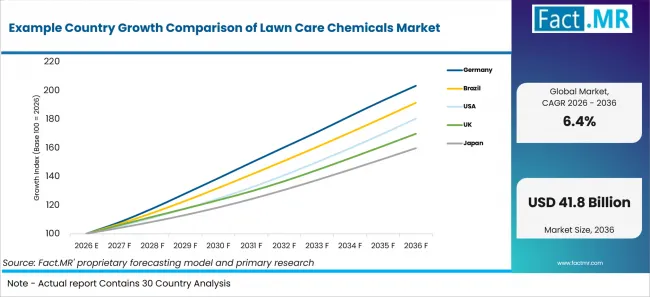
Example Country Growth Comparison Of Lawn Care Chemicals Market | Source: Fact.MR
| Country | CAGR (2026-2036) |
|---|---|
| Germany | 7.4% |
| Brazil | 6.7% |
| USA | 6.1% |
| UK | 5.4% |
| Japan | 4.8% |
Source: Fact.MR analysis. Updated Aug 14, 2026
What supports Germany adoption?
7.4% CAGR, supported by regulated garden retail and professional landscaping use.
Germany’s growth reflects a structured lawn-care market where retailers and contractors must follow product labels carefully. BVL published its 2024 report on domestic sales and exports of plant-protection products under §64 PflSchG on 30 October 2025, and Destatis reported 2,821 ornamental plant holdings in November 2025. Demand is expected to remain tied to compliant weed control, garden retail advice and professional grounds maintenance.
How is Brazil scaling demand?
6.7% CAGR, supported by formal pesticide registration and service-led turf demand.
Brazil’s growth is tied to formal pesticide registration and monitored commercialisation rather than informal product availability. MAPA updated its registrations-granted list on 29 December 2025, and IBAMA’s pesticide-commercialisation reports page was updated on 18 December 2025, with 2024 sales datasets available in the official report directory. Service providers are expected to favour products with clear registration status before expanding turf-care programs.
What supports USA adoption?
6.1% CAGR, driven by residential lawns and labelled spot-treatment products.
The USA outlook is shaped by residential lawns and contractor service routes. U.S. Census Bureau 2025 housing characteristics report 1,005,000 single-family homes completed; 41% of single-family homes built for sale had lot sizes under 7,000 square feet. This housing base is expected to keep selective herbicide and fertiliser purchases visible in garden retail and professional lawn care.
How does the UK perform?
5.4% CAGR, supported by amenity turf care and ornamentals demand.
The UK outlook is shaped by amenity pesticide monitoring and ornamental-horticulture activity. Defra reported in June 2026 that the value of UK ornamental production was £1.6 billion in 2025, while HSE published the Pesticide Usage Survey Report: Amenity Survey 2024 on May 14, 2026. Operators are expected to prioritise documented use near schools, sports grounds and public green space.
What supports Japan adoption?
4.8% CAGR, backed by golf-course care and specialised turf disease control.
Japan’s growth reflects golf-course maintenance and close water-quality oversight. The Ministry of the Environment reported in October 2025 that FY2024 monitoring covered 35,012 samples from 2,095 golf courses; 2 drainage samples exceeded water-pollution guideline values and 7 exceeded aquatic-life guideline values. Golf-course managers are expected to select fungicides and herbicides with stronger residue documentation.
Which companies have direct Lawn Care Chemicals Market relevance?
Syngenta and Envu have direct turf-product relevance, while BASF SE and Corteva Agriscience add professional turf offerings, FMC has residential lawn-herbicide label exposure, and The Scotts Miracle-Gro Company has consumer lawn-care products.
Syngenta has turf-herbicide and professional distribution relevance. Envu supports golf, lawn and landscape users. BASF SE adds specialty golf-course fungicide development.
Corteva Agriscience and FMC strengthen registered herbicide exposure. The Scotts Miracle-Gro Company adds a consumer route through fertilizers, grass seed and retail brand visibility.
Which companies are the key providers?
Syngenta and Envu are key providers. BASF SE and The Scotts Miracle-Gro Company are also profiled. Corteva Agriscience and FMC complete the company set.
- Syngenta
- Envu
- BASF SE
- The Scotts Miracle-Gro Company
- Corteva Agriscience
- Nufarm Limited
Bibliography
- BASF Japan. (2025, February 14). BASF Japan launches new fungicide Pure-Star Flowable for golf-course lawns, with two additional products planned for April. BASF.
- Department for Environment, Food & Rural Affairs. (2026, June 25). Horticulture statistics 2025. GOV.UK.
- Department for Environment, Food & Rural Affairs, Welsh Government, The Scottish Government, & Northern Ireland Executive. (2025, March 21). UK Pesticides National Action Plan 2025. GOV.UK.
- Envu. (2025, May 5). Envu adds new Tarvecta™ fungicide to treat difficult turfgrass diseases.
- U.S. Environmental Protection Agency. (2025, May 16). F7214 RTU Herbicide, EPA Reg. No. 279-9646 [Pesticide product label].
- Ministério da Agricultura e Pecuária. (2025, December 29). Registros concedidos até 29 de dezembro de 2025 [Granted registrations through December 29, 2025] [Excel spreadsheet].
- Ministry of the Environment, Government of Japan. (2025, October 6). FY 2024 survey results of agricultural chemicals in drainage waters from golf courses.
- Syngenta Turf & Landscape. (2025, January 24). Launching ESTATE Herbicide Triple-Active Herbicide.
- Health and Safety Executive. (2026, May 14). Pesticide Usage Survey Report: Amenity Survey 2024. GOV.UK.
- U.S. Census Bureau. (2026, July 1). Characteristics of new housing.
This Report Answers
- The report provides strategic intelligence on Product and Application choices shaping turf-treatment programs.
- Segment analysis covers Herbicides and Residential Lawn Care as 2026 share leaders.
- Country outlook evaluates Germany, Brazil, the USA, the UK and Japan.
- Competitive analysis profiles Syngenta, Envu, BASF SE, The Scotts Miracle-Gro Company, Corteva Agriscience and Nufarm Limited.
- Technology assessment covers precision delivery, controlled release and targeted application systems.
- Formulation assessment covers liquid, granular and powder formats.
- Source review combines official statistics, labels, regulator documents and company developments.
What does the Lawn Care Chemicals Market cover?
Herbicides, fertilizers, insecticides and fungicides used for managed lawn and turf care.
The Lawn Care Chemicals Market covers products used to control weeds, pests and diseases in maintained turf. Fertilizers are included where nutrient delivery supports lawn recovery and appearance.
Coverage differs from broad crop-protection chemicals because the end use is managed turf. Agricultural pesticide revenue is excluded unless a product has a clear lawn, turf, garden retail or amenity-use route.
What is included in the scope?
Lawn care chemicals used in residential, commercial, municipal, sports and golf-course turf settings.
The scope includes herbicides, fertilizers, insecticides and fungicides sold for residential lawns, golf-course maintenance, sports fields and landscaping. Adjacent home and garden pesticides are referenced only where the product is used on lawns or garden turf. Controlled-release fertilizers are included when turf-care programs use smart release fertilizers for longer nutrient availability. turf sprayers are included only as demand enablers, not chemical revenue.
What is excluded from the scope?
Agricultural crop pesticides and unrelated landscape equipment are outside the scope.
The scope excludes broad-acre agricultural herbicides, crop fungicides and farm insecticides unless labelled use links them to lawn or turf. It also excludes irrigation systems, mowing equipment and general landscaping services. Adjacent urban turf insecticides are related only when the scope narrows to managed turf insect control.
How Was the Analysis Built?
120+ sources, 35+ company portfolios, 25+ countries, and more than 20 interviews.
- Primary Research: Interviews cover contractors, garden retailers, distributors, golf managers, municipal grounds teams and formulators. Discussions review product choice and label limits.
- Desk Research: Desk research covers labels, official statistics, regulator pages, company launches, horticulture data and amenity-use surveys.
- Market Sizing and Forecasting: Estimates combine the value path with segment shares, country CAGRs, lawn indicators, service demand and registration constraints.
- Data Validation and Update Cycle: Findings are checked through country evidence, company mapping, source-date review and turf-use boundary tests.
Segmentation
What is the report’s scope and coverage?
| Attribute | Details |
|---|---|
| Quantitative Units | USD Billion |
| Market Definition | Chemical products used to manage weeds, pests, disease and nutrition across residential lawns, golf courses, sports fields and commercial landscapes |
| Product | Herbicides; Fertilizers; Insecticides; Fungicides |
| Application | Residential Lawn Care; Golf Course Maintenance; Sports Field Maintenance; Commercial Landscaping |
| End Use | Professional Lawn Care Companies; Residential Users; Municipal Authorities; Sports Facility Operators |
| Technology | Precision Chemical Delivery Systems; Controlled Release Technology; Smart Irrigation Integration Systems; Formulation Enhancement Technology |
| Formulation | Liquid Formulations; Granular Formulations; Powder Formulations |
| Distribution Channel | Agricultural & Garden Retail Stores; Home Improvement Stores; Online Retail Platforms; Professional Distributors |
| Regions Covered | North America; Latin America; Europe; East Asia; South Asia and Pacific; Middle East and Africa |
| Countries Covered | Germany; Brazil; USA; UK; Japan |
| Key Companies Profiled | Syngenta; Envu; BASF SE; The Scotts Miracle-Gro Company; Corteva Agriscience; Nufarm Limited |
| Forecast Period | 2026 to 2036 |
| Approach | Hybrid top-down and bottom-up approach using residential lawn area indicators, turf-care channels, pesticide labels, country regulations, segment shares, company portfolios, and official statistics |
Source: Fact.MR analysis. Updated Aug 14, 2026
How is the market segmented?
-
By Product
- Herbicides
- Selective Herbicides
- Non Selective Herbicides
- Fertilizers
- Nitrogen Based Fertilizers
- Phosphorus Based Fertilizers
- Insecticides
- Contact Insecticides
- Systemic Insecticides
- Fungicides
- Preventive Fungicides
- Curative Fungicides
- Herbicides
-
By Application
- Residential Lawn Care
- Home Garden Applications
- Private Lawn Maintenance Services
- Golf Course Maintenance
- Greens Management Applications
- Fairway Maintenance Applications
- Sports Field Maintenance
- Football Field Management
- Cricket & Baseball Fields
- Commercial Landscaping
- Urban Landscaping Projects
- Corporate Landscaping Services
- Residential Lawn Care
-
By End Use
- Professional Lawn Care Companies
- Commercial Landscaping Firms
- Specialized Turf Service Providers
- Residential Users
- Individual Homeowners
- Housing Communities
- Municipal Authorities
- City Park Departments
- Infrastructure Maintenance Bodies
- Sports Facility Operators
- Stadium Management Authorities
- School & University Grounds
- Professional Lawn Care Companies
-
By Technology
- Precision Chemical Delivery Systems
- Controlled Release Technology
- Targeted Application Systems
- Smart Irrigation Integration Systems
- Sensor Based Irrigation Systems
- Automated Lawn Treatment Platforms
- Formulation Enhancement Technology
- Nano Encapsulation Systems
- Stability Enhancement Systems
- Precision Chemical Delivery Systems
-
By Formulation
- Liquid Formulations
- Water Based Solutions
- Oil Based Formulations
- Granular Formulations
- Slow Release Granules
- Direct Application Granules
- Powder Formulations
- Soluble Powder Systems
- Dry Application Powders
- Liquid Formulations
-
By Distribution Channel
- Agricultural & Garden Retail Stores
- Specialty Lawn Care Stores
- Home Improvement Stores
- Online Retail Platforms
- E Commerce Marketplaces
- Subscription Lawn Care Services
- Professional Distributors
- Industrial Lawn Care Suppliers
- Regional Chemical Distributors
- Agricultural & Garden Retail Stores
-
By Region
- North America
- Latin America
- Western Europe
- Eastern Europe
- East Asia
- South Asia and Pacific
- Middle East & Africa
Frequently Asked Questions
How big is the lawn care chemicals market in 2026?
What is the CAGR of the lawn care chemicals market from 2026 to 2036?
Which product leads the lawn care chemicals market?
Which application leads the lawn care chemicals market?
Who are the leading companies in the lawn care chemicals market?
Who worked on this report


Preview the report firsthand - request a free sample
Free SampleGet the brochure for pricing and purchase details
Download PDF