- Base Value(2025): 5.0 Bn
- Estimated Value(2026): 5.3 Bn
- Forecast Value (2036): 9.6 Bn
- CAGR (2026 - 2036): 6.1%
Encapsulated Flavors and Fragrances Market Forecast and Outlook By Fact.MR
In 2025, the encapsulated flavors and fragrances market was valued at USD 5.0 billion. Based on Fact.MR analysis, demand for encapsulated flavors and fragrances is estimated to grow to USD 5.3 billion in 2026 and USD 9.6 billion by 2036. FACT.MR projects a CAGR of 6.1% during the forecast period.
The market is expected to generate USD 4.3 billion in incremental revenue. This reflects strong and steady growth. Demand is driven by rising processed food and beverage production in Asia Pacific. Clean-label encapsulation adoption is increasing in North America and Europe. However, growth faces some challenges. Natural wall materials are expensive. Process qualification for food-grade encapsulation is complex. Cost-sensitive markets still prefer unencapsulated ingredients.
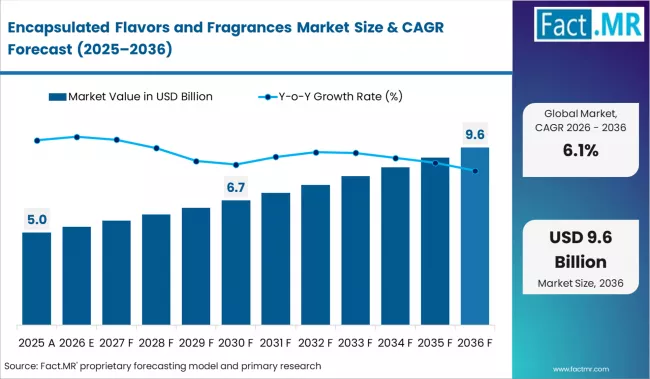
Encapsulated Flavors And Fragrances Market Market Value Analysis | Source: Fact.MR
Summary of Encapsulated Flavors and Fragrances Market
- Market Definition
- The encapsulated flavors and fragrances market refers to the production and supply of flavour and fragrance ingredients that are coated within protective wall materials such as maltodextrin, gum arabic, or cyclodextrin. This process helps improve stability, control release, and extend shelf life.
- Demand Drivers
- U.S. demand rises for controlled-release flavour systems.
- EU clean-label rules push natural wall materials.
- Japan invests in flavour stability for processed foods.
- Key Segments Analyzed
- By Product Type: Flavor blends lead 38% due to use in food and beverages.
- By Technology: Mechanical leads 46% as spray drying dominates production.
- By Geography: USA leads 6.0% CAGR driven by functional food demand.
- Analyst Opinion at FACT.MR
- Shambhu Nath Jha, Principal Consultant at Fact.MR, states that producers must adopt clean-label wall materials. Gum arabic, cyclodextrin, and whey protein are key. Without this, they may lose premium customers. Buyers now prefer both performance and clean-label compliance.
- Strategic Implications
- Invest in natural wall materials like gum arabic and whey protein.
- Develop nano-encapsulation for functional beverages.
- Expand powder formats for Asia’s food markets.
- Methodology
- Based on shipment volumes and pricing by segment.
- Uses EU, FDA, FSSAI, and company data.
- Forecasts include clean-label trends and food processing growth.
| Metric | Value |
|---|---|
| Estimated Value in 2026 | USD 5.3 billion |
| Forecast Value in 2036 | USD 9.6 billion |
| Forecast CAGR (2026 to 2036) | 6.1% |
Source: Fact.MR analysis. Updated Mar 31, 2026
Country growth reflects clean-label ingredient adoption pace, processed food manufacturing scale, and functional beverage market development. The USA leads at 6.0% CAGR through advanced food technology adoption and strong demand from functional beverage and nutraceutical manufacturers for controlled-release encapsulation systems. Germany follows at 5.6% through EU food ingredient regulation-aligned natural encapsulant development and premium food and beverage manufacturer sourcing. Japan records 4.9% through food texture and flavour stability technology investment in premium packaged food. China records 5.0% through expanding processed food and cosmetics manufacturing and rising demand for flavour protection in heat-processed food products. India records 4.3%, generating steady demand through expanding organised food processing and domestic flavour ingredient sector development, constrained by price sensitivity in mainstream food applications.
Segmental Analysis
Encapsulated Flavors and Fragrances Market Analysis by Product Type
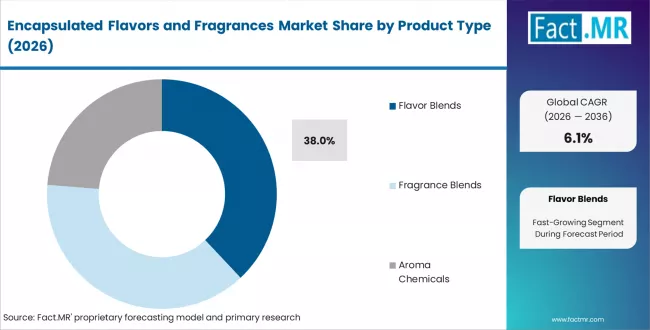
Encapsulated Flavors And Fragrances Market Analysis By Product Type | Source: Fact.MR
Flavor blends hold 38% share in 2026. They are widely used across food and beverage applications. Encapsulation protects flavour from heat and oxidation. It ensures stability during processing.
- IFF Investment: Expanded encapsulation capacity in 2024. Focus on clean-label flavour blends. Targets European food manufacturers. [4]
- Givaudan Technology: Launched natural encapsulation range in 2024. Uses gum arabic and starch. Improves flavour stability in beverages and dairy. [5]
- Fragrance Trend: Encapsulated fragrance demand grew 14% in 2024. Used in laundry and personal care. Supports long-lasting scent delivery. [6]
Encapsulated Flavors and Fragrances Market Analysis by Technology
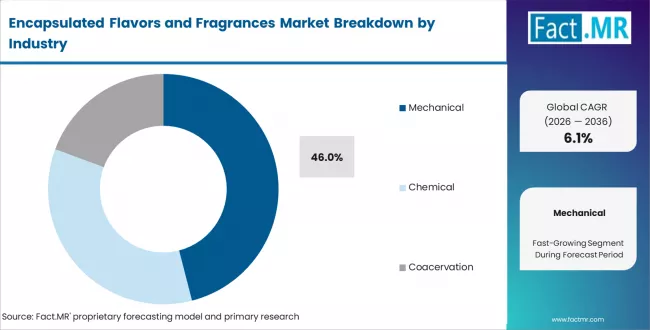
Encapsulated Flavors And Fragrances Market Analysis By Technology | Source: Fact.MR
Mechanical encapsulation holds 46% share in 2026. Spray drying remains the dominant method. It is cost-effective and scalable. Widely used in food applications.
- Symrise Expansion: Upgraded spray drying lines in 2024. Improved particle consistency and coating quality. Supports premium product demand. [7]
- Kerry Launch: Introduced nano-encapsulation in 2025. Targets functional beverage applications. Improves stability at high temperatures. [8]
Supercritical Trend: Demand for solvent-free encapsulation increased in 2024. Premium food and pharma sectors are adopting it. Supports clean-label product development. [9]
Drivers, Restraints, and Opportunities
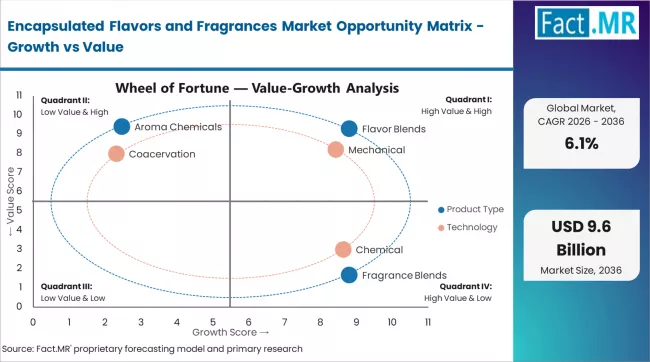
Encapsulated Flavors And Fragrances Market Opportunity Matrix Growth Vs Value | Source: Fact.MR
FACT.MR highlights two key demand trends. Developed markets are shifting to clean-label encapsulation. Natural wall materials are replacing synthetic systems. Emerging markets focus on cost-effective encapsulation. Growth is driven by processed food and cosmetics demand.
Standard maltodextrin encapsulation faces substitution pressure. Clean-label alternatives are gaining share in Europe and North America. However, maltodextrin remains strong in Asia Pacific. Natural encapsulants command 25–50% price premiums. This supports revenue growth despite slower volumes.
- China Clean Beauty Fragrance Adoption: China updated cosmetic safety rules in 2024. Encapsulated fragrances are included in compliance reviews. This drives demand for documented systems. Export-focused brands are investing more. [1]
- EU Food Flavouring Regulation: EU updated flavouring rules in 2024. It clarified natural classification and wall material approval. Manufacturers must ensure compliance. This increases demand for certified encapsulants. Leading suppliers benefit from this shift. [2]
- U.S. Functional Beverage Expansion: The U.S. functional beverage market grew 11% in 2024. Demand includes sports and health drinks. Encapsulation supports flavour stability and delivery. It is key for product performance. [3]
Regional Analysis
The encapsulated flavors and fragrances market is analysed across North America, Europe, Asia Pacific, Latin America, and Middle East and Africa, covering 40+ countries with distinct demand profiles shaped by food processing technology adoption, clean-label regulatory requirements, cosmetics industry growth, and functional beverage ingredient investment levels. The full report offers market attractiveness analysis based on food manufacturing output, clean-label adoption benchmarks, and encapsulation technology penetration rates.
.webp "Top Country Growth Comparison Encapsulated Flavors And Fragrances Market Cagr (2026 2036)")
Top Country Growth Comparison Encapsulated Flavors And Fragrances Market Cagr (2026 2036) | Source: Fact.MR
| Country | CAGR (2026 to 2036) |
|---|---|
| United States | 6.0% |
| Germany | 5.6% |
| China | 5.0% |
| Japan | 4.9% |
| India | 4.3% |
Source: Fact.MR analysis. Updated Mar 31, 2026
Source: Fact.MR (FACT.MR) analysis, based on proprietary forecasting model and primary research
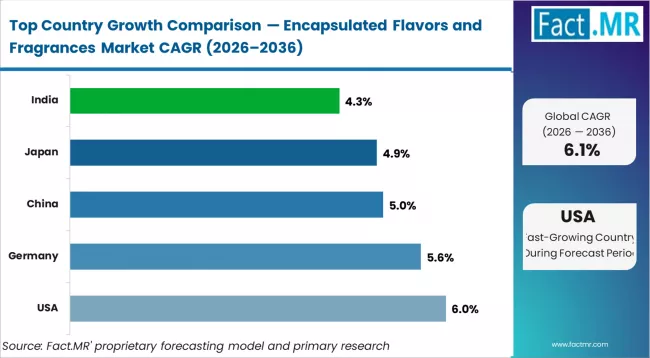
Encapsulated Flavors And Fragrances Market Cagr Analysis By Country | Source: Fact.MR
North America Encapsulated Flavors and Fragrances Market Analysis
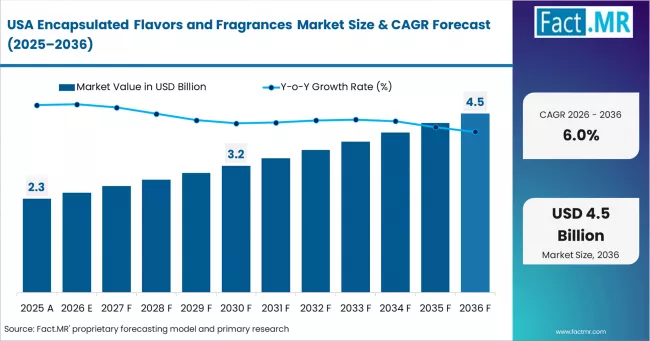
Encapsulated Flavors And Fragrances Market Country Value Analysis | Source: Fact.MR
North America is the highest-value region. Growth is driven by functional foods and beverages. The U.S. leads demand from nutraceutical and sports nutrition sectors. IFF, Kerry, and Sensient lead supply. Givaudan and Symrise focus on premium clean-label segments.
- United States: Growth is driven by functional food innovation and clean-label demand. The market grows at 6.0% CAGR through 2036. Kerry launched nano-encapsulated flavours in 2025. These support high-temperature processing. Industry guidance was updated in 2024. It clarified wall material classification. This helps compliance and label transparency. Demand is regulation-aware and performance-driven.
FACT.MR covers the U.S., Canada, and Mexico. It includes demand data, compliance trends, and forecasts.
Europe Encapsulated Flavors and Fragrances Market Analysis
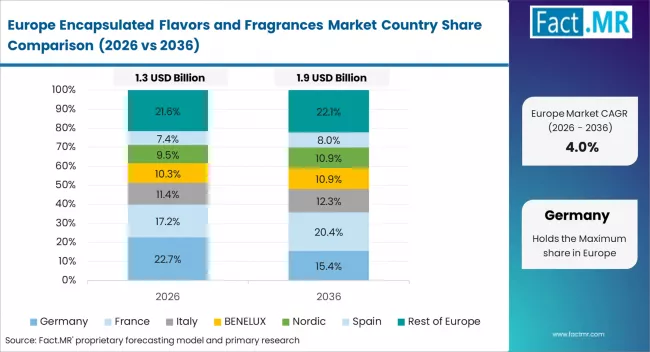
Encapsulated Flavors And Fragrances Market Europe Country Market Share Analysis, 2026 & 2036 | Source: Fact.MR
Europe is a compliance-driven market. EU rules define flavour classification and safety. EFSA guidance shapes ingredient approval. IFF, Givaudan, Symrise, and Firmenich lead supply. Germany and France are key demand centres.
- Germany: Growth is driven by clean-label adoption and compliance. The market grows at 5.6% CAGR through 2036. EU rules were updated in 2024. This clarified wall material standard. Food companies are reviewing supplier documentation. Symrise upgraded production lines in 2024. This supports premium flavour demand. Procurement is regulation-led.
- Japan: Growth is driven by food quality and stability needs. The market grows at 4.9% CAGR through 2036. Regulations were updated in 2024. The positive list system ensures ingredient safety. Companies invest in heat-stable encapsulation. T. Hasegawa expanded its portfolio. Demand is quality-focused and stable.
FACT.MR covers Germany, France, the UK, Italy, Spain, and Rest of Europe. It includes compliance data and forecasts.
Asia Pacific Encapsulated Flavors and Fragrances Market Analysis
Asia Pacific is the fastest-growing volume region. Growth is driven by food processing and cosmetics demand. China and India lead expansion. Global players supply through regional networks.
- China: Growth is driven by food production and cosmetics compliance. The market grows at 5.0% CAGR through 2036. Regulations were updated in 2024. Encapsulated fragrances require documentation. Food manufacturers need heat-stable flavours. Takasago expanded operations in 2024. Demand comes from both food and personal care sectors.
- India: Growth is driven by food processing expansion. The market grows at 4.3% CAGR through 2036. FSSAI updated standards in 2024. More wall materials are now approved. This supports encapsulation adoption. Mane expanded operations in 2024. Demand is cost-driven and volume-focused.
FACT.MR covers China, Japan, India, South Korea, ASEAN, and ANZ. It includes regulatory data, market trends, and forecasts.
Competitive Aligners for Market Players
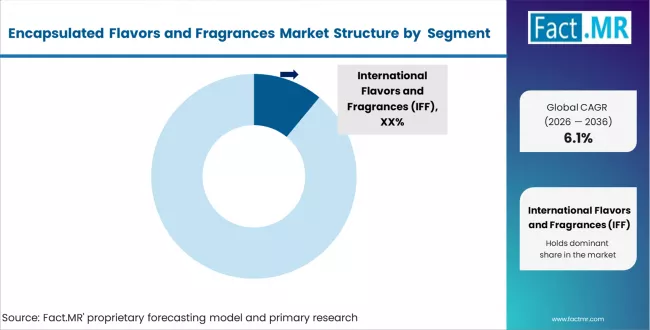
Encapsulated Flavors And Fragrances Market Analysis By Company | Source: Fact.MR
The encapsulated flavors and fragrances market is moderately concentrated. A few global companies dominate the premium segment. Key players include IFF, Givaudan, Firmenich, Symrise, Mane, and Kerry Group. These companies hold strong positions in high-value applications.
Competition is not only about scale. It depends on technology and product capability. Encapsulation methods, wall material options, and clean-label compliance are critical. Food and beverage companies require full regulatory documentation. Suppliers must meet standards across multiple regions.
IFF has a strong advantage in this space. It offers a wide range of encapsulation technologies. These include spray drying, coacervation, and nano-encapsulation. Its integrated supply chain supports quality control from start to finish. Givaudan and Symrise benefit from strong European relationships. They also have deep experience with EU regulations. This creates high switching costs for buyers.
Kerry Group focuses on functional applications. It supports controlled-release and enhanced bioavailability. This makes it strong in functional food and beverage markets. Large manufacturers manage supplier risk carefully. Companies like Nestlé, Danone, and Unilever use approved supplier lists. They also conduct regular formulation reviews. Once a formulation is approved, switching suppliers becomes difficult. It requires new trials and regulatory checks. This creates long-term supplier relationships. It also limits pricing flexibility in standard products.
Key Players
- International Flavors and Fragrances (IFF)
- Givaudan
- Firmenich
- Symrise
- Sensient Technologies
- Takasago International Corporation
- Mane SA
- Robertet Group
- Kerry Group
- T. Hasegawa Co., Ltd.
Bibliography
- [1] National Medical Products Administration, China. (2024). Cosmetic Ingredient Safety Review Guidelines Update: Encapsulated Fragrance Systems for Personal Care Applications Included in Reviewed Ingredient Categories for Export-Market Compliance Documentation. 2024. nmpa.gov.cn
- [2] European Commission. (2024). EU Regulation (EC) No 1334/2008 Food Flavourings Update: Natural Flavouring Substance Classification Requirements and Encapsulation Wall Material Approval Criteria Clarification for Encapsulated Flavour Ingredient Compliance. 2024. eur-lex.europa.eu
- [3] Beverage Marketing Corporation. (2024). U.S. Beverage Market Review 2024: Functional Beverage Category Growth of 11% Year-on-Year Including Sports Nutrition and Enhanced Water with Encapsulated Flavour and Bioactive Ingredient Technology Adoption Data. 2024. beveragemarketing.com
- [4] International Flavors and Fragrances Inc. (2024). Production Expansion: Encapsulated Flavour Ingredient Capability Expansion at Tilburg Netherlands Facility Targeting European Clean-Label Natural Wall Material Demand Under EU Regulation (EC) No 1334/2008 Compliance. September 2024. iff.com/investor-relations
- [5] Givaudan SA. (2024). Product Launch: Enhanced Natural Extract Encapsulation Range Using Gum Arabic and Modified Starch Wall Materials with Improved Oxidation Protection for Citrus and Herb Flavour Clean-Label Beverage and Dairy Applications. October 2024. givaudan.com/media
- [6] International Fragrance Association. (2024). Industry Market Review 2024: Encapsulated Fragrance Blend Growth of 14% Year-on-Year for Laundry, Personal Care, and Home Care Applications Including Micro-Encapsulated Burst-on-Friction Technology Adoption Data. December 2024. ifrafragrance.org
- [7] Symrise AG. (2024). Facility Upgrade: Spray Drying Encapsulation Production Line Improvements at Holzminden Germany Flavour Manufacturing Facility for Powder Morphology Consistency and Wall Material Coating Uniformity in Premium Flavour Blend Encapsulants. 2024. symrise.com/investors
- [8] Kerry Group plc. (2025). Product Launch: Nano-Encapsulated Natural Flavour Ingredient System for Functional Beverage Manufacturers in United States and Europe Requiring Controlled-Release Delivery Above 90 Degrees Celsius for Hot-Fill Beverage Applications. January 2025. kerrygroup.com/media
- [9] Sensient Technologies Corporation. (2024). FY2024 Annual Results: Supercritical Fluid Encapsulation Technology Orders Growth of 22% Year-on-Year from Pharmaceutical and Premium Food Customers for Solvent-Free Heat-Sensitive Natural Extract Encapsulation. 2024. sensient.com/investor-relations
This Report Addresses
- Strategic insights on encapsulated flavour and fragrance demand across functional beverage controlled-release systems, EU clean-label natural wall material compliance, Japan food flavouring regulatory framework, U.S. functional food technology adoption, and China cosmetics fragrance encapsulation compliance investment.
- Market forecast from USD 5.3 billion in 2026 to USD 9.6 billion by 2036 at a CAGR of 6.1%.
- Growth opportunity mapping across U.S. nano-encapsulated functional beverage ingredient demand, Germany EU Regulation (EC) No 1334/2008 clean-label natural encapsulant adoption, Japan heat-stable micro-encapsulated flavour investment, China processed food spray-dried encapsulant expansion, and India FSSAI-compliant encapsulated flavour market development.
- Segment-wise analysis by product type (flavor blends, fragrances, essential oils, aroma chemicals), technology (mechanical, nano, supercritical), wall material (gum arabic, cyclodextrin, whey protein), end-use (food/beverage, consumer goods), form (powder, paste, granules), and process (micro, nano, hybrid, macro-encapsulation).
- Regional outlook covering North America functional food technology leadership, Europe EU flavouring regulation-driven clean-label encapsulant adoption, and Asia Pacific processed food manufacturing volume expansion trends.
- Competitive landscape analysis of IFF, Givaudan, Symrise, Firmenich, Kerry Group, Mane SA, Sensient Technologies, Takasago, Robertet, and T. Hasegawa covering encapsulation technology portfolio depth, natural wall material sourcing, and regional food manufacturer relationship positioning.
- Technology tracking including nano-encapsulation controlled-release advances, gum arabic and cyclodextrin clean-label wall material development, supercritical CO2 solvent-free encapsulation, spray drying particle morphology optimisation, and coacervation flavour protection system innovation.
Report delivery in PDF, Excel datasets, and presentation formats supported by primary interviews, IFF and Givaudan revenue disclosures, EU food flavouring regulation publications, FDA GRAS notification data, and food processing industry association statistics.
Encapsulated Flavors and Fragrances Market Definition
The market includes encapsulated flavour and fragrance ingredients. Active compounds are coated within wall materials. Materials include maltodextrin, gum arabic, and cyclodextrin. It improves stability, controls release, and extends shelf life. Used in food, beverages, cosmetics, and personal care.
Encapsulated Flavors and Fragrances Market Inclusions
Includes forecasts from 2026 to 2036. Covers product type, technology, wall material, and end-use. Includes flavour blends, fragrances, oils, and aroma chemicals. Covers powder, paste, and granule forms across regions.
Encapsulated Flavors and Fragrances Market Exclusions
Excludes encapsulated ingredients. Omits finished consumer products using encapsulated flavors. Excludes standalone equipment and pharma drug delivery systems. Focus remains on flavor and fragrance encapsulation.
Encapsulated Flavors and Fragrances Market Methodology
- Primary Research
- Interviews with ingredient buyers and formulation experts. Inputs from R&D teams and engineers. Covers North America, Europe, Japan, China, and India.
- Desk Research
- Uses EU, FDA, and FSSAI regulatory data. Includes IFF and Givaudan reports. Reviews patent and industry data from 2024–2025.
- Market Sizing and Forecasting
- Based on shipment volumes and pricing by technology. Includes food processing growth data. Supported by industry interviews.
- Data Validation and Update Cycle
- Validated using company revenues and market data. Cross-checked with regulatory sources. Updated regularly.
Segmentation
Scope of Report
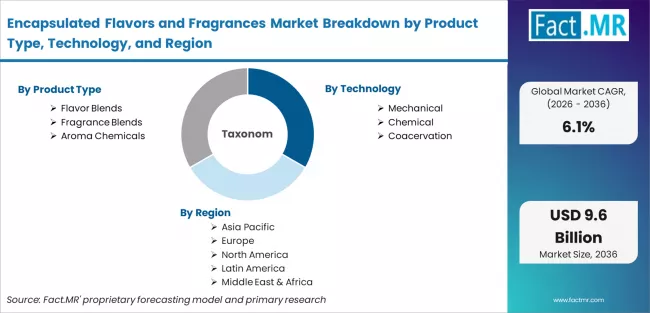
Encapsulated Flavors And Fragrances Market Breakdown By Product Type, Technology, And Region | Source: Fact.MR
| Attribute | Details |
|---|---|
| Quantitative Units | USD 5.3 billion (2026) to USD 9.6 billion (2036), at a CAGR of 6.1% |
| Market Definition | Flavour blends, fragrance blends, essential oils, and aroma chemicals protected within wall material encapsulation systems via mechanical, chemical, nano, and coacervation processes in powder, paste, and granule forms for food, beverage, cosmetics, and personal care end-use applications. |
| Product Type Segmentation | Flavor Blends, Fragrance Blends, Essential Oils and Natural Extracts, Aroma Chemicals |
| Technology Segmentation | Mechanical, Chemical, Concertation, Freeze Drying, Supercritical Fluid Technique, Nano Precipitation, Others |
| Wall Material Segmentation | Maltodextrin, Corn Syrup Solid, Modified Cellulose, Gum Arabic, Modified Starch, Gelatin, Cyclodextrin, Lecithin, Whey Protein, Hydrogenated Fat, Others |
| End-use Segmentation | Consumer Goods, Food and Beverage |
| Encapsulated Form Segmentation | Powder, Paste, Granules |
| Process Segmentation | Micro-encapsulation, Nano-encapsulation, Hybrid-encapsulation, Macro-encapsulation |
| Application Coverage | Functional beverage flavour stability, clean-label food product flavour blend supply, premium cosmetics micro-encapsulated fragrance, laundry and fabric care burst-release fragrance, nutraceutical controlled-release encapsulated natural extract, and bakery and confectionery heat-stable flavour protection. |
| Regions Covered | North America, Europe, Asia Pacific, Latin America, Middle East and Africa |
| Countries Covered | USA, Canada, Mexico, Germany, UK, France, Italy, Spain, Nordic, BENELUX, China, Japan, South Korea, India, ASEAN, Australia and New Zealand, Brazil, Argentina, Chile, Saudi Arabia, GCC, Turkey, South Africa, Rest of MEA |
| Key Companies Profiled | International Flavors and Fragrances (IFF), Givaudan, Firmenich, Symrise, Sensient Technologies, Takasago International Corporation, Mane SA, Robertet Group, Kerry Group, T. Hasegawa Co. Ltd. |
| Forecast Period | 2026 to 2036 |
| Approach | Hybrid top-down and bottom-up model using encapsulated flavour and fragrance shipment volumes by product type and end-use, average selling prices by technology and wall material tier, food and beverage processing growth benchmarks, and primary interviews with flavour chemists, encapsulation engineers, and food ingredient procurement managers. |
Source: Fact.MR analysis. Updated Mar 31, 2026
Encapsulated Flavors and Fragrances Market by Segments
-
By Product Type:
- Flavor Blends
- Fragrance Blends
- Essential Oils and Natural Extracts
- Aroma Chemicals
-
By Technology:
- Mechanical (Emulsification, Spray Drying, Spray Chilling/Cooling, Fluidized-Bed Coating, Centrifugal Extrusion)
- Chemical
- Coacervation
- Freeze Drying
- Supercritical Fluid Technique
- Nano Precipitation
- Others
-
By Wall Material:
- Maltodextrin (DE<20)
- Corn Syrup Solid (DE>20)
- Modified Cellulose
- Gum Arabic
- Modified Starch
- Gelatin
- Cyclodextrin
- Lecithin
- Whey Protein
- Hydrogenated Fat
- Others
-
By End-use:
- Consumer Goods
- Food and Beverage
-
By Encapsulated Form:
- Powder
- Paste
- Granules
-
By Process:
- Micro-encapsulation
- Nano-encapsulation
- Hybrid-encapsulation
- Macro-encapsulation
-
By Region:
-
North America
- United States
- Canada
- Mexico
-
Latin America
- Brazil
- Mexico
- Argentina
- Chile
- Rest of Latin America
-
Western Europe
- Germany
- United Kingdom
- France
- Italy
- Spain
- Nordic Countries
- BENELUX
- Rest of Western Europe
-
Eastern Europe
- Russia
- Poland
- Hungary
- Balkan and Baltic
- Rest of Eastern Europe
-
East Asia
- China
- Japan
- South Korea
-
South Asia and Pacific
- India
- ASEAN
- Australia and New Zealand
- Rest of South Asia and Pacific
-
Middle East and Africa
- Kingdom of Saudi Arabia
- Other GCC Countries
- Turkey
- South Africa
- Rest of Middle East and Africa
-
Frequently Asked Questions
How large is the encapsulated flavors and fragrances market in 2025?
What will the market size be in 2026?
What is the projected market size by 2036?
What is the expected CAGR of the encapsulated flavors and fragrances market?
What is the absolute dollar opportunity in this market?
Which product type segment leads the market?
Which technology segment holds the largest share?
Which region grows fastest?
Which country shows the fastest growth?
Who worked on this report


Preview the report firsthand - request a free sample
Free SampleGet the brochure for pricing and purchase details
Download PDF