- Market Value (2025): USD 1.5 Bn
- Estimated Value (2026): USD 1.6 Bn
- Forecast Value (2036): USD 2.8 Bn
- CAGR (2026-2036): 5.7%
What is the Salon Chairs Market forecast to be worth by 2036?
USD 1.6 billion in 2026 to USD 2.8 billion by 2036 at a 5.7% CAGR.
- The Salon Chairs Market reached approximately USD 1.5 billion in 2025.
- Demand is projected to increase from USD 1.6 billion in 2026 to USD 2.8 billion by 2036.
- The market is forecast to record a 5.7% CAGR from 2026 to 2036.
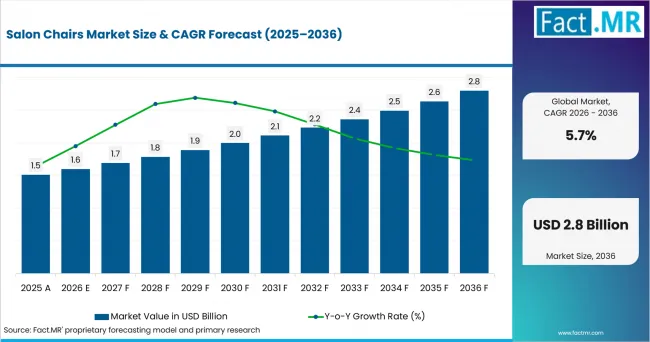
Salon Chairs Market Value Analysis | Source: Fact.MR
What are the defining numbers behind Salon Chairs Market growth?
An absolute opportunity of USD 1.2 billion is expected between 2026 and 2036.
- Demand Drivers in the Market
- Salon chairs are high-use workstations, so replacement demand follows the installed salon base. The U.S. Census Bureau counted 84,176 employer beauty salon establishments in 2023. It also recorded 838,264 nonemployer beauty salon businesses. This fragmented buyer structure supports recurring purchases in small quantities, often around individual station replacement rather than a complete refit.
- Ergonomics is influencing chair specification. EU-OSHA guidance for the hairdressing sector recommends adjustable chairs and stools as part of musculoskeletal-risk prevention. A peer-reviewed study of hairdressers in India found lower-back pain among 39.8% of participants. Hydraulic height adjustment gives stylists a practical way to bring clients closer to a workable cutting height.
- Service demand keeps chair stations occupied. The U.S. Bureau of Labor Statistics projects 5% employment growth for barbers, hairstylists and cosmetologists from 2024 to 2034. It links demand primarily to basic hair care and continued interest in coloring or advanced treatments. Growth in professional hair care and hair color keeps salon seating tied to a recurring service cycle.
- Chair design is becoming more service-specific. Current catalogs from the companies covered in this report show hydraulic styling chairs, reclining models and shampoo-compatible seating. Salons can therefore match seating to hair styling workflows and floor-plan constraints instead of using one chair format at every station.
- Procurement is moving toward configurable and direct channels. Manufacturers offer multiple base styles, upholstery choices and hydraulic options, while direct sellers carry quick-ship replacement chairs. That structure supports direct purchases for salons that need specification support or coordinated multi-chair orders across beauty services. Buyers still separate seating budgets from adjacent beauty devices, which follow a different equipment cycle.
- Key Segments Analyzed
- Hydraulic Salon Chairs account for 63.4% of Product in 2026 because adjustable working height fits repeated cutting and styling tasks without requiring a powered lift system.
- Hair Cutting Services represent 71.8% of Application in 2026 as the client remains seated for most of the cutting workflow and chair height directly affects stylist posture.
- Professional Salons account for 58.9% of End Use in 2026 because fixed multi-station layouts create a recurring requirement for durable commercial seating and planned replacement.
- Hydraulic Lift Technology holds 54.6% of Technology in 2026 as foot-operated height adjustment combines simple control with a stable commercial base.
- Standard Salon Chair Systems represent 46.2% of Formulation in 2026 because basic functional and commercial-grade chairs cover a broad set of day-to-day salon requirements.
- Direct Manufacturer Sales account for 38.7% of Distribution Channel in 2026 because salons often need coordinated choices for base type, upholstery and after-sales parts when purchasing several chairs.
- Analyst Opinion at Fact.MR
- Shambhu Nath Jha, Principal Consultant at Fact.MR, states, "Salon chairs are selected as working equipment rather than decorative furniture. A salon owner has to match seat geometry with the service task and choose the lift range around working height. The floor footprint must also fit the station layout. Hydraulic chairs remain practical because they give the stylist quick height control with limited system complexity. Suppliers that combine reliable pumps with cleanable upholstery and accessible replacement parts can improve the economics of long-term salon use."
- Strategic Implications
- Suppliers should publish lift range, base dimensions and weight ratings in consistent product documentation so salon owners can compare chairs against workstation height and floor space.
- Hydraulic reliability should be treated as a service proposition. Warranty coverage, replacement pumps and local technical support influence the usable life of the chair after the initial purchase.
- Upholstery should be specified around cleaning frequency and exposure to colorants. Removable or stain-resistant surfaces can reduce downtime between clients and extend appearance life.
- Multi-site salon operators can reduce variation by standardizing a small number of chair configurations across cutting, grooming and washing stations while keeping upholstery options flexible.
- Direct sellers should separate quick-ship models from made-to-order ranges. The first serves replacement demand, while the second fits refurbishment projects that need coordinated materials and finishes.
How does the Salon Chairs Market break down by segment?
The market is segmented by Product, Application, End Use, Technology, Formulation and Distribution Channel.
Why do Hydraulic Salon Chairs lead Product?
Hydraulic Salon Chairs are projected to account for a 63.4% share in 2026.
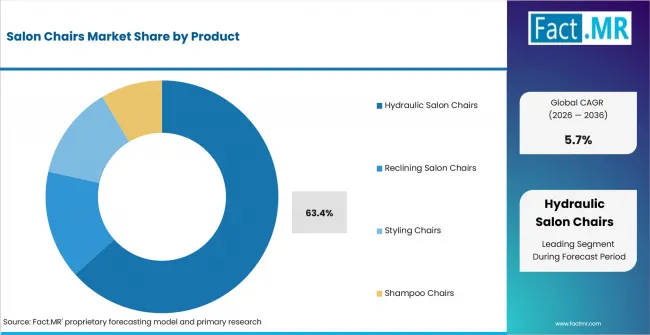
Salon Chairs Market Analysis By Product | Source: Fact.MR
Hydraulic chairs lead because a stylist needs to change client height repeatedly during cutting and grooming. A foot-operated pump allows adjustment while the client remains seated, which keeps the service station stable and avoids dependence on an electric motor for routine movement.
Current commercial products from Takara Belmont, Maletti, Gamma & Bross, Collins and Buy-Rite Beauty use hydraulic bases across styling-chair ranges. The technology also supports different upper-chair designs, allowing a salon to standardize the lift mechanism while varying upholstery or seat geometry by service area.
Why do Hair Cutting Services lead Application?
Hair Cutting Services are projected to account for a 71.8% share in 2026.
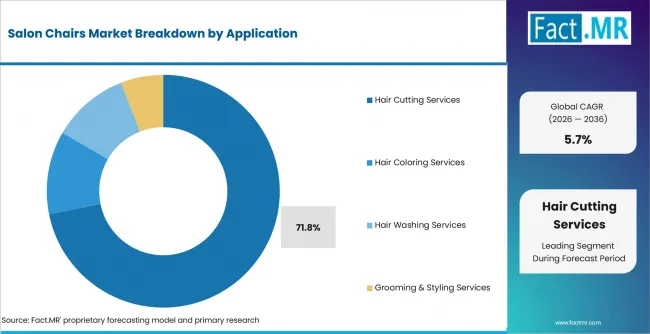
Salon Chairs Market Analysis By Application | Source: Fact.MR
Hair cutting leads because the chair is used for most of the service cycle. The stylist needs clear access around the client and must position the head or shoulders at a workable height, so chair adjustment directly affects service execution.
The U.S. Bureau of Labor Statistics states that demand for barbers and hairdressers will stem primarily from basic hair care services. Coloring and washing remain important, but those services can use additional equipment such as backwash units or processing stations. Cutting keeps the salon chair at the center of the workstation.
Why do Professional Salons lead End Use?
Professional Salons are projected to account for a 58.9% share in 2026.
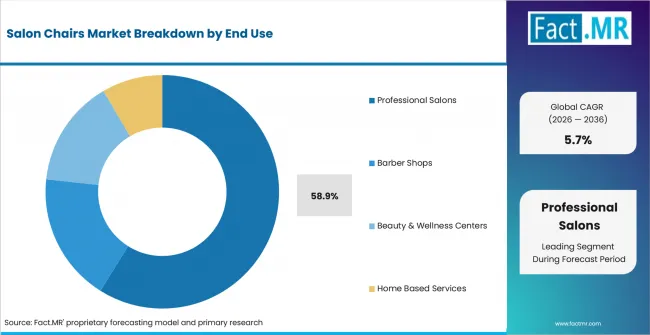
Salon Chairs Market Analysis By End Use | Source: Fact.MR
Professional salons lead because they operate permanent workstations with repeated client turnover. Each occupied cutting or styling position requires a chair that can withstand daily rotation and height adjustment, while a multi-chair layout creates replacement demand as individual units wear at different rates.
The U.S. Census Bureau recorded 84,176 employer beauty salon establishments in 2023. Japan reported 274,070 beauty salons at the end of fiscal 2023. These established service networks create a broad installed base for salon seating, with purchases linked to new openings, renovations and station-level replacement.
Why does Hydraulic Lift Technology lead Technology?
Hydraulic Lift Technology is projected to account for a 54.6% share in 2026.
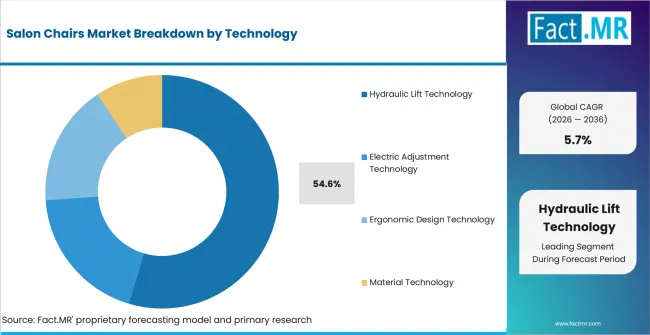
Salon Chairs Market Analysis By Technology | Source: Fact.MR
Hydraulic lift technology leads because it addresses the core ergonomic requirement without adding a powered actuator to every chair. Stylists can raise or lower the client with a foot control, which supports frequent adjustment and keeps hands available for the service task.
EU-OSHA guidance for hairdressing identifies adjustable chairs and stools as part of preventing musculoskeletal disorders. Hydraulic lift systems translate that workplace requirement into a chair feature that can be used throughout the day. Electric adjustment remains relevant where additional powered movement is required, but it introduces more components and a higher specification level.
Why do Standard Salon Chair Systems lead Formulation?
Standard Salon Chair Systems are projected to account for a 46.2% share in 2026.
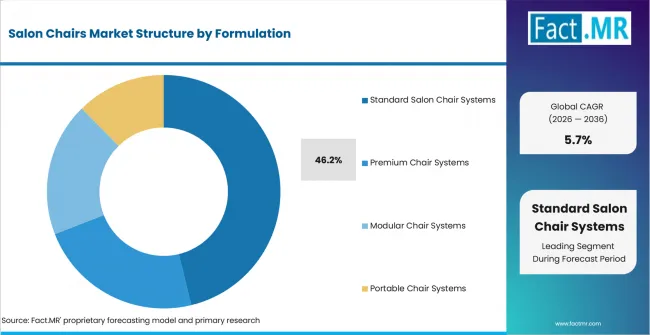
Salon Chairs Market Analysis By Formulation | Source: Fact.MR
Standard systems lead because most day-to-day salon stations require dependable height control, a commercial base and cleanable seating rather than specialized powered functions. Basic Functional Chairs and Commercial Grade Chairs therefore cover a wide purchasing range without moving into luxury or highly customized fit-outs.
This configuration also fits phased replacement. A salon can replace worn chairs one station at a time while keeping a familiar footprint and operating method. Premium or modular chair systems serve renovation projects that place more weight on design customization, while portable systems address narrower mobile-service needs.
Why does Direct Manufacturer Sales lead Distribution Channel?
Direct Manufacturer Sales are projected to account for a 38.7% share in 2026.
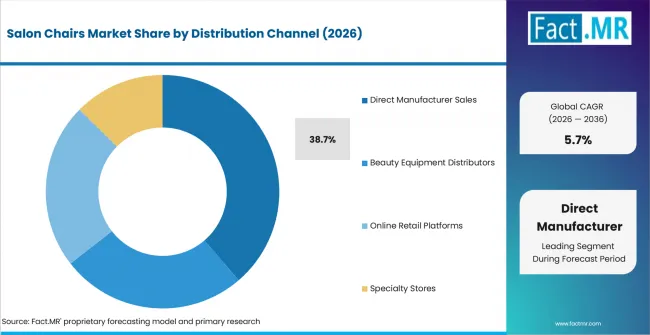
Salon Chairs Market Analysis By Distribution Channel | Source: Fact.MR
Direct sales lead because salon chairs are configurable capital items. Buyers may need to choose a hydraulic base, upholstery and footrest while checking dimensions against the station layout. Manufacturer-led sales also make it easier to coordinate several units with the same finish for a new salon or chain refurbishment.
The channel has an after-sales advantage as well. Hydraulic pumps and upholstery can require service during the chair life, so access to parts and warranty support can influence the purchase. Distributor and online channels remain useful for fast availability, but direct manufacturer contact carries more value when specifications or multi-chair coordination are involved.
What is accelerating Salon Chairs Market adoption, and what is holding it back?
Growth is supported by salon refurbishment, workstation ergonomics and sustained cutting and grooming activity, while deferred furniture spending, freight costs and hydraulic-service constraints can slow purchases.
Drivers Impact Analysis
| Factor | (~) % Impact on CAGR | Geographic Relevance | Impact Timeline |
|---|---|---|---|
| Salon refurbishment and station-level replacement | +1.3% | Global | Short term (<= 2 years) |
| Workstation ergonomics and adjustable-height demand | +1.0% | Germany; UK; USA | Short term (<= 2 years) |
| Cutting and grooming service activity | +0.8% | Global | Medium term (2-4 years) |
| Direct replacement availability | +0.5% | USA; UK; Europe | Medium term (2-4 years) |
Source: Fact.MR analysis. Updated Aug 21, 2026
Opportunity Impact Analysis
| Factor | (~) % Impact on CAGR | Geographic Relevance | Impact Timeline |
|---|---|---|---|
| Configurable chair platforms for salon chains | +0.6% | Global | Medium term (2-4 years) |
| Compact and portable chair formats | +0.4% | USA; UK; Japan | Medium term (2-4 years) |
| Direct online replacement channels | +0.3% | USA; UK; Europe | Medium term (2-4 years) |
| After-sales parts and service programs | +0.3% | Global | Long term (>= 4 years) |
Source: Fact.MR analysis. Updated Aug 21, 2026
Restraints Impact Analysis
| Factor | (~) % Impact on CAGR | Geographic Relevance | Impact Timeline |
|---|---|---|---|
| Deferred salon furniture capital expenditure | -0.8% | Global | Short term (<= 2 years) |
| Freight and installation cost | -0.6% | Global | Short term (<= 2 years) |
| Hydraulic component and service risk | -0.4% | Import-dependent markets | Medium term (2-4 years) |
| Long chair replacement cycles | -0.3% | Developed markets | Long term (>= 4 years) |
Source: Fact.MR analysis. Updated Aug 21, 2026
Which countries are scaling the Salon Chairs Market through 2036?
- Germany: The German hairdressing craft remains a broad base of small service businesses, and Destatis continues to track hairdresser enterprises and employment through its craft statistics. Replacement purchases are supported by the need to keep fixed salon stations functional while ergonomic expectations become more explicit across European hairdressing workplaces.
- USA: The U.S. Census Bureau counted 84,176 employer beauty salon establishments in 2023, while a much larger nonemployer base shows how fragmented the buyer population is. This supports a mix of direct, distributor and online chair purchases across independent operators and multi-site salons.
- UK: The Office for National Statistics maintains a 2025 extract covering enterprise counts and employment for hairdressing and beauty salons across UK countries and local areas. A dispersed establishment base supports recurring chair replacement outside a small number of national chains.
- Japan: The Ministry of Health, Labour and Welfare reported 274,070 beauty salons at the end of fiscal 2023, up 1.5% from the previous year. A dense salon network gives equipment suppliers a substantial installed base for hydraulic-chair replacement and refurbishment.
- France: INSEE's permanent equipment database tracks hairdressing services across French communes and regions. The broad geographic presence of salons supports steady replacement demand, while current INRS guidance keeps musculoskeletal-risk prevention relevant to workstation design.
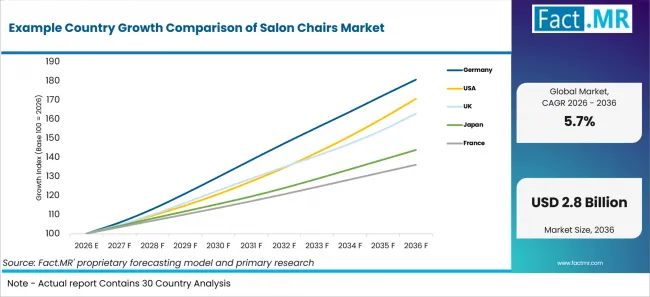
Example Country Growth Comparison Of Salon Chairs Market | Source: Fact.MR
Country CAGR (2026-2036)
| Country | CAGR (2026-2036) |
|---|---|
| Germany | 6.1% |
| USA | 5.5% |
| UK | 5.0% |
| Japan | 3.7% |
| France | 3.13% |
Source: Fact.MR analysis. Updated Aug 21, 2026
What is driving Germany's growth through 2036?
Germany is forecast to expand at a 6.1% CAGR from 2026 to 2036.
Growth is supported by an established hairdressing craft base and the routine replacement needs of small salon businesses. Destatis table 53111-0011 covers hairdresser enterprises and employment in the 2024 craft census, providing a direct indicator of the operating base that uses professional seating.
European hairdressing safety guidance also recommends adjustable chairs and stools to reduce musculoskeletal risk. For equipment buyers, that turns height adjustment from a design preference into a practical workstation consideration during salon refurbishment.
What is driving the USA's growth through 2036?
The USA is forecast to expand at a 5.5% CAGR from 2026 to 2036.
The country combines an established employer-salon base with a large independent operator population. Census data recorded 838,264 nonemployer beauty salon establishments in 2023, showing that chair demand is spread across many small businesses that often replace one or two stations at a time.
The labor outlook supports continued chair utilization. The Bureau of Labor Statistics projects about 84,200 annual openings for barbers, hairstylists and cosmetologists on average through 2034, reflecting replacement hiring and demand for personal appearance services. This sustains the workstation base that equipment suppliers serve.
What is driving the UK's growth through 2036?
The UK is forecast to expand at a 5.0% CAGR from 2026 to 2036.
The Office for National Statistics published a dedicated 2025 dataset for hairdressing and beauty salons that covers enterprise counts, employment and local geography. This business structure creates demand from independent salons as well as organized operators, with purchasing spread across refurbishment, new fit-outs and chair replacement.
UK workplace guidance on awkward posture also emphasizes adjustable seating and appropriate working height. Salon owners can apply the same ergonomic principle by selecting chairs that allow the client position to move rather than forcing the stylist to sustain an awkward shoulder or back posture.
What is driving Japan's growth through 2036?
Japan is forecast to expand at a 3.7% CAGR from 2026 to 2036.
Japan reported 579,768 working beauticians in fiscal 2023. The number of beauty salons also increased during the year, which supports a continuing need for salon equipment across established and new service locations.
The market is shaped by a mature installed base, so replacement and workstation improvement carry more weight than rapid expansion alone. Current salon equipment from Japanese suppliers emphasizes seating comfort, compact design and hydraulic control, fitting dense salon layouts and long operating hours.
What is driving France's growth through 2036?
France is forecast to expand at a 3.13% CAGR from 2026 to 2036.
INSEE's Base permanente des équipements records hairdressing services across French local areas, confirming that the salon network extends well beyond the major cities. This supports a recurring replacement market in which distributors and direct suppliers can serve geographically dispersed buyers.
INRS updated its prevention guidance for beauty trades in 2026 and identifies musculoskeletal disorders as a continuing workplace risk in hairdressing. Replacement chairs that improve working height and client positioning therefore have a practical role in salon modernization, even where the number of outlets grows slowly.
Who Leads the Salon Chairs Market?
Takara Belmont USA, Maletti, GAMMA & BROSS S.p.A., Collins, BUY-RITE BEAUTY and other suppliers compete through hydraulic-chair ranges, upholstery configurations, product availability and after-sales support. Takara Belmont USA offers salon seating and hydraulic bases, while Maletti and GAMMA & BROSS supply professional styling-chair systems with configurable finishes and lift options.
EarthLite LLC, LCL BEAUTY, Pietranera Srl and Keller International also participate across professional salon and barber seating. Direct online sellers compete on quick availability, while manufacturers serving refurbishment projects place more emphasis on coordinated finishes and multi-chair specification support.
Competition is shaped by hydraulic reliability and seat durability. Buyers also evaluate cleaning requirements, replacement-part access and delivery lead time. Design customization matters during full salon refurbishment, while rapid availability carries more weight when an operating station needs replacement.
Which companies are the key providers?
Key companies profiled include Takara Belmont USA; Maletti; EarthLite LLC; BUY-RITE BEAUTY; Collins; LCL BEAUTY; GAMMA & BROSS S.p.A.; Pietranera Srl; and Keller International.
- Takara Belmont USA
- Maletti
- EarthLite LLC
- BUY-RITE BEAUTY
- Collins
- LCL BEAUTY
- GAMMA & BROSS S.p.A.
- Pietranera Srl
- Keller International
Bibliography
- U.S. Census Bureau. (2025). County Business Patterns 2023: Beauty Salons, NAICS 812112. U.S. Department of Commerce.
- U.S. Census Bureau. (2025). Nonemployer Statistics 2023: Beauty Salons, NAICS 812112. U.S. Department of Commerce.
- U.S. Bureau of Labor Statistics. (2025). Barbers, Hairstylists, and Cosmetologists: Occupational Outlook Handbook. U.S. Department of Labor.
- Federal Statistical Office of Germany. (2026). Handwerksunternehmen, Tätige Personen, Umsatz: 2024, Friseure. Destatis.
- Office for National Statistics. (2025). Hairdressing and Beauty Salons, 2025. UK Statistics Authority.
- Ministry of Health, Labour and Welfare, Japan. (2024). Report on Public Health Administration and Services: Beauty Salons and Beauticians. Government of Japan.
- Institut national de la statistique et des études économiques. (2025). Base permanente des équipements 2024: Coiffure. Government of France.
- Institut national de recherche et de sécurité. (2026). Métiers de la beauté : évaluez pour agir en prévention. INRS.
- European Agency for Safety and Health at Work. (2025). European Framework Agreement on the Protection of Occupational Health and Safety in the Hairdressing Sector. European Union.
- Mishra, S., and Sarkar, K. (2021). Work-related musculoskeletal disorders and associated risk factors among urban metropolitan hairdressers in India. Journal of Occupational Health.
- Takara Belmont USA. (2026). Salon Seating and Hydraulic Base Product Information. Takara Belmont USA.
- Maletti. (2026). Hair Salon Furniture and Hydraulic Chair Bases. Maletti.
- GAMMA & BROSS S.p.A. (2026). Salon Styling Chairs. Gamma & Bross.
- Collins. (2026). Salon Equipment and Styling Chairs. Collins.
- BUY-RITE BEAUTY. (2026). Salon Styling Chairs and Hydraulic Chair Specifications. Buy-Rite Beauty.
- LCL BEAUTY. (2026). Salon and Barber Chairs. LCL Beauty.
- Pietranera Srl. (2026). Equipment and Furniture for Hairdressers and Barber Shops. Pietranera.
This Report Answers
- The report explains how salon-chair demand differs across Product, Application, End Use, Technology, Formulation and Distribution Channel.
- Segment analysis examines why hydraulic seating and hair-cutting applications account for a substantial part of professional salon-chair demand.
- Country analysis evaluates the salon operating base and workplace factors shaping equipment replacement across Germany, the USA, the UK, Japan and France.
- Competitive analysis reviews the listed companies through product configuration, hydraulic support and route-to-market considerations.
- The scope separates salon seating from adjacent beauty equipment and general furniture so the market boundary remains tied to the defined segmentation.
What does the Salon Chairs Market cover?
The Salon Chairs Market covers professional seating designed for client positioning during hair cutting, styling, grooming and washing services. The product boundary follows the supplied categories for hydraulic chairs, reclining chairs, styling chairs and shampoo chairs, together with the specified technology and channel classifications.
Revenue is counted when a chair is sold as salon or barber service equipment within the covered Product, Application, End Use, Technology, Formulation and Distribution Channel structure. The market includes fixed commercial installations as well as the portable-chair systems listed within the segmentation.
What is included in the scope?
The scope includes Hydraulic Salon Chairs, Reclining Salon Chairs, Styling Chairs and Shampoo Chairs supplied to Professional Salons, Barber Shops, Beauty & Wellness Centers and Home Based Services. Both hydraulic and electric adjustment systems are included where the chair itself is the commercial product.
The assessment also includes Standard Salon Chair Systems, Premium Chair Systems, Modular Chair Systems and Portable Chair Systems. Sales through direct manufacturers, beauty-equipment distributors, online platforms and specialty stores are included when they relate to the covered salon-chair products.
What is excluded from the scope?
General household chairs and waiting-room seating are excluded when they are not designed for a covered salon service. Standalone styling stations, mirrors, trolleys and storage cabinets fall outside the market because they do not provide the client-seating function.
Shampoo basins sold without an integrated or paired chair are excluded, as are massage tables, facial beds, pedicure chairs and tattoo chairs when sold for applications outside the stated salon-chair segmentation. Replacement pumps and upholstery parts sold separately are treated as components rather than complete chair revenue. Used-equipment resale is also outside the market.
How Was the Analysis Built?
The analysis draws on salon operating activity, product configuration and purchasing behavior across the covered segments and countries.
- Primary Research: Interviews with salon owners, multi-site operators, equipment distributors, salon designers and service technicians examine chair replacement timing, hydraulic performance, workstation density and purchasing channels.
- Desk Research: The review covers official salon-establishment statistics, hairdressing employment data, occupational-health guidance and current supplier product documentation. Company catalogs are used to verify chair configurations and commercial availability.
- Market Sizing and Forecasting: Estimates combine salon-establishment counts, chair stations per outlet, product mix, replacement cycles and average selling prices. Channel mix and country-level service activity are used to test the forecast path.
- Data Validation and Update Cycle: Findings are reviewed against current supplier activity, official salon statistics and product availability. Updates account for changes in salon openings, replacement demand, hydraulic-chair ranges and distribution channels.
Segmentation
What is the report's scope and coverage?
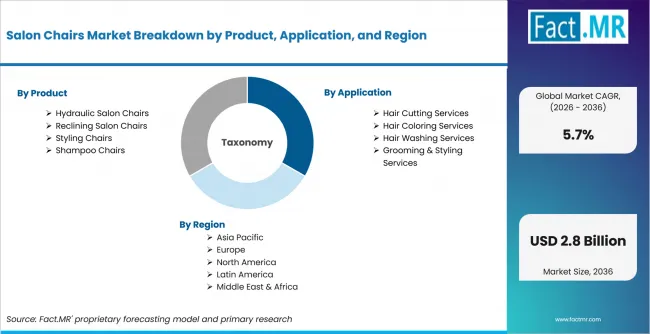
Salon Chairs Market Breakdown By Product, Application, And Region | Source: Fact.MR
| Attribute | Details |
|---|---|
| Quantitative Units | USD billion |
| Market Definition | Professional seating sold for hair cutting, styling, grooming and washing workflows across the covered salon-chair configurations. |
| Segments Covered | Product; Application; End Use; Technology; Formulation; Distribution Channel |
| Regions Covered | North America; Latin America; Europe; East Asia; South Asia and Pacific; Middle East and Africa |
| Countries Covered | Germany; USA; UK; Japan; France |
| Key Companies Profiled | Takara Belmont USA; Maletti; EarthLite LLC; BUY-RITE BEAUTY; Collins; LCL BEAUTY; GAMMA & BROSS S.p.A.; Pietranera Srl; Keller International |
| Forecast Period | 2026 to 2036 |
| Base Year | 2025 |
| Market Value, 2026 | USD 1.6 billion |
| Market Value, 2036 | USD 2.8 billion |
| CAGR, 2026-2036 | 5.7% |
| Absolute Opportunity | USD 1.2 billion |
| Approach | Combines salon establishment base, chair stations per outlet, replacement cycles, product configuration mix, distribution channel, average selling price and country-level salon activity. |
Source: Fact.MR analysis. Updated Aug 21, 2026
How is the market segmented?
-
By Product:
- Hydraulic Salon Chairs
- Pump Based Hydraulic Chairs
- Electric Hydraulic Chairs
- Reclining Salon Chairs
- Basic Recliner Chairs
- Luxury Recliner Chairs
- Styling Chairs
- Cutting Chairs
- All Purpose Styling Chairs
- Shampoo Chairs
- Fixed Basin Shampoo Chairs
- Portable Shampoo Chairs
- Hydraulic Salon Chairs
-
By Application:
- Hair Cutting Services
- Men’s Hair Cutting
- Women’s Hair Cutting
- Hair Coloring Services
- Permanent Coloring Services
- Temporary Coloring Services
- Hair Washing Services
- Basic Hair Wash Services
- Therapeutic Hair Wash Services
- Grooming & Styling Services
- Beard Grooming Services
- Advanced Styling Services
- Hair Cutting Services
-
By End Use:
- Professional Salons
- Unisex Salons
- Luxury Beauty Salons
- Barber Shops
- Traditional Barber Shops
- Modern Barber Chains
- Beauty & Wellness Centers
- Spa Integrated Salons
- Wellness Chains
- Home Based Services
- Mobile Salon Services
- Freelance Stylists
- Professional Salons
-
By Technology:
- Hydraulic Lift Technology
- Single Pump Systems
- Dual Pump Systems
- Electric Adjustment Technology
- Motorized Height Control
- Remote Controlled Systems
- Ergonomic Design Technology
- Comfort Optimization Systems
- Adjustable Support Systems
- Material Technology
- Synthetic Leather Systems
- Metal Frame Technology
- Hydraulic Lift Technology
-
By Formulation:
- Standard Salon Chair Systems
- Basic Functional Chairs
- Commercial Grade Chairs
- Premium Chair Systems
- Luxury Salon Chairs
- Ergonomic Premium Chairs
- Modular Chair Systems
- Customizable Chairs
- Multi Function Chairs
- Portable Chair Systems
- Foldable Chairs
- Compact Chair Systems
- Standard Salon Chair Systems
-
By Distribution Channel:
- Direct Manufacturer Sales
- Salon Chain Contracts
- Individual Salon Sales
- Beauty Equipment Distributors
- Regional Distributors
- National Distributors
- Online Retail Platforms
- E Commerce Marketplaces
- Manufacturer Direct Websites
- Specialty Stores
- Beauty Equipment Showrooms
- Trade Exhibition Sales
- Direct Manufacturer Sales
-
By Region:
- North America
- Latin America
- Western Europe
- Eastern Europe
- East Asia
- South Asia and Pacific
- Middle East & Africa
Frequently Asked Questions
What is the Salon Chairs Market value in 2026?
At what CAGR is the market projected to grow?
What is the projected market value by 2036?
Which Product leads the market?
Which Application leads the market?
Which End Use leads the market?
Which Technology leads the market?
Which Formulation leads the market?
Which Distribution Channel leads the market?
Which country records the highest listed CAGR?
What is the primary driver in this market?
What is the main restraint?
Which companies are included in the market assessment?
Who worked on this report


Preview the report firsthand - request a free sample
Free SampleGet the brochure for pricing and purchase details
Download PDF