- Market Value (2025): USD 2.0 Bn
- Estimated Value (2026): USD 2.1 Bn
- Forecast Value (2036): USD 3.7 Bn
- CAGR (2026-2036): 5.8%
What is the Food Grade Ink Market forecast to be worth by 2036?
USD 3.7 billion by 2036.
- The Food Grade Ink Market reached approximately USD 2.0 billion in 2025.
- Demand is projected to increase from USD 2.1 billion in 2026 to USD 3.7 billion by 2036.
- The market is forecast to record a 5.8% CAGR from 2026 to 2036.
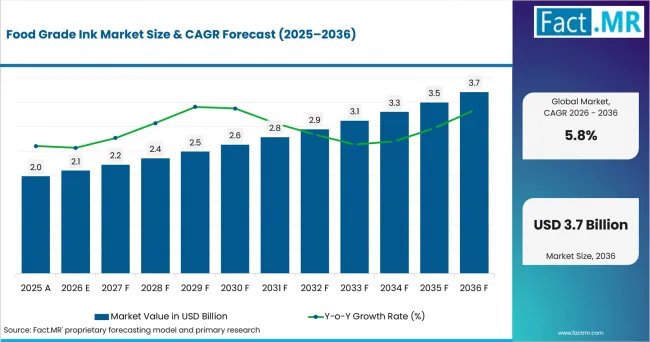
Food Grade Ink Market Value Analysis | Source: Fact.MR
What are the defining numbers behind Food Grade Ink Market growth?
An absolute opportunity of USD 1.6 billion is expected between 2026 and 2036.
- Demand Drivers in the Market
- Food-contact safety requirements are increasing scrutiny of inks used on packaging. EU rules require food-contact materials to be manufactured so that constituents do not transfer to food in quantities that could endanger health or alter the food. This makes migration behaviour a purchasing consideration for packaging converters and food manufacturers selecting inks for printed substrates.
- Low-migration formulation is becoming more important as packaging structures become thinner and printing moves closer to food-contact layers. The U.S. FDA has examined photoinitiators used in UV-cured inks because substances applied to the exterior of packaging can, under some conditions, migrate into food. Ink suppliers therefore need formulations designed around controlled diffusion and suitable curing conditions.
- Flexible packaging creates recurring ink demand because films and pouches require printing that can withstand converting, filling and distribution while limiting unwanted transfer. Food pouch printing and film printing also involve varied polymer surfaces, increasing demand for inks with appropriate adhesion and drying characteristics.
- Regulatory differences across markets increase demand for documented formulations. Germany has specific national requirements for printing-ink components used on food-contact materials, including a positive list covering categories such as colorants, solvents and photoinitiators. This encourages suppliers serving multinational packaging converters to maintain clearer formulation records and migration data.
- Direct-food and primary-packaging applications create an additional requirement for inks developed specifically for food use. The U.S. Department of Agriculture maintains a list of approved inks for stamping shell eggs, while commercial suppliers offer food-grade inks for produce, eggs and packaging applications. This supports purchases from food processors that need coding or identification directly on edible or food-contact surfaces.
- Key Segments Analyzed
- Solvent-Based Food Grade Inks account for 44.9% of the Product segment in 2026, supported by rapid drying and adhesion across films and other packaging substrates.
- Flexible Packaging Printing holds 67.8% of the Application segment in 2026 as pouches and printed films require inks compatible with high-volume food-packaging conversion.
- Food Packaging Manufacturers represent 53.6% of the End Use segment in 2026 because ink selection is closely linked to substrate compatibility, migration control and printing-line performance.
- Flexographic Printing Technology accounts for 36.8% of the Technology segment in 2026, reflecting its use across roll-fed flexible packaging and labels.
- Low Migration Formulations hold 74.1% of the Formulation segment in 2026 because food-packaging buyers require greater control over the transfer of ink constituents into packaged products.
- Direct Manufacturer Sales account for 31.7% of the Distribution Channel segment in 2026 as packaging converters often require formulation support and substrate-specific qualification directly from ink suppliers.
- Analyst Opinion at Fact.MR
- Shambhu Nath Jha, Senior Consultant at Fact.MR, states, “Food Grade Ink demand is increasingly linked to migration control and application-specific performance. Packaging converters must evaluate how an ink behaves on the intended substrate, under the selected curing process and through the packaged product’s shelf life. Suppliers that can document formulation suitability while supporting different printing technologies are likely to deepen relationships with food-packaging customers.”
- Strategic Implications
- Ink suppliers should position formulations around the intended food-packaging structure and printing process. A low-migration ink designed for flexible film serves a different operating requirement from ink used for cartons or direct food coding.
- Packaging converters should assess ink, substrate and curing conditions as one system. An otherwise compliant formulation can still require validation for the intended packaging construction and conditions of use.
- Suppliers serving several countries need stronger technical documentation because food-contact rules differ by jurisdiction. Migration data and formulation traceability can reduce qualification work for multinational packaging customers.
- Investment in digital and flexographic compatibility can broaden the number of packaging lines served without requiring customers to change established production workflows.
How does the Food Grade Ink Market break down by segment?
The market is segmented by Product, Application, End Use, Technology, Formulation and Distribution Channel.
Why do Solvent-Based Food Grade Inks lead Product?
Solvent-Based Food Grade Inks are projected to account for a 44.9% share in 2026.
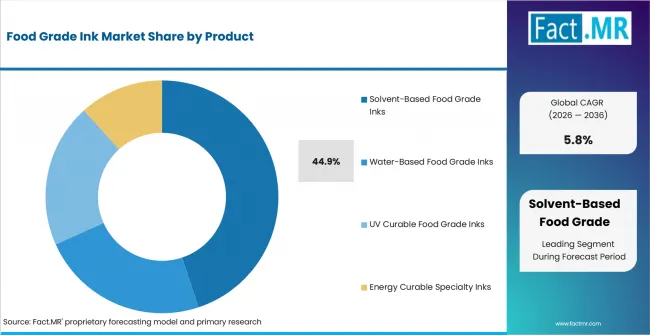
Food Grade Ink Market Analysis By Product | Source: Fact.MR
Solvent-based systems remain important because food-packaging converters require rapid drying and reliable adhesion on films that may have limited surface absorbency. Alcohol-based and ester-based systems can be configured for high-speed printing where the ink must dry before subsequent converting or winding.
The segment is particularly relevant to flexible packaging, where printing frequently takes place on polymer films. Buyers assess drying behaviour alongside adhesion and compatibility with laminating or converting steps.
Solvent choice must still be controlled around food-contact requirements. EU food-contact rules require finished materials to avoid transferring constituents to food at unsafe levels, which makes formulation and migration assessment part of qualification for packaging applications.
Why does Flexible Packaging Printing lead Application?
Flexible Packaging Printing is projected to account for a 67.8% share in 2026.
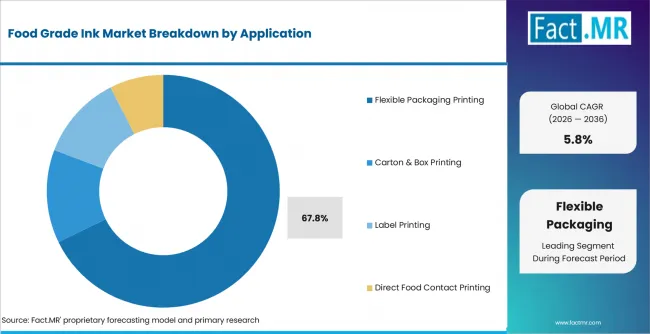
Food Grade Ink Market Analysis By Application | Source: Fact.MR
Flexible packaging leads because pouches and films provide large printable areas while being used across packaged foods with different shelf-life and barrier requirements. Printing must remain attached to the film during conversion, filling and transportation.
The same package may combine several functional layers. Ink therefore has to work with substrate treatments and lamination processes without compromising the packaging structure.
Food-contact regulation adds a safety requirement. The European Commission states that materials intended to contact food must not release substances at levels that could endanger health or change food composition, taste or smell. This makes ink selection part of the complete packaging-compliance process.
Why do Food Packaging Manufacturers lead End Use?
Food Packaging Manufacturers are projected to account for a 53.6% share in 2026.
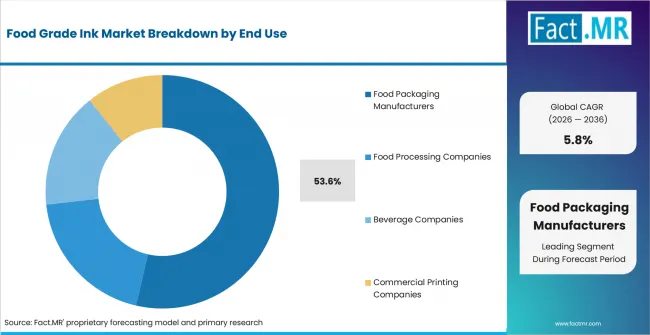
Food Grade Ink Market Analysis By End Use | Source: Fact.MR
Food packaging manufacturers lead because they purchase inks as part of a repeat production process rather than as an isolated consumable. Each packaging structure requires control over colour consistency and drying while maintaining suitability for the intended food application.
Converters also need to evaluate interactions between ink and the substrate. This is relevant where the printed layer can transfer components through migration or set-off during storage.
The UK Food Standards Agency has studied set-off from printed outer surfaces to food-contact surfaces and the subsequent migration of ink components into food. The work illustrates why food-packaging printers need controlled formulations and production conditions rather than relying solely on visible print quality.
Why does Flexographic Printing Technology lead Technology?
Flexographic Printing Technology is projected to account for a 36.8% share in 2026.
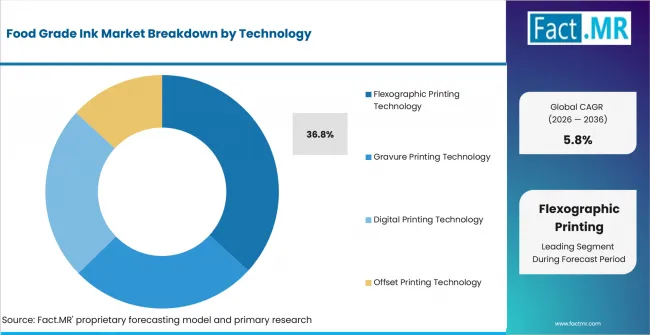
Food Grade Ink Market Analysis By Technology | Source: Fact.MR
Flexography leads because it is compatible with roll-fed films and labels used extensively in food packaging. Central impression and stack configurations allow converters to print repeated designs at industrial production speeds.
The process also accommodates different ink systems, giving converters flexibility when moving between packaging substrates. This supports its use for pouches and film applications where drying and adhesion must be balanced with productivity.
Buyer preference therefore reflects installed printing infrastructure as much as ink chemistry. Ink manufacturers that supply formulations tuned to existing flexographic equipment can reduce qualification work for packaging converters.
Why do Low Migration Formulations lead Formulation?
Low Migration Formulations are projected to account for a 74.1% share in 2026.
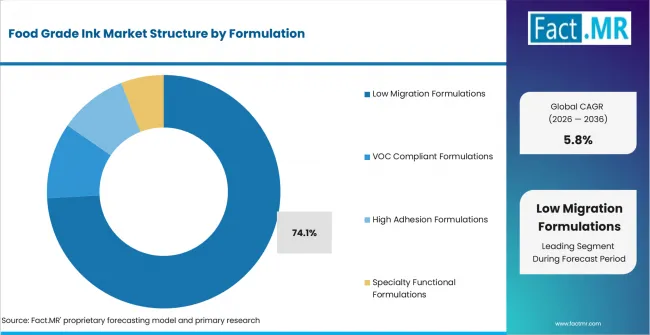
Food Grade Ink Market Analysis By Formulation | Source: Fact.MR
Low-migration formulations lead because food packaging must control the transfer of unintended substances into food. The issue applies even where ink is printed on the outside of a package if constituents can migrate through the material or transfer through set-off.
The FDA has specifically investigated photoinitiators used in UV-cured printing inks because some substances applied to exterior food packaging may migrate into food. This strengthens demand for formulations that limit transferable components and use photoinitiators or other ingredients appropriate to the application.
Germany provides another example of the regulatory direction. Its printing-ink requirements include a positive list of permitted substances and restrictions where relevant, giving packaging producers a more defined basis for material selection.
Why does Direct Manufacturer Sales lead Distribution Channel?
Direct Manufacturer Sales are projected to account for a 31.7% share in 2026.
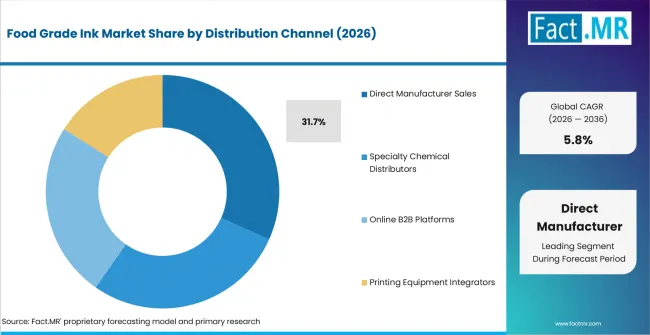
Food Grade Ink Market Analysis By Distribution Channel | Source: Fact.MR
Direct sales lead because ink qualification often requires technical discussion between the formulator and packaging converter. Buyers may need guidance on viscosity and drying behaviour according to substrate, press configuration and packaged-food application.
Key account relationships also support repeat colour matching and formulation consistency across long production programmes. This becomes more important when a food brand uses the same packaging design across several converters.
Direct supply allows ink manufacturers to maintain closer control over product specifications and technical documentation while responding to formulation changes requested by packaging customers.
What is accelerating Food Grade Ink Market adoption, and what is holding it back?
Drivers Impact Analysis
| Driver | (~) % Impact on CAGR | Geographic Relevance | Impact Timeline |
|---|---|---|---|
| Expansion of flexible food packaging printing | +1.6% | Global | Short term (≤ 2 years) |
| Food-contact migration and compliance requirements | +1.4% | USA, Germany and UK | Short term (≤ 2 years) |
| Demand for low-migration formulations | +1.1% | Global | Medium term (2–4 years) |
| Growth of digital and variable-data food printing | +0.9% | USA, UK and Japan | Medium term (2–4 years) |
| Improved curing and ink-performance efficiency | +0.6% | Global | Long term (≥ 4 years) |
Opportunity Impact Analysis
| Opportunity | (~) % Impact on CAGR | Geographic Relevance | Impact Timeline |
|---|---|---|---|
| Direct food and edible-substrate printing | +1.0% | Global | Medium term (2–4 years) |
| Low-migration specialty formulations | +0.8% | USA, UK and Germany | Medium term (2–4 years) |
| Digital food-packaging printing | +0.7% | Global | Long term (≥ 4 years) |
| Regulatory documentation and formulation support | +0.5% | USA, Brazil and Japan | Long term (≥ 4 years) |
Restraints Impact Analysis
| Restraint | (~) % Impact on CAGR | Geographic Relevance | Impact Timeline |
|---|---|---|---|
| Formulation and compliance cost | -1.1% | Global | Short term (≤ 2 years) |
| Migration testing and qualification requirements | -0.9% | USA, UK and Germany | Short term (≤ 2 years) |
| Substitution by conventional packaging inks where barriers are adequate | -0.7% | Price-sensitive markets | Medium term (2–4 years) |
| Raw-material and solvent pricing pressure | -0.5% | Global | Long term (≥ 4 years) |
Which countries are scaling the Food Grade Ink Market?
- Germany: Demand is influenced by specific national controls for printing inks used on food-contact materials. Germany’s Consumer Goods Ordinance contains a positive list covering substances such as colorants, solvents and photoinitiators, increasing the value of documented low-migration formulations.
- Brazil: Packaging and materials used in food production must comply with technical rules administered through ANVISA. This creates recurring qualification work for food processors and packaging companies selecting inks for primary packaging.
- USA: FDA oversight of food-contact substances and continued investigation of printing-ink components make migration control relevant to packaging specification. Direct food coding provides an additional application through approved inks used on products such as shell eggs.
- UK: Food-packaging converters must control potential migration and set-off from printed packaging. Food Standards Agency research has evaluated how ink components can transfer from printed surfaces and subsequently migrate into food, supporting demand for controlled formulations and production practices.
- Japan: Japan maintains specifications and standards for utensils, containers and packaging intended for food use. The positive-list approach for food-contact materials strengthens the need for packaging suppliers to understand the composition of materials used across finished packaging structures.
Country CAGR (2026–2036)
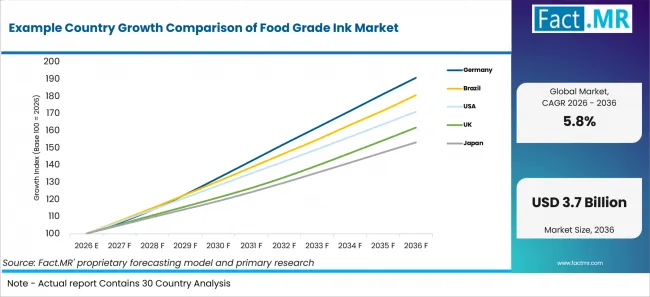
Example Country Growth Comparison Of Food Grade Ink Market | Source: Fact.MR
| Country | CAGR |
|---|---|
| Germany | 6.67% |
| Brazil | 6.09% |
| USA | 5.5% |
| UK | 4.93% |
| Japan | 4.35% |
What is driving Germany’s growth through 2036?
Germany is forecast to expand at a 6.67% CAGR from 2026 to 2036.
Growth is supported by clearly defined national requirements for printing inks used on food-contact materials. Annex 14 of Germany’s Consumer Goods Ordinance contains a positive list of substances that may be used in printing inks and can specify migration limits or other restrictions.
This increases the technical work required when packaging converters qualify new formulations. Ink producers capable of supplying migration information and application-specific formulations can support converters serving food manufacturers with strict material specifications.
Germany’s regulatory approach also gives low-migration inks a clear operating role. Buyers are more likely to evaluate formulation chemistry alongside print quality when packaging is intended for sensitive food-contact applications.
What is driving Brazil’s growth through 2036?
Brazil is forecast to expand at a 6.09% CAGR from 2026 to 2036.
ANVISA requires packaging used in food production to comply with applicable technical requirements even where the packaging itself does not require individual product registration. This places responsibility on packaging producers and food companies to verify the suitability of the complete material system.
Food-grade ink suppliers can therefore support Brazilian packaging converters through composition information and formulation guidance for different substrates. Demand is reinforced where packaged-food producers require consistent printing across films and other primary packaging materials.
What is driving USA’s growth through 2036?
The USA is forecast to expand at a 5.5% CAGR from 2026 to 2036.
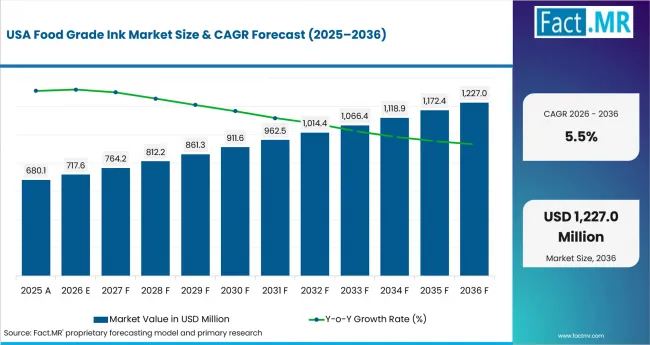
Food Grade Ink Market Country Value Analysis | Source: Fact.MR
The FDA regulates substances that come into contact with food, including substances applied to food-packaging surfaces. Packaging components may fall within food-contact substance requirements depending on their intended use and potential for migration.
The FDA has also examined photoinitiators potentially used in printing inks applied to exterior food packaging because some may migrate into food. Such scrutiny strengthens the use case for low-migration formulations and documented curing conditions.
Direct food coding creates an additional niche. USDA maintains approved inks for shell-egg stamping, supporting specialized demand for formulations that can be used directly on selected food products.
What is driving the UK’s growth through 2036?
The UK is forecast to expand at a 4.93% CAGR from 2026 to 2036.
UK demand is shaped by the need to control the transfer of ink constituents from printed packaging. Food Standards Agency research has examined visible and non-visible set-off and the migration of ink components into food, showing why print design must be assessed together with the packaging structure.
This supports low-migration formulations for pouches and other primary food packaging. Packaging converters also require inks that maintain adhesion after printing while avoiding transfer during winding or storage.
Food-packaging projects therefore place a premium on formulations that can be qualified for specific substrates and printing conditions.
What is driving Japan’s growth through 2036?
Japan is forecast to expand at a 4.35% CAGR from 2026 to 2036.
Japan’s Ministry of Health, Labour and Welfare maintains specifications and manufacturing requirements for utensils, containers and packaging used with food. Its positive-list framework provides greater control over substances used in food-contact materials.
Japanese printing and packaging companies also have an established history of voluntary controls on materials used in packaging inks. Government records describe industry restrictions originally developed for inks used on food packaging, reflecting long-standing attention to chemical safety in printed packaging.
This supports continued demand for inks with clear composition data and performance suited to films, labels and other packaged-food applications.
Who leads the Food Grade Ink Market?
Needham Ink is positioned as a key supplier within the assessed company group, with food-grade formulations and printing systems serving direct-food and food-packaging applications. Its portfolio includes inks for applications such as eggs and other food products.
Inkjet Inc. competes through food-grade formulations for direct food contact and packaging. Independent Ink Inc. also supplies food-grade and edible inks used in coding and direct-to-food applications.
Mylan Group supplies aqueous, solvent and UV-curable thermal inkjet formulations for primary and secondary packaging applications. Digital Ink Technologies Pty Ltd participates through thermal inkjet technologies used across food and broader FMCG coding applications.
Competition depends on formulation safety and substrate compatibility. Drying speed and migration control influence qualification for packaging applications, while direct-food applications require more specific ingredient and manufacturing controls.
Supplier selection also depends on printing technology. Companies that can support continuous inkjet or thermal inkjet systems alongside packaging-printing requirements can serve different points in the food production and packaging process.
Which companies are the key providers?
Key companies include Needham Ink; Inkjet Inc.; Mylan Group; Independent Ink Inc.; and Digital Ink Technologies Pty Ltd.
- Needham Ink
- Inkjet Inc.
- Mylan Group
- Independent Ink Inc.
- Digital Ink Technologies Pty Ltd
Bibliography
- Agência Nacional de Vigilância Sanitária. (2020). Materiais em contato com alimentos: perguntas e respostas. Government of Brazil.
- Agência Nacional de Vigilância Sanitária. (2026). Regularização de matérias primas, ingredientes e embalagens. Government of Brazil.
- European Commission. (2026). Food Contact Materials. European Commission.
- European Parliament and Council of the European Union. (2004). Regulation (EC) No 1935/2004 on materials and articles intended to come into contact with food. Official Journal of the European Union.
- Federal Institute for Risk Assessment. (2026). Materials and Links to Printing Inks. Government of Germany.
- Food Standards Agency. (2008). Screening Tests for Visible and Non-visible Set-off. Government of the United Kingdom.
- Ministry of Health, Labour and Welfare. (2026). Utensils, Containers, and Packaging. Government of Japan.
- U.S. Department of Agriculture, Agricultural Marketing Service. (2026). List of Approved Inks for Stamping Shell Eggs. U.S. Department of Agriculture.
- U.S. Food and Drug Administration. (2023). Hazard Identification of Printing Ink Substances Used on the Exterior of Food Packaging. U.S. Department of Health and Human Services.
- U.S. Food and Drug Administration. (2024). Food Packaging & Other Substances that Come in Contact with Food. U.S. Department of Health and Human Services.
This Report Answers
- The report examines demand for Food Grade Ink across product categories, packaging applications, end users and printing technologies.
- Segment analysis assesses the categories shaping food-packaging ink demand and application selection.
- Country analysis evaluates Germany, Brazil, the USA, the UK and Japan.
- Competitive analysis examines the listed ink manufacturers serving food-packaging and direct-food printing requirements.
- Application analysis assesses ink requirements across flexible packaging, cartons, labels and direct food-contact printing.
What does the Food Grade Ink Market cover?
The Food Grade Ink Market covers printing inks supplied for food-packaging and specified food-related printing applications. The analysis includes inks used on flexible films, cartons, labels and selected direct-food or food-service substrates.
The assessment covers solvent-based, water-based and energy-curable products used through flexographic, gravure, digital and offset printing technologies. It also evaluates formulation requirements including low migration and adhesion characteristics.
What is included in the scope?
The scope includes food-grade printing inks used by food-packaging manufacturers, food processors, beverage companies and commercial packaging printers.
Product coverage includes Solvent-Based Food Grade Inks, Water-Based Food Grade Inks, UV Curable Food Grade Inks and Energy Curable Specialty Inks.
Applications include Flexible Packaging Printing, Carton & Box Printing, Label Printing and Direct Food Contact Printing.
The analysis includes inks supplied through Direct Manufacturer Sales, Specialty Chemical Distributors, Online B2B Platforms and Printing Equipment Integrators.
What is excluded from the scope?
The scope excludes general-purpose printing inks that are not intended or qualified for the food-packaging or food-related applications included in the segmentation.
Printing equipment is excluded when sold without food-grade ink. Packaging films, cartons and labels are also excluded as standalone materials.
Food colourings used as ingredients rather than printing inks fall outside the market. General industrial coatings and decorative inks used outside food-packaging applications are also excluded.
How Was the Analysis Built?
The analysis draws on more than 120 sources, over 35 company portfolios and more than 20 industry interviews across at least 25 countries.
- Primary Research: Interviews with ink manufacturers, packaging converters, food processors, printing companies and distribution partners examine formulation selection, migration requirements and purchasing criteria.
- Desk Research: The review covers food-contact regulations, packaging requirements, printing technology, company disclosures and technical guidance from food-safety authorities. External sources used in the analysis are recorded in the bibliography.
- Market Sizing and Forecasting: Estimates combine food-packaging ink consumption, printed packaging output, ink pricing, printing-process mix and formulation requirements. Country forecasts consider food-packaging activity and regulatory requirements affecting ink qualification.
- Data Validation and Update Cycle: Findings are cross-checked against supplier portfolios, regulatory developments and industry interviews. Updates consider changes in food-contact requirements, ink chemistry and packaging-print technology.
What is the report's scope and coverage?
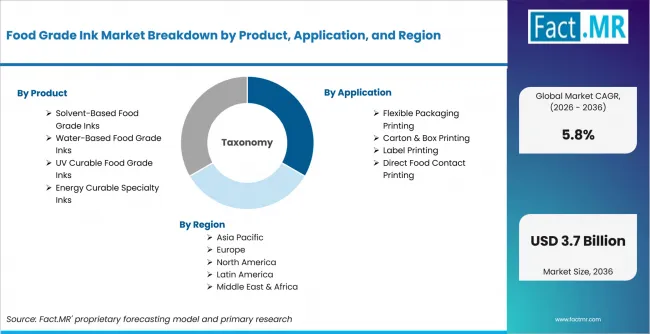
Food Grade Ink Market Breakdown By Product, Application, And Region | Source: Fact.MR
| Attribute | Details |
|---|---|
| Quantitative Units | USD billion |
| Market Definition | Food Grade Ink used across the specified product, application, end-use, technology, formulation and distribution categories |
| Segments Covered | Product; Application; End Use; Technology; Formulation; Distribution Channel |
| Regions Covered | North America; Latin America; Europe; East Asia; South Asia and Pacific; Middle East and Africa |
| Countries Covered | Germany; Brazil; USA; UK; Japan |
| Key Companies Profiled | Needham Ink; Inkjet Inc.; Mylan Group; Independent Ink Inc.; Digital Ink Technologies Pty Ltd |
| Forecast Period | 2026 to 2036 |
| Approach | Hybrid top-down and bottom-up approach using ink demand, packaging-print volumes, formulation mix, technology adoption and country-level growth |
How is the market segmented?
-
By Product
- Solvent-Based Food Grade Inks
- Alcohol-Based Ink Systems
- Ester-Based Ink Systems
- Water-Based Food Grade Inks
- Acrylic Water-Based Inks
- Polymeric Water-Based Inks
- UV Curable Food Grade Inks
- Free Radical UV Inks
- Cationic UV Inks
- Energy Curable Specialty Inks
- Electron Beam Curable Inks
- Hybrid Curable Inks
- Solvent-Based Food Grade Inks
-
By Application
- Flexible Packaging Printing
- Food Pouch Printing
- Film Printing
- Carton & Box Printing
- Folding Carton Printing
- Corrugated Box Printing
- Label Printing
- Pressure Sensitive Labels
- Shrink Sleeve Labels
- Direct Food Contact Printing
- Edible Substrate Printing
- Food Service Paper Printing
- Flexible Packaging Printing
-
By End Use
- Food Packaging Manufacturers
- Flexible Packaging Producers
- Rigid Packaging Producers
- Food Processing Companies
- Packaged Food Producers
- Fresh Food Packers
- Beverage Companies
- Alcoholic Beverage Producers
- Non-Alcoholic Beverage Producers
- Commercial Printing Companies
- Label Printing Firms
- Packaging Printing Firms
- Food Packaging Manufacturers
-
By Technology
- Flexographic Printing Technology
- Central Impression Flexography
- Stack Flexography
- Gravure Printing Technology
- Electromechanical Gravure
- Laser Engraved Gravure
- Digital Printing Technology
- Inkjet Printing Systems
- Electrophotographic Systems
- Offset Printing Technology
- Sheetfed Offset Systems
- Web Offset Systems
- Flexographic Printing Technology
-
By Formulation
- Low Migration Formulations
- Photoinitiator Optimized Systems
- Controlled Diffusion Systems
- VOC Compliant Formulations
- Low Solvent Systems
- Water Dominant Systems
- High Adhesion Formulations
- Polymer Enhanced Systems
- Surface Modified Systems
- Specialty Functional Formulations
- Heat Resistant Systems
- Chemical Resistant Systems
- Low Migration Formulations
-
By Distribution Channel
- Direct Manufacturer Sales
- Key Account Sales
- OEM Supply Programs
- Specialty Chemical Distributors
- Regional Distribution Partners
- Value Added Distributors
- Online B2B Platforms
- Industrial Procurement Portals
- Manufacturer Portals
- Printing Equipment Integrators
- Packaging Line Integrators
- Automation Partners
- Direct Manufacturer Sales