- Market Value (2025): USD 156.3 Mn
- Estimated Value (2026): USD 164.5 Mn
- Forecast Value (2036): USD 274.5 Mn
- CAGR (2026-2036): 5.3%
What is the 2-Chloro-6-fluorobenzaldehyde (2,6-CFAD) Market forecast to be worth by 2036?
USD 164.5 million in 2026 to USD 274.5 million by 2036 at a 5.3% CAGR.
- Fact.MR estimates the 2-chloro-6-fluorobenzaldehyde market at USD 156.3 million for 2025.
- Generic drug and crop protection pipelines will draw on halogenated building blocks, and the market will move from USD 164.5 million in 2026 to USD 274.5 million by 2036.
- Steady outsourcing of multi-step synthesis to specialist intermediate makers will support a 5.3% CAGR.
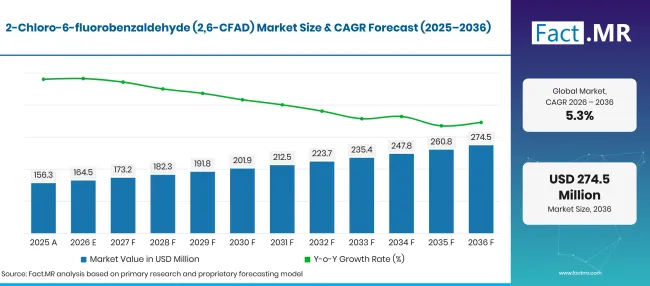
Factmr 2 Chloro 6 Fluorobenzaldehyde 26 Cfad Market Forecast Global | Source: Fact.MR
| Year | Basis | Market Value (USD million) |
|---|---|---|
| 2025 | Actual | 156.3 |
| 2026 | Estimate | 164.5 |
| 2036 | Forecast | 274.5 |
| CAGR 2026 to 2036 | Forecast period | 5.3% |
Source: Fact.MR analysis. Updated Oct 21, 2026
What are the defining numbers behind 2-Chloro-6-fluorobenzaldehyde (2,6-CFAD) Market growth?
USD 110.0 million of added revenue will build up between 2026 and 2036, mainly from drug intermediate orders.
- Demand Drivers in the Market
- Antibiotic intermediates demand stays firm because bacterial resistance keeps doctors cycling through older and newer drug classes. The World Health Organization reported in October 2025 that one in six laboratory-confirmed bacterial infections in 2023 resisted antibiotic treatment [1]. Producers of antibacterial actives keep halogenated aromatic aldehydes on long-term supply contracts as a result.
- Crop protection chemistry relies on fluorinated aromatic rings for potency and field stability. FAO reported that total pesticide use in agriculture reached 3.73 million tonnes of active ingredients in 2023 [2]. Fungicide and herbicide makers that build ortho-substituted phenyl groups source chloro-fluoro aldehydes from the same pool of suppliers that serve pharma.
- Fluorinated building block sales gain from medicinal chemistry habits. Adding a fluorine atom often slows metabolic breakdown of a drug candidate, so discovery teams order many fluorinated aldehydes in small lots and scale the winners. The U.S. Food and Drug Administration reported that its drug center approved 46 novel drugs in 2025 [3].
- European pharmaceutical trade adds pull on upstream intermediates. Eurostat reported that EU exports of medicinal and pharmaceutical products rose by 16% in 2025 against 2024 [4]. The European Medicines Agency recommended 104 human medicines for authorisation in 2025, of which 38 carried a new active substance [5]. Higher finished-drug output raises call-offs for registered starting materials and their precursors.
- Contract manufacturing in India and China widens the buyer base. Western drug owners prefer suppliers that can run chlorination, side-chain oxidation and purification in one validated route.
- Key Segments Analyzed
- By Purity: Below 99% will account for 57.6% share in 2026, since most downstream steps purify the product again after condensation or oxidation.
- By Application: Pharmaceutical Intermediates will capture 42.7% share in 2026 on repeat orders for active ingredient routes that start from ortho-halogenated benzaldehydes.
- By End-User: Pharmaceutical Industry will hold 48.3% share in 2026, reflecting drug makers’ habit of qualifying two or more intermediate sources per route.
- Analyst Opinion at Fact.MR
- Shambhu Nath Jha, Principal Consultant at Fact.MR, states, “Buyers of 2-chloro-6-fluorobenzaldehyde care less about headline purity than about a route that delivers the same impurity profile batch after batch. Suppliers that control the 2-chloro-6-fluorotoluene feedstock and the oxidation step will win the multi-year drug contracts. Agrochemical demand will add volume, but pharmaceutical qualification work will decide who keeps the margin.”
- Strategic Implications
- Intermediate producers should secure their own chlorination and fluorination capacity upstream, given that toluene-based feedstock sets cost and lead time.
- Pharmaceutical buyers should audit impurity profiles and regulatory files of each source before a route reaches commercial scale.
- Crop protection formulators should lock in multi-year supply for fluorinated aldehydes, because their registration dossiers name the starting material route.
- Catalog suppliers should keep certificates of analysis and safety data current across regions, since research users switch vendors when documents lag.
Germany will grow at 6.0% CAGR, where a deep drug and crop science base keeps buying fluorinated building blocks. Brazil follows at 5.5% on the back of vast soybean acreage that consumes crop protection products each season. In the United States, a 4.9% pace reflects a large community of industrial chemists working in synthesis. The United Kingdom adds 4.4%, helped by antimicrobial resistance monitoring that keeps antibiotic research active. Japan records 3.9%, with a mature pharmaceutical output base that buys high-grade inputs.
How does the 2-Chloro-6-fluorobenzaldehyde (2,6-CFAD) Market break down by segment?
Below 99% will lead Purity at 57.6%; Pharmaceutical Intermediates will top Application at 42.7%; Pharmaceutical Industry will hold first place in End-User at 48.3%.
Which Purity dominates?
Below 99% grades make up 57.6% of 2026 sales.
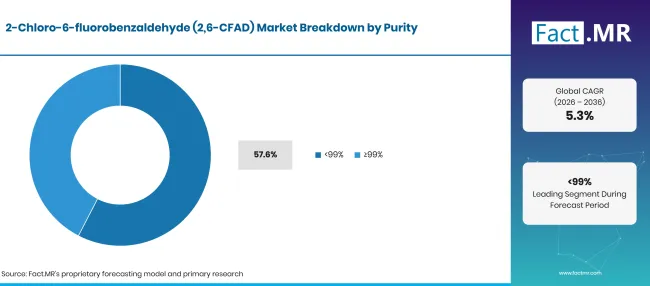
Factmr 2 Chloro 6 Fluorobenzaldehyde 26 Cfad Market Breakdown Purity | Source: Fact.MR
| Purity | Share (2026) |
|---|---|
| Below 99% (Leading segment) | 57.6% |
| Other segments combined | 42.4%* |
| Total | 100.0% |
Source: Fact.MR analysis. Updated Oct 21, 2026
Technical-grade 2-chloro-6-fluorobenzaldehyde suits multi-step plants that clean up the material in their own later steps. A buyer converting the aldehyde to an oxime, acid chloride or Knoevenagel product removes most trace isomers during that conversion. Paying for an extra distillation pass adds cost without a clear gain. Published catalog specifications for the compound run from 95% to 98% minimum assay, which places them in this grade. Grades at 99% and Above go to analytical work, reference standards and late-stage routes where the aldehyde lies only one or two steps from the final active. Clearsynth in India offers the compound for quality control reference use. Feedstock comes from toluene derivatives that are chlorinated and fluorinated in several steps. Oxidation know-how carries over from the parent benzaldehyde chemistry used across these plants.
What leads the Application segment?
Pharmaceutical Intermediates take 42.7% of 2026 sales.
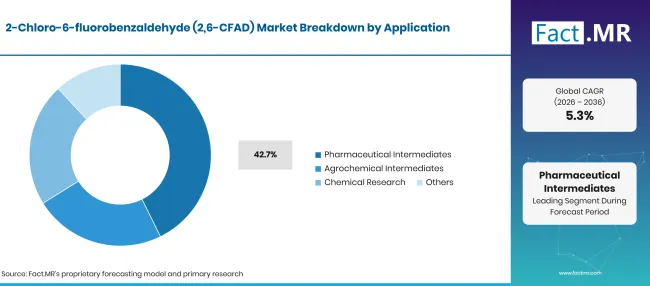
Factmr 2 Chloro 6 Fluorobenzaldehyde 26 Cfad Market Breakdown Application | Source: Fact.MR
| Application | Share (2026) |
|---|---|
| Pharmaceutical Intermediates (Leading segment) | 42.7% |
| Other segments combined | 57.3%* |
| Total | 100.0% |
Source: Fact.MR analysis. Updated Oct 21, 2026
Medicinal chemists use the 2-chloro-6-fluorophenyl group to fix the shape of a molecule and block metabolic attack at the ortho positions. That makes the aldehyde a common entry point into isoxazole, quinazoline and other heterocyclic cores. Oxidation to the acid gives a route toward benzoic acid derivatives and acyl chlorides used in amide coupling. Agrochemical Intermediates form the second pull, where fungicide and herbicide makers need a stable halogenated phenyl ring. Chemical Research covers academic and industrial discovery labs that buy small packs for screening and method work. Demand for ntibacterial drug classes keeps generic producers ordering ortho-substituted aromatic aldehydes in campaign volumes.
How does End-User shape demand?
Pharmaceutical Industry buyers account for 48.3% of 2026 sales.
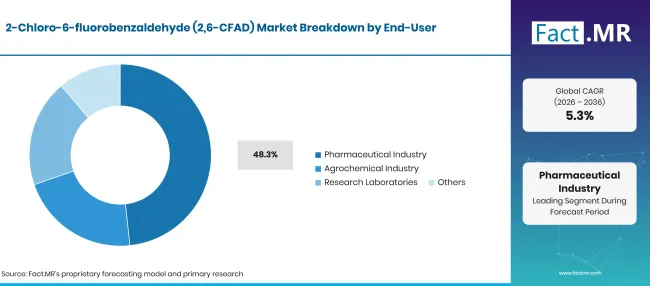
Factmr 2 Chloro 6 Fluorobenzaldehyde 26 Cfad Market Breakdown End User | Source: Fact.MR
| End-User | Share (2026) |
|---|---|
| Pharmaceutical Industry (Leading segment) | 48.3% |
| Other segments combined | 51.7%* |
| Total | 100.0% |
Source: Fact.MR analysis. Updated Oct 21, 2026
Drug companies and their contract manufacturers sign supply agreements that run for several years once a route is filed with regulators. Each change of supplier triggers comparability testing, so the volumes attached to a validated source rarely move. This keeps buyers loyal once a vendor passes audit. The Agrochemical Industry buys in larger lots timed to planting seasons and links purchases to crop protection chemicals output plans. Research Laboratories order grams to kilograms through distributors. EU chemical production reached 224 million tonnes in 2024, according to Eurostat, which shows the wider industrial base these intermediates feed into [6].
What is accelerating 2-Chloro-6-fluorobenzaldehyde (2,6-CFAD) Market adoption, and what is holding it back?
Adoption will rise with antibiotic and fluorinated drug pipelines, crop protection demand and outsourcing of synthesis to Asian fine-chemical plants. Hazard handling of chlorine and fluorine chemistry, isomer purity demands and price swings in toluene feedstock will slow new capacity.
Drivers Impact Analysis
| DRIVER | (~) % IMPACT ON CAGR | GEOGRAPHIC RELEVANCE | IMPACT TIMELINE |
|---|---|---|---|
| Pharmaceutical routes built on ortho-halogenated aromatic aldehydes | +1.5% | North America, Western Europe, South Asia & Pacific | Short term (<= 2 years) |
| Antimicrobial resistance keeping antibacterial synthesis active | +1.1% | Global | Medium term (2-4 years) |
| Fluorinated crop protection actives for fungicide and herbicide use | +1.0% | Latin America, North America, East Asia | Medium term (2-4 years) |
| Outsourced multi-step synthesis to Indian and Chinese fine-chemical plants | +0.8% | East Asia, South Asia & Pacific | Short term (<= 2 years) |
| Fluorine use in discovery chemistry to improve metabolic stability | +0.5% | North America, Western Europe | Long term (>= 4 years) |
Source: Fact.MR analysis. Updated Oct 21, 2026
Opportunity Impact Analysis
| OPPORTUNITY | (~) % IMPACT ON CAGR | GEOGRAPHIC RELEVANCE | IMPACT TIMELINE |
|---|---|---|---|
| Higher-purity grades for late-stage and reference standard use | +0.8% | Western Europe, North America | Medium term (2-4 years) |
| Backward integration into 2-chloro-6-fluorotoluene feedstock | +0.6% | South Asia & Pacific, East Asia | Long term (>= 4 years) |
| Second-source qualification by Western drug makers | +0.5% | North America, Western Europe | Short term (<= 2 years) |
Source: Fact.MR analysis. Updated Oct 21, 2026
Restraints Impact Analysis
| RESTRAINT | (~) % IMPACT ON CAGR | GEOGRAPHIC RELEVANCE | IMPACT TIMELINE |
|---|---|---|---|
| Safety and permit burden of chlorination and fluorination steps | -0.6% | Global | Medium term (2-4 years) |
| Toluene and chlorine feedstock price swings | -0.5% | Global | Short term (<= 2 years) |
| Isomer impurities that force extra purification | -0.3% | East Asia, South Asia & Pacific | Short term (<= 2 years) |
Source: Fact.MR analysis. Updated Oct 21, 2026
Which countries are scaling the 2-Chloro-6-fluorobenzaldehyde (2,6-CFAD) Market through 2036?
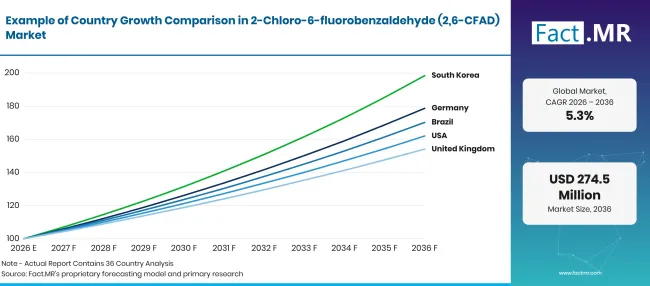
Factmr 2 Chloro 6 Fluorobenzaldehyde 26 Cfad Market Growth Index | Source: Fact.MR
| Country | CAGR (2026 to 2036) |
|---|---|
| Germany | 6.0% |
| Brazil | 5.5% |
| United States | 4.9% |
| United Kingdom | 4.4% |
| Japan | 3.9% |
Source: Fact.MR analysis. Updated Oct 21, 2026
What supports Germany’s adoption?
6.0% CAGR, backed by pharmaceutical and crop science groups with large synthesis needs.
Fluorinated intermediate demand in Germany draws on a large domestic health system and its drug spending. Destatis reported that diseases and health problems caused direct costs of EUR 528.5 billion in Germany in 2024, up 7.6% on the prior year [7]. German drug makers and crop science groups run synthesis and process development at home while sourcing intermediates from Asia. Buyers ask for full route documentation and REACH registration before they place volume orders.
How is Brazil scaling demand?
5.5% CAGR, driven by large crop areas that consume fungicides and herbicides every season.
Agrochemical intermediate sales in Brazil follow the size of its soybean crop. The U.S. Department of Agriculture forecast Brazil’s soybean production at 186.0 million metric tons for 2026/27, up from 180.5 million metric tons in 2025/26 [8]. IBGE reported that Brazil’s 2025 soybean harvest reached a record 166.1 million tonnes, up 14.6% on 2024 [9]. Fungal disease pressure in tropical soybean fields keeps fungicide spraying high. Local formulators import technical actives and intermediates, which links Brazilian demand to Chinese and Indian fine-chemical output.
What supports United States adoption?
4.9% CAGR, helped by a broad base of synthesis chemists in industry.
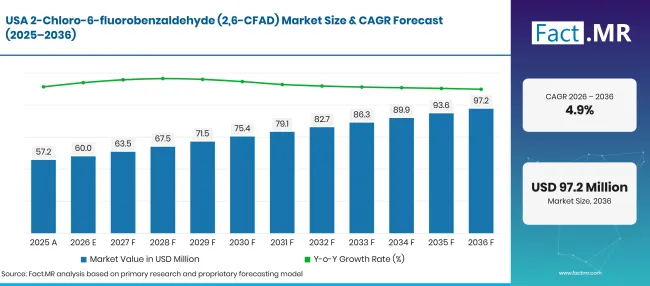
Factmr 2 Chloro 6 Fluorobenzaldehyde 26 Cfad Market Forecast Usa | Source: Fact.MR
Research chemical buying in the United States rests on a large pool of bench chemists. The Bureau of Labor Statistics reported that chemists held about 84,900 jobs in 2025, with 33% employed in chemical manufacturing [10]. Discovery groups order fluorinated aldehydes in catalog packs, then move promising routes to contract manufacturers. Generic drug makers also qualify second sources to reduce dependence on a single Asian plant.
How is the United Kingdom developing demand?
4.4% CAGR, as resistance surveillance keeps antibacterial research and supply active.
Antibiotic use in the United Kingdom stays under close watch. The UK Health Security Agency reported 20,484 antibiotic-resistant bacteraemia episodes in England in 2024, a 13.1% rise since 2019 [11]. The same report noted that penicillins remained the most commonly used antibiotics [11]. University and biotech labs in the Golden Triangle buy small lots of halogenated aldehydes for medicinal chemistry programs.
How does Japan perform?
3.9% CAGR, reflecting a mature drug manufacturing base with strict quality demands.
Pharmaceutical output in Japan grew modestly in the latest annual count. The Ministry of Health, Labour and Welfare reported that domestic production of finished pharmaceuticals reached JPY 10.2485 trillion in 2024, up 2.1% from 2023 [12]. Japanese buyers favor suppliers with consistent impurity profiles and detailed documentation. Tokyo Chemical Industry supplies the compound to domestic and overseas research users from its catalog.
Who leads the 2-Chloro-6-fluorobenzaldehyde (2,6-CFAD) Market?
Supply splits into two tiers. Bulk producers in China and India run the chlorination and oxidation chemistry.
Zhejiang Xieshi New Materials lists 2-chloro-6-fluorobenzaldehyde alongside 2,6-difluorobenzaldehyde and other fluorobenzaldehydes made through its fluorination and bromination processes. Shital Chemical Industries in Gujarat markets itself as a manufacturer of the compound for pharmaceutical and agrochemical intermediates. Capot Chemical offers the aldehyde at 98% minimum purity with production scale up to metric tons. Research suppliers form the second tier. Merck sells it under the Sigma-Aldrich brand at 95% assay, while Tokyo Chemical Industry lists a grade above 95.0% by GC. Thermo Fisher Scientific offers a 95% grade through Thermo Scientific Chemicals, and Clearsynth supplies reference material for quality control. Consistent isomer purity, audited documentation and control of 2-chloro-6-fluorotoluene feedstock will separate long-term pharmaceutical suppliers from spot sellers.
Which companies are the key providers?
Key companies include Zhejiang Xieshi New Materials Co., Ltd.; Shital Chemical Industries; Capot Chemical Co., Ltd.; Merck KGaA (Sigma-Aldrich); Tokyo Chemical Industry Co., Ltd.; Thermo Fisher Scientific Inc.; and Clearsynth.
- Zhejiang Xieshi New Materials Co., Ltd.
- Shital Chemical Industries
- Capot Chemical Co., Ltd.
- Merck KGaA (Sigma-Aldrich)
- Tokyo Chemical Industry Co., Ltd.
- Thermo Fisher Scientific Inc.
- Clearsynth
Bibliography
- [1] World Health Organization. (2025, October 13). WHO warns of widespread resistance to common antibiotics worldwide.
- [2] Food and Agriculture Organization of the United Nations. (2025, July 15). Pesticides use and trade. 1990-2023.
- [3] U.S. Food and Drug Administration. (2026, July 8). Novel Drug Approvals for 2025.
- [4] Eurostat. (2026, March). International trade in medicinal and pharmaceutical products.
- [5] European Medicines Agency. (2026, June 11). EMA’s 2025 annual report shows strong approval numbers for human and veterinary medicines.
- [6] Eurostat. (2025, December). Chemicals production and consumption statistics.
- [7] Statistisches Bundesamt (Destatis). (2026, October 8). Krankheitskosten im Jahr 2024 um 7,6 % gestiegen [Disease costs rose by 7.6% in 2024].
- [8] U.S. Department of Agriculture, Foreign Agricultural Service. (2026, October). Oilseeds: World Markets and Trade.
- [9] Instituto Brasileiro de Geografia e Estatística (IBGE). (2026, January 15). Safra de 2025 é recorde e previsão para 2026 é 1,8% menor [2025 harvest is a record and 2026 forecast is 1.8% lower].
- [10] U.S. Bureau of Labor Statistics. (2026, August 27). Chemists and Materials Scientists: Occupational Outlook Handbook.
- [11] UK Health Security Agency. (2026, May 13). ESPAUR report 2024 to 2025: extended summary.
- [12] Ministry of Health, Labour and Welfare, Japan. (2025, December 24). 令和6年 薬事工業生産動態統計年報 [Annual report on the Statistics of Production by Pharmaceutical Industry, 2024].
This Report Answers
- How large is 2,6-CFAD revenue in 2026, and what will it reach by 2036?
- Why do technical grades outsell high-purity material, and where does each grade end up?
- Which uses, from drug routes to fungicide synthesis, account for the bulk of tonnage?
- How do Germany, Brazil, the United States, the United Kingdom and Japan differ in growth and buyer needs?
- Which bulk producers and catalog suppliers serve the compound today, and on what basis do they compete?
What does the 2-Chloro-6-fluorobenzaldehyde (2,6-CFAD) Market cover?
2-Chloro-6-fluorobenzaldehyde, also called 6-fluoro-2-chlorobenzaldehyde, is a pale solid or liquid near room temperature with the formula C7H4ClFO. It is made mainly by side-chain chlorination of 2-chloro-6-fluorotoluene followed by hydrolysis or oxidation to the aldehyde.
This study tracks sales of the aldehyde in bulk drums, intermediate lots and catalog packs. It measures demand across pharmaceutical routes, agrochemical routes, research use and other specialty chemistry.
What is included in the scope?
Technical and high-purity grades sold to drug makers, contract manufacturers, crop protection producers and research laboratories fall inside the revenue boundary. Material sold as an analytical or reference standard counts at its sale value.
Sales of the aldehyde used to make fluoropolymer additives or other specialty materials are included under Others. Captive volumes moved between legal entities of one group count at transfer value where reported.
What is excluded from the scope?
Downstream derivatives such as 2-chloro-6-fluorobenzoic acid, 2-chloro-6-fluorobenzoyl chloride and finished active ingredients are excluded. The 2-chloro-6-fluorotoluene feedstock is also outside the scope.
Other isomers, including 2-chloro-4-fluorobenzaldehyde and 2,6-difluorobenzaldehyde, are excluded even when the same plants make them.
How Was the Analysis Built?
The analysis draws on 120+ sources, 35+ company portfolios, 25+ countries, and more than 20 industry interviews.
- Primary Research: Primary research includes discussions with manufacturers, service providers, technology developers, distributors, end users, and subject-matter experts. These conversations examine purchasing priorities, product adoption, operational challenges, approval requirements, competitive positioning, and the factors that influence wider market acceptance.
- Desk Research: Desk research covers government statistics, regulatory publications, company filings, trade data, technical studies, industry associations, standards, public policy, and other authoritative sources. Every source used in the analysis is documented in the bibliography.
- Market Sizing and Forecasting: Market estimates combine historical performance, demand indicators, pricing and volume trends, segment shares, company participation, country-level growth, adoption patterns, investment activity, and barriers to market expansion.
- Data Validation and Update Cycle: Findings are validated by comparing primary interviews with public data, company activity, regulatory changes, trade patterns, and industry developments. Regular updates review new product launches, capacity changes, partnerships, approvals, and shifts in commercial adoption.
Segmentation
What is the report’s scope and coverage?
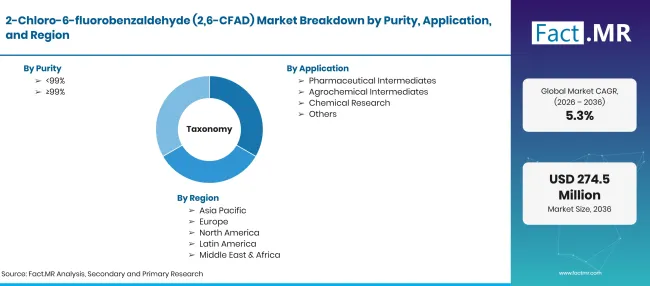
Factmr 2 Chloro 6 Fluorobenzaldehyde 26 Cfad Market Taxonomy | Source: Fact.MR
| Attribute | Details |
|---|---|
| Quantitative Units | USD million in 2026 to USD million by 2036 at CAGR |
| Market Definition | 2-Chloro-6-fluorobenzaldehyde (CAS 387-45-1) sold as a chemical intermediate and research chemical. Revenue is counted at the first sale by producers and catalog suppliers. |
| Purity | Below 99%; 99% and Above |
| Application | Pharmaceutical Intermediates; Agrochemical Intermediates; Chemical Research; Others |
| End-User | Pharmaceutical Industry; Agrochemical Industry; Research Laboratories; Others |
| Regions Covered | North America; Latin America; Western Europe; Eastern Europe; East Asia; South Asia & Pacific; Middle East & Africa |
| Countries Covered | Germany; Brazil; United States; United Kingdom; Japan |
| Companies Profiled | Zhejiang Xieshi New Materials Co., Ltd.; Shital Chemical Industries; Capot Chemical Co., Ltd.; Merck KGaA (Sigma-Aldrich); Tokyo Chemical Industry Co., Ltd.; Thermo Fisher Scientific Inc.; Clearsynth |
| Forecast Period | 2026 to 2036 |
| Approach | Hybrid top-down and bottom-up approach using drug and crop protection route demand; 2-chloro-6-fluorotoluene feedstock capacity; purity grade pricing; country synthesis activity; and supplier catalog review. |
Source: Fact.MR analysis. Updated Oct 21, 2026
How is the market segmented?
-
By Purity
- Below 99%
- 99% and Above
-
By Application
- Pharmaceutical Intermediates
- Agrochemical Intermediates
- Chemical Research
- Others
-
By End-User
- Pharmaceutical Industry
- Agrochemical Industry
- Research Laboratories
- Others
-
By Region
- North America
- Latin America
- Western Europe
- Eastern Europe
- East Asia
- South Asia & Pacific
- Middle East & Africa
Frequently Asked Questions
How big is the 2-chloro-6-fluorobenzaldehyde market in 2026?
What is the CAGR of the 2,6-CFAD market from 2026 to 2036?
Which purity grade leads the 2,6-CFAD market?
Which application leads the 2-chloro-6-fluorobenzaldehyde market?
Which end-user leads the 2,6-CFAD market?
Which country will grow the most in the 2,6-CFAD market?
Who are the main companies in the 2-chloro-6-fluorobenzaldehyde market?
Who worked on this report


Preview the report firsthand - request a free sample
Free SampleGet the brochure for pricing and purchase details
Download PDF