- Market Value (2025): USD 692.8 Bn
- Estimated Value (2026): USD 732.4 Bn
- Forecast Value (2036): USD 1276.2 Bn
- CAGR (2026-2036): 5.7%
What is the Fluoroplastic Adhesive Tape Market forecast to be worth by 2036?
USD 732.4 million in 2026 to USD 1,276.2 million by 2036 at a 5.7% CAGR.
- In 2025, the fluoroplastic adhesive tape market was worth USD 692.8 million, as per Fact.MR.
- Electrified vehicles, aircraft and electronics plants will specify more high-temperature insulation, taking yearly sales from USD 732.4 million in 2026 to USD 1,276.2 million in 2036.
- Tape is consumed on a wear cycle and reordered at each maintenance shutdown, so demand will advance at 5.7% CAGR across the decade.
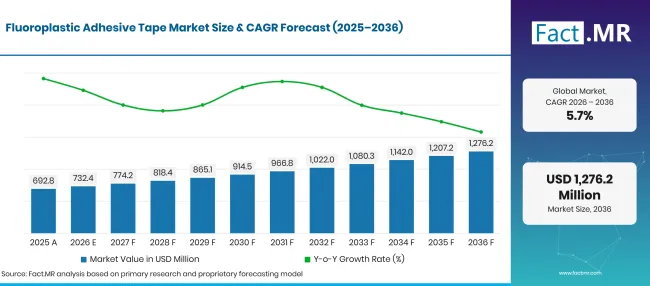
Factmr Fluoroplastic Adhesive Tape Market Forecast Global | Source: Fact.MR
| Year | Basis | Market Value (USD million) |
|---|---|---|
| 2025 | Actual | 692.8 |
| 2026 | Estimate | 732.4 |
| 2036 | Forecast | 1,276.2 |
| CAGR 2026 to 2036 | Forecast period | 5.7% |
Source: Fact.MR analysis. Updated Oct 21, 2026
What are the defining numbers behind Fluoroplastic Adhesive Tape Market growth?
Between 2026 and 2036, USD 543.8 million of fresh revenue will emerge, chiefly from electrical and electronics uses.
- Demand Drivers in the Market
- Electric vehicle insulation tape demand is rising with battery and motor output. The International Energy Agency reported that electric car sales grew by 20% to exceed 20 million in 2025, a quarter of all new cars sold [1]. Each car carries busbars, cell stacks and motor windings that call for thin, heat-stable dielectric wraps.
- High-temperature tape for aircraft builds benefits from a growing commercial fleet. The Federal Aviation Administration forecast that the U.S. commercial aircraft fleet will increase from 6,949 aircraft in 2025 to 10,677 in 2046 [2]. Airframers use PTFE and FEP tapes on wire harnesses, composite moulds and anti-chafe points.
- Heat seal release tape keeps packaging machines running. Form-fill-seal and impulse sealers burn through jaw covers in weeks, so food and medical packers hold rolls in stock as a routine consumable.
- Chemical-resistant tape for process plants supports a steady repair market. Maintenance crews line chutes, hoppers and guide rails with low-friction tape to stop sticky product from building up and to cut wear on metal parts.
- PFAS rules in Europe are reshaping how buyers specify fluoropolymer tape. ECHA issued an updated restriction report in June 2025, and by June 2026 its Risk Assessment Committee had adopted an opinion, with the socio-economic opinion due by the end of 2026 [3]. Users with a strict heat or dielectric need will keep PTFE, while lower-heat jobs will test substitutes.
- Key Segments Analyzed
- By Product Type: Single-Sided will hold 64.8% share in 2026, because a release or insulation job needs one exposed fluoropolymer face and one bonding face.
- By Application: Electrical and Electronics will account for 32.5% share in 2026, owing to coil, cable and circuit board work that needs dielectric strength at high heat.
- By Adhesive Type: Silicone will capture 38.1% share in 2026, given that silicone keeps its tack near the 260°C service limit of PTFE film.
- By End-User: Manufacturing will represent 44.9% share in 2026 through repeat orders from packaging, textile and processing lines that change tape on fixed intervals.
- Analyst Opinion at Fact.MR
- Shambhu Nath Jha, Principal Consultant at Fact.MR, states, “Most of this tape is bought as a maintenance item, so plant run hours tell you more about demand than new machinery sales. Electrified vehicles and aircraft wiring will add a second, specification-driven stream that rewards suppliers with UL and military approvals. PFAS rules in Europe will push tape makers to prove essential use or to offer fluorine-free substitutes for lower-heat jobs.”
- Strategic Implications
- Tape converters should hold UL 510A and AS9100 credentials, since cable makers and aircraft suppliers will not qualify a tape without them.
- Packaging machine builders should list approved PTFE glass cloth tapes in their spare-parts kits, given that jaw covers wear out long before the sealer does.
- Fluoropolymer resin suppliers should document essential-use cases for wire insulation and semiconductor tooling as European PFAS rules take shape.
- Electronics assemblers should test silicone-free acrylic grades for clean-room and vacuum work where outgassing limits apply.
Germany heads the five at 6.2% CAGR, where car plants are shifting export output toward electric models. Brazil follows at 5.7% as vehicle factories lift production above pre-2020 levels. The United States will post 5.1%, supported by a surge in semiconductor output. A 4.6% rate for the United Kingdom tracks a quick rise in zero emission vehicles on the road. Japan completes the group at 4.1%, with a mature electronics base that buys tape mainly for replacement.
How does the Fluoroplastic Adhesive Tape Market break down by segment?
Single-Sided will lead Product Type at 64.8%; Electrical and Electronics will top Application at 32.5%; Silicone will head Adhesive Type at 38.1%; Manufacturing will hold first place in End-User at 44.9%.
Which Product Type dominates?
Single-Sided tape takes 64.8% of 2026 sales.
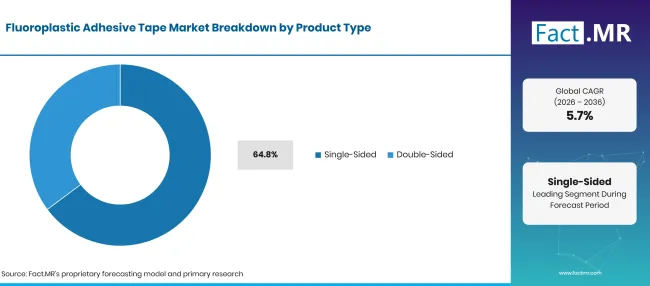
Factmr Fluoroplastic Adhesive Tape Market Breakdown Product Type | Source: Fact.MR
| Product Type | Share (2026) |
|---|---|
| Single-Sided (Leading segment) | 64.8% |
| Other segments combined | 35.2%* |
| Total | 100.0% |
Source: Fact.MR analysis. Updated Oct 21, 2026
Machine operators want the slick fluoropolymer face pointing outward, toward the hot film, web or wire. One adhesive layer bonds the tape to a heater bar, roller or chute while the PTFE side does the work. Skived PTFE, cast PTFE and PTFE-coated glass cloth are all sold mainly in this format. Double-sided fluoroplastic tape serves a smaller set of laminating and mounting jobs, such as bonding PTFE sheet to metal or fixing release layers inside moulds. These grades often use an etched PTFE film so that adhesive can grip both faces. Converters cut them into gaskets and die-cut parts within the wider adhesive tapes range.
What leads the Application segment?
Electrical and Electronics make up 32.5% of 2026 sales.
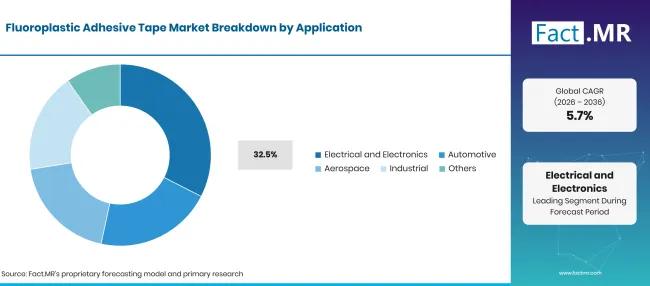
Factmr Fluoroplastic Adhesive Tape Market Breakdown Application | Source: Fact.MR
| Application | Share (2026) |
|---|---|
| Electrical and Electronics (Leading segment) | 32.5% |
| Other segments combined | 67.5%* |
| Total | 100.0% |
Source: Fact.MR analysis. Updated Oct 21, 2026
Coil winders, cable makers and circuit board shops need a wrap that resists arc tracking and stays stable through solder reflow. PTFE and FEP offer low dielectric loss and do not char at soldering heat. Silicone-free grades are chosen where outgassing would contaminate optics or sensors. Automotive use is rising with battery packs and e-motors, where cell wraps and slot liners face both heat and electrolyte. Aerospace buyers tape wire bundles and lay up composites, and rely on PTFE release faces in curing ovens. Industrial users wrap rollers and line packaging jaws, many of them on tray sealing machines and pouch sealers.
How does Adhesive Type shape demand?
Silicone adhesives represent 38.1% of 2026 sales.
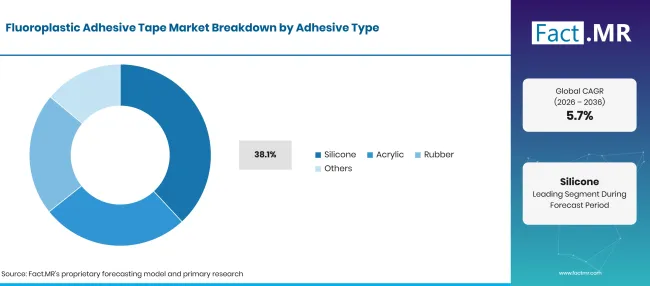
Factmr Fluoroplastic Adhesive Tape Market Breakdown Adhesive Type | Source: Fact.MR
| Adhesive Type | Share (2026) |
|---|---|
| Silicone (Leading segment) | 38.1% |
| Other segments combined | 61.9%* |
| Total | 100.0% |
Source: Fact.MR analysis. Updated Oct 21, 2026
Heat sealing bars and curing ovens run hotter than most acrylics can tolerate over long periods. Silicone pressure-sensitive adhesive bonds well to low-energy surfaces and keeps its grip through repeated heating, which suits PTFE film. Demand ties closely to suppliers of silicone adhesives used in other high-heat tapes. Acrylic systems win where silicone transfer is a risk, as in paint shops, vacuum chambers and electronics that later need coating. Rubber adhesives give fast tack at lower cost for short-term masking. Most formulations come from the same pressure sensitive adhesives chemistry used across industrial tapes.
What supports Manufacturing within End-User?
Manufacturing buyers account for 44.9% of 2026 sales.
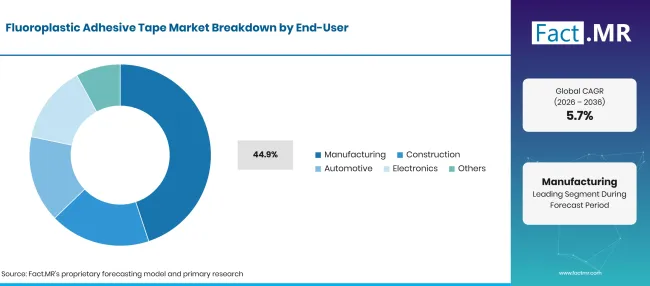
Factmr Fluoroplastic Adhesive Tape Market Breakdown End User | Source: Fact.MR
| End-User | Share (2026) |
|---|---|
| Manufacturing (Leading segment) | 44.9% |
| Other segments combined | 55.1%* |
| Total | 100.0% |
Source: Fact.MR analysis. Updated Oct 21, 2026
Plant maintenance teams change PTFE tape on sealers, conveyors and rollers as part of planned upkeep, so orders return every few weeks. Food, textile, paper and plastics plants hold the most stock. A single packaging line can use several rolls a month on its sealing jaws. Construction buyers use PTFE tape on expansion joints and glazing slides, while automotive and electronics plants buy it for production fixtures as well as finished parts. Base resin prices follow the wider fluoropolymers supply chain, which links tape costs to fluorspar and refrigerant feedstocks.
What is accelerating Fluoroplastic Adhesive Tape Market adoption, and what is holding it back?
Adoption will gain from electrified transport, aircraft builds and packaging lines that need non-stick, heat-proof surfaces. Progress is limited by European PFAS restriction plans and by the price gap with polyimide and glass cloth tapes.
Drivers Impact Analysis
| DRIVER | (~) % IMPACT ON CAGR | GEOGRAPHIC RELEVANCE | IMPACT TIMELINE |
|---|---|---|---|
| Electric vehicle battery, busbar and motor insulation needs | +1.3% | East Asia, Western Europe, North America | Short term (<= 2 years) |
| Heat sealing jaw and release covers on packaging lines | +1.1% | Global | Short term (<= 2 years) |
| Aircraft wire harness and composite tooling demand | +0.8% | North America, Western Europe | Medium term (2-4 years) |
| Semiconductor and electronics assembly in clean environments | +0.7% | North America, East Asia | Medium term (2-4 years) |
| Low-friction linings for chutes, rollers and process equipment | +0.5% | Global | Long term (>= 4 years) |
Source: Fact.MR analysis. Updated Oct 21, 2026
Opportunity Impact Analysis
| OPPORTUNITY | (~) % IMPACT ON CAGR | GEOGRAPHIC RELEVANCE | IMPACT TIMELINE |
|---|---|---|---|
| Low-outgassing silicone-free grades for vacuum and space use | +0.8% | North America, Western Europe | Medium term (2-4 years) |
| Thin FEP and PTFE wraps for battery cell and module insulation | +0.7% | East Asia, Western Europe | Medium term (2-4 years) |
| Custom die-cut fluoroplastic parts for electronics makers | +0.5% | East Asia | Long term (>= 4 years) |
Source: Fact.MR analysis. Updated Oct 21, 2026
Restraints Impact Analysis
| RESTRAINT | (~) % IMPACT ON CAGR | GEOGRAPHIC RELEVANCE | IMPACT TIMELINE |
|---|---|---|---|
| European PFAS restriction plans covering fluoropolymer articles | -0.7% | Western Europe | Medium term (2-4 years) |
| Price premium over polyimide and glass cloth tapes | -0.5% | Global | Short term (<= 2 years) |
| Fluorspar and fluoropolymer resin cost swings | -0.4% | Global | Short term (<= 2 years) |
Source: Fact.MR analysis. Updated Oct 21, 2026
Which countries are scaling the Fluoroplastic Adhesive Tape Market through 2036?
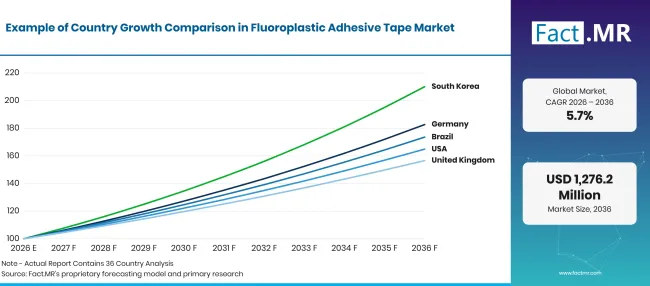
Factmr Fluoroplastic Adhesive Tape Market Growth Index | Source: Fact.MR
| Country | CAGR (2026 to 2036) |
|---|---|
| Germany | 6.2% |
| Brazil | 5.7% |
| United States | 5.1% |
| United Kingdom | 4.6% |
| Japan | 4.1% |
Source: Fact.MR analysis. Updated Oct 21, 2026
What supports Germany’s adoption?
6.2% CAGR, driven by electric car output that needs high-heat insulation tape.
PTFE tape demand in Germany follows its car and machinery plants. Destatis reported that Germany exported about 2.0 million new cars between January and July 2026, and battery-electric models made up 28.1% of that volume, about 560,000 units [4]. Each of these cars uses fluoropolymer wraps in battery packs and high-voltage cabling. German packaging machine builders add steady demand for sealing jaw covers.
How is Brazil scaling demand?
5.7% CAGR, backed by vehicle plants running above pre-pandemic output.
Industrial tape buyers in Brazil are working against a slow economy. IBGE reported that national industrial production grew 0.6% in 2025 [5]. Vehicle makers did better: IBGE’s May 2026 survey put seasonally adjusted output of vehicles, trailers and bodies 4.4% above its February 2020 level [6]. Tape distributors in São Paulo and Paraná serve these plants alongside food packers.
What supports United States adoption?
5.1% CAGR, on the back of rising semiconductor production and large factory projects.
Fluoropolymer tape use in the United States gains from new chip and electronics capacity. The Federal Reserve reported that output of semiconductors and related electronic components rose at a 28.4% annual rate in the third quarter of 2026 [7]. The Census Bureau put 2025 spending on manufacturing construction at USD 220.4 billion, down 6.5% from 2024 but still high by historical standards [8]. New fabs and battery plants specify clean-room grades.
How is the United Kingdom developing demand?
4.6% CAGR, reflecting a growing fleet of zero emission vehicles and a car industry back on its feet.
The Department for Transport reported 2,313,000 licensed zero emission vehicles in the United Kingdom at the end of June 2026, up 30.7% on a year earlier [9]. The Office for National Statistics found that transport equipment output rose 8.9% in the three months to February 2026, the main positive contributor to manufacturing [10]. Aerospace plants in the Midlands and the North West add orders for harness and composite tapes.
How does Japan perform?
4.1% CAGR, as a mature electronics and machinery base orders replacement tape.
Japan already makes much of the world’s PTFE film, so local demand rises with factory activity. The Ministry of Economy, Trade and Industry reported that the original industrial production index for August 2026 was up 2.7% from a year earlier [11]. Electronics, precision machinery and food packaging plants account for most local orders.
Who leads the Fluoroplastic Adhesive Tape Market?
Competition splits into three groups. Diversified tape makers lead on breadth: Nitto Denko sells NITOFLON PTFE tapes with silicone adhesive, 3M offers PTFE Film Tape 5490 for roller wraps and wire bundling, and tesa markets tesa 4820 PTFE tape. Engineered materials groups compete on coated fabrics and approvals.
Saint-Gobain supplies Norgard PTFE glass cloth tapes for heat sealers, and in January 2026 it introduced SGP5, a PFAS-free heat sealing tape rated to 260°C [12]. Rogers Corporation offers DeWAL skived PTFE tapes with UL 510A recognition, and in July 2025 it published a materials guide on skived, unsintered and extruded PTFE films and tapes [13]. AGC sells Taconic PTFE, FEP and coated glass tapes for electronics and battery lines. Specialists such as CS Hyde convert small runs fast. PFAS compliance, aerospace and UL listings, and quick custom slitting will decide who gains share.
Which companies are the key providers?
Key companies include Nitto Denko Corporation; 3M Company; Saint-Gobain; tesa SE; Rogers Corporation; AGC Inc.; and CS Hyde Company.
- Nitto Denko Corporation
- 3M Company
- Saint-Gobain
- tesa SE
- Rogers Corporation
- AGC Inc.
- CS Hyde Company
Bibliography
- [1] International Energy Agency. (2026). Global EV Outlook 2026: Executive summary.
- [2] Federal Aviation Administration. (2026). FAA Aerospace Forecast Fiscal Years 2026-2046.
- [3] European Chemicals Agency. (2026, June 11). ECHA’s update on the REACH Restriction on PFAS.
- [4] Statistisches Bundesamt (Destatis). (2026, September 21). Exporte von neuen Pkw in den ersten sieben Monaten 2026 um 4,0 % zum Vorjahreszeitraum gesunken [New car exports fell 4.0% in the first seven months of 2026].
- [5] Instituto Brasileiro de Geografia e Estatística (IBGE). (2026, February 10). Produção industrial fecha 2025 com avanço em 10 dos 18 locais pesquisados [Industrial production ends 2025 with gains in 10 of 18 locations surveyed].
- [6] Instituto Brasileiro de Geografia e Estatística (IBGE). (2026, July 3). Pesquisa Industrial Mensal: Produção Física, Brasil, Maio de 2026 [Monthly Industrial Survey: Physical Production, Brazil, May 2026].
- [7] Board of Governors of the Federal Reserve System. (2026, October 16). Industrial Production and Capacity Utilization - G.17.
- [8] U.S. Census Bureau. (2026, February 27). Monthly Construction Spending, December 2025.
- [9] Department for Transport. (2026, September 23). Vehicle licensing statistics: April to June 2026.
- [10] Office for National Statistics. (2026, April 16). Index of Production, UK: February 2026.
- [11] Ministry of Economy, Trade and Industry, Japan. (2026, October 15). Indices of Industrial Production: Revised Report for August 2026.
- [12] Saint-Gobain Tape Solutions. (2026, January 27). Lead the Market in 2026: Four Advanced Tape Solutions Innovations You Can Try Now.
- [13] Rogers Corporation. (2025, July 9). DeWAL Materials 101: Understanding PTFE and UHMW-PE for High-Performance Tapes and Films.
This Report Answers
- How large fluoroplastic tape sales are by product type, application, adhesive type and end-user from 2026 to 2036.
- Why single-sided, silicone-backed tape for electrical work holds first place in each segment.
- Where Germany, Brazil, the United States, the United Kingdom and Japan differ in vehicle, chip and packaging demand.
- Which tape makers, materials groups and converters compete, and on what approvals and grades.
- How European PFAS restriction plans could shift buyers toward fluorine-free substitutes.
What does the Fluoroplastic Adhesive Tape Market cover?
PTFE tape with adhesive backing, FEP film tape and PTFE-coated glass cloth tape all belong to the Fluoroplastic Adhesive Tape Market. These products come in rolls, sheets and die-cut parts, in single-sided and double-sided form.
Sales are tracked across electrical, automotive, aerospace and industrial uses. Revenue is taken at the point where converters and tape makers sell finished rolls or parts to end users and distributors.
What is included in the scope?
Skived, cast and extruded PTFE film tapes are in scope, along with FEP and PFA film tapes. Glass fabric tapes impregnated with PTFE, sold through the fluoropolymer coating supply chain, are counted once an adhesive layer is applied.
Silicone, acrylic and rubber adhesive systems are all covered. Custom slit widths and die-cut parts sold by converters are included at their selling value.
What is excluded from the scope?
Non-adhesive PTFE thread seal tape used by plumbers falls outside the boundary. Unbacked PTFE sheet, film and coated fabric sold without adhesive are also left out.
Polyimide, polyester and plain glass cloth tapes do not count, even when they compete for the same job. Fluoropolymer resin sold to film makers is excluded.
How Was the Analysis Built?
The analysis draws on 120+ sources, 35+ company portfolios, 25+ countries, and more than 20 industry interviews.
- Primary Research: Primary research includes discussions with manufacturers, service providers, technology developers, distributors, end users, and subject-matter experts. These conversations examine purchasing priorities, product adoption, operational challenges, approval requirements, competitive positioning, and the factors that influence wider market acceptance.
- Desk Research: Desk research covers government statistics, regulatory publications, company filings, trade data, technical studies, industry associations, standards, public policy, and other authoritative sources. Every source used in the analysis is documented in the bibliography.
- Market Sizing and Forecasting: Market estimates combine historical performance, demand indicators, pricing and volume trends, segment shares, company participation, country-level growth, adoption patterns, investment activity, and barriers to market expansion.
- Data Validation and Update Cycle: Findings are validated by comparing primary interviews with public data, company activity, regulatory changes, trade patterns, and industry developments. Regular updates review new product launches, capacity changes, partnerships, approvals, and shifts in commercial adoption.
Segmentation
What is the report’s scope and coverage?
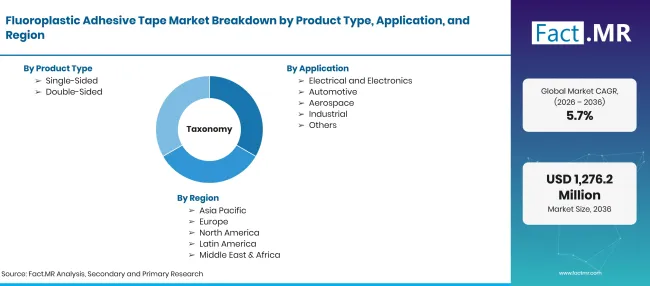
Factmr Fluoroplastic Adhesive Tape Market Taxonomy | Source: Fact.MR
| Attribute | Details |
|---|---|
| Quantitative Units | USD million in 2026 to USD million by 2036 at CAGR |
| Market Definition | Pressure-sensitive tapes with a backing of PTFE film, FEP film or PTFE-coated glass cloth. Revenue is counted at the converted tape level for industrial, electrical and transport buyers. |
| Product Type | Single-Sided; Double-Sided |
| Application | Electrical and Electronics; Automotive; Aerospace; Industrial; Others |
| Adhesive Type | Silicone; Acrylic; Rubber; Others |
| End-User | Manufacturing; Construction; Automotive; Electronics; Others |
| Regions Covered | North America; Latin America; Western Europe; Eastern Europe; East Asia; South Asia & Pacific; Middle East & Africa |
| Countries Covered | Germany; Brazil; United States; United Kingdom; Japan |
| Companies Profiled | Nitto Denko Corporation; 3M Company; Saint-Gobain; tesa SE; Rogers Corporation; AGC Inc.; CS Hyde Company |
| Forecast Period | 2026 to 2036 |
| Approach | Hybrid top-down and bottom-up approach using PTFE and FEP film output; tape consumption per packaging line, vehicle and aircraft; adhesive and backing mix; PFAS rules by region; and supplier catalogue review. |
Source: Fact.MR analysis. Updated Oct 21, 2026
How is the market segmented?
-
By Product Type
- Single-Sided
- Double-Sided
-
By Application
- Electrical and Electronics
- Automotive
- Aerospace
- Industrial
- Others
-
By Adhesive Type
- Silicone
- Acrylic
- Rubber
- Others
-
By End-User
- Manufacturing
- Construction
- Automotive
- Electronics
- Others
-
By Region
- North America
- Latin America
- Western Europe
- Eastern Europe
- East Asia
- South Asia & Pacific
- Middle East & Africa
Frequently Asked Questions
How big is the fluoroplastic adhesive tape market in 2026?
What is the CAGR of the fluoroplastic adhesive tape market from 2026 to 2036?
Which product type leads the fluoroplastic adhesive tape market?
Which application leads the fluoroplastic adhesive tape market?
Which adhesive type leads the fluoroplastic adhesive tape market?
Which end-user leads the fluoroplastic adhesive tape market?
Which country will grow the most in the fluoroplastic adhesive tape market?
Who are the main companies in the fluoroplastic adhesive tape market?
Who worked on this report


Preview the report firsthand - request a free sample
Free SampleGet the brochure for pricing and purchase details
Download PDF